
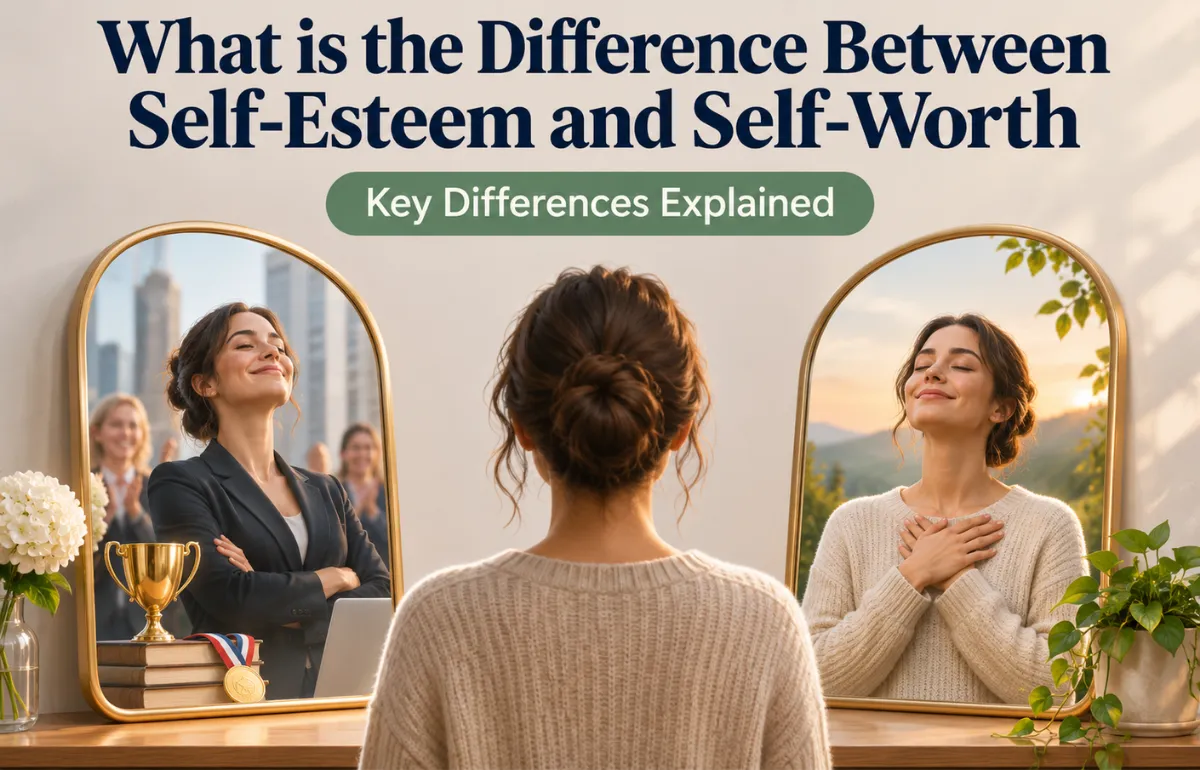
What is the difference between self-esteem and self-worth? Self-esteem refers to how positively or negatively you evaluate yourself, including your abilities, qualities, appearance, and achievements. Self-worth refers to your belief that you are valuable as a person and deserving of love, respect, and consideration.
While self-esteem can change in response to success, failure, criticism, and life experiences, a healthy sense of self-worth allows you to recognize your value regardless of these circumstances.
I like to explain the difference using two simple questions: “How do I feel about myself?” and “Do I believe I am enough, even when things go wrong?”
The first reflects self-esteem, while the second emphasizes self-worth.
Although these concepts overlap in psychology, understanding their practical differences can help you develop a healthier relationship with yourself, handle rejection, overcome insecurity, and pursue personal growth without constantly feeling the need to prove your value.
What Is Self-Esteem?
Self-esteem is your overall evaluation of yourself. It reflects how you perceive your personality, abilities, physical appearance, accomplishments, and other characteristics that contribute to your identity.
The American Psychological Association (APA) explains self-esteem in terms of how positively individuals perceive the characteristics that make up their self-concept.
Imagine spending several weeks preparing for a presentation. When it goes well, you feel capable, proud, and confident. Your opinion of yourself may become more positive.
However, if the presentation goes poorly, you might temporarily question your abilities.
This illustrates how experiences can influence self-esteem, although healthy self-esteem does not necessarily disappear after a setback.
What Influences Your Self-Esteem?
Several factors can shape your perception of yourself throughout life:
- Childhood experiences and upbringing.
- Academic and professional achievements.
- Social relationships and acceptance.
- Physical appearance and body image.
- Feedback, praise, and criticism.
- Personal expectations and beliefs.
- Comparisons with other people.
These influences affect everyone differently. Someone may feel satisfied with their professional abilities while struggling with their physical appearance or social skills.
What Does Healthy Self-Esteem Look Like?
Healthy self-esteem involves having a positive yet realistic opinion of yourself.
You recognize your strengths without exaggerating them and acknowledge your weaknesses without allowing them to overshadow everything good about you.
For example, you might recognize that you are an excellent listener but struggle with public speaking. Neither observation needs to define your entire identity.
Healthy self-esteem leaves room for improvement without demanding perfection.
What Is Self-Worth?
Self-worth is your internal sense of value as a human being. It reflects whether you believe you deserve kindness, respect, care, and meaningful relationships.
When I explain unconditional self-worth, I separate personal value from personal performance. Your achievements can describe what you have accomplished, but they do not have to determine whether you deserve respect.
Imagine losing your job after years of professional success.
You might feel disappointed, uncertain, and less confident about your career. However, having a healthy sense of self-worth means recognizing that unemployment does not make you less deserving of dignity or compassion.
Your circumstances have changed, but they do not need to become a verdict on your value.
What Does Healthy Self-Worth Look Like?
A healthy sense of self-worth often appears in ordinary decisions rather than dramatic displays of confidence.
It may involve:
- Setting boundaries without excessive guilt.
- Accepting that everyone makes mistakes.
- Recognizing that your emotional needs matter.
- Refusing to tolerate disrespectful behavior.
- Allowing yourself to rest without earning it.
- Asking for help when you need support.
- Accepting yourself while working on personal improvement.
You do not need to feel impressive every day to practice self-acceptance. Sometimes, recognizing your worth simply means treating yourself fairly during a difficult moment.
What Is the Difference Between Self-Esteem and Self-Worth?
The main difference between self-esteem and self-worth lies in their emphasis. Self-esteem focuses on your overall evaluation of yourself, whereas unconditional self-worth emphasizes accepting your personal value independently of achievements or external approval.
Psychologists sometimes use these terms interchangeably because both involve self-evaluation. However, distinguishing them in everyday situations can help you understand where insecurity comes from and what kind of emotional support you need.
Here is a side-by-side comparison.
| Aspect | Self-Esteem | Self-Worth |
|---|---|---|
| Meaning | Your overall opinion of yourself | Your belief in your value as a person |
| Primary focus | Self-evaluation | Personal value and acceptance |
| Influencing factors | Abilities, experiences, beliefs, and feedback | Beliefs about deserving respect and consideration |
| Response to failure | May temporarily decline | Can remain secure despite disappointment |
| External validation | Can be influenced by others’ opinions | Can exist independently of approval |
| Personal development | Encourages a positive, realistic self-image | Encourages unconditional self-acceptance |
| Key question | How do I feel about myself? | Do I believe I am valuable? |
| Example | I am proud of my abilities. | I deserve respect even when I struggle. |
I find it useful to think of self-esteem as an ongoing assessment and unconditional self-worth as a personal commitment.
The assessment can change as you learn and experience new things. The commitment means treating yourself with dignity throughout those changes.
Self-Esteem vs. Self-Worth: Real-Life Examples
Definitions become much easier to understand when applied to situations people encounter regularly. Here are five examples that reveal how these concepts can operate differently.
1. Making a Mistake at Work
Suppose you make an expensive mistake at work and receive negative feedback from your manager.
Your self-esteem might suffer because you feel disappointed in your performance. You may question your professional abilities or worry about repeating the mistake.
With healthy self-worth, however, you can acknowledge your responsibility without believing you are a fundamentally inadequate person.
You can apologize, correct the mistake, and improve your skills while maintaining self-respect.
2. Experiencing Romantic Rejection
Being rejected by someone you care about can affect how attractive, interesting, or desirable you consider yourself.
If your personal value depends heavily on acceptance, you might interpret rejection as evidence that you are unlovable.
A healthier response recognizes that another person’s feelings, preferences, or decisions cannot determine your entire value.
Rejection can still hurt. Secure self-worth does not eliminate emotional pain; it helps prevent that pain from becoming a permanent judgment about yourself.
3. Comparing Yourself With Others on Social Media
Imagine scrolling through social media and seeing people celebrating promotions, expensive vacations, fitness transformations, and relationship milestones.
Your self-esteem might decline if you begin evaluating your life against their carefully selected highlights.
A secure sense of self-worth helps you recognize that another person’s success does not reduce your significance.
You can admire someone’s accomplishments without treating their progress as evidence of your inadequacy.
4. Struggling With Body Image
Physical changes, aging, illness, or weight fluctuations can influence how you feel about your appearance.
You might experience days when you are dissatisfied with the way you look.
However, body dissatisfaction does not have to determine whether you believe you deserve affection, respectful treatment, or proper care.
You can work toward healthier habits without making appearance a requirement for self-acceptance.
5. Having an Unproductive Day
Imagine planning an ambitious day but completing very little because you feel exhausted.
Your satisfaction with your performance may decline. You might feel frustrated about leaving important tasks unfinished.
Healthy self-worth allows you to distinguish a disappointing day from a disappointing identity.
An unfinished task deserves attention, but it does not require self-punishment.
Can You Have High Self-Esteem but Low Self-Worth?
Yes. Under this practical distinction, someone can feel highly positive about their achievements while maintaining a fragile or conditional sense of personal value.
Consider a successful business owner who feels confident, receives admiration, and regularly achieves professional goals.
Despite these accomplishments, they may privately believe that losing their business would make them insignificant.
Their positive self-evaluation depends heavily on continued success.
Psychologists Jennifer Crocker and Connie Wolfe explored this pattern in their 2001 research on contingencies of self-worth.
Their work explains how people can attach personal value to particular areas of life, making their self-esteem sensitive to outcomes in those areas.
This helps explain why outwardly successful individuals can experience intense insecurity. Their accomplishments provide reassurance, but that reassurance may disappear when circumstances change.
Can You Have Low Self-Esteem but High Self-Worth?
Yes, particularly when low self-esteem relates to temporary circumstances or specific aspects of your self-image.
For example, someone recovering from an injury might struggle with their physical abilities and feel dissatisfied with their current situation.
Nevertheless, they can maintain the belief that they deserve patience, care, and respect.
I consider this distinction especially useful during periods of uncertainty. You do not have to feel confident, attractive, successful, or capable at every moment to treat yourself with kindness.
A secure sense of personal value can coexist with genuine dissatisfaction and the desire to improve.
Conditional vs. Unconditional Self-Worth
One of the most overlooked aspects of understanding what is the difference between self-esteem and self-worth is recognizing the conditions you place on your own value.
Conditional self-worth develops when you believe you must satisfy particular requirements before you deserve acceptance.
These requirements might sound like:
- I am valuable only when I succeed.
- I deserve love only when everyone approves of me.
- I am good enough only when I look attractive.
- I deserve rest only after being productive.
- I matter only when other people need me.
Unconditional self-worth challenges these requirements.
It allows you to recognize your dignity without denying the importance of responsibility, personal growth, or meaningful achievements.
The goal is not to stop caring about results. It is to stop using results as the sole measure of your humanity.
How to Recognize Which Concept You Are Struggling With
Rather than immediately assuming you have low self-esteem, I suggest examining what happens when something disappoints you.
Pay attention to whether your thoughts criticize a specific quality or question your entire value as a person.
| Situation | Self-Esteem-Related Thought | Self-Worth-Related Thought |
|---|---|---|
| Failing an exam | I am disappointed in my academic performance. | I am worthless because I failed. |
| Receiving criticism | I need to improve my skills. | I do not deserve respect. |
| Being rejected | I feel less confident about dating. | Nobody could ever love me. |
| Making a mistake | I handled that situation poorly. | I am a terrible person. |
| Asking for help | I wish I could manage this independently. | My needs are a burden to everyone. |
These examples are reflection prompts, not diagnostic criteria. Thoughts about competence and worth often overlap.
However, noticing whether you are evaluating a particular experience or condemning your entire identity can help you respond more constructively.
The Bad-Day Test: A Practical Self-Reflection Exercise
I like to call this exercise the bad-day test. It helps reveal whether your self-acceptance depends on favorable circumstances.
Think about a recent day when things did not go according to plan.
Then ask yourself three questions:
- What specifically went wrong?
- What did that experience make me believe about myself?
- Would I treat someone I care about differently in the same situation?
The third question deserves particular attention.
If you would comfort a friend after a mistake but harshly criticize yourself for making an identical mistake, you may be applying an unnecessarily demanding standard to your own value.
This exercise is not a psychological assessment. Its purpose is to help you notice the difference between disappointment, constructive self-evaluation, and unfair self-judgment.
How to Build Healthy Self-Esteem and Self-Worth
Developing a healthier self-image and a more secure sense of personal value takes time. The following practices address different aspects of your relationship with yourself.
1. Separate Your Identity From Your Behavior
Notice the difference between saying “I made a mistake” and “I am a failure.”
The first statement identifies a specific problem. The second turns an experience into a judgment about your entire identity.
Accurate language allows you to accept responsibility without unnecessary self-condemnation.
2. Build Competence Through Small Achievements
Setting realistic goals, learning new skills, and following through on manageable commitments can strengthen self-esteem.
Start with activities that are meaningful and achievable rather than attempting to impress others.
Celebrate progress without making your personal value dependent on maintaining a perfect record.
3. Practice Self-Compassion
Self-compassion involves responding to personal difficulties with understanding rather than relentless criticism.
Research published by Kristin Neff and Roos Vonk in 2009 found that self-compassion was associated with more stable feelings of self-worth and less dependence on particular outcomes.
I recommend replacing exaggerated positive affirmations with believable, compassionate statements.
Instead of insisting that everything is wonderful, try acknowledging that something is difficult while reminding yourself that you deserve patience as you work through it.
4. Establish Healthy Personal Boundaries
Constantly prioritizing other people’s expectations can reinforce the belief that your value depends on being useful or agreeable.
Practice declining requests when necessary. Communicate your needs honestly and recognize that someone else’s disappointment does not automatically mean you have done something wrong.
Boundaries are one way to put self-respect into practice.
5. Create Two Separate Journal Entries
For one week, write two short entries each evening.
In the first, record something you accomplished, learned, or handled well. This encourages a more balanced evaluation of your abilities.
In the second, describe one way you deserve care or respect regardless of what you accomplished that day.
Keeping these entries separate helps prevent productivity from becoming your only source of personal validation.
6. Challenge Long-Standing Negative Beliefs
The NHS recommends identifying and questioning negative beliefs about yourself as part of improving low self-esteem.
When a recurring thought appears, examine the evidence supporting it and the evidence contradicting it.
If feelings of worthlessness, persistent self-criticism, or insecurity interfere with your relationships or daily life, consider speaking with a qualified mental health professional.
Professional support can help address deeper emotional patterns that self-help exercises alone may not resolve.
Which Is More Important: Self-Esteem or Self-Worth?
Both contribute to emotional well-being, and psychological research does not establish a universal hierarchy between them.
However, if your confidence depends entirely on achievements or approval, developing a less conditional sense of personal value may be particularly helpful.
Positive self-esteem encourages you to recognize your strengths. Secure self-worth allows you to maintain self-respect when those strengths are challenged.
You do not need to choose between accepting yourself and improving yourself.
A healthy relationship with yourself makes room for both.
Conclusion
Understanding what is the difference between self-esteem and self-worth can change how you interpret failure, success, rejection, and personal growth.
Self-esteem reflects how you evaluate yourself, while unconditional self-worth emphasizes recognizing your value without requiring constant proof of achievement.
I encourage you to notice your internal dialogue the next time something goes wrong. Are you evaluating a specific experience, or are you questioning your entire value?
Start by replacing one unfair personal judgment with a realistic and compassionate observation.
You can acknowledge your imperfections, pursue ambitious goals, and continue becoming a better version of yourself without making acceptance something you must earn.
Frequently Asked Questions
Is self-esteem the same as self-worth?
They are closely related but can emphasize different things. Self-esteem concerns your overall self-evaluation, while self-worth emphasizes your perceived value as a person.
What causes low self-worth?
Repeated criticism, childhood neglect, bullying, unhealthy relationships, perfectionism, and dependence on external validation can contribute to low self-worth.
Can you have high self-esteem and low self-worth?
Yes. Someone may feel confident about their achievements while believing their personal value depends entirely on continued success or approval.
What is the difference between self-worth and self-confidence?
Self-worth concerns your value as a person, whereas self-confidence refers to your belief in your ability to handle particular tasks or situations.
How do I improve my sense of self-worth?
Practice self-compassion, establish healthy boundaries, challenge negative beliefs, and recognize your personal value independently of achievements and other people’s opinions.

FOLLOW YOUR CURIOSITY
A little more to explore
Stay with the topic. Find another perspective to take into your day.
How to Walk More Confidently: 13 Ways to Move With Ease
By Nattaya Boonmee
How to Regain Confidence After Divorce: 12 Smart Tips
By Nattaya Boonmee
Why Is Self-Belief Important? 9 Key Reasons to Grow
By Nattaya Boonmee