
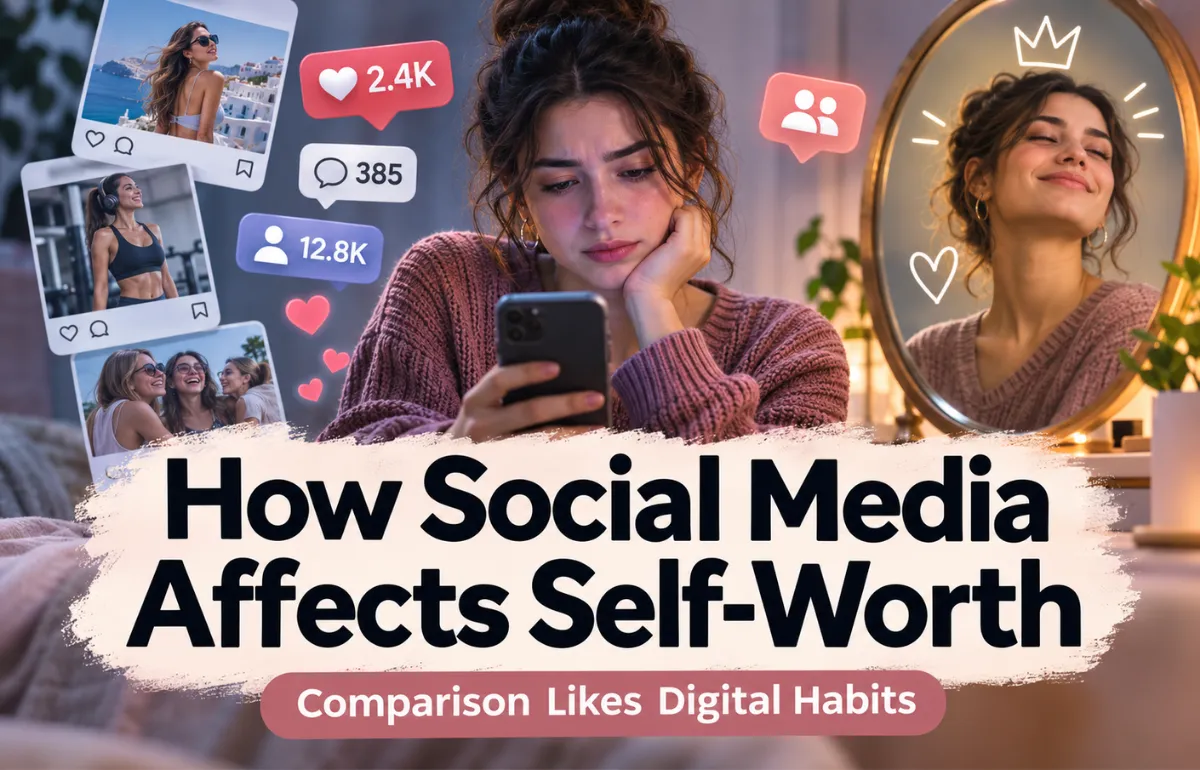
Understanding how social media affects self-worth begins with recognizing how online experiences influence the way we value ourselves. Social media can lower self-worth by encouraging constant social comparison, creating unrealistic expectations, and making personal value feel dependent on likes, comments, and followers. However, it can also strengthen self-worth through meaningful connections, authentic self-expression, and supportive communities.
Self-worth is the belief that you are valuable as a person, regardless of your appearance, achievements, popularity, or other people’s opinions. When digital approval becomes the main source of that belief, your sense of personal value can become unstable.
I believe the most overlooked part of this issue is how quietly it develops. You might open Instagram to relax and close it feeling dissatisfied with a life you were perfectly happy with moments earlier.
Understanding why that happens can help you develop a healthier relationship with the digital world without completely disconnecting from it.
Understanding the Relationship Between Social Media and Self-Worth
Social media has changed more than the way people communicate. It has also changed the environments in which people evaluate themselves.
In the past, social comparisons were largely limited to friends, relatives, colleagues, and people within local communities. Today, you can compare your lifestyle, appearance, relationships, and achievements with hundreds of strangers before breakfast.
The problem is that these comparisons rarely happen under equal conditions.
You’re seeing carefully selected moments from other people’s lives while experiencing every ordinary, difficult, and disappointing moment of your own.
I find it useful to distinguish between three closely related concepts:
| Concept | What It Means | How Social Media Can Influence It |
|---|---|---|
| Self-worth | Your belief in your value as a person | Makes personal value feel dependent on approval |
| Self-esteem | How positively or negatively you evaluate yourself | Influences satisfaction with your qualities and abilities |
| Self-confidence | Your belief in your ability to do something | Creates doubts about your skills and capabilities |
Although these concepts overlap, self-worth goes deeper. You can feel disappointed about a particular achievement without believing that you are less valuable as a human being.
Social media becomes especially problematic when that distinction begins to disappear.
How Social Media Affects Self-Worth Through Social Comparison
Social comparison is the process of evaluating yourself against other people. It’s a natural psychological tendency, but digital platforms provide an unusually large number of opportunities to engage in it.
The more frequently you compare yourself with selectively presented versions of other people’s lives, the easier it becomes to overlook your own strengths.
1. Comparing Your Ordinary Life With Someone Else’s Highlights
Imagine spending a quiet Saturday at home. You’re comfortable, relaxed, and enjoying your afternoon.
Then you open Instagram and see someone traveling internationally, another person celebrating a promotion, and a friend attending an expensive event.
Suddenly, your peaceful afternoon feels unproductive or disappointing.
Nothing about your circumstances has changed. Only the standard you’re using to evaluate them has changed.
This is an example of upward social comparison, which happens when you compare yourself with someone you perceive as more successful, attractive, or fortunate.
A 2023 meta-analysis published in Media Psychology found that exposure to upward comparisons on social media negatively affected self-esteem, body image, and subjective well-being on average.
Upward comparison can sometimes inspire personal growth. However, when inspiration repeatedly turns into inadequacy, it can damage how you perceive yourself.
2. Developing Unrealistic Expectations About Success
Social media makes exceptional achievements appear surprisingly ordinary.
You might see people buying homes in their twenties, building successful businesses, traveling frequently, or achieving impressive fitness goals.
What you rarely see is the complete story behind those accomplishments.
Financial support, previous failures, family circumstances, years of preparation, and personal sacrifices are often missing from the picture.
I would describe this as a missing-context comparison: judging your complete circumstances against someone else’s visible results.
It’s difficult to evaluate your own progress fairly when you don’t know the conditions under which another person’s progress occurred.
3. Experiencing Body Image Dissatisfaction
Beauty filters, photo editing, carefully selected angles, and AI-generated imagery can create appearance standards that are difficult or impossible to achieve naturally.
Repeated exposure to idealized images may influence what people consider normal, attractive, or acceptable.
The American Psychological Association highlights associations between appearance-based social comparison, poorer body image, depressive symptoms, and disordered eating among young people.
The emotional consequences aren’t limited to appearance. When someone begins believing that being physically attractive determines whether they deserve respect, attention, or love, body dissatisfaction becomes a self-worth issue.
Why Online Validation Can Make Self-Worth Unstable
One of the most significant ways social media affects self-worth is by turning social approval into something measurable.
Likes, comments, shares, views, and follower counts provide visible signals of attention. Although these numbers can be useful for measuring content performance, they become misleading when interpreted as measures of personal value.
The Emotional Cycle of Seeking Likes
Receiving positive feedback can make you feel appreciated. That reaction isn’t inherently unhealthy.
The difficulty begins when you increasingly depend on that feedback to feel good about yourself.
A typical validation-seeking cycle might look like this:
- You publish a photo, video, or personal update.
- You repeatedly check how people respond.
- Positive engagement temporarily improves your mood.
- Limited engagement creates disappointment or self-doubt.
- You seek reassurance through another post.
A 2024 study published in Science Advances found that adolescents were more sensitive than adults to variations in social media feedback.
When reassurance becomes dependent on unpredictable responses, emotional stability can suffer.
When Low Engagement Feels Like Personal Rejection
A post receiving little attention doesn’t necessarily mean people dislike you.
Its performance may depend on posting time, content distribution, audience activity, recommendation systems, and numerous other factors.
Yet the emotional interpretation can be surprisingly personal.
Instead of thinking, “This post didn’t reach many people,” someone might think, “Nobody cares about what I have to say.”
I consider that difference essential. One statement evaluates a digital outcome; the other turns that outcome into a judgment about personal worth.
Social media metrics can describe engagement. They cannot reliably describe your importance as a person.
Losing Authenticity to Gain Approval
When external validation becomes a priority, people may gradually change how they present themselves online.
Someone might avoid sharing genuine interests because they seem unpopular, express opinions mainly to gain approval, or remove photographs that don’t receive enough attention.
Over time, maintaining an online identity can become more important than developing an authentic one.
A useful question to ask before posting is: Would I still want to share this if nobody could like or comment on it?
Your answer may reveal whether you’re expressing yourself or primarily seeking reassurance.
How Digital Habits Quietly Influence Your Sense of Worth
Discussions about social media and mental health often focus on screen time. However, I think that measuring minutes alone misses an essential part of the experience.
When you use social media, why you open it, and what you encounter can matter alongside how long you spend there.
Checking Social Media Immediately After Waking Up
Starting your morning with social media can introduce other people’s priorities, achievements, and opinions before you’ve had time to consider your own.
If you’re already feeling uncertain about your career, appearance, or relationships, comparison-heavy content may intensify those concerns.
Waiting until you’ve eaten breakfast, prepared for the day, or completed a meaningful activity can create some psychological distance between your identity and your digital environment.
Scrolling During Emotionally Vulnerable Moments
People frequently turn to their phones when they’re bored, lonely, stressed, or disappointed.
Imagine receiving a rejection email and immediately opening LinkedIn, where several people are announcing exciting career developments.
Their achievements might feel more discouraging than they would on an emotionally balanced day.
This is why I recommend paying attention to your emotional state before scrolling, not just afterward.
Repeatedly Consuming Comparison-Heavy Content
Recommendation algorithms respond to various signals about what attracts your attention.
Spending time watching luxury lifestyle videos, appearance-focused content, or dramatic success stories may lead to more similar recommendations.
That repetition can gradually make uncommon lifestyles appear typical.
It’s worth remembering that your personalized feed isn’t a representative sample of society. It’s a selected collection of content that a platform predicts you may engage with.
Why Social Media Affects Some People More Than Others
Not everyone experiences the same psychological effects from digital platforms.
A 2021 study in the Journal of Communication found that social media use had no or very small short-term effects on self-esteem for 88% of the adolescents studied. Another 4% experienced positive effects, while 8% experienced negative effects.
These findings apply to that particular study rather than every social media user, but they demonstrate why individual experiences matter.
People with existing low self-esteem, perfectionistic tendencies, experiences of rejection, or strong approval-seeking habits may be more vulnerable to certain online experiences.
Life circumstances also matter. Someone experiencing unemployment might be particularly sensitive to career-related content, while someone recovering from a breakup may struggle with relationship-focused posts.
Understanding how social media affects self-worth requires looking at the individual, the content, and the circumstances surrounding their digital habits.
Can Social Media Positively Affect Self-Worth?
Social media isn’t automatically harmful. It can offer valuable opportunities to develop a stronger sense of identity and belonging.
People who feel isolated in their immediate surroundings may discover communities that share their interests, experiences, or values.
Creative individuals can express themselves, receive constructive feedback, and develop skills. Others may encounter relatable stories that challenge unrealistic expectations about success and appearance.
The difference often lies in whether social media supports an existing sense of identity or becomes the primary source of that identity.
| Unhealthy Social Media Habits | Healthier Social Media Habits |
|---|---|
| Posting mainly to receive approval | Posting to express yourself |
| Comparing achievements constantly | Learning from other people’s experiences |
| Measuring popularity through followers | Valuing meaningful relationships |
| Editing yourself to meet expectations | Maintaining authentic self-expression |
| Scrolling to escape difficult emotions | Using platforms with a clear purpose |
| Following accounts that trigger insecurity | Choosing supportive and realistic content |
I wouldn’t recommend judging every online interaction as either good or bad. Instead, consider whether your overall digital experience encourages connection, curiosity, and self-acceptance or repeatedly leaves you feeling inadequate.
Signs Social Media Is Negatively Affecting Your Self-Worth
The effects of social media aren’t always dramatic. Sometimes, they appear as small changes in everyday thoughts and behaviors.
You may need to reconsider your digital habits if:
- Your mood depends heavily on likes and comments.
- You frequently feel behind in life after scrolling.
- You delete posts because they receive limited engagement.
- You feel uncomfortable sharing unedited photographs.
- You struggle to enjoy achievements without announcing them online.
- You constantly seek reassurance about your appearance or abilities.
- You feel less satisfied with your life after using social media.
These signs aren’t a medical diagnosis. However, recurring patterns can indicate that digital experiences are influencing your self-perception more than you’d like.
How to Protect Your Self-Worth While Using Social Media
You don’t necessarily need to delete every social networking app to develop a healthier relationship with yourself.
I recommend starting with realistic changes that address the specific habits affecting your emotional well-being.
1. Conduct an Emotional Feed Audit
Instead of only checking your weekly screen-time report, examine how individual accounts make you feel.
After viewing someone’s content, ask yourself:
- Do I feel inspired or inadequate?
- Am I learning something or questioning my value?
- Does this content reflect my interests or exploit my insecurities?
Mute or unfollow accounts that consistently leave you feeling worse.
You can appreciate another person’s achievements without needing to receive daily updates about them.
2. Keep a Private Achievement Record
Not every accomplishment needs an audience.
Create a private journal where you record small victories, meaningful decisions, challenges you’ve overcome, and moments you’re proud of.
These could include completing a difficult task, helping someone, maintaining a personal boundary, or learning a new skill.
The purpose is to practice recognizing your progress without requiring external recognition.
3. Separate Digital Performance From Personal Identity
If you’re a content creator, business owner, or someone who regularly posts online, completely ignoring engagement metrics may not be practical.
Instead, assign those numbers an appropriate purpose.
Low engagement can provide information about content strategy, audience interests, or distribution. It doesn’t establish whether you’re intelligent, talented, attractive, or deserving of respect.
Treat your analytics as feedback about your work, not your identity.
4. Practice Intentional Scrolling
Before opening a social media app, identify what you want from the experience.
Perhaps you’re checking a message, researching an idea, or taking a short entertainment break.
Having a purpose can make it easier to recognize when you’ve shifted from useful engagement into habitual scrolling or comparison.
Turning off nonessential notifications can also reduce unnecessary interruptions and repeated checking.
5. Try a Seven-Day Social Media Experiment
A short digital break or change in routine can help you understand your personal response to social media.
A 2024 experimental study published in Body Image found improvements in self-esteem and body image among young women who took a one-week social media break.
Rather than treating a break as a guaranteed solution, I suggest using it as a personal experiment.
For seven days, reduce unnecessary scrolling, avoid comparison-heavy accounts, and write down how your mood and self-perception change.
Notice whether you feel more comfortable with your appearance, less pressured to achieve, or more satisfied with ordinary activities.
6. Develop an Identity Outside the Digital World
A stable sense of self-worth benefits from having multiple meaningful areas of life.
Spend time developing hobbies, strengthening relationships, learning skills, and participating in activities that don’t depend on public recognition.
If feelings of worthlessness, anxiety, or body dissatisfaction persist or interfere with daily life, consider speaking with a qualified mental health professional.
Digital boundaries can help, but greater emotional difficulties sometimes require additional support.
The Three-Question Self-Worth Check
I suggest using a simple reflection exercise after a social media session. It focuses on three areas: emotional response, identity, and behavior.
- Emotion: How do I feel about myself after scrolling?
- Identity: Did anything I saw make me question my personal value?
- Behavior: Am I now tempted to change something about myself mainly to gain approval?
This isn’t a clinical assessment. It’s a practical way to notice patterns that ordinary screen-time measurements might miss.
If your answers regularly reveal insecurity, dissatisfaction, or approval-seeking behavior, consider changing the content you consume and the circumstances in which you consume it.
The goal isn’t to eliminate every uncomfortable emotion. It’s to prevent temporary online experiences from becoming permanent beliefs about yourself.
Final Thoughts
Understanding how social media affects self-worth means recognizing the difference between receiving attention and possessing genuine personal value.
Social comparison, online validation, and unconscious digital habits can gradually distort self-perception. However, intentional usage, realistic expectations, and meaningful offline experiences can help protect your emotional well-being.
I recommend starting with one small change today. Unfollow an account that consistently triggers insecurity, delay checking social media in the morning, or celebrate a personal achievement without posting about it.
You don’t have to prove your value every time you open an app. Your worth exists independently of an audience.
Frequently Asked Questions
1. How does social media affect self-worth and self-esteem?
Social media can reduce self-worth and self-esteem through unrealistic comparisons and dependence on external approval, although supportive interactions can have positive effects.
2. Why does social media make me feel like I’m not good enough?
Repeated exposure to idealized lifestyles and achievements can create unrealistic expectations, making your own appearance, progress, or circumstances seem inadequate.
3. Can quitting social media improve self-esteem?
Reducing or temporarily quitting social media may improve self-esteem by decreasing comparison and validation-seeking, although individual results vary.
4. How do likes and followers affect self-worth?
Likes and followers can provide temporary reassurance, but depending on these metrics for personal validation can make self-worth emotionally unstable.
5. How can I stop comparing myself to others on social media?
Limit comparison-triggering content, focus on personal progress, practice self-compassion, and remember that online posts rarely represent someone’s complete reality.

FOLLOW YOUR CURIOSITY
A little more to explore
Stay with the topic. Find another perspective to take into your day.
How to Walk More Confidently: 13 Ways to Move With Ease
By Nattaya Boonmee
How to Regain Confidence After Divorce: 12 Smart Tips
By Nattaya Boonmee
Why Is Self-Belief Important? 9 Key Reasons to Grow
By Nattaya Boonmee