Healthcare organizations today face a difficult balancing act. On one side, they must deliver exceptional patient care while meeting growing expectations from patients, providers, and regulators. On the other side, they must manage a financial system that becomes more complicated each year.
Insurance companies continue updating reimbursement requirements. Patient financial responsibility continues rising. Administrative workloads continue expanding. Even successful healthcare organizations can find themselves struggling with delayed payments, denied claims, and increasing operational costs.
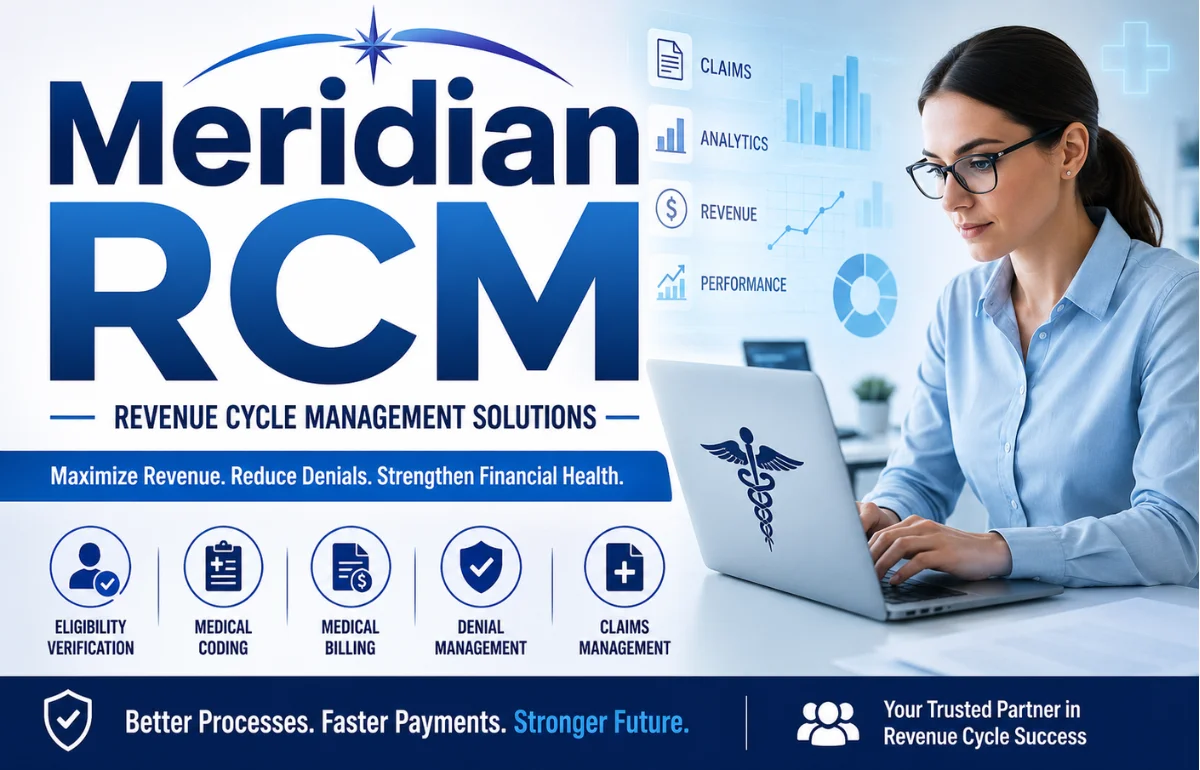
As a result, many providers are seeking specialized support to help manage the financial side of healthcare. Meridian RCM has emerged as a company focused on helping healthcare organizations improve reimbursement performance through comprehensive revenue cycle management services.
By helping providers strengthen their revenue cycle operations, Meridian RCM supports healthier cash flow, improved collections, and greater financial stability. In an industry where reimbursement challenges can quickly impact overall performance, that support can make a meaningful difference.
Revenue Cycle Management Has Become a Strategic Priority
Not long ago, many healthcare organizations viewed revenue cycle management primarily as an administrative function.
Today, it has become a critical business strategy.
Every financial interaction within a healthcare organization contributes to revenue cycle performance. Patient registration, insurance verification, documentation, coding, claim submission, payment posting, collections, and accounts receivable management all play important roles.
When one area experiences problems, the entire reimbursement process can be affected.
Healthcare rcm has become increasingly important because providers need efficient systems that support both financial performance and operational efficiency. Organizations that invest in strong revenue cycle processes are often better positioned to adapt to changing reimbursement environments.
Meridian RCM focuses on helping providers create those stronger financial foundations.
The First Steps in the Revenue Cycle Matter

Many reimbursement issues originate long before a claim reaches an insurance company.
Patient information must be collected accurately. Insurance coverage needs to be reviewed. Authorization requirements may need to be identified before services are performed.
When errors occur during these early stages, reimbursement problems often follow.
Accurate eligibility verification helps organizations avoid many of these challenges. By confirming coverage information ahead of time, providers can identify potential issues before they affect reimbursement.
Many organizations also utilize eligibility verifidcation procedures as an additional safeguard against registration errors and insurance discrepancies.
The earlier issues are identified, the easier they typically are to resolve.
This is why front-end revenue cycle performance remains such an important area of focus.
Supporting Accuracy Through Medical Coding
Clinical care generates documentation, but documentation alone does not produce reimbursement.
Patient encounters must be translated into standardized codes that insurance carriers can understand and process.
This responsibility falls to medical coding professionals.
Coding accuracy directly influences claim quality, reimbursement levels, and payer responses. Errors can result in payment delays, denials, or compliance concerns.
As healthcare regulations continue evolving, coding accuracy becomes increasingly important.
Organizations that maintain strong medical coding practices often experience fewer reimbursement complications because claims contain more accurate and complete information.
Effective coding helps ensure providers receive appropriate reimbursement for the care they deliver.
Medical Billing Keeps Revenue Moving

After coding is completed and claims are prepared, the reimbursement process enters another critical phase.
Medical billing involves much more than simply transmitting claims to insurance carriers.
Claims must be monitored carefully. Payments must be posted accurately. Outstanding balances require follow-up. Insurance companies frequently request additional information or clarification.
Without proper oversight, claims can become delayed, and revenue can remain trapped within the system.
Meridian RCM helps healthcare organizations manage these activities more efficiently, reducing administrative burdens while supporting healthier cash flow.
Strong medical billing processes help ensure claims continue moving toward resolution and payment.
Denials Can Create Significant Financial Pressure
Denied claims remain one of the biggest challenges facing healthcare providers.
A denial not only delays reimbursement but also creates additional administrative work. Staff members must review the claim, identify the issue, gather supporting documentation, and communicate with the payer.
When denial volumes increase, administrative costs rise as well.
This is why denial management has become such a critical component of revenue cycle success.
Organizations that analyze denial trends and address root causes often achieve better financial outcomes than those that simply react to denials as they occur.
Meridian RCM works with providers to identify opportunities for denial reduction and process improvement, helping organizations protect revenue that might otherwise be lost.
Improving Medical Claims Management
Claims serve as the foundation of healthcare reimbursement.
The efficiency with which claims move through payer systems often determines how quickly providers receive payment.
Strong medical claims management creates visibility into every stage of the reimbursement process. Claims can be tracked, monitored, and evaluated to ensure issues are addressed promptly.
This proactive approach helps organizations reduce delays while improving overall collection performance.
Providers that strengthen medical claims management often gain better insight into reimbursement trends and payer behavior.
That visibility allows organizations to make more informed decisions regarding staffing, operations, and future growth.
Accounts Receivable Performance Affects the Entire Organization
Outstanding accounts receivable balances represent revenue that has not yet been collected.
The longer those balances remain unresolved, the greater the impact on financial performance.
Cash flow becomes less predictable. Budget planning becomes more difficult. Operational flexibility may be reduced.
Managing accounts receivable effectively requires consistent follow-up and detailed attention to reimbursement activity.
Meridian RCM helps healthcare organizations improve accounts receivable performance by focusing on collections, payer communication, and claim resolution activities.
Reducing outstanding balances often creates immediate financial benefits while improving overall organizational stability.
Technology and Data Continue Shaping Revenue Cycle Management
Healthcare organizations generate enormous amounts of financial information every day.
Claims data, reimbursement metrics, denial reports, collection statistics, and payer performance indicators all provide valuable insight into operational performance.
Modern revenue cycle management relies heavily on technology and analytics to transform that information into actionable strategies.
Organizations that leverage data effectively can identify inefficiencies, monitor trends, and implement improvements more quickly.
Meridian RCM supports healthcare providers by helping them gain greater visibility into financial performance and reimbursement activity.
Better information often leads to better decisions.
Helping Healthcare Organizations Adapt to Change
Healthcare reimbursement continues evolving.
Insurance carriers introduce new requirements. Regulatory expectations change. Patients demand greater transparency and convenience. Administrative complexity continues growing.
Organizations that succeed in this environment must remain flexible and proactive.
Strong healthcare RCM strategies provide the structure needed to adapt to ongoing change while maintaining financial stability.
By supporting eligibility verification, eligibility verifidcation workflows, medical coding, medical billing, denial management, and medical claims management, Meridian RCM helps providers strengthen the financial side of their operations.
The healthcare industry will continue facing challenges, but organizations with efficient revenue cycles are often better prepared to navigate uncertainty and pursue growth opportunities.
A Partner for Long-Term Financial Success
Revenue cycle performance influences nearly every aspect of a healthcare organization.
From cash flow and collections to staffing and expansion plans, financial outcomes are directly connected to the effectiveness of reimbursement processes.
Meridian RCM focuses on helping providers improve those processes through specialized expertise and comprehensive revenue cycle support.
As healthcare organizations continue seeking ways to improve efficiency, reduce administrative burdens, and strengthen financial performance, experienced revenue cycle partners will remain an important resource.
A well-managed revenue cycle does more than collect payments. It creates the stability needed for providers to focus on delivering quality care while building a stronger future for their organizations.