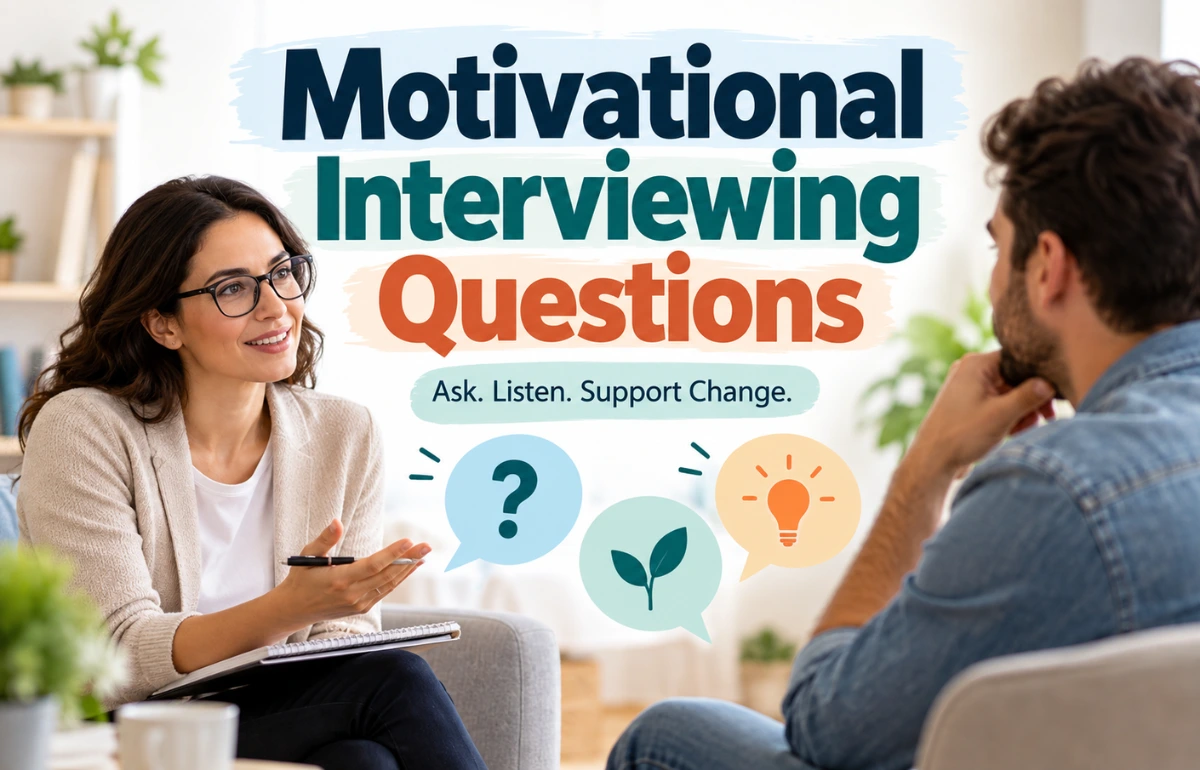
Motivational interviewing questions are open, purposeful questions that help someone explore their own reasons for changing a behavior. Rather than telling a person what to do, a helper asks about what matters to them, what feels difficult, and what they might be willing to try. These questions are part of motivational interviewing (MI), a collaborative conversation style used in healthcare, counseling, coaching, and other helping relationships. They work best when paired with careful listening, reflections, and respect for the person’s choice. A question such as “What would be different in your life if this changed?” invites a fuller answer than “Are you ready to change?” The goal is understanding and movement toward a goal the person can genuinely own.
I think of a good MI question as an open door, not a push from behind. The difference matters most when somebody feels two ways at once: they want better sleep but enjoy late-night scrolling, or they want to cut back on alcohol but rely on it to unwind. Asking well makes room for both truths.
What makes a question motivational interviewing?
MI has a direction: it helps a person examine a possible change. Yet the person, not the interviewer, supplies the reasons and decides what to do. The Motivational Interviewing Network of Trainers (MINT) describes partnership, acceptance, compassion, and drawing out the person’s own ideas as central to the approach.
That means “What concerns you about this pattern?” may be useful, while “Don’t you see how harmful this is?” usually invites a defense. The second question carries a verdict. Even a technically open question can feel controlling if its tone assumes the answer.
The familiar OARS skills provide the wider frame: open questions, affirmations, reflective listening, and summaries. Questions start exploration; reflections show what I heard. An affirmation recognizes a real effort or strength. A summary gathers the person’s competing thoughts without deciding for them. SAMHSA’s TIP 35 discusses these skills in substance use treatment, and the same communication principles can inform other helping conversations.
| Less helpful question | More useful MI question | What changes |
|---|---|---|
| “Why haven’t you stopped?” | “What makes stopping difficult right now?” | Shame gives way to a discussion of barriers. |
| “You know exercise helps, right?” | “What, if anything, have you noticed when you move more?” | The person’s own experience becomes the starting point. |
| “Will you commit to a plan?” | “What would you feel ready to try this week?” | The size and timing of a step stay in their hands. |
The wording in the right column is a starting point, not a line to recite. I would change it to fit the person’s language, culture, and situation. If someone says “I need some breathing room,” I might ask what breathing room would look like, rather than switch to a clinical label.
Questions for the four parts of an MI conversation
MINT describes four processes: engaging, focusing, evoking, and planning. They can overlap or repeat. Planning is optional when a person is still exploring. The questions below follow that natural progression rather than a rigid checklist.
1. Engaging: understand before steering
Early questions help establish trust and hear the whole story. They should be easy to answer without feeling examined.
- “What has been going on for you lately?”
- “What would make this conversation useful today?”
- “How does this issue affect an ordinary day?”
- “What have other people missed when they’ve talked with you about it?”
- “What is already working, even a little?”
The fourth question can uncover a surprisingly important detail. Someone who has received a string of lectures may be waiting for the next one. Acknowledging that history can make an honest conversation possible.
After asking, I would allow a pause. If the person says, “Everybody thinks I’m lazy, but I’m exhausted,” a reflection such as “You’re carrying more than people can see” may help more than another question. MI is a dialogue, not an interview form.
2. Focusing: agree on what to discuss
A person may arrive with several concerns. The interviewer may also have a legitimate health, safety, or service priority. Focusing means agreeing on a useful topic without pretending those priorities are identical.
- “Of the things you’ve mentioned, which one would be most useful to talk about first?”
- “Where does this concern fit among your other priorities?”
- “I have a concern about your sleep, and you’ve mentioned stress. Which would you like to start with?”
- “What would you like to leave this conversation clearer about?”
Notice the third example: I can be transparent about a concern and still offer a choice. If a topic is not optional, such as a required workplace discussion, honesty about that limit matters. I can still ask what the person hopes to get from the time and how they see the situation.
3. Evoking: hear the person’s reasons for change
Evoking is where many motivational interviewing questions become especially useful. I am listening for “change talk”: the person’s own words about wanting, being able, having reasons, needing, or intending to change. Mixed feelings are normal. I do not need to argue away the side that favors staying the same.
Questions about desire and values include:
- “What would you like to be different six months from now?”
- “How does this fit with the kind of parent, friend, or colleague you want to be?”
- “What matters enough to you that this change is worth considering?”
Questions about ability and past success include:
- “When has this been a little easier, and what helped then?”
- “What strengths have helped you handle other difficult changes?”
- “If you decided to try, what might make a first attempt possible?”
Questions about reasons and concerns include:
- “What are the good things about how things are now?”
- “What worries you, if anything, about continuing this way?”
- “What might you gain from making a change, and what might you miss?”
That last pair is deliberate. If I ask only for the costs of a habit, I can miss the job it performs. Late-night scrolling might be someone’s only quiet time. A plan that ignores that need is unlikely to fit their life. This “hidden function” question is a practical way to make advice less shallow: what useful thing is the current behavior doing, and what could meet that need if the behavior changed?
I would use an importance ruler carefully: “On a scale from zero to ten, how important is this change to you now?” If the answer is four, I might ask, “Why a four rather than a one?” That invites the person to describe existing reasons. I would then ask, “What would help it move to a five?” The number is a conversation aid, not a score of character or readiness.
4. Planning: ask only when the person is ready
Planning works better after the person has voiced some interest or intention. A plan offered too soon can become another thing to resist.
- “What do you think your next step might be?”
- “Which option feels realistic with the week you actually have?”
- “What could get in the way, and how would you like to handle it?”
- “Who, if anyone, could support you in the way you want?”
- “How would you know this experiment was useful, even if it wasn’t perfect?”
I like the word “experiment” for a small, reversible change. It lowers the pressure to promise a permanent new identity. A person might choose to put a phone outside the bedroom on two nights and then notice how they sleep. The interviewer can ask permission to revisit the result later, including what the person learned if the attempt did not work.
Examples for common situations
The same question can sound caring in one setting and intrusive in another. Start with permission where privacy or trust is uncertain: “Would it be okay to talk about this?” Then use the person’s words for the behavior.
| Situation | Opening question | Useful follow-up |
|---|---|---|
| Sleep and screen use | “What do you enjoy about being online at night?” | “What, if anything, would you like your mornings to feel like instead?” |
| Missed appointments | “What has made getting here difficult?” | “When you have managed to come, what made that possible?” |
| Alcohol or another substance | “What do you get from using it, and what concerns you about it?” | “Where does that leave you at the moment?” |
| Workload and burnout | “What tells you your current pace is costing you something?” | “What could change without putting your livelihood at risk?” |
| A habit someone wants to build | “Why does this habit matter to you now?” | “What is the smallest version that would still feel worthwhile?” |
These are conversation examples, not a substitute for assessment or treatment. In a medical setting, a clinician may also need direct questions about symptoms, risks, medication, and immediate safety. MI does not require every question to be open-ended. A clear yes-or-no question can be exactly right when a precise fact is needed.
What to say after the answer
Many lists of MI questions stop at the question mark. The next response often determines whether the person keeps talking. I use a simple sequence: listen, reflect, then ask whether I understood.
Imagine someone says, “I know I should exercise, but I’m worn out after work.” A rushed reply is “Could you go in the morning?” A reflective reply is “Your energy is already used up by the time you get home.” After they confirm or correct that understanding, I might ask, “When, if ever, does movement feel manageable?”
Reflecting both sides is useful when the person is torn: “Walking helped your mood before, and right now even starting feels like another demand.” I would keep the language tentative enough to invite correction. An accurate reflection helps the person hear their own thinking; it does not smuggle in my preferred solution.
If I have useful information, I can ask permission: “Would you like to hear one option people sometimes try?” After sharing it briefly, I can ask, “What do you make of that?” This exchange leaves room for the person to accept, reject, or adapt the idea. MINT calls attention to this respectful exchange of information alongside OARS.
Mistakes that make good questions fall flat
Asking too many in a row
Five open questions without a reflection can still feel like an interrogation. A useful self-check is whether I have shown understanding before moving to the next topic. Silence can also give a person time to find an answer they have not said aloud before.
Disguising advice as a question
“Have you tried setting an alarm?” may be advice in question form. It has a place if the person wants ideas, but it does little to explore motivation. I would first ask, “What have you tried?” and “What would make a reminder useful or annoying for you?”
Treating hesitation as defiance
If someone says, “I don’t want to quit,” responding with a list of consequences can turn the conversation into a debate. I might say, “You have reasons to keep things as they are.” Then I can ask, “Is there any part of it you do wish were different?” If the answer is no, I need to respect that answer while handling any professional duties plainly.
Assuming a small step is always easy
“Just take a ten-minute walk” can overlook disability, unsafe streets, caregiving, money, or fatigue. A better question is “What would a workable step look like in your circumstances?” The person’s constraints are part of the problem to understand, not objections to overcome.
Using the method to force agreement
MI is not a clever route to a predetermined yes. People can detect when every question points toward the interviewer’s preferred answer. If I am required to recommend a particular action, I should say so openly, explain why, and ask for the person’s view. The MINT overview emphasizes autonomy and cautions against unsolicited advice or confrontation.
Can you use these questions on yourself?
You can borrow the curiosity behind MI for a private check-in, although a journal page cannot replace a skilled conversation. I would choose one behavior and write without editing for five minutes:
- “What do I like about things as they are?”
- “What is no longer working for me?”
- “If I changed one part, why would that matter to me?”
- “When have I handled something similar, even briefly?”
- “What small trial would I choose, and what support would make it realistic?”
The order matters because it permits honesty before planning. If my first answer is “I don’t want to change this,” that is information, not failure. I can return to the question later. If the issue involves substance dependence, serious mental health symptoms, or immediate danger, self-reflection should sit alongside appropriate professional support.
Frequently asked questions
What are the best motivational interviewing questions to ask first?
Start with “What would make this conversation useful?” or “What has been going on?” The best opening fits the person’s concern and invites a story.
Are motivational interviewing questions always open-ended?
Usually, they invite more than yes or no, but closed questions are useful for specific facts, consent, and safety. The purpose and the listening that follows matter more than the format alone.
What is an example of a change talk question?
“What would be better in your life if this changed?” invites a person to name their own reasons. Follow up by reflecting the reason you hear.
How do you respond when someone says they are not ready to change?
Respect their position and explore it without pressure: “What feels most important to you right now?” Planning can wait until the person wants to consider it.
Can motivational interviewing help with habits and procrastination?
Its questions can clarify why a change matters and what makes it hard. They do not replace practical support or treatment when other problems are driving the behavior.
A useful next question
The strongest motivational interviewing questions make a person feel heard and help them hear themselves. Choose one open question that fits the conversation, listen long enough to understand the answer, and reflect it before asking another. That small shift can make the next step clearer—and leave ownership where it belongs.
Related Posts: