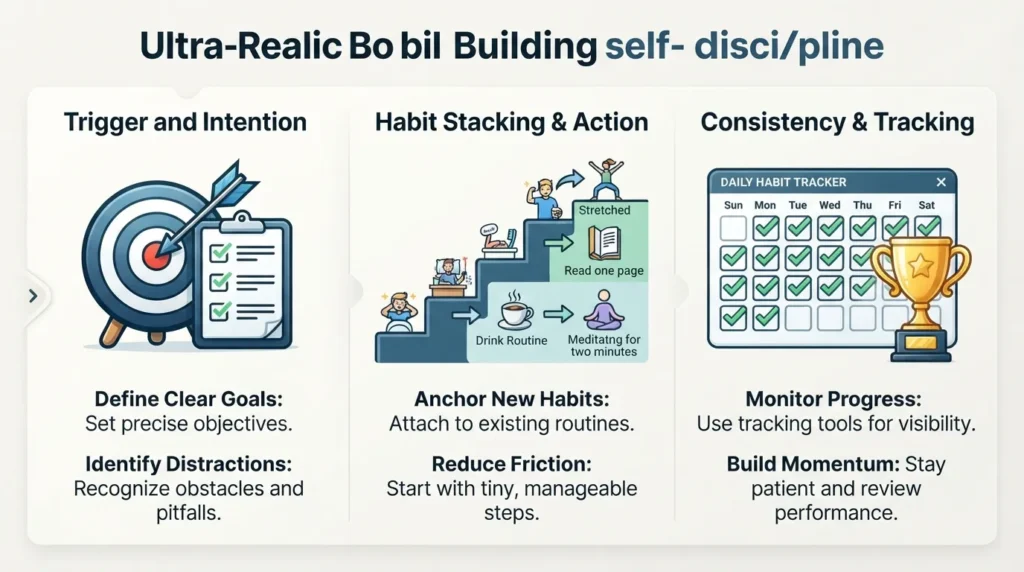
You wake up inspired, map out an ambitious morning routine, and stick to it for three days straight. Then Thursday rolls around. You’re exhausted, your alarm goes off, and the warm bed wins. By noon, your ambitious plan is abandoned, leaving you with that familiar, frustrating question: Why can’t I just stay disciplined?
Most people fail at building discipline because they rely entirely on motivation. Motivation is an emotion—unpredictable, fleeting, and easily drained by a bad night’s sleep or a stressful afternoon. Discipline isn’t a feeling you wait for; it is a system you construct. When you build reliable systems instead of leaning on fickle moods, taking action becomes your default behavior regardless of how you feel when your feet hit the floor.
This comprehensive guide breaks down everything you need to transform your daily execution. You will discover what genuine self-discipline actually is, the neuroscience that drives it, a step-by-step framework to build unshakeable routines, practical daily exercises, real-world examples, tailored strategies for specific scenarios, and answers to the most common discipline questions. By the end of this article, you will have every tool required to master your habits—no further searching needed.
What Is Self-Discipline? Meaning and Definition
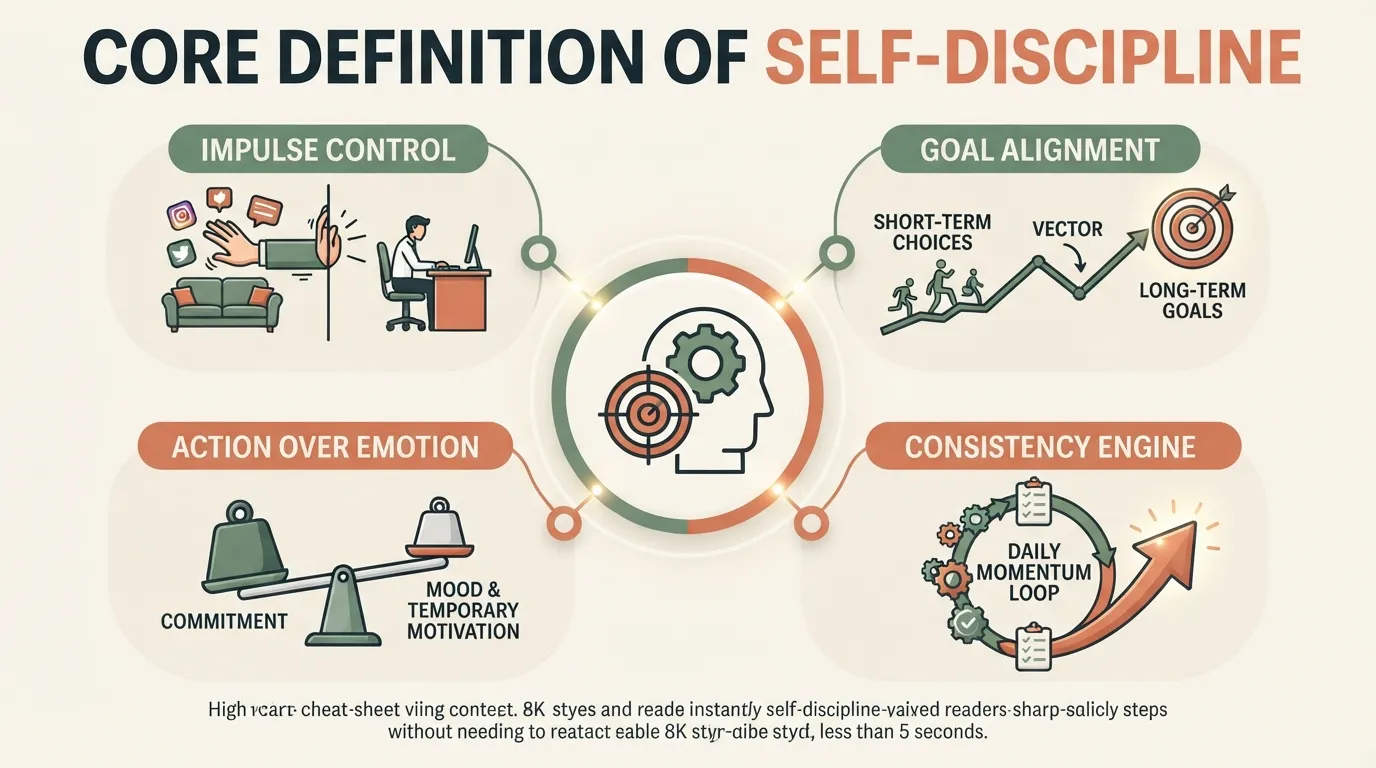
At its core, self-discipline is simply the ability to align your actions with your intentions rather than your immediate impulses or fleeting moods. It’s what bridges the gap between deciding to do something and actually doing it, especially when friction, boredom, or fatigue set in.
It is crucial to understand that mental discipline is a trained skill, not an innate, fixed personality trait you’re either born with or lacking. Just like building physical muscle, your capacity for self-restraint expands through deliberate practice and targeted stress over time. If you’ve struggled to stick to your goals in the past, it doesn’t mean you lack the “discipline gene”—it just means you haven’t built the mental muscle yet.
What “True” Self-Discipline Actually Means
Most people view discipline through a heavy, punitive lens. They picture drill sergeants, strict rules, and depriving themselves of enjoyment. That framing is precisely why so many people subvert their own progress—deep down, nobody wants to spend their life in a self-imposed prison.
True self-discipline isn’t about self-punishment or blind rule-following; it is about staying in integrity with the promises you make to yourself.
When you tell yourself you’re going to write for an hour, go to the gym, or close your laptop at 6 PM, keeping that promise is an act of deep self-respect. It builds internal trust. Reframing discipline from “forcing myself to suffer” to “honoring my word to myself” removes the core emotional barrier that keeps most people stuck.
Self-Discipline vs. Willpower — What’s the Difference?
While people often use these terms interchangeably, confusing willpower with self-discipline is a major reason habits fail.
Willpower is a short-term, acute force. It’s the in-the-moment brute mental energy you exert to resist a slice of cake or force yourself to open a spreadsheet when you’d rather sleep.
Self-discipline is the overarching system and lifestyle practice that structures your environment so that you rarely have to rely on willpower in the first place.
Willpower is the emergency brake; self-discipline is the design of the road. If you rely on raw willpower to carry you through every hour of the day, you will inevitably burn out. Self-discipline automates decisions so your mental energy stays intact.
Why Self-Discipline Feels So Hard
If taking action toward our long-term goals is so beneficial, why is sitting on the couch scrolling through social media so enticing? The answer lies in how our brains evolved. Inside your skull, two main areas constantly compete for control over your choices:
The Limbic System (Your Primal Brain): This is your brain’s ancient emotional center. It runs on instant gratification, constantly seeking pleasure and avoiding pain or exertion to conserve energy. When you feel the pull to check your phone or order fast food, that’s your limbic system driving a quick hit of dopamine—the chemical involved in reward anticipation. Modern environments are packed with hyper-stimulating triggers (social media feeds, notification badges, engineered snacks) that hijack this system, training your brain to expect low-effort, high-dopamine rewards around the clock.
The Prefrontal Cortex (Your Rational Brain): Sitting right behind your forehead, this is the logical, civilized center responsible for long-term planning, executive function, and weighing future consequences. It’s the voice that tells you to save money, eat healthy, and focus on deep work.
The fundamental conflict is that your prefrontal cortex requires significant metabolic energy to run and suffers heavily from decision fatigue. Every choice you make throughout the day—from picking an outfit to answering emails—drains this mental reserve. As the day goes on and your prefrontal cortex grows exhausted, your emotional limbic system naturally takes the wheel.
Discipline feels hard not because you are weak, but because you are fighting millions of years of evolutionary wiring designed to prioritize immediate comfort over future rewards.
Why Self-Discipline Is Important Benefits
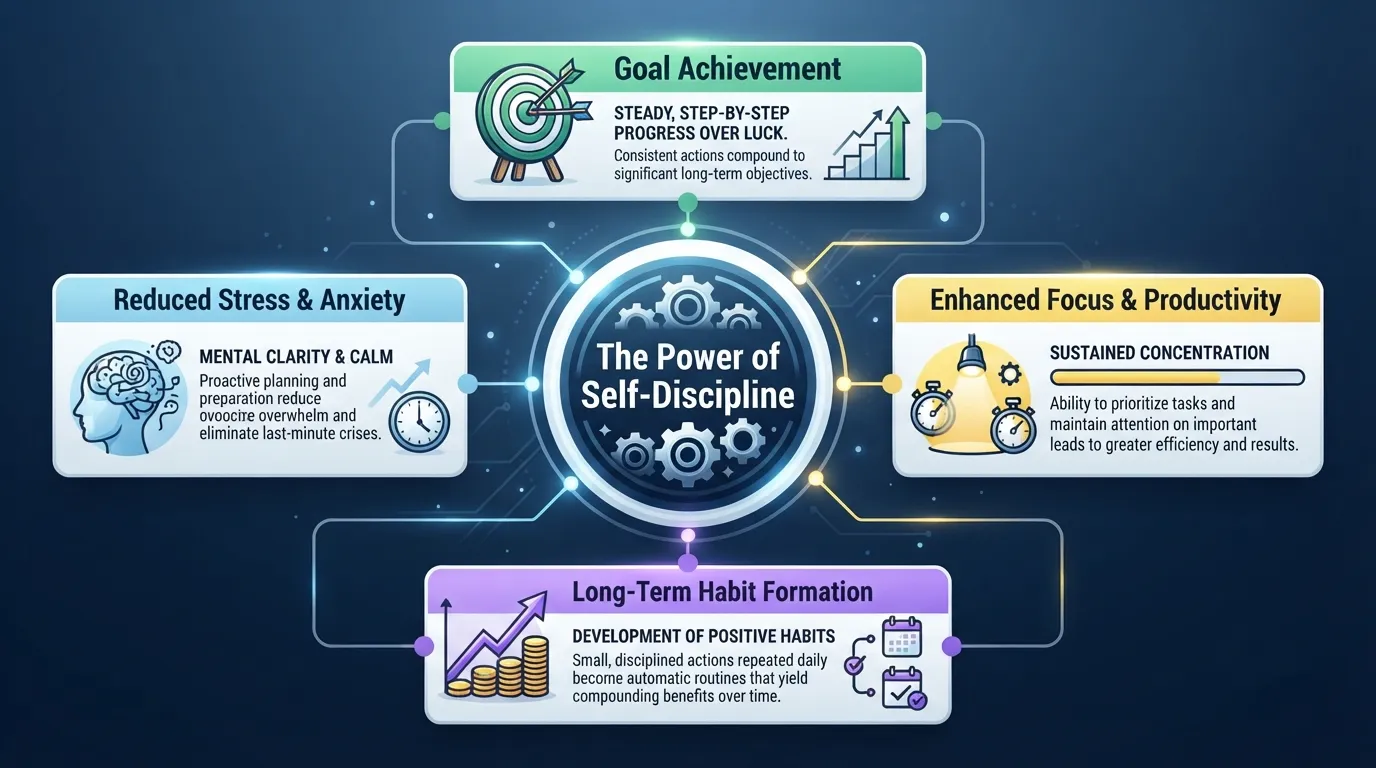
Self-discipline is often framed as a tool for achievement, but its true value goes far deeper than a finished to-do list. It fundamentally changes how you interact with your thoughts, stress, and identity. When you develop consistent discipline, you unlock distinct long-term advantages:
Reduces anxiety and overthinking: Half-finished projects and unmade decisions sit in the back of your mind, creating a constant background noise of low-grade anxiety. Discipline creates immediate action, which silences that internal dialogue. When you execute consistently, you eliminate the mental strain of constantly negotiating with yourself.
Bridges the gap to long-term goals: Short-term comfort is the enemy of meaningful achievement. Discipline acts as the vehicle that carries you past temporary boredom or discomfort toward major milestones—whether that is building a business, saving for a home, or mastering a complex skill.
Builds operational resilience: Every time you push through minor resistance, you strengthen your capacity to handle stress. Small, deliberate wins condition your nervous system to tolerate friction, making sudden setbacks far easier to navigate without collapsing into bad habits.
Restores self-trust and confidence: Real confidence isn’t positive thinking; it is evidence of capability. Keeping small promises to yourself repeatedly builds an undeniable track record. You begin to view yourself as someone who follows through, which fundamentally upgrades your self-image.
Signs You’re Lacking Self-Discipline
Lacking discipline rarely looks like a dramatic failure. More often, it shows up as a series of quiet compromises that erode your momentum over time. Common indicators include:
Chronic procrastination: Continually delaying high-priority tasks until the pressure of an impending deadline forces you into a panic-driven sprint.
A pattern of broken promises: Telling yourself you will wake up at 6 AM, hit the gym, or stop scrolling by 10 PM, only to ignore your own rules minutes later.
The “Starting Monday” loop: Pushing off necessary lifestyle changes to an arbitrary future date because taking immediate action feels inconvenient right now.
Relying entirely on motivation: Waiting for the “right mood” or an external spark of inspiration before sitting down to do important work.
Disorganized environment and finances: Piles of unfinished tasks, untracked spending, and physical clutter that reflect an internal state of reactive, unstructured decision-making.
How to Build Self-Discipline — A Step-by-Step Framework
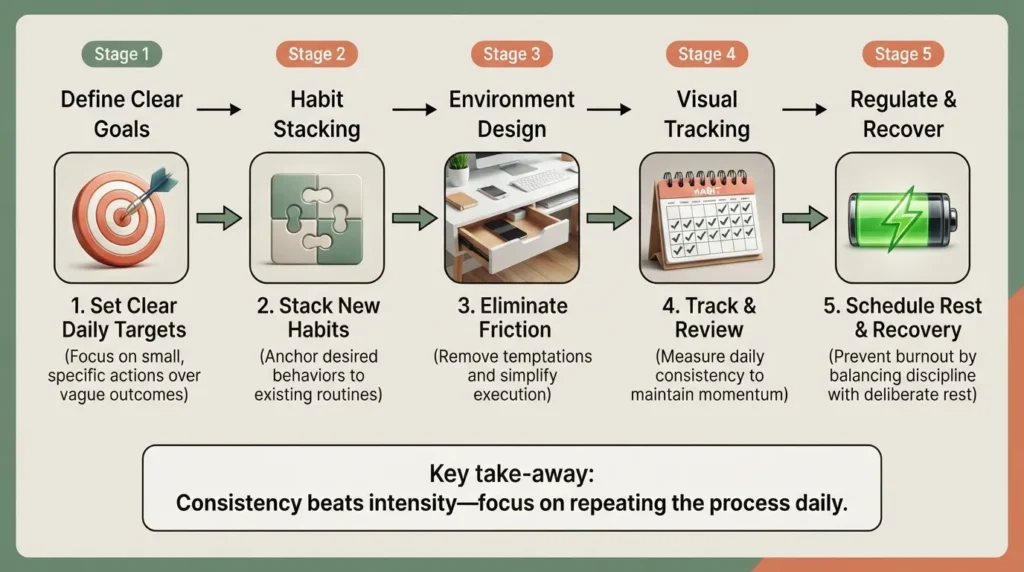
Building self-discipline isn’t about radically transforming your life overnight. It is an iterative process of designing systems that make good choices effortless and bad choices difficult. Follow this eight-step blueprint to build lasting momentum.
Step 1 — Find Your Real “Why”
Vague goals produce weak commitment. Wanting to “get in shape” or “work harder” won’t pull you out of bed on a freezing Tuesday morning when your alarm goes off. To stick to difficult routines, you need a motive deeply tied to your personal identity and core values.
Ask yourself why a goal matters to you, and then ask why four more times to dig past surface-level answers:
Initial goal: “I want to save $500 a month.”
Why? “So I have an emergency fund.”
Why? “So I don’t feel stressed when unexpected bills arrive.”
Why? “Because feeling financially insecure makes me anxious around my family.”
Core “Why”: “I want to be a grounded, dependable presence for the people I care about.”
When your reasons are rooted in who you want to be, staying disciplined feels less like a chore and more like living in alignment with your true self.
Step 2 — Start With Tiny, Non-Negotiable Actions
The biggest mistake people make is trying to overhaul their entire routine at once. Massive goals trigger fear in your brain’s emotional centers, prompting immediate resistance.
Scale your targets down until they feel impossibly easy:
Instead of reading for an hour, commit to reading one page.
Instead of running three miles, commit to putting on your running shoes and stepping outside.
Instead of studying for two hours, commit to opening your notes and spending five minutes reviewing them.
The secret is that starting is almost always the hardest part. Once you overcome the initial friction, momentum usually carries you forward far past the minimum threshold.
Step 3 — Redesign Your Environment
Relying on sheer willpower to resist temptation in a high-friction environment is a losing battle. True discipline means modifying your surroundings so you don’t have to exert self-control all day long.
To Build a Good Habit (Lower the Friction):
Put your workout clothes right next to your bed the night before.
Keep a full water bottle directly on your work desk.
Place healthy snacks at eye level in your pantry.
To Break a Bad Habit (Increase the Friction):
Put your phone in another room or inside a drawer while working.
Log out of social media accounts after every single use.
Unplug the TV or remove batteries from the remote to stop mindless viewing.
When you make good choices frictionless and bad choices inconvenient, self-discipline becomes your default setting.
Step 4 — Practice Discomfort Tolerance on Purpose
Discipline is a muscle that strengthens when exposed to controlled, intentional friction. If you avoid every small discomfort, your tolerance for effort shrinks, making even basic tasks feel overwhelming.
Incorporate small, deliberate challenges into your daily routine:
End your morning shower with 30 seconds of cold water.
Delay taking your first bite of food for a few minutes after sitting down.
Choose the stairs over the elevator.
Sit with a craving or boredom for five full minutes without immediately reaching for your phone.
These micro-practices train your nervous system to stay calm in the presence of friction, proving to yourself that discomfort is merely a temporary sensation, not an emergency.
Step 5 — Use Mindfulness to Notice Urges Without Obeying Them
When an impulse hits—like the urge to check social media while writing a report—most people react instantly. Mindfulness creates a crucial gap between the urge and your response.
Try the “Urge Surfing” technique:
Notice the impulse: Acknowledge the craving without judging yourself for having it.
Pause: Realize that an urge is just a sensation in your body (a tightness in your chest, a restless feeling in your hands).
Observe: Watch the feeling peak and naturally fade, like a wave crashing on the shore.
An urge is a suggestion from your brain, not a command. Learning to observe impulses without acting on them is one of the most effective ways to master self-restraint.
Step 6 — Anchor New Habits to Existing Routines
Trying to build a new habit out of thin air requires significant mental effort. It is far easier to attach a new behavior to an established, automatic daily routine using a technique called habit stacking.
The formula is straightforward:
“After [Current Habit], I will [New Habit].”
Morning coffee: “After I pour my morning coffee, I will write down my top three priorities for the day.”
Workday end: “After I close my laptop at 5 PM, I will immediately do 10 pushups.”
Brushing teeth: “After I brush my teeth at night, I will read two pages of a book.”
By piggybacking on neural pathways your brain has already constructed, the new habit takes root with far less resistance.
Step 7 — Track Progress and Add Accountability
What gets measured gets managed. Keeping visual track of your efforts provides a steady stream of positive feedback, helping reinforce your identity as a disciplined person.
Use a simple habit tracker, a calendar where you mark an “X” for every successful day, or a digital app. Your primary goal is simply not to break the chain.
To elevate your results, introduce external accountability:
Partner with a friend and text each other proof of completed tasks daily.
Join a structured group or community with shared goals.
Hire a coach or mentor to review your progress regularly.
We naturally work harder to honor commitments when someone else is observing our progress.
Step 8 — Treat Failure as Data, Not Defeat
Missing a day is inevitable. How you respond to that slip-up determines whether you suffer a minor bump in the road or collapse into a complete relapse.
Self-critical thoughts (“I have no willpower,” “I ruined everything”) activate stress responses that actually drive you back toward comfort habits. Instead, view every stumble through a neutral lens:
Ask objective questions: Was I too tired? Was my goal too ambitious? Was the friction in my environment too high?
Adjust the system: Fix the environmental or scheduling flaw that caused the breakdown.
Follow the “Never Miss Twice” rule: Missing one day is an anomaly; missing two days in a row is the start of a new, negative habit. Re-establish your baseline immediately the next day, no matter how small the action.
How to Develop a Disciplined Mindset for Personal Growth
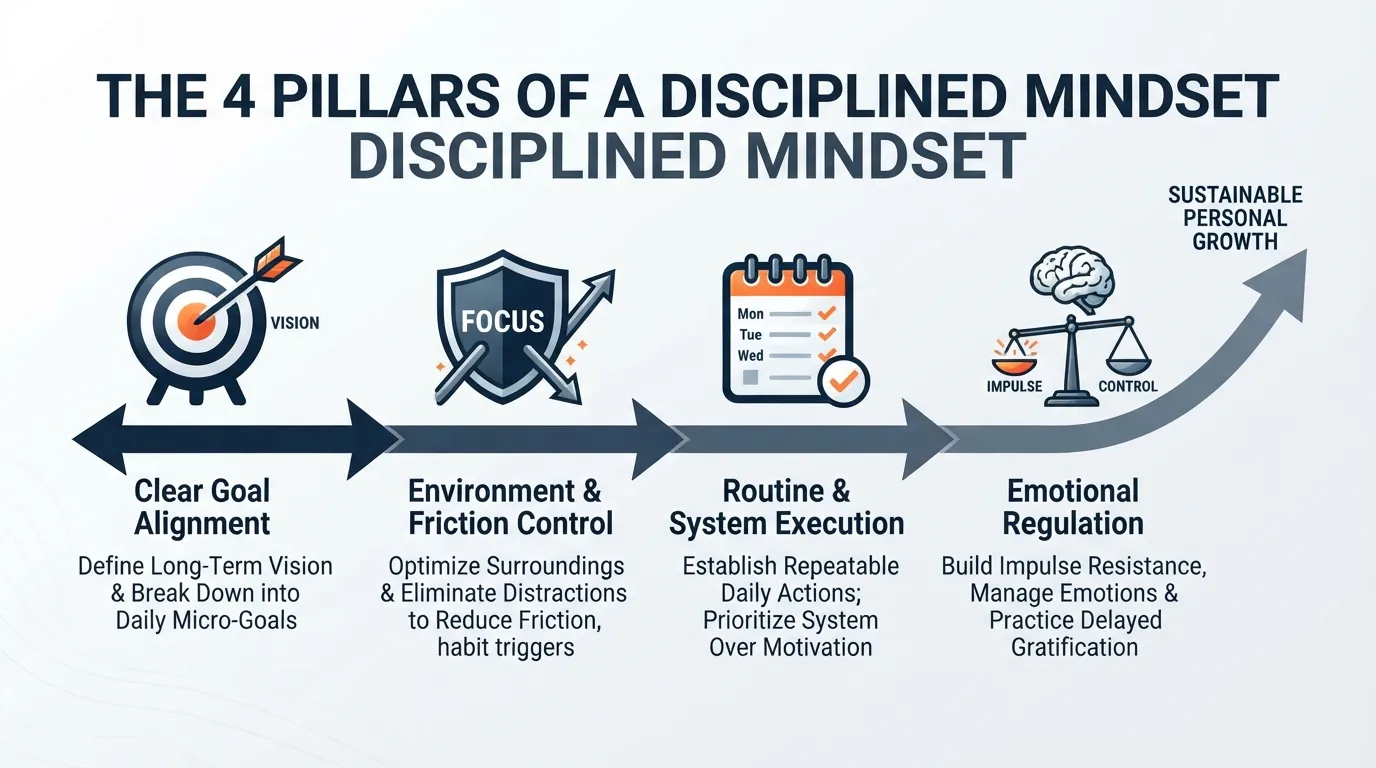
Building systems and altering your environment are essential tactical steps, but your internal narrative dictates whether discipline feels like a sustainable lifestyle or a sentence to hard labor. True mindset shifts occur when you change how you speak to yourself about your daily obligations and how you evaluate your progress.
Shift from “I have to” to “I choose to”: Language shapes your perception of agency. Saying “I have to hit the gym,” “I have to finish this report,” or “I have to eat healthy” frames you as a victim of your own goals, which immediately triggers internal friction and resistance. Reframe those thoughts into identity-driven choices: “I choose to workout because I value my energy,” or “I choose to finish this project so I can enjoy my weekend fully.” You are stepping into personal ownership rather than bowing to external obligation.
Judge yourself by effort and consistency, not single-day outcomes: External results—like weight lost, revenue generated, or words written—fluctuate due to variables outside your direct control. If you measure your self-worth solely on daily output, a low-energy day can throw you into a spiral of self-doubt. Shift your metric of success to fidelity to the process. Did you show up and honor your non-negotiable action today, even if the work felt sluggish? If yes, that day was a success.
Why Discipline Starts to Feel Good (Not Painful) Over Time
People looking to build self-control often wonder how high achievers maintain rigorous daily routines without burning out or looking miserable. The secret isn’t that they possess heroic suffering capacity; it’s that the underlying neurobiology of the habit changes as it matures.
In the beginning stage of any new behavior, taking action requires conscious force. Your prefrontal cortex must work overtime to override comfort-seeking impulses, which causes real, physical mental fatigue.
However, as you stack small daily wins, a fundamental shift happens in your brain’s reward circuitry:
Phase 1 (Initial Effort): High friction → Small outcome → Brain relies on willpower.
Phase 2 (Compounding Momentum): Reduced friction → Internal feedback (pride, self-trust, clarity) → Brain anticipates intrinsic reward.
Eventually, your brain stops associating the habit strictly with effort and begins associating it with the immediate emotional payoff that follows: the surge of quiet pride, the drop in anxiety, and the visceral feeling of momentum.
This is the point where discipline stops feeling like self-denial and starts feeling like self-care. You don’t become “obsessed” with punishment; you simply get hooked on the deep satisfaction of staying in integrity with yourself. Consistently disciplined people don’t drag themselves through the day—they genuinely prefer the feeling of execution over the hollow guilt of avoidance.
Self-Discipline Exercises and Techniques You Can Start Today
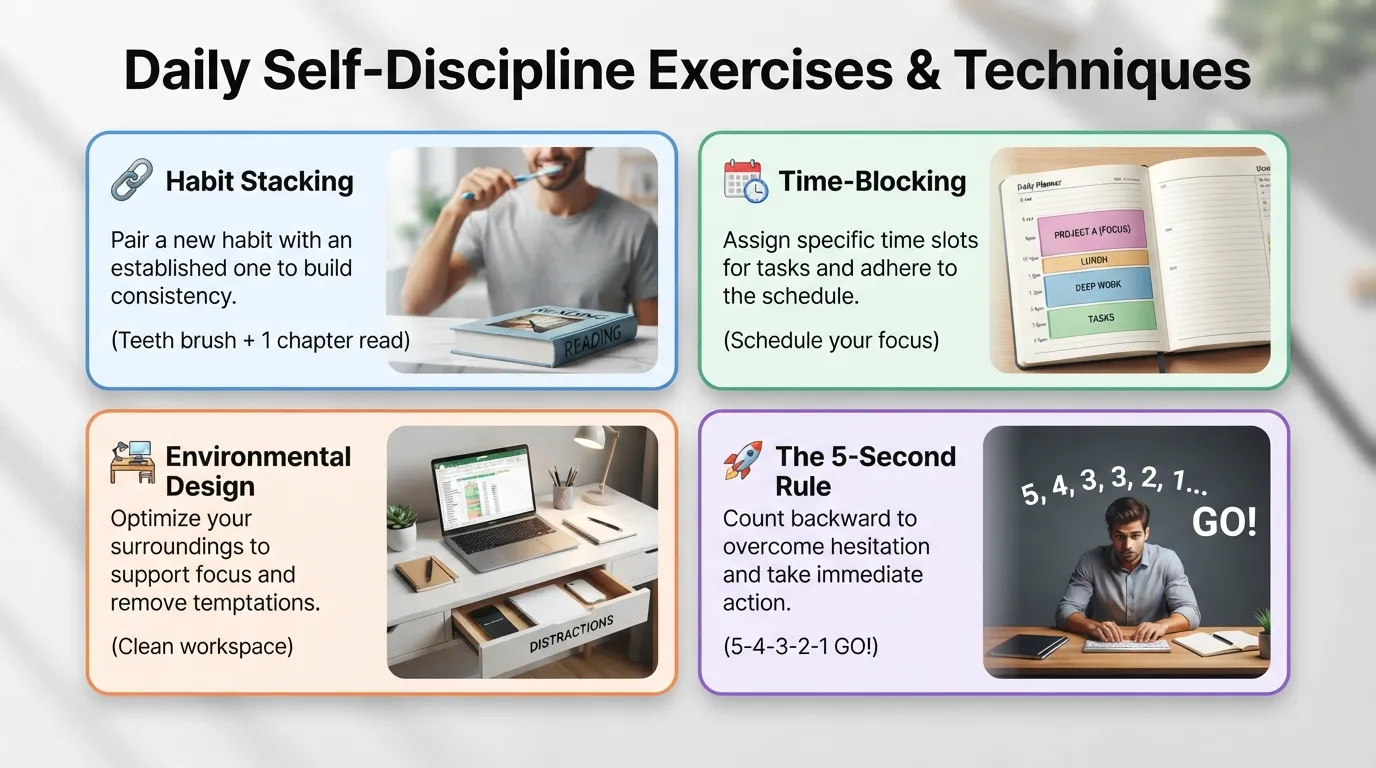
Building mental discipline doesn’t require complex software or a complete life overhaul. You can train your focus and follow-through using concrete, proven psychological techniques. Here are six actionable exercises you can implement right away to overcome resistance and take control of your day.
1. The 10-Minute Focus Sprint
When a task feels overwhelming, your brain attempts to protect you from discomfort by pushing you toward distraction. The 10-Minute Focus Sprint breaks this friction by lowering the entry barrier.
Set a timer for exactly 10 minutes and make a contract with yourself: work on the target task with single-minded focus until the bell rings. When time is up, you have full permission to stop.
In practice, the hardest part of any habit is initiation. By the time the 10 minutes expire, your brain has crossed the action threshold, momentum has built, and you will usually choose to keep going.
2. The “Write or Nothing” Rule
Multitasking and context-switching are often just disguised forms of procrastination. Popularized by author Raymond Chandler, the “Write or Nothing” rule is a powerful single-task commitment technique designed to enforce deep focus.
Set aside a fixed window of time (e.g., 45 minutes) to work on a specific deliverable. During this window, you only have two options:
Option A: Work on the target task.
Option B: Sit quietly and do absolutely nothing.
You are not allowed to check your phone, browse tabs, tidy your desk, or read emails. If you aren’t actively writing or working, you must simply sit still and stare at a blank wall or screen. Faced with total boredom versus working, your brain will almost always choose to get to work.
3. Temptation Bundling
If a task feels dry or tedious, you can leverage an immediate reward to pull you through the friction. Temptation bundling pairs an action you need to do (high effort) with an action you want to do (high pleasure).
The formula is simple: I will only [ENJOYABLE EXTRA] while doing [DIFFICULT TASK].
“I will only listen to my favorite true-crime podcast while folding laundry or scrubbing the kitchen.”
“I will only order my favorite coffee on days I go to the gym before 8 AM.”
“I will only watch this TV series while riding the stationary bike.”
By linking instant gratification directly to execution, you turn low-dopamine tasks into something you actively anticipate.
4. If-Then Planning (Implementation Intentions)
Vague intentions invite decision fatigue. Saying “I’ll try to study later today” forces your prefrontal cortex to constantly evaluate when, where, and how to execute.
If-Then Planning removes in-the-moment decision-making by creating explicit, pre-determined triggers:
“IF [Specific Trigger], THEN I will [Specific Action].”
Time-based: “IF it is 7:00 AM, THEN I will put on my running shoes and walk out the door.”
Location-based: “IF I sit down at my office desk, THEN I will open my primary project document before checking email.”
Event-based: “IF the clock strikes 12:00 PM, THEN I will eat my prepared meal instead of ordering takeout.”
Pre-programming your responses turns disciplined execution into a reflex rather than a debate.
5. The 2-Minute Rule for Habit Building
Popularized by productivity frameworks, the 2-Minute Rule states that when starting a new habit, it should take less than two minutes to execute.
The goal isn’t to optimize performance right away; it is to establish the habit of showing up.
Instead of “Read for 30 minutes every night,” change it to “Read one page.”
Instead of “Do 30 minutes of yoga,” change it to “Unroll my yoga mat.”
Instead of “Organize my entire workspace,” change it to “Clear one piece of paper off my desk.”
You must standardize before you can optimize. Once a 2-minute entry point becomes automatic, scaling the effort upward becomes easy.
6. Identity-Based Self-Talk
The language you use to describe your habits reinforces your underlying self-image. When you say “I should exercise more” or “I’m trying to avoid sugar,” you are speaking like an outsider attempting to force a behavior that conflicts with your identity.
Shift your internal monologue from obligation-based to clear, identity-driven statements:
Instead of: “I’m trying to study.”
Say: “I am a focused student.”
Instead of: “I should go to the gym.”
Say: “I am someone who doesn’t miss workouts.”
Instead of: “I can’t eat that.”
Say: “I don’t eat that.”
When choices are framed around who you are rather than what you are forced to do, staying disciplined ceases to be a battle of willpower—it simply becomes living in accordance with your core identity.
Real-Life Examples of Self-Discipline

Self-discipline isn’t an abstract philosophy—it is visible in everyday decisions across every area of life. When built into daily execution, it transforms reactive habits into intentional choices. Here is how genuine self-discipline operates across distinct domains:
Physical: Getting out of bed for a scheduled 6:00 AM workout when your bed is warm, it’s raining outside, and you feel zero initial motivation. You pack your bag the night before, put your shoes on without opening social media, and focus solely on showing up for the first five minutes.
Financial: Setting aside time every Sunday evening to review your bank accounts and log expenses. When an unexpected expense pops up, you adjust your discretionary spending categories for the rest of the month rather than ignoring the budget or putting excess purchases on a credit card.
Emotional: Pausing during a heated disagreement at work or home when you feel a surge of anger. Instead of snapping back immediately, you take a slow breath, acknowledge the emotional trigger internally, and choose a constructive, calm response rather than venting your immediate impulse.
Personal: Sitting down for ten minutes of quiet meditation or daily journaling every single morning, regardless of whether you feel serene, distracted, or pressed for time. You view the practice as non-negotiable mental hygiene rather than an optional leisure activity.
Self-Restraint: Pausing for 48 hours before purchasing a high-ticket item you saw online, or placing your phone in another room when an urge to check notifications strikes during dinner. Self-restraint is the active decision to create a delay between impulse and action, giving your rational brain time to evaluate if the desire matches your long-term intentions.
Relational: Following through on helping a friend move or attending a scheduled meeting when you’d much rather stay home and relax. You keep your commitment because your word matters to you, treating your promises to others with the same integrity you bring to yourself.
Health: Maintaining a consistent sleep schedule by turning off screens at 10:00 PM every night, even on weekends or when an enticing show is playing. You prioritize long-term recovery and cognitive function over temporary late-night entertainment.
Creative: Opening your notebook or digital workspace at 9:00 AM to write or practice your instrument for an hour, regardless of whether inspiration strikes. You treat creative work as a professional discipline where showing up regularly creates the environment for breakthroughs to happen.
How to Build Self-Discipline as a Student or Self-Learner
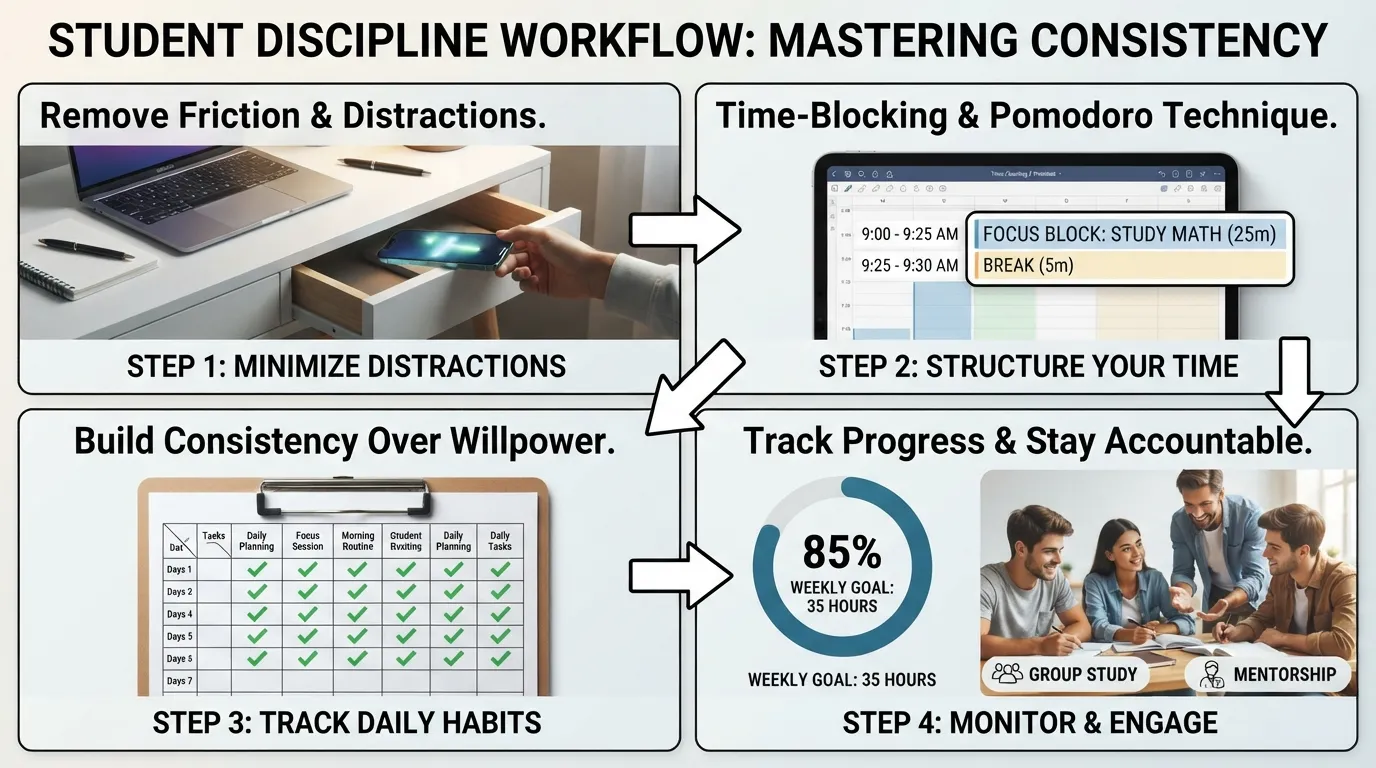
Studying effectively is rarely an issue of intelligence—it is almost always an issue of structure. Left unstructured, academic workloads invite endless procrastination, leading to high-stress, late-night cramming sessions that leave you burned out and retaining very little.
Building self-discipline as a student comes down to removing guesswork from your schedule and building non-negotiable routines around your coursework.
Set fixed study blocks tied to existing routines: Vague intentions like “I need to study more today” force you to make decisions continuously throughout the afternoon. Instead, anchor your study time to established daily events: “I will complete 45 minutes of flashcards immediately after walking through the front door from class.”
Remove phone access entirely during study sessions: Your phone is designed by engineers specifically to hijack your attention. Keeping it on your desk—even facedown—drains your working memory as your brain works to ignore it. Place your phone in another room, put it in a drawer, or use an app locker before your timer starts.
Break large assignments into micro-tasks: Looking at an entire research paper or a multi-chapter exam syllabus triggers an immediate stress response. Break the project down until the first action feels effortless: instead of “write essay,” your first task is “open document and write three thesis ideas.”
Leverage external accountability: Share your specific target with a peer, parent, or study partner before you begin. Texting a friend “I’m doing 60 minutes of math practice now and sending you a photo of my completed notes at 4:00 PM” turns private intentions into public commitments.
Self-Discipline for Self-Directed Learning
Learning outside a traditional classroom—whether you are teaching yourself a programming language, reading through a history curriculum, or mastering a new professional skill—is the ultimate test of self-discipline. Without grades, deadlines, or professors enforcing compliance, most self-learners drop off within the first month.
The difference between people who complete self-education programs and those who abandon them comes down to one principle: scheduling a fixed, recurring block instead of relying on open-ended free time.
If you promise yourself you will take that online course “whenever you find a spare hour,” it will never happen. Life easily fills empty gaps with low-effort entertainment or minor chores.
To succeed as an independent learner:
Treat your self-study time as a hard appointment: Block out 7:00 AM to 7:45 AM every Monday, Wednesday, and Friday on your calendar. Protect that block with the same seriousness you would give a mandatory work meeting or doctor’s visit.
Apply habit stacking to your learning input: Connect your independent practice directly to an established daily habit. Read 10 pages of your technical book immediately after pouring your morning coffee, or review language vocabulary right after your evening dinner.
Track output, not just time spent: Don’t just sit in front of a video module for an hour. Define a concrete, tangible output for every session—such as writing a summary paragraph, solving three practice problems, or building a functional code snippet.
When self-directed learning transitions from an unanchored goal to an automated, calendar-backed habit, skill acquisition becomes predictable rather than accidental.
Building Self-Discipline With ADHD
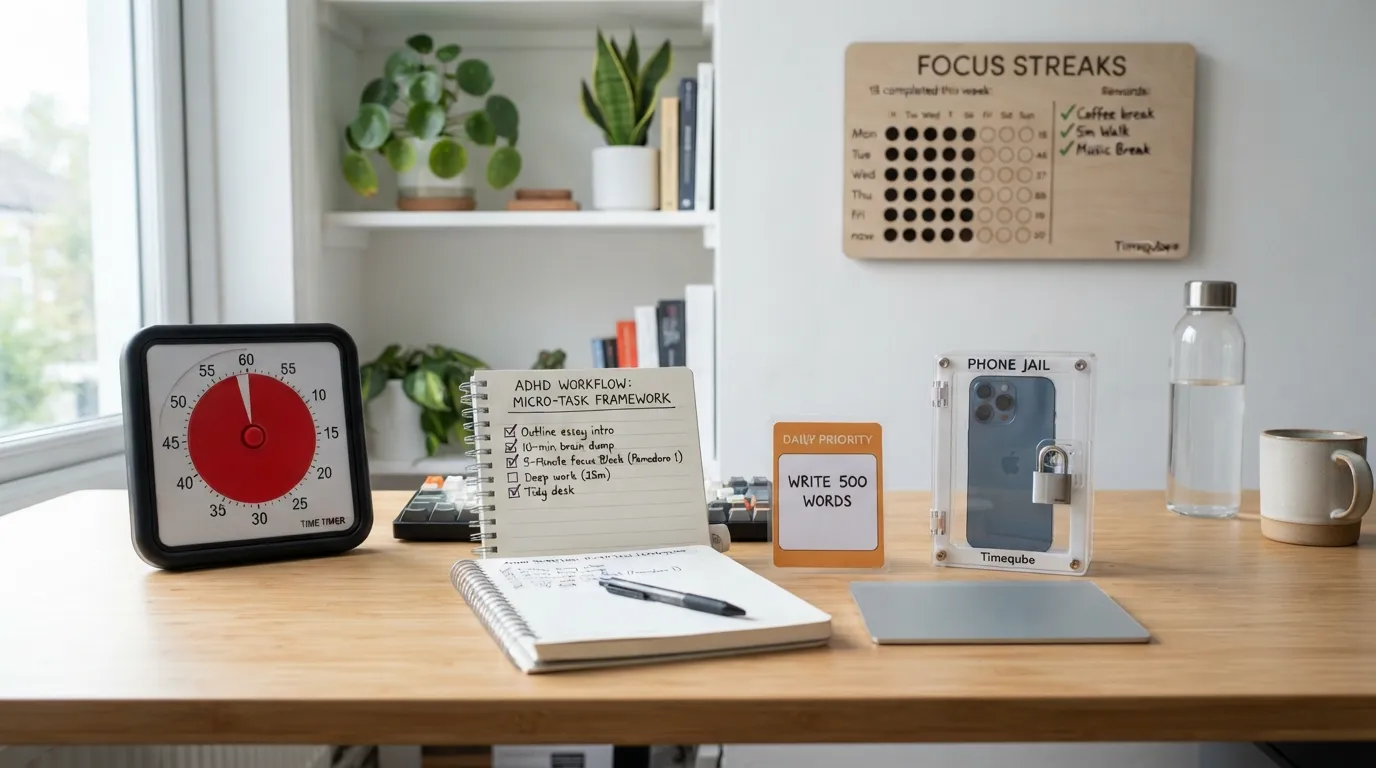
Traditional self-discipline advice usually centers around “trying harder,” forcing yourself to sit still, or summoning raw willpower. For an ADHD brain, this approach almost always fails.
ADHD is fundamentally an executive function and dopamine-regulation challenge, not a character flaw. Asking an ADHD brain to use internal resolve to initiate a low-dopamine task is like trying to start a car with an empty fuel tank. Building self-discipline with ADHD isn’t about pushing harder; it is about building external structures that bypass internal resistance entirely.
Why External Structure Outweighs Internal Resolve
Because baseline dopamine levels are lower in ADHD brains, future rewards (like getting a good grade next month or saving money for next year) carry very little motivational weight right now. The brain naturally prioritizes immediate stimulation or immediate threat avoidance.
Relying on internal grit leads straight to executive dysfunction and guilt cycles. To stay on track, you must outsource your discipline to external environment design—scaffolding your day so that starting a task requires minimal internal decision-making.
1. Visual Timers and Body Doubling
Abstract time is notoriously difficult for ADHD brains to track, a phenomenon often described as “time blindness.” Digital clock digits on a screen don’t create urgency until a deadline is actively collapsing on you.
Visual Timers: Using a physical timer where a colored disk shrinks as time passes makes time visual and concrete. Watching the physical block of color disappear provides a gentle, continuous external cue that keeps your focus grounded without the high-stress shock of a loud alarm.
Body Doubling: Working alongside another person—even silently—works wonders for ADHD focus. Having someone else in the room or on a quiet video call acts as an anchor, subtly signaling to your brain that it is time to work.
2. Immediate, Dopamine-Friendly Rewards
If a task offers zero intrinsic excitement, you need to artificially attach dopamine to the process rather than waiting for a distant outcome.
Micro-Rewards: Break a 30-minute block into three 10-minute sprints. After each sprint, give yourself an immediate, tangible reward—a piece of dark chocolate, a quick stretch, or three minutes listening to a favorite track.
Novelty Injection: Change your physical location, use colorful pens, play ambient soundscapes, or work at a standing desk. Adding novelty lowers the brain’s resistance to boring tasks.
3. Shrinking the “Start” Threshold to Beat Task Paralysis
Task paralysis happens when the brain perceives an action as too complex, firing an overwhelm signal that freezes you in place. The solution is to shrink the initiation step until it feels laughably small.
The 2-Minute Micro-Start: Tell yourself you only have to do the task for two minutes. If you want to stop after two minutes, you have full permission to walk away.
Actionable First Steps: Instead of putting “clean the kitchen” on your list, write down “put two dirty plates in the sink.”
By lowering the barrier to entry, you bypass the initial wall of dread. Once initiation happens, hyperfocus often kicks in, allowing momentum to take over naturally.
What to Do When You Feel Like You Have Zero Self-Discipline
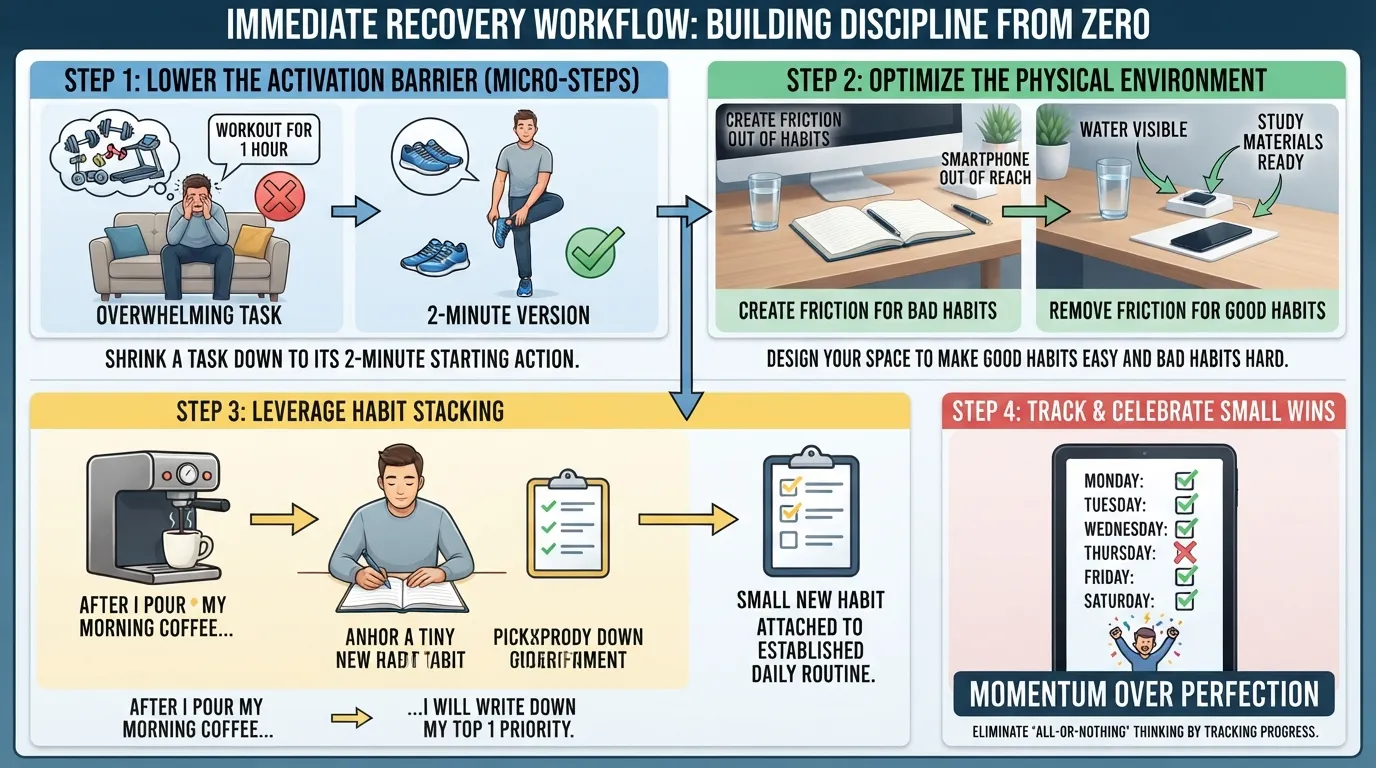
Believing you have zero self-discipline is a heavy, paralyzing feeling. When every past attempt at starting a diet, building a budget, or launching a routine has fallen apart, it’s easy to conclude that you simply lack whatever core ingredient disciplined people possess.
First, take a breath: feeling like you have zero discipline is a temporary state, not a permanent personality trait. You are not broken, and you haven’t missed your chance. You are simply starting from a baseline of exhausted mental energy and zero momentum.
Start With One 5-Minute Action Today
When motivation is at absolute zero, attempting a total life overhaul—waking up at 5:00 AM, hitting the gym, reading 50 pages, and clearing your inbox—guarantees immediate failure. Your brain views massive sudden shifts as threats and shuts down execution before you even begin.
Instead, lower the bar until it feels almost ridiculously small. Pick one 5-minute action and declare victory when it’s done:
Do not try to clean the whole house—spend 5 minutes folding clothes.
Do not try to write an entire report—open the document and type for 5 minutes.
Do not commit to a 45-minute workout—put on your shoes and walk down the street for 5 minutes.
The goal today isn’t transformation; it is proving to your brain that you are capable of initiating action. One micro-win breaks the freeze response and restores your basic sense of agency.
Remove the Shame Narrative
The biggest obstacle to building discipline isn’t laziness—it’s shame. When you view past failures through a moral lens (“I’m lazy,” “I have no willpower,” “I always ruin my progress”), you trigger a stress response that pushes you straight back toward comfort habits like scrolling, eating, or avoiding.
It is time to reframe your history: your past failures were missing systems, not missing character.
You didn’t fail at your routine because you are fundamentally flawed. You failed because you relied on motivation instead of environment design, set unrealistic goals without building baseline habits, or tried to fight millions of years of brain biology with raw grit. When a key doesn’t turn in a lock, you don’t blame the metal—you find the right key. Treat your habits as a structural engineering problem, make the necessary adjustments, and move forward without the weight of past mistakes.
Self-Discipline at Work

In a modern work environment filled with constant notifications, urgent requests, and back-to-back meetings, workplace discipline rarely means working harder. It means protecting your attention. Without clear boundaries, it’s easy to spend eight hours being intensely busy without actually accomplishing anything meaningful.
Developing professional discipline comes down to shifting from a reactive mindset—responding to whatever pops up—to a proactive rhythm built around your highest-value priorities.
Prioritize Your Main Task Before Opening Communications
Checking your email or messaging apps first thing in the morning immediately puts your brain in reactive mode. You surrender your focus to other people’s agendas before establishing your own.
The “Eat the Frog” Rule: Identify your single most critical, high-friction task for the day—the project that moves the needle most.
The First Hour Protect: Spend the first 45 to 60 minutes of your workday executing that priority before opening your inbox, team chat, or news feeds.
Set Communication Windows: Shift from constant monitoring to checking messages at designated times (e.g., 10:00 AM, 1:00 PM, and 4:00 PM).
Time-Blocking and Single-Tasking
Multitasking is a psychological illusion. The brain cannot process two complex tasks simultaneously; instead, it rapidly switches context between them, causing cognitive fatigue and increasing error rates by up to 40%.
Calendar Blocking: Dedicate specific blocks of time on your calendar for deep work tasks, just as you would for an important client presentation.
Single-Task Commitment: When you sit down for a 90-minute focus block, close every tab, document, and application not directly related to that single task.
Batch Reactive Tasks: Group small, administrative errands—like filing expense reports or responding to quick queries—into a single 30-minute block at the end of the day.
Set Boundaries to Protect Focus Time
If you don’t dictate how your time is spent, your colleagues will. Self-discipline at work requires establishing firm, transparent boundaries around your focus hours.
Communicate Status: Turn on “Do Not Disturb” status on team messaging platforms during deep work blocks so colleagues know you are temporarily offline.
Audit Meetings: Politely decline or request recordings for meetings that lack a clear agenda or where your direct input isn’t strictly required.
Decline Gracefully: Practice clear, professional boundary-setting: “I’m currently focused on completing [Key Deliverable] today, but I can look into this first thing tomorrow morning.”
The Weekly Review Habit
Professional discipline degrades when you lose sight of the big picture. A structured weekly review keeps your daily actions aligned with long-term objectives so nothing critical slips through the cracks.
Block out 30 minutes every Friday afternoon to go through a standardized review process:
Clear the Decks: Zero out your inbox, organize your desktop, and collect loose notes scattered across the week.
Review Outcomes: Evaluate what got done versus what was planned. Identify where projects stalled and why.
Define Next Week’s Focus: Choose your top 3 to 5 non-negotiable priorities for the upcoming week and pre-block the required focus time on your calendar.
Ending your workweek with a clear review closes open mental loops, allowing you to fully disconnect over the weekend and hit the ground running on Monday morning.
Videos to Help You Build Self-Discipline
Building long-term self-discipline starts with understanding how to trust yourself rather than relying on strict, unnatural pressure. In this video, Muchelleb breaks down a refreshing, four-part framework for creating habits that align with your natural preferences.
When motivation fades, having actionable strategies keeps you moving forward regardless of how you feel. Rob Dial explores seven practical methods—from designing your environment to leveraging quick action triggers—to help you build lasting momentum.
Rather than treating discipline like a constant uphill struggle, small shifts in your routines can dramatically reduce friction. In this video, Ali Abdaal shares key insights learned from author Ryan Holiday on maintaining consistency without burning out.
Best Resources to Learn More About Self-Discipline
Atomic Habits by James Clear – Focuses on how small, systematic daily habits compound into long-term discipline without relying on sheer willpower.
The Willpower Instinct by Kelly McGonigal – Explores the cognitive science behind self-control and provides practical strategies to strengthen your mental endurance.
Can’t Hurt Me by David Goggins – Offers an extreme, mindset-driven perspective on pushing past self-imposed limits and mastering mental toughness.
For individuals who repeatedly struggle to maintain consistency on their own, working with an accountability coach can provide the external structure, personalized strategies, and regular feedback needed to bridge the gap between intention and action.
Frequently Asked Questions
In simple words, self-discipline is the ability to push yourself to take action and do what needs to be done, even when you don't feel like doing it.
Self-discipline is primarily a skill, not an innate trait. While some people may naturally have higher levels of conscientiousness, anyone can build and strengthen self-discipline through practice, structured habits, and environmental design.
Building self-discipline is a continuous process rather than a fixed destination. While forming a specific underlying habit takes anywhere from 18 to 254 days (with an average of 66 days), noticeable improvements in overall self-control can be built within a few weeks of consistent practice.
To stay consistent beyond short bursts of motivation, shift your reliance from feelings to systems. Focus on building small daily routines, reducing friction for positive behaviors, optimizing your environment to minimize distractions, and relying on clear schedules rather than willpower.
Yes, self-discipline can be developed at any stage of life. Thanks to neuroplasticity, the human brain retains the ability to adapt, learn new behavioral patterns, and form disciplined routines regardless of age.
Self-control is typically short-term and reactive—it’s the ability to resist an immediate impulse or temptation in the moment. Self-discipline is long-term and proactive—it’s the ongoing commitment to structured routines and decisions that align with your overarching goals.
Discipline isn’t an innate personality trait, nor is it created through temporary bursts of motivation. It is a trainable muscle built quietly through small, deliberate, daily systems. When you stop relying on how you feel in the moment and instead trust structured routines, consistency becomes effortless. To start putting this into practice immediately, return to our Step-by-Step Framework above and pick just one small action to implement today.
Kittisak Wattanakul
Kittisak Wattanakul is the Discipline Editor at Holistic Wellbeing Living. He writes about routines, focus, consistency, and practical follow-through. With nine years of experience creating personal-growth content, Kittisak helps readers build realistic systems for steady progress without extreme productivity pressure.