Model Rules of Professional Conduct: The Ultimate Attorney Guide
What Are the Model Rules of Professional Conduct?
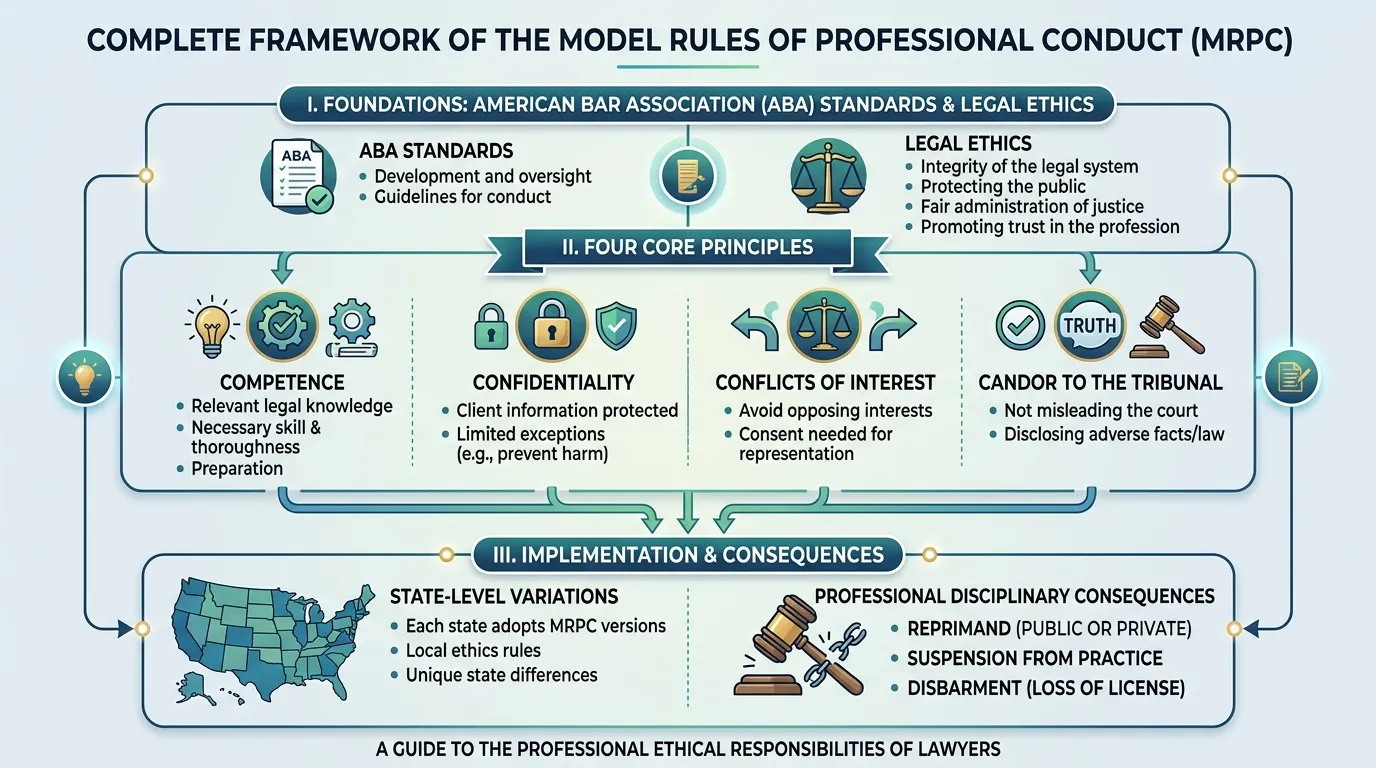
The Model Rules of Professional Conduct (MRPC) are a set of comprehensive guidelines drafted by the American Bar Association (ABA) to govern attorney ethics, professional behavior, and disciplinary standards across the legal profession. Serving as a foundational blueprint, they ensure lawyers uphold integrity, client confidentiality, and fiduciary duties while navigating complex judicial environments.
Quick Definition
The Model Rules of Professional Conduct represent a model code of ethics established by the American Bar Association to guide lawyer conduct and regulatory enforcement. While they do not carry the force of law on their own, they serve as the template for the binding professional responsibility codes adopted by most U.S. states.
Establishes baseline ethical standards for legal practitioners.
Governs attorney-client relationships, conflicts of interest, and courtroom decorum.
Provides a standardized framework for state bar disciplinary actions.
Who Created the Model Rules?
The American Bar Association developed and maintains the MRPC to unify and modernize legal ethics across the United States. Originally adopted in 1983—superseding the earlier Model Code of Professional Responsibility—the rules undergo continuous review by the ABA Standing Committee on Ethics and Professional Responsibility to address emerging legal challenges.
The ABA’s Role: A voluntary national organization of lawyers that drafts and updates the model standards.
State Adoption: Individual state supreme courts or legislatures must officially adopt these rules for them to become binding law within their jurisdictions.
Evolving Standards: Amendments frequently incorporate modern realities, such as cybersecurity, digital communication, and cross-state practice.
Why the Model Rules Matter to Every Lawyer
Every practicing attorney must master the Model Rules because compliance is mandatory for maintaining a law license. Violating these standards can trigger severe professional repercussions, ranging from private reprimands to permanent disbarment.
Client Protection: Safeguards sensitive client information and ensures competent, diligent representation.
Risk Management: Helps attorneys identify and avoid prohibited conflicts of interest before taking on new cases.
Licensing Compliance: Directly dictates the ethical parameters tested on the Multistate Professional Responsibility Examination (MPRE) required for bar admission.
What Is an Ethical Rule?
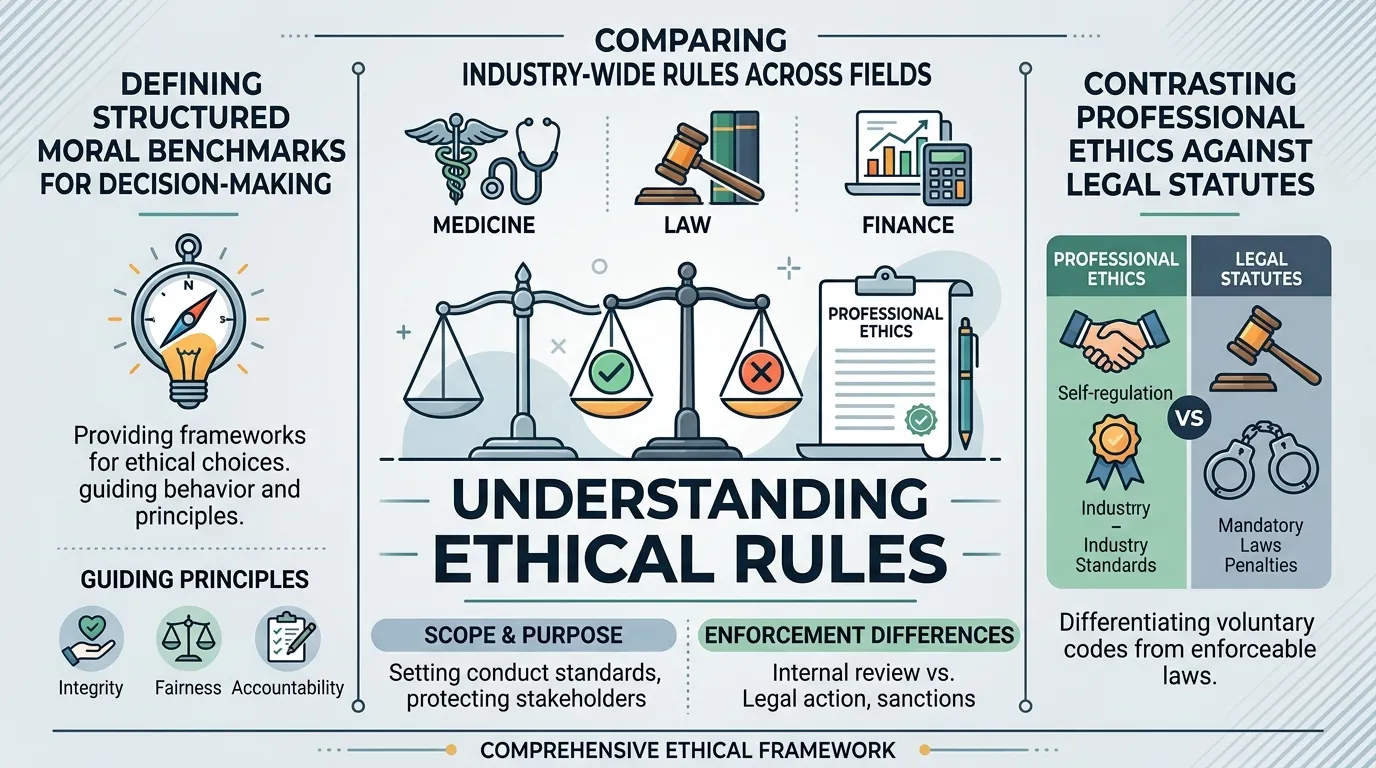
An ethical rule is a formalized principle or standard of conduct that dictates what is morally right or wrong within a specific profession, organization, or social context. These guidelines establish professional boundaries, promote accountability, and ensure practitioners act with honesty and integrity.
Definition: What Is an Ethical Rule?
Ethical rules function as structured moral benchmarks designed to guide decision-making when practitioners face conflicts of interest, client vulnerability, or complex dilemmas. Unlike personal morals, professional ethics rules are codified by governing bodies to establish uniform expectations for an entire industry.
Serves as a standard for acceptable behavior within professional organizations.
Protects stakeholders, consumers, and the public from exploitation or harm.
Bridges the gap between abstract moral values and daily professional actions.
Examples of Ethical Rules
Various industries implement explicit codes of ethics to govern daily operations and protect public trust. These standards apply across diverse fields to ensure practitioners maintain high levels of responsibility and transparency.
Medical Confidentiality: Physicians and healthcare providers must protect patient health records and private disclosures under strict privacy regulations.
Financial Fiduciary Duty: Financial advisors are required to prioritize their clients’ financial best interests ahead of their own profits or commissions.
Journalistic Objectivity: Reporters and editors must strive for factual accuracy, correct errors promptly, and avoid conflicts of interest in reporting.
Engineering Public Safety: Engineers must prioritize the safety, health, and welfare of the public in all structural and technological designs.
How Ethical Rules Differ From Laws
While both laws and ethical rules regulate behavior, they originate from different sources, carry distinct enforcement mechanisms, and serve separate purposes within society. Understanding this distinction clarifies why professionals face both legal and disciplinary consequences for misconduct.
Enforcement and Authority: Laws are enacted by government legislatures and enforced through criminal or civil courts, whereas ethical rules are typically enforced by professional boards or peer review committees.
Scope of Conduct: Laws dictate the absolute minimum legal standard of conduct required to avoid state penalties, while ethical rules often demand a higher standard of moral and professional excellence.
Consequences: Breaking a law results in fines, probation, or imprisonment; violating an ethical rule leads to professional reprimands, suspension, or revocation of a professional license.
The Core Ethical Principles Every Lawyer Must Follow
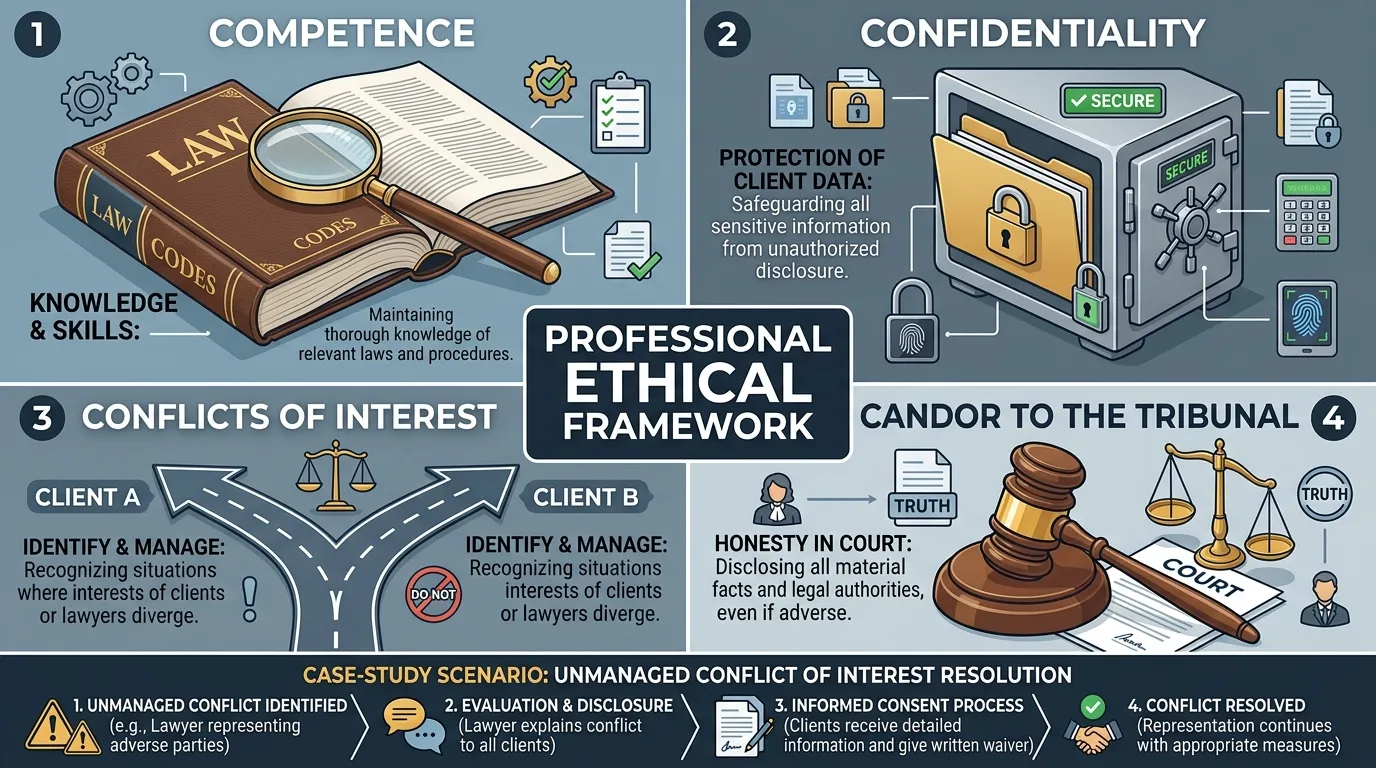
Legal practice is anchored by foundational professional ethics rules designed to safeguard the administration of justice and protect the public. These core principles outline the baseline duties attorneys owe to their clients, the courts, and the legal profession.
Competence
Competence requires a lawyer to possess the legal knowledge, skill, thoroughness, and preparation reasonably necessary for effective client representation. Providing substandard representation due to lack of preparation or expertise violates professional responsibility standards.
Requires thorough research and mastery of the relevant substantive and procedural law.
Demands adequate preparation time to handle legal matters effectively.
Obligates lawyers to associate with knowledgeable co-counsel or decline cases outside their area of expertise.
Confidentiality
Confidentiality protects all information relating to the representation of a client, creating an essential pillar of trust between attorney and client. Lawyers cannot disclose sensitive information without informed consent unless specific narrow exceptions apply.
Extends to all communications, documents, and facts learned during the course of the representation.
Prevents lawyers from using client information to the client’s disadvantage.
Includes limited exceptions, such as preventing reasonably certain death, substantial bodily harm, or ongoing criminal fraud.
Conflicts of Interest
Conflicts of interest arise when a lawyer’s loyalty to a client is materially limited by responsibilities to another client, a former client, or the lawyer’s own personal interests. Navigating these conflicts requires careful screening and written informed consent.
Prohibits representing opposing parties in the same litigation or transaction.
Restricts business transactions with clients unless strict fairness and disclosure requirements are met.
Requires immediate disclosure and withdrawal from representation if an unresolvable conflict emerges.
Candor to the Tribunal
Candor to the tribunal demands complete honesty and transparency from attorneys when dealing with judges, juries, and administrative courts. Lawyers must uphold the integrity of the judicial process even when zealous advocacy tempts them to conceal adverse facts.
Prohibits attorneys from knowingly making false statements of law or fact to a court.
Requires the disclosure of directly adverse legal authority from the controlling jurisdiction that opposing counsel failed to identify.
Mandates that lawyers take remedial measures if they discover a client or witness has provided perjured testimony.
Real-World Example: How a Conflict of Interest Plays Out
A mid-sized litigation firm is approached by a tech startup seeking representation in a breach of contract lawsuit against a major software vendor. Unbeknownst to the incoming client, the firm’s senior partner currently represents that same software vendor on unrelated intellectual property matters.
The Ethical Violation: Taking on the new lawsuit without authorization constitutes a concurrent conflict of interest because the firm’s duties of loyalty and diligence to both parties are directly adverse.
The Resolution: The firm must decline the new representation immediately unless both clients provide written informed consent after full disclosure of the risks. If consent is refused, the firm cannot proceed with the lawsuit.
How the Model Rules Are Structured
The American Bar Association organizes the Model Rules of Professional Conduct into a systematic, thematic framework. Understanding this organization is essential for law students, legal practitioners, and candidates preparing for the Multistate Professional Responsibility Examination (MPRE).
The 8 Subject Areas of the Model Rules
The rules are grouped into topical chapters numbered by subject matter, making it straightforward to locate specific professional duties. Each number grouping correlates directly to a distinct area of legal practice and responsibility:
Client-Lawyer Relationship (Rules 1.0–1.18): Governs foundational duties like competence, confidentiality, fees, and conflicts of interest.
Counselor (Rules 2.1–2.4): Outlines the lawyer’s role as an advisor, evaluator, and third-party neutral.
Advocate (Rules 3.1–3.9): Details duties during litigation, including candor to the tribunal, fairness to opposing parties, and trial publicity.
Transactions with Persons Other Than Clients (Rules 4.1–4.4): Regulates truthfulness in statements to others and respect for third-party rights.
Law Firms and Associations (Rules 5.1–5.8): Sets supervisory responsibilities for partners, managers, and subordinate lawyers.
Public Service (Rules 6.1–6.5): Encourages pro bono publico service and outlines responsibilities regarding legal services organizations.
Information About Legal Services (Rules 7.1–7.6): Controls lawyer advertising, solicitation, and communication regarding firm credentials.
Integrity of the Profession (Rules 8.1–8.5): Mandates bar admission honesty, reporting professional misconduct, and disciplinary jurisdiction.
Rules vs. Comments — What’s the Difference?
Every model rule consists of two distinct components: the black-letter rule text and the accompanying official comments. While the rule text sets binding legal standards, the comments provide vital interpretive context.
Black-Letter Rules: Contain the mandatory commands, prohibitions, and precise structural exceptions (subsections A, B, and beyond).
Official Comments: Explain the purpose of each rule, provide concrete illustrations, and are treated by examiners and disciplinary boards as persuasive authority.
Testing Standards: MPRE questions frequently test the specific applications and scenarios detailed within the comments rather than just broad generalizations.
How Many Rules Are There?
The MRPC framework consists of roughly 58 to 59 active rules, anchored by initial definition sections and expanded by dozens of subparts. Because states frequently amend or customize these provisions upon adoption, practitioners must always cross-reference local court rules.
Total Count: Approximately 58 distinct rules spanning across the eight primary subject chapters.
Internal Anatomy: Most individual rules feature a broad prohibition or mandate in subsection (a), followed by specific categorical exceptions in subsection (b).
Baseline Uniformity: While states vary, the numbering and core text provide a unified national vocabulary for legal ethics.
Are the Model Rules Legally Binding?
The Model Rules of Professional Conduct are not legally binding on their own because the American Bar Association is a private, voluntary professional organization rather than a legislative or judicial body. They carry no direct force of law until a state’s highest authority formally reviews, modifies, and adopts them into law.
Why the ABA’s Model Rules Are Not Law
The American Bar Association serves as a national standard-setting entity for the legal profession, but it lacks jurisdiction to license attorneys or enforce disciplinary actions.
Voluntary Nature: Membership in the ABA is optional for practicing lawyers, and the organization has no sovereign authority to enact state laws.
Advisory Status: The standards function as expert recommendations rather than mandatory statutes until localized.
Enforcement Separation: Only individual state bar associations and state supreme courts hold the constitutional authority to discipline lawyers.
How States Adopt (or Modify) the Model Rules
For ethical standards to govern practice within a specific state, the state’s highest court or legislature must formally review and incorporate them into local court rules. You can review the complete framework directly at the ABA Model Rules Table of Contents{rel=”nofollow”}.
State Customization: Most U.S. states model their local codes of professional responsibility closely on the ABA framework, though many introduce tailored amendments.
Binding Authority: Once adopted by a state supreme court, the rules become fully binding law for every attorney licensed within that jurisdiction.
Judicial Disciplinary Power: State bar grievance committees enforce these locally adopted rules through investigations, suspensions, and disbarment.
What Happens Until a State Adopts Them
If a state has not formally adopted a recent ABA amendment or specific rule, attorneys in that jurisdiction are governed strictly by their existing local professional code. However, courts and disciplinary boards often look to the broader ABA model rules as persuasive authority when evaluating novel ethical questions.
Jurisdictional Divergence: Practices permissible in one state may violate professional codes in an adjacent state depending on local adoption status.
Persuasive Guidance: Disciplinary tribunals frequently cite the ABA model rules and official comments to interpret ambiguous local standards.
National Examinations: Candidates preparing for the Multistate Professional Responsibility Examination must study the uniform ABA rules rather than idiosyncratic state variations.
How Rules of Professional Conduct Vary by State
State bar associations maintain independent authority over attorney licensing and regulation, meaning ethical standards differ across jurisdictions. While most states adopt the ABA framework with minor modifications, several states implement unique structural formats and distinct professional codes.
California: A Notable Exception to the Model Rules Format
California stands out as a primary exception, historically operating independently from the ABA Model Rules structure. Rather than adopting the numbered model code, California governs its practitioners through the California Rules of Professional Conduct, which are approved by the California Supreme Court and enforced by the State Bar of California.
Uses a distinct numbering system and text format that diverges from the standard 1.0 through 8.5 ABA structure.
Incorporates specific state requirements regarding client communications and fee agreements that differ from national norms.
Requires all practicing attorneys to complete specialized continuing legal education (MCLE) tailored to California-specific ethics mandates.
Texas Disciplinary Rules of Professional Conduct (TDRPC)
Texas manages lawyer ethics through the Texas Disciplinary Rules of Professional Conduct (TDRPC), which were heavily influenced by the ABA Model Rules but contain unique structural provisions. Enforced by the Texas Bar, these rules establish distinct requirements for client trust accounts and advertising.
Integrates specific terminology regarding disciplinary authority and public grievance procedures.
Features distinct provisions governing lawyer advertising and specialization branding within the state.
Requires adherence to local procedural rules established by the Supreme Court of Texas.
Quick Comparison Table: Model Rules vs. State Variations
| Feature / Aspect | ABA Model Rules (MRPC) | California Rules of Professional Conduct | Texas Disciplinary Rules (TDRPC) |
| Governing Authority | American Bar Association (Advisory) | State Bar of California / Supreme Court | Texas Bar / Supreme Court of Texas |
| Numbering Format | Thematic decimals (1.0 to 8.5) | Independent state-specific numbering | Unique state-specific numbering format |
| Binding Force | None until state adoption | Fully binding within California | Fully binding within Texas |
| Primary Purpose | Provide a national template | Govern California practice exclusively | Govern Texas legal practitioners exclusively |
What Happens When a Lawyer Violates These Rules?
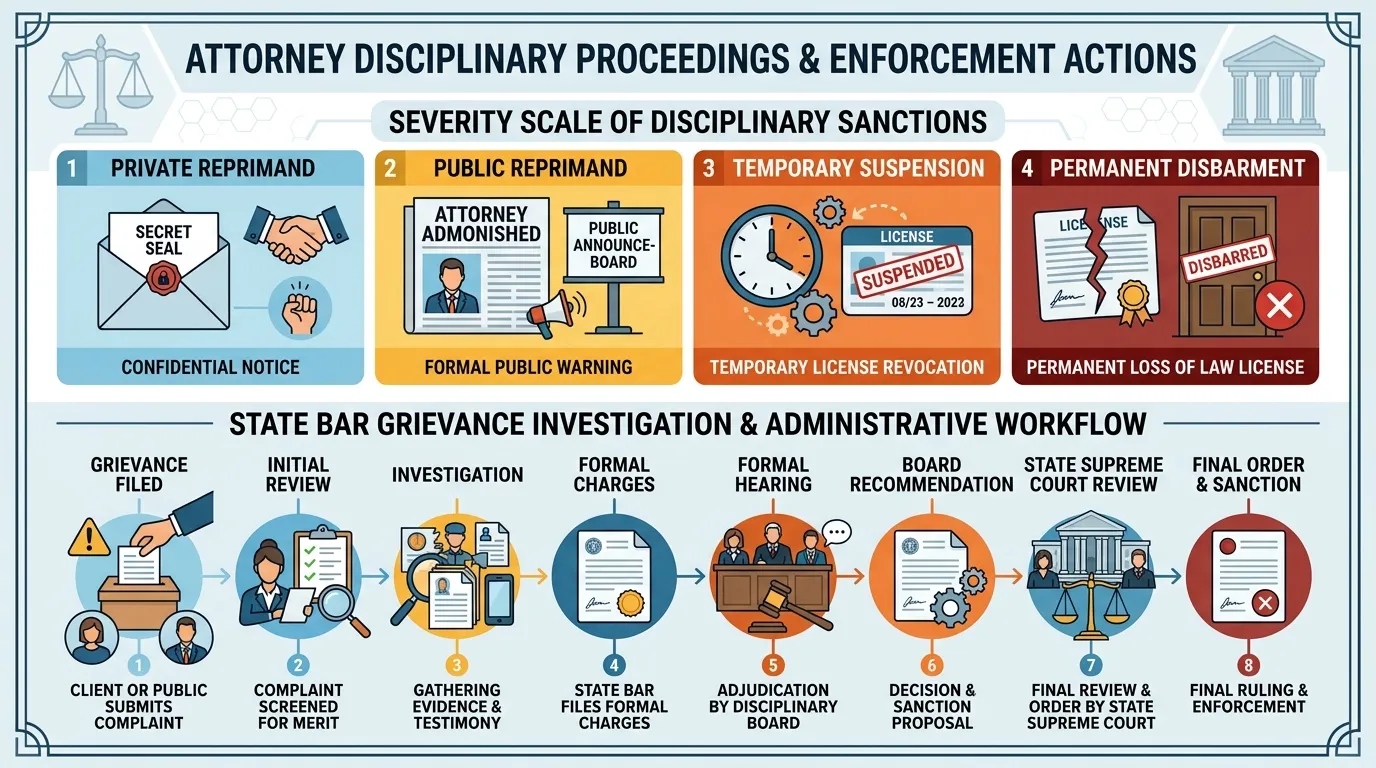
When an attorney breaches professional conduct codes, they face formal professional discipline administered by state regulatory authorities. These disciplinary actions protect the public, maintain the integrity of the judicial system, and deter future ethical violations within the legal profession.
Public or Private Reprimand
A reprimand represents a formal censure for relatively minor or technical ethical breaches that do not cause severe client harm. Depending on the severity of the misconduct, the disciplinary board will issue either a private warning or a public reprimand recorded on the attorney’s permanent bar file.
Private Reprimand: A confidential warning issued for minor infractions, remaining hidden from public view unless compounded by future offenses.
Public Reprimand: A published official censure that appears on the state bar website, alerting current and prospective clients to the attorney’s ethical lapse.
Administrative Conditions: Often accompanied by mandatory requirements to complete targeted continuing legal education or ethics courses.
Suspension
Suspension temporarily strips an attorney of their license to practice law for a specified period, ranging from a few months to several years. During a suspension, the lawyer cannot represent clients, appear in court, or collect legal fees.
Reinstatement Hurdles: Re-entering practice usually requires petitioning the state disciplinary board and proving rehabilitation.
Client Protection Orders: Suspended lawyers must notify all active clients immediately and transition files to new counsel.
Severe Financial Impact: Results in a total halt to active law practice income during the disciplinary term.
Disbarment
Disbarment is the most severe penalty available, involving the complete revocation of an attorney’s law license. This sanction is reserved for egregious misconduct, such as misappropriating client trust funds, committing fraud, or criminal convictions.
Permanent Separation: In most jurisdictions, disbarment is permanent, though some states permit a petition for reinstatement after five or more years under strict conditions.
Mandatory Surrender: The disciplined individual must surrender their bar card, close all client trust accounts, and notify opposing counsel in ongoing matters.
Public Record: Permanently documented in state judicial records and national lawyer databases.
How Disciplinary Proceedings Work
Disciplinary proceedings follow a structured administrative process designed to ensure due process while investigating client grievances or professional complaints. State bar investigators review the facts, conduct hearings, and recommend appropriate sanctions to the state supreme court.
Filing a Grievance: A client, opposing counsel, or judge files a formal complaint detailing the alleged ethical violation.
Investigation and Hearing: The bar association investigates the claim and, if warranted, holds a formal evidentiary hearing before a disciplinary panel.
Final Judicial Review: The state supreme court reviews the panel’s recommendation and issues the final, binding disciplinary order.
A Brief History — From Canons to the Model Rules
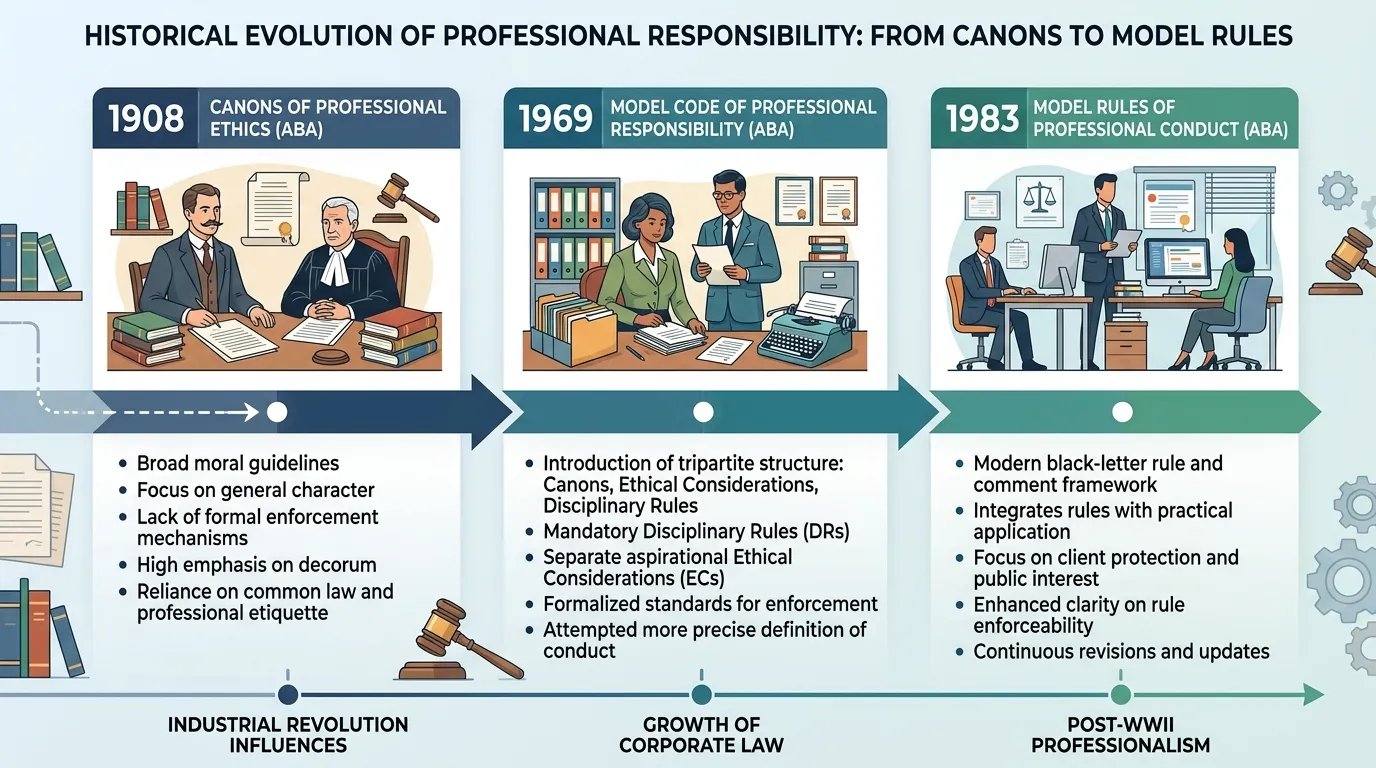
The evolution of modern legal ethics reflects the legal profession’s ongoing effort to adapt to changing societal norms, commercial pressures, and judicial complexities. Tracing the historical transition from early advisory canons to the modern framework reveals how attorney standards became formalized and enforceable.
1908: The Canons of Professional Ethics
The American Bar Association established its first nationwide ethical framework in 1908 with the adoption of the Canons of Professional Ethics. Influenced heavily by earlier state codes such as Alabama’s 1887 code, these initial canons relied on aspirational language rather than strict, enforceable rules.
Consisted primarily of broad moral guidelines and traditional gentlemen’s agreements rather than binding legal regulations.
Addressed fundamental professional ideals, including courtroom decorum, fee setting, and avoiding direct public solicitation.
Lacked formal enforcement mechanisms, leaving discipline largely to informal peer pressure and early local bar associations.
1969: The Model Code of Professional Responsibility
To address the growing complexity of legal practice, the ABA replaced the 1908 canons with the Model Code of Professional Responsibility in 1969. This framework introduced a tripartite structure dividing standards into Canons, Ethical Considerations, and Disciplinary Rules.
Established mandatory Disciplinary Rules that gave states a clearer foundation for prosecuting attorney misconduct.
Incorporated Ethical Considerations as aspirational objectives that lawyers should strive to achieve.
Served as the direct template for state-level disciplinary codes throughout the 1970s and early 1980s.
1983: The Model Rules of Professional Conduct
The shortcomings and outdated language of the 1969 code prompted the ABA to establish the Kutak Commission, leading to the adoption of the modern Model Rules of Professional Conduct in 1983 ABA sessions. This overhaul reorganized legal ethics into a cleaner, subject-matter-driven format.
Adopted a functional “Black-Letter Rule and Comment” layout that improved readability for practitioners and law students.
Clarified critical duties regarding client confidentiality, conflicts of interest, and corporate representation.
Provided the uniform structural baseline that continues to influence state bar regulations across the United States today.
Frequently Asked Questions
What are examples of ethical rules?
Examples of professional ethics rules include maintaining strict client confidentiality in law, preserving patient health information privacy in medicine, prioritizing client financial best interests in finance, and avoiding conflicts of interest across licensed professions. These principles establish binding expectations for transparency, accountability, and honesty.
Legal Confidentiality: Protecting all communications and secrets shared between an attorney and a client.
Medical Privacy: Safeguarding patient medical records under strict regulatory standards.
Financial Fiduciary Duty: Placing client investment security ahead of personal commissions or firm profits.
What is an ethical rule?
An ethical rule is a formalized principle or standard of conduct that dictates professional and moral expectations within a specific industry, organization, or social setting. Unlike personal morals, these rules are codified by governing bodies to ensure practitioners maintain public trust and accountability.
Serves as a structured benchmark for professional decision-making.
Protects consumers, clients, and the public from harm or exploitation.
Carries professional disciplinary consequences when violated.
What are the ethical rules in Texas?
Ethics rules in Texas are governed by the Texas Disciplinary Rules of Professional Conduct (TDRPC) and enforced by the State Bar of Texas. While heavily influenced by national frameworks, these jurisdiction-specific rules establish unique local requirements for client trust accounts, lawyer advertising, and professional responsibility.
Regulate attorney conduct exclusively within the state of Texas.
Outlined under the authority of the Supreme Court of Texas.
Dictate mandatory compliance standards for all licensed Texas practitioners.
What are the 12 principles of professional ethics?
Professional ethics are generally anchored by core universal pillars rather than a rigid 12-step universal code, though standard business and legal frameworks commonly emphasize twelve shared values. These principles guide daily decision-making across corporate, legal, and medical environments.
Integrity, objectivity, and professional competence.
Confidentiality, loyalty, and avoidance of conflicts of interest.
Due diligence, transparency, and respect for the law.
Accountability, fairness, and commitment to public service.
What are 5 professional ethics?
Five foundational professional ethics universally recognized across licensed occupations include integrity, objectivity, professional competence, confidentiality, and accountability. These standards ensure that practitioners serve clients and the public honorably and effectively.
Integrity: Maintaining absolute honesty and ethical soundness in all professional dealings.
Objectivity: Rendering unbiased advice and independent professional judgment.
Competence: Possessing and applying the requisite skill, knowledge, and preparation.
Confidentiality: Safeguarding sensitive proprietary or client data against unauthorized disclosure.
Accountability: Accepting responsibility for professional actions and regulatory compliance.
Can a lawyer be sued for violating the Model Rules?
A lawyer cannot be sued directly by a client solely for violating an ABA Model Rule of Professional Conduct because the rules themselves do not create a private civil cause of action. However, the same underlying misconduct frequently gives rise to a separate civil lawsuit for professional malpractice or breach of fiduciary duty.
Violation of a rule serves as evidence of a breach of the standard of care in a malpractice lawsuit.
Disciplinary penalties like suspension or disbarment are handled exclusively by state bar grievance committees and courts, not civil juries.
Clients must prove actual financial harm or damages to successfully recover compensation in a civil legal malpractice claim.
Key Takeaways
The rules of professional conduct serve as the ethical backbone of the legal profession, ensuring that practitioners uphold justice, protect client trust, and maintain high standards of accountability. Mastery of these principles is essential for legal compliance, professional longevity, and safeguarding the integrity of the judicial system.
The 4 Core Principles
Legal ethics are anchored by four foundational duties that govern every aspect of client representation and courtroom advocacy. Adhering to these pillars prevents malpractice liabilities and ensures professional excellence.
Competence: Delivering thorough, well-prepared legal services backed by necessary skill and knowledge.
Confidentiality: Shielding sensitive client communications and private disclosures from unauthorized release.
Conflicts of Interest: Identifying and avoiding divided loyalties that compromise independent professional judgment.
Candor to the Tribunal: Maintaining absolute honesty before judges, juries, and administrative courts.
Why These Rules Protect Both Lawyers and the Public
Professional standards establish a clear, predictable framework that benefits both the consumers of legal services and the attorneys who provide them. By defining acceptable boundaries, the rules foster public confidence in the legal system while shielding practitioners from ambiguity.
Client Safeguards: Protects vulnerable individuals from exploitation, fraud, and unauthorized disclosure of sensitive data.
Professional Clarity: Provides attorneys with definitive guidelines to navigate complex ethical dilemmas and client disputes.
Systemic Integrity: Maintains public trust in the courts and ensures fair, impartial administration of justice across all jurisdictions.