Holding Employees Accountable: A Leader’s Guide to Ownership

What Does It Mean to Hold Employees Accountable?
Workplace accountability is the practice of ensuring employees take ownership of their roles, commitments, and performance outcomes. Rather than waiting for top-down intervention, an accountable workforce proactively tracks expectations, meets deadlines, and accepts the consequences of their choices. Far from being a punitive measure, true accountability fosters clarity, trust, and long-term professional growth across all organizational levels.
Accountability vs. Responsibility: The Key Difference
Responsibility and accountability are often used interchangeably, but they represent entirely different workplace dynamics. Understanding this distinction prevents blurred lines, finger-pointing, and operational friction among team members.
Responsibility: Focuses on the input, task, or duty assigned to an individual. Multiple people can share responsibility for completing a project phase.
Accountability: Focuses on the final outcome, ownership, and ultimate answerability. Accountability can only belong to a single individual to ensure absolute clarity.
The Execution Split: An entire team may share the responsibility for drafting a marketing campaign, but a single project manager holds the accountability for its launch success.
Why Most Managers Get Accountability Wrong
Many leaders mistakenly treat accountability as a reactive disciplinary tool, creating an environment of fear and anxiety. When accountability is equated with punishment, employees naturally hide mistakes, suppress innovation, and dodge ownership.
Weaponized Mistakes: Using performance reviews or team meetings to assign blame rather than analyze root causes destroys psychological safety.
Vague Expectations: Expecting high performance without providing explicit benchmarks, metrics, or resources sets employees up for failure.
Lack of Autonomy: Micromanaging tasks prevents employees from exercising true ownership over their workflow and final results.
Inconsistent Follow-Through: Enforcing rules selectively or failing to address performance gaps promptly erodes managerial credibility.
Sustainable accountability requires shifting the focus from monitoring compliance to enabling empowerment. By establishing transparent expectations and separating accountability from fear, leaders can build resilient teams driven by genuine ownership.
Accountability vs. Micromanaging — Where's the Line?
Holding employees accountable means setting clear expectations and focusing on performance outcomes, whereas micromanagement involves controlling every minute detail of how tasks are executed. True workplace accountability grants autonomy within structured boundaries, whereas micromanagement erodes trust, stifles initiative, and damages psychological safety.
The Core Difference: Oversight vs. Ownership
The boundary between healthy oversight and damaging micromanagement lies in whether a leader focuses on the “what” or the “how.” Accountable leaders manage by outcomes, while micromanagers obsess over processes.
Outcome Focus: Accountable leadership defines the desired end result, establishes clear benchmarks, and steps back to let the team determine the path to success.
Process Control: Micromanagement dictates every step of execution, demanding constant approvals and tracking every minor movement.
Dignity-Based Accountability: This approach respects employee intelligence and professional capability, treating team members as capable owners rather than compliance-driven subordinates.
Comparison Table: Micromanager Behavior vs. Accountable Leader Behavior
| Dimension | Micromanager Behavior | Accountable Leader Behavior |
| Primary Focus | Controlling the daily workflow and minor steps | Aligning on core goals, KPIs, and final deliverables |
| Communication | Constant interruptions, status checks, and demands | Scheduled check-ins, open feedback loops, and resource offering |
| Problem Solving | Imposing personal solutions and overriding decisions | Coaching employees to find their own solutions and learn from missteps |
| Error Handling | Assigning blame and reacting with frustration | Analyzing systemic failures and using mistakes as growth opportunities |
3 Warning Signs You’ve Crossed Into Micromanagement
Even well-intentioned leaders can slip into controlling habits when under high pressure or dealing with high-stakes projects. Recognizing these behavioral shifts protects team morale and preserves autonomy.
Demanding Constant Updates: If you find yourself asking for progress reports multiple times a day without a critical deadline forcing it, you are tracking anxiety rather than performance.
Rewriting Work Unnecessarily: Changing an employee’s completed work to match your personal stylistic preferences rather than objective quality standards signals that their input does not matter.
Employee Hesitancy: When team members stop making independent decisions and run to you for approval on routine matters, they have learned that autonomy is unsafe.
Effective leadership balances structure with freedom. By swapping compulsive control for clear outcome ownership, you empower employees to deliver exceptional results without feeling monitored at every turn.
The Popular Accountability Frameworks (5 C's & 3 C's Explained)
Structured accountability frameworks provide leaders with a repeatable methodology to establish expectations, track progress, and support team performance without resorting to guesswork. The 5 C’s and 3 C’s frameworks serve as proven operational blueprints that translate abstract management theories into daily leadership habits.
What Are the 5 C’s of Accountability?
The 5 C’s framework offers a comprehensive roadmap for building a culture of ownership from the ground up, ensuring every layer of a project is fully supported.
Clarity: Defining exact goals, roles, and desired outcomes so employees know precisely what success looks like from day one.
Capability: Ensuring team members possess the necessary skills, training, tools, and authority to execute their assigned tasks effectively.
Commitment: Securing genuine buy-in from employees rather than forcing compliance, turning assigned duties into agreed-upon goals.
Communication: Maintaining open, continuous dialogue to address blockers, share progress updates, and adjust strategies in real-time.
Consequences: Establishing transparent outcomes for performance—both recognizing excellence and addressing missed benchmarks objectively.
What Are the 3 C’s of Accountability?
When time is tight or teams need a streamlined approach, the 3 C’s framework strips accountability down to its absolute core components for rapid deployment.
Clarity: Establishing unambiguous expectations and targets so there is zero confusion regarding responsibilities.
Capability: Confirming that the individual has the requisite competence and resources to deliver on the expectation.
Consequence: Implementing fair, predictable results tied directly to performance outcomes, ensuring accountability has actual teeth.
Which Framework Should You Use? (Quick Comparison)
Choosing the right framework depends on the scope of your project, the maturity of your team, and the specific performance challenges you are trying to solve.
| Feature / Scenario | The 5 C’s Framework | The 3 C’s Framework |
| Best Used For | Complex, long-term projects, onboarding, and comprehensive cultural transformations | Quick troubleshooting, daily alignment, and fast-paced operational updates |
| Complexity Level | High depth, addressing psychological buy-in and communication channels | Streamlined focus, zeroing in on structural essentials |
| Primary Advantage | Builds deeply resilient, highly autonomous teams with robust support systems | Delivers immediate clarity and fast problem resolution without overwhelm |
Applying these models correctly transforms accountability from an ambiguous corporate buzzword into a predictable, scalable system for team success.
Step-by-Step Process to Hold Employees Accountable
Establishing a predictable, sustainable system for workplace accountability prevents misunderstandings, eliminates performance ambiguity, and builds high-performing teams. By following a structured step-by-step process, leaders can move away from reactive punishment and foster an environment rooted in trust, ownership, and measurable execution.
Step 1: Set Clear, Measurable Expectations
Setting explicit performance expectations from day one eliminates confusion and provides a concrete foundation for evaluation. Leaders must define quality standards, communication norms, and delivery timelines before projects begin [02:36].
Define Success Metrics: Establish exact quantitative and qualitative targets so employees know precisely what meeting expectations entails [03:37].
Establish Interaction Norms: Agree upon communication channels, update frequencies, and progress-tracking formats early in the workflow [02:42].
Document Agreements: Write down agreed-upon milestones to ensure both parties share a unified vision of the deliverables [05:57].
Step 2: Treat Assignments as Commitments, Not Suggestions
Accountability requires transforming top-down task assignments into mutual commitments where employees take psychological ownership of the goal [05:05]. Instead of dictating rigid deadlines, involve team members in shaping the timeline to ensure it aligns with their broader workload [05:29].
Collaborative Scheduling: Ask team members to propose realistic completion dates that fit their current bandwidth [05:18].
Reprioritize When Needed: Use deadline-setting conversations to evaluate competing projects and shift lower-priority tasks if necessary [05:45].
Secure Explicit Buy-In: Ensure the employee verbally confirms their commitment to the final timeline and outcome [05:05].
Step 3: Build Regular Check-Ins Into the Process
Consistent follow-through is the bedrock of team accountability, signaling to employees that leadership actively tracks progress and values support [06:06]. Regular check-ins create safe spaces to review milestones, evaluate roadblocks, and adjust strategies before deadlines are compromised [06:40].
Maintain Scheduled 1-on-1s: Implement recurring individual meetings to discuss ongoing projects and assess capacity [06:10].
Monitor Milestones: Check in specifically on key project gates rather than micromanaging every daily task [06:26].
Offer Real-Time Support: Use check-in windows to identify resource shortages or external bottlenecks holding the team back [06:40].
Step 4: Focus on Behavior, Not Personality
Constructive accountability addresses specific operational actions rather than attacking an individual’s character, traits, or working style [06:59]. Grounding feedback in objective observations preserves professional dignity and maintains psychological safety across the team.
Isolate the Action: Discuss the exact missed metric or delayed deliverable rather than generalizing about work ethic.
Provide Timely Feedback: Address performance observations closely to when they occur rather than waiting for annual reviews [07:20].
Analyze Systemic Causes: Determine whether process gaps, poor training, or shifting priorities contributed to the performance slip [07:48].
Step 5: Address Gaps Early, Before They Escalate
Ignoring minor performance slips sends a silent signal that subpar execution is acceptable, eroding morale among high performers [01:51]. Early intervention allows leaders to coach struggling employees, identify root causes, and secure a renewed commitment to success [08:29].
Stay Curious: Approach performance gaps with a problem-solving mindset to understand what external or internal factors are blocking progress [07:48].
Coach Through Solutions: Guide the employee in developing a corrective action plan rather than imposing top-down penalties [08:19].
Secure Recommitment: Have the employee outline their next steps and a revised timeline to re-establish accountability moving forward [08:29].
How to Set Measurable Goals for Accountability
Establishing clear metrics transforms accountability from a subjective guessing game into an objective, data-driven process. When goals are precisely defined, tracked, and shared, team members can independently gauge their performance and course-correct before issues escalate.
Using SMART Goals to Remove Ambiguity
Vague instructions breed confusion and give employees an easy excuse when deadlines or quality standards are missed. Applying the SMART framework ensures that every objective is specific, measurable, achievable, relevant, and time-bound.
Specific: Define the exact deliverable, target audience, and expected outcome without using corporate jargon.
Measurable: Attach precise numbers, percentages, or binary pass/fail benchmarks so success is indisputable.
Time-Bound: Establish a definitive completion date to prevent tasks from lingering indefinitely on daily to-do lists.
Breaking Big Goals Into Trackable Milestones
Large, long-term projects often overwhelm employees, leading to procrastination and frantic last-minute scrambles. Segmenting massive objectives into bite-sized milestones makes tracking simple and maintains continuous momentum.
Phase-Based Checkpoints: Divide quarterly goals into monthly or bi-weekly deliverables that require visible progress.
Early Warning Indicators: Designate specific sub-deadlines that highlight potential delays weeks before the final due date arrives.
Incremental Wins: Celebrate smaller milestone completions to boost team morale and reinforce positive execution habits.
Why Written, Shared Documentation Matters
Relying on verbal agreements or memory creates dangerous misunderstandings regarding who owns what outcome. Maintaining a centralized, accessible accountability document ensures permanent clarity for all stakeholders.
Centralized Tracking: Store goal metrics, ownership assignments, and deadlines in a shared project management tool or document.
Eliminating He-Said-Said: Keep an immutable record of agreed-upon commitments to eliminate discrepancies during performance reviews.
Transparent Visibility: Allow team members to view collective goals, fostering peer accountability and cross-functional alignment.
Script & Framework for a Difficult Accountability Conversation
Navigating a conversation when an employee misses a deadline or falls short of performance standards is one of a leader’s toughest duties. Utilizing a structured dialogue framework shifts the interaction away from emotional friction, encouraging genuine accountability and cooperative problem-solving.
Before the Conversation: Preparation Checklist
Entering an accountability meeting without preparation often leads to vague arguments and defensive reactions from the employee. Solid prep work keeps the focus strictly on objective data and shared outcomes.
Gather Concrete Data: Compile exact dates, missed metrics, or specific project deliverables rather than relying on general impressions.
Identify the Impact: Determine how the performance gap affected the broader team, client timelines, or organizational goals.
Adopt a Coach’s Mindset: Approach the meeting assuming the employee wants to succeed, viewing the discussion as a collaborative troubleshooting session.
Word-for-Word Script Template (Opening, Middle, Close)
A reliable conversation script provides structural safety, ensuring you address the performance gap firmly while maintaining professional dignity.
The Opening (Direct & Objective): “Thanks for meeting with me. I want to look at the status of our recent campaign deliverables. We agreed the final copy would be submitted by Tuesday, and I noticed it hasn’t been uploaded yet. Let’s look at where things stand.”
The Middle (Collaborative Inquiry): “I’m not here to judge or assign blame, but I want to understand what happened. What blockers or challenges got in the way of hitting this milestone?”
The Close (Recommitment & Action): “Thanks for sharing those details. Based on what we discussed, what do you need from me or the team to get this completed, and when can we expect the final version?”
Open-Ended Questions That Invite Ownership (Not Defensiveness)
Asking the right coaching questions shifts the cognitive load onto the employee, encouraging them to self-diagnose the problem and propose a viable solution.
“What factors contributed to this delay?” Invites an objective look at workload, external blockers, or shifting priorities.
“How can we adjust your workflow to prevent this next week?” Encourages forward-looking strategy rather than dwelling on past mistakes.
“What support do you need from me to feel confident about this revised deadline?” Reestablishes leadership support while anchoring mutual commitment.
What Is Toxic Accountability?
Toxic accountability occurs when leadership practices shift from supporting growth to enforcing compliance through fear, blame, and intimidation. Instead of building trust and ownership, toxic accountability creates a dysfunctional environment where employees prioritize self-preservation over innovation and transparency.
Signs Accountability Has Become Toxic
Recognizing the subtle shifts from healthy oversight to toxic control helps leaders intervene before burnout and high turnover devastate the team.
Weaponized Mistakes: Errors are met with public reprimands and punitive measures rather than root-cause analysis and coaching.
Constant Fear of Failure: Employees stop taking creative risks or proposing new ideas out of dreading executive retaliation.
Hiding Performance Gaps: Team members actively conceal missed deadlines or operational bottlenecks to avoid confrontation.
How to Correct Course If You’ve Gone Too Far
If your management style has inadvertently drifted into fear-based enforcement, resetting team trust requires deliberate transparency and behavioral change.
Acknowledge Past Shifts: Directly address the team, admitting that previous accountability measures felt punitive rather than supportive.
Reframe Mistakes as Data: Explicitly state that missteps are now viewed as learning opportunities rather than disciplinary triggers.
Involve the Team in Norms: Collaborate with team members to co-create operating standards and psychological safety boundaries.
The 4 Lines a Leader Should Never Cross
Effective accountability requires maintaining clear operational boundaries that protect professional dignity while upholding performance standards across multiple organizational layers [09:00].
The Company Line: Upholding core KPIs, Sops, and company-wide okrs with authentic conviction rather than defensive compliance [01:52].
Your Personal Leadership Line: Enforcing your unique team standards regarding work ethic, respect, and professional attitude [03:27].
The Team-Generated Line: Honoring and enforcing the collaborative behavioral norms established by the team itself [05:48].
The Employee’s Personal Line: Respecting individual standards of pride and self-excellence, helping team members course-correct when they fall below their own internal benchmark [07:08].
How to Handle an Employee Who Won't Take Accountability
Handling a team member who consistently deflects responsibility requires shifting from collaborative coaching to structured performance management. When recurring performance gaps go uncorrected despite multiple check-ins, leaders must implement a transparent escalation process to protect team morale and operational standards.
Common Reasons Employees Deflect Responsibility
Understanding why an employee resists accountability prevents leaders from misdiagnosing skill gaps as behavioral defiance. Deflection is often a psychological defense mechanism triggered by underlying workplace friction.
Fear of Consequences: Employees hide mistakes or blame external factors because previous experiences taught them that errors result in punishment rather than problem-solving.
Unclear Role Boundaries: Ambiguity regarding task ownership allows individuals to genuinely believe a missed deadline belongs to someone else.
Skill or Resource Deficits: When team members lack the competence or tools to succeed, deflecting blame feels safer than admitting they are overwhelmed.
A 3-Stage Escalation Approach (Coach → Document → Formal Action)
Addressing chronic accountability issues demands a disciplined, predictable progression that ensures fairness while establishing clear organizational boundaries.
Stage 1: Coaching and Alignment: Focus on collaborative problem-solving, clarifying expectations, and securing a verbal recommitment during routine 1-on-1 meetings.
Stage 2: Formal Documentation: Issue written performance records, detailing specific missed metrics, agreed-upon timelines, and a targeted remediation window.
Stage 3: Formal Action & PIPs: Implement a structured Performance Improvement Plan (PIP) with non-negotiable milestones and explicit consequences for non-compliance.
When Accountability Becomes a Discipline or Termination Issue
There comes a point where continued coaching enables dysfunction rather than supporting growth. If an employee willfully refuses to meet core responsibilities after receiving clear support, documentation, and time to adjust, the issue transitions into formal human resources territory.
Willful Non-Compliance: Consistently ignoring direct operational directives or abandoning agreed-upon deliverables signals a breakdown in the employment contract.
Impact on Team Morale: Allowing a repeat offender to evade accountability indefinitely frustrates high performers and breeds organizational resentment.
The Final Decision: When remediation efforts fail, separating the employee protects team culture and reinforces that standards truly matter.
5 Steps to Taking Personal Accountability
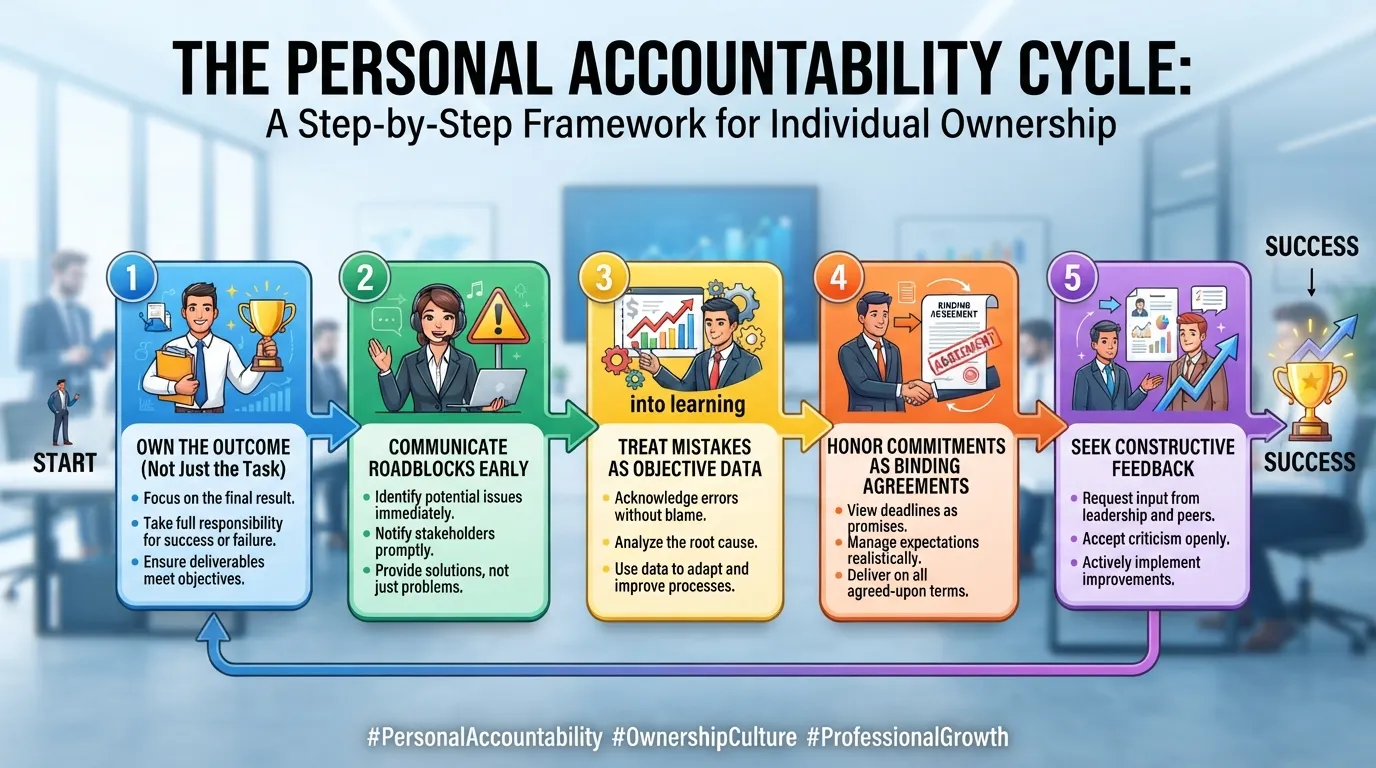
Personal accountability is the intentional practice of taking complete ownership of your work, decisions, and professional outcomes without blaming external circumstances. Cultivating an ownership mindset empowers employees to steer their career trajectory, build profound trust with leadership, and transform workplace challenges into growth opportunities.
Step-by-Step Breakdown for Employees
Adopting self-accountability requires a systematic approach to daily execution, turning passive task completion into active professional stewardship.
Step 1: Own the Outcome, Not Just the Task: Shift your focus from simply finishing a checklist to delivering the actual strategic result the business needs.
Step 2: Proactively Communicate Roadblocks: Raise a flag the moment you encounter a blocker rather than waiting for a deadline to pass silently.
Step 3: Treat Mistakes as Data: Acknowledge errors immediately, analyze the root cause objectively, and propose a corrective solution.
Step 4: Honor Your Commitments: Treat every professional promise—whether to a manager, peer, or client—as a binding agreement.
Step 5: Seek Constructive Feedback: Actively ask supervisors for specific areas of improvement to continuously elevate your performance standards.
How Managers Can Reinforce Each Step
Leaders play a critical role in nurturing individual ownership by providing the structural support and psychological safety necessary for employees to thrive.
Support Outcome Ownership: Guide team members to focus on end goals while giving them autonomy over their daily execution methods.
Create Open Communication Channels: Build a judgment-free environment where reporting a roadblock early is met with coaching instead of criticism.
Reframe Failure Constructively: Use missteps as teaching moments during one-on-ones to normalize problem-solving over blame.
Establish Clear Commitments: Collaborate with employees to co-create realistic, agreed-upon timelines rather than imposing rigid top-down deadlines.
Deliver Timely, Specific Feedback: Provide regular positive reinforcement and course-correction metrics so employees always know where they stand.
Dealing With Employees Who Don't Listen
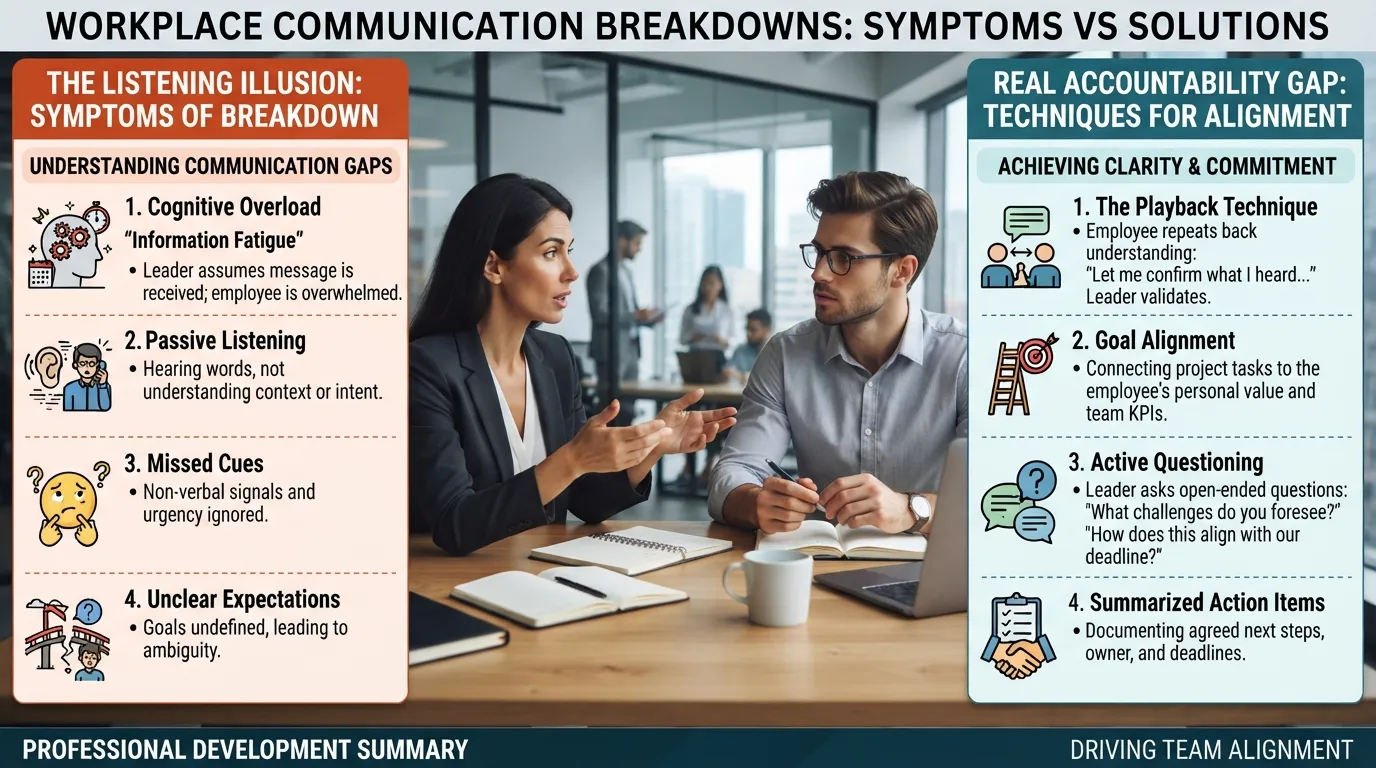
When instructions are repeatedly misunderstood or ignored, leaders often assume the core issue is poor listening. In most cases, however, a communication breakdown is actually a symptom of deeper structural or motivational misalignment within the team.
Is It a Listening Problem or an Accountability Problem?
Distinguishing between a failure to hear instructions and a failure to take ownership prevents leaders from applying the wrong fix to a performance issue.
The Listening Illusion: Assuming employees heard and understood a directive simply because it was spoken during a meeting or written in an email.
The Accountability Gap: When employees understand the expectation perfectly well but choose to disengage because they lack buy-in or fear the outcome.
Cognitive Overload: Employees often stop “listening” when they are overwhelmed by competing priorities, vague directions, or constant micromanagement.
Practical Techniques to Get Buy-In
Securing genuine attention and cooperation requires moving away from passive broadcasting and shifting toward interactive, two-way communication models.
The Playback Technique: Ask the employee to summarize the assignment and timeline back to you in their own words before ending the conversation.
Tie Goals to Personal Value: Connect the task directly to their professional goals, skill development, or daily operational ease to capture genuine interest.
Minimize Distractions: Conduct alignment discussions in focused, dedicated settings rather than giving drive-by instructions in hallways or via hurried chat messages.
Red Flags in a Manager (The Reverse Accountability Check)
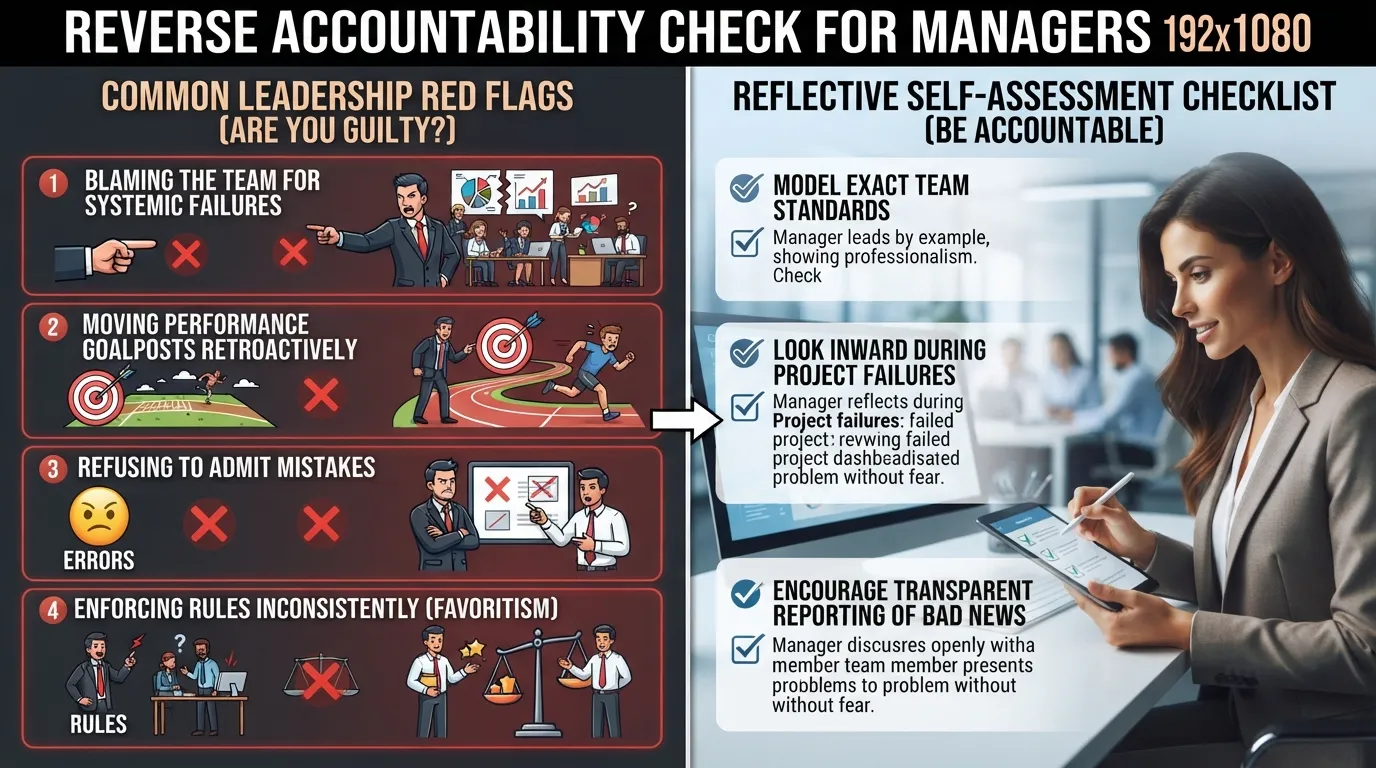
Accountability in the workplace is a two-way street that starts at the top. When leaders demand ownership from their teams while deflecting blame or failing to follow through themselves, organizational trust collapses. Conducting a reverse accountability check allows managers to evaluate their own behavior and eliminate toxic leadership habits.
Signs a Manager Is Failing at Accountability
Managers who struggle to hold themselves accountable often create an environment of fear, resentment, and double standards. Recognizing these red flags is the first step toward building genuine credibility.
Blaming the Team for Systemic Failures: Pointing fingers at employees when a project fails due to poor planning, vague directions, or a lack of resources destroys psychological safety.
Moving the Goalposts: Changing performance benchmarks or deadlines retroactively when initial projections prove inaccurate, leaving employees feeling set up for failure.
Refusing to Admit Mistakes: Doubling down on poor decisions rather than admitting an error or apologizing to the team for missteps.
Inconsistent Enforcement: Applying rules, deadlines, and policies selectively based on personal favoritism rather than objective organizational standards.
Self-Check Questions for Leaders
True leadership requires rigorous self-awareness and a willingness to examine how your personal habits impact team performance and morale. Ask yourself these critical questions regularly to maintain operational integrity:
“Do I model the exact standards I demand from my team?” Evaluate whether your punctuality, work quality, and communication norms match what you expect of your subordinates.
“When a project misses its mark, do I look inward first?” Assess whether your immediate reaction is to examine your role in providing clarity and support before questioning employee effort.
“Do team members feel safe bringing me bad news?” Determine whether your past reactions encourage transparent reporting or drive employees to hide blockers and mistakes out of fear.
“Am I consistent with my follow-through?” Check if you honor your commitments to your team with the same rigor you expect them to apply to their deliverables.
Building a Culture of Team-Wide Accountability

Sustainable accountability extends far beyond isolated manager-employee interactions, forming the foundational culture of a high-performing organization. According to workplace research from Gallup, organizations with strong engagement and clear operational expectations experience up to 23% higher profitability and significantly lower turnover. Building this environment requires shifting accountability from a top-down mandate to a shared team value.
Peer Accountability: Why It Works
When accountability relies exclusively on management surveillance, teams become dependent and fragile. True cultural maturity occurs when peers feel empowered to hold one another to high performance standards.
Self-Regulating Norms: Teams that co-create their operating standards naturally correct offside behavior before it requires executive intervention.
Increased Speed of Execution: Peer-to-peer accountability eliminates bottlenecks caused by waiting for management to review every minor misstep or missed deadline.
Stronger Collective Trust: Holding each other accountable fosters deep mutual respect, as team members realize everyone shares an equal commitment to excellence.
Recognizing and Reinforcing Accountable Behavior
Accountability must be actively reinforced through positive recognition, ensuring that owning mistakes and delivering results are publicly valued.
Highlight Ownership Publicly: Praise team members during meetings not just for hitting targets, but for proactively raising blockers or fixing systemic errors.
Tie Recognition to Core Values: Connect exemplary accountability directly to organizational goals to demonstrate how individual ownership drives collective success.
Celebrate Smart Risk-Taking: Reward employees who take ownership of bold initiatives, even if the initial outcome requires iterative troubleshooting.
Why Leaders Must Model It First
Culture is caught, not taught. Leaders cannot successfully demand accountability from their teams if they operate under a separate set of rules.
Own Your Missteps Publicly: When a project fails due to strategic oversight, admit your error transparently to normalize accountability across the board.
Honor Commitments Rigorously: Follow through on your promises to your team with the exact discipline you expect from them.
Maintain Consistent Standards: Apply policies, deadlines, and performance expectations evenly without showing favoritism or moving goalposts.
Frequently Asked Questions
Addressing common questions about workplace accountability provides quick, authoritative answers that satisfy search engine intent and help readers apply these strategies immediately.
What is it called when you hold people accountable?
Holding people accountable is commonly referred to as ownership management, performance stewardship, or result-oriented leadership. In modern organizational psychology, it is often described as fostering a culture of psychological ownership, where employees willingly embrace the consequences and outcomes of their decisions rather than complying purely out of fear.
What is the best way to hold staff accountable?
The most effective approach combines absolute clarity of expectations with dignity-based coaching. Instead of treating accountability as a punitive measure, successful leaders co-create realistic milestones, establish open communication channels, and focus corrective discussions on objective behaviors rather than personal traits.
How often should you follow up on accountability commitments?
Follow-up cadence should match the complexity of the project and the experience level of the employee, but recurring weekly or bi-weekly 1-on-1 meetings serve as the ideal baseline. Consistent, predictable check-ins ensure that potential roadblocks are caught early without slipping into the trap of daily micromanagement.
When does accountability become a disciplinary issue?
Accountability transitions from a coaching opportunity into a disciplinary or termination issue when an employee willfully refuses to meet core responsibilities despite receiving clear expectations, necessary resources, and documented feedback over time. If recurring performance gaps remain unaddressed after structured support and targeted remediation plans fail, formal HR action becomes necessary to protect team morale.
Key Takeaways / Conclusion
Effective workplace accountability is not about policing mistakes or enforcing compliance through fear; it is a foundational leadership practice built on clarity, trust, and mutual ownership. By shifting focus from micro-controlling processes to empowering outcome ownership, leaders can build resilient teams that thrive on high performance and psychological safety.
Quick-Reference Accountability Checklist
Use this actionable summary to audit your leadership approach and ensure sustainable accountability across your organization.
Establish Absolute Clarity: Define clear expectations, key performance indicators, and deliverables from day one.
Secure Mutual Commitment: Transform top-down task assignments into collaborative commitments by aligning on realistic timelines.
Maintain Consistent Check-Ins: Use recurring 1-on-1 meetings to track milestones, catch blockers early, and offer real-time support.
Focus on Behavior, Not Personality: Ground all corrective feedback in objective metrics and systemic context rather than emotional frustration.
Model the Standard First: Hold yourself to the exact same rigor, transparency, and follow-through that you expect from your team.