Army Discipline: Meaning, Core Rules, and Real-World Leadership
What Is Army Discipline?
Army Discipline Definition (Simple, Direct Answer)
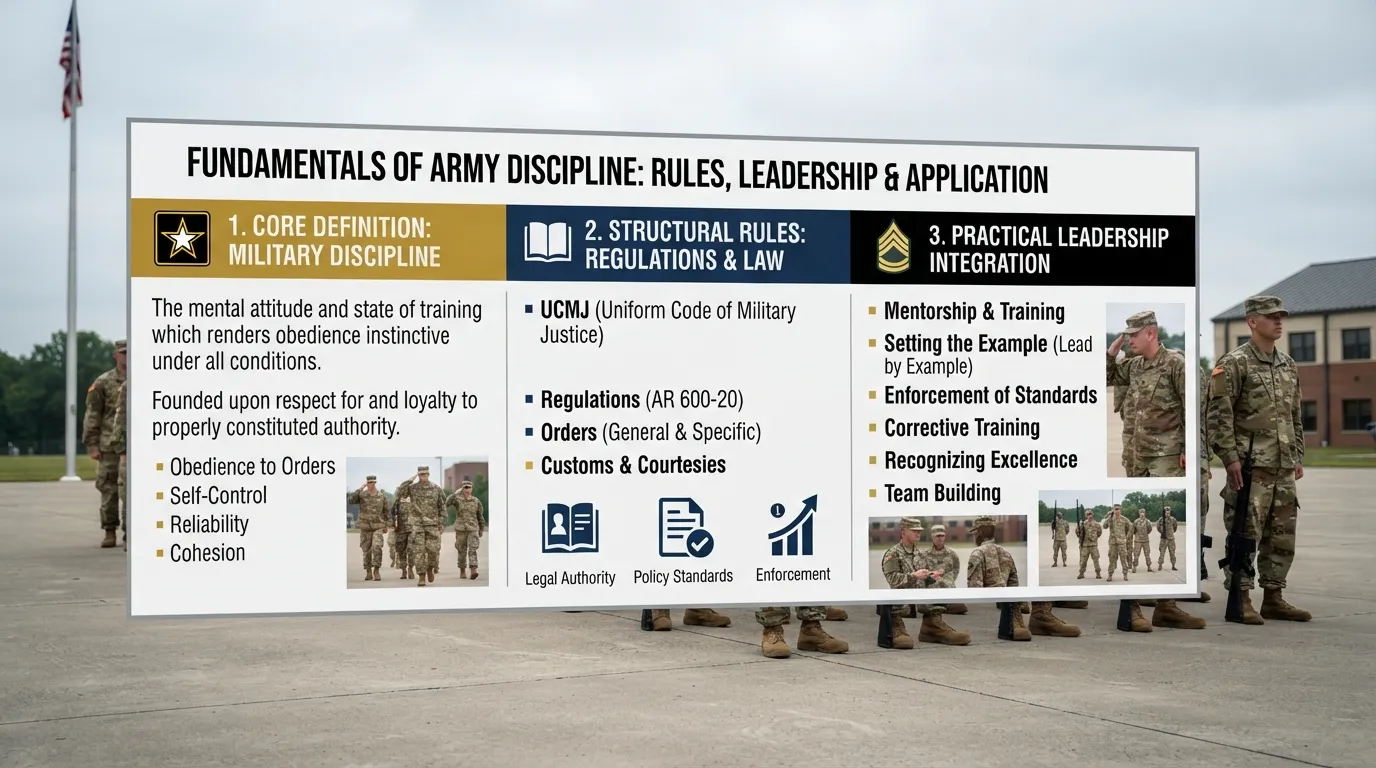
Army discipline—often referred to as military discipline—is the foundational state of order, obedience, and self-control instilled within soldiers. It is not merely about punishment or blind compliance; rather, it represents a dedicated commitment to unit readiness, mission accomplishment, and professional standards. True military discipline is best described as “doing right when no one is watching,” ensuring that service members consistently execute their duties with integrity, precision, and mutual trust.
Discipline vs. Obedience — What’s the Real Difference?
While often used interchangeably, discipline and obedience serve distinct functions within a military force:
Obedience is the prompt and proper execution of lawful orders issued by a superior. It is reactive, structural, and essential for immediate coordination during operations.
Discipline goes deeper; it is proactive and internal. While obedience relies on external command, discipline relies on self-control and internalized core values.
A soldier can show temporary obedience out of fear of punishment, but order and obedience sustained under extreme pressure stem from genuine, deeply ingrained discipline.
Key Takeaway: Obedience follows the rules of the chain of command, but discipline ensures that a soldier maintains standards, protects their peers, and executes missions correctly even in the complete absence of leadership.
The Core Purpose of Military Discipline
Building Trust and Teamwork Within a Unit
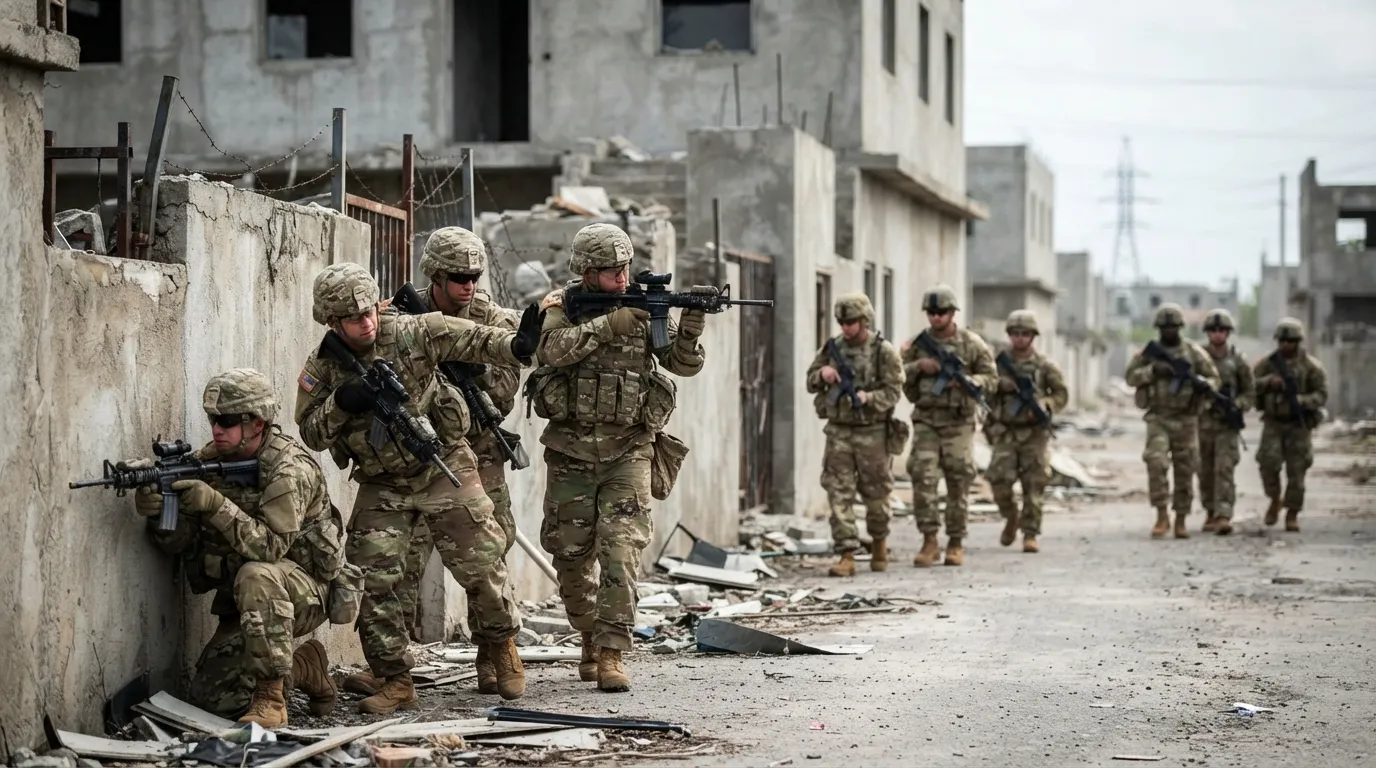
Military discipline is the bedrock of unit trust and operational cohesion. In high-stakes environments, soldiers must rely entirely on the person standing to their left and right. Teamwork is forged when every member adheres to the same rigorous standards, ensuring predictable, reliable behavior across the entire formation. This shared discipline transforms a collection of individuals into a synchronized, high-performing team capable of executing complex maneuvers seamlessly.
From Routine to Combat — Why Small Habits Matter
Discipline is built long before a soldier ever sees a battlefield; it starts with the smallest, everyday routines.
Attention to Detail: Inspecting gear, maintaining equipment, and keeping quarters orderly build the neural pathways required for precision under pressure.
Habit Formation: When routine tasks—like weapon maintenance or communication checks—become second nature, they free up critical cognitive bandwidth for complex problem-solving.
Warfighting Readiness: These micro-habits directly translate to warfighting readiness, ensuring that systems don’t fail when the margin for error is zero.
The Role of Self-Control in High-Stress Situations
When chaos erupts, external controls often break down, leaving self-discipline as the ultimate safeguard. In high-stress scenarios and active combat, fear, fatigue, and confusion run high. Discipline provides soldiers with the vital self-control needed to manage emotional responses, override panic, and execute their training. It ensures adherence to the rules of engagement and maintains tactical focus when the instinct for self-preservation threatens to take over.
Would you like to examine how military leaders actively cultivate this level of discipline within their formations?
The 5 Points of Military Discipline
Point 1 – Obey First Before You Complain
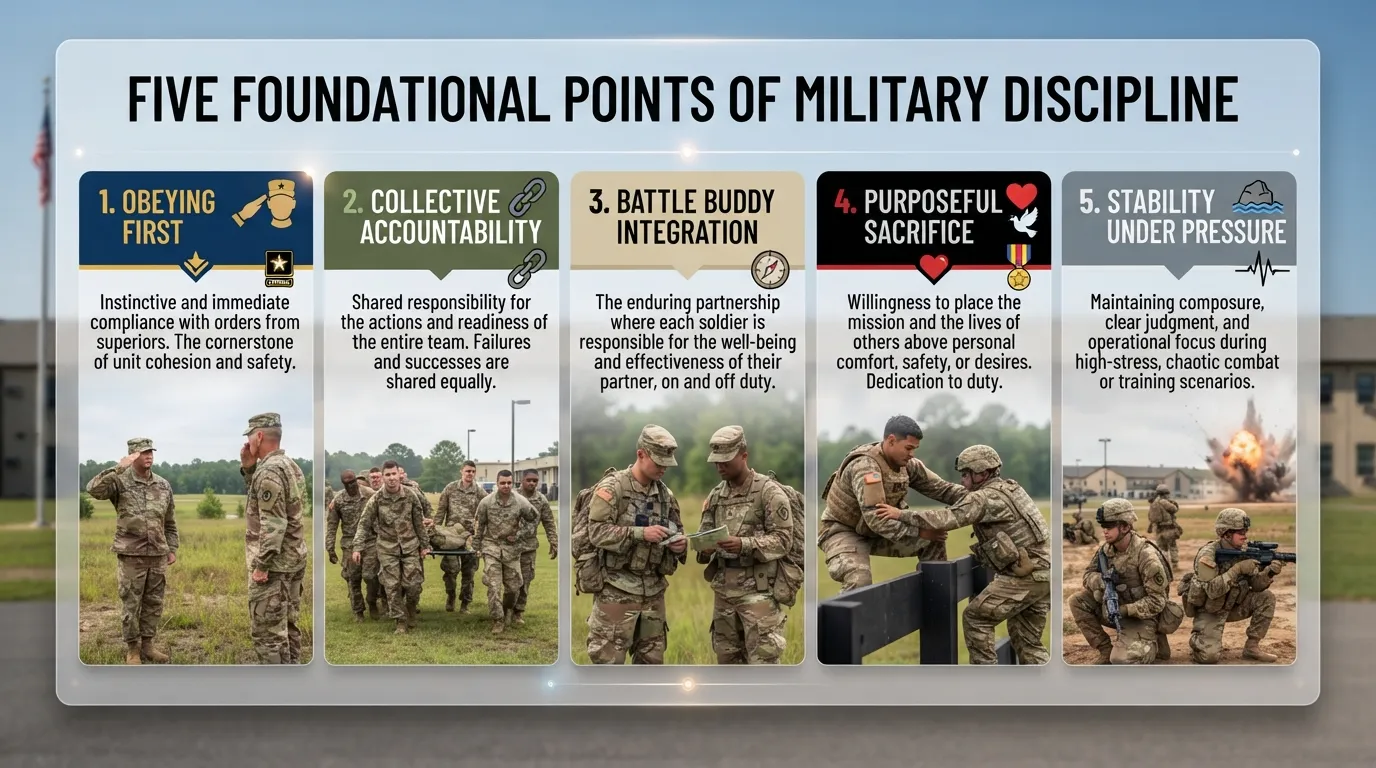
The first principle of the military discipline framework establishes that lawful orders must be executed promptly and efficiently before any grievances or feedback are voiced. In high-pressure operational environments, debating instructions in real time creates critical delays and risks lives. Compliance with the chain of command ensures that immediate objectives are met seamlessly, leaving structured channels (such as an open-door policy or chain-of-command feedback) for addressing concerns afterward.
Point 2 – The Fault of One Is the Fault of All
This tenet underscores collective responsibility and group accountability within a unit. Military organizations operate as unified systems rather than isolated individuals. If one soldier fails to maintain standards—whether through slack gear, missed details, or poor conduct—it degrades the operational capacity and reputation of the entire team. This principle reinforces mutual reliance and peer accountability.
Point 3 – My “Buddy” Is My Body
A core pillar of combat survivability is the absolute integration between a soldier and their peer. Every service member is trained to treat their battle buddy’s safety, well-being, and mission success as extensions of their own. This deep bond eliminates individualism in favor of collective survival, ensuring that no one is ever left behind on the battlefield.
Point 4 – If It Is Not for the Good of All, I Will Not Sacrifice Myself
True military sacrifice is calculated, purposeful, and directed toward the collective mission or the preservation of the unit. Individual actions must align with broader strategic goals rather than reckless bravado. This point ensures that every soldier’s energy, risk management, and tactical decisions serve the overarching objective and protect the force as a whole.
Point 5 – I Must Be Stable Even Under Pressure
Emotional and psychological composure under extreme duress separates a professional military force from a disorganized group. Soldiers face chaos, fatigue, and friction; maintaining internal stability allows them to process information rationally, suppress panic, and execute complex tactical maneuvers when stakes are at their highest.
What core area of military training or leadership would you like us to detail next?
The 4 Types of Discipline in the Military
Self-Discipline
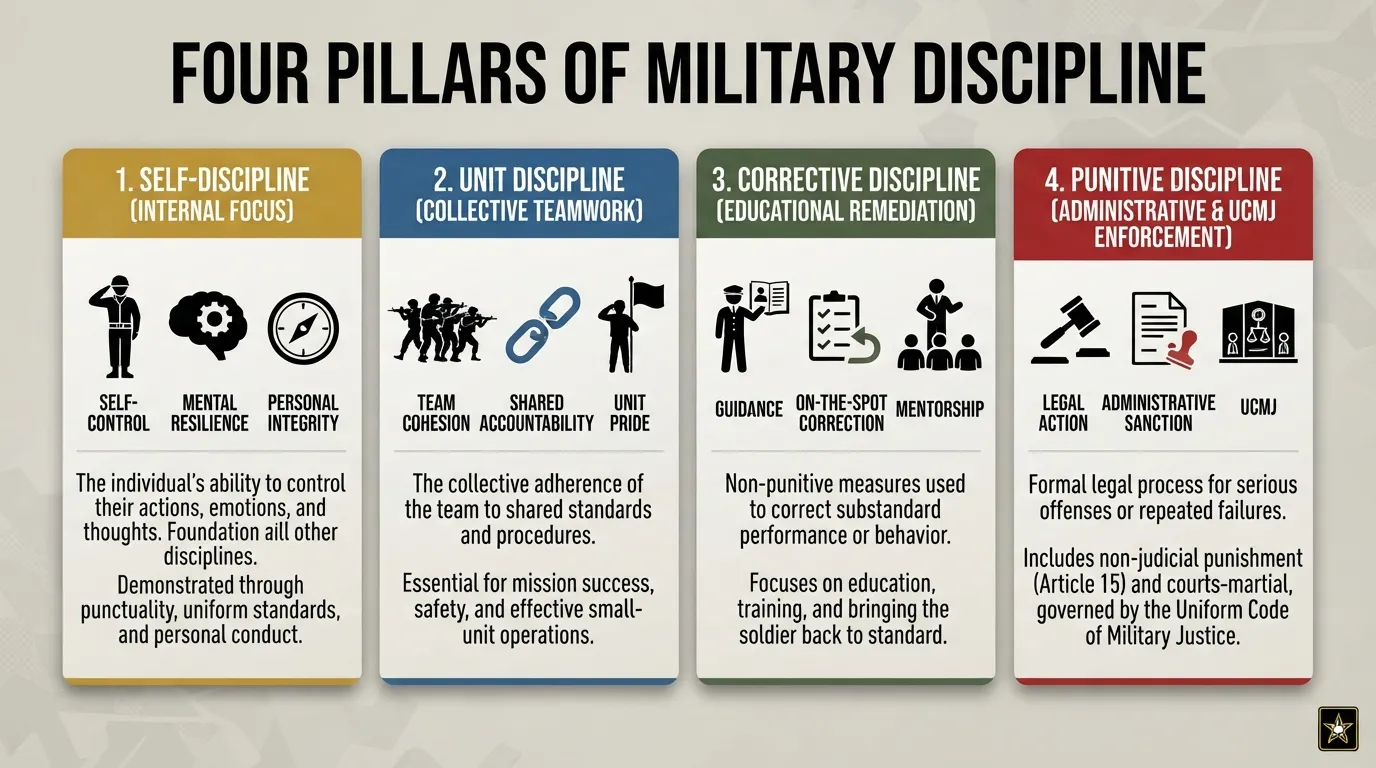
Self-discipline is considered the highest form of military order because it originates from within the individual. It represents a willing, internal sense of responsibility that drives a service member to execute duties correctly, set priorities, and maintain personal integrity without requiring external oversight. When external structures fail or communication breaks down in dynamic environments, self-discipline ensures that soldiers continue to make sound, ethical, and tactically sound decisions.
Unit/Team Discipline
Also referred to as group discipline, unit discipline reflects the collective behavior, synchronization, and mutual trust of a formation. It transforms a collection of independent service members into a cohesive team capable of executing complex maneuvers. This type of discipline relies on peer accountability, shared standards enforcement, and the unshakeable understanding that individual actions directly impact the safety and survival of the entire unit.
Corrective Discipline
Corrective discipline (often tied to corrective training) focuses on remediation and behavioral modification rather than punishment. When a soldier commits a minor infraction, lapses in attention to detail, or fails to meet a standard, leaders use targeted instruction, extra practice, or localized guidance to correct the deficiency. The primary goal is to educate the service member, reinforce professional expectations, and prevent future mistakes before they compromise operational readiness.
Punitive Discipline
Punitive discipline involves formal administrative or legal actions taken when minor corrective measures fail or when a service member commits serious violations of regulations or the Uniform Code of Military Justice (UCMJ). This category includes formal reprimands, restriction, reduction in rank, forfeiture of pay, or trial by court-martial. Punitive action serves to maintain the overall integrity of the force, deter future misconduct across the command, and uphold public accountability.
Would you like to explore how military leaders balance corrective training with punitive measures in modern units?
How Discipline Is Enforced and Maintained
Maintaining operational readiness across a military force requires a continuous cycle of teaching, monitoring, and accountable enforcement. As highlighted by military leadership, discipline is not simply about reactive punishment; rather, it is sustained through active mentorship, clear benchmarks, and structured legal frameworks.
The Role of NCOs in Guarding Standards
Noncommissioned officers (NCOs) serve as the backbone of military discipline. Often called the standard-bearers of the force, NCOs are responsible for daily coaching, mentorship, and inspections. They ensure that every soldier understands that “a standard passed over is a new standard set”, meaning that overlooking even a minor discrepancy degrades the entire unit’s baseline. Through continuous guidance, NCOs bridge the gap between abstract regulations and practical, everyday execution.
Corrective Training and Administrative Actions (Minor Infractions)
When minor lapses occur—such as uniform discrepancies or missed details—leaders rely on localized administrative measures rather than heavy legal punishment. Corrective training is designed to educate rather than penalize, focusing on extra repetition of a task to fix a specific deficiency. Additional administrative tools, such as formal counseling statements or extra duties, help correct behavior early before small habits compound into major operational risks.
Article 15 – Nonjudicial Punishment Explained Simply
When minor infractions persist or standard corrective measures are insufficient, commanders utilize Article 15 of the Uniform Code of Military Justice (often referenced through resources like the UCMJ legal framework). Also known as nonjudicial punishment (NJP), Article 15 allows a commanding officer to resolve disciplinary offenses without a formal trial by court-martial. Punishments under an Article 15 can include extra duty, restriction to specified areas, correctional custody, forfeiture of pay, or reduction in rank, serving as a swift mechanism to maintain good order.
Courts-Martial – When Discipline Becomes a Legal Matter
For major offenses, serious breaches of regulations, or violations of federal military law, discipline transitions into a formal judicial process via courts-martial. A court-martial is a military court designed to try service members for serious criminal offenses. Divided into summary, special, and general courts-martial depending on the severity of the charge, this system guarantees due process while safeguarding the supreme legal standards, security, and integrity of the armed forces.
The 7 Army Core Values and Their Link to Discipline
Listing the 7 Core Values (LDRSHIP)
The foundational ethical standard of the U.S. Army is built upon seven core values, collectively remembered by the acronym LDRSHIP. These values serve as the moral compass for every soldier and civilian within the profession:
Loyalty: Bear true faith and allegiance to the U.S. Constitution, the Army, your unit, and other soldiers.
Duty: Fulfill your obligations, taking responsibility for your actions and completing tasks to the best of your ability.
Respect: Treat people as they should be treated and foster a culture of dignity and inclusion.
Selfless Service: Put the welfare of the nation, the Army, and your subordinates before your own.
Honor: Live up to all the Army values, maintaining moral rectitude in every action.
Integrity: Do what is right, legally and morally, regardless of who is watching or the pressures involved.
Personal Courage: Face fear, danger, or adversity (physical and moral) head-on.
How Each Value Reinforces Discipline
True military discipline cannot exist in a vacuum; it is entirely sustained and energized by the army core values:
Loyalty and Selfless Service reinforce unit discipline, ensuring that a soldier values collective safety and mission success over personal comfort.
Duty and Integrity form the backbone of self-discipline, driving the internal commitment to maintain standards and execute tasks accurately when unobserved.
Respect stabilizes the chain of command, guaranteeing that authority is executed and followed with mutual dignity.
Honor and Personal Courage provide the mental fortitude required for the hardest form of discipline: choosing the difficult right over the easy wrong under extreme pressure.
Daily Habits That Build Military Discipline
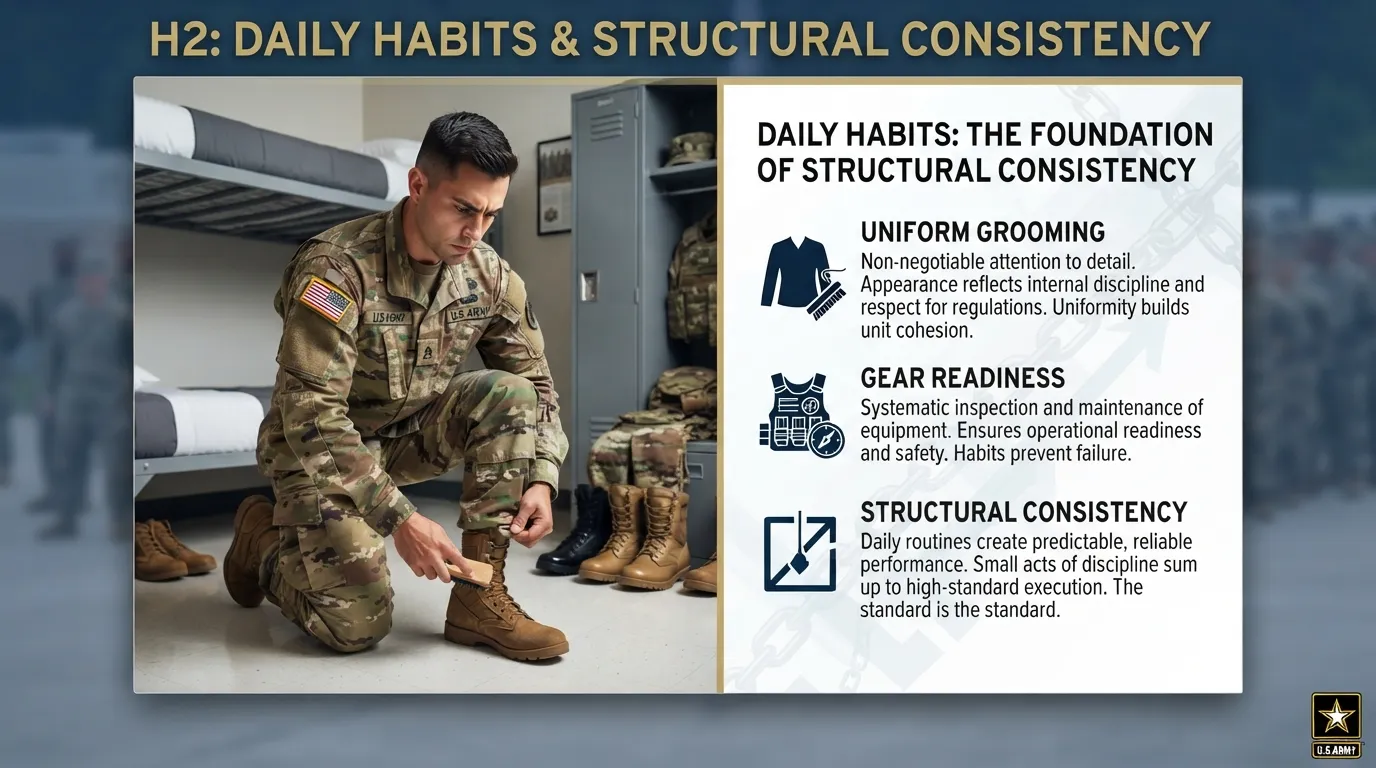
Uniform Standards and Why They Matter
In a military environment, the daily routine begins with uniform wear, a foundational practice that goes far beyond mere appearance. Meticulous grooming, crisp creases, and properly aligned insignia serve as external reflections of an internal commitment to order. When soldiers take pride in their uniforms, it establishes a shared baseline of accountability. This constant attention to detail trains the mind to notice and correct minor discrepancies, reinforcing the neurological pathways required to handle high-stakes operational tasks with absolute precision.
Punctuality as a Discipline Foundation
Punctuality in the military is treated as an absolute moral and professional obligation. Being “early is on time, and on time is late” is more than a cliché; it is a vital operational principle. Arriving early for formations, briefings, and movements demonstrates profound respect for fellow service members and ensures seamless coordination. Cultivating this daily habit eliminates friction, prevents costly delays, and instills the reliability required when execution windows in the field are measured in seconds.
Saluting and Respect for Rank
The military salute is a time-honored exchange of mutual respect and pride between junior and senior personnel, rather than a gesture of servility. Maintaining proper saluting protocols and adherence to customs and courtesies reinforces the chain of command every single day. This visible acknowledgment of rank and authority keeps the organization grounded, ensuring that respect for structure remains second nature so that command and control operate flawlessly under pressure.
How Disciplined Are Different Military Branches? (Quick Comparison)
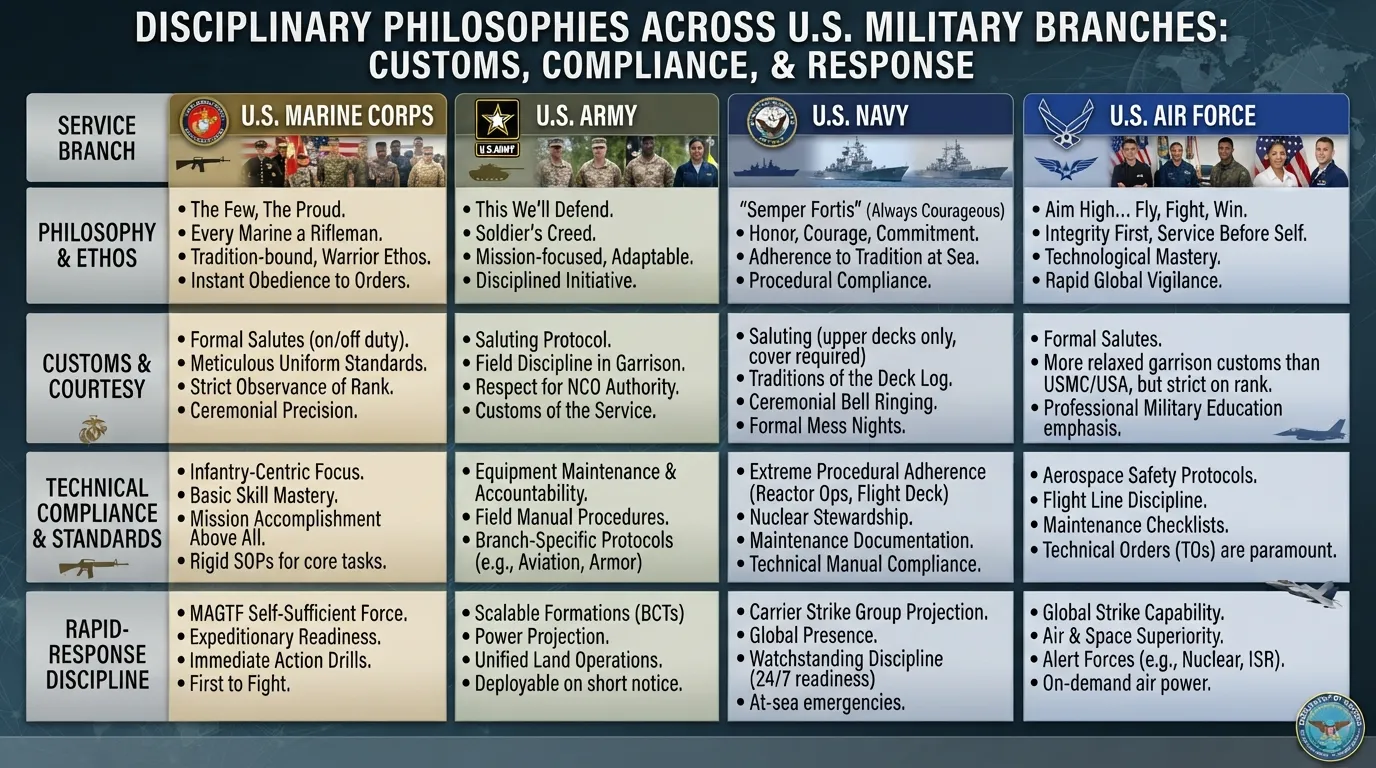
Which Military Branch Is Considered Most Disciplined?
While public perception often associates strictness with specific branches like the Marine Corps, the reality is that discipline comparison across the U.S. armed forces reveals different organizational cultures rather than differing levels of baseline professionalism. Every branch maintains exceptionally high standards, but they cultivate them through distinct operational philosophies:
The Marine Corps emphasizes traditional, hyper-visible adherence to customs, courtesies, and razor-sharp uniformity as direct reflections of combat readiness.
The Army focuses heavily on large-scale tactical synchronization, empowering noncommissioned officers to enforce standards across vast and diverse occupational specialties.
The Navy and Air Force heavily prioritize technical competence, procedural compliance, and individual accountability, given the extreme complexity of operating multi-million-dollar aviation, naval, and cyber assets.
Marines vs. Army — Is One Tougher Than the Other?
The question of whether the Marines or the Army is the toughest branch is a frequent point of debate, but it fundamentally misunderstands how these forces operate.
The Marine Corps functions as a rapid-response expeditionary force, instilling a deep-seated warrior ethos and intense cultural uniformity from day one of recruit training.
The Army is a massive, multifaceted land force designed for sustained, large-scale combat operations across diverse global environments, requiring decentralized leadership and extensive technical specialization.
Key Takeaway: Neither branch is objectively “more disciplined” than the other. Instead, their unique manifestations of discipline reflect their specific strategic missions—the Marine Corps excels in rapid, culturally unified amphibious assaults, while the Army thrives in sustained, complex multi-domain land campaigns.
How to Build Self-Discipline Like the Military (Practical Guide)

Start With Small, Non-Negotiable Routines
True self-discipline is not forged overnight through grand, sweeping resolutions; it is built the exact way the military trains its recruits—through micro-habits. Begin your daily routine by establishing a few non-negotiable anchor tasks that you execute every single day, regardless of how you feel. Whether it is waking up at an exact time, making your bed instantly, or completing a 15-minute physical workout, treating these small actions as absolute commands trains your brain to override friction and resistance.
Apply the “Discipline Equals Freedom” Mindset
Adopt the core military mindset that structure creates autonomy rather than restricting it. When you impose rigid rules on your schedule—such as dedicated work blocks, strict sleep hygiene, or planned meal prep—you eliminate decision fatigue and chaos. By mastering your daily schedule through proactive discipline, you free up the mental bandwidth, time, and security needed to pursue creative and personal goals without feeling overwhelmed.
Track Consistency, Not Perfection
In any rigorous training environment, long-term success relies on relentless consistency rather than flawless execution. When building new habits, accept that you will encounter setbacks, distractions, or low-motivation days. Instead of letting a single missed workout or broken routine derail your progress, focus on showing up day after day. Tracking your streak and evaluating your baseline habits over weeks and months creates the steady momentum required to sustain elite personal discipline.
Applying Military Discipline to Work and Leadership

Why Leaders Study Military Discipline
High-performing executives, entrepreneurs, and organizational managers frequently study military discipline because it represents the ultimate framework for executing complex objectives under pressure. In a corporate or professional setting, discipline is not about micromanagement or imposing fear; it is about creating alignment, reducing operational friction, and establishing a predictable standard of excellence. Leaders look to military models because they prove that when a team shares a unified standard, individual initiative thrives and organizational goals are met consistently.
Turning Military Standards Into Workplace Accountability
Translating military accountability into the civilian workplace requires replacing vague expectations with measurable, observable, and achievable standards. Much like the military uses codified regulations and NCO oversight to maintain clarity, effective civilian leaders establish transparent benchmarks for performance, project delivery, and communication.
Define Clear Left and Right Limits: Just as troops operate safely within defined training boundaries, teams need explicit operational parameters to understand their autonomy and responsibilities.
Eliminate Ambiguity: Vague feedback breeds confusion. Clear standards ensure that every team member knows precisely what “done right” looks like.
Embrace Early Correction: Addressing minor performance slips immediately prevents them from compounding into major systemic failures or cultural bottlenecks.
Building a Disciplined Team Culture (Without Being a Drill Sergeant)
Cultivating workplace discipline does not require adopting a harsh, top-down authoritative persona. Sustainable team culture is built on mutual trust, shared values, and empathetic leadership. Leaders can foster professional discipline organically by modeling the behaviors they expect, empowering team members to take ownership of their roles, and prioritizing mentorship over punishment. When employees understand the “why” behind organizational standards and feel genuinely supported by their leadership, discipline transforms from a mandatory rule into a shared, collective pride.
Real-World Example / Case Study
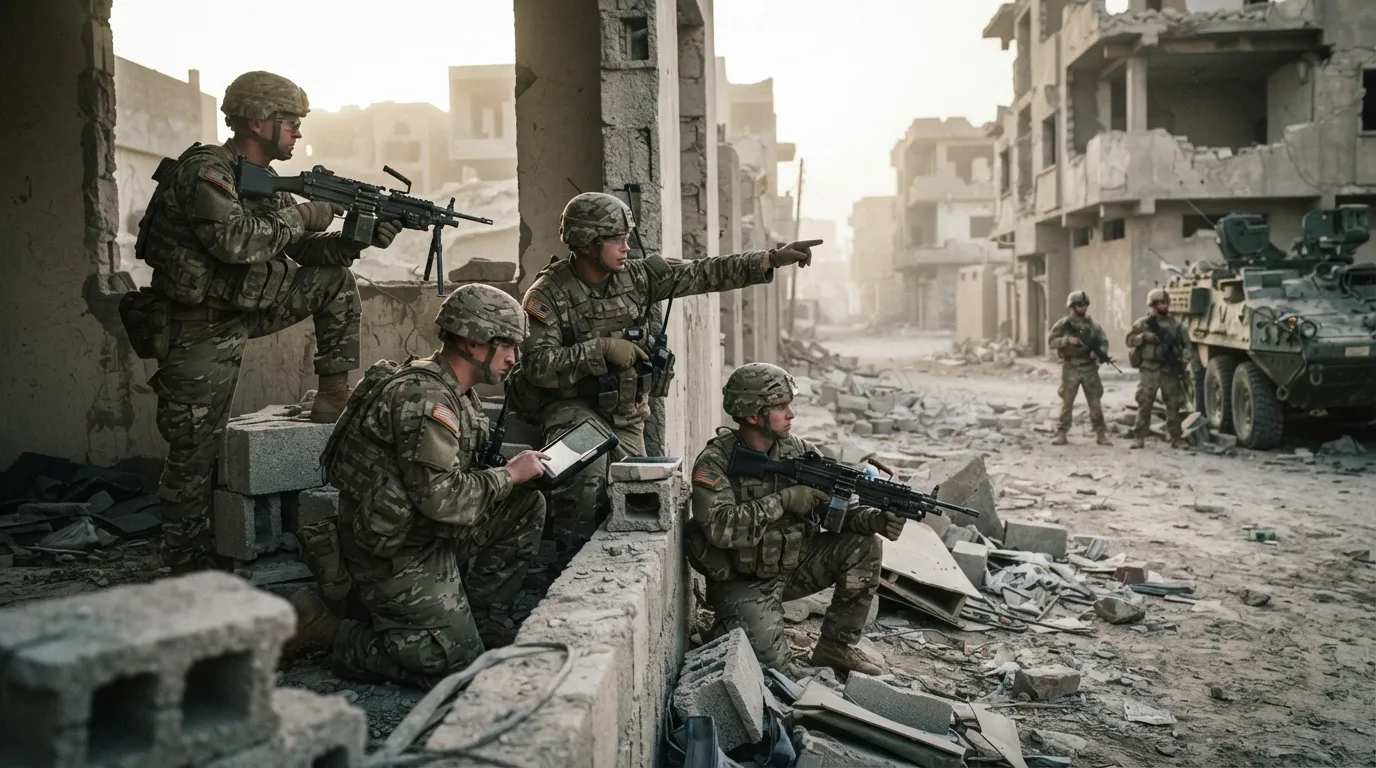
Case Study — Discipline in Action
A classic real-world demonstration of military discipline and standards operating under extreme pressure occurred during the Battle of COP Keating (Combat Outpost Keating) in Afghanistan. Manned by a drastically outnumbered troop of U.S. soldiers, the remote outpost faced a coordinated, pre-dawn attack by hundreds of insurgent fighters.
In the opening minutes of the assault, the base suffered devastating mortar and rocket-propelled grenade fire, destroying critical communications equipment, setting structures ablaze, and wounding key leadership. In a chaotic environment where the instinct for survival easily threatens to fracture an organization, the soldiers did not break. Relying entirely on their rigorous training, internalized self-discipline, and mutual trust, junior soldiers and surviving noncommissioned officers stepped into leadership vacuums. They calmly coordinated defensive fires, managed ammunition redistribution across burning compounds, and directed medical evacuations under intense, continuous fire. The disciplined adherence to their tactical drills and their commitment to their battle buddies prevented the complete overrun of the position and enabled the unit to ultimately repel the assault.
Key Takeaways From the Example
This high-stakes case study provides profound lessons in real-world application and organizational leadership that extend far beyond the battlefield:
Training Overrides Chaos: When a crisis hits, you do not rise to the occasion; you sink to the level of your training. Routine drills and micro-habits practiced in peacetime become the automatic reflex during a crisis.
Decentralized Execution: True discipline empowers individuals at every level. Because junior personnel were thoroughly trained in the unit’s standards, they could take decisive, autonomous action when the chain of command was temporarily disrupted.
The Power of Collective Accountability: The refusal of the soldiers to abandon their peers or their post highlights how deep-seated unit discipline transforms a group into an unbreakable team.
Key Takeaway: Whether applied in a combat outpost or a high-pressure corporate boardroom, elite discipline ensures that calm, systematic execution replaces panic when circumstances become most volatile.
Frequently Asked Questions (FAQ)
Why is discipline important in the military?
Discipline is essential because it forms the bedrock of warfighting readiness, operational safety, and unit trust. In high-stress or combat scenarios, external controls often fail. Rigorous discipline and shared standards ensure that soldiers maintain their composure, execute their tactical training, protect their peers, and successfully accomplish the mission despite extreme adversity.
What is the weakest U.S. military branch?
No branch of the U.S. military is considered “weak,” as each is designed for a completely distinct domain of warfare and possesses specialized capabilities. The Army handles land dominance, the Navy controls maritime operations, the Air Force manages air and cyber dominance, the Marine Corps acts as a rapid-response expeditionary force, the Coast Guard secures maritime borders, and the Space Force protects orbital assets. Their relative strengths depend entirely on the specific strategic objective.
What is the most feared military branch?
Public and global perception often associates the U.S. Marine Corps or U.S. Special Operations Forces (such as Army Rangers or Navy SEALs) with the highest levels of intimidation due to their intense psychological conditioning, rigorous physical standards, and rapid-deployment combat roles. However, adversaries evaluate the U.S. military as a joint force, where the combined lethal capabilities of all branches create an overwhelming deterrent.
Do people who join the military regret their decision?
Like any major career path, experiences vary widely. While some veterans report challenges related to physical injuries, long deployments, or the difficult transition back to civilian life, many others report that military service provided invaluable career skills, lifelong camaraderie, financial stability, education benefits, and personal growth that positively shaped their futures.
If military discipline is so effective, why isn’t it used in family, school, or office life?
Aspects of military discipline—such as punctuality, accountability, and clear standards—are widely used in schools, homes, and offices. However, a strict, top-down military model relies on unique legal structures (like the UCMJ) and life-or-death stakes that do not translate neatly into civilian settings. Modern civilian leadership and parenting generally prioritize collaborative problem-solving, autonomy, and psychological safety over rigid command-and-control enforcement to foster creativity and long-term engagement.
Conclusion
Key Takeaways
Army discipline and military discipline extend far beyond the parade grounds or the battlefield; they represent a comprehensive framework for achieving excellence under pressure. Across this guide, we have explored how foundational standards, shared core values, and structured accountability transform a group of individuals into a synchronized, high-performing team.
Whether examining the rigorous daily habits of a soldier, the protective structures of the chain of command, or the real-world applications of workplace leadership and personal self-discipline, the underlying truth remains constant: true discipline is not about fear or blind obedience. It is about building trust, honoring commitments, and mastering the internal fortitude to do what is right when no one is watching. By integrating these principles into your daily routines and professional leadership, you can foster clarity, eliminate friction, and drive sustainable success in any environment.