Code of Professionalism: Complete Guide to Principles, Standards & Ethics
What Is a Code of Professionalism?
Definition of a Code of Professionalism
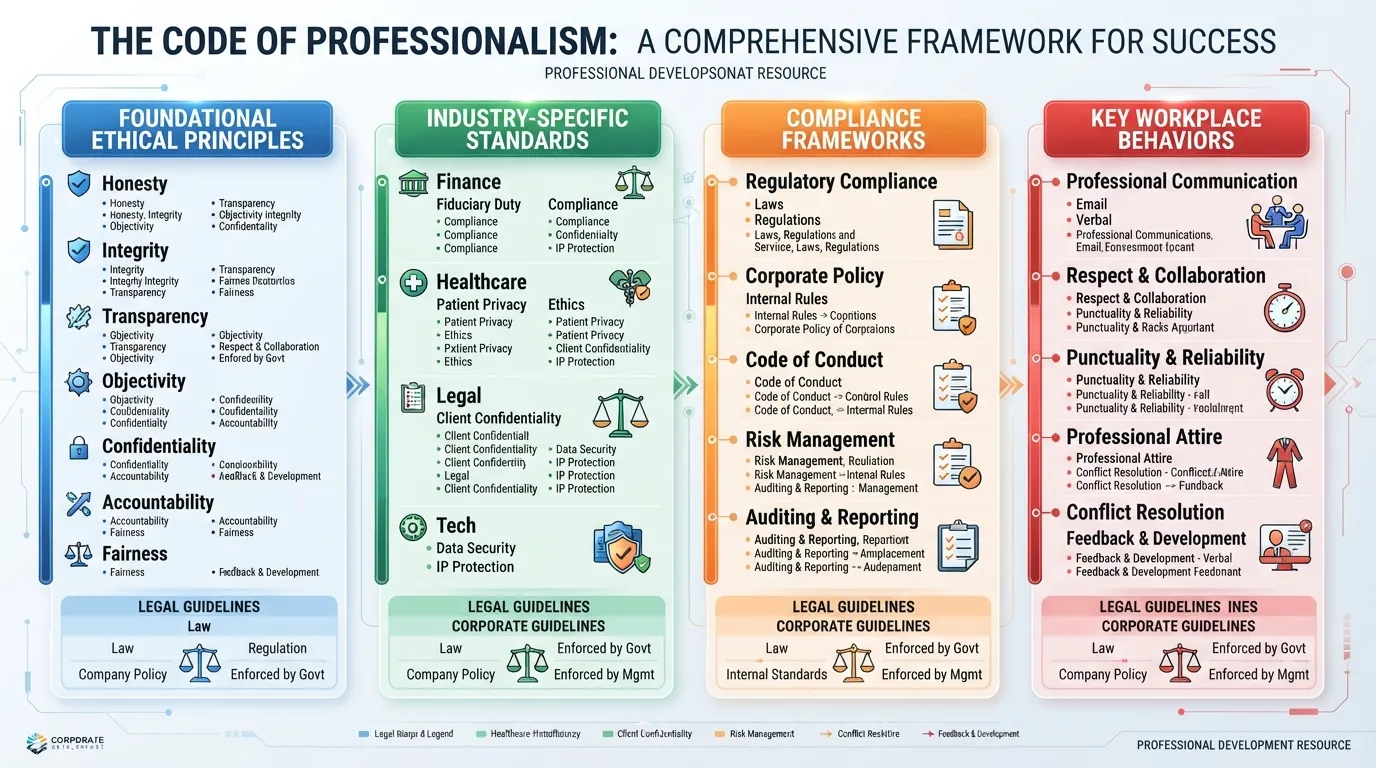
A code of professionalism functions as an authoritative framework of ethical principles and behavioral standards designed to regulate professional behavior within a specific field or organization. It establishes clear expectations for practitioners, bridging abstract moral concepts with everyday operational decisions to protect clients, stakeholders, and the public interest.
Why Every Profession Needs One
A formal professional standard is essential for maintaining public trust, ensuring accountability, and providing reliable benchmarks for conduct.
Trust and Credibility: Assures clients and the general public that practitioners adhere to rigorous ethical and competence standards.
Risk Mitigation: Offers explicit guidelines to navigate complex scenarios, reducing liability and preventing professional malpractice.
Internal Consistency: Harmonizes rules and standards across an organization, aligning employee actions with core corporate values.
Code of Professionalism vs. Code of Conduct vs. Code of Ethics
While these terms are frequently used interchangeably, they represent distinct tiers of professional regulation and governance.
Code of Professionalism: A broad framework encompassing overall demeanor, attitude, accountability, and the broader cultural obligations of a practitioner within an industry.
Code of Conduct: A granular set of operational rules and prohibitions outlining specific do’s and don’ts for daily workplace interactions and compliance.
Code of Ethics: A foundational, values-driven document detailing the fundamental moral commitments, philosophical principles, and obligations owed to society and stakeholders.
What is the Professional Code of Ethics?
Watch this video to learn more about how a professional code of ethics works in practice to encourage moral conduct and protect stakeholders.
Purpose and Importance of a Code of Professionalism
Protecting the Public and Building Trust
A code of professionalism acts as an essential safeguard for consumers, clients, and society by establishing mandatory benchmarks for competence and integrity. When practitioners commit to these standards, it bridges the gap of information asymmetry, assuring individuals that services delivered will be safe, ethical, and reliable.
Consumer Protection: Shields vulnerable clients from exploitation, negligence, and substandard practices.
Credibility Anchor: Fosters long-term confidence between practitioners and the communities they serve.
Accountability Standard: Gives consumers a clear recourse mechanism when professional misconduct occurs.
Guiding Ethical and Legal Decision-Making
These frameworks provide practical guidance when professionals encounter complex moral dilemmas or regulatory ambiguity in their daily workflows. By converting abstract ethical decision-making into actionable criteria, the code empowers practitioners to evaluate options objectively and uphold professional responsibility.
Moral Clarity: Offers structured evaluation steps during high-stakes or conflicting situations.
Regulatory Alignment: Bridges internal company policies with broader statutory and legal mandates.
Consistency: Eliminates guesswork by ensuring teams approach compliance challenges with a unified mindset.
Maintaining a Profession’s Reputation
An industry’s collective standing relies heavily on the consistent, honorable behavior of its individual members. Upholding rigorous standards protects the entire field from systemic scandals, negative public perception, and external regulatory overreach.
Brand Equity: Elevates the overall prestige and perceived value of the profession in the global market.
Crisis Prevention: Mitigates the risk of isolated malpractice incidents escalating into widespread industry reputation damage.
Self-Regulation: Demonstrates to government bodies that the industry can police its own members effectively and fairly.
Core Principles of Professionalism
The 7 Principles of Professionalism
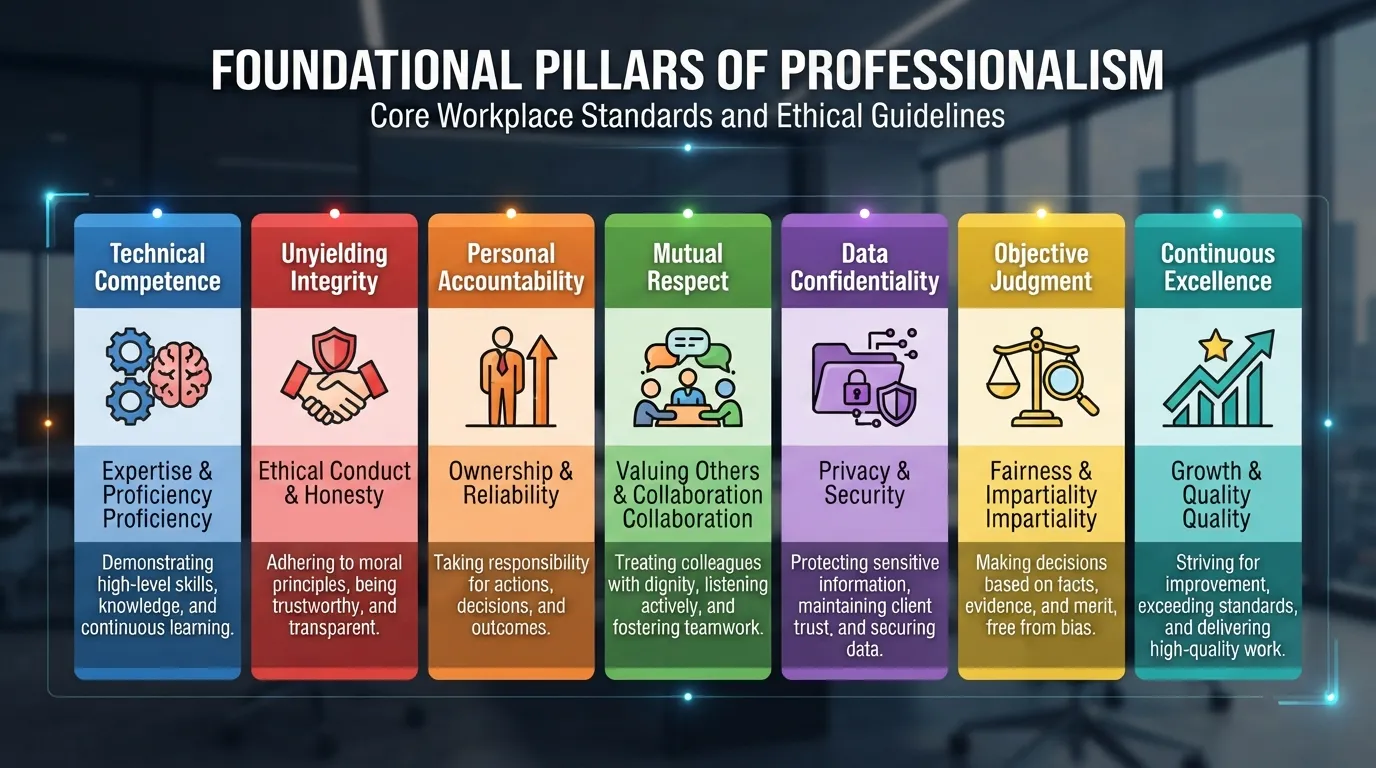
The modern standard of occupational excellence relies on seven foundational pillars that guide everyday behavior and long-term career growth. These principles ensure practitioners deliver consistent quality while maintaining high moral standards.
Competence: Maintaining up-to-date knowledge, technical mastery, and the necessary skills to perform duties effectively.
Integrity: Acting with honesty, moral uprightness, and uncompromised adherence to ethical guidelines.
Accountability: Accepting full responsibility for one’s actions, decisions, and professional outcomes.
Respect: Treating colleagues, clients, and stakeholders with dignity, valuing diverse perspectives and boundaries.
Confidentiality: Safeguarding sensitive, private, and proprietary information entrusted during the course of work.
Objectivity: Making unbiased, evidence-based judgments free from personal conflicts of interest or external pressures.
Excellence: Striving for continuous improvement and delivering work that consistently exceeds baseline expectations.
The 5 Principles of a Code of Professional Conduct
Regulatory frameworks and governance boards rely on a distinct set of five core commitments to monitor compliance and enforce disciplinary standards within an industry.
Public Interest Primacy: Prioritizing the safety, health, and welfare of the general public above individual or corporate gain.
Due Care: Performing professional duties with the diligence, caution, and thoroughness expected of a prudent practitioner.
Scope and Scope Limits: Operating strictly within one’s authorized professional boundaries and recognized areas of expertise.
Fair Dealing: Engaging in honest, transparent, and equitable competition and communication with clients and peers.
Disciplinary Compliance: Adhering to the rulings, investigative processes, and corrective measures mandated by governing bodies.
The Pillars of Professionalism
The Four Pillars of Professionalism Explained
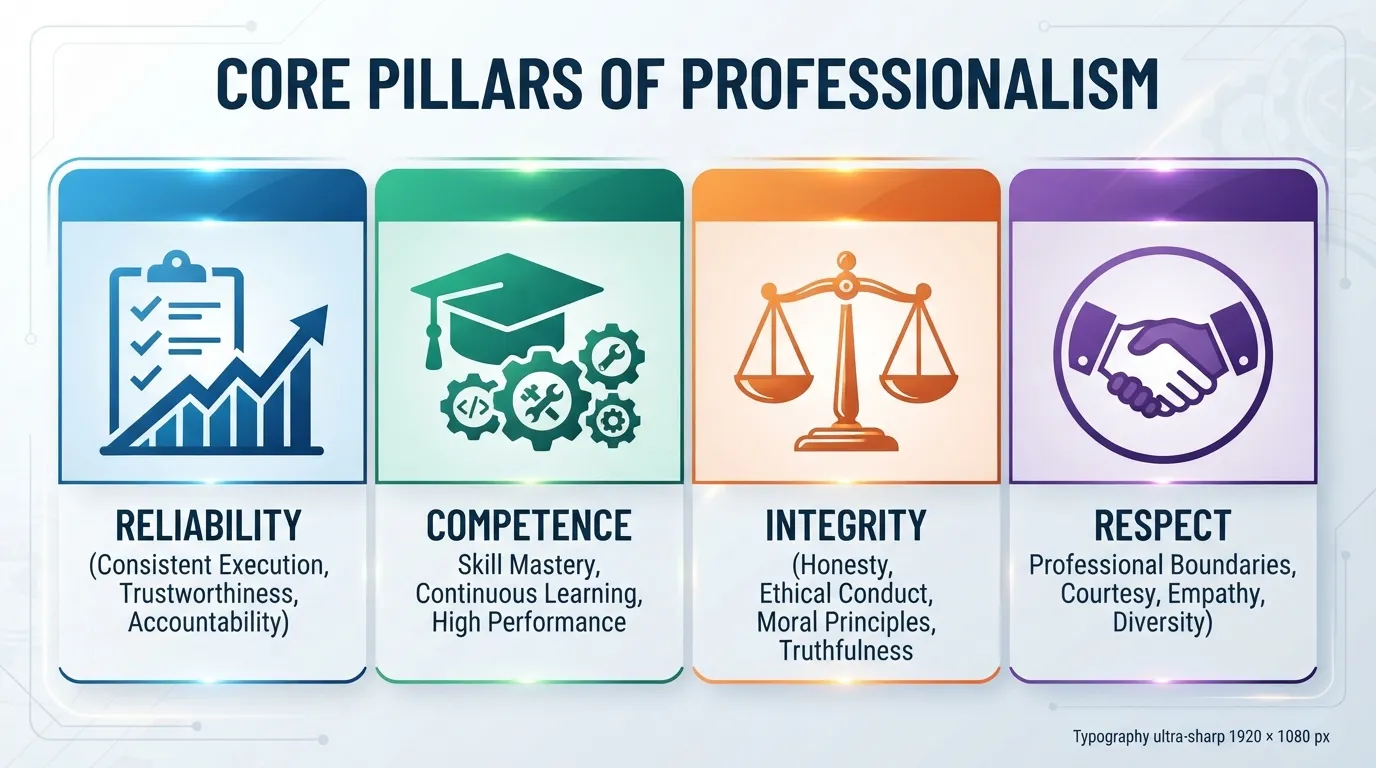
The traditional four-pillar framework forms the foundational bedrock of workplace excellence, focusing on behavioral reliability and character. This model is widely utilized in corporate governance to evaluate baseline employee suitability and client-facing conduct.
Reliability: Consistently meeting deadlines, honoring commitments, and delivering predictable, high-quality results without constant supervision.
Competence: Possessing the requisite technical skills, continuous training, and specialized knowledge to execute duties accurately.
Integrity: Maintaining unwavering honesty and ethical alignment, even when navigating high-pressure or unsupervised situations.
Respect: Demonstrating active listening, professional courtesy, and deep regard for workplace boundaries and peer perspectives.
The Five Pillars Framework (Alternative Model)
Expanding upon the traditional structure, the five-pillar model introduces organizational stewardship and structural responsibility as core performance indicators. This alternative framework is frequently adopted in leadership development and regulated industries.
Accountability: Accepting total ownership of professional outcomes, acknowledging mistakes openly, and proactively executing corrective actions.
Competence: Maintaining mastery over evolving industry standards through lifelong learning and rigorous skill enhancement.
Integrity: Safe-guarding organizational trust by rejecting conflicts of interest and upholding transparent practices.
Reliability: Establishing a reputation for dependable execution, operational stability, and punctuality across all projects.
Stewardship: Actively protecting organizational assets, mentoring junior peers, and uplifting the overall standard of the profession.
Key Characteristics of Professionalism
7 Key Characteristics of a True Professional
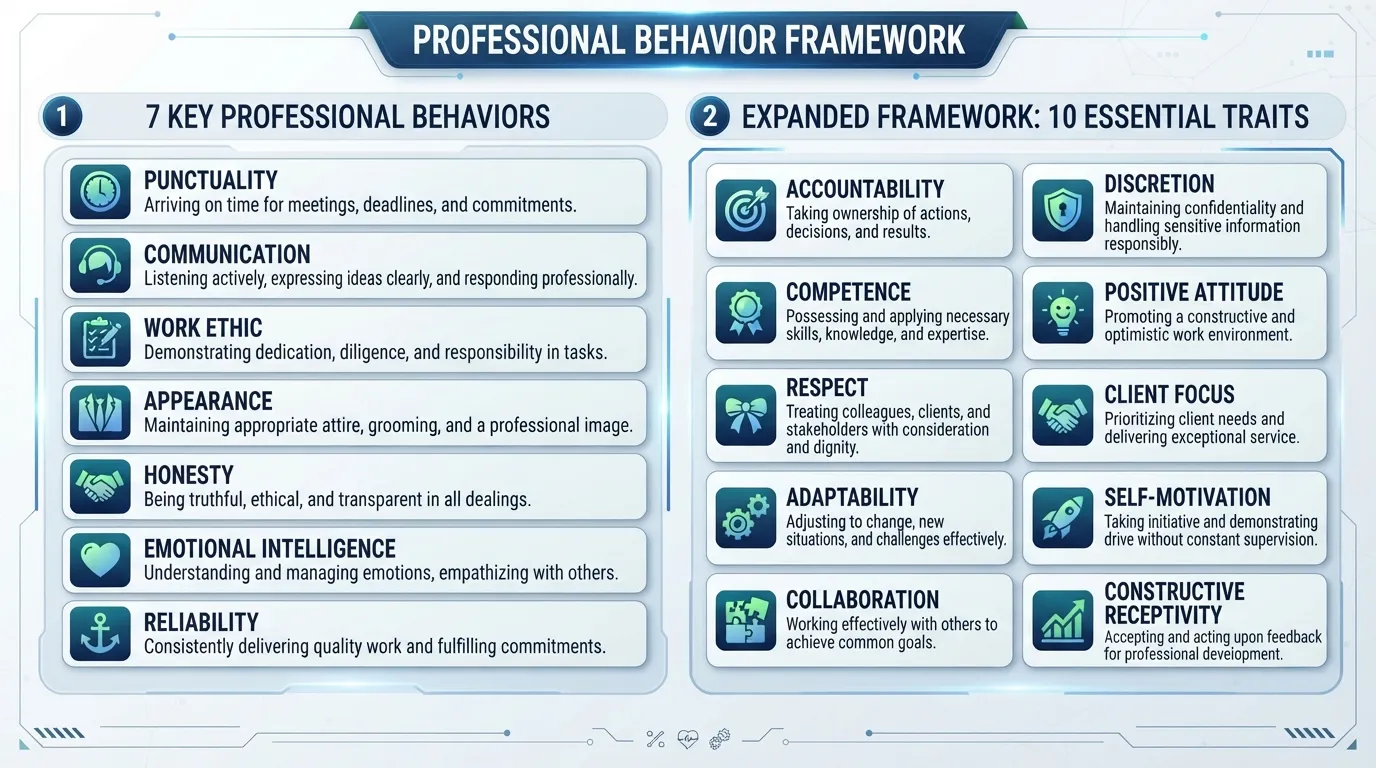
True professionalism is demonstrated through a consistent blend of behavioral habits, emotional intelligence, and technical discipline. These seven core traits define how an individual navigates daily workplace responsibilities.
Punctuality: Respecting time by arriving promptly for meetings, adhering tightly to deadlines, and valuing others’ schedules.
Effective Communication: Expressing ideas clearly, listening actively, and maintaining constructive dialogue across all channels.
Impeccable Work Ethic: Delivering consistent effort, taking initiative, and refusing to compromise on quality even under pressure.
Professional Appearance: Dressing and presenting oneself in a manner appropriate for the specific industry environment.
Unyielding Honesty: Maintaining transparency, admitting errors quickly, and engaging in ethical business practices.
Emotional Intelligence: Managing personal reactions constructively, resolving conflicts calmly, and maintaining composure during crises.
Reliability: Fulfilling promises faithfully so colleagues and clients know they can depend on your output.
10 Key Characteristics (Expanded List)
Expanding the scope to a comprehensive ten-point profile provides a deeper look into the holistic mindset required for long-term career advancement and leadership.
Accountability: Owning all outcomes, both positive and negative, without deflecting blame onto others.
Competence: Committing to lifelong learning to keep skills sharp and industry knowledge up-to-date.
Respect: Treating every coworker, client, and stakeholder with fundamental dignity and professional courtesy.
Adaptability: Embracing change, pivoting smoothly during unexpected disruptions, and maintaining productivity under ambiguity.
Collaboration: Working seamlessly within team structures, uplifting peers, and sharing knowledge unselfishly.
Discretion: Safeguarding sensitive company data, client privacy, and proprietary information with strict confidentiality.
Positive Attitude: Bringing constructive energy to the workplace and approaching challenges with a solution-oriented mindset.
Client Focus: Prioritizing client needs and delivering tailored solutions that create genuine, sustainable value.
Self-Motivation: Driving projects forward proactively without requiring micro-management or constant external prompts.
Constructive Receptivity: Accepting feedback gracefully and utilizing performance critiques as tools for professional growth.
Standards of Professional Behavior
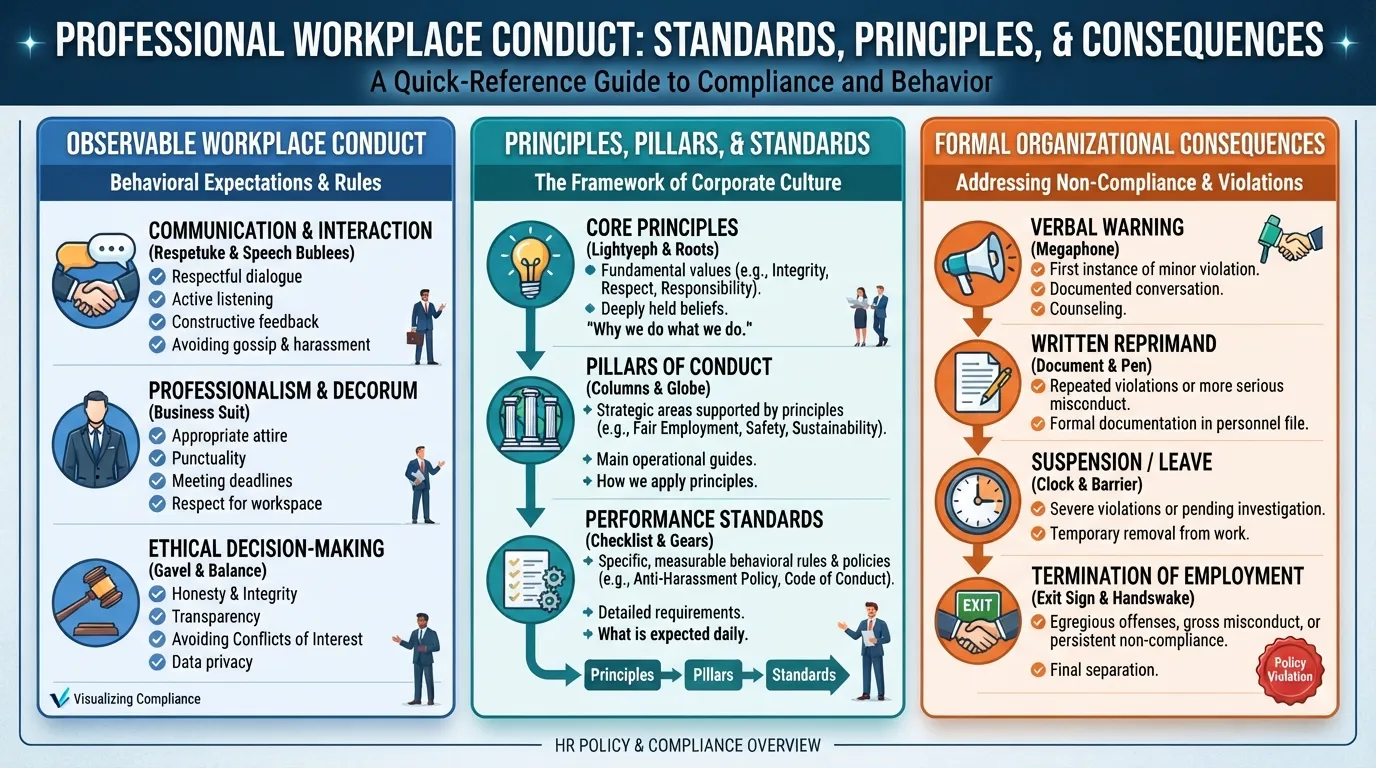
Behavioral Standards in the Workplace
Standards of professional behavior establish the concrete, observable actions required of employees within a corporate environment. Unlike abstract values, these standards translate core values into daily operational requirements, such as maintaining respectful email etiquette, managing conflicts constructively, and adhering strictly to established workplace conduct guidelines.
Observable Actions: Focus on measurable behaviors rather than internal intentions or beliefs.
Operational Alignment: Directly tie daily routines to organizational culture and statutory compliance.
Uniform Expectations: Set clear baseline behavioral expectations across all departments and seniority levels.
How Standards Differ From Principles and Pillars
While principles provide the philosophical compass and pillars offer the structural support, behavioral standards represent the day-to-day rules of execution. Principles answer “why” we act, pillars define “what” categories we build upon, and standards dictate “how” we must specifically behave.
Principles: Broad, timeless ethical foundations like honesty and justice.
Pillars: Categorized competencies or core traits such as reliability and competence.
Standards: Specific, enforceable rules governing tactical actions and procedural compliance.
Consequences of Not Meeting Professional Standards
Failing to adhere to established professional benchmarks disrupts team cohesion, damages client trust, and triggers formal organizational interventions. Organizations typically outline explicit disciplinary standards within HR policy documents to address performance deviations fairly and consistently.
Formal Corrective Action: Triggers progressive warnings, mandatory retraining, or performance improvement plans.
Reputational Damage: Erodes individual credibility and diminishes overall team morale.
Legal and Termination Risks: Can lead to immediate suspension or employment termination depending on the severity of the violation.
Code of Professional Conduct by Profession
Law: ABA Model Rules & State Bar Rules
Legal professionals operate under strict regulatory frameworks designed to protect client confidentiality and uphold the integrity of the judicial system. The American Bar Association sets baseline expectations, which individual jurisdictions like the State Bar of California adapt into binding rules.
Client Confidentiality: Absolute protection of privileged communications except under extreme, legally defined safety exceptions.
Competence and Diligence: Obligation to provide thorough, skillful representation without unnecessary delay.
Conflict of Interest Avoidance: Strict prohibition against representing opposing clients or handling matters with compromised loyalty.
Accounting: AICPA Code of Professional Conduct
Certified Public Accountants follow rigorous governance to safeguard financial transparency and market stability. The AICPA Code of Professional Conduct provides a comprehensive framework centered on unbiased reporting and public protection.
Independence: Maintaining mental and financial autonomy from audit clients to ensure objective reporting.
Due Care: Exercising professional skepticism and rigorous technical skill during every engagement.
Confidentiality of Client Information: Safeguarding sensitive corporate financial data from unauthorized disclosure.
Financial Planning: CFP Board Code of Ethics
Financial planners certified by the CFP Board must act as fiduciaries, meaning they are legally and ethically bound to place client interests above their own financial gain.
Fiduciary Duty: Prioritizing the client’s financial well-being over commissions, firm products, or personal incentives.
Integrity and Objectivity: Delivering unbiased financial advice free from hidden conflicts or deceptive marketing.
Professionalism: Maintaining transparent disclosures regarding fees, compensation models, and potential service limitations.
Engineering & Safety: ASSP Code of Conduct
Engineers and occupational safety professionals governed by bodies like the ASSP prioritize human life, environmental preservation, and structural integrity above all commercial pressures.
Public Safety Primacy: Holding paramount the safety, health, and welfare of the public in all design and operational decisions.
Truthful Public Statements: Issuing objective, evidence-based assessments without bowing to external political or corporate pressure.
Professional Development: Continuously updating technical competencies to match evolving engineering safety standards.
Medical Professionals’ Code of Conduct
Healthcare practitioners operate under deeply rooted codes of medical ethics prioritizing patient autonomy, healing, and compassionate care. These standards govern everything from bedside manner to clinical decision-making.
Beneficence and Non-Maleficence: Acting always in the patient’s best interest while ensuring no avoidable harm is caused.
Patient Autonomy: Respecting the patient’s right to make informed medical choices, including the right to accept or refuse treatment.
Informed Consent: Providing complete, transparent details regarding treatment risks, benefits, and viable alternatives.
Teachers & Education Sector Code of Conduct
Educators guide vulnerable populations, making ethical modeling, student safety, and classroom equity foundational to academic codes of conduct.
Student Welfare and Safety: Maintaining a secure, harassment-free environment that protects students from physical or emotional harm.
Professional Boundaries: Establishing clear, ethical limits in all interactions with students, both inside and outside the classroom.
Fairness and Inclusivity: Delivering unbiased instruction and grading without prejudice toward race, background, or learning ability.
Comparison Table: Core Values by Profession
| Profession | Governing Body / Framework | Primary Focus & Core Value | Key Ethical Obligation |
|---|---|---|---|
| Law | ABA & State Bar jurisdictions | Justice & Client Advocacy | Confidentiality & Conflict Avoidance |
| Accounting | AICPA Code | Financial Transparency | Independence & Due Care |
| Financial Planning | CFP Board Code | Fiduciary Duty | Putting Client Interests First |
| Engineering & Safety | ASSP Framework | Public Safety & Welfare | Structural Integrity & Honesty |
| Medicine | Medical Boards & Associations | Patient Health & Autonomy | Informed Consent & Non-Maleficence |
| Education | State Departments & School Boards | Student Growth & Protection | Ethical Boundaries & Inclusivity |
Code of Professional Responsibility (Legal Context)
What Is a Code of Professional Responsibility?
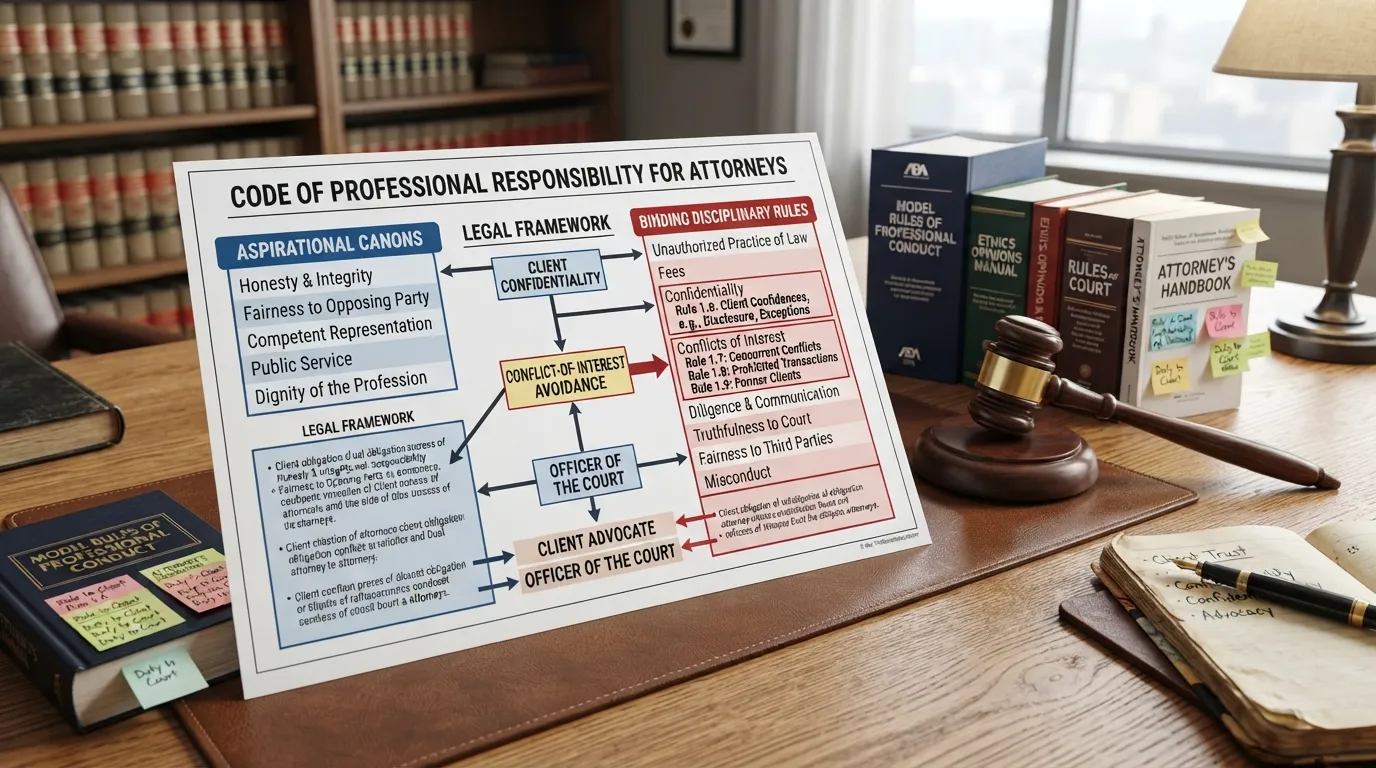
A code of professional responsibility is a specialized regulatory framework that dictates the legal, moral, and ethical boundaries for attorneys and officers of the court. Historically established by bodies like the American Bar Association (ABA), these rules protect clients, maintain judicial integrity, and outline mandatory standards for competent practice. For a detailed academic definition and history, review the Cornell Law School Wex Legal Definition.
Judicial Safeguard: Protects the administration of justice from fraud, corruption, and bad-faith litigation.
Client-Centric Mandates: Enforces strict protocols concerning privileged communication, trust accounting, and loyalty.
Binding Compliance: Sets enforceable rules where violations lead to formal bar association sanctions or disbarment.
How It Differs From a Code of Conduct
While a general code of conduct applies broadly to workplace decorum across various industries, a code of professional responsibility carries specific legal authority and fiduciary weight unique to licensed practitioners. Breaching these provisions can trigger direct legal liability or jeopardize ongoing court proceedings.
Scope of Enforcement: Governed by state supreme courts and specialized disciplinary boards rather than internal human resources departments.
Fiduciary Duties: Imposes high-level legal obligations of loyalty and care that transcend standard employment agreements.
Public Officer Status: Treats attorneys as officers of the legal system with a primary duty to uphold public access to justice.
Legal Profession Case Reference
Legal frameworks address professional responsibility through specific structural components, transitioning over decades from aspirational canons into strictly enforceable mandates. Understanding this evolution is critical for compliance and risk management within law practices.
Aspirational vs. Mandatory: Early frameworks divided guidance into broad ethical considerations and strict disciplinary rules.
Modern Evolution: Contemporary practices rely on modernized frameworks like the ABA Model Rules, which provide targeted guidance on conflicts of interest and trial conduct.
Jurisdictional Adoption: While model frameworks offer a template, binding rules are formally adopted and enforced individually by each state’s bar association.
How to Create and Apply a Code of Professionalism (Practical Guide)
Step-by-Step: Drafting a Workplace Code of Professionalism
Creating an effective internal code requires a systematic approach that balances organizational values with legal compliance. Human resources leaders must collaborate with cross-functional teams to ensure the guidelines are practical, enforceable, and reflective of the company culture.
Audit Core Values: Define the organization’s fundamental mission, ethical anchors, and long-term behavioral expectations.
Draft Clear Operational Policies: Translate abstract principles into concrete rules regarding attendance, communication, and compliance.
Review with Legal Counsel: Ensure all provisions align with local labor laws, employment regulations, and statutory mandates.
Integrate into the Employee Handbook: Embed the finalized standard clearly within standard onboarding documentation and HR policy.
Launch Mandatory Training: Implement interactive workplace training modules to walk employees through realistic compliance scenarios.
Common Mistakes Organizations Make
Many organizations struggle with code adoption because they rely on vague language or treat the document as a mere formality rather than an operational tool. Avoiding these common traps ensures greater accountability and staff buy-in.
Overly Legalistic Language: Drafting documents filled with dense legibility hurdles that employees cannot easily understand or apply.
Lack of Leadership Modeling: Failing to hold executives and senior managers to the exact same behavioral standard as entry-level staff.
Zero Enforcement Mechanisms: Publishing a code without outlining progressive disciplinary consequences for non-compliance.
Set-It-And-Forget-It Mentality: Never updating the framework as remote work, technological shifts, and modern industry standards evolve.
Real-World Example: Applying Professionalism Standards in a Team Setting
Consider a mid-sized tech enterprise rolling out a new cross-functional product launch under tight deadlines. When tension rises between engineering and marketing teams, leadership must rely on established behavioral standards rather than emotional reactions.
Scenario Identification: Two team members begin speaking over each other in a review meeting, violating baseline communication courtesy.
Immediate Intervention: The project lead pauses the meeting to redirect the focus back to objective data and constructive feedback.
Post-Meeting Resolution: HR uses the incident as a teachable moment, reinforcing conflict resolution protocols outlined in the internal conduct manual.
Watch this video to explore essential workplace ethics, professional etiquette, and the core conduct expectations enforced by leading organizations globally.
Common Types of Codes of Conduct
The 5 Common Codes of Conduct
Organizations across industries deploy distinct categories of conduct codes depending on their operational environment, legal requirements, and internal culture. Understanding these five primary models ensures that businesses implement the precise governance framework required for their specific sector.
Compliance Code: Focuses heavily on adhering to federal laws, state regulations, and internal legal requirements to minimize corporate liability and risk.
Ethical Code: Anchored in moral principles and core values, guiding employees through complex decision-making where the law may remain silent.
Regulatory Code: Tailored specifically for highly monitored industries like finance or healthcare, enforcing strict adherence to external governing board mandates.
Organizational Code: Designed to reinforce corporate culture, brand reputation, interpersonal workplace behavior, and daily operational etiquette.
Supplier or Vendor Code: Extends governance outward, mandating that external partners, contractors, and supply chain vendors meet the organization’s ethical and labor standards.
Which Type Applies to Your Industry?
Selecting the appropriate code model depends on your sector’s risk profile, public exposure, and regulatory oversight level. While non-regulated tech startups often lean toward organizational and ethical codes, heavily regulated fields require rigorous compliance and regulatory structures.
Financial and Healthcare Sectors: Require strict regulatory and compliance codes to protect sensitive consumer data and maintain public trust.
Creative and Tech Enterprises: Rely heavily on organizational culture codes and ethical guidelines to foster innovation while maintaining respectful collaboration.
Global Supply Chains: Must implement comprehensive vendor codes to prevent labor violations and ensure ethical sourcing across international borders.
Frequently Asked Questions
What is the professionalism Code?
A professionalism code is a formal set of guidelines and ethical principles that defines acceptable behavior, performance expectations, and moral obligations for individuals within a specific organization or profession. It serves as a practical bridge between abstract values and daily operational conduct.
What are the 5 points of professionalism?
While frameworks vary across industries, the five core points commonly emphasized in professional standards include:
Competence: Maintaining up-to-date skills and technical knowledge.
Integrity: Acting honestly and adhering strictly to moral principles.
Accountability: Owning all personal actions, decisions, and professional outcomes.
Respect: Valuing colleagues, clients, and boundaries with courtesy.
Reliability: Consistently meeting commitments, deadlines, and performance benchmarks.
What is respect in a professionalism code of conduct, especially for teachers?
In an educational setting, respect within a code of conduct requires educators to maintain safe, inclusive, and boundary-driven environments for students. It involves listening actively, treating every learner fairly regardless of background, and protecting student dignity and emotional well-being.
What ethical code of conduct do medical professionals follow?
Medical professionals follow comprehensive codes rooted in medical ethics, such as the principles outlined by the American Medical Association (AMA). These frameworks prioritize patient autonomy, beneficence, non-maleficence, justice, and strict medical confidentiality.
What is an example of a code of conduct?
An example of a corporate code of conduct is a policy document prohibiting workplace harassment, mandating data privacy protection, outlining conflict-of-interest disclosure rules, and setting clear protocols for accepting client gifts or vendor entertainment.
Conclusion
Key Takeaways
A robust code of professionalism serves as the foundational anchor for individual integrity, public trust, and organizational excellence. By establishing clear behavioral expectations, defining core principles, and outlining distinct professional standards across industries, these frameworks bridge the gap between abstract values and daily operational accountability.
Clear Governance: Translates moral commitments into actionable rules across legal, medical, corporate, and educational sectors.
Public Protection: Safeguards clients, stakeholders, and society through strict adherence to ethical decision-making and accountability.
Continuous Alignment: Equips organizations and practitioners with the necessary structures to navigate complexity and prevent professional malpractice.
Final Thoughts on Building a Culture of Professionalism
Embracing a code of professionalism requires more than publishing compliance manuals or passive paperwork. True organizational excellence emerges when leadership actively models these behaviors, integrates ethical principles into daily workflows, and fosters a transparent workplace culture built on mutual respect and continuous improvement.