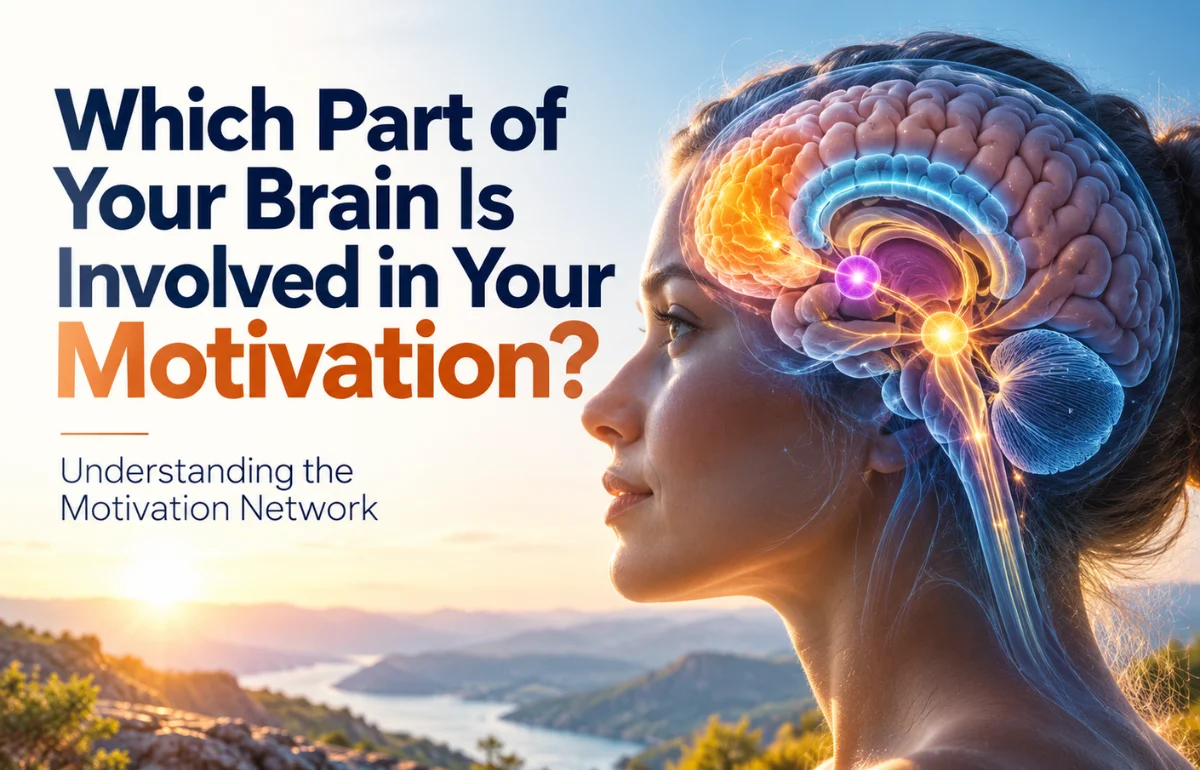
Which part of your brain is involved in your motivation? The most direct answer is the brain’s reward and goal-directed network, especially the ventral tegmental area (VTA), nucleus accumbens, anterior cingulate cortex, and prefrontal cortex. Motivation means the processes that help you choose a goal, begin acting, and keep going when action takes effort. The VTA supplies dopamine signals, the nucleus accumbens helps turn potential rewards into action, and frontal regions weigh costs, make plans, and guide behavior. There is no single motivation switch: your needs, memories, emotions, and surroundings change how this connected system works.
I find that more useful than naming one “motivation center.” I can want a result and still struggle to start: valuing, weighing effort, and acting are different jobs.
Is there one part of the brain that controls motivation?
No. If someone asks me to name one area, I would point to the nucleus accumbens as a key hub for reward-seeking behavior. But naming only that structure leaves out much of the story. It receives information from other regions, including the prefrontal cortex, amygdala, and hippocampus, while dopamine-producing cells in the VTA influence how strongly certain opportunities attract us.
Researchers describe these connections as the mesolimbic reward pathway and broader cortico-striatal circuits. The practical question is whether an outcome matters enough to justify the work of pursuing it.
Here is the short map I keep in mind:
| Brain area or system | Main contribution to motivation | Everyday example |
|---|---|---|
| Ventral tegmental area (VTA) | Sends dopamine signals involved in learning and pursuit | A promising cue catches your attention |
| Nucleus accumbens, in the ventral striatum | Helps connect expected value with willingness to act | You decide a difficult goal is worth starting |
| Anterior cingulate cortex (ACC) | Helps evaluate effort and support goal-directed action | You keep working when the task becomes demanding |
| Prefrontal cortex | Represents goals, plans, consequences, and self-control | You choose to work on a deadline instead of checking your phone |
| Amygdala and hippocampus | Add emotional significance and memory-based context | A familiar place or cue reminds you why a goal matters |
| Hypothalamus | Tracks bodily needs and helps shape basic drives | Hunger makes food unusually compelling |
These roles overlap. A single decision recruits several regions, and scientists are still refining how their activity relates to daily behavior. A neuroscience review and a review of motivational circuits after brain injury support the network account.
How the reward pathway helps you want to act
The VTA and dopamine: learning what is worth pursuing
The VTA is a small area in the midbrain whose dopamine-producing neurons communicate with the nucleus accumbens and parts of the frontal cortex. Dopamine is a chemical messenger, not a synonym for happiness. In motivation research, it is linked to learning from rewards, responding to meaningful cues, and the willingness to expend effort.
Some dopamine neurons respond to differences between expected and actual outcomes. An unexpected reward can strengthen learning about a preceding cue, which may later become attention-grabbing. A notification or the smell of food can prompt action before you consciously weigh every option. Dopamine does more than carry one message, however. Research on reward-prediction signals explains this learning role.
I would be wary of the phrase “boost your dopamine to get motivated.” It implies a single chemical dial that you can safely turn up. Motivation depends on what you expect, the effort involved, your physical state, and competing choices. A dopamine signal can make a cue compelling without making the resulting activity satisfying or wise.
The nucleus accumbens: turning possible rewards into action
The nucleus accumbens sits within the ventral striatum, a set of structures involved in reward-guided behavior. It helps combine information about possible outcomes with the work required to get them. That is why it comes up so often when people ask which part of your brain is involved in your motivation.
Think of two ways to get the same reward: a short walk to buy a meal or a long trip across town. Your preference may change even though the meal has not. Studies of effort-based choice help researchers examine how dopamine in the nucleus accumbens contributes to that calculation. It is especially relevant when the question is whether an attractive outcome is worth substantial work, rather than whether you are physically capable of moving. A review of dopamine and effort explains this distinction.
Its contribution depends on inputs and available choices. An immediate, easy reward can win against a more meaningful distant goal.
The frontal cortex decides whether effort makes sense
The anterior cingulate cortex weighs cost and payoff
The anterior cingulate cortex, or ACC, is a frontal region involved in monitoring demands and guiding effortful behavior. Researchers connect it with decisions in which a bigger possible reward requires more work. It also communicates with the ventral striatum, linking estimates of value and effort with the systems that support action.
Picture opening a complicated application form. Completing it could lead to a useful opportunity, but the first page already looks tiring. The ACC is among the regions implicated in weighing whether to persist. I would not say it alone “creates willpower”; persistence involves a wider network and the specific situation you are in.
In a study of a stress-sensitive frontal-to-accumbens circuit, researchers connected chronic stress exposure with altered effortful reward seeking in experimental animals. That finding helps illustrate a mechanism, but it does not prove that a stressful week affects every person’s motivation in exactly the same way.
The prefrontal cortex keeps a goal in view
The prefrontal cortex is the broad area behind your forehead involved in planning, evaluating outcomes, and regulating behavior. Different parts contribute in different ways. The dorsolateral prefrontal cortex helps maintain task goals and plans; the orbitofrontal and ventromedial regions help represent the value of possible outcomes. These regions work with the ACC and striatum rather than operating above them as a single “boss.”
Suppose I plan to write for an hour. The immediate reward of scrolling may feel clearer than the later reward of a finished article. A written outline, a specific starting sentence, or a quiet work period gives the planning system a more concrete job. I am describing a useful way to structure a choice, not claiming that a particular trick activates one exact spot in the brain.
Human evidence also links dopamine with the willingness to do demanding mental work. In a 2020 experimental study, researchers found that striatal dopamine influenced how participants weighed the benefits against the costs of cognitive effort. The result concerns choices under study conditions; it is not a test you can use to diagnose your own dopamine levels.
Why emotion, memory, and bodily needs matter
The amygdala helps assign emotional significance to cues; the hippocampus contributes memories and context. A person who associates presentations with embarrassment may avoid one despite caring about the result.
The hypothalamus helps integrate bodily signals related to hunger, thirst, and other basic needs. When you are hungry, food-related choices can gain urgency. When you are exhausted or stressed, a long-term plan may face stronger competition from whatever offers quick relief. Those experiences are not proof that a single structure has “shut off.” They show that motivation is sensitive to the state of the whole person. A review of hypothalamic interactions with learning and motivated behavior describes these connections.
This also explains an often-missed distinction: motivation is not always about approaching a pleasant reward. You might act to prevent a loss, escape discomfort, meet a responsibility, or care for someone else. The brain’s valuation systems consider consequences that matter to you, even when the task itself is not enjoyable.
Wanting, liking, and doing are different
If you have ever looked forward to a snack and felt underwhelmed after eating it, you already know that wanting and enjoyment can diverge. Researchers distinguish incentive “wanting” from pleasure or “liking.” Dopamine-related circuits have an especially strong role in the pursuit side; the pleasure of an outcome involves other processes too. A research review of wanting and liking lays out the evidence and its limits.
Doing is a third distinction. I can want a completed project, enjoy the work once I begin, and still dislike the uncertain first five minutes. Calling all three states “motivation” hides the bottleneck.
| What you notice | Possible bottleneck | A more useful question |
|---|---|---|
| “I care about the goal, but I cannot start.” | Starting effort, unclear next action, or competing demands | What is the smallest visible first action? |
| “I start, then quit when it gets hard.” | Effort cost rises or progress is hard to see | Can I reduce friction or make progress measurable? |
| “I keep chasing it, but I do not enjoy it.” | Wanting and liking have come apart | Does this activity still serve the goal I chose? |
| “Nothing feels worthwhile lately.” | A broader change in mood, energy, health, or circumstances may be involved | Has this been persistent or affected daily life? |
These are prompts for reflection, not a way to identify a brain condition from a feeling. The same behavior can have several causes.
Why you can have a goal and still procrastinate
Procrastination is shaped by timing and uncertainty. A distant benefit is abstract; the effort of opening a messy file is immediate. Add an easy alternative and the short-term choice can win.
Consider a report due next week. “Finish the report” contains several hidden decisions: find the data, choose a structure, write a rough section, and revise it. Until you specify the first action, the task may feel larger than it is. I would make the opening move concrete: “At 9 a.m., I will open the document and write three headings.” That plan does not guarantee motivation. It reduces one source of effort: deciding what to do at the moment you begin.
This approach is consistent with research on implementation intentions, which connect a situation with a planned response. Experimental and meta-analytic research on if-then plans suggests that such plans can improve goal follow-through in some settings. The effect depends on the goal and context; a plan cannot remove exhaustion, depression, or an unrealistic workload.
What can you do with this science in everyday life?
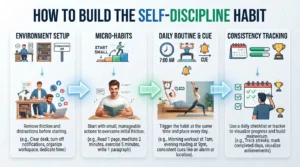
Make the first action smaller than the goal
When a task feels heavy, I would identify an action that takes a few minutes and produces something visible: open the file, put shoes by the door, or write a rough question at the top of the page. This does not “hack” the nucleus accumbens. It changes the choice your brain has to evaluate, especially the effort and uncertainty at the starting line.
Beginning also provides feedback: you know more about the task than you did while imagining it.
Bring the payoff closer and make it specific
“Improve my future” is meaningful but vague. “Send one application before lunch” has a clear endpoint. Marking a completed action or checking progress can make an otherwise distant outcome easier to notice. I would choose feedback that matches the real goal, such as pages drafted or walks completed, instead of chasing arbitrary points or streaks.
Feedback need not be a treat. Seeing genuine progress or helping another person may be reason enough to continue.
Adjust friction in your environment
If the phone is beside your keyboard, checking it takes almost no effort. If the document is open and the phone is in another room, the balance of effort changes. Arranging the environment can help a chosen goal compete with immediate alternatives without asking you to win the same internal argument every minute.
Look at physical needs too. If you regularly struggle to concentrate after skipping meals or sleeping poorly, improving those conditions may help more than searching for a motivational slogan. I would treat sleep, stress, and workload as real parts of the situation, not character flaws.
Know when low motivation deserves attention
A short dip in drive is common. A persistent loss of interest, marked fatigue, or difficulty functioning may call for a conversation with a qualified health professional. Depression, for example, can involve loss of interest and low energy; the National Institute of Mental Health describes symptoms and when to seek help. Other health, sleep, medication, and life factors may also matter.
Avoid using an article like this to conclude that your dopamine is “low” or that your prefrontal cortex is “broken.” Motivation research describes patterns across groups and experiments. An individual assessment requires more context than a brain diagram can provide.
The answer to keep in mind
So, which part of your brain is involved in your motivation? The nucleus accumbens is a central reward-related hub, but your motivation emerges from its connections with dopamine-producing VTA neurons, the ACC, the prefrontal cortex, and regions that process emotion, memory, and bodily needs. Those circuits help determine what seems valuable, whether effort is worth paying, and how to follow through.
The next time a goal feels hard to start, I would ask a practical question before judging myself: Is the payoff unclear, the first step vague, or the effort too high right now? Choose one of those obstacles and change the conditions around it. That is a more grounded next step than waiting for a mythical motivation switch to flip.
Frequently asked questions
Is motivation controlled by the frontal lobe?
The frontal lobe helps plan, value outcomes, and regulate effort, but motivation also depends on connected reward, emotion, memory, and body-state circuits.
What does dopamine do for motivation?
Dopamine helps the brain learn about meaningful outcomes and influences willingness to pursue them, particularly when effort is required; it is not simply a “pleasure chemical.”
Which part of the brain makes you want a reward?
The nucleus accumbens and its connections with the VTA are central to reward pursuit, while other regions shape what that reward means in context.
Can the prefrontal cortex help with procrastination?
It supports planning and goal-directed control. A specific first action and a clear time to start can make that planning easier to use, though procrastination has many causes.
Does low motivation always mean low dopamine?
No. Low motivation can reflect stress, poor sleep, illness, depression, competing demands, or other factors; a feeling alone cannot establish a dopamine level.
Related Posts: