Jump to:
ToggleMindset Shift: The Complete Guide to Changing How You Think
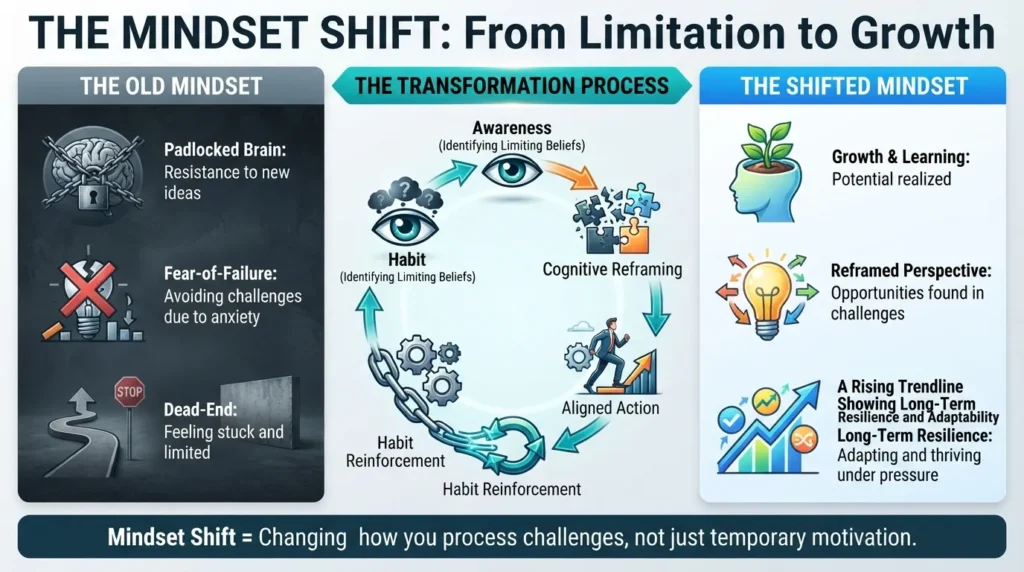
Have you ever worked endlessly toward a goal, only to feel trapped by the frustrating sense that you’ve hit an invisible ceiling? That wall isn’t a lack of talent—it’s a signal that your underlying cognitive framework has reached its limit. A mindset shift is the intentional process of reframing your core beliefs and mental filters to fundamentally alter how you perceive challenges, failures, and daily opportunities.
Unlike a temporary motivation boost that vanishes when initial excitement fades, a genuine mindset transformation rewires how your brain processes stress for long-term behavioral change. In fact, foundational research from Stanford University demonstrates that cultivating a growth-oriented mindset is a far stronger predictor of resilience and high performance than raw IQ or innate talent alone.
In this complete guide, you will learn the neurobiology of cognitive reframing, practical strategies to dismantle limiting beliefs, and step-by-step frameworks to upgrade your thinking. If you want a structured daily tool to help track and reinforce these mental habits, consider pairing this guide with our mindset app.
What Is a Mindset Shift?
The Simple Definition
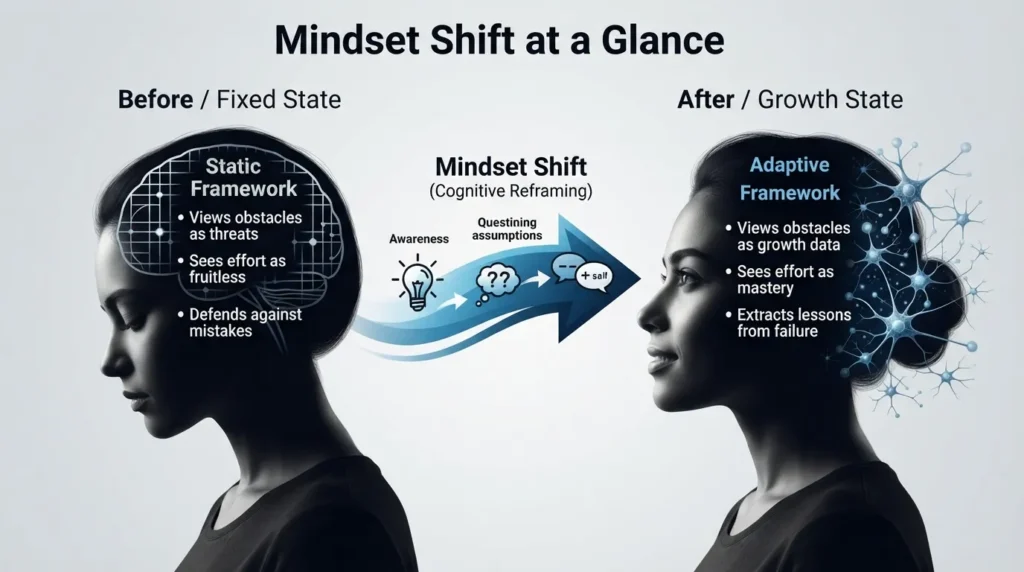
A mindset shift is the fundamental transformation of your underlying cognitive framework, core beliefs, and mental models. Rather than simply changing what you think in a specific moment, a true mindset shift alters how you process information, evaluate challenges, and respond to adversity, enabling long-term personal growth and behavioral change.
Mindset Shift vs. Motivation vs. Willpower
To successfully alter mindset patterns, you must first understand how a mindset shift differs from short-term emotional or mental drivers like motivation and willpower.
| Concept | What It Is | Longevity | Primary Function |
|---|---|---|---|
| Mindset Shift | A structural change in how you interpret reality and core beliefs. | Permanent & Sustainable | Rewires your default reaction to challenges and setbacks. |
| Motivation | A temporary emotional state or spike in desire to take action. | Short-Lived (Fluctuates) | Provides an initial push to start a task or goal. |
| Willpower | A finite cognitive resource used to resist temptation or force action. | Exhaustible (Depletes) | Overrides immediate impulses through conscious effort. |
While motivation gets you started and willpower helps you push through temporary resistance, only a true mindset transformation permanently changes your default habits so success requires less conscious strain over time.
The Psychology Behind a Mindset Shift
At its psychological core, shifting your mindset requires cognitive reframing and schema change. A schema is a mental blueprint your brain uses to organize and interpret information. When you experience a mindset shift, you actively disassemble old schemas—such as “failure means I am incapable”—and construct new, adaptive cognitive frameworks.
Psychologist Carol Dweck’s pioneering research on implicit theories of intelligence highlights this structural difference. Dweck demonstrated that individuals who hold a growth mindset view challenges as opportunities to develop abilities, whereas those operating under a fixed mindset psychology definition view their traits as static and unchangeable. By consciously practicing cognitive reframing, you train your brain’s neuroplastic pathways to abandon limiting beliefs and adopt healthier, more empowering interpretations of daily life.
Why You Need a Mindset Shift
Signs Your Current Mindset Is Holding You Back
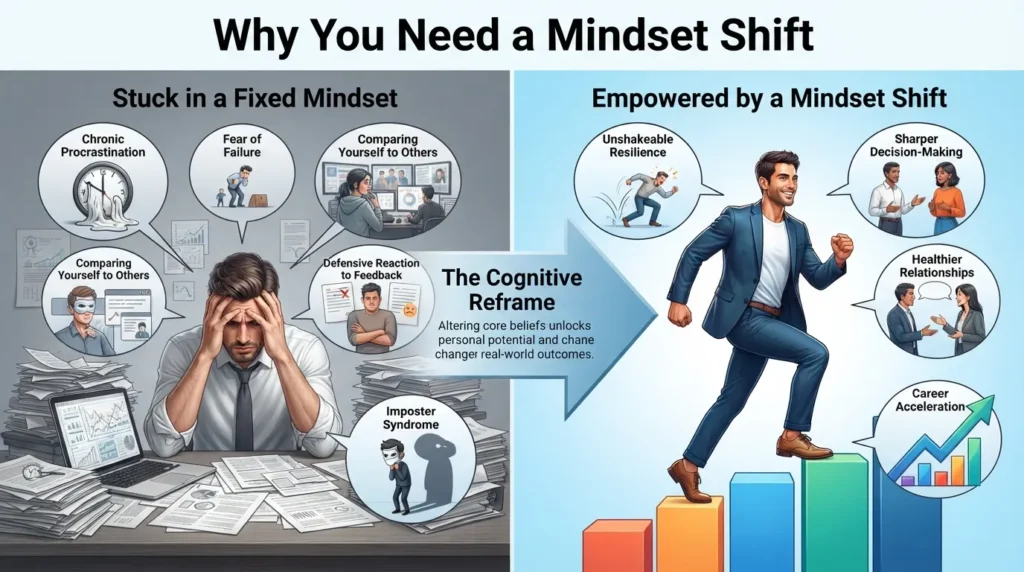
If you consistently find yourself running into the same emotional brick walls, your mindset—not your potential—is likely the bottleneck. Recognizing these behavioral pattern triggers is the first step toward meaningful cognitive reframing:
Chronic Procrastination: Constantly delaying important tasks because the pressure to perform perfectly creates overwhelming anxiety.
Pervasive Fear of Failure: Viewing mistakes as permanent blemishes on your personal worth rather than standard data points in the learning process.
The Comparison Trap: Measuring your behind-the-scenes reality against everyone else’s curated highlight reels, leading to feelings of inadequacy.
Defensive Responses to Feedback: Perceiving constructive criticism as a personal attack rather than valuable input for growth.
Overwhelming Imposter Syndrome: Believing that your achievements are purely due to luck and that you will eventually be exposed as a fraud.
Signs of a Fixed Mindset (Specifically)
A fixed mindset operates on the assumption that your intelligence, skills, and character are static traits you are born with. Identifying these specific patterns helps you know when to alter mindset habits:
Avoiding Challenges: Turning down new projects or opportunities because you fear failing or looking inexperienced.
Giving Up Easily: Abandoning goals at the first sign of friction or obstacle, mistaking difficulty for a lack of capability.
Ignoring Constructive Criticism: Ignoring helpful feedback to protect your ego, which reinforces negative fixed mindset traits.
Feeling Threatened by the Success of Others: Viewing another person’s achievements as a direct devaluation of your own potential.
Believing Effort Is Fruitless: Operating under the assumption that if you have to work hard at something, you simply lack natural talent—one of the key fixed mindset characteristics that limits personal growth.
What Changes When You Shift Your Mindset
When you execute a deliberate mindset transformation, your interpretation of daily experiences fundamentally changes. Here is a clear snapshot of what shifts when you upgrade your underlying mental models:
Resilience Under Pressure: Instead of breaking during setbacks, you bounce back quickly because failure is re-framed as feedback rather than a final verdict.
Sharper Decision-Making: You spend less time second-guessing yourself or agonizing over perfection, moving toward action-oriented choices.
Healthier Relationships: Communicating openly becomes easier when you no longer see difference of opinion as a threat to your identity.
Career Acceleration: Embracing new skills and taking calculated risks opens doors that self-doubt previously kept locked.
While we will cover detailed mindset shift examples across life, work, and relationships in a dedicated section below, the core takeaway is simple: shifting your mindset changes not just how you think, but the actual real-world outcomes you produce.
The Four Main Types of Mindsets
Fixed Mindset
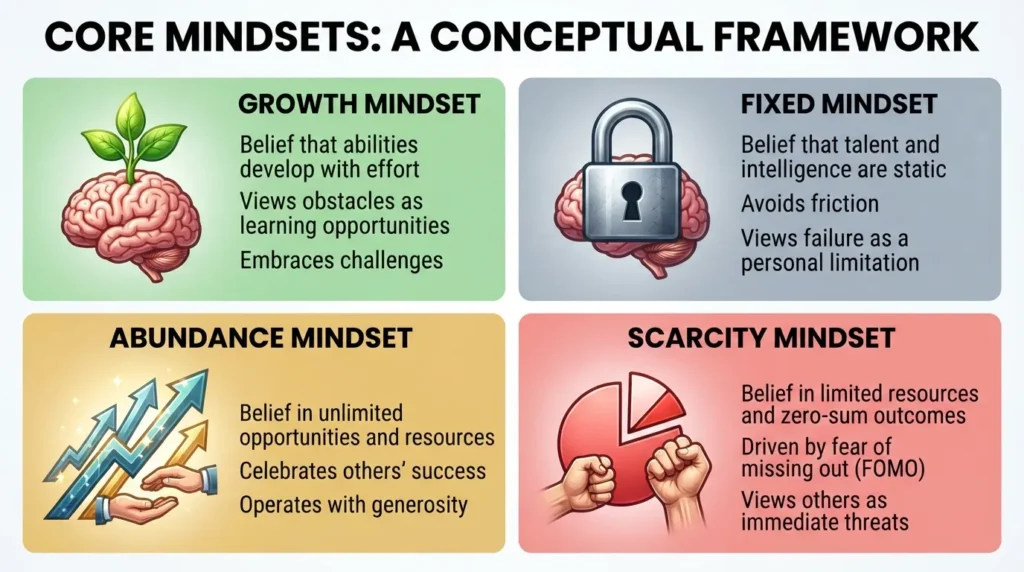
A fixed mindset is the belief that basic qualities—such as intelligence, talent, and personality—are static, predetermined traits. People with this framework tend to avoid challenges, give up easily under stress, and view effort as a sign of weakness rather than a path to mastery. (To explore how this develops, read our full breakdown on the fixed mindset psychology definition).
Growth Mindset
A growth mindset is the belief that your abilities and intelligence can be developed through dedication, hard work, and effective strategies. Championed by psychologists like Carol Dweck, adopting a growth mindset frames obstacles as learning opportunities and views effort as the essential engine of personal achievement.
Abundance Mindset
An abundance mindset is the fundamental belief that there are plentiful resources, opportunities, and successes available for everyone. Instead of viewing life as a zero-sum game, individuals with an abundance mindset celebrate others’ accomplishments and operate with a sense of generosity, knowing that one person’s gain does not subtract from their own potential.
Scarcity Mindset
A scarcity mindset stems from the deep-seated belief that resources—whether time, money, recognition, or love—are extremely limited. This perspective often triggers anxiety, defensive behaviors, and competitive paranoia, causing individuals to make short-sighted decisions driven by the fear of missing out or coming up empty-handed.
A Note on Broader Frameworks: The 7 Mindsets
While these core four form the foundation of psychological research on belief systems, you may also encounter broader frameworks in coaching literature that outline “7 Mindsets” for success. These frameworks typically expand on the fundamentals to include specialized orientations like the Everything is Possible, Passion First, 100% Accountable, We Are Connected, Attitude of Gratitude, Live to Give, and The Time is Now mindsets. While helpful for specific life-coaching goals, every broader framework relies on executing a fundamental mindset shift away from fixed, scarce thinking toward growth and abundance.
How to Make a Mindset Shift Step-by-Step Framework
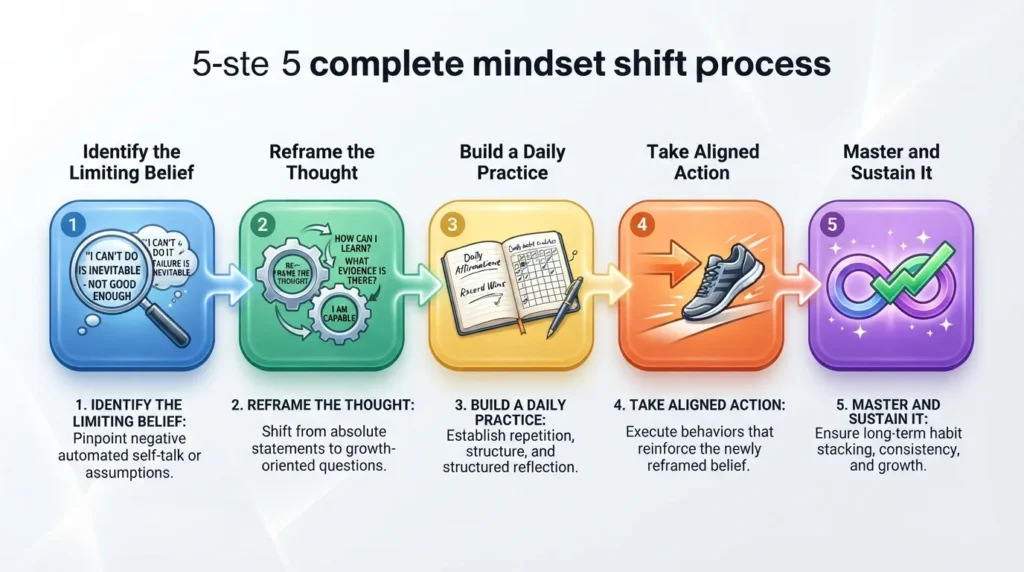
Step 1 — Identify the Limiting Belief
You cannot alter a habit of thought that you aren’t aware of. Most limiting beliefs run on automated loops in the subconscious, disguised as facts rather than mere assumptions. Start by observing your internal dialogue during moments of stress or hesitation.
Watch for absolute language like “I’ve always been terrible at this,” “I can’t handle this,” or “People like me don’t succeed here.” When these thoughts arise, write them down immediately without judgment. To explore specific exercises for uncovering these hidden cognitive blocks, read our deep-dive guide on how to change your thinking.
Step 2 — Reframe the Thought
Once a limiting belief is exposed, you must systematically challenge its validity using cognitive reframing. This isn’t about forced positivity; it’s about replacing an unhelpful, rigid interpretation with a realistic, empowering one.
When a negative thought occurs, apply these two reframing techniques:
The “Yet” Addition: Append the word “yet” to absolute statements. Transform “I don’t know how to do this” into “I don’t know how to do this yet.”
Evidence Testing: Ask yourself, “What concrete evidence supports this belief, and what evidence contradicts it?” By actively dissecting your assumptions, you disrupt your automatic neural reactions and begin shifting how to change your thinking process over time.
Step 3 — Build a Daily Practice
A mindset transformation requires daily repetition to turn new neural pathways into default habits. Spontaneous effort isn’t enough; you need a structured daily routine:
Evidence-Based Journaling: End each day by writing down three moments where you faced a challenge and chose growth over avoidance.
Targeted Identity Statements: Practice affirmations focused on process and effort rather than traits (e.g., “I adapt quickly to new problems” instead of “I am smart”).
Process Visualization: Spend 2–3 minutes visualizing yourself navigating a difficult task calmly, rather than just imagining the final victory.
(Note: Using a daily tool like our mindset app can help anchor these reflection habits and keep your streak consistent).
Step 4 — Take Aligned Action
Mindset follows action as much as action follows mindset. Cognitive reframing creates the opportunity, but behavioral execution cements the shift. You must act in alignment with your new belief system—even when it feels uncomfortable.
If your new belief is “I learn through experimentation,” you must take a micro-action that risks failure today, such as volunteering for a new project or sending an ambitious pitch. Every time you take aligned action, you prove to your brain that the old limiting belief is obsolete. For a comprehensive walkthrough of this behavioral phase, check out our resource on how to change your mindset.
Step 5 — Master and Sustain It
Sustaining a new perspective over years—not just weeks—requires long-term systems. Resistance will re-emerge during high-stress periods, so you must build environment-level triggers to keep your new mental models active.
Leverage habit stacking by pairing a mindset practice with an existing daily habit:
After I pour my morning coffee, then I will write down my primary focus for growth today.
When I receive constructive critique, then I will pause for three seconds and say, “This feedback makes me sharper.”
Building these automatic cues is the cornerstone of learning how to master your mindset for permanent success.
Bonus — Three Fastest Ways to Shift Your Mindset Today
If you need to quickly alter mindset patterns and regain momentum right now, focus on these three high-impact strategies:
Reframe the Problem with the “What Is This Teaching Me?” Prompt: Instantly swap frustration for curiosity by asking what skill or insight an obstacle is forcing you to develop.
Change Your Physical State: Shift your body language, posture, or environment immediately—a brief brisk walk or posture reset breaks acute cognitive stress loops.
Adopt a Micro-Action Rule: Break down a daunting objective into a task so small it takes under two minutes, eliminating the friction that triggers fear of failure.
How to Change Your Mindset Specific Situations
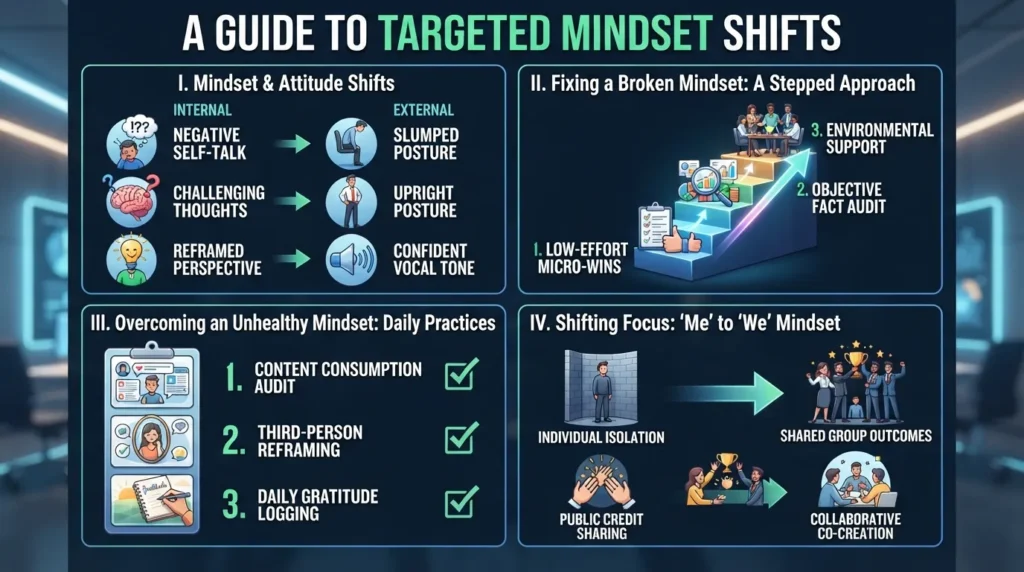
How to Change Your Mindset and Attitude Together
While your mindset represents your underlying belief system, your attitude is the outward expression of those beliefs through your mood, body language, and tone. Changing one requires actively working on the other.
To adjust both simultaneously, match cognitive reframing with immediate physical and verbal adjustments. For instance, when tackling a difficult project, pair the internal belief “This is a growth opportunity” with open body language and enthusiastic speech. Consistently aligning your outward expressions with your internal goals accelerates the overall process to change your mindset and helps anchor new behavioral habits.
How to Fix a Broken Mindset
A “broken” mindset occurs when you feel completely defeated, hopeless, or stuck in an overwhelming state of learned helplessness. Fixing it isn’t about forced optimism; it’s about rebuilding basic agency through tiny, indisputable wins.
Lower the Bar to Micro-Wins: Break goals down to the smallest possible unit of action (e.g., writing one sentence, making one phone call). Completing micro-tasks proves to your brain that you still have agency.
Conduct a Fact-Audit: Write down the catastrophic thoughts you are experiencing and separate actual facts from emotional assumptions.
Surround Yourself with Evidence: Shift your environment by reading stories or speaking with peers who have successfully overcome similar setbacks.
How to Fix an Unhealthy Mindset
Unlike a broken mindset (which stems from feeling defeated), an unhealthy mindset is driven by harmful, toxic cognitive patterns like constant comparison, severe self-criticism, chronic cynicism, or perfectionism.
Audit Your Mental Consumption: Reduce exposure to social media feeds, news outlets, or relationships that trigger envy, outrage, or feelings of inadequacy.
Interrupt the Internal Critic: When toxic self-talk arises, switch from first-person (“I am failing”) to third-person perspective (“Name is experiencing stress right now”). Distancing yourself emotionally reduces the impact of harmful thoughts.
Practice Gratitude Benchmarking: Counter chronic cynicism by intentionally identifying three specific things that went right each day, forcing your brain to search for constructive patterns.
How to Shift Your Mindset From “Me” to “We”
Shifting from an individualistic “Me” mindset to a collaborative “We” mindset is essential for effective leadership, teamwork, and healthy personal relationships. This transition moves your primary motivation from personal credit to collective impact.
Focus on Shared Outcomes: Evaluate decisions based on how they benefit the team or partnership as a whole, rather than asking “What do I gain from this?”
Practice Active Credit-Sharing: Make a conscious habit of highlighting the contributions of others and sharing ownership of wins publicly.
Swap Competition for Co-Creation: Replace the impulse to outperform peers with the goal of elevating everyone’s collective performance. View surrounding talent as a multiplier rather than a threat.
How to Master and Control Your Mindset
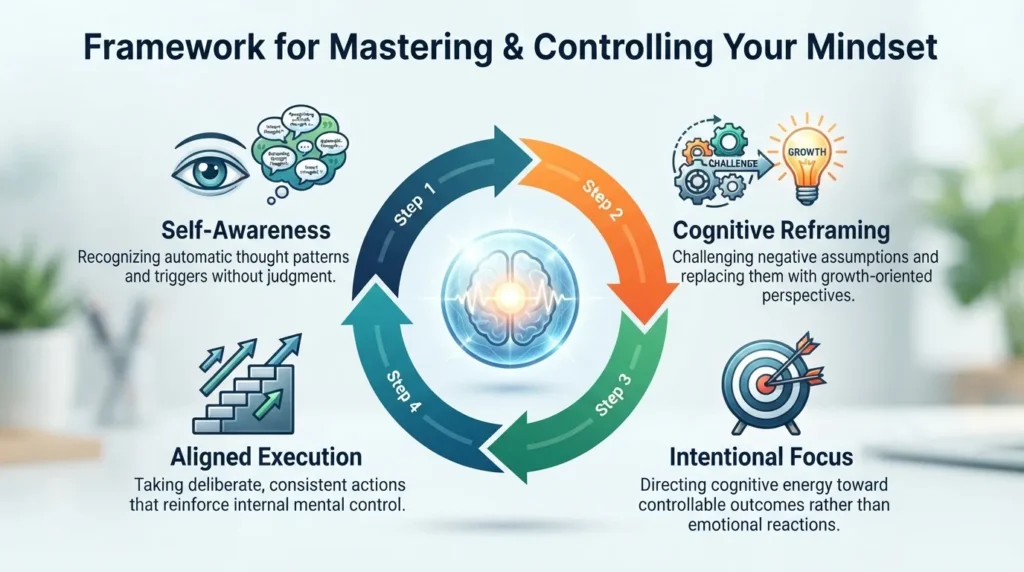
Taking Control of Your Mindset
Gaining control over your mental landscape is not about suppressing negative emotions or forcing constant positivity; it is about directing your attention intentionally. When you practice how to control your mindset, you move from reacting passively to life’s stressors to consciously choosing your responses.
By building daily awareness, challenging automatic assumptions, and taking deliberate action, taking control of mindset patterns becomes an achievable daily habit rather than an overwhelming challenge.
What Is the Most Powerful Mindset?
The most powerful mindset is the Growth Mindset paired with an Abundance orientation. This hybrid framework allows you to view every obstacle as a skill-building opportunity while operating under the belief that success and resources are unlimited. By combining continuous learning with an abundance focus, you build unshakeable resilience and eliminate the fear of failure.
Clearing Mental Clutter Before You Shift Your Mindset
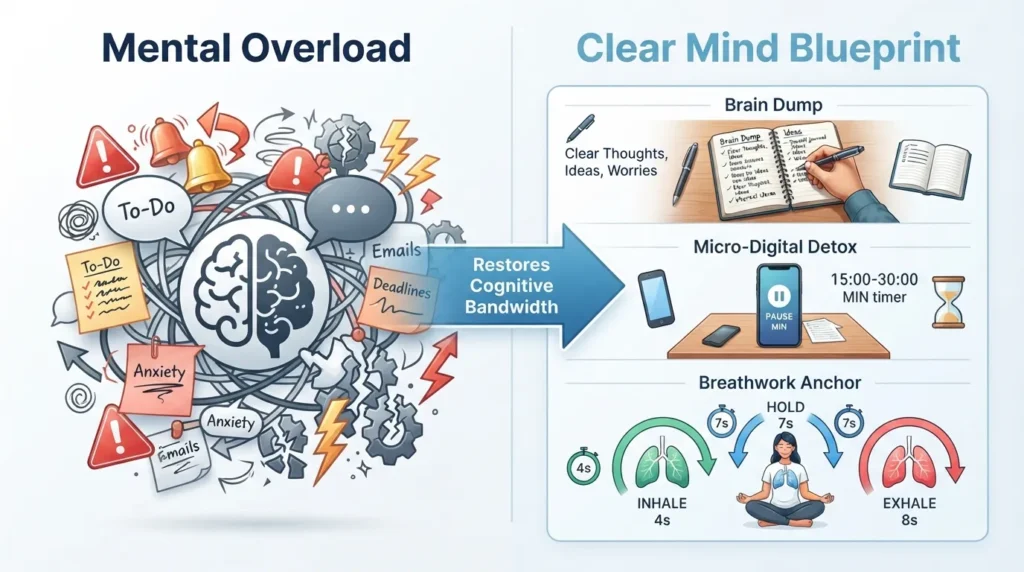
Why a Clear Mind Is the Foundation of a Mindset Shift
Attempting to execute a mindset shift while your brain is overwhelmed with unorganized thoughts, unaddressed stress, and constant notifications is like trying to install new software on a freezing computer. When your cognitive bandwidth is maxed out, your brain defaults to its oldest, most deeply ingrained patterns simply to save energy.
Mental clutter creates constant background noise, making it almost impossible to notice limiting beliefs, let alone reframe them. By taking time to clear away unnecessary cognitive overhead first, you create the calm space required to consciously evaluate your thoughts and successfully clear your brain for lasting change.
How to Clear Your Mind
To restore mental clarity and prepare your mind for deeper belief work, implement these quick, high-impact strategies:
Perform a Brain Dump: Grab a notebook and write down every task, worry, idea, or nagging thought currently occupying your mind. Getting them out of your head onto paper immediately frees up working memory.
Practice Micro-Digital Detoxes: Step away from screens for just 15 to 30 minutes a day. Constant inputs from social media and email flood your system with unnecessary information, reinforcing cognitive clutter.
Focus on Breathwork Anchor Exercises: Use a simple 4-7-8 breathing technique (inhale for 4 seconds, hold for 7, exhale for 8) for two minutes. This physically lowers your stress response and brings your focus back to the present moment, helping you learn how to have a clearer mind before diving into cognitive reframing work.
Real Mindset Shift Examples
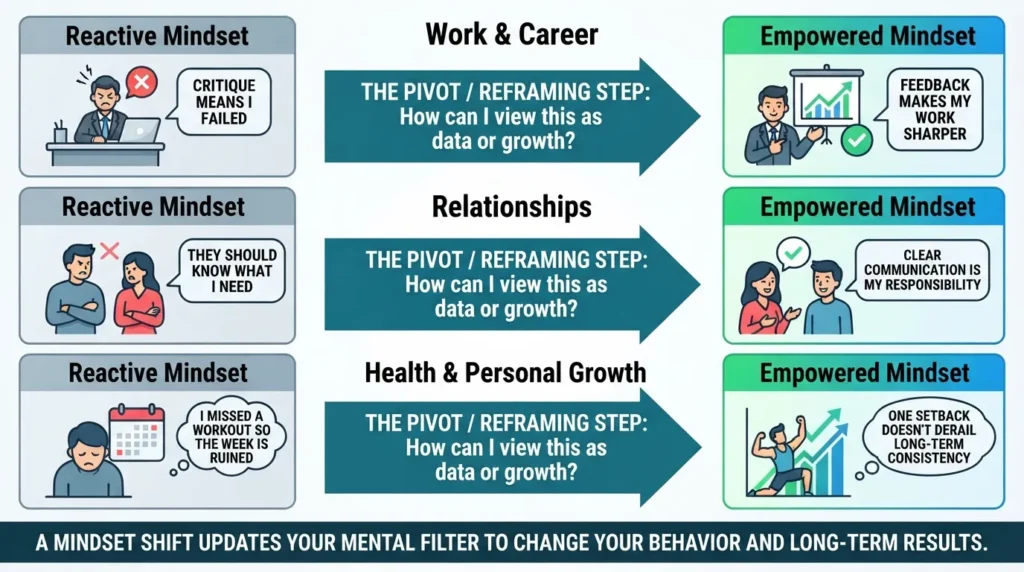
Everyday Examples (Work, Relationships, Health)
To successfully alter mindset patterns, it helps to see how small reframing choices play out in daily life. Below is a comprehensive look at common before-and-after mindset shifts across career, fitness, and personal growth:
| Category | Fixed / Reactive Mindset (Before) | Growth / Empowered Mindset (After) | Core Shift |
|---|---|---|---|
| Career | "I'm not qualified for this promotion, so I shouldn't bother applying." | "I don't meet every single qualification yet, but applying will help me learn what to develop next." | From self-selection out to viewing applying as a learning process. |
| Workplace Feedback | "My boss gave me critical notes because they think I'm bad at my job." | "This feedback points out specific areas where I can make my work stronger and more impactful." | From personal defense to skill optimization. |
| Fitness & Health | "I missed my workout today, so my whole diet is ruined for the week." | "One missed session is just a minor bump; my next choice can get me right back on track." | From all-or-nothing thinking to long-term consistency. |
| Relationships | "If they really cared about me, they would automatically know what's wrong." | "People cannot read my mind; clear communication is my responsibility." | From passive expectation to active responsibility. |
| Personal Finance | "I'm just bad with money, and I will always be living paycheck to paycheck." | "Managing money is a skill I can learn and improve over time through better habits." | From fixed identity to learnable capability. |
| Creative Pursuits | "My first draft isn't good, so I must not have natural talent for this." | "First drafts are meant to be messy; skill comes through editing and refining." | From demanding instant perfection to trusting the iteration process. |
Mindset Shifts That Changed People’s Lives
Beyond daily routines, fundamental cognitive reframing often marks the turning point in major life trajectories. Here are three illustrative examples of how shifting core beliefs completely alters real-world outcomes:
1. From “Failure is Final” to “Failure is Data”
A middle-manager spent years avoiding high-visibility projects due to an intense fear of making public mistakes. After missing out on multiple career steps, they decided to consciously change their framework: every project outcome was reclassified as either a success or a data-gathering exercise.
By treating unexpected obstacles as valuable information rather than evidence of incompetence, they began volunteering for complex challenges. Within two years, their willingness to experiment and iterate led to leading a major initiative that reshaped their team’s direction.
2. From “Productivity Is Worth” to “Rest Is Maintenance”
An ambitious entrepreneur spent years working 80-hour weeks under the assumption that downtime equaled laziness. Eventually, chronic exhaustion damaged both their health and decision-making quality.
The breakthrough came when they reframed rest as essential maintenance for performance—much like servicing a high-performance engine—rather than a reward earned only after burn-out. By protecting non-negotiable recovery time, their focus sharpened, their problem-solving improved, and their business grew more sustainably.
3. From “I Need to Prove Myself” to “I Need to Serve Others”
A talented designer constantly struggled with imposter syndrome and severe public speaking anxiety because every presentation felt like a personal test of their competence.
The turning point occurred when they shifted their internal focus outward: instead of asking “How am I performing?”, they began asking “How can this information help my audience solve their problem?” By making the work about helping others rather than protecting their ego, the anxiety subsided, making way for clear, confident communication.
Expanding Your Mindset
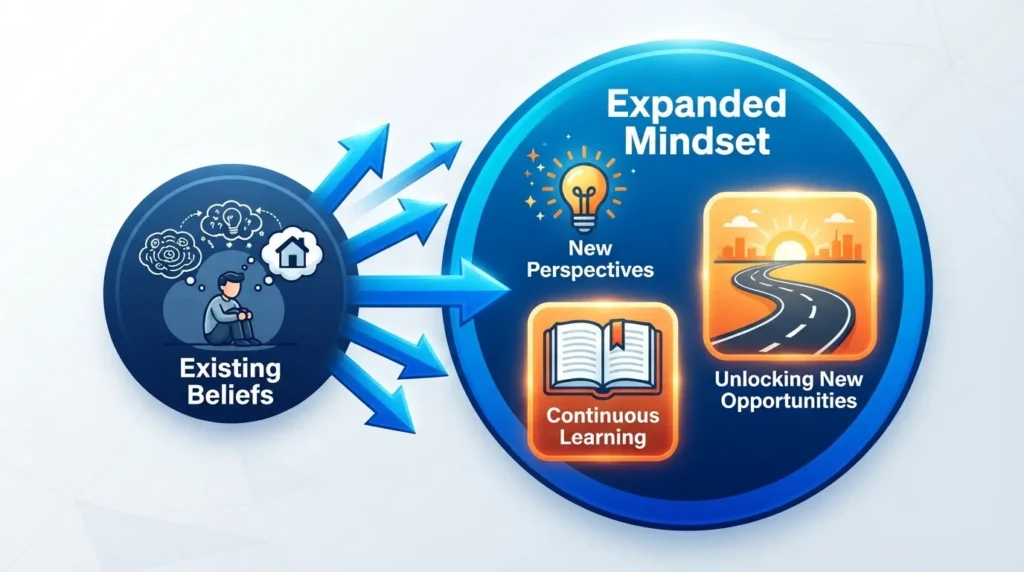
What It Means to Expand Your Mindset
Once you have established a foundational growth orientation, the next evolution is expanding your perspective beyond daily habit changes. Expanding your mindset means actively broadening your intellectual horizons, seeking out contrasting viewpoints, and constantly pushing past your existing cognitive boundaries. To explore advanced strategies for stretching your perspective into new areas of life, read our full guide on expanding mindset capabilities.
The Power of Perspective
Your mindset acts as the lens through which you interpret every experience, opportunity, and challenge. When you consciously upgrade that lens, your entire reality responds—problems transform into possibilities, and limits reveal themselves as temporary assumptions. Understanding the power of your mindset gives you the tool needed to actively shape your life path rather than simply reacting to circumstances as they unfold.
Mindset Shift Quotes & Inspiration
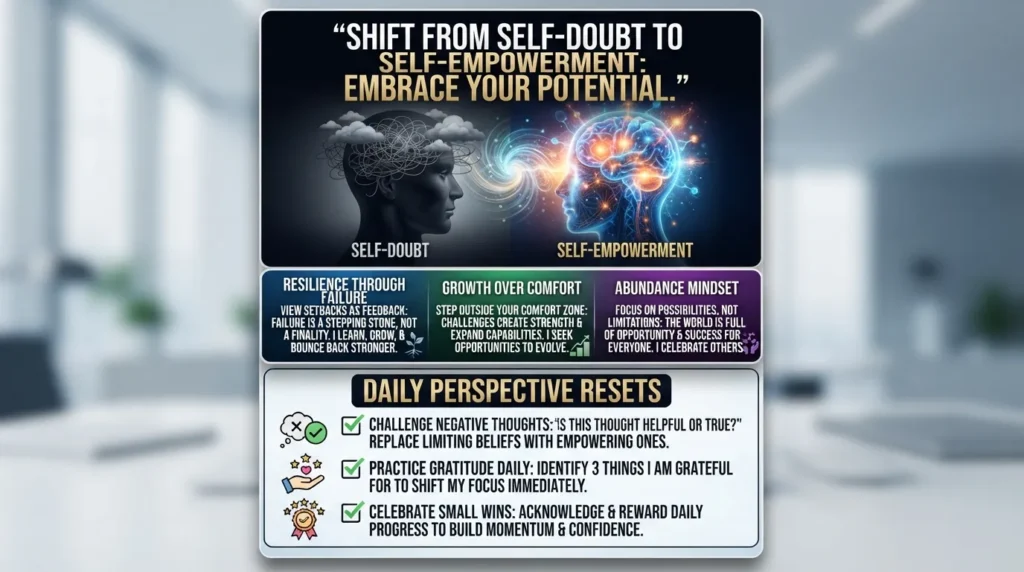
Short Quotes to Anchor a New Mindset
Memorable phrases and wisdom can serve as powerful mental anchors when you are working to change your thinking patterns. A well-timed insight acts as an immediate reset button during moments of self-doubt or stress, helping you stay grounded in your growth journey. For a curated collection of impactful wisdom to support your ongoing personal growth, explore our complete guide to life quotes about life changes, which covers deep self quotes, inspirational change quotes, and daily perspective resets.
Tools to Help You Shift Your Mindset
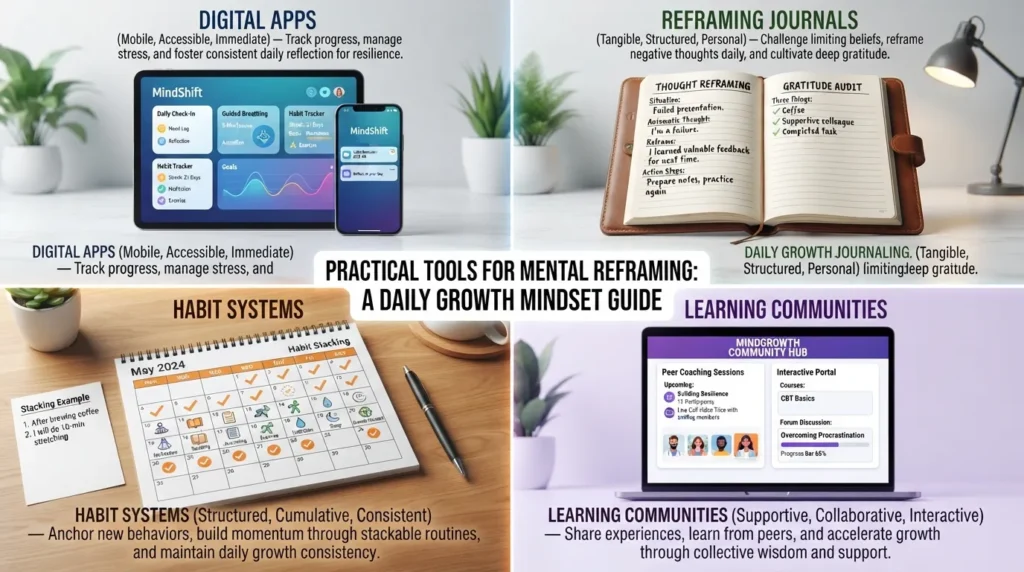
Mindset Apps and Trackers
Consistently reinforcing a growth perspective takes structure, and digital tracking tools provide the daily cues needed to build lasting mental habits. Utilizing a dedicated app simplifies cognitive reframing by offering daily reflection prompts, habit trackers, guided visualizations, and structured check-ins right from your phone.
If you are looking to accelerate your personal growth with daily guidance, completing a mindset app download gives you an accessible, on-the-go toolkit to monitor your self-talk, log progress, and stay focused on continuous improvement wherever you are.
Mindset Programs and Communities
While individual daily practice is powerful, sustained belief work often thrives in structured learning environments backed by community support. Immersive coaching programs, workshops, and accountability groups provide expert frameworks and peer feedback to help you work through persistent cognitive roadblocks.
If you are already participating in a dedicated coaching curriculum or structured digital course, you can access your user dashboard via the mindset login portal to complete your daily exercises, track ongoing program modules, and connect with your learning community.
Frequently Asked Questions
A mindset shift is the fundamental transformation of your underlying core beliefs, cognitive frameworks, and mental models. Rather than just changing your thoughts in a single moment, it alters how you process information, evaluate challenges, and respond to adversity.
While classical psychology focuses on four primary mindsets (Fixed, Growth, Abundance, and Scarcity), expanded coaching models outline seven distinct mindsets:
- Everything is Possible
- Passion First
- 100% Accountable
- We Are Connected
- Attitude of Gratitude
- Live to Give
- The Time is Now
The three fastest ways to alter your mindset are:
- Reframe your current challenge by asking, "What is this situation teaching me?"
- Shift your physical state through posture adjustments, movement, or breathing to break acute stress loops.
- Take a micro-action that takes less than two minutes to overcome resistance and rebuild momentum.
To fix an unhealthy mindset—such as chronic comparison, cynical thinking, or harsh self-criticism—audit your daily mental inputs to reduce outrage and envy triggers, practice talking to yourself in the third person to create emotional distance from negative self-talk, and keep a daily gratitude log to retrain your brain to spot constructive patterns.
The most powerful mindset is a Growth Mindset paired with an Abundance orientation. This combination allows you to view every obstacle as an opportunity to build skills while maintaining the belief that opportunities and resources are unlimited.
Yes, several foundational books explore the science and application of cognitive change:
- Mindset: The New Psychology of Success by Dr. Carol Dweck is the leading academic work on growth vs. fixed mindsets.
- Atomic Habits by James Clear and Mindset Secrets for Winning by Mark Owens offer actionable frameworks for shifting long-term habits and mental perspectives.
Yes! You can download our free Mindset Shift Action Plan PDF, which includes a daily cognitive reframing worksheet, limiting belief tracking templates, and a 30-day habit-building checklist to help implement the strategies outlined in this guide.
Common synonyms and related terms for a mindset shift include:
- Paradigm shift
- Perspective shift
- Cognitive reframe
- Attitude adjustment
- Mental model upgrade
Chalida Suksawat
Chalida Suksawat is the Mindset Editor at Holistic Wellbeing Living. She writes about self-awareness, beliefs, resilience, and thoughtful personal growth. With eleven years of experience creating personal-growth content, Chalida helps readers question limiting assumptions and respond to everyday challenges with greater balance.