Jump to:
ToggleHow to Build Confidence: The Complete Guide to Becoming Unshakeably Confident
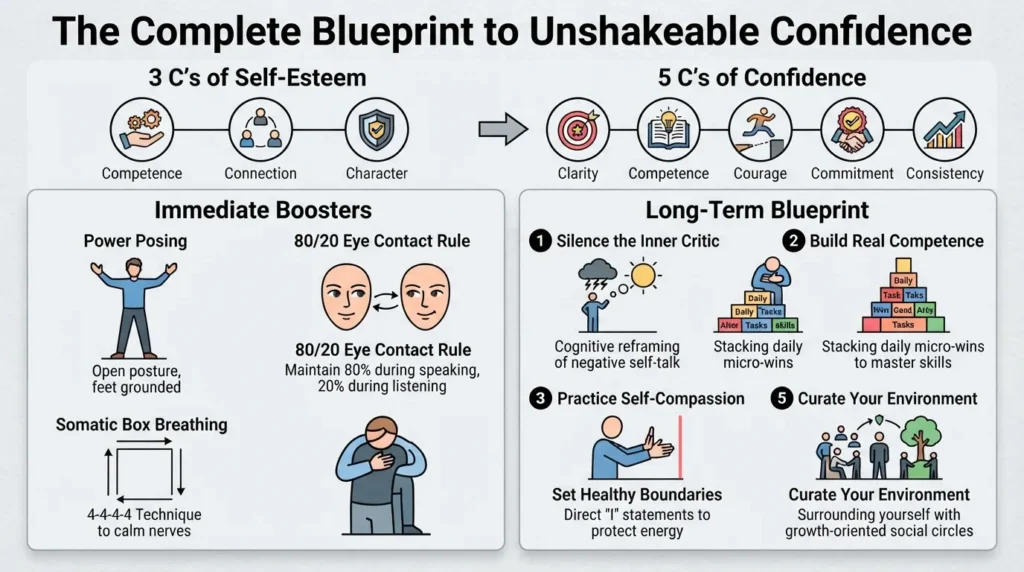
Confidence is not an innate trait reserved for a lucky few at birth; it is a psychological skill built through deliberate practice, self-awareness, and rewiring key neural pathways. If you have spent years struggling with self-doubt, social anxiety, or the persistent feeling that you aren’t “enough,” you are not broken—you simply haven’t been taught the correct framework.
In this comprehensive, evidence-based roadmap on how to build confidence, we discard vague platitudes like “just believe in yourself” and dive into actionable, science-backed strategies. Whether your goal is to master public speaking, assert yourself at work, or simply stop second-guessing every decision, understanding the root causes of a lack of confidence is your first step toward real transformation.
By the end of this guide, you will learn how to gain confidence grounded in genuine self-worth, leverage neuroplasticity to quiet your inner critic, and adopt actionable daily habits that will empower you to become a genuinely resilient, unshakeably confident person.
Understanding Confidence: What It Truly Means & Why You Need It
Self-Confidence vs. Self-Esteem vs. Self-Efficacy
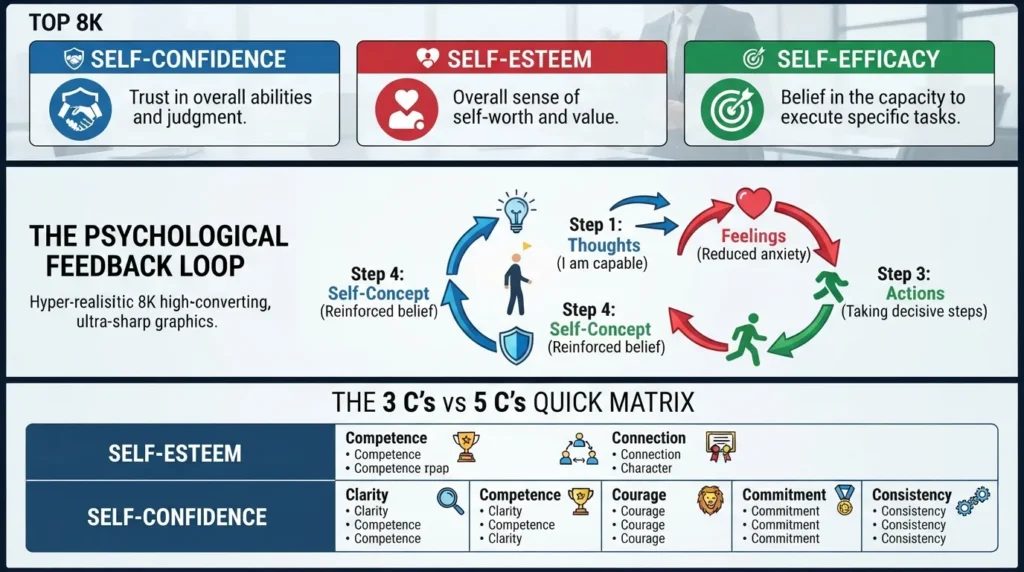
To raise your confidence level, you first need to understand what you are actually trying to build. People often use “self-confidence,” “self-esteem,” and “self-efficacy” interchangeably, but they represent distinct psychological pillars:
Self-Confidence: Your trust in your overall abilities and judgment to navigate various situations.
Self-Esteem: Your global sense of self-worth—how much you value, respect, and accept yourself regardless of external achievement.
Self-Efficacy: Your belief in your capacity to execute specific tasks or handle specific challenges (e.g., believing you can pass a specific exam vs. feeling generally capable in life).
Understanding these distinctions helps pinpoint where your growth is stalled. A person can have high self-efficacy in coding but suffer from a deep lack of confidence in social settings, or have high self-confidence in their career while struggling with low self-esteem overall.
The Psychological Feedback Loop
Confidence isn’t a static trait; it is a dynamic loop operating across three levels:
[ Thoughts ] ──> [ Feelings ] ──> [ Actions ] ──> [ Self-Concept ]
▲ │
└────────────────────────────────────────────────────┘
Thoughts: “I’ve prepared well for this meeting.”
Feelings: Reduced anxiety and a sense of calm readiness.
Actions: Speaking clearly, making eye contact, and offering constructive ideas.
Self-Concept: Your brain logs the success, reinforcing the belief that you are capable, which automatically shapes your future thoughts.
When you disrupt negative thoughts or take deliberate action despite feeling uncertain, you reset this loop in your favor.
The Myth of Born Confidence: Why Self-Assurance Is a Skill, Not a Trait
A common misconception is that confident people are simply “born with it.” In reality, self-assurance is a trainable mental muscle governed by neuroplasticity—the brain’s ability to reorganize itself by forming new neural connections throughout life.
Every time you face a new challenge, endure minor discomfort, or practice a skill, your brain strengthens the neural pathways associated with competence. Through repeated exposure and practice, actions that once caused anxiety become second nature. Confidence is not the absence of fear; it is the deliberate habit of taking action in spite of it.
The Extrovert Fallacy
Introversion is often mistaken for self-doubt, while loud extroversion is mistaken for self-assurance. Extroversion simply describes where you derive your energy (social interaction); confidence describes your trust in your own value and abilities.
Extroverted confidence often shows up as high energy, public speaking comfort, and quick social engagement.
Introverted confidence often manifests as deep listening, calm composure, strong internal conviction, and deliberate decision-making.
You do not need to alter your personality to become a confident person—you simply need to align your actions with your core values.
The 3 C’s of Self-Esteem & The 5 C’s of Confidence
To build a grounded sense of self, it helps to break down self-esteem and self-confidence into actionable components.
The 3 C’s of Self-Esteem
| Element | Description | Practical Example |
|---|---|---|
| Competence | Recognizing that you can acquire skills and solve problems. | Learning a new software tool to streamline your work. |
| Connection | Building healthy, reciprocal relationships where you feel valued. | Surrounding yourself with supportive peers who respect your boundaries. |
| Character | Living in alignment with your personal moral code and ethics. | Standing up for what is right, even when it is uncomfortable. |
The 5 C’s of Confidence
Clarity: Knowing exactly what you want, what your values are, and what steps you need to take.
Competence: Developing the actual skills required to succeed in your chosen area.
Courage: Taking action before you feel fully ready or comfortable.
Commitment: Dedicating yourself to a process or goal regardless of short-term setbacks.
Consistency: Showing up repeatedly over time to build undeniable proof of your capabilities.
The High Cost of Doubt: How Confidence Is the Key to Success in Life and Career
Self-doubt acts as an invisible tax on your potential. It causes hesitation, overthinking, and avoidance, leading to missed opportunities, unfulfilled potential, and chronic stress. When you second-guess your worth, you are far more likely to accept less than you deserve in your career, relationships, and personal goals.
Conversely, developing authentic self-assurance changes how you navigate the world:
Career Advancement: You advocate for promotions, negotiate effectively, take calculated risks, and share ideas without waiting for permission.
Healthier Relationships: You set clear boundaries, communicate openly, and avoid relying on external validation to feel complete.
Personal Fulfillment: You pursue goals based on genuine interest rather than fear of failure or fear of judgment.
Ultimately, confidence is the key to success in every domain of life because it translates internal capability into outward action.
Identifying the Root Causes & Signs of Low Confidence
What Causes Lack of Confidence?
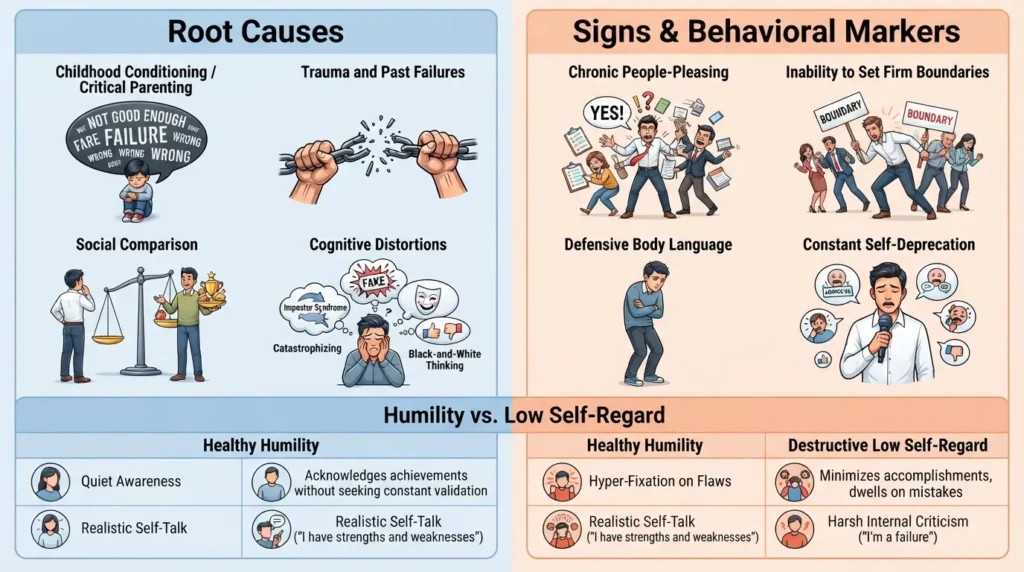
Low self-assurance does not develop in a vacuum; it is typically the result of accumulated experiences, environmental influences, and internal thought patterns. Identifying these underlying drivers is the first step toward lasting change.
Environmental and Developmental Factors
Childhood Conditioning & Critical Parenting: Early experiences heavily shape self-worth. Growing up with overly critical parents, unpredictable caregivers, or high-pressure academic environments can wire the brain to view mistake-making as dangerous.
Trauma and Past Failures: Bullying, emotional neglect, or significant professional setbacks can leave deep emotional scars. If left unprocessed, past failures transform into a belief that future failure is inevitable.
Social Comparison: Constantly measuring your unedited daily life against someone else’s curated highlight reel fuels dissatisfaction and reinforces feelings of inadequacy.
Cognitive Distortions
Your brain uses mental shortcuts to process information, but distorted thinking patterns skew reality and undermine your confidence:
Catastrophizing: Automatically assuming the absolute worst-case scenario will happen (e.g., “If I stumble during my presentation, my career is over”).
Impostor Syndrome: Persistently believing your accomplishments are due to luck rather than skill, accompanied by a constant fear of being “exposed” as a fraud.
Black-and-White Thinking: Viewing performance in binary terms—either an absolute success or a total failure—leaving no room for nuance or learning.
Recognizing the Signs of Low Self-Esteem and Self-Respect
Low self-confidence often reveals itself through subtle daily habits and behavioral patterns long before it manifests as overt self-doubt.
Common Behavioral Markers
People-Pleasing: Prioritizing others’ needs, opinions, and comfort at the expense of your own, driven by a fear of rejection or conflict.
Inability to Set Boundaries: Saying “yes” to demands you do not have the capacity for because you feel your own time and well-being are less valuable.
Avoiding Eye Contact & Defensive Posture: Subconsciously trying to make yourself smaller or unnoticeable in group settings.
Constant Self-Deprecation: Hiding behind self-mockery as a preemptive defense mechanism to criticism from others.
Defensiveness: Viewing constructive feedback as a personal attack on your character rather than an opportunity for growth.
Healthy Humility vs. Destructive Low Self-Regard
It is crucial to distinguish between genuine modesty and a destructive lack of confidence:
| Trait | Healthy Humility | Destructive Low Self-Regard |
|---|---|---|
| Focus | Quiet awareness of strengths without needing external applause. | Hyper-fixation on flaws, weaknesses, and perceived shortcomings. |
| Handling Praise | Gratefully accepts compliments while acknowledging teamwork or effort. | Deflects compliments, minimizes achievements, or assumes dishonesty. |
| Handling Failure | Views failure as a temporary setback or a valuable learning opportunity. | Views failure as proof of personal inadequacy and worthlessness. |
| Self-Talk | Balanced, compassionate, and realistic. | Harsh, punitive, and overly critical. |
Overcoming Social Anxiety and Lack of Confidence in Every Situation
Social situations frequently trigger self-doubt because human beings are evolutionary hardwired to seek group belonging and fear social rejection. In ancestral times, exile from the group meant physical danger, so your nervous system often treats potential judgment, awkwardness, or rejection as a threat to your survival.
Cognitive Reframing Tools
To calm your nervous system and reframe social anxiety, apply these two proven psychological frameworks:
The Spotlight Effect: People routinely overestimate how much others are paying attention to their appearance, mistakes, or performance. In reality, most people are absorbed in their own lives and internal anxieties. Realizing that you are not under a microscope instantly lowers the pressure to be perfect.
Rejection Desensitization: Build tolerance to social discomfort by intentionally seeking out low-stakes rejection. Start small: ask for a discount at a coffee shop, request a custom order, or ask a stranger for directions even if you know the way. By exposing yourself to mild social friction, you teach your brain that rejection is survivable and rarely fatal.
The Immediate Toolkit: How to Gain Instant Confidence in 5 Minutes or Less
What Is the Biggest Confidence Booster?
When you need an immediate boost in self-assurance—before walking onto a stage, entering a tough meeting, or starting a difficult conversation—waiting for deep psychological shifts takes too long. The fastest way to shift your state is to leverage the physical connection between your body and brain.
The single biggest confidence booster is quick momentum wins paired with deliberate physical shifts. You do not need hours of preparation to change how you feel; you simply need to change how you move, breathe, and speak. By altering your body’s physiological signals, you instantly disrupt anxiety loops and trigger feelings of readiness.
Physical & Behavioral Body Language Hacks
Your physical posture directly influences your hormonal output and neurological state. When you adopt high-power physical stances, you signal to your nervous system that you are safe, capable, and in control.
Posture and Physical Space
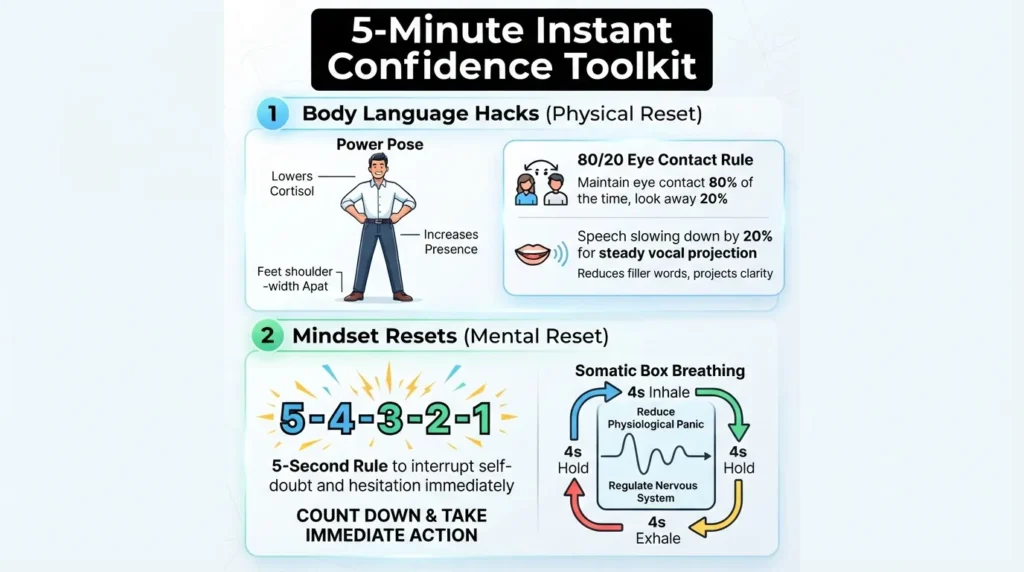
Power Posing: Stand tall with your feet shoulder-width apart, hands on your hips, and chest open for 60 seconds. Expanding your physical body reduces stress hormones (cortisol) and elevates feelings of personal power.
Open Posture: Keep your chest exposed, arms uncrossed, and shoulders rolled back. Avoid shielding your torso, as closed postures signal defensiveness and anxiety to both yourself and others.
Grounding Your Feet: Distribute your weight evenly across both feet. Feeling firmly connected to the floor prevents nervous pacing, fidgeting, or swaying, instantly projecting stability.
Taking Up Physical Space: Rest your arms comfortably on armrests or table surfaces instead of tucking them tightly against your sides. Claiming your immediate space builds internal self-regard.
Communication and Eye Contact Protocols
The 80/20 Eye Contact Rule: Aim to maintain eye contact 80% of the time while listening and 20% while speaking (or break eye contact naturally to process thoughts, then reconnect). Sustained eye contact signals trustworthiness and self-assurance.
Slowing Down Your Speaking Rate: Stress causes people to rush their words out of fear of losing the room’s attention. Deliberately slow your cadence by 15–20% and use intentional pauses. Speaking at an unhurried pace signals to others that your message is valuable and worth waiting for.
Rapid Mindset Resets
When anxiety or inner negative self-talk spikes right before an event, these two rapid reset techniques interrupt panic before it escalates.
The “5-Second Rule” for Interrupting Self-Doubt
Created by author Mel Robbins, the 5-Second Rule is a simple metacognition tool to bypass overthinking:
The moment you feel hesitation, fear, or self-doubt creeping in before taking action, count backward in your head: 5 – 4 – 3 – 2 – 1.
The countdown forces your prefrontal cortex to activate, interrupting default habit loops of hesitation.
As soon as you hit “1,” move physically. Step toward the microphone, raise your hand, or start your opening sentence immediately.
Somatic Box Breathing
When panic hits, your body enters a flight-or-fight response—shallow breathing, rapid heart rate, and shaky hands. Box breathing lowers your heart rate and signals safety directly to your parasympathetic nervous system:
Hold (4s)
┌──────────┐
│ │
Inhale (4s) │ Exhale (4s)
│ │
└──────────┘
Hold (4s)
Inhale: Breathe in slowly through your nose for 4 seconds.
Hold: Retain the air softly in your lungs for 4 seconds.
Exhale: Release the breath completely through your mouth for 4 seconds.
Hold: Keep your lungs empty for 4 seconds.
Repeat for 3 to 4 full cycles to completely reset your physiological state.
The Long-Term Blueprint: How to Become a Confident Person Step-by-Step
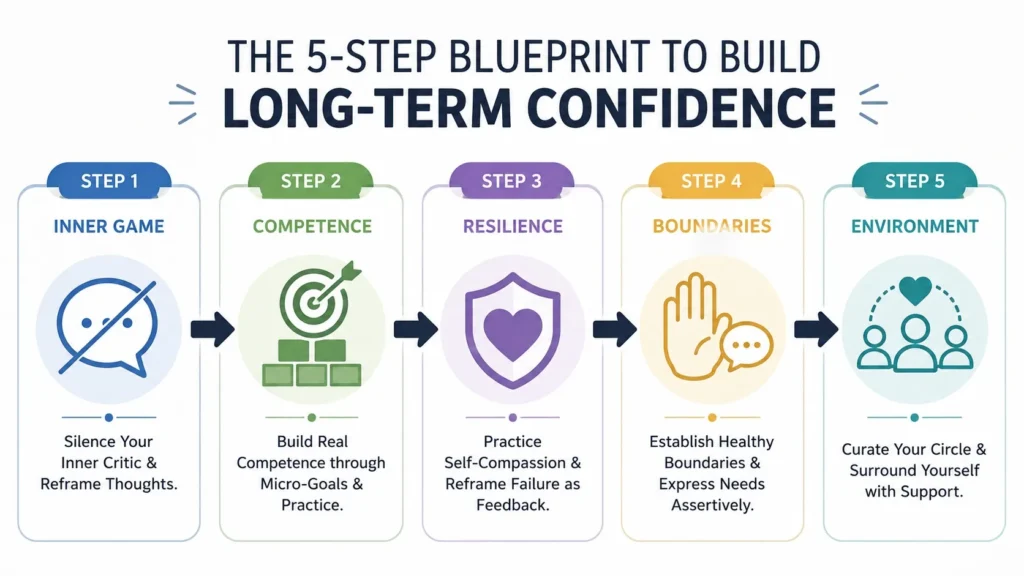
Step 1: Silence Your Inner Critic and Reframe Self-Talk
Long-term confidence requires changing your internal dialogue. The voice inside your head often operates on automatic loops, repeating harsh judgments you would never say to a friend.
Personify the “Obnoxious Roommate”
To stop identifying with negative self-talk, separate your core self from your inner critic. Treat that negative voice as an “obnoxious roommate”—an overly dramatic, unhelpful commentator who happens to share your mental space.
When you hear thoughts like “You’re going to ruin this presentation,” label it immediately: “There goes the roommate again, catastrophizing.” This creates psychological distance, transforming an absolute truth into just another background noise you can choose to ignore.
Reframe Thoughts with Objective Evidence
Replace emotionally charged judgments with objective, evidence-based statements:
Harsh Self-Talk: “I suck at public speaking; I’m going to embarrass myself.”
Objective Reframe: “I feel nervous, but I have prepared my slides, practiced three times, and answered questions successfully in past meetings.”
Focus on facts rather than feelings to evaluate your abilities accurately.
Step 2: Build Real Competence (The Competence-Confidence Loop)
Confidence is not born from unearned positive thinking; it is built on a foundation of tangible skills and proven experience.
┌──────────────────────────────────────────────────────────┐
│ The Competence-Confidence Loop │
└──────────────────────────────────────────────────────────┘
│
▼
┌───────────────────────────┐
│ 1. Skill Acquisition │
│ & Deliberate Practice │
└─────────────┬─────────────┘
│
▼
┌───────────────────────────┐
│ 2. Action & Execution │
└─────────────┬─────────────┘
│
▼
┌───────────────────────────┐
│ 3. Small Wins Staked │
└─────────────┬─────────────┘
│
▼
┌───────────────────────────┐
│ 4. Increased Self-Trust │
└─────────────┬─────────────┘
│
└────────────────────────┐
│
▼
(Repeats with Higher Goals)
Stacking Micro-Wins
To build momentum, set micro-goals that are so achievable it is almost impossible to fail.
Want to speak up more in meetings? Start by committing to asking just one question or making one brief observation in your next call.
Want to improve your physical fitness? Start with 5 minutes of daily stretching instead of an intense 90-minute routine.
Each completed micro-goal serves as a daily “win” that accumulates in your brain as hard evidence of your reliability and capability.
Deliberate Practice
To gain deep skill in any area:
Break down the skill: Divide complex tasks into smaller, manageable components.
Focus on weak areas: Spend dedicated effort correcting specific mistakes rather than repeating what you already do well.
Seek direct feedback: Measure your output objectively so you can adjust your approach rapidly.
Step 3: Practice Radical Self-Compassion & Resilience
Building self-assurance is not about avoiding failure; it is about changing how you respond when failure inevitably occurs.
Failure as Feedback, Not Identity
Distinguish between your actions and your identity:
Identity-Based Failure: “I failed the test, so I am a failure.”
Feedback-Based Failure: “I failed the test, which means my current study method was ineffective and needs adjustment.”
When you view failure strictly as data, setbacks lose their ability to destroy your self-worth.
The Self-Compassion Letter Exercise
When facing a major setback or personal disappointment, write a brief self-compassionate letter using these three components:
Mindfulness: Acknowledge your current pain without exaggerating it (“This situation is really painful and challenging right now”).
Common Humanity: Remind yourself that struggle is a universal human experience (“Everyone makes mistakes and feels overwhelmed at times; I am not alone in this”).
Self-Kindness: Offer yourself encouraging words as you would to a trusted friend (“I give myself permission to take a break, learn from this, and try again tomorrow”).
Step 4: Establish Healthy Boundaries & Assertiveness
A crucial part of self-assurance is honoring your own time, energy, and values.
How to Say “No” Without Guilt
You do not need to over-explain or fabricate excuses to decline a request. Practice simple, direct refusals that respect both your boundary and the other person:
“Thank you for thinking of me, but I don’t have the bandwidth to take this on right now.”
“I won’t be able to make it to that event, but I hope it goes great!”
Saying no to demands that drain you creates the space required to say yes to your own growth priorities.
Use Direct “I” Statements
Communicating assertively ensures your needs are voiced without resorting to aggression or passive-aggressiveness:
| Passive / Aggressive Approach | Assertive "I" Statement |
|---|---|
| "You always interrupt me and ignore my ideas!" | "I feel frustrated when I am interrupted, and I would like to finish sharing my thought." |
| "Fine, whatever you want to do is okay, I guess." | "I would prefer to eat at home tonight so I can rest." |
Step 5: Curate Your Environment and Social Circle
Your social environment constantly shapes your internal baseline for self-assurance.
Distance Yourself from Critical Influences
Identify people in your network who consistently criticize, undermine, or trivialize your goals. Limit your exposure to environments that trigger self-doubt or force you into people-pleasing patterns. Protecting your focus and energy is essential for sustainable personal growth.
Surround Yourself with Growth-Oriented Peers
Actively seek out communities, mentors, and friends who model emotional maturity, encourage your ambitions, and offer constructive support. Surrounding yourself with individuals who celebrate progress accelerates your development and reinforces a positive self-concept.
Building Confidence Across Specific Life Stages & Demographics
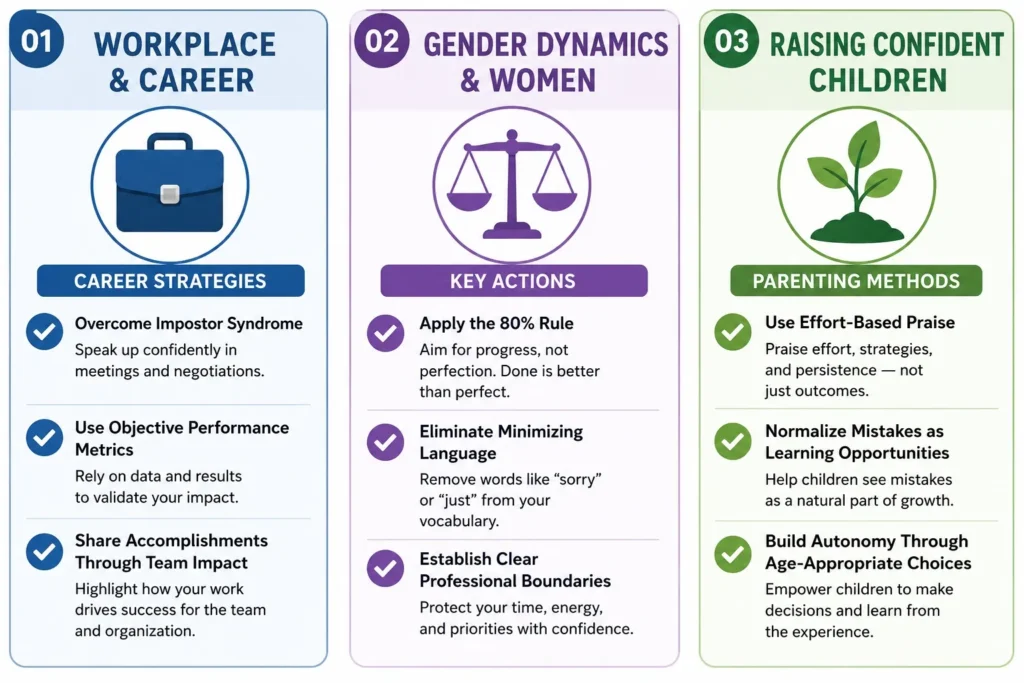
Workplace & Career Success: How to Build Confidence at Work
Navigating professional environments requires translating internal self-belief into clear, observable actions. Whether you are stepping into a new role or aiming for a promotion, building workplace confidence comes down to mastering key career moments.
Overcoming Impostor Syndrome in High-Stakes Situations
Meetings: Shift your mindset from “needing to prove myself” to “adding value to the conversation.” Prepare 1-2 key insights prior to the meeting and share them early—speaking in the first 10 minutes lowers the friction to contribute later.
Presentations: Treat nervous energy as excitement. Physiologically, anxiety and excitement are nearly identical (elevated heart rate, alertness). Tell yourself: “I am not nervous; I am energized to share this project.” Frame your slides around solving problems for your audience rather than defending your expertise.
Salary Negotiations: Base your conversation entirely on data and outcomes. Research market standards and outline your specific contributions. Frame your ask around objective metrics (e.g., revenue generated, processes optimized) rather than personal financial needs, removing emotional vulnerability from the process.
Sharing Achievements Without Arrogance
Promoting your work is not boasting; it is keeping your team and leaders informed.
Focus on Impact: Instead of saying “I closed a huge deal,” try “Our team secured a strategic partnership that increases quarterly revenue by 15%.”
Credit Collaboration: Highlight the efforts of your team members while acknowledging your leadership or execution role.
Share the Process: Talk about the lessons learned and problem-solving strategies behind a win, making your success instructional and inspiring rather than self-aggrandizing.
Gender Dynamics: Addressing Unique Challenges and how can we build self confidence in woman
Societal conditioning often encourages women to prioritize perfectionism, compliance, and modesty over assertiveness. Overcoming these deep-seated expectations requires intentional strategies tailored for professional and personal growth.
Deconstructing Perfectionism and the “Permission Trap”
Women are frequently socialized to avoid making mistakes, leading to the habit of waiting to feel 100% qualified before applying for jobs, taking risks, or offering opinions.
Adopt the “80% Rule”: Recognize that waiting for perfection leads to missed opportunities. Strive for high-quality execution rather than flawless perfection, and take action when you are mostly prepared.
Eliminate Minimizing Language: Audit your written and spoken communication for softeners like “I’m no expert, but…”, “Just checking in…”, or “Sorry to interrupt…” Replace them with clear, authoritative phrases such as “My recommendation is…” or “I want to highlight…”
Navigating Professional and Personal Boundaries
Building self-assurance involves dismantling the fear of being perceived as “bossy” or “unpleasant” when setting boundaries:
Separate Authority from Aggression: Assertiveness is stating your boundaries calmly and directly; aggression is imposing your will on others. You can be deeply kind and uncompromisingly clear at the same time.
Build Support Networks: Peer mentorship groups and professional networks provide a safe space to practice negotiation techniques, test ideas, and receive constructive validation.
Raising the Next Generation: Fostering a confident child
Helping children develop lasting self-assurance requires guiding them through challenges rather than shielding them from discomfort.
Effort-Based Praise vs. Person-Based Praise
The way adults praise children fundamentally shapes their response to failure and learning:
Person-Based Praise (Fixed Mindset): “You are so smart!” or “You’re a natural athlete!” This teaches children that success depends on innate talent, making them risk-averse out of fear of losing that label if they fail.
Effort-Based Praise (Growth Mindset): “I love how hard you worked on that math problem!” or “You kept practicing that piano section until you got it right.” This teaches children that competence comes from effort and perseverance, building resilience when faced with obstacles.
Nurturing Emotional Resilience
Normalize Failure: Share your own mistakes and how you handled them. When a child fails a test or loses a game, validate their feelings (“It’s disappointing to lose”) before exploring solutions (“What can we practice differently next time?”).
Encourage Autonomy: Avoid stepping in to solve every minor problem. Allow children to make age-appropriate choices, manage small responsibilities, and experience the natural consequences of their actions to build genuine problem-solving skills.
Expert Video Guide: Science-Backed Strategies to Build Unstoppable Confidence
Video Breakdown & Key Takeaways
This comprehensive guide breaks down the core physical and mental mechanics of self-assurance into actionable daily habits:
-
Visual Body Language Cues:
- Maintaining an open posture with arms uncrossed to project safety and authority.
- Using deliberate, controlled hand gestures within the "power plane" (between chest and waist line) to emphasize key points without appearing erratic.
-
Vocal Modulation Techniques:
- Finishing sentences with a downward inflection rather than an upward tone (avoiding "upspeak," which makes statements sound like questions).
- Strategic use of 2-second pauses before answering questions to project composure and control.
-
Daily Actionable Exercises:
- Practicing 2-minute daily posture checks to reset physical alignment.
- Rephrasing one internal self-criticism into an objective statement every morning.
Frequently Asked Questions
To increase your self-confidence long-term, focus on four daily habits:
- Stack micro-wins: Set and complete small, achievable daily goals to build undeniable proof of your capabilities.
- Adopt open body language: Ground your feet, open your posture, and maintain eye contact to signal calm authority to your brain and others.
- Challenge negative self-talk: Treat your inner critic as an external voice and reframe emotional judgments with objective, factual evidence.
- Focus on skill mastery: Invest continuous effort into improving specific competencies—real confidence follows genuine capability.
The 5 C's of confidence are:
- Clarity: Having a clear understanding of your values, goals, and direction.
- Competence: Developing the real skills needed to perform effectively in a given area.
- Courage: Taking action even when you feel fear or uncertainty.
- Commitment: Staying dedicated to your personal growth over time, despite setbacks.
- Consistency: Showing up repeatedly to build trust in your own reliability.
A lack of confidence typically stems from a combination of past trauma or early critical parenting, unhelpful cognitive loops (such as catastrophizing and impostor syndrome), frequent social comparison, and a lack of exposure to new challenges. When negative experiences are left unprocessed, the brain hardwires hesitation as a defense mechanism against potential failure or judgment.
- Adopt open body language: Stand tall, broaden your chest, and slow down your speech cadence.
- Challenge negative thoughts: Identify cognitive distortions and replace them with compassionate, evidence-based facts.
- Stack daily micro-wins: Break large goals down into tiny steps you can execute consistently.
- Practice self-compassion: Treat failure as constructive feedback rather than a direct reflection of your character or worth.
- Prepare thoroughly: Research, practice, and rehearse before high-stakes events to lower anxiety and sharpen execution.
You fix a lack of confidence by shifting from passive worrying to active exposure and incremental skill building. Stop waiting to "feel confident" before taking action. Instead, expose yourself gradually to uncomfortable situations (exposure therapy), master small skills step-by-step, and keep small daily promises to yourself until your nervous system adapts to taking calculated risks.
The single biggest confidence booster is taking deliberate action despite feeling fear—and keeping the promises you make to yourself. True self-assurance isn't built on compliments or positive thinking; it comes from having hard evidence that you can rely on yourself to act, endure discomfort, and figure things out.
A genuinely confident person typically exhibits:
- Comfort with uncertainty and admitting when they do not know something.
- The ability to acknowledge mistakes openly without becoming defensive.
- Active listening skills, giving others room to speak without needing to dominate the conversation.
- Relaxed, open body language and steady eye contact.
- A sincere willingness to celebrate the achievements of others without feeling threatened.
The three C's of self-esteem are:
- Competence: Knowing you have the ability to solve problems and master skills.
- Connection: Belonging to healthy, reciprocal relationships where you feel accepted and valued.
- Character: Living in alignment with your personal ethics, values, and principles.
Signs of low self-respect include tolerating poor treatment or disrespect from others, engaging in chronic people-pleasing at your own expense, making constant self-deprecating jokes as a preemptive defense, neglecting personal boundaries, and staying in unhealthy or toxic environments out of a fear of being alone.
When you need an immediate shift in high-pressure moments:
- Power posture: Stand grounded with an open posture for 60 seconds to lower stress signals.
- Vocal grounding: Slow your speaking speed down by 20% and use deliberate pauses.
- Somatic box breathing: Inhale for 4 seconds, hold for 4, exhale for 4, and hold empty for 4 to reset your nervous system.
- Instant action: Use the 5-Second Rule (count 5-4-3-2-1) and launch straight into action before hesitation sets in.
Nattaya Boonmee
Nattaya Boonmee is the Confidence Editor at Holistic Wellbeing Living. She writes about self-trust, boundaries, communication, and thoughtful personal growth. With five years of experience creating wellbeing content, Nattaya helps readers build confidence through preparation, self-respect, and small actions—not pressure to appear perfect.