Jump to:
ToggleJournal Prompts for Mental Health: 100+ Prompts to Process Emotions, Reduce Stress, and Build Self-Awareness
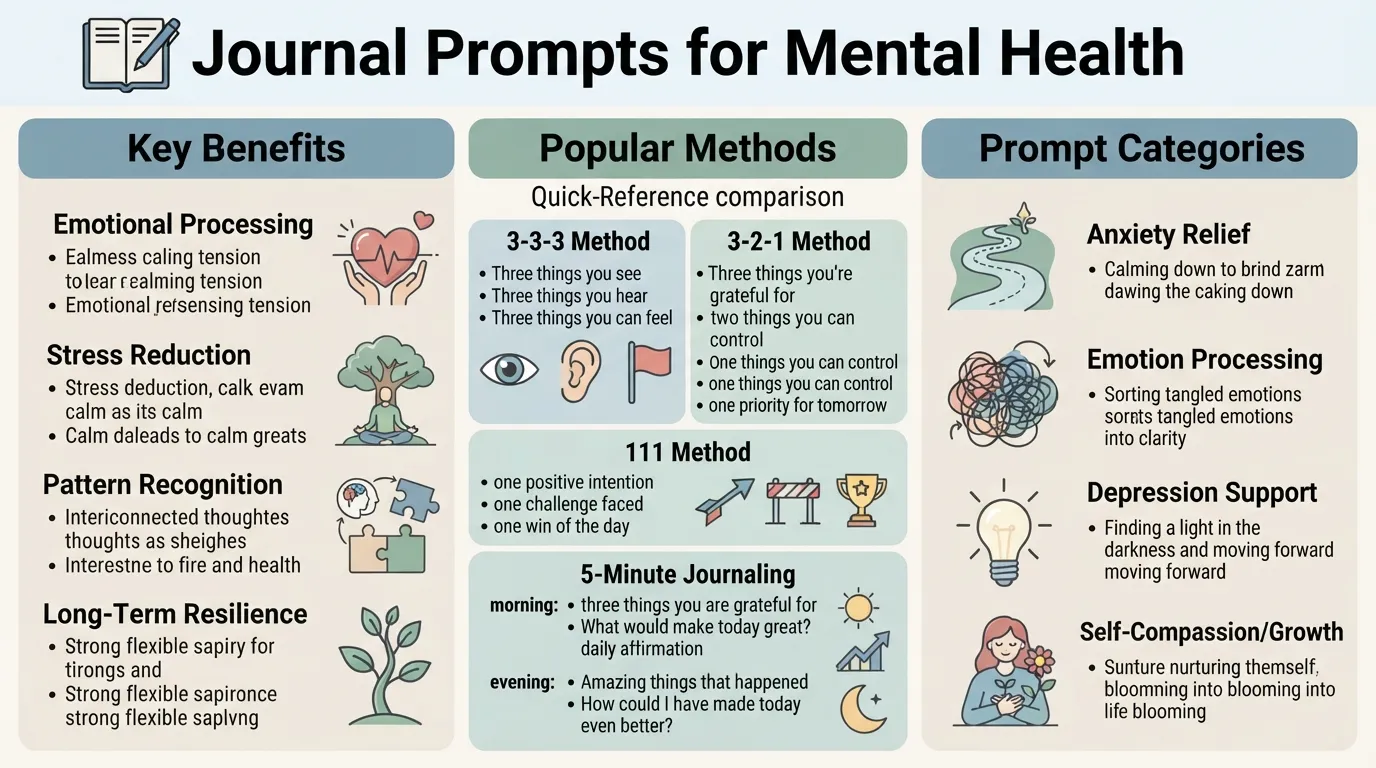
Think of mental health journal prompts as gentle entry points into your own mind. When your thoughts feel like a tangled knot or your emotions seem too heavy to name, a targeted question gives your pen a place to start. You aren’t writing for an audience, a grade, or an editor—you’re simply creating a quiet space on paper to figure out what you are carrying and why.
If you have ever opened a fresh notebook and felt intimidated by the blank white page, know that there is zero pressure to sound poetic or profound. There is no wrong way to do this. Your entry can be a single messy sentence, a bulleted list of frustrations, or three pages of uninterrupted stream-of-consciousness writing. The real therapeutic value comes from the honest act of getting things out of your head and down onto paper, not from how neat the handwriting looks.
Below, you will find practical methods to help you establish a low-stress routine, curated categories of prompts tailored to specific emotional states—from anxiety and burnout to self-compassion and growth—answers to common journaling questions, and a printable list to keep near your desk or bed whenever you need a quick reset.
What Are Journal Prompts for Mental Health?
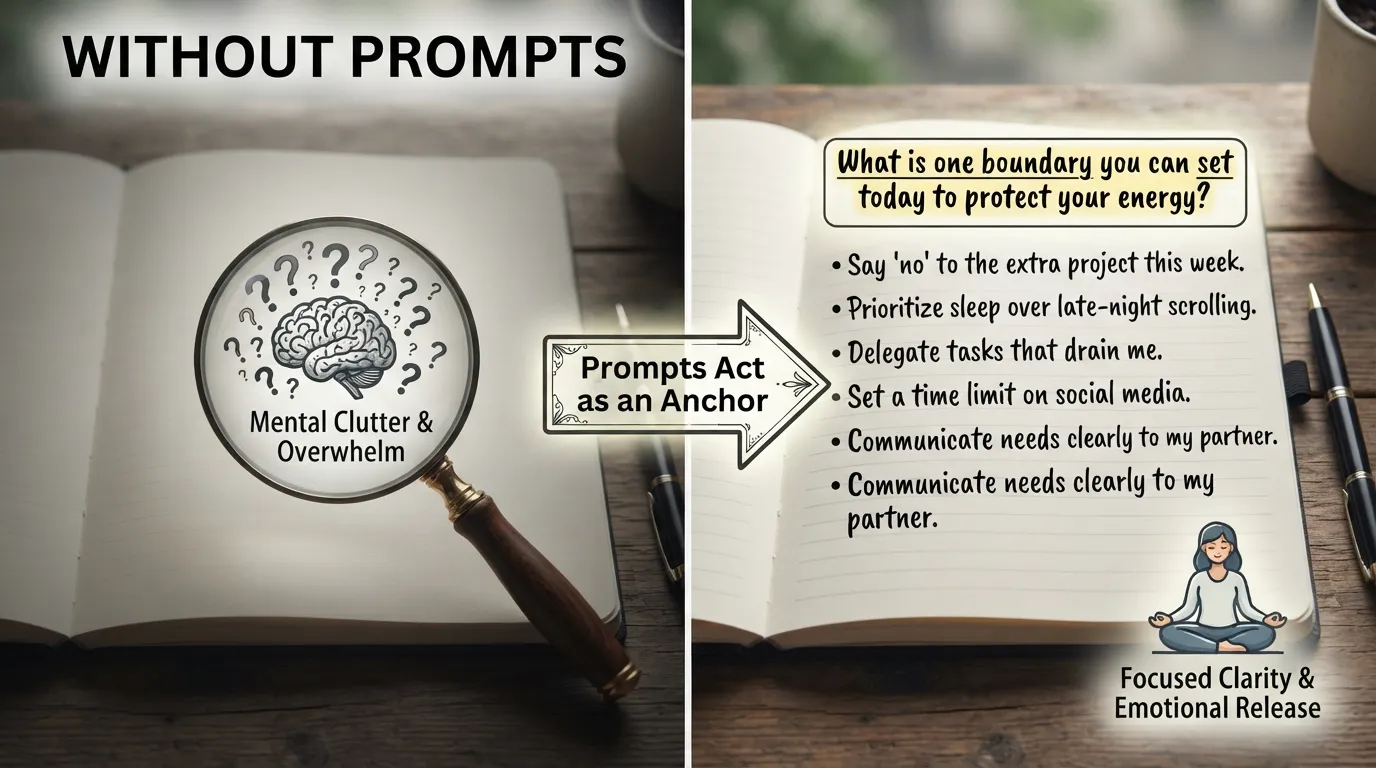
Mental health journal prompts are targeted questions or sentence starters designed to help you drop past surface-level thoughts and check in with yourself. Instead of staring at an empty page wondering what to say, a prompt gives your brain a specific anchor. It shifts journaling from an intimidating open-ended task into a focused, bite-sized conversation with yourself.
When you’re overwhelmed, anxious, or just plain exhausted, free writing can feel like opening a valve on a pressure cooker with no control. Prompts act like a steering wheel. By asking direct questions—like what your body is currently holding onto, or what one boundary could protect your energy today—they bypass the friction of starting and help you name what you’re actually feeling.
How Journaling Supports Your Mental Health
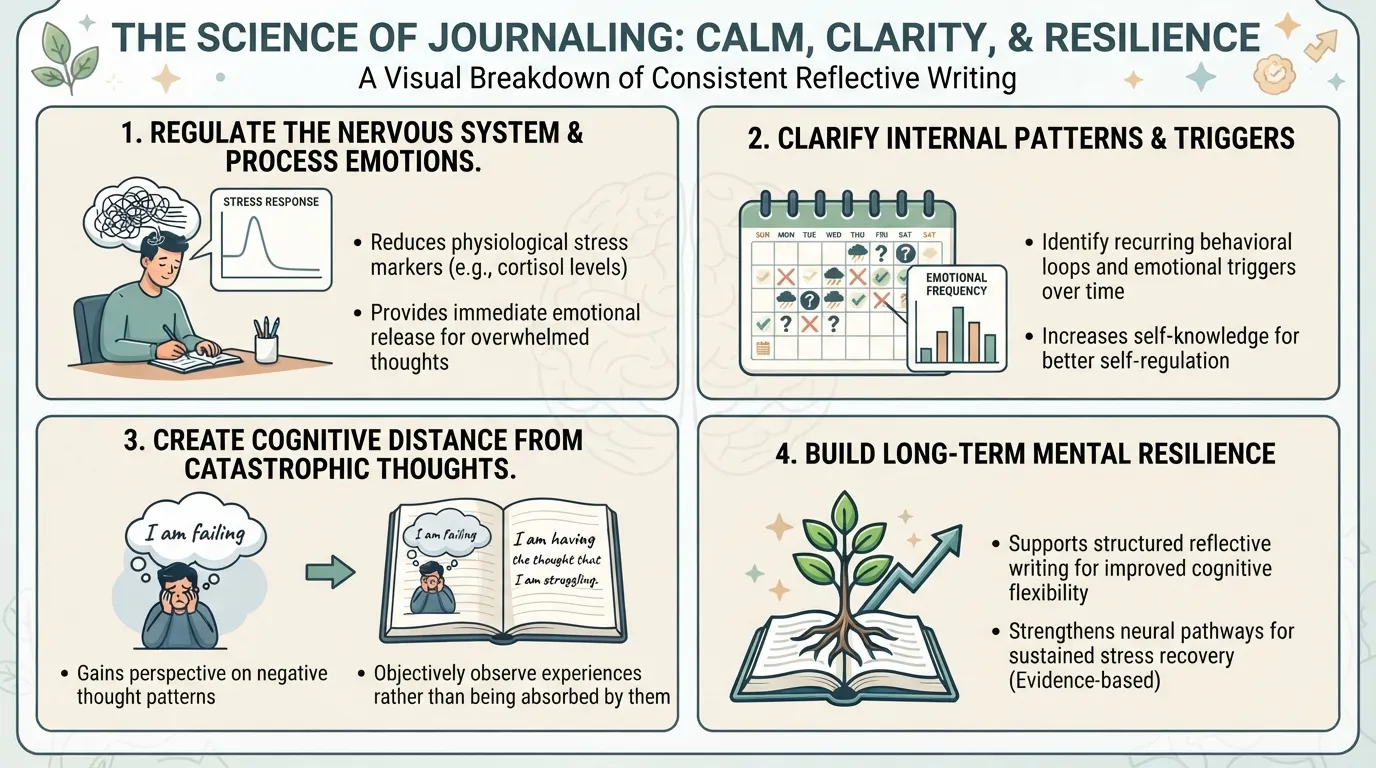
Putting thoughts into words changes how your brain processes them. When emotional noise stays trapped inside your head, it tends to loop endlessly. Translating those internal experiences into sentences on a page engages different neural pathways, turning vague, heavy sensations into concrete concepts you can actually look at and work with.
Processing emotions and reducing stress
Unexpressed stress acts like friction in the background of your day. Expressive writing gives those lingering feelings—frustration, grief, subtle anxiety—a dedicated outlet so they stop leaking into your work, relationships, and sleep. When you write down what is troubling you, your physiological response calms down; your nervous system registers that the threat has been acknowledged rather than ignored.
Building self-awareness and spotting patterns
Most of us react to life on autopilot, repeating habits without realizing why. Regular journaling creates a running record of your inner life. Over time, reviewing past entries reveals clear triggers and behavioral loops—like noticing you consistently feel drained after calls with a specific person, or that your self-criticism spikes on Sunday evenings. Once these patterns become visible on paper, you can finally make conscious choices to change them.
Creating emotional distance from overwhelming thoughts
When an anxious thought takes hold, it feels like an undeniable fact. Journaling creates crucial psychological distance between who you are and what you are feeling. The simple act of writing “I am having the thought that I am failing” instead of letting “I am failing” run on repeat reminds you that thoughts are just mental events, not objective truths. You become the observer of your experience rather than a captive to it.
Strengthening resilience over time
Journaling isn’t just about managing immediate distress; it builds long-term psychological strength. Documenting how you navigate difficult weeks creates a personal archive of your ability to endure and adapt. Research from public health institutions like the National Institutes of Health highlights how structured reflective writing supports stress reduction, helping people build cognitive flexibility and bounce back faster when life throws unexpected challenges their way.
Popular Journaling Methods for Mental Health
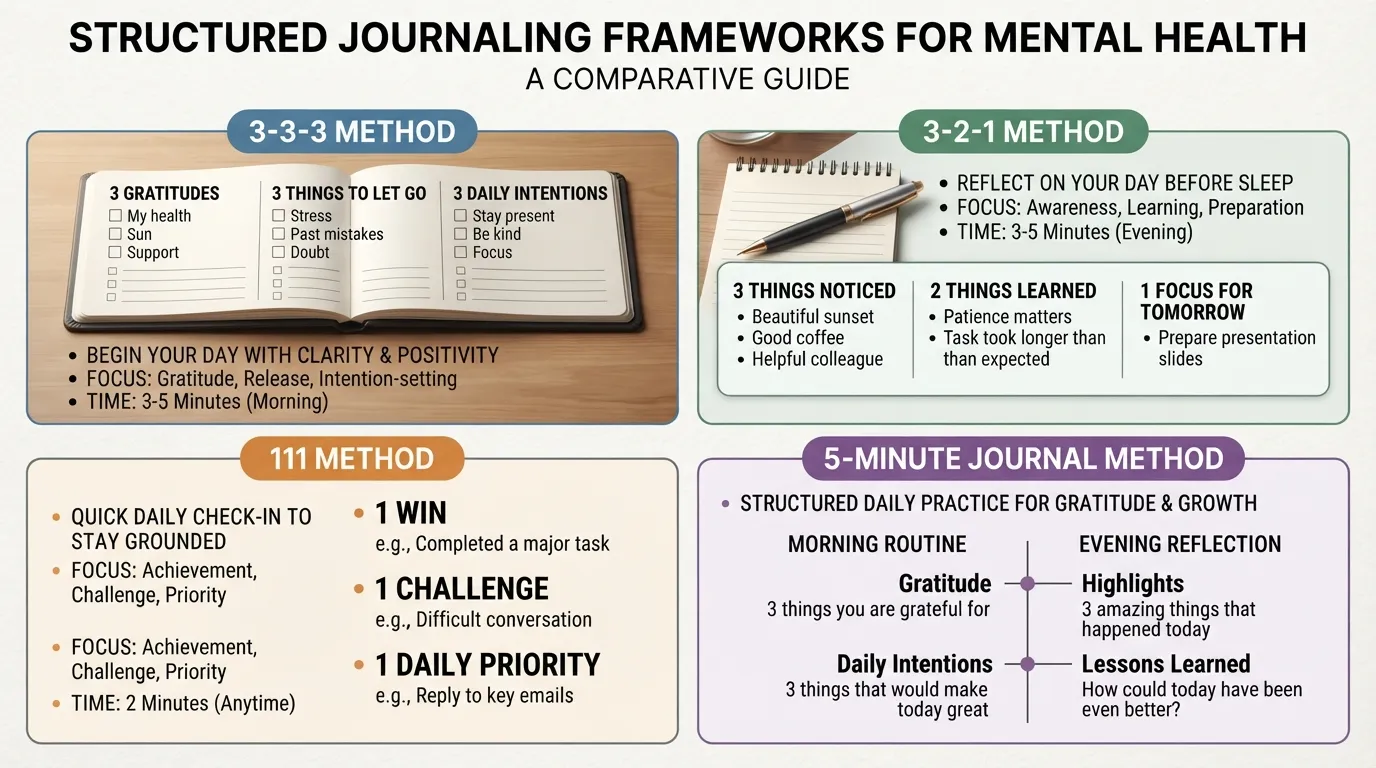
If sitting down with an open page feels too unstructured, structured journaling frameworks give your mind clear guardrails. Instead of wondering what to write, these popular daily methods use fixed numerical patterns or simple timed prompts to help you build a sustainable practice without overwhelming your schedule.
The 3-3-3 Journaling Method
The 3-3-3 method is a grounded, three-part daily check-in that balances emotional release, gratitude, and practical intention. It prevents you from dwelling entirely on negatives while keeping your expectations realistic.
To use it, answer these three prompts in your notebook:
3 things you are grateful for: Focus on small, specific details from the last 24 hours rather than broad concepts (e.g., “hot coffee on the porch” instead of just “my health”).
3 things you need to let go of: Write down lingering worries, minor irritations, or self-critical thoughts that are draining your mental bandwidth today.
3 small intentions for today: List three manageable actions or mindset shifts that will help you navigate your day with ease (e.g., “taking a 10-minute walk at lunch,” “saying no to extra tasks”).
The 3-2-1 Method
Designed for quick reflection, the 3-2-1 method cuts through mental clutter by narrowing your focus to what truly matters in the moment. It works exceptionally well as an evening reflection tool to wind down before bed.
To practice this method, write down:
3 things you noticed today: Ground yourself by listing sensory or emotional observations (e.g., the cool air outside, a moment of tension in your shoulders, a kind interaction).
2 things you learned: Identify insights about yourself, your work, or others, no matter how minor.
1 thing you want to focus on tomorrow: Pick a single priority or emotional focus to guide your next day, keeping your mind clear and intentional.
The 111 Journaling Method
The 111 method (often written as 1-1-1) is one of the fastest journaling routines available, taking under two minutes to complete. It is ideal for busy mornings or periods when low energy makes longer writing feel impossible.
To follow the 111 structure, answer just three simple lines:
1 win: Acknowledge one thing that went well or an effort you made recently, reinforcing self-efficacy.
1 challenge: Briefly name the primary stressor or obstacle currently on your mind without over-analyzing it.
1 focus: State one core priority or gentle reminder to ground your mindset for the rest of the day.
The 5-Minute Journal Method
Popularized as a quick morning and evening ritual, the 5-Minute method divides your practice into two short, structured bookends for your day. It uses repetitive daily prompts to train your brain toward positive focus and self-reflection.
How to structure your 5-minute entries:
In the morning (3 minutes): Write three things you are grateful for, three things that would make today great, and one daily affirmation (e.g., “I am capable of handling unexpected changes today”).
In the evening (2 minutes): Reflect on three highlight moments from the day and one lesson or thing you could have done differently to care for yourself better.
How to Use These Journal Prompts
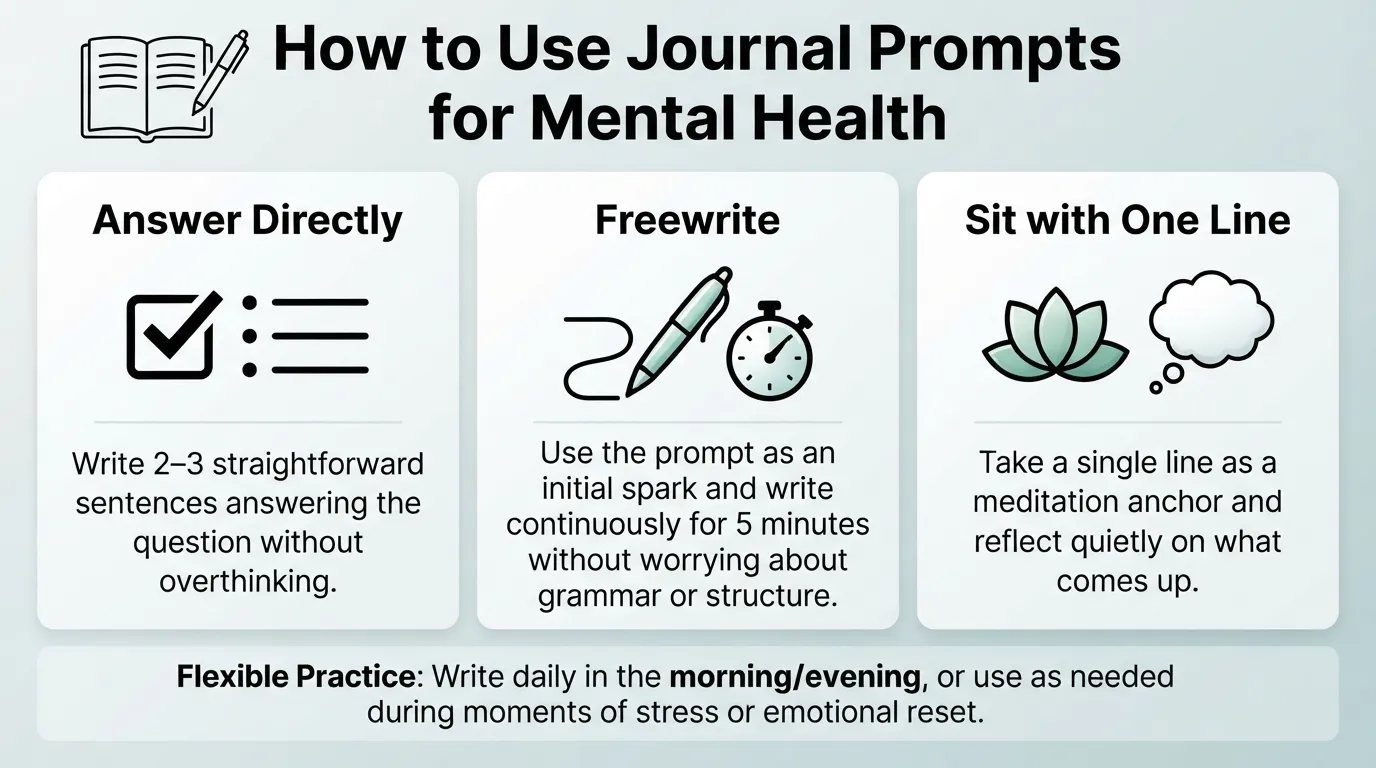
There is no formal playbook for using mental health journal prompts, and you don’t need any special training to get the benefits. All of the prompts provided on this page are completely free to use, copy, print, or save for whenever you need a moment of clarity.
When you pick a prompt, give yourself permission to respond in whatever format feels natural right now:
Answer directly: Write two or three straightforward sentences addressing the question directly without overthinking your wording.
Use stream-of-consciousness freewriting: Let the prompt serve as an initial spark, then keep your pen moving for five minutes straight without worrying about grammar, punctuation, or making sense.
Sit with a single line: Sometimes a prompt acts more like a meditation anchor. You might write just one sentence or a bulleted list and spend a few quiet moments reflecting on what came up.
You can also adapt your journaling schedule to fit your current season of life. A daily routine—spending five minutes every morning or right before bed—helps build a steady habit of self-reflection. However, an as-needed approach works just as well. Keeping these prompts handy for high-stress moments, emotional flare-ups, or Sunday evening resets allows you to treat journaling as a flexible mental health tool rather than another obligation on your to-do list.
Common Struggles When Journaling and How to Get Past Them
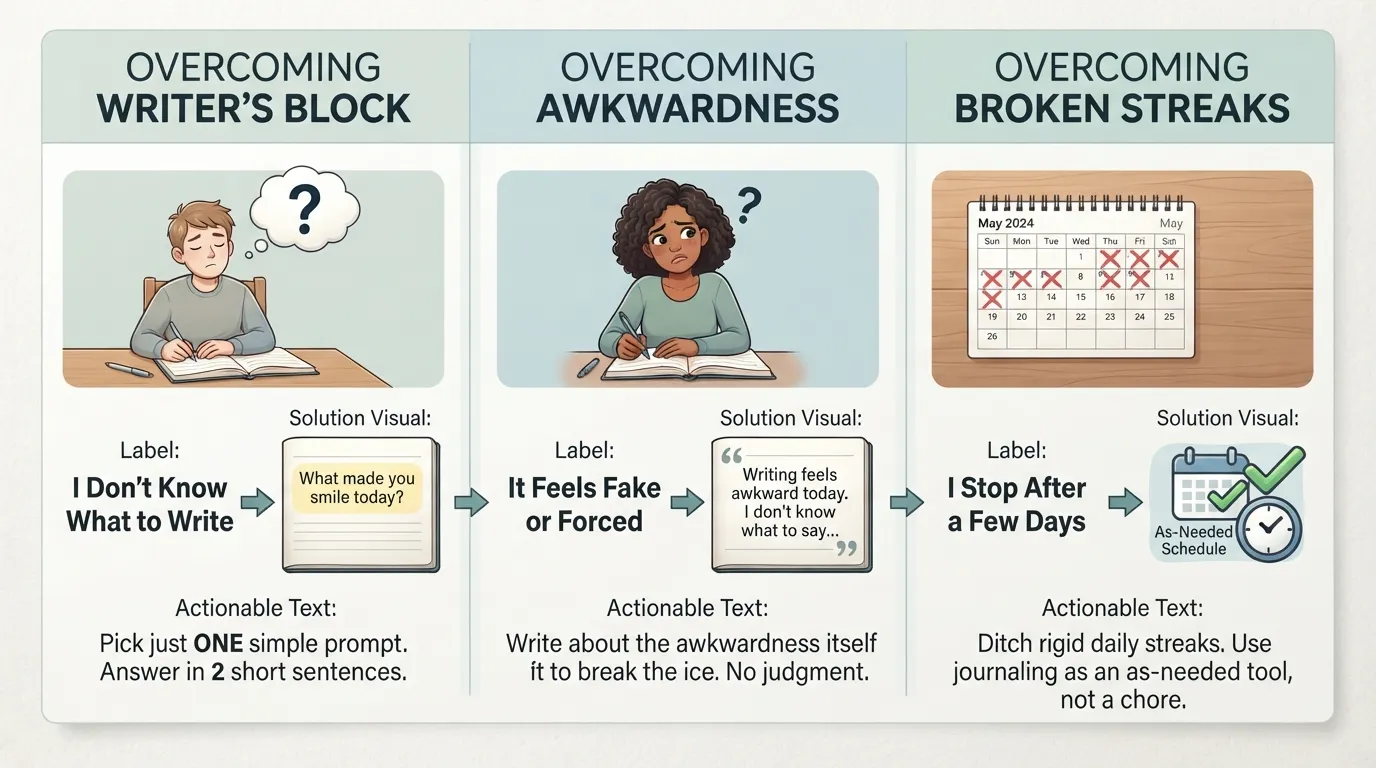
Starting a mental health journaling practice often looks effortless on paper, but hitting friction when you actually open your notebook is completely normal. Recognizing these common mental hurdles makes it much easier to keep going without judging yourself.
“I don’t know what to write”
Staring at a blank page causes instant decision paralysis. When your head feels crowded, trying to summarize your entire day or explain a complex emotion feels like a massive chore.
How to move past it: Don’t try to answer every question or chronicle your life. Scan a list of prompts and pick just one line that triggers an immediate reaction—even if that reaction is slight annoyance or curiosity. Write two honest sentences responding to that single question, and call it a win.
“It feels fake or forced at first”
If you aren’t used to expressing your inner thoughts on paper, sitting down to write about your feelings can feel awkward, performative, or unnatural. You might worry about sounding dramatic or feel like you are writing for an imaginary audience.
How to move past it: Expect that initial discomfort—it simply means you are trying a new skill. Your journal isn’t a stage, and nobody is grading your authenticity. If writing feels forced, start by writing about that exact feeling: “I feel ridiculous sitting here trying to write down my thoughts.” Acknowledging the awkwardness breaks the ice and gets your pen moving without pretense.
“I start strong and then stop after a few days”
Many people start a journaling habit with huge enthusiasm, only to skip three days in a row and abandon the notebook altogether out of guilt.
How to move past it: Shift your mindset away from rigid streaks. Journaling is a tool to support your well-being, not an assignment with an attendance grade. Missing days doesn’t mean you failed or broke the habit; it just means life was busy. Treat journaling as a low-pressure resource you drop into when you need clarity, whether that is every morning, twice a week, or once a month.
Daily Journaling Prompts for Mental Health
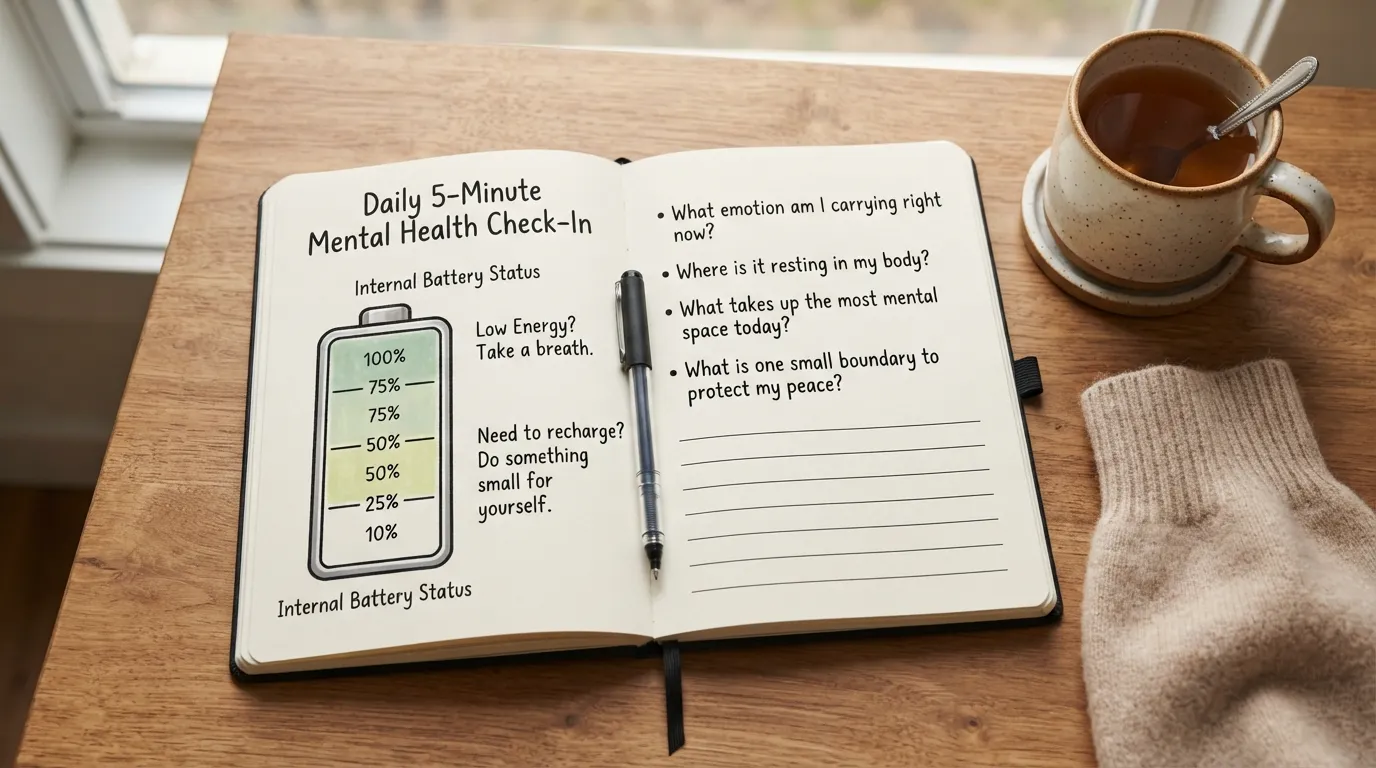
These quick daily prompts act as a gentle morning or evening check-in. They are designed to fit into a quick five-minute routine, helping you take an honest pulse on your day without feeling like an exhausting chore.
What is one emotion sitting near the surface for you right now, and where do you physically feel it in your body?
What is currently taking up the most mental space or bandwidth in your mind today?
What is one small boundary or choice you can make today to preserve your energy?
How would you describe your current internal battery percentage, and what is one simple thing that could restore a bit of power?
What is something you need to hear right now that you can tell yourself directly?
What is one minor task or worry you can safely give yourself permission to put off until tomorrow?
If today had a central theme or word, what would it be and why?
What is one gentle intention you can set for how you want to respond to stress today?
Journal Prompts for Emotional Awareness
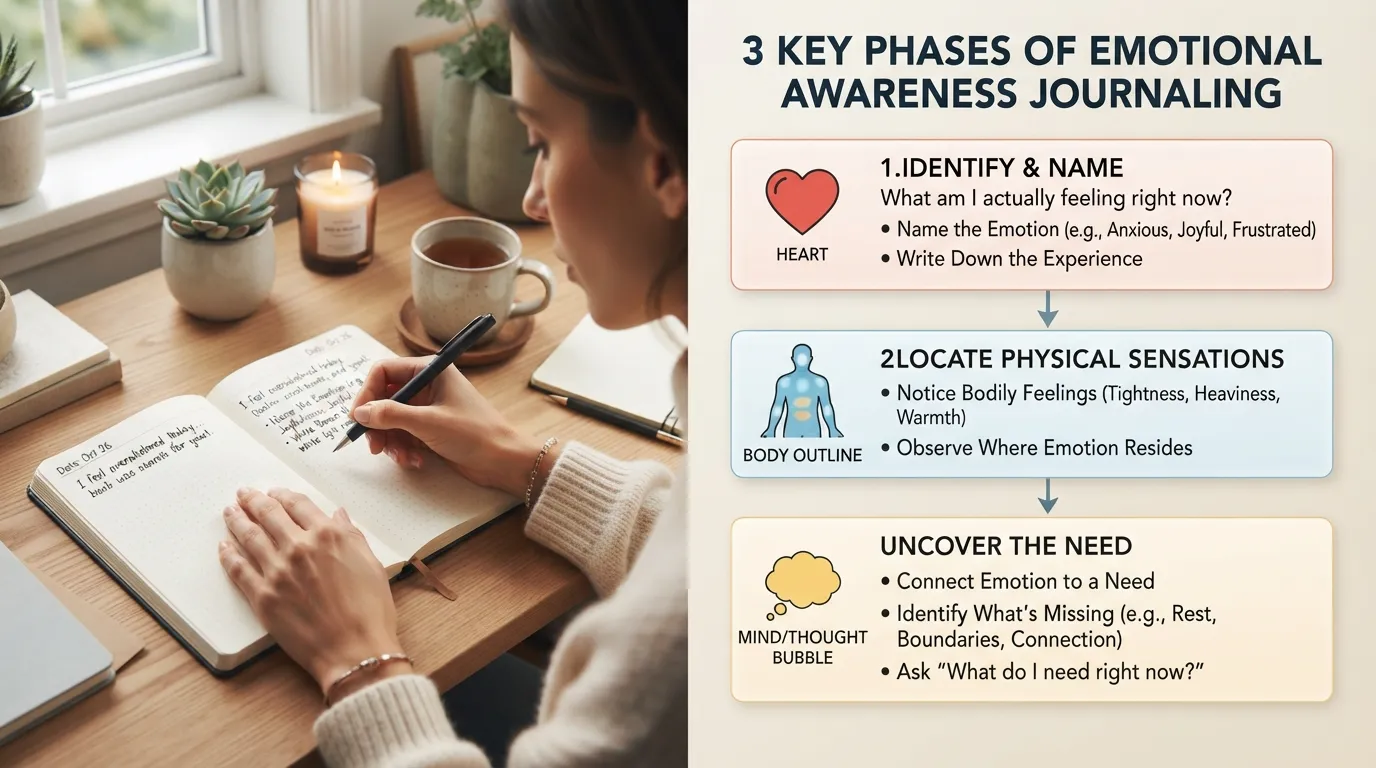
When emotions feel chaotic or vague, these prompts help you step back and name what you are experiencing. Use them to untangle complex feelings and understand what your emotions are trying to communicate.
What is a subtle feeling you have been ignoring or pushing aside over the last few days?
If your current primary emotion had a physical shape, weight, or temperature, how would you describe it?
What is a recent situation that triggered a stronger emotional reaction than you expected, and what felt so vulnerable about it?
Complete this sentence without overthinking: “Right now, I feel deeply misunderstood about…”
What emotion do you find hardest to allow yourself to feel, and what happens when you try to suppress it?
If your current mood was trying to protect you from something, what would that threat be?
When was the last time your emotional reaction didn’t match the reality of the situation, and what old habit was driving it?
What is an underlying need—such as rest, validation, or connection—that your present feelings are pointing toward?
Journal Prompts for Anxiety Relief
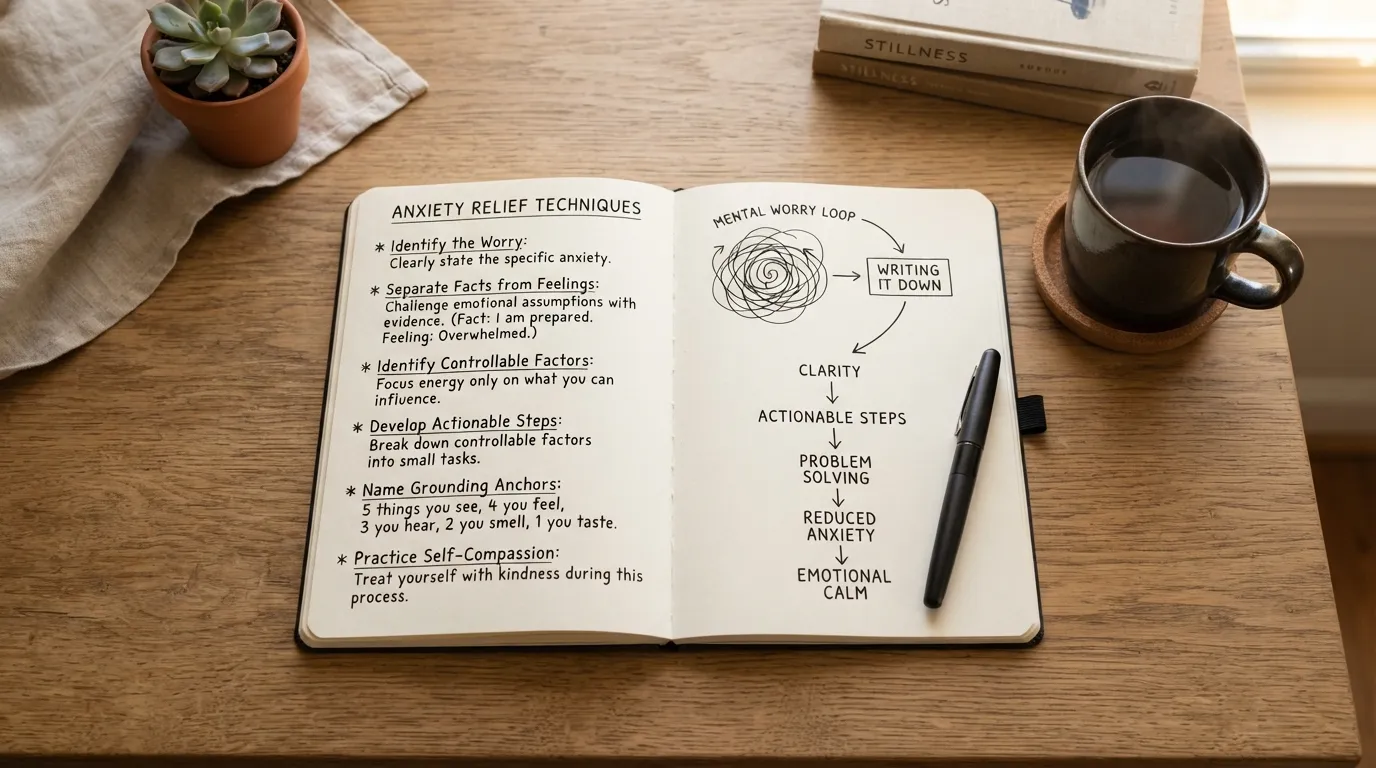
Journaling for anxiety is not about fixing or eliminating your fears on the spot; it is about getting them out of your head so you can evaluate them with clarity. When anxious thoughts spiral, they thrive on vagueness and speed. Writing forces your thoughts to slow down to the speed of your pen, transforming catastrophic internal scenarios into concrete sentences you can actually question and challenge.
According to resources from the National Institute of Mental Health, persistent anxiety involves excessive worry or fear that can disrupt daily activities. Using structured writing techniques helps interrupt these automatic worry loops by shifting your brain into a more logical, analytical state.
Try these targeted anxiety-relief prompts when your mind feels like it’s spinning:
What is the absolute worst-case scenario worrying me right now, and what are three realistic reasons I could handle it if it actually happened?
Which aspects of this stressful situation are genuinely within my control, and which aspects do I need to let go of?
What is an anxious story my brain is telling me right now that isn’t backed up by facts?
If a close friend came to me with the exact worry I am carrying today, what gentle advice would I give them?
What is one physical sensation of tension I am holding in my body right now, and what happens when I consciously take a deep breath into it?
What are three small, undeniable evidence points showing that I am safe in this present moment?
What is one minor action step I can take right now to lower the temperature of this worry?
Looking back at past times I felt this level of anxiety, what helped me navigate through it safely?
Journal Prompts for Depression
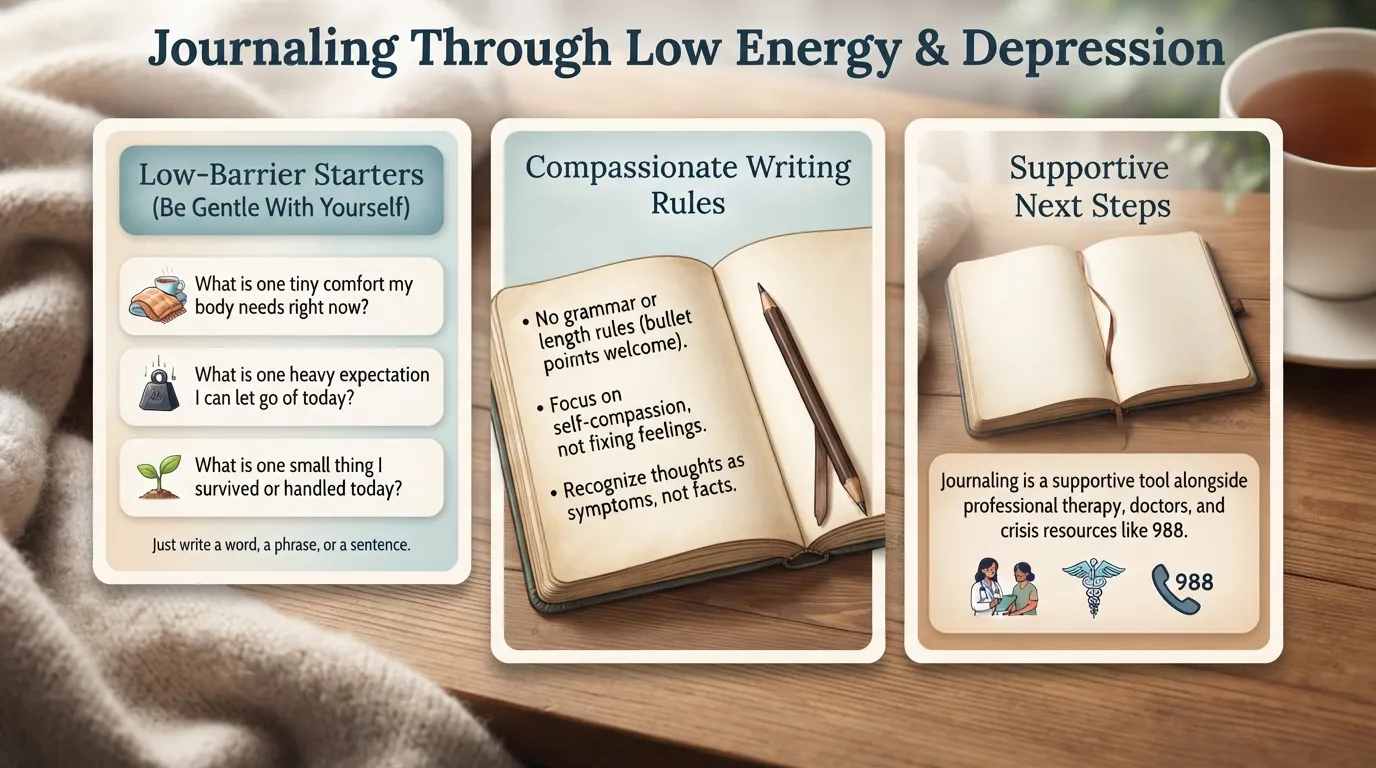
When you are navigating depression, opening a journal can feel like climbing a mountain when you barely have the energy to stand. If you find yourself staring at a blank page with total numbness or heavy exhaustion, please lower every expectation you have for yourself right now. Writing through low moods isn’t about forcing artificial positivity or fixing how you feel; it is simply about creating a safe, judgment-free harbor for whatever heavy weather you are currently weathering.
Clinical guidance from organizations like the National Institute of Mental Health highlights that depression involves persistent feelings of sadness, emptiness, or fatigue that can significantly impact daily life. While journaling cannot replace professional support, therapy, or medical treatment, it can offer a gentle complement to your care by giving unexpressed weight a place to land.
If you have the energy to write a few words today, try moving through these prompts with absolute gentleness:
What is one extremely small, low-effort comfort I can offer my physical body right now, even if it’s just drinking a glass of water or wrapping up in a blanket?
If my exhaustion could speak without any judgment or self-criticism, what would it tell me I need most?
What is a heavy expectation or standard I am holding myself to today that I can completely drop off my plate?
What is one tiny memory or moment from the past week—no matter how brief—that didn’t feel entirely gray?
If I were talking to a tired friend experiencing the exact same heaviness, what compassionate words would I offer them?
What is one thought or self-blaming story my mind is repeating right now that I can choose to recognize as just a symptom, not a fact?
What is one boundary I can set today to protect my depleted energy from outside demands?
What is one thing, no matter how small, that I survived or handled today simply by staying here?
Journal Prompts for Self-Compassion and Growth
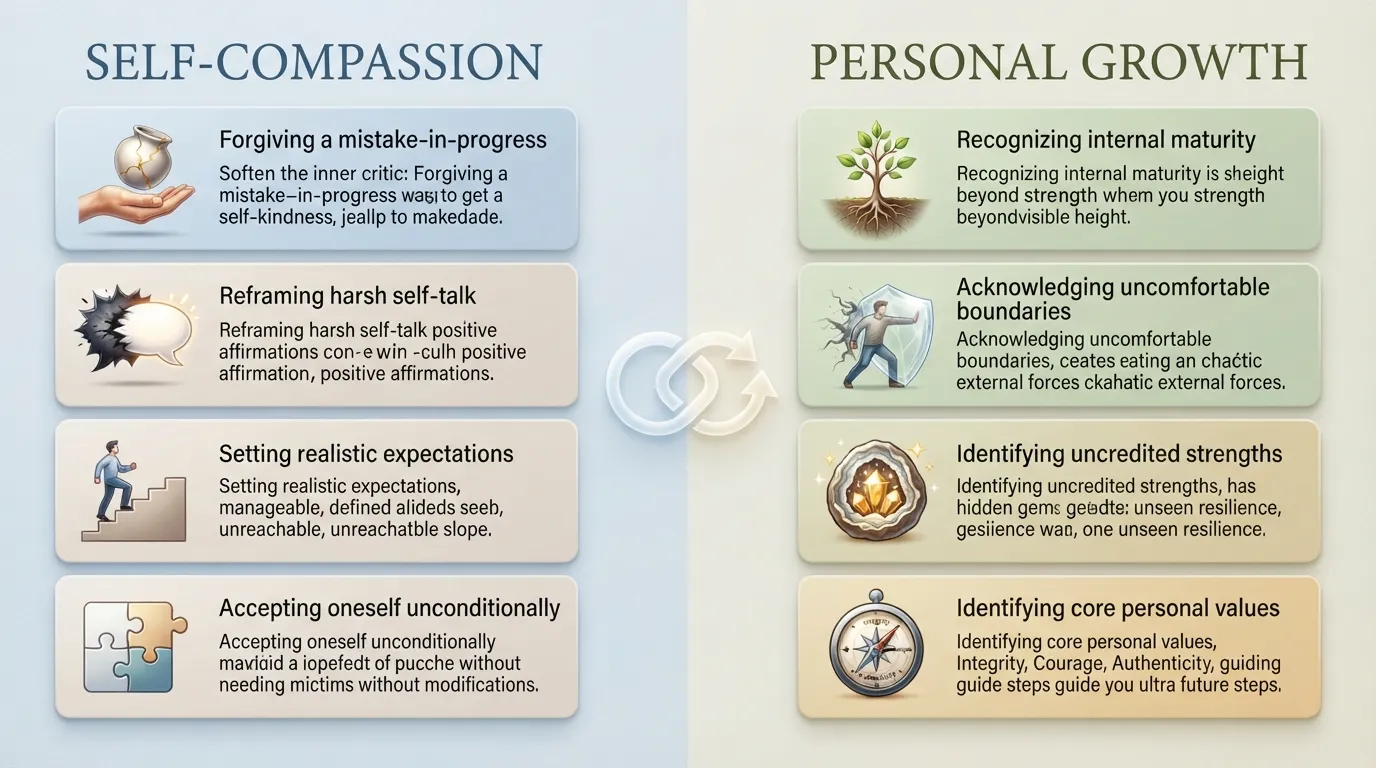
Self-compassion means giving yourself the same kindness, care, and understanding that you would extend to a good friend when things go wrong. These prompts are designed to help you soften your inner critic, celebrate subtle personal progress, and reframe missteps as natural parts of growing.
What is a mistake or mistake-in-progress I have been beating myself up over, and how can I view it with more grace?
In what area of my life am I being hardest on myself right now, and what would a softer, more realistic expectation look like?
What is one harsh statement my inner critic frequently makes, and how can I rewrite that statement using compassionate, factual language?
How have I grown or matured over the past year in a way that wouldn’t necessarily show up on a resume or social media profile?
What is a boundary I set recently that felt uncomfortable or scary to enforce, but ultimately protected my well-being?
What is something about my character, values, or effort that I rarely give myself credit for?
If I accepted myself completely as I am today, without needing to change or fix anything first, what decision would I make next?
What is a personal strength I relied on during a recent challenge that I can lean into again moving forward?
Wellness and Gratitude Journal Prompts
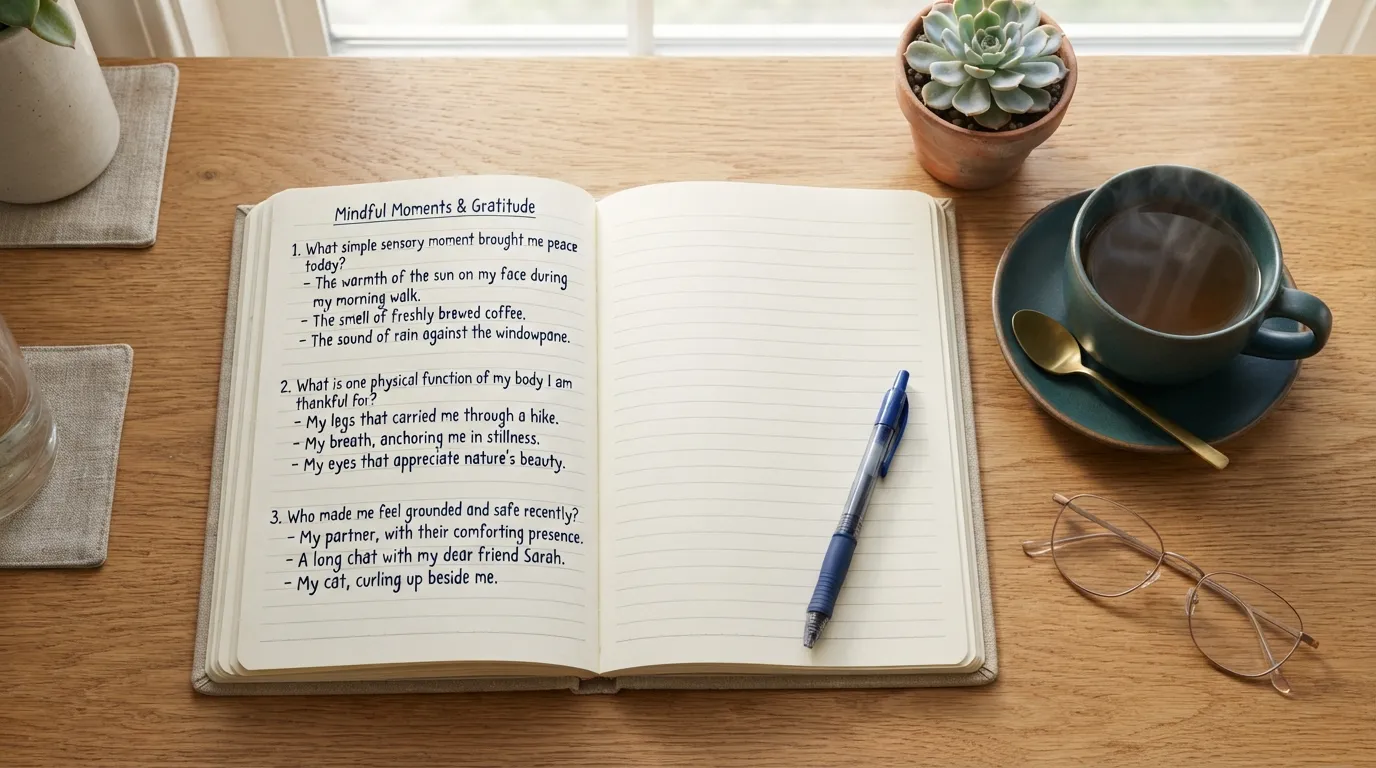
Gratitude isn’t about ignoring life’s real difficulties or forcing toxic optimism; it’s about shifting your awareness to notice the good things that exist alongside the challenges. These prompts help you cultivate grounded appreciation for everyday moments, your body, and the quiet spaces that support your overall well-being.
What is a simple sensory pleasure from today—a sound, smell, texture, or taste—that brought you a momentary sense of peace?
What is one physical capability or function of your body that you often take for granted, and how did it serve you today?
Who is a person in your life whose presence feels grounding, and what specifically about them makes you feel safe?
What is a ordinary object in your immediate surroundings that makes your daily life easier or more comfortable?
What is a recent piece of bad luck, a minor inconvenience, or a task you avoided that unexpectedly turned into a positive learning experience?
What is a small, quiet moment from the past week that felt genuinely restorative to your mind or body?
What is a skill, hobby, or personal practice that consistently helps you reconnect with yourself when you feel off balance?
What is one freedom, choice, or resource you have right now that your younger self would have been deeply grateful for?
Deep and Guided Journal Prompts Therapy-Style
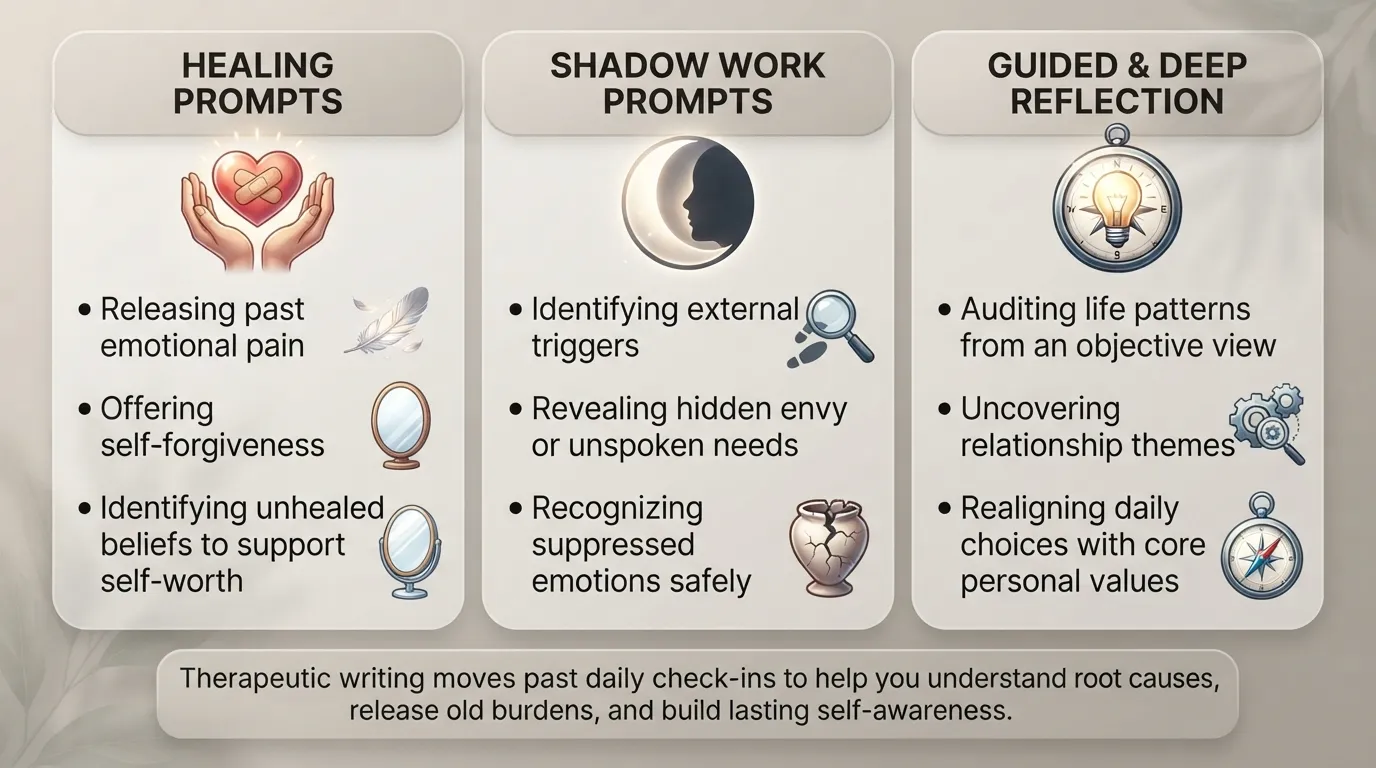
Deep, therapy-style journal prompts invite you to explore the root causes behind your current reactions, patterns, and self-perceptions. Going past daily check-ins, these reflective questions help you make sense of old emotional patterns so you can move forward with greater self-understanding.
Healing prompts
Healing writing focuses on processing past emotional pain, releasing old baggage, and offering care to parts of yourself that felt unsupported.
What is an unhealed emotional wound from your past that still influences how you respond to current stress or conflict?
What is a message you needed to hear during a difficult season in your life that you can speak to yourself today?
What is a belief about your self-worth that you picked up early in life, and is it truly serving you now?
What or whom do you need to forgive—including yourself—in order to free up emotional energy today?
In what ways have you been protecting yourself from getting hurt, and is that protection actually keeping you isolated?
Shadow work prompts
Shadow work involves exploring the hidden, ignored, or uncomfortable parts of your personality—like jealousy, resentment, or shame—without judgment.
What traits or behaviors in other people trigger intense annoyance in you, and what might that reveal about your own suppressed traits?
What is a secret envy or jealousy you harbor, and what unfulfilled need or desire is it pointing toward?
In what situations do you tend to hide your true feelings or put on a mask, and what are you afraid will happen if you drop it?
What is a personal rule or expectation you enforce strictly on yourself, and where did that rigid rule come from?
What is an emotion you consider “bad” or unacceptable to express, and how do you secretly act it out when you try to suppress it?
Guided/therapy-style deep reflection prompts
These structured questions mirror reflective therapy exercises, helping you identify behavioral loops and realign with your personal values.
If you look at your life right now through the eyes of an objective, compassionate observer, what core pattern or habit needs your attention most?
What is a recurring theme or argument in your close relationships, and what role do your own unmet needs play in it?
Where in your life are you currently settling for less than what aligns with your core values, and what fear is keeping you there?
If your current life story was a book, what title would you give the chapter you are living through right now, and how do you want the next chapter to begin?
What is one uncomfortable truth about your current routine or choices that you have been avoiding facing?
Printable Wellness Journal Prompts
If you prefer writing away from screens or want to keep a physical copy inside your paper planner, you can print this complete list of prompts to use anytime. Having a visual reminder on your nightstand or desk makes it much easier to stay consistent without needing to scroll through your phone every time you want to write.
To help you build a year-round practice, we have compiled these prompts along with an extended collection into a free 365-Day Mental Health Journaling PDF. This downloadable bonus gives you a fresh, structured reflection question for every single day of the year—categorized by month so you can easily navigate anxiety, self-compassion, boundaries, and personal growth at your own pace.
Looking for resources tailored to younger writers? If you are a parent, educator, or teenager looking for age-appropriate prompts on identity, peer pressure, and school stress, explore our dedicated journal prompts for teens guide.
Frequently Asked Questions
What is the 3-3-3 journal method?
The 3-3-3 journaling method is a structured daily writing exercise where you note three things you are grateful for, three things you need to let go of, and three small intentions for your day. It balances positive focus with practical action while preventing you from dwelling entirely on daily stressors.
What are 5 minute journal prompts?
5-minute journal prompts are brief, highly focused writing starters designed for quick daily check-ins. Typically used in the morning and evening, they focus on rapid reflection—such as listing three quick gratitudes, naming a daily goal, or identifying a single highlight from your evening—making journaling manageable even on busy days.
How to heal yourself mentally and emotionally?
Healing mentally and emotionally involves creating space to process suppressed feelings, setting healthy boundaries, and practicing self-compassion. Regular reflective practices like journaling help untangle complex emotions, while working alongside mental health professionals, building a supportive social network, and attending to physical wellness provide the groundwork for lasting emotional recovery.
What is the 3-2-1 method of journaling?
The 3-2-1 method is an evening reflection framework where you write down three things you noticed during the day, two things you learned, and one thing you want to focus on tomorrow. It helps quiet mental chatter before sleep by organizing your experiences into clear, bite-sized insights.
What is the dark side of journaling?
The main drawback of journaling occurs when it turns into repetitive rumination—endlessly looping over negative events without seeking perspective or emotional release. If writing leaves you feeling consistently more distressed, overwhelmed, or stuck in critical self-talk, it helps to switch to structured, solution-focused prompts or take a temporary break from the notebook.
What are some deep journal prompts?
Deep journal prompts are reflective questions that explore core beliefs, unhealed emotional patterns, shadow traits, and personal values. Rather than asking about your day-to-day routine, these prompts invite you to evaluate where you feel stuck, what unexpressed needs you are carrying, and how your past experiences influence your current choices.
What is the 5 minute journal method?
The 5-minute journal method uses a fixed morning and evening template to build a consistent mental health routine. You spend three minutes in the morning writing gratitudes, intentions, and positive affirmations, followed by two minutes at night reflecting on daily highlights and personal growth moments.
How to make a depression journal?
To start a depression journal, remove all pressure regarding grammar, length, or consistent schedules. Focus on low-barrier entries like bulleted energy check-ins, simple sensory observations, or identifying one tiny comfort from your day. Treating your journal as a gentle harbor rather than a demanding chore allows you to safely express heavy emotions without feeling overwhelmed.
How to properly journal for anxiety?
Properly journaling for anxiety involves getting vague, catastrophic thoughts out of your head so you can examine them logically on paper. Instead of just listing your worries, use prompts that ask you to separate facts from assumptions, identify what is within your direct control, and map out realistic coping strategies.
What is the 111 journaling method?
The 111 journaling method is a super-fast daily routine where you write down one win, one challenge, and one focus for the day ahead. Taking under two minutes to complete, it offers an immediate mental reset without requiring significant time or energy.
When Journaling Isn't Enough — Getting Extra Support
Journaling is a powerful self-reflection tool, but it is not a substitute for therapy, medical care, or crisis intervention. Writing can help you make sense of your internal world, but there are times when emotional pain requires more than a quiet moment with a notebook. Recognizing when you have hit the limits of self-guided reflection is a sign of self-awareness, not failure.
It may be time to reach out for external support if you notice any of these signs:
You feel stuck in a rumination loop: Writing down your thoughts consistently leaves you feeling more hopeless, panicked, or emotionally drained rather than relieved.
Daily functioning feels impossible: Persistent numbness, overwhelming anxiety, or heavy low moods make it difficult to manage basic tasks like working, sleeping, or taking care of yourself.
You feel completely isolated: You find yourself carrying deep emotional burdens alone because expressing them on paper still leaves you feeling disconnected from the people in your life.
You are experiencing intense distress: Thoughts of self-harm, severe hopelessness, or feeling unable to keep yourself safe begin surfacing in your writing.
If you are going through a mental health crisis or simply feeling completely overwhelmed, please know that immediate, compassionate help is available. You can call or text the 988 Suicide & Crisis Lifeline at 988 (available 24/7, free, and confidential) to connect with a trained counselor who can support you through difficult moments. Reaching out to a mental health professional, primary care doctor, or a trusted loved one is often the most important entry point on your healing journey.
Start Your Journaling Practice Today
Pick up your notebook, choose just one prompt that catches your eye, and let your pen move without worrying about how it sounds. You don’t need a fancy setup or a rigid daily rule to start untangling what you are carrying.
Bookmark this page or save your favorite prompts so you always have a quiet, reliable place to land whenever your mind needs a little extra room to breathe.
Pimchanok Srisuk
Pimchanok Srisuk is the Journaling Editor at Holistic Wellbeing Living. She writes about journaling prompts, reflective writing, emotional clarity, and mindful routines. With seven years of experience creating personal-growth content, Pimchanok helps readers use simple writing practices to understand their thoughts and make calmer everyday decisions.