The Complete Guide to Dream Journaling for Beginners
What is Dream Journaling?
Dream journaling is the practice of recording your dreams immediately upon waking up. It strengthens dream recall, enhances self-awareness, helps process subconscious emotions, and serves as a foundational step for experiencing lucid dreaming.
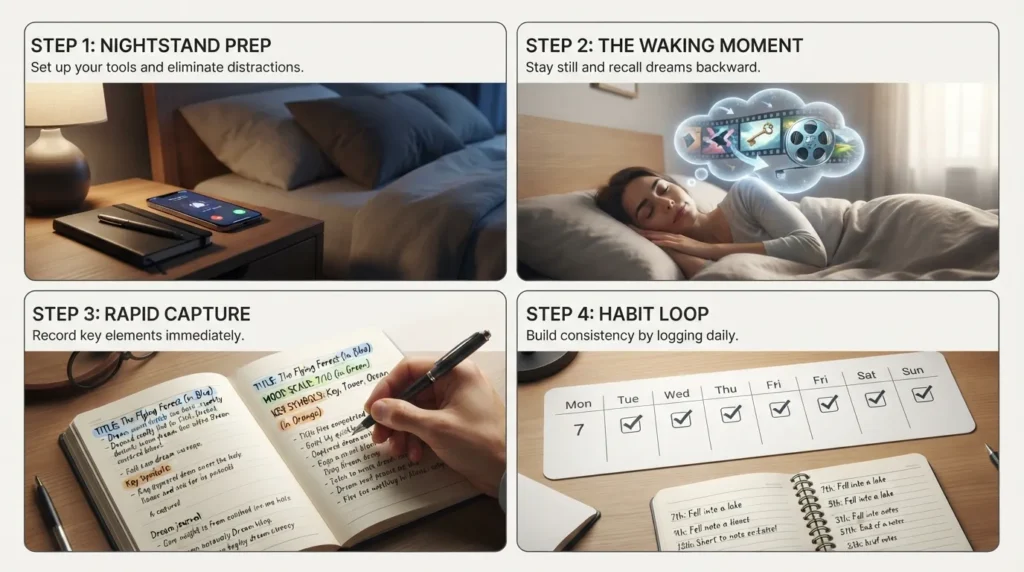
4 Steps to Start Today
Bedside Setup: Keep a dedicated notebook and pen (or a voice recording app) right next to your pillow before you go to sleep.
Stay Still Upon Waking: The second you wake up, do not move or check your phone. Keep your eyes closed and trace the dream backward in your mind.
Log Key Elements First: Write down the core emotion, key symbols, locations, and giving your dream a short 3-word title before details fade.
Set a Nightly Intention: Tell yourself right before falling asleep: “Tonight, I will remember my dreams clearly.”
Why Read Further?
Want to make this daily habit effortless? Keep reading to access our Free Downloadable Word Template, 15 Beginner Prompts, and Micro-Journaling Hacks for busy mornings when you only have 60 seconds to spare.
What is Dream Journaling & How It Works: The Science Behind Dream Recall
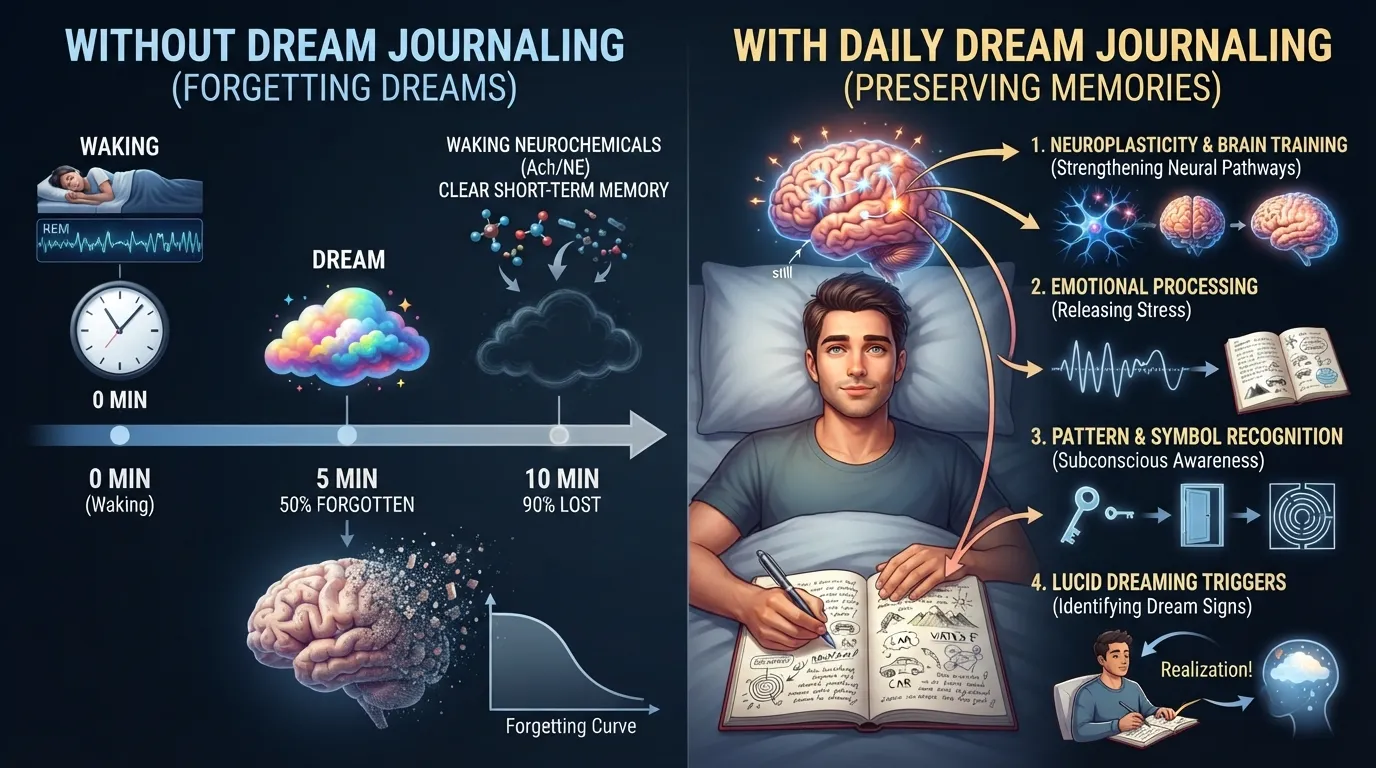
Dream journaling is not just a personal habit—it is a scientifically recognized practice grounded in cognitive psychology and neuroscience. To understand why dream journaling works, you first need to understand why your brain forgets dreams so quickly.
The Mechanism of Action: Why We Forget Dreams (and How Journaling Fixes It)
When you sleep, your brain transitions through various stages, with vivid dreaming occurring primarily during REM (Rapid Eye Movement) sleep. Upon waking, the brain undergoes a immediate neurochemical shift:
The Memory Erasure Window: Within just 5 minutes of waking up, you forget roughly 50% of your dream content. Within 10 minutes, nearly 90% is gone. This happens because the neurotransmitters responsible for transferring short-term memories into long-term storage (like norepinephrine) are operating at low levels during REM sleep.
Neuroplasticity in Action: Your brain prioritizes information it considers “important.” If you wake up and immediately jump into your morning routine—checking your phone, making coffee, or rushing out the door—your brain classifies dream memories as useless noise and erases them.
Training the Brain: By writing down your dreams the second you wake up, you send a clear signal to your subconscious that dream information is relevant. Over time, this consistent reinforcement builds neural pathways that dramatically sharpen your daily dream recall.
Core Science-Backed Benefits of Dream Journaling
Emotional Processing: Dreams act as a natural emotional filter, allowing your brain to process daytime stress and unresolved anxieties in a safe, simulated environment. Logging these experiences helps bring hidden emotional triggers into conscious awareness.
Subconscious Awareness: Keeping a record reveals recurring dream signs, recurring symbols, and underlying behavioral patterns. Recognizing these themes gives you deeper insight into your mental well-being and daily stress factors.
The Lucid Dreaming Link: Frequent dream logging helps you identify unique “dream signs”—unrealistic elements or recurring scenarios that only happen when you are dreaming. Once you become familiar with these patterns, you can use them as reality checks during sleep to trigger lucid dreaming (the ability to realize you are dreaming while still inside the dream).
Creative Boost & Problem-Solving: During REM sleep, the brain makes unexpected connections without the logical constraints of waking life. Historical innovators, writers, and scientists have used dream journals to capture creative breakthroughs, unique imagery, and solutions to complex problems before they slip away.
How to Keep a Dream Journal: The 5-Minute "Rewind Method"

Building a consistent dream journaling habit doesn’t mean writing lengthy essays every morning. By using the 5-Minute “Rewind Method,” you can capture vivid dream memories before they fade, even on your busiest days.
Step 1: Nighttime Prep & Intention Setting
Your morning dream recall actually begins the night before.
Bedside Setup: Place a dedicated physical notebook and pen directly on your nightstand within arm’s reach.
Zero Digital Distractions: Avoid using your phone as your primary journal if looking at screens immediately wakes your brain up or distracts you with notifications.
Set an Intention: As you close your eyes to sleep, repeat a simple internal phrase: “Tonight, I will remember my dreams when I wake up.” This primes your subconscious mind to hold onto dream memories upon waking.
Step 2: The “Rewind the Tape” Morning Technique
The moments immediately following awakening are critical for dream retention.
Stay Completely Still: When you wake up, do not open your eyes, change your physical position, or reach for your phone. Physical movement triggers waking brain waves that rapidly wipe out dream memories.
Trace Backwards: Start with the very last image, feeling, or scene you remember. From there, mentally “rewind the tape” step-by-step: Where was I before this happened? Who was I talking to? What started this scenario?
Step 3: Rapid Capture (What to Write First)
Once you have held the dream memory in your mind, open your journal and capture the essential building blocks first:
Emotion Level (1–10): Note the primary feeling (e.g., Anxiety: 7/10 or Peace: 9/10).
3-Word Title: Give the entry a quick headline (e.g., “Flying Over Mountains”).
Key Symbols & Settings: List prominent objects, recurring people, colors, or locations.
Main Narrative: Jot down a brief summary of the events in chronological order.
Step 4: Alternative Micro-Journaling Methods (For Busy Mornings)
If you don’t have time for a full entry, use these low-effort alternatives to keep your daily streak alive:
Voice Notes Method: Record a quick 60-second audio memo on your phone while still in bed, describing key scenes and feelings.
One-Word Mood & Symbol Method: Write down just one word for your mood and 2–3 keywords for the main symbols (e.g., Mood: Nostalgic | Symbols: Old School, Red Car, Ocean).
Sketching & Visual Doodling Method: Draw a rapid 30-second sketch of a vivid scene, map, or object from your dream. Visual memory often bypasses the need for complex descriptions.
Free Dream Journal Template for Word & Google Docs

To make dream tracking seamless, you can use this structured template. Copy and paste the table directly into Microsoft Word or Google Docs to create your own digital dream journal.
Ready-to-Use Copy-Paste Dream Journal Template
| Entry Field | What to Write / Example |
|---|---|
| Date & Time | September 4, 2026 | 7:15 AM |
| Mood Upon Waking | Peaceful (8/10) / Anxious (3/10) |
| Dream Title | 3-4 word title (e.g., “The Floating Library”) |
| Core Narrative | Quick 2–3 sentence summary of the main events and storyline. |
| Key Symbols & People | Specific colors, recurring characters, unusual objects, or locations. |
| Waking Life Connection | Any real-life events, thoughts, or emotions from yesterday that relate to this. |
How to Download & Use This Template in MS Word / Google Docs
Copy the Table: Highlight the table above, right-click, and select Copy (or press
Ctrl+C/Cmd+C).Open Your Document App: Launch Microsoft Word or create a new blank document in Google Docs.
Paste & Customize: Right-click inside the blank document and select Paste (or press
Ctrl+V/Cmd+V).Save as a Master Template: Save this file as
Dream_Journal_Template.docxon your device. Every morning, simply duplicate the table row or copy-paste a fresh table below your previous entry to build your ongoing dream log.
15 Practical Dream Journal Prompts for Beginners
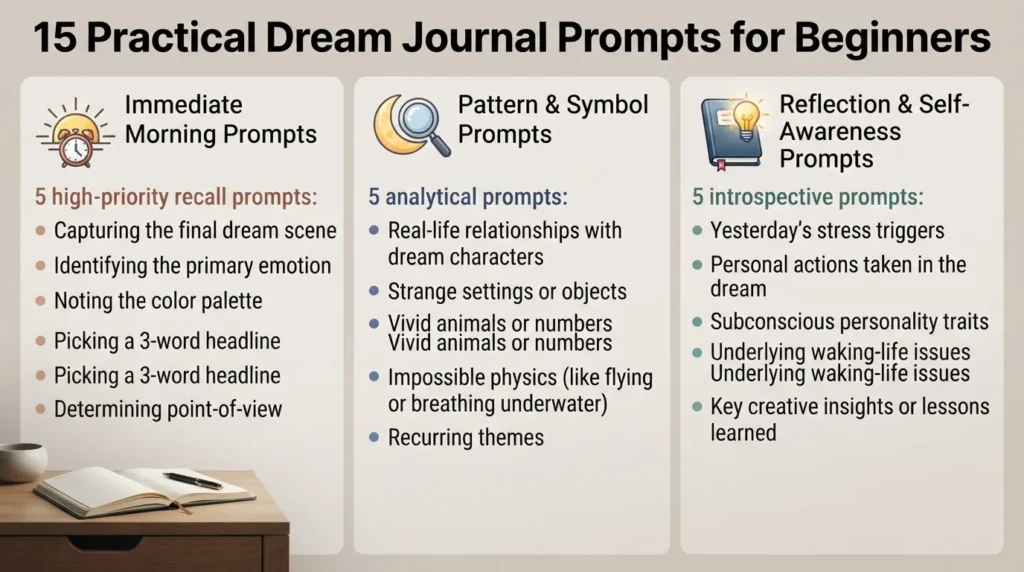
If you open your journal and feel stuck on what to write, using structured prompts can quickly unlock details from your subconscious. Use these categorized prompts to guide your daily reflection:
Category 1: Immediate Morning Prompts (Focus on Recall)
Use these prompts immediately upon waking to capture fading memories before they vanish.
“What was the very last scene or image I saw right before opening my eyes?”
“What was the dominant emotion I felt inside the dream, and how did I feel upon waking?”
“What was the overall atmosphere or color palette of the dream (bright, dark, hazy, vivid)?”
“If I had to give this dream a 3-word headline right now, what would it be?”
“Was I observing the events like a movie, or was I actively participating through my own eyes?”
Category 2: Pattern & Symbol Prompts (Focus on Details)
Use these prompts to track recurring themes and potential dream signs for lucid dreaming.
“Who was present in the dream, and what is my real-life relationship with them?”
“Did any location, house, or landscape feel unusually familiar, strange, or out of place?”
“Were there any specific objects, animals, or numbers that stood out during the narrative?”
“Did any laws of physics break (e.g., flying, floating, breathing underwater, changing shapes)?”
“Have I experienced a similar scenario, theme, or feeling in a previous dream?”
Category 3: Reflection & Self-Awareness Prompts (Focus on Meaning)
Use these prompts later in the day to connect your dream content to your waking life.
“What stress, conversation, or event from yesterday might have triggered this dream?”
“What action did I take in the dream, and did I react with courage, fear, or indifference?”
“If a specific character in the dream represented a part of my own personality, what part would that be?”
“Is there an unresolved issue or hidden emotion in my waking life that this dream is highlighting?”
“What lesson, creative insight, or warning can I take away from this experience?”
Common Challenges & Quick Hacks
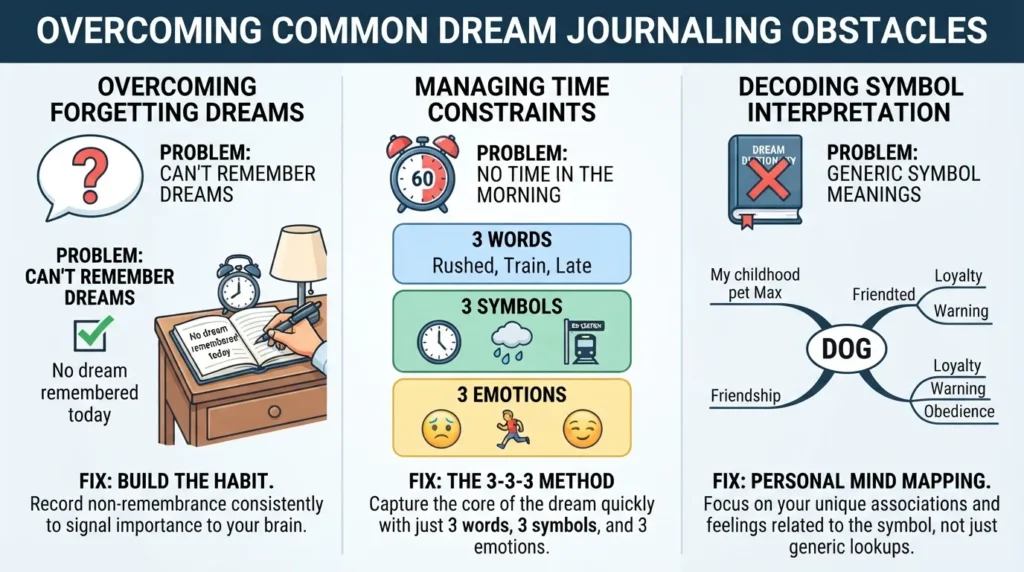
Starting a dream journal is simple, but staying consistent can be tricky. Here is how to overcome the most common roadblocks using quick, practical solutions:
Problem 1: “I Can’t Remember My Dreams at All”
The Solution: Write “No dream remembered today” in your journal every single morning without fail.
Why It Works: Doing this trains your brain to expect a recording session upon waking. Within 3 to 7 days of this consistent habit, your mind will naturally begin holding onto dream fragments.
Problem 2: “I Don’t Have Time for This in the Morning”
The Solution: Use the 3-3-3 Method (takes under 60 seconds).
How to Do It: Write down exactly:
3 Words: A mini headline (e.g., Late for Train).
3 Symbols: Key objects or places (e.g., Clock, Rain, Station).
3 Emotions: Primary feelings (e.g., Anxious, Rushed, Relieved).
Problem 3: “Do Dream Dictionaries Actually Work?”
The Real Answer: Generic dream dictionaries claim that specific symbols mean the exact same thing for everyone (e.g., “seeing a snake always means betrayal”). However, sleep psychologists emphasize that dreams are deeply personal.
The Better Approach: Context matters far more than fixed definitions. A dog in a dream might represent comfort to a pet lover, but fear to someone who was previously bitten. Always interpret your symbols based on your own personal feelings and waking life connections.
Frequently Asked Questions
What does dream journaling do?
Dream journaling trains your brain to recognize dream memories as important information rather than temporary noise. Scientifically, it strengthens your dream recall, boosts self-awareness, aids in emotional processing, and helps you identify subconscious thoughts, recurring symbols, and behavioral patterns.
What should I write in my dream journal?
You don’t need to write long, perfect paragraphs. Focus on capturing these core details:
Dream Title & Date
Waking Mood & Emotions (1–10 scale)
Core Storyline (A brief 2–3 sentence summary)
Key Symbols, Colors, Places, or People
Real-Life Connections (Any events from yesterday that might have triggered the dream)
Does dream journaling help with lucid dreaming?
Yes. Dream journaling is considered the foundation of lucid dreaming. By logging your dreams regularly, you learn to spot recurring “dream signs”—unrealistic elements or recurring scenarios that only happen while dreaming. Recognizing these patterns makes it easier to realize you are inside a dream and trigger in-dream awareness.
What is the 5-Minute Journal method for dreams?
The 5-Minute Journal method for dreams focuses on rapid, low-effort daily logging to keep the habit easy and consistent. Instead of writing a lengthy narrative, you spend just 5 minutes answering key structured prompts upon waking (e.g., Headline, Main Symbols, Primary Emotion, and Waking Life Connection).
What time of day should you dream journal?
You should dream journal within 60 seconds of waking up. Studies show that the human brain forgets up to 50% of dream details within 5 minutes of waking and 90% within 10 minutes. Recording your dreams immediately while remaining physically still gives you the highest chance of capturing vivid details.