
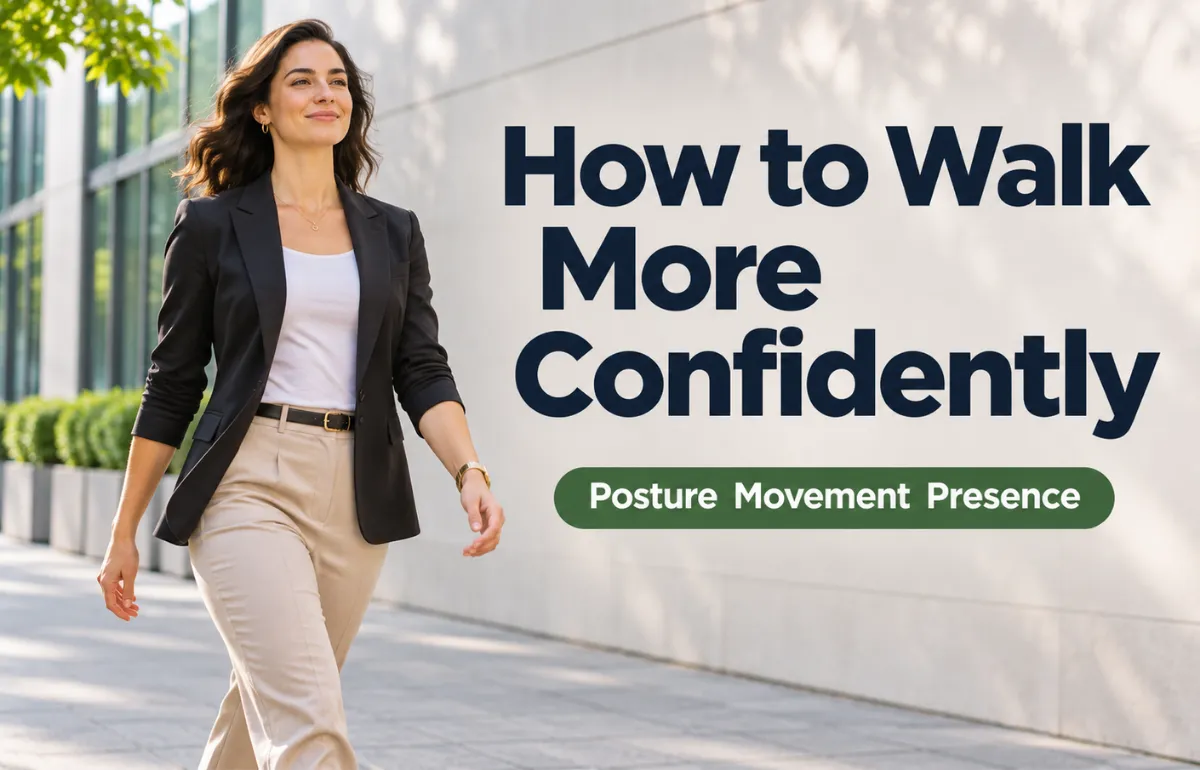
How to walk more confidently comes down to maintaining an upright but relaxed posture, taking natural and controlled steps, keeping your eyes forward, and moving with a clear sense of purpose. Let your shoulders relax, allow your arms to swing naturally, and maintain a steady walking pace without rushing or forcing your movements.
A confident walk is a balanced, purposeful way of moving that communicates composure and self-assurance through body language. It is not about looking intimidating, copying someone else’s walking style, or attracting attention.
I recommend focusing on how comfortably you move rather than how impressive you look. Even small adjustments to your head position, stride length, and body alignment can make a noticeable difference in your physical presence.
With regular practice, confident walking can become a natural part of your everyday life rather than something you constantly have to think about.
What Does a Confident Walk Look Like?
A confident walk looks relaxed, balanced, and intentional. Your movements appear natural, your posture remains open, and your walking rhythm suits your surroundings.
Imagine two people entering an office. One walks with tense shoulders, constantly checks their phone, and repeatedly changes their pace. The other moves steadily, looks ahead, and keeps their upper body relaxed.
The second person may appear more composed, even without saying a word.
Interestingly, research published in the Journal of Vision suggests that people interpret emotions through several features of walking, including movement speed, posture, and joint movements.
However, walking style alone cannot reliably reveal someone’s personality or actual confidence. Pain, fatigue, disabilities, and environmental conditions also influence movement.
The goal is to develop a walking style that feels comfortable and controlled for your own body.
How to Walk More Confidently: 13 Practical Ways
Learning to walk with confidence becomes easier when you understand how different parts of your body work together.
Here are the physical adjustments and movement habits I recommend prioritizing.
1. Maintain an Upright but Relaxed Posture
Good walking posture begins with natural body alignment. Your head should sit comfortably above your shoulders, while your upper body remains balanced over your hips.
Imagine creating a little more space between the top of your head and your waist. This mental cue encourages you to stand taller without forcing your spine into an uncomfortable position.
Avoid pushing your chest excessively forward or pulling your shoulders too far backward. Both habits can make your movements appear rigid.
Mayo Clinic’s walking recommendations also emphasize maintaining an upright head position and avoiding unnecessary tension throughout the upper body.
I prefer the idea of relaxed height over perfect posture. You want to appear comfortable in your body, not as though you are standing at military attention.
2. Keep Your Head Up and Your Chin Neutral
Your head position influences how the rest of your upper body moves.
Constantly looking downward can encourage your neck to bend forward. Meanwhile, raising your chin too high may create unnecessary tension and make your posture appear exaggerated.
Keep your chin in a comfortable, neutral position and direct your attention toward your surroundings.
On a clear, level path, looking several feet ahead is generally more useful than watching every individual footstep.
Naturally, you should still look down when navigating stairs, uneven surfaces, or obstacles. Confident body language should never come at the expense of safety.
3. Relax Your Shoulders Instead of Forcing Them Back
One of the biggest misunderstandings about confident posture is that your shoulders must always be pulled backward.
Excessively retracting your shoulders can restrict natural upper-body movement and make walking feel uncomfortable.
Try gently raising your shoulders toward your ears and then allowing them to settle naturally. Notice how your arms feel when that tension disappears.
Let your chest remain comfortably open without exaggerating its position.
If your shoulders gradually rise again while walking, release the tension rather than repeatedly correcting your entire posture.
4. Find Your Natural Stride Length
Taking longer steps does not automatically make you look more confident.
Overstriding can disrupt your balance and make your walk appear forced. Similarly, unnecessarily shortening your steps may interrupt your natural walking rhythm.
Allow your feet to land at a comfortable distance based on your height, mobility, and walking speed.
Harvard Health Publishing recommends avoiding excessively long strides because they can interfere with balance.
A useful experiment is to walk normally for several seconds, deliberately lengthen your steps, and then return to your usual stride.
Notice which version requires less effort. A confident stride should feel sustainable, not like a movement you must constantly maintain.
5. Walk at a Steady, Purposeful Pace
Walking confidently is less about speed and more about controlling your speed.
You can walk quickly and appear composed. You can also walk slowly and appear equally self-assured.
Problems arise when your movements become unnecessarily rushed, hesitant, or inconsistent.
Imagine approaching a reception desk. Instead of accelerating nervously and stopping abruptly, maintain a comfortable pace and gradually slow down as you reach your destination.
This creates a smoother transition between walking and standing.
I recommend choosing a pace appropriate for the situation rather than trying to maintain one supposedly confident walking speed everywhere.
6. Allow Your Arms to Swing Naturally
Your arms contribute to the rhythm and coordination of your walk.
For many people, natural walking involves the opposite arm and leg moving forward together. There is no need to consciously exaggerate this pattern.
Keep your elbows comfortably relaxed and allow your hands to move with your stride.
Avoid unnecessarily clenching your fists, holding your arms rigidly against your sides, or deliberately swinging them too far.
If you are carrying a bag, holding an umbrella, or using a mobility aid, adapt your movements accordingly. Natural arm movement varies with circumstances and physical ability.
7. Improve Your Foot Placement and Weight Transfer
A confident walking style often feels grounded because your weight moves smoothly from one foot to the other.
On level ground, many people naturally make initial contact with their heel before transferring weight forward and pushing away through the front of the foot.
However, you do not need to force a particular foot-strike pattern.
Pay attention to whether you are landing comfortably, unnecessarily stomping, or struggling to maintain your balance.
I suggest thinking about smooth weight transfer instead of trying to make every footstep look identical.
Comfortable, coordinated movement matters more than following a rigid walking formula.
8. Keep Your Breathing Comfortable
If you concentrate too intensely on your appearance, you may unintentionally tense your abdomen, tighten your jaw, or hold your breath.
These habits can make walking feel less fluid.
Allow yourself to breathe naturally while moving. Avoid constantly pulling your stomach inward to create a particular silhouette.
A comfortable exhale before entering a room can also serve as a reminder to release unnecessary muscular tension.
You do not need to synchronize your breathing with an exact number of footsteps. The objective is simply to remain physically comfortable.
9. Give Your Eyes a Destination
Instead of wondering where everyone else is looking, identify where you are going.
It could be a doorway, an available seat, a shop entrance, or the next clear section of pavement.
Directing your attention toward a destination gives your movements a practical purpose and may reduce excessive self-monitoring.
I call this the destination-first approach: decide where you are moving before worrying about how you look while getting there.
You can still acknowledge people around you, make brief eye contact when appropriate, and scan your surroundings naturally.
There is no need to stare straight ahead or maintain eye contact with every stranger.
10. Reduce Unnecessary Hand Movements
Repeatedly adjusting your clothes, checking your pockets, touching your hair, or switching your phone between hands can make your movements feel fragmented.
These actions are not proof of insecurity, but they can interrupt your walking rhythm when they become unnecessary habits.
Before walking into a meeting or social gathering, organize anything you need to carry.
Put your phone away if you do not need it, adjust your clothing, and give your hands a comfortable resting position.
The objective is not to eliminate every small gesture. It is to remove avoidable distractions from your movement.
11. Practice Smooth Turns, Stops, and Direction Changes
Many discussions about how to walk more confidently focus entirely on moving in a straight line.
However, everyday walking involves turning corners, opening doors, avoiding obstacles, and stopping to speak with people.
These transitions deserve attention too.
When changing direction, look toward your intended path and allow your feet and body to follow naturally. When stopping, reduce your pace rather than making an unnecessarily abrupt halt.
Practice walking toward a chair, turning around, and sitting down comfortably.
This simple exercise develops awareness of how your body moves between different positions, rather than focusing exclusively on your stride.
12. Take Up Your Natural Amount of Space
Walking with confidence does not mean making yourself physically larger than necessary.
You do not need to spread your elbows, broaden your stance excessively, or expect other pedestrians to move out of your way.
Instead, occupy the amount of space your body naturally requires.
Avoid making yourself unnecessarily small when passing through ordinary open spaces. At the same time, remain considerate of other people and their personal boundaries.
A confident physical presence combines spatial awareness with comfortable movement, not dominance.
13. Wear Footwear That Supports Comfortable Movement
Your walking style can change significantly when your shoes are uncomfortable.
Shoes that slip, pinch your toes, or make balancing difficult may encourage shorter steps, awkward weight distribution, or excessive muscular tension.
Choose footwear that fits securely and suits the surface you regularly walk on.
Clothing matters too. Extremely restrictive garments can interfere with your natural stride or arm movement.
I recommend judging an outfit partly by how easily you can move in it. Looking polished is useful, but feeling physically comfortable deserves equal attention.
Confident Walking vs. Hesitant and Exaggerated Walking
There is a meaningful difference between appearing composed and trying too hard to project confidence.
The following comparison highlights common movement patterns rather than fixed personality traits.
| Movement | Hesitant Walking | Confident Walking | Exaggerated Walking |
|---|---|---|---|
| Posture | Body appears withdrawn | Upright and relaxed | Excessively rigid |
| Head position | Frequently lowered | Naturally aligned | Chin raised too high |
| Shoulders | Tense or rounded | Comfortable and open | Forcefully pulled back |
| Stride | Unnecessarily shortened | Balanced and natural | Excessively long |
| Walking pace | Frequently changes | Steady and adaptable | Deliberately forceful |
| Arm movement | Restricted or restless | Natural and coordinated | Overly dramatic |
| Direction changes | Indecisive movements | Smooth transitions | Abrupt movements |
The middle column represents the qualities worth developing. You do not have to copy every characteristic to have a confident walking style.
How to Walk Confidently in Different Situations
Your physical presence should adapt to your environment. Walking through a crowded supermarket requires different movements from entering a professional meeting.
Walking Into a Room Full of People
Before entering, identify where you need to go.
Open the door comfortably, maintain your natural pace, and look toward your destination. If you need to locate someone, allow yourself to pause and look around.
You do not have to pretend you know exactly where you are going. A composed pause often feels more natural than walking aimlessly.
Walking Confidently in Public
When walking in public, prioritize awareness over appearance.
Maintain a comfortable rhythm, observe approaching pedestrians, and adjust your route when necessary.
If a sidewalk becomes crowded, shorten your stride or slow down. Being adaptable demonstrates better movement control than stubbornly maintaining the same pace.
Walking in a Professional Environment
At work, focus on smooth, efficient movements.
Avoid unnecessarily rushing between rooms, repeatedly adjusting your belongings, or looking at your phone while approaching colleagues.
When someone stops to speak with you, come to a comfortable halt and orient your body toward them.
These small transitions can contribute to a composed professional presence.
My Three-Part Method for Developing a Confident Walk
Rather than monitoring every muscle, I recommend dividing walking practice into three manageable stages: alignment, rhythm, and transitions.
This is a practical training framework, not a clinically validated assessment.
Part One: The Alignment Check
Stand comfortably and notice your head, shoulders, and hips.
Release tension from your jaw and upper body. Begin walking without attempting to hold your body in a fixed position.
Focus on maintaining comfortable alignment while allowing natural movement.
Part Two: The Rhythm Check
Walk along a familiar, unobstructed path.
Notice whether your steps feel consistent and whether your arms move comfortably. Adjust your pace if you find yourself forcing your stride.
Once your rhythm feels natural, stop consciously monitoring your feet.
Part Three: The Transition Check
Choose a destination, approach it, slow down, and come to a comfortable stop.
Repeat the exercise with a turn or direction change.
The purpose is to make confident movement continuous from the moment you begin walking until you reach your destination.
A 7-Day Practice Plan to Walk More Confidently
You do not need lengthy training sessions to become more aware of your walking habits.
I suggest spending five to ten minutes each day practicing one specific movement skill.
| Day | Focus | Practical Exercise |
|---|---|---|
| Day 1 | Body alignment | Observe your usual posture during a short walk. |
| Day 2 | Head position | Look ahead while naturally checking your path. |
| Day 3 | Shoulder relaxation | Release upper-body tension periodically. |
| Day 4 | Stride and rhythm | Maintain comfortable, consistent footsteps. |
| Day 5 | Direction changes | Practice gentle turns and controlled stops. |
| Day 6 | Physical presence | Apply your adjustments in a familiar public setting. |
| Day 7 | Natural movement | Combine the techniques without overthinking them. |
After completing the week, identify which adjustment made walking feel easier.
Continue practicing that particular habit until it requires less conscious attention. There is no fixed timeline for developing a more confident gait.
How to Evaluate Your Walking Style Without Becoming Self-Conscious
Recording a short video of your walk can provide useful feedback that a mirror cannot.
Place your phone somewhere secure and record yourself walking naturally from the front and side.
When reviewing the footage, focus on three questions:
- Does my upper body appear comfortable or unnecessarily tense?
- Do my steps look natural and reasonably consistent?
- Can I start, turn, and stop without forcing my movements?
Avoid judging your attractiveness, body shape, or resemblance to someone else’s walking style.
I recommend selecting just one adjustment from each recording. Trying to correct everything simultaneously can make walking feel more complicated than necessary.
If you experience persistent pain, dizziness, unexplained changes in your gait, or repeated balance difficulties, consult a healthcare professional or physical therapist rather than forcing posture corrections.
Signs Your Walking Confidence Is Improving
Progress is not always something other people will notice immediately.
You may recognize improvements through greater physical comfort, less unnecessary muscular tension, smoother direction changes, or reduced concern about how every footstep looks.
Another useful sign is your ability to maintain comfortable movement while carrying on a conversation or paying attention to your surroundings.
When walking begins to require less deliberate correction, your new movement habits may be becoming more familiar.
The objective is not to develop a flawless walk. It is to move through everyday environments with greater ease and control.
Conclusion
Learning how to walk more confidently is about developing natural, purposeful movement rather than performing an exaggerated version of confidence.
An upright posture, relaxed shoulders, comfortable strides, and smooth transitions can help create a more composed physical presence.
I recommend starting with one adjustment during your next walk. Release your shoulder tension, look toward your destination, and allow your body to move naturally.
Practice consistently, respect your physical limitations, and prioritize comfort over appearance. A confident walk should eventually feel like your own.
Frequently Asked Questions
1. How can I make my walk look more confident?
Maintain an upright but relaxed posture, look ahead, take natural steps, and move at a steady pace without exaggerating your movements.
2. Where should I look when walking confidently?
Look toward your intended destination and scan your surroundings naturally, checking the ground whenever necessary for safety.
3. Should I walk fast or slowly to look confident?
Neither speed is inherently more confident. Choose a comfortable, purposeful pace that suits your surroundings and physical abilities.
4. Why do I feel awkward when walking in public?
Excessive attention to your movements, nervousness, muscular tension, or unfamiliar surroundings can make walking feel awkward.
5. Can improving my walking posture increase my confidence?
Improving posture may help you feel more physically comfortable and composed, although lasting self-confidence depends on more than body language alone.

FOLLOW YOUR CURIOSITY
A little more to explore
Stay with the topic. Find another perspective to take into your day.
How to Regain Confidence After Divorce: 12 Smart Tips
By Nattaya Boonmee
Why Is Self-Belief Important? 9 Key Reasons to Grow
By Nattaya Boonmee
How to Overcome Self-Limiting Beliefs: 10 Powerful Tips
By Nattaya Boonmee