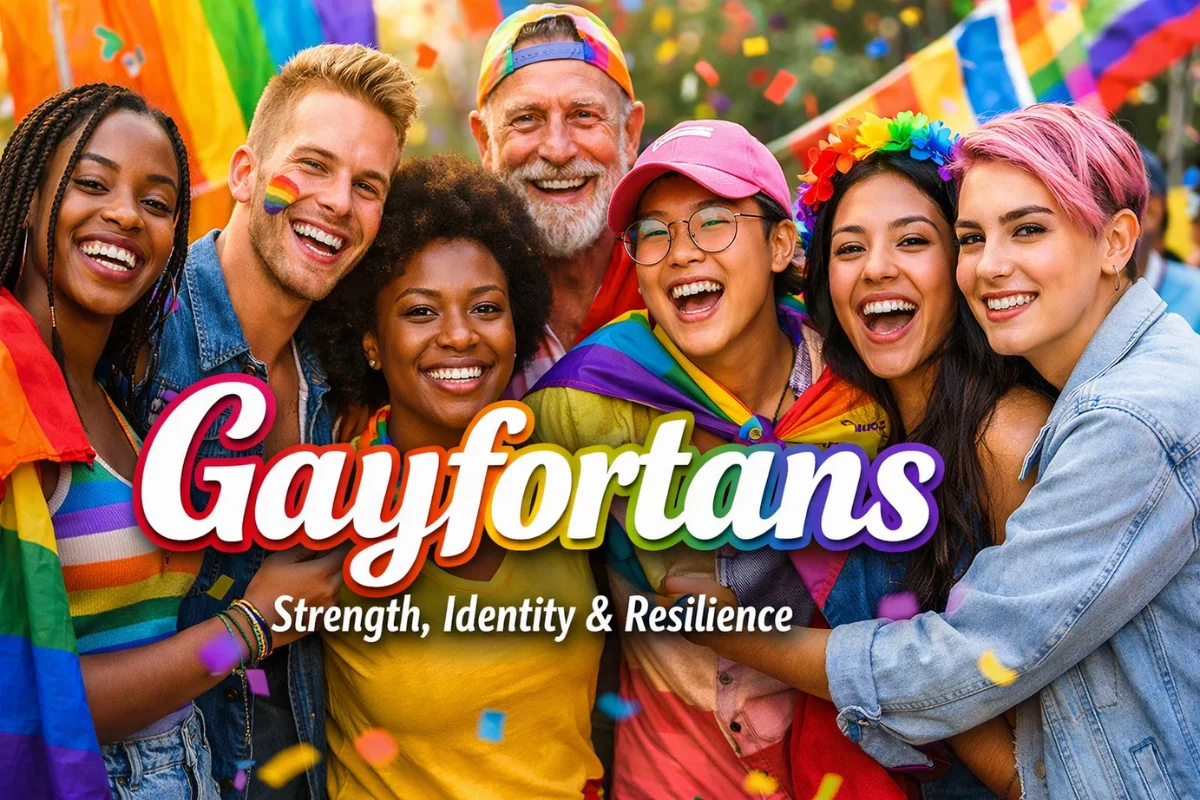
Gayfortans is an emerging cultural term used within and around LGBTQ+ discourse to describe the intersecting pillars of gay identity, fortitude, and community resilience. At its core, it refers to the strength, solidarity, and self-determined pride that sustains LGBTQ+ individuals and communities — especially in environments where acceptance is still being fought for. Think of it as a framework for understanding how queer culture builds and protects itself over time.
Why the Word “Gayfortans” Is Gaining Traction Right Now
Language inside the LGBTQ+ community has always evolved faster than mainstream culture catches up. New terms emerge not because people lack better words, but because existing vocabulary doesn’t fully capture a lived experience.
Gayfortans falls into that category — a compound that tries to articulate something that rainbow flags and pride parades gesture toward but don’t fully name: the internal architecture of queer survival and celebration.
The United States, in 2025 and beyond, finds itself in a strange cultural moment. Legal protections have advanced significantly in many states. Queer representation in entertainment and media has never been broader.
And yet, anti-LGBTQ+ legislation has also increased in several state legislatures, and visibility doesn’t always translate into safety. In this environment, concepts like gayfortans — rooted in both joy and resilience — carry real emotional and political weight.
Understanding gayfortans means understanding not just what LGBTQ+ communities celebrate, but what they’ve had to build to survive long enough to celebrate anything.
The Dual Roots: Gay Identity and Fortitude
To understand gayfortans, it helps to break the word into its conceptual parts.
Gay identity here is used as a broad, inclusive marker — not in the narrow sense of “gay men only,” but as an umbrella acknowledging the full LGBTQ+ spectrum: lesbian, gay, bisexual, transgender, queer, intersex, asexual, and more. Identity in this context is not just orientation or gender; it’s culture, community, history, and a shared set of experiences and reference points.
Fortitude is the more unexpected half. We don’t usually pair strength and endurance language with communities that are often framed (even sympathetically) as vulnerable. But fortitude is accurate. LGBTQ+ individuals have consistently demonstrated remarkable psychological resilience, community organizing capacity, and cultural creativity in the face of sustained institutional and social opposition.
Put together, gayfortans describes something more than survival. It names the active, generative force that emerges when a marginalized group doesn’t just endure — but builds, creates, and thrives.
The Historical Foundation You Need to Understand Gayfortans
Before Stonewall: Invisible Fortitude
Before June 1969, LGBTQ+ life in America existed primarily underground. Gay bars operated under constant threat of police raids. Gender nonconformity could result in arrest. Same-sex relationships were criminalized in most states under sodomy laws.
But communities still formed. Drag performers kept queer culture alive in basements and back rooms. Lesbian women built networks through sport, literature, and mutual aid. Gay men in cities like New York, San Francisco, and Chicago quietly organized.
This pre-Stonewall period is the origin point of gayfortans: survival through community formation when the mainstream offered nothing but exclusion.
Stonewall and the Birth of Public Pride
The Stonewall Uprising changed the terms of engagement. Rather than enduring quietly, LGBTQ+ New Yorkers fought back — literally and symbolically. What followed wasn’t just a protest; it was the founding of an entire infrastructure of gay liberation: newspapers, legal organizations, health clinics, and political clubs.
The first Pride marches, held on the anniversary of Stonewall, were not celebrations in the contemporary sense. They were acts of political assertion. Gayfortans, in those early marches, looked like shouting your identity into a hostile street and refusing to be ashamed of it.
The AIDS Crisis: Fortitude Under Catastrophe
Nothing tested the concept of gayfortans more severely than the AIDS epidemic of the 1980s. The federal government’s failure to respond, the stigma attached to the disease, the loss of entire friendship networks — these were conditions of genuine catastrophe.
What emerged was remarkable: ACT UP’s direct action campaigns, the NAMES Project AIDS Memorial Quilt, grassroots care networks in cities across the country, and a generation of activists who turned grief into political organizing.
The crisis also built durable infrastructure — LGBTQ+ health centers, legal aid organizations, and community-based social services that outlasted the acute crisis and serve communities today.
From Defense to Celebration: The Modern Era
The legalization of same-sex marriage nationally in 2015 (Obergefell v. Hodges) marked a watershed moment in LGBTQ+ civil rights. But even in the years since, gayfortans hasn’t become obsolete — it’s evolved.
The conversation has shifted from marriage equality to trans rights, intersectionality, and LGBTQ+ experiences among people of color, immigrants, and people with disabilities.
Celebration and resilience now coexist. Pride Month is both a party and a protest. Gayfortans names that dual nature accurately.
Also Read: Sydneebeeyxo
What Gayfortans Looks Like in Practice
This is where abstract concepts meet real life. Gayfortans isn’t just a historical or theoretical idea — it shows up in everyday experience.
In Family Dynamics
Coming out remains one of the most significant acts in an LGBTQ+ person’s life — and one of the most variable. For some Americans, it’s a non-event met with support. For others, it ruptures family relationships, leads to housing loss, or triggers ongoing conflict.
The fortitude embedded in gayfortans is visible in those who navigate these situations: finding chosen family, maintaining dignity in hostile home environments, or rebuilding connections over time.
Organizations like PFLAG (Parents, Families, and Friends of Lesbians and Gays) explicitly support this dimension — helping families work toward acceptance, and giving LGBTQ+ individuals communities to lean on when their families of origin fall short.
In Workplace Life
Despite legal protections (Bostock v. Clayton County, 2020, confirmed LGBTQ+ workers are protected under Title VII), workplace discrimination hasn’t disappeared — it’s become more subtle.
Microaggressions, misgendering, exclusion from informal networks, and the emotional labor of deciding whether to come out at work are all dimensions of the experience.
Gayfortans in the workplace looks like employee resource groups, mentorship programs for LGBTQ+ professionals, and the growing number of openly queer executives and public figures who create visibility in industries where it was previously absent.
In Creative Culture
Queer culture has always been generative. From the Harlem Renaissance (which included a significant queer dimension that mainstream history long erased) to the emergence of house and ballroom culture among Black and Latino LGBTQ+ communities in the 1970s–80s, to contemporary queer literature, film, and music, cultural creativity is inseparable from gayfortans.
When shows like Pose or Schitt’s Creek or artists like Lil Nas X bring queer stories to mainstream audiences, they’re drawing on a tradition of cultural expression that has always been central to LGBTQ+ community life. The art didn’t start when mainstream culture noticed — it was there all along.
Intersectionality: Gayfortans Isn’t One-Size-Fits-All
One of the most important evolutions in LGBTQ+ discourse over the past two decades has been a growing attention to intersectionality — the recognition that identity categories like race, class, disability, and immigration status shape how people experience being queer.
A gay Black man in rural Mississippi navigates gayfortans differently than a white lesbian in Seattle. A transgender Latina undocumented immigrant in Texas faces a different set of pressures than a bisexual cisgender man in a liberal urban center.
Genuinely understanding gayfortans requires holding these differences seriously. The movement at its strongest is one that centers the most marginalized — not just the most visible.
This is why organizations led by queer people of color, by trans women of color specifically, by LGBTQ+ youth in foster care or homelessness — these aren’t niche concerns. They’re where the fortitude is most needed and most evident.
Gayfortans and Mental Health: Naming the Real
Any honest account of gayfortans has to include a candid look at mental health. LGBTQ+ Americans experience higher rates of depression, anxiety, and suicidal ideation than their non-LGBTQ+ peers — not because of anything inherent to being queer, but because of minority stress: the chronic, cumulative burden of stigma, discrimination, and the mental effort of navigating a world that wasn’t built with you in mind.
The Trevor Project’s annual surveys consistently show that LGBTQ+ youth who have access to affirming adults and spaces have significantly better mental health outcomes. Affirmation — being seen, named correctly, and accepted — is not just emotionally significant. It’s a health intervention.
Gayfortans, in this context, is also a mental health framework. It names the protective factors: community belonging, cultural pride, intergenerational connection, and the validation that comes from knowing your identity has a history and a future.
Explore: Movirz
Comparison: How Gayfortans Manifests Across Different Life Contexts
| Context | What Gayfortans Looks Like | Key Challenge Faced |
|---|---|---|
| Youth & Education | GSAs (Gay-Straight Alliances), affirming counselors, inclusive curricula | Book bans, anti-LGBTQ+ school policies |
| Family Life | Chosen family networks, PFLAG support, adoption advocacy | Family rejection, custody disputes for LGBTQ+ parents |
| Workplace | ERGs, mentorship, visibility in leadership | Subtle discrimination, misgendering, coming out calculus |
| Healthcare | LGBTQ+-affirming providers, community health centers | Provider bias, lack of trans-competent care |
| Aging | LGBTQ+-welcoming senior housing, elder advocacy | Isolation, returning to the closet in care facilities |
| Creative Culture | Queer art, literature, performance, digital communities | Censorship, deplatforming, cultural erasure |
The Role of Allyship in Amplifying Gayfortans
Gayfortans is primarily about LGBTQ+ communities building their own strength — but allyship plays a real supporting role. Genuine allies don’t center themselves in the conversation; they use their access and privilege to expand the space in which queer communities can operate.
What does effective allyship look like in practice?
- Consistent, not performative: A company that sponsors a Pride float but donates to anti-LGBTQ+ politicians isn’t a genuine ally — it’s doing reputational management. Allyship shows up year-round.
- Following, not leading: Allies take cues from the communities they support about what’s needed, rather than deciding unilaterally what help looks like.
- Accepting correction graciously: Language and understanding in LGBTQ+ spaces evolve. Allies who get something wrong and respond defensively aren’t actually committed to learning.
- Material support: Donating to LGBTQ+ organizations, supporting LGBTQ+-owned businesses, advocating in workplaces and families for inclusive policies — these are concrete expressions of allyship that directly reinforce gayfortans.
Looking Forward: The Future of Gayfortans in America
The current political and legal landscape in the United States is mixed, and that complexity will shape how gayfortans evolves.
- On one side: greater visibility than ever before, legal protections that exist at the federal level, growing popular support for LGBTQ+ rights across generations, and a cultural ecosystem that includes queer voices in virtually every industry and art form.
- On the other: a surge in state-level legislation targeting transgender youth, efforts to restrict LGBTQ+-inclusive education, and ongoing legal challenges to protections won in previous decades.
What this means for gayfortans is that the framework remains as relevant as ever — possibly more so. The communities that invested in building durable institutions, networks of care, cultural infrastructure, and political capacity are the ones best positioned to navigate what comes next.
The fortitude embedded in gayfortans is not a relic of harder times. It’s an ongoing necessity and, more than that, a source of genuine community pride.
FAQs About Gayfortans
1What does “Gayfortans” mean?
Gayfortans refers to the combined strength, resilience, cultural identity, and community solidarity that characterizes LGBTQ+ experience — particularly the active, generative capacity to build thriving communities in the face of social and institutional challenges.
2Is Gayfortans a formal organization or movement?
It functions more as a cultural concept or framework than a formal organization. It describes a set of values and characteristics — fortitude, pride, community-building — rather than a specific group or campaign with membership.
3How does Gayfortans relate to Pride Month?
Pride Month is one of the most visible expressions of gayfortans. It originated as a political protest and has evolved to encompass both celebration and advocacy — embodying exactly the dual nature of resilience and joy that the concept captures.
4Why is intersectionality important to understanding Gayfortans?
Because LGBTQ+ people are not a monolithic group. Race, class, disability, and other identity factors shape each person’s experience profoundly. A full understanding of gayfortans requires centering the most marginalized members of the community, not just the most visible.
5How can someone who is not LGBTQ+ support Gayfortans?
Through genuine, consistent allyship: advocating for inclusive policies, supporting LGBTQ+-led organizations materially, learning and adapting when corrected on language or issues, and standing up against discrimination in everyday contexts — workplaces, families, schools, and communities.
Final Thought
Gayfortans isn’t just a word for LGBTQ+ communities to recognize themselves in — it’s a word for anyone trying to understand why these communities are the way they are: creative, resilient, politically sophisticated, and deeply invested in care for one another. That didn’t happen by accident. It was built, over decades, out of necessity and love in equal measure.
That’s what gayfortans names. And it’s worth understanding clearly.
Learn about Faccccccccccccc