Jump to:
ToggleJournal vs Diary: What's the Real Difference and Which One You Actually Need
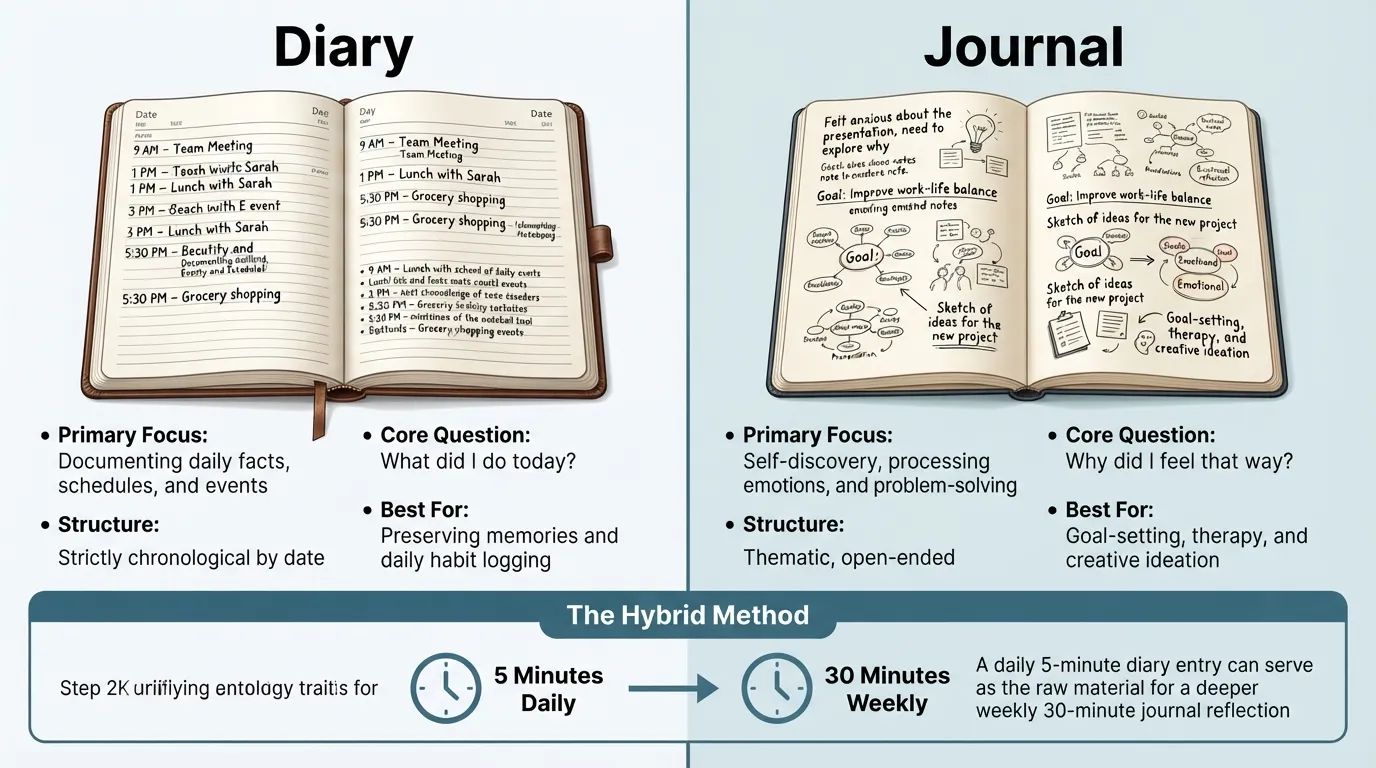
Journal vs Diary Comparison Table: Side-by-Side Breakdown
| Feature | Diary | Journal |
|---|---|---|
| Primary Focus | Documentation of daily life | Introspection, self-discovery, and growth |
| Typical Questions | What did I do today? Who did I see? | Why did I feel that way? How can I improve? |
| Structure | Chronological (by date) | Thematic, open-ended, or prompt-driven |
| Style | Factual, narrative, and typically brief | Subjective, exploratory, and essay-like |
| Frequency | Usually daily | As needed — daily, weekly, or occasional |
| Best For | Preserving memories, daily habit tracking | Self-growth, processing emotions, goal-setting |
| Common Types | Travel diary, dream diary, daily diary | Gratitude, bullet, or reflective journal |
| Word Origin | Latin diarium — daily record | French jour ("day") — evolved beyond daily use |
While the line between the two can get blurry in practice—and plenty of writers seamlessly blend both into a single notebook—their underlying intent sets them apart.
What Is a Diary? Definition + Origin
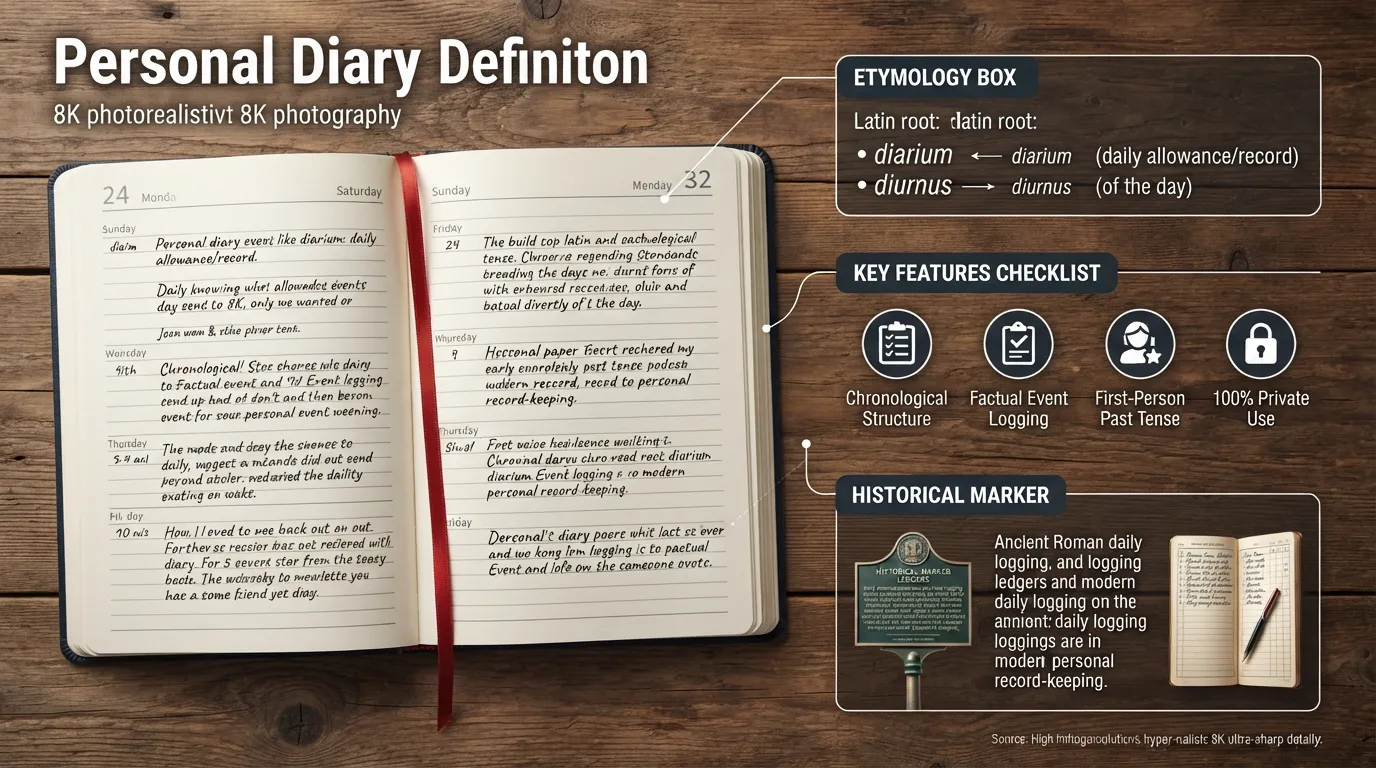
At its core, a diary is a personal record of daily life. It acts as an anchor in time, capturing the baseline facts of what happened, when it happened, and who was there. Rather than dissecting abstract ideas or long-term growth strategies, a traditional diary focuses on capturing lived history as it unfolds day by day.
Where the Word “Diary” Comes From
The word traces directly back to the Latin diarium, which translates to “daily allowance” or “daily record.” This root stems from diurnus, meaning “of the day” (the same root that gives us the word “journal,” curiously enough). Historically, Roman soldiers and administrators kept daily ledgers to track provisions, movements, and events—a habit of systematic, day-by-day logging that eventually evolved into the personal private diaries we recognize today.
What Goes Into a Diary Entry
While anyone can adapt the format, a standard diary entry almost always relies on a few defining features:
Chronological dates: Entries are strictly bound by time, usually starting with a timestamp, day, or explicit date header to maintain a clear historical sequence.
Daily events and actions: The core content centers on actual occurrences—where you went, who you talked to, meals eaten, work completed, or news of the day.
Factual, direct tone: Writing tends to be descriptive and narrative-driven, focusing on “what occurred” rather than deep philosophical analysis.
First-person past tense: Entries are written from your perspective looking back at the recent past (e.g., “This morning I met Sarah for coffee, then finished the quarterly report…”).
Private, unvarnished nature: Diaries are meant for your eyes only, allowing for candid honesty, raw feelings, and trivial details without concern for an external audience.
Common variations include a travel diary focused strictly on trip itineraries and sights, or a dream diary used to log nightly sleep experiences upon waking.
Famous Diary Examples
To see the classic diary format in action, look no further than some of history’s most celebrated personal records.
Anne Frank (The Diary of a Young Girl): Written between 1942 and 1944 while hiding during the Nazi occupation of the Netherlands, Anne’s diary captures both the harrowing day-to-day realities of life in the Secret Annex and the ordinary emotional milestones of an adolescent girl.
Samuel Pepys (Samuel Pepys’s Diary): Keeping a detailed diary throughout the 1660s, English administrator Samuel Pepys documented major historical events—including the Great Plague of London and the Great Fire of 1666—alongside mundane personal details like his daily meals, financial transactions, and theater trips, offering historians an unparalleled glimpse into 17th-century life.
What Is a Journal? Definition + Origin
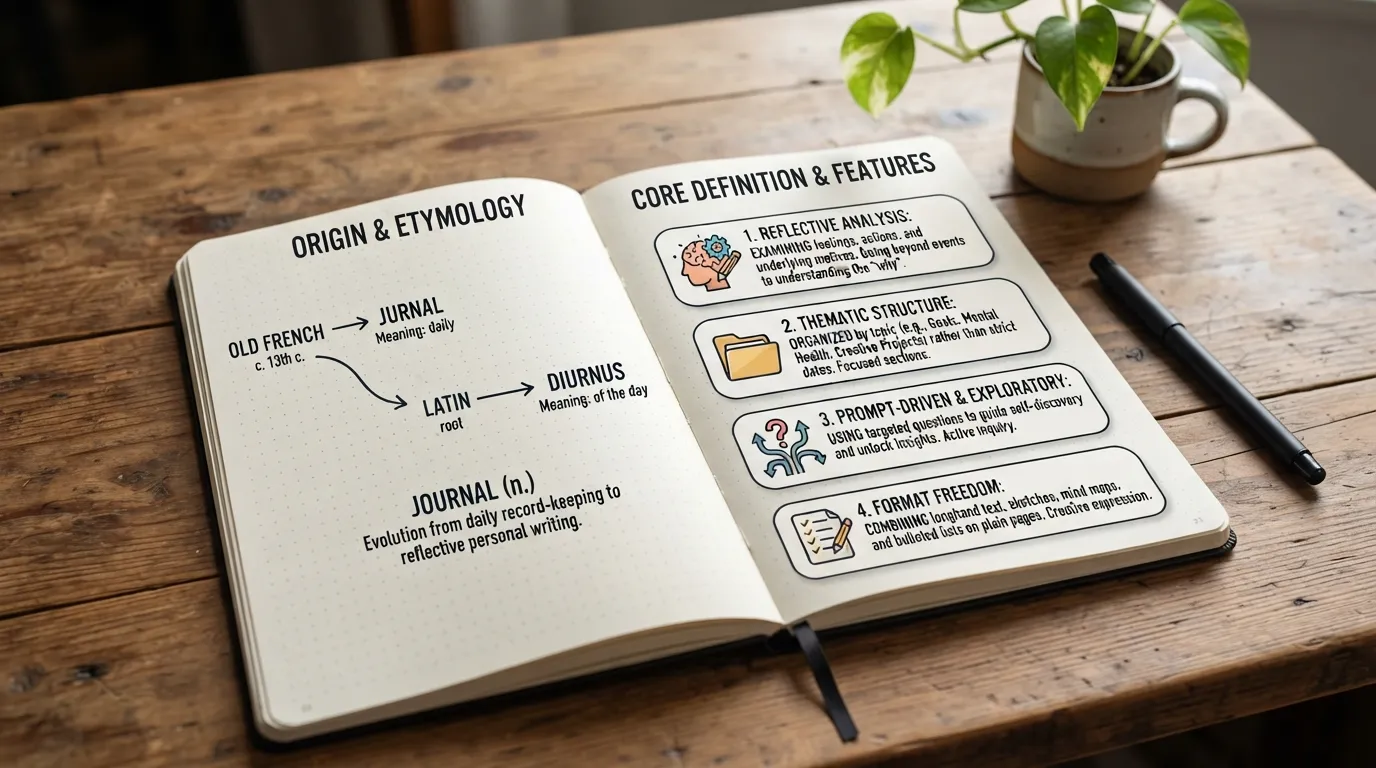
If a diary is a log of your life, a journal is a lab where you process it. A journal moves past the surface level of daily logistics to explore thoughts, emotions, patterns, and big-picture ideas. Rather than asking “What happened today?”, a journal asks “What did today mean, and what can I learn from it?”
Where the Word “Journal” Comes From
The word enters English through the Old French jurnal (meaning “daily”), which shares the exact same ultimate Latin root as diary: diurnus. While both words started with the idea of daily tracking, their paths diverged over centuries. “Diary” stayed tied to literal day-by-day record-keeping, while “journal” broadened into newspaper publishing, professional logging, and deeply analytical personal writing that isn’t bound by a strict calendar.
What Goes Into a Journal Entry
Because journaling is centered on inner discovery rather than external events, entries tend to be far more fluid and varied:
Reflective analysis: You might spend three pages unpacking a single conversation from yesterday, exploring why a passing comment triggered defensive feelings.
Thematic organization: Entries often center on specific topics—such as career goals, personal relationships, mental health, or creative ideas—rather than a linear sequence of events.
Prompt-driven writing: Writers frequently use structured questions (e.g., “What is currently draining my energy?”) to break through creative blocks and focus their thinking.
Exploratory narrative: The writing style is rarely a simple list of facts; it functions like an essay or free-form train of thought where you figure out what you think as you write.
Mixed media & visual elements: Sketches, diagrams, mind maps, taped-in mementos, and rapid list-making sit right alongside paragraphs of text.
Popular targeted styles include a gratitude journal focused entirely on positive reflection, or a bullet journal used to combine habit tracking, planning, and rapid logging into one customized notebook.
Creativity & Format Freedom
Unlike a traditional diary—which usually comes pre-printed with dates on every page—a journal gives you complete structural freedom. You aren’t forced to write every single day, nor are you restricted to lined pages.
This total flexibility is why history’s greatest thinkers and artists kept journals rather than strict diaries. Leonardo da Vinci’s famous notebooks blended mechanical inventions, artistic anatomical studies, and philosophical ramblings on the same page. A journal accommodates stream-of-consciousness brain dumps, rapid habit-tracking spreads, or strategic life planning without forcing you into a rigid chronological box.
Academic and Formal Use of Journals
Beyond personal growth, the term “journal” carries a distinct formal meaning in academic and professional settings. You’ll encounter two primary formal uses:
Academic & Research Journals: In academia, a journal is a peer-reviewed periodical (such as The New England Journal of Medicine) where researchers publish original studies, empirical data, and scholarly analyses.
Educational Learning Journals: Schools and exam boards (like IGCSE or IB curricula) frequently assign “reflective journals” or “learning logs.” In this context, students use a journal to document their thought process, track project progress, and critically reflect on key learnings rather than simply submitting a final answer.
Journal vs Diary vs Log vs Memoir vs Blog — Where Do They Overlap?
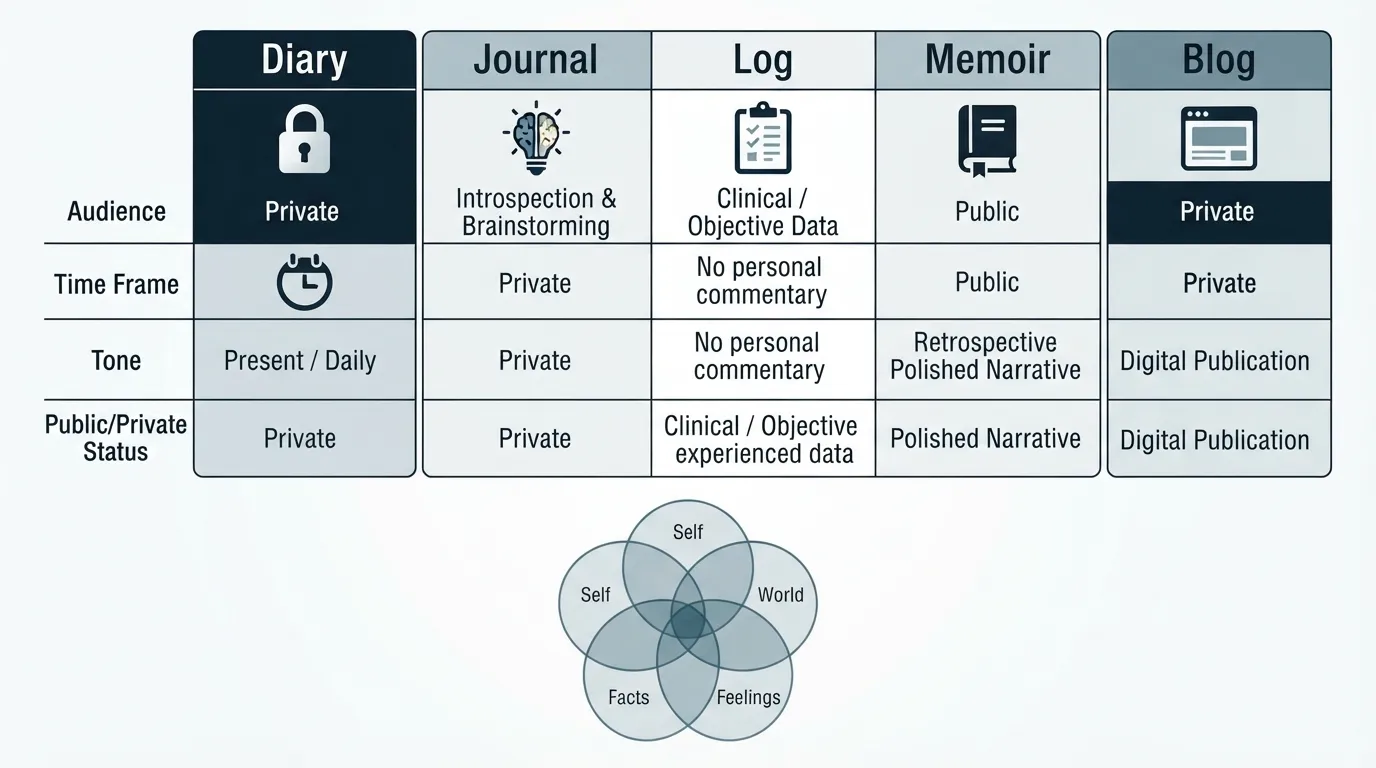
Understanding the distinctions between personal writing styles comes down to intent, tone, and audience. While people often use these terms interchangeably, each serves a distinct role in documenting thoughts, experiences, and data.
Log (Factual, No Emotion — Ship’s Log, Workout Log)
A log is a systematic, objective record of specific events or measurements. Unlike diaries or journals, a log strips away emotional narrative in favor of pure, actionable data.
Historical maritime ship’s logs recorded weather conditions, coordinates, and speed without personal commentary. Modern equivalents include workout logs tracking sets and reps, food logs recording macronutrients, or server error logs in software engineering. The goal is precise tracking, not self-expression.
Memoir (Retrospective, Polished, Meant for Readers)
While diaries and journals are written in real time as events occur, a memoir is written looking back across years or decades. It takes raw personal experiences and crafts them into a cohesive narrative arc with thematic focus.
Memoirs are heavily edited, polished, and written specifically for an external public audience. A diary contains the messy, unedited raw material; a memoir is the finished story curated long after the dust has settled.
Blog (Public vs Private — The Key Difference)
Short for “weblog,” a blog is essentially a digital publication platform. The core difference between a private journal or diary and a blog is the audience.
Diaries and journals are inherently private spaces for unvarnished self-expression. Blogs are intentionally public, structured for readers, and designed to inform, entertain, or build an online community around specific topics.
Notebook (General-Purpose vs Personal-Record Specific)
A notebook is the physical object—the blank vessel—rather than a specific writing style. It refers to any bound book of blank, lined, or dotted pages.
You can use a notebook to keep a diary, write a journal, draft a novel, or jot down grocery lists. A diary or journal is the practice, whereas a notebook is simply the paper tool you use to capture it.
| Format | Audience | Time Frame | Tone | Public or Private |
|---|---|---|---|---|
| Diary | Self only | Present (day-by-day) | Factual, narrative, personal | Private |
| Journal | Self only | Present & reflective | Introspective, exploratory, analytical | Private |
| Log | Self or team | Real-time / Immediate | Clinical, concise, objective | Private or Internal |
| Memoir | General public | Past (retrospective) | Polished, story-driven, reflective | Public |
| Blog | Online readers | Past or Present | Conversational, informative, structured | Public |
Which Should You Choose? Decision Guide
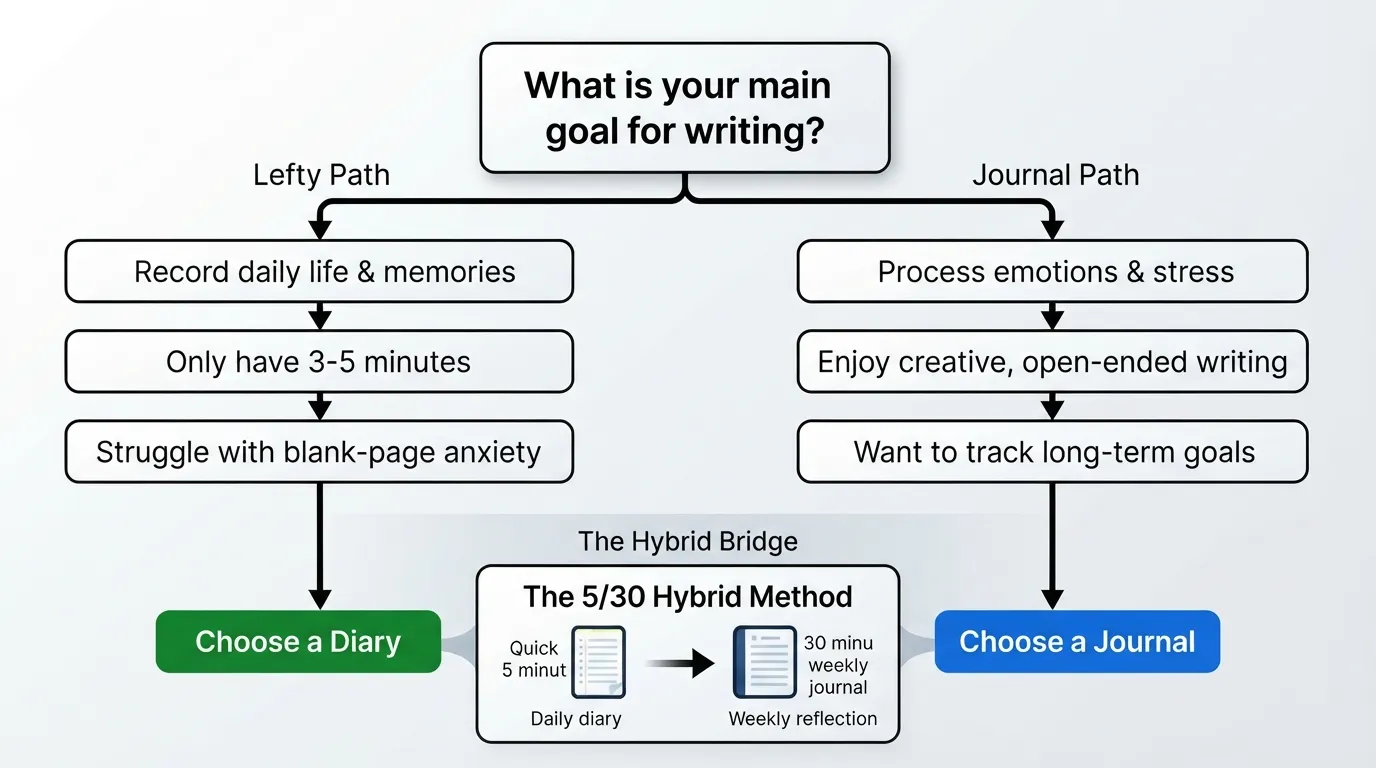
Choosing between a journal and a diary doesn’t require overcomplicating your routine. The decision simply comes down to what you want to get out of your writing time right now.
Choose a Diary If…
You want to preserve life memories: You want a clear historical record of what you did, places you visited, and milestones reached so you can look back years from now.
You struggle with blank-page anxiety: You prefer a straightforward format with clear expectations: log the day’s highlights, track basic habits, and move on.
You have limited time: You only have 3 to 5 minutes at night to quickly summarize the day before going to bed.
You want to build consistency first: You need a low-friction daily habit that doesn’t demand deep emotional processing or lengthy reflection every time you open the book.
Choose a Journal If…
You want self-growth and clarity: You’re looking to work through complex emotions, understand behavioral patterns, or navigate major life transitions.
You enjoy creative, free-form writing: You want to write essay-style reflections, sketch ideas, use guided prompts, or design custom bullet layouts without rigid page rules.
You prefer writing as needed: You don’t want the guilt of empty dated pages when you skip a few days or weeks.
You are working toward big goals: You need space to brainstorm, track long-term projects, practice gratitude, or solve specific mental bottlenecks.
Or Do Both: The Hybrid Method
You don’t have to pick a side. In fact, most long-term writers naturally end up blending both approaches into a single system.
A popular and sustainable approach is the 5/30 Hybrid Model:
Daily Diary (5 Minutes): Every morning or evening, quickly log 3 to 4 bullet points covering key events, mood, and daily accomplishments in a simple notebook or dated planner.
Weekly Journal (30 Minutes): Once a week—perhaps on Sunday afternoon—set aside a longer block of time to review those daily logs and write a deeper reflection on what went well, what felt stressful, and what you want to adjust for the upcoming week.
By using your daily diary entries as raw material for your weekly journal reflections, you get the best of both worlds: a clear record of your life without losing the transformative benefits of deep self-discovery.
Popular Journaling Methods You Can Try
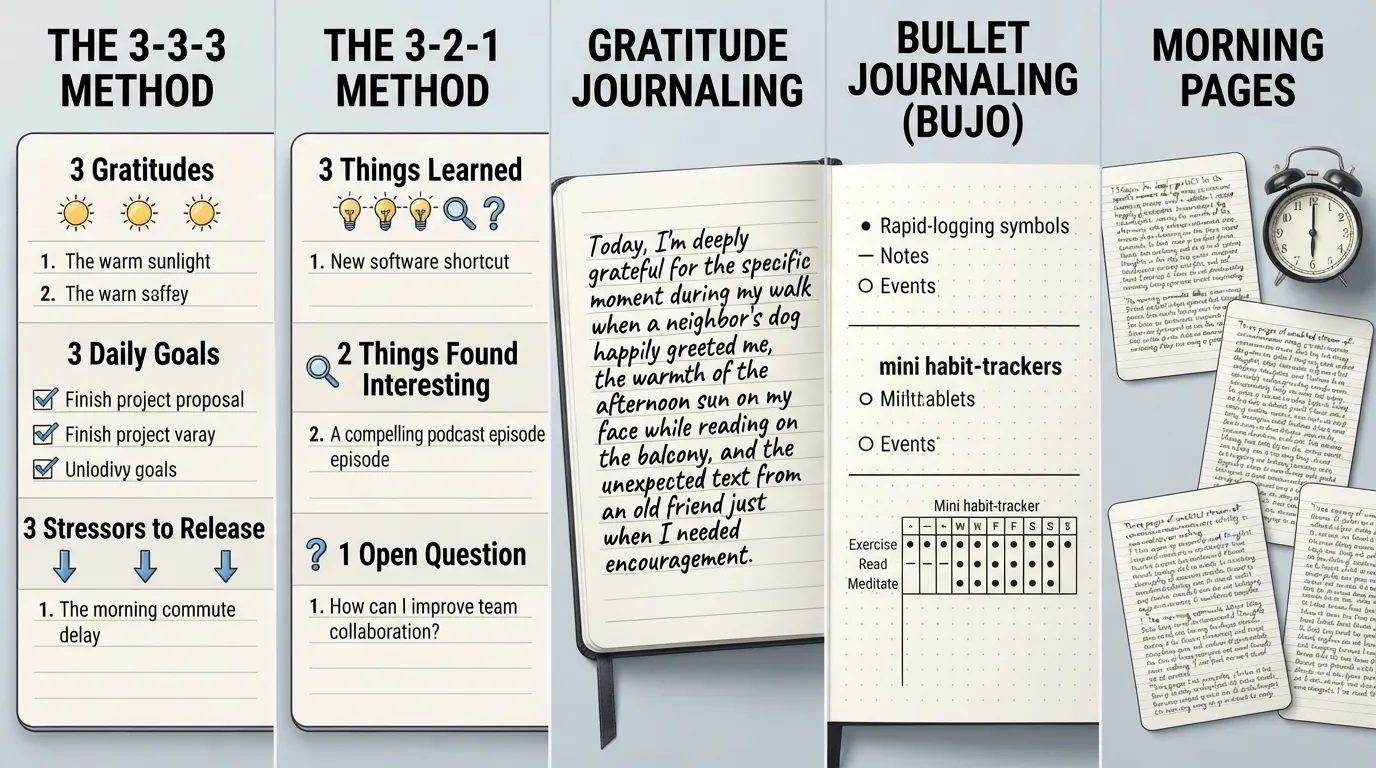
If you want the reflective benefits of journaling but aren’t sure how to start without staring at a blank page, structured frameworks make all the difference. These five popular methods give your writing immediate direction, whether you have three minutes or thirty.
The 3-3-3 Journaling Method
Designed to build focus and momentum, the 3-3-3 method uses quick numerical prompts to structure your entry without taking over your schedule.
Every morning or evening, you answer three straightforward prompts:
3 Things You’re Grateful For: Focus on small, specific moments from the last 24 hours.
3 Things You Want to Accomplish Today: Focus strictly on high-priority tasks that move the needle.
3 Things You Want to Let Go Of: Identify minor stresses, negative thoughts, or distractions you need to stop carrying around.
The 3-2-1 Journaling Method
The 3-2-1 method is a quick reflection tool popular among students and professionals looking to end their workday with intentionality.
At the end of your day, write down:
3 Things You Learned: Key insights, fresh pieces of information, or lessons from mistakes made.
2 Things You Found Interesting: Ideas, conversations, or articles that sparked curiosity.
1 Question You Have: A central question or challenge to leave sleeping on overnight.
Gratitude Journaling Method
Rather than documenting every event of your day, gratitude journaling focuses entirely on training your brain to spot positive patterns.
Instead of writing vague entries like “I’m grateful for my health,” aim for concrete specificity: “I’m grateful for the quiet 15 minutes I had drinking coffee before the house woke up.” Research in positive psychology shows that consistently detailing specific micro-moments of appreciation improves overall emotional resilience far more than generic lists.
Bullet Journaling Method
Created by designer Ryder Carroll, the Bullet Journal (or BuJo) system combines task management, habit tracking, and personal reflection into a single dot-grid notebook.
It uses rapid logging—a system of symbols (bullets for tasks, dashes for notes, circles for events)—to keep entry fast and organized. Because you design the pages yourself, a bullet journal effortlessly shifts between acting as a daily planner-style diary and an open-ended reflection journal.
Morning Pages Method
Pioneered by author Julia Cameron in The Artist’s Way, Morning Pages is a stream-of-consciousness writing practice designed to clear mental clutter and unlock creativity.
The rule is simple: write three pages of longhand text immediately upon waking, before checking your phone or talking to anyone. You write whatever comes to mind without editing, filtering, or overthinking—even if it’s just “I don’t know what to write.” The goal isn’t to produce brilliant prose, but to dump your brain’s surface-level anxiety onto the page so you can start your day with a clear head.
What Psychologists Say About Journaling and Diaries
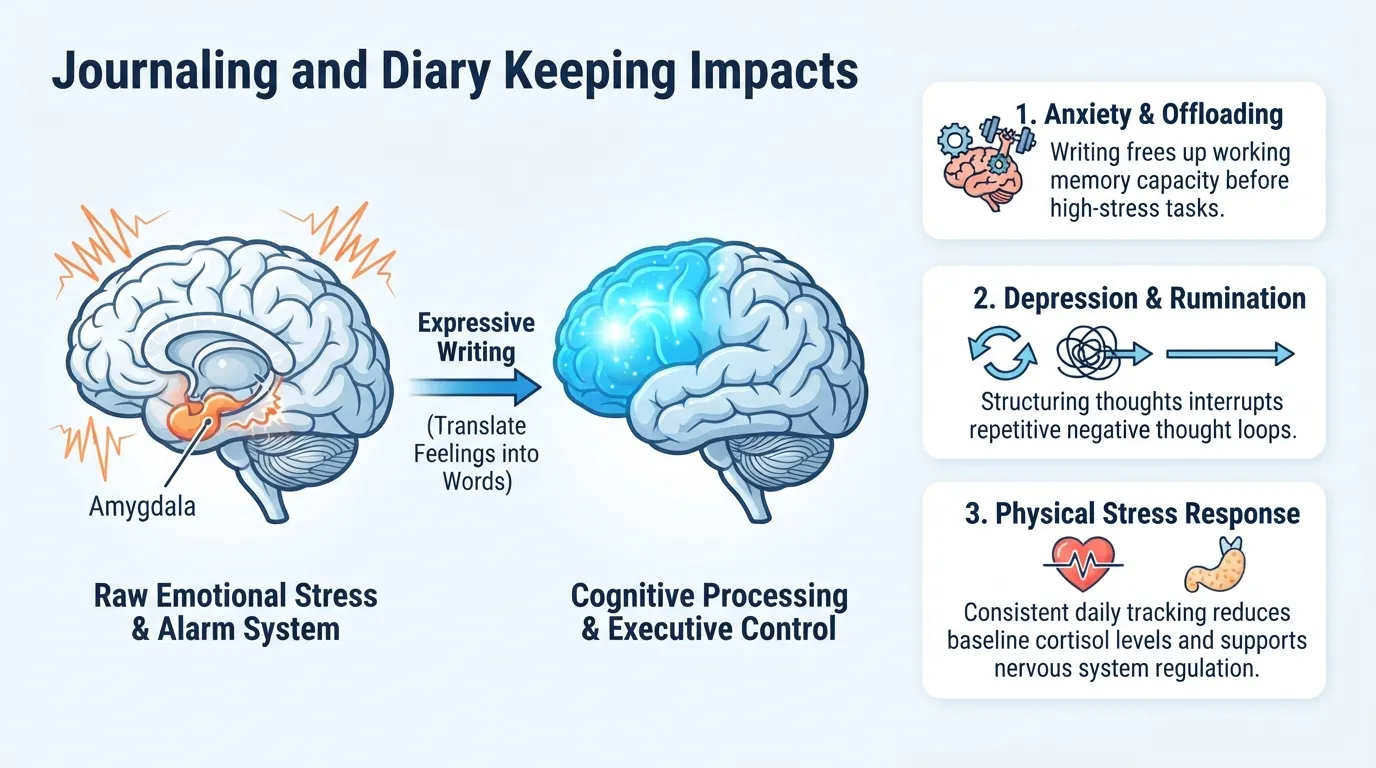
Psychologists and cognitive neuroscientists don’t treat journaling as a simple hobby—they view it as a low-cost, evidence-backed therapeutic tool.
Research curated by institutions like the American Psychological Association (APA) and Harvard Health Publishing highlights that externalizing internal thoughts creates psychological distance. Pioneered by Dr. James Pennebaker at the University of Texas at Austin, the clinical practice of expressive writing demonstrates that translating raw emotional distress into structured sentences changes how the brain processes trauma.
How Journaling Rewires Brain Processing
Raw Emotional Overwhelm: Stress activates the amygdala, keeping your nervous system on high alert and cycling through unorganized worries.
Writing & Structuring Language: Translating feelings into concrete words requires active effort from the prefrontal cortex—the brain’s center for logic and planning.
Cognitive Processing & Offloading: As the prefrontal cortex takes over, it dampens the emotional alarm system and unloads mental clutter.
Reduced Memory Load & Lower Cortisol: With your thoughts safely stored on paper, working memory frees up and baseline stress hormones drop.
Clinical studies show that structured writing practices yield measurable mental health outcomes across distinct clinical scenarios:
Depression: Writing helps interrupt rumination—the habit of looping over negative thoughts—by forcing the brain to organize diffuse feelings into concrete language.
PTSD & Trauma Recovery: Expressive writing allows individuals to process traumatic memories in a controlled, safe environment, facilitating cognitive integration without overwhelming the nervous system.
Grief & Serious Illness: Studies tracking patients navigating major medical diagnoses (such as cancer or cardiovascular recovery) found that emotional writing reduced stress hormones, improved sleep quality, and lowered the frequency of stress-related doctor visits.
Journaling for Anxiety — What Actually Helps
When it comes to managing anxiety, not all writing styles work equally well. Simply venting without structure can sometimes worsen anxiety by reinforcing distress loops. Psychologists emphasize three specific methods backed by clinical research:
Expressive Writing (Cognitive Offloading): A landmark Harvard Health study revealed that writing freely about specific worries for 8 to 10 minutes before a high-stress task “offloads” intrusive thoughts from working memory. This reduces overactivity in the brain’s worry circuits and restores focus.
Positive-Affect Journaling (PAJ): Randomized controlled trials show that PAJ—where writers focus intentionally on positive aspects, personal strengths, or framing challenges constructively—significantly lowers psychological distress and anxiety compared to unstructured venting.
Specific Gratitude Journaling: Meta-analyses covering hundreds of studies confirm that gratitude journaling reduces symptoms of anxiety and depression. However, the research shows that vague lists yield minimal benefit. The psychological payoff comes from specificity—detailing exact micro-moments and explaining why they mattered.
What Happens If You Journal Every Day?
Committing to a daily journaling practice triggers cumulative cognitive and physiological shifts:
Immediate (Day 1–3): You experience immediate “brain dumping” benefits. Writing down pressing concerns frees up working memory, providing instant emotional relief and improved short-term focus.
Short-Term (Weeks 1–4): Consistent journaling begins to lower baseline cortisol (stress hormone) levels. You’ll notice heightened emotional self-awareness, making it easier to spot anxiety triggers before they cause emotional burnout.
Long-Term (Months 1–6+): Daily processing strengthens emotional regulation via structural neuroplasticity. Over time, you build a searchable archive of your cognitive patterns, helping you recognize how you solved past problems, navigated grief, and overcame hardship.
Is There a Downside to Journaling? Honest Take
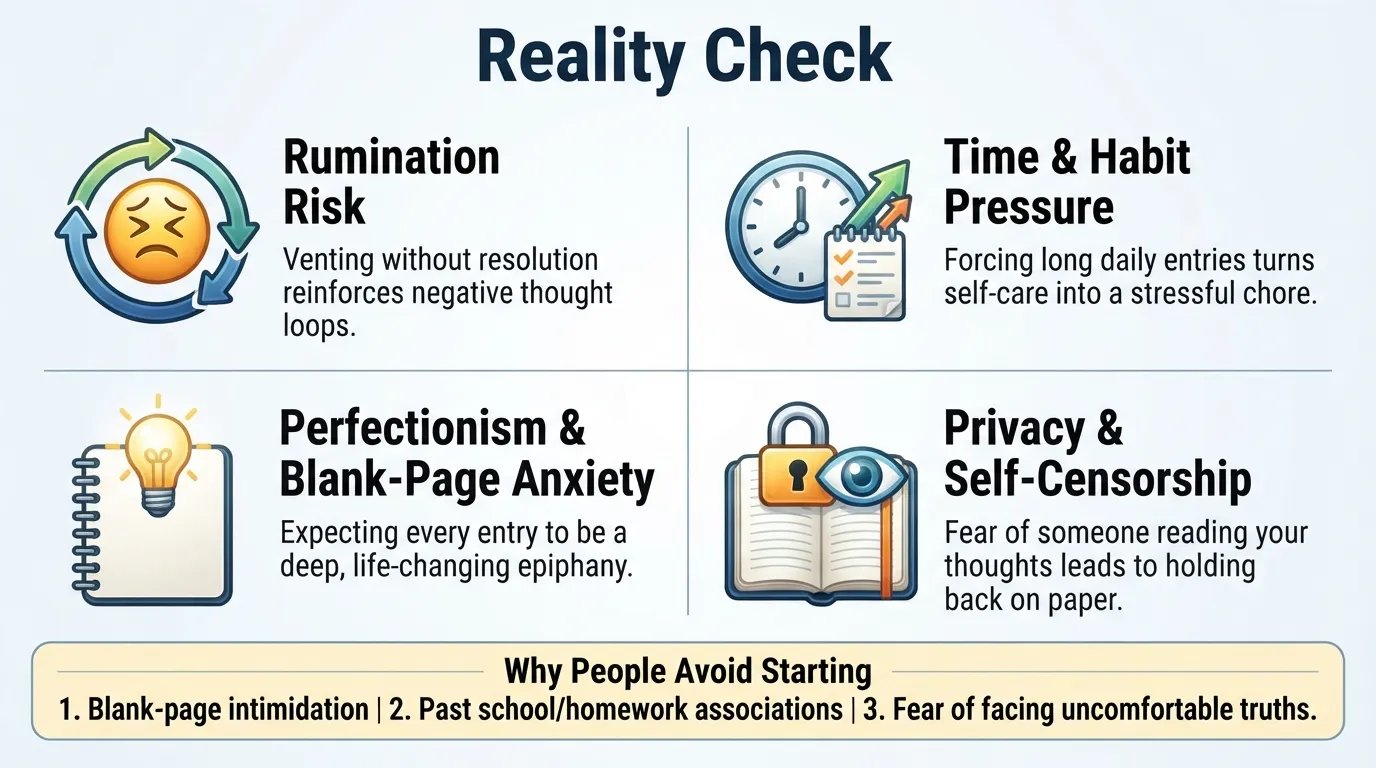
While journaling is widely praised as a silver bullet for mental health and personal growth, it isn’t always a flawless habit. For some, staring at an empty page can feel more like a burdensome chore than a restorative practice.
Understanding the realistic downsides helps you avoid common pitfalls and keep writing a helpful tool rather than an added stressor:
Rumination Risk: If your entries focus exclusively on venting without moving toward reflection or problem-solving, writing can lock you into a negative loop. Re-reading identical grievances day after day reinforces distress rather than resolving it.
Time Commitment & Pressure: Forcing yourself to write when you’re completely exhausted can turn a self-care habit into another overwhelming item on your daily to-do list.
Unrealistic Expectations: Expecting every single page to yield a life-changing epiphany or deep emotional breakthrough creates unnecessary pressure. Most entries are naturally mundane, and that is completely normal.
Privacy Concerns: The fear of someone reading your private thoughts can lead to self-censorship. If you feel compelled to edit your raw feelings for a potential secondary audience, the mental health benefits decline rapidly.
Why Do People Avoid Journaling?
Despite knowing its benefits, many people avoid picking up a notebook altogether. The most common hurdle is blank-page anxiety—the feeling that you need to write something profound or grammatically perfect. Others associate writing with school assignments or painful memories from difficult times in their past.
Finally, confronting unvarnished personal thoughts can feel uncomfortable. Facing hard truths on paper requires a level of honesty that feels intimidating, causing many to put off starting until they feel completely ready.
How to Start — Diary or Journal Practical First Steps
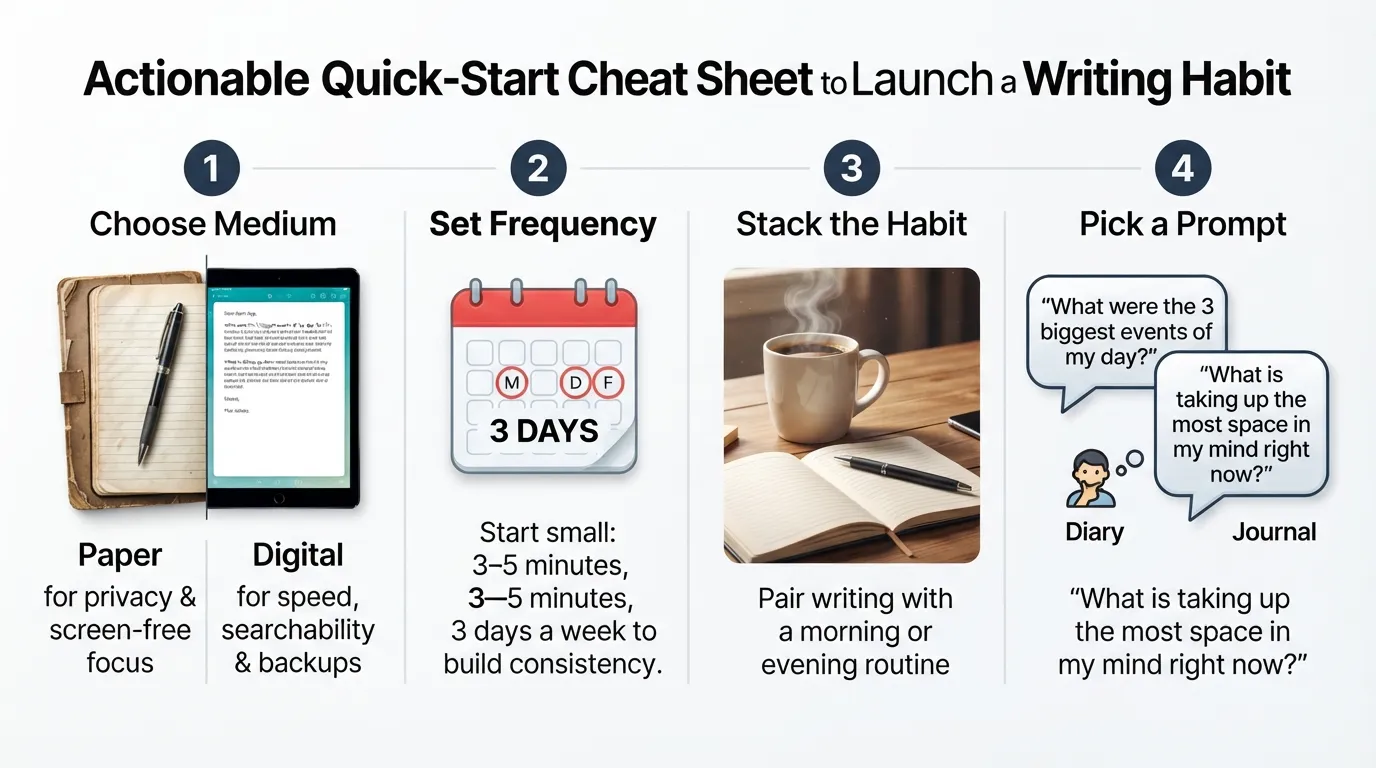
Starting a writing habit doesn’t require expensive notebooks or hours of free time. The key to building a practice that sticks is removing friction and setting clear, manageable expectations from day one.
Step-by-Step for Beginners
Pick Your Medium (Paper vs. Digital) Decide where your entries will live before you start writing. Neither option is inherently superior; choose the tool that fits your daily workflow best:
Paper Notebooks: Best for privacy, tactile feel, screen-free focus, and emotional connection. The main trade-offs are lack of searchability and risk of physical damage or loss.
Digital Apps: Best for rapid typing, cloud backups, password protection, and instant search across past entries. The main trade-offs are screen distraction and a less tactile, more formal experience.
Decide on a Minimal Frequency Commit to an achievable baseline rather than an aggressive daily goal. Aim for 3 to 5 minutes, 3 days a week. It is much easier to scale up a small, successful habit than to recover from the guilt of abandoning a rigid daily routine.
Set Up Your Environment Pair your writing practice with an existing habit (a technique known as habit stacking). Write for three minutes immediately after brewing your morning coffee, or place your notebook directly on your pillow so it’s the last thing you touch before sleep.
Start with a Low-Friction Prompt If you feel stuck staring at the first blank page, bypass the pressure to be profound by using a simple starter prompt:
For a Diary entry: “What were the three biggest events of my day, and who did I interact with?”
For a Journal entry: “What is currently taking up the most space in my mind right now, and why?”
Frequently Asked Questions
A diary focuses primarily on documenting daily life events, schedules, and actions in chronological order. A journal focuses on deep reflection, processing emotions, exploring ideas, and tracking personal growth over time.
Yes. While they have distinct traditional definitions, many people seamlessly blend both into a single notebook. You can log the factual events of your day (diary style) and immediately follow up with a deep reflection on how those events made you feel (journal style).
Journaling can lead to negative rumination if you repeatedly vent without seeking resolutions or perspective. Additionally, privacy fears, blank-page anxiety, and forcing rigid time commitments can make the habit feel like a stressful chore.
It is a rapid daily framework where you write down 3 things you are grateful for, 3 main tasks you want to accomplish today, and 3 stressors or negative thoughts you want to let go of.
Most people avoid journaling due to blank-page anxiety, fear of someone reading their private thoughts, lack of time, or the uncomfortable feeling of confronting difficult emotions on paper.
It is an end-of-day reflection framework where you record 3 things you learned, 2 things you found interesting, and 1 question you want to explore further.
Conclusion
Ultimately, choosing between a diary and a journal isn’t about following strict rules—it’s about matching your notebook to your current intent.
| Objective | Best Choice |
| Record daily life, memories, and schedules | Diary |
| Process feelings, reframe stress, and grow | Journal |
| Combine daily tracking with deep reflection | Hybrid |
Your actionable takeaway: Grab a simple notebook today and test the 5-minute approach. Use three quick bullet points to record what happened today (diary), then write one sentence about how it made you feel (journal). Start small, keep it frictionless, and let your practice evolve naturally.
Pimchanok Srisuk
Pimchanok Srisuk is the Journaling Editor at Holistic Wellbeing Living. She writes about journaling prompts, reflective writing, emotional clarity, and mindful routines. With seven years of experience creating personal-growth content, Pimchanok helps readers use simple writing practices to understand their thoughts and make calmer everyday decisions.