Jump to:
ToggleExample of a Journal: The Complete Guide to Formats, Templates & 20+ Real Sample Entries
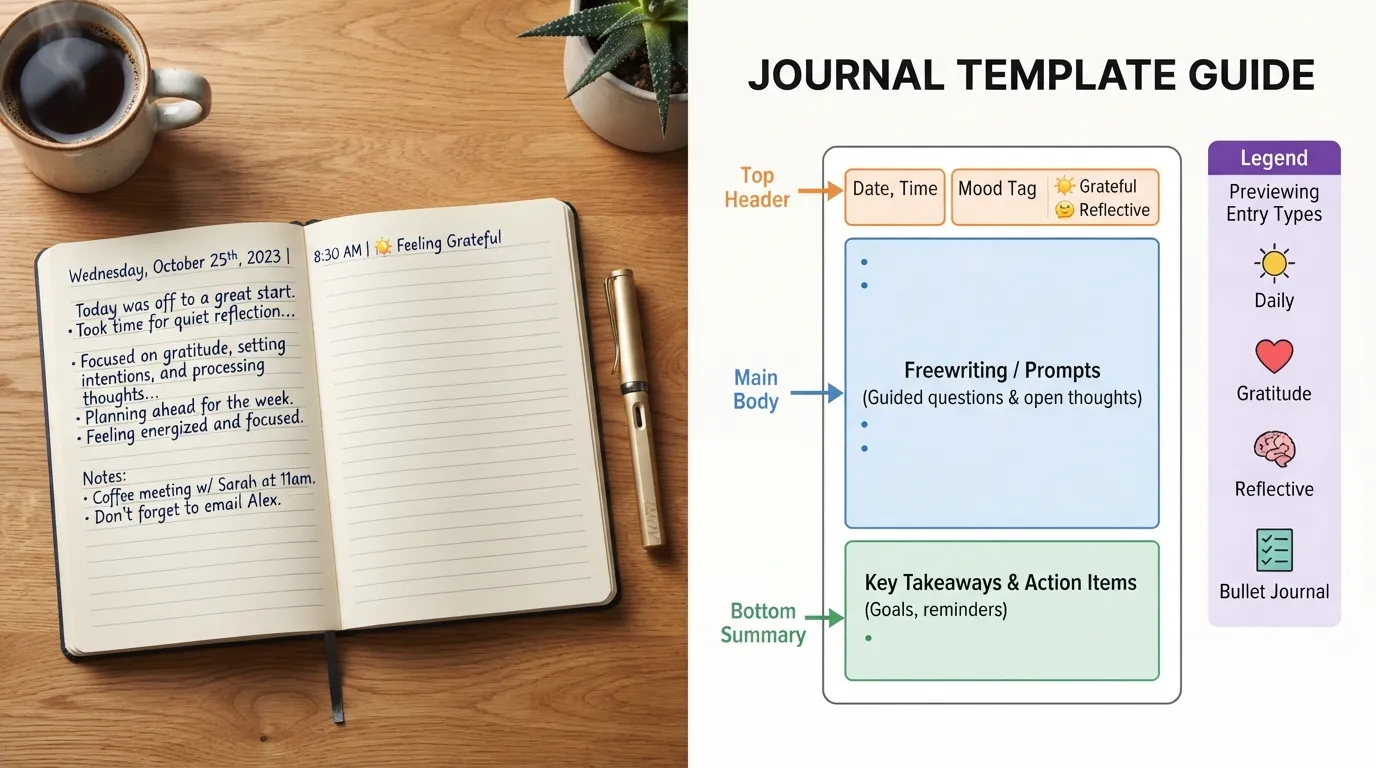
A journal is a personal, ongoing space where you record raw thoughts, everyday experiences, emotional reactions, and reflections to make sense of your life as it happens.
October 16, 2025 — Rain against the window all morning. Coffee went cold while I was staring at the unread emails, but taking ten minutes to write this down actually stopped my brain from spinning.
If you’re looking for academic or accounting journal examples instead, jump to that section below.
What Is a Journal?
A journal is a dedicated space—a notebook, a digital app, or even audio notes—where you record thoughts, experiences, emotional reactions, and observations to help make sense of your life. Unlike a simple log of events, a journal focuses heavily on your inner experience: how a situation felt, what you learned from it, or what you’re trying to figure out.
Journal vs. Diary — What’s the Difference?
While people often use the terms interchangeably, the main distinction comes down to purpose and structure. A diary traditionally captures a daily record of external events (“what happened today”), whereas a journal tends to explore internal reflections, ideas, and personal growth (“how today impacted me”).
| Feature | Journal | Diary |
|---|---|---|
| Flexibility | High. Can be written daily, weekly, or whenever the mood strikes; uses various formats (prompts, freeform, bullet points). | Moderate. Typically focused on sequential, date-stamped, daily entries. |
| Structure | Open-ended. Can adapt to specific goals like habit tracking, stress relief, or creative brainstorming. | Chronological. Primarily structured around calendar dates and routine logs. |
| Typical Content | Internal processing, reflections, feelings, goals, self-inquiry, and creative thoughts. | External facts, daily schedules, brief summaries of interactions, and routine events. |
Looking for a different kind of journal? This guide focuses specifically on personal journaling for wellness and self-reflection. If you are looking for information on scholarly research publications or double-entry bookkeeping, jump down to the sections near the end on academic journals or accounting journal entries.
What Does a Journal Look Like?
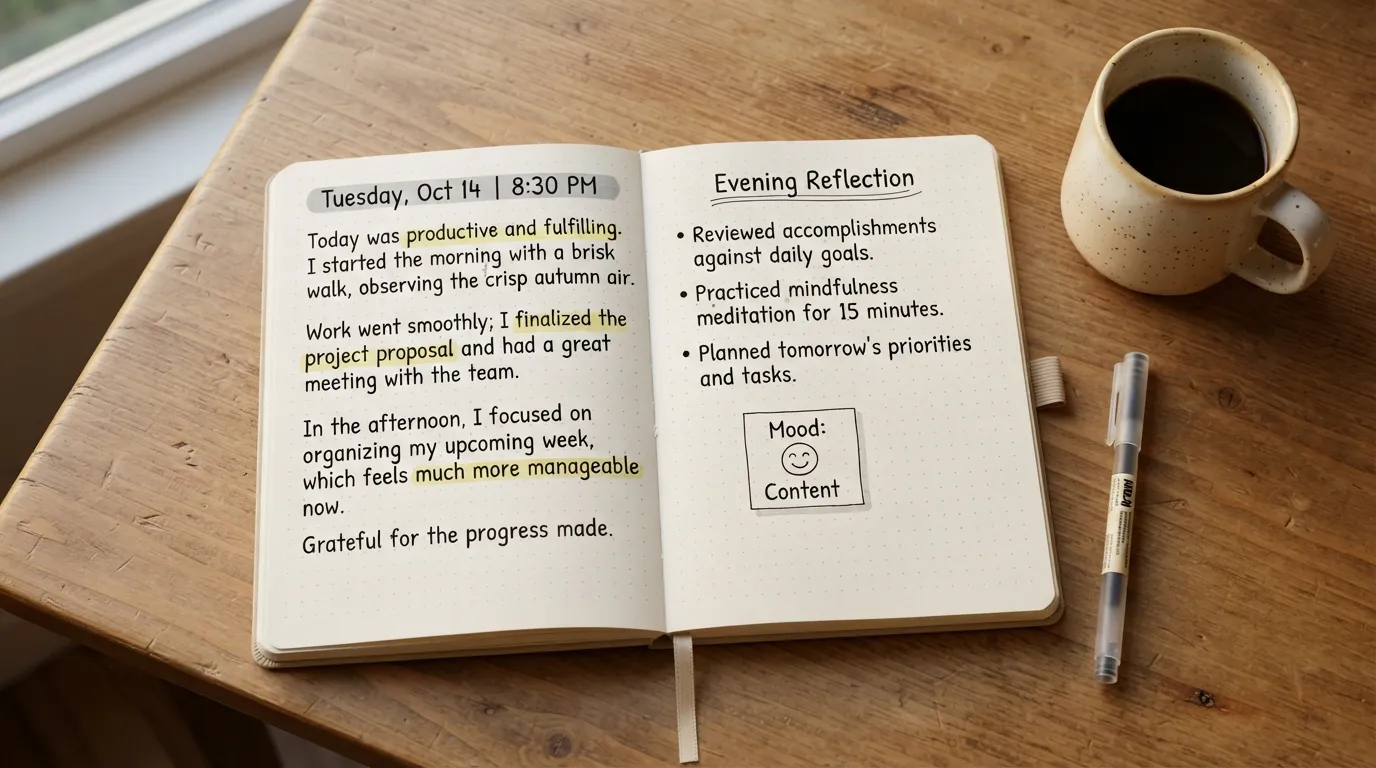
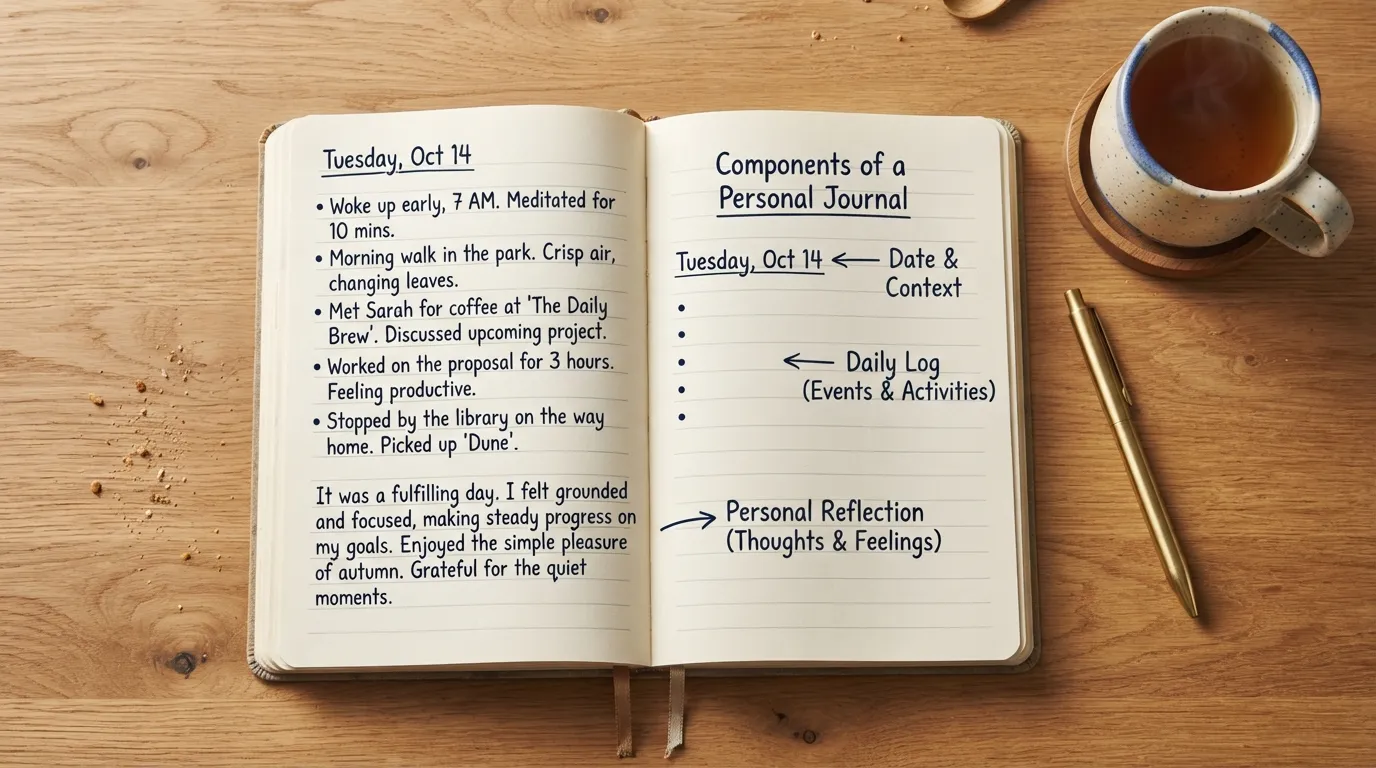
If you opened ten different people’s journals on a random Tuesday, you’d find ten completely different layouts. Some look like chaotic, scribbled streams of consciousness; others look like neat, bulleted logs. That said, a typical daily entry usually shares a few simple structural elements:
- Date and time: Written right at the top (e.g., Oct 14, 8:15 AM). Adding the time helps you spot patterns over time, like realizing your morning entries are hopeful while your late-night ones trend anxious.
- Optional prompt or title: A quick heading to focus your thoughts, like “Post-meeting debrief” or “Why am I procrastinating today?”
- The entry body: The actual writing. It might be three raw sentences, a two-page brain dump, or a neat list of what happened during the day.
- Optional mood or tag: A small note in the margin—like a quick smiley face, a weather icon, or a keyword like #work or #energy—to help you categorize how you were feeling.
You can set up your journal using whatever medium feels easiest to stick with. A physical paper notebook is the classic choice, but plenty of people prefer a digital journal document saved on their computer or phone for quick typing on the go. You might also print out a structured journal sheet or a pre-formatted journal form if you prefer guided boxes and prompts over a blank page.
The most important thing to remember is that there is no single “correct” way a journal is supposed to look. A messy paragraph written on a stray scrap of paper counts just as much as a beautifully hand-lettered page in a leather-bound book. The right format is simply whichever one gets the thoughts out of your head and onto the page.
What Is the Format of a Journal? Copy This Universal Template

The standard format of a journal entry includes four basic elements: a date header, an optional title or prompt, the main body of writing, and an optional tracker or mood tag. You don’t need fancy layouts or rigid rules to start—this clean framework works regardless of what type of journaling you choose to do.
| Journal Entry Log | |
|---|---|
| Date / Time | Tuesday, Oct 14 | 8:30 PM |
| Location / Setting | Kitchen table, rainy evening |
| Mood / Energy | Calmer than this morning, 6/10 |
| Focus / Prompt | What's on your mind? Or insert a specific question here |
| Journal Entry | Write your entry here. Let your thoughts flow naturally without worrying about grammar, neatness, or structure. Write three sentences or three pages. |
| Key Takeaway | Optional: One thing you learned or want to do tomorrow |
Why This Structure Works for Any Journal Type
This framework takes away the paralyzing “blank page” feeling by giving your brain an easy entry point. Anchoring your page with a date, time, and quick mood check creates immediate context, while the unstructured middle leaves total freedom to write whatever you need in that moment.
We use this exact underlying structure to build all of the ready-made daily and weekly templates featured further down this page, so you can adapt it to fit any writing habit without overcomplicating things.
20+ Examples of Journal Entries by Type
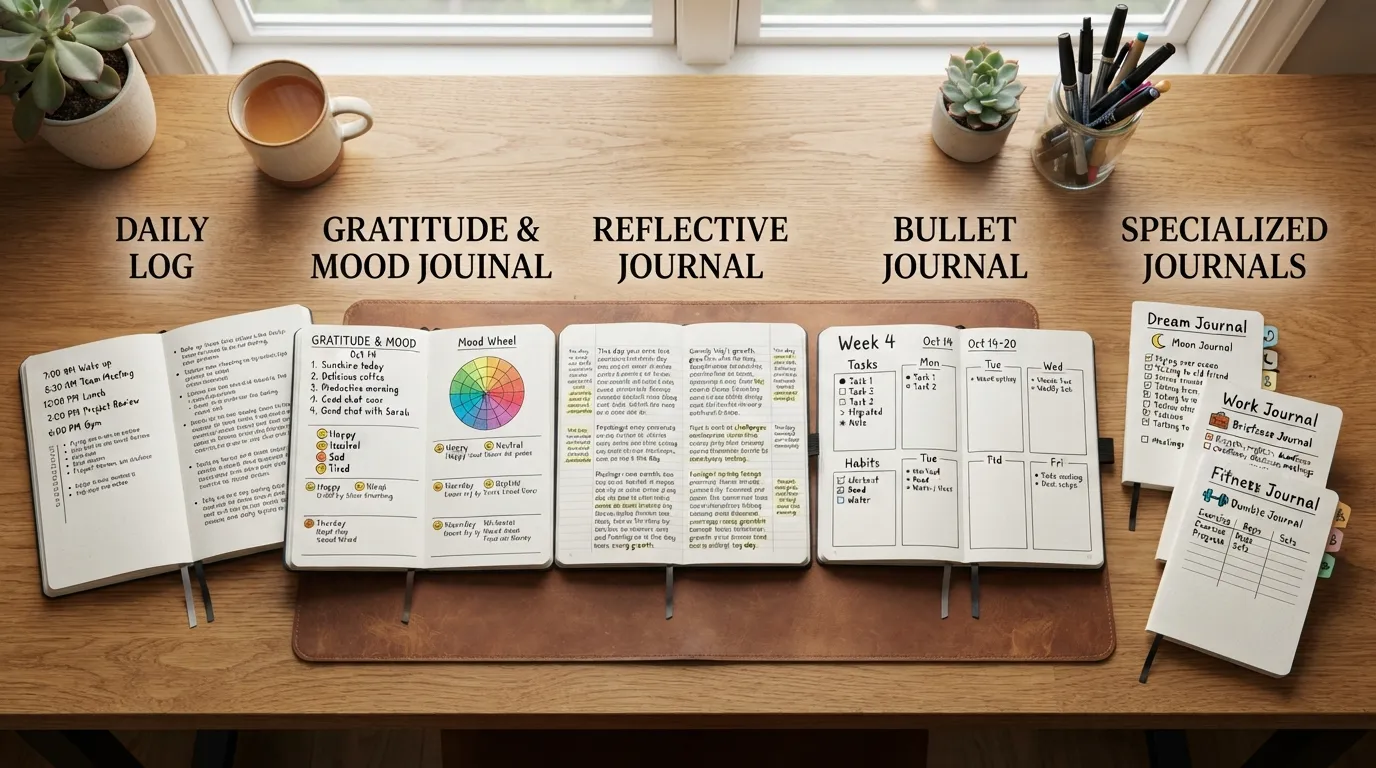
A personal journal acts as the overarching framework for all of these approaches, with daily entries, reflective writing, and one-line summaries serving as the most common everyday formats. Below are distinct examples of a personal journal adapted for specific goals, moods, and routines.
Daily Journal Example
A daily journal records the raw events, routines, and stray thoughts of your everyday life as they happen. It gives you a dedicated space to unpack the day without needing a specific theme or goal.
Tuesday, Oct 14 – 8:40 PM Rainy all afternoon, which meant the kitchen stayed dark until I turned the radiator on around four. Spent most of the morning stuck on a budget sheet that refused to balance, but finally spotted the error after a brief walk around the block. Dinner was leftover lentil soup and a slice of crusty bread that was slightly too stale, though it filled me up. Still feeling a quiet hum of anxiety about Thursday’s presentation, but writing it down makes me realize I’ve already done most of the prep work.
Gratitude Journal Example
A gratitude journal shifts your focus toward positive moments, small wins, and things you appreciate. It works best when you record specific, vivid details from your day rather than vague generalities.
Thursday Morning
The rich smell of fresh coffee beans right when I opened a brand-new bag.
My neighbor offering to pull my trash cans up the driveway while I was running late.
That ten minutes of warm morning sun hitting my desk right before the Zoom call started.
Reflective Journal Example
A reflective journal goes beyond describing events to explore why something happened and how you reacted. It helps you process emotions, spot behavioral patterns, and evaluate your choices with some perspective.
March 3 I felt an immediate flare of irritation when Sarah moved our dinner plans to next week. My first instinct was to assume she wasn’t prioritizing our friendship, but after sitting quietly for a few minutes, I realized my reaction was mostly about my own exhausting week. When I’m already overwhelmed, sudden schedule changes feel much bigger than they are. Next time a plan shifts, I want to take a breath before texting back.
Bullet Journal Example
A bullet journal uses concise, rapid-logging lists combined with symbols like dots, circles, and dashes to track tasks and notes efficiently. It strips away long-form writing in favor of clean, scannable organization.
Oct 18 • Call the plumber about the slow kitchen drain
• Outline second paragraph for project pitch
o 2:00 PM – Quarterly planning call with team
– Pick up high-wattage lightbulbs on the way home
x Submit travel expense report (Done)
Dream Journal Example
A dream journal sits on your nightstand so you can capture night visions, scenes, and strange emotions the moment you wake up. Keeping one helps you spot recurring patterns, subconscious thoughts, and odd themes over time.
Nov 2 – 6:15 AM I was standing in the main hallway of my old high school, but the walls were made of glass holding back ocean water. I had a canvas backpack stuffed with heavy library books that I couldn’t return because the front desk was locked with an oversized brass padlock. Felt an odd mixture of panic and complete calm. Everything in the dream had a deep cobalt blue tint.
Travel Journal Example
A travel journal captures the sights, sounds, local food, and small moments from a trip so they don’t fade over time. It preserves sensory details and personal observations that photos alone usually miss.
Day 4 – Oaxaca The air smelled like roasted chiles and damp stone early this morning. We sat at a tiny wooden table near the market entrance while a woman pressed fresh corn tortillas by hand over a hot clay griddle. The coffee had real cinnamon sticks brewed right into the pot. Spent the afternoon wandering quiet side streets, ducking under heavy clusters of pink bougainvillea whenever a delivery truck squeezed past.
Nature Journal Example
A nature journal combines field observations, weather tracking, and natural curiosity into a record of the outdoors. It encourages you to slow down and notice subtle environmental shifts in your immediate surroundings.
April 12 – Back Garden Conditions: 58°F, overcast with a damp breeze coming out of the east.
Noticed two robins actively gathering dry grass stems near the trunk of the oak tree. The fern leaves along the wooden fence are finally uncurling into bright green spirals. The soil feels wet and heavy from yesterday’s rain, and fresh worm castings are appearing all along the garden border.
Art/Creative Journal Example
An art or creative journal blends words, quick sketches, color swatches, and gathered scraps to explore visual ideas. The focus remains entirely on creative experimentation rather than making a perfect piece of artwork.
July 9 (Pasted ticket stub from the independent cinema next to a loose charcoal sketch of a coffee cup) Experimenting with diluted yellow ink washes tonight. The liquid bled through the paper fibers a bit, but I actually love the rough texture it created. Inspired by the muted earth tones in that vintage film from last night—want to try mixing warm ochre and slate grey pigments tomorrow.
Mood Journal Example
A mood journal tracks your daily emotional state alongside physical triggers, sleep quality, and daily events. It helps you recognize emotional trends over time so you can manage stress more effectively.
Date: Jan 15
Overall Mood: 4/10 (Low energy, easily frustrated)
Physical State: Tight neck muscles, dull headache starting around 3 PM.
Triggers: Slept under six hours and skipped breakfast to make an early commute. Spent three continuous hours answering backlogged emails.
Next Step: Stepping away from all screens for twenty minutes, drinking a full bottle of water, and going for a brisk walk after dinner.
Food & Nutrition Journal Example
A food journal logs meals, snacks, and liquid intake alongside physical notes on how certain foods make your body feel. It serves as a practical tool for spotting food sensitivities, energy slumps, or simple habits.
Wednesday
Breakfast (8:00 AM): Rolled oats with chopped almonds, fresh blueberries, and a pinch of cinnamon. Energy stayed level straight through lunch.
Lunch (1:15 PM): Turkey and avocado wrap with a small handful of salted chips. Felt noticeably sluggish around 2:30 PM.
Dinner (7:00 PM): Baked salmon fillet, roasted broccoli, and brown rice. Digestion felt light and comfortable all evening.
Health & Fitness Journal Example
A health and fitness journal tracks physical workouts, personal records, recovery periods, and daily physical performance. It gives you a clear record of your physical progress over weeks and months.
May 22 – Lower Body Focus
Goblet Squats: 3 sets x 10 reps @ 45 lbs (form felt stable, last set was tough)
Romanian Deadlifts: 3 sets x 8 reps @ 65 lbs
Walking Lunges: 3 sets x 12 steps total
Notes: Right knee felt slightly stiff during the warm-up set, but felt fine after dynamic hip stretches. Drank three full bottles of water throughout the afternoon.
Pregnancy Journal Example
A pregnancy journal documents the physical milestones, doctor visits, changing body signals, and personal feelings during pregnancy. It acts as both a practical health tracking tool and a lasting personal keepsake.
Week 18 Felt the first faint flutterings this morning while sitting on the couch—like little bubble pops low in my abdomen. The heavy morning fatigue from the early months is finally starting to lift, and my appetite is coming back. We spent an hour looking at paint samples for the nursery today and settled on a warm, muted sage green.
Prayer/Spiritual Journal Example
A prayer or spiritual journal provides a dedicated space to write out prayers, reflect on religious texts, or work through personal spiritual questions. It builds structure around quiet daily reflection.
Sunday Evening Passage: Psalm 46:10
Reflection: It is so easy to stay restless when my mind keeps running through everything I need to manage this coming week. Today I want to practice sitting in quiet trust instead of trying to control every detail. Asking for patience with my coworkers tomorrow, especially during the morning project review.
Manifestation Journal Example
A manifestation journal outlines your personal goals and aspirations using clear, intentional language. Writing down your desires helps align your daily choices and focus with the long-term changes you want to build.
August 11 I am moving into a role that values my creative judgment and offers clear room for growth. My daily work feels focused, balanced, and free from constant rushing. I handle high-pressure tasks with steady confidence, and I trust my ability to solve complex problems as they come up.
Work Journal Example
A work journal logs completed assignments, hard technical problems, positive feedback, and ongoing projects. It provides a clear, factual record to draw from when writing performance reviews or updating your resume.
Nov 12
Fixed the payment gateway bug that was causing checkout timeouts on mobile devices.
Met with the product designer to finalize the revised layout for the user dashboard.
Positive Feedback: Team lead mentioned the bug fix saved significant time during peak hours.
Follow-up: Check the error logs on Friday morning to confirm stability before the weekly build.
Book/Reading Journal Example
A book journal records your reactions, memorable quotes, and critical thoughts about the books you read. It helps process main themes deeply and keeps a running archive of your reading history.
Title: The Remains of the Day by Kazuo Ishiguro
Rating: 5/5
Notes: A quiet, beautifully written story about restraint, missed chances, and personal regret. The narrator’s internal logic is so disciplined that what he leaves unsaid carries far more weight than what he actually reveals out loud.
Key Line: “What is the point in worrying oneself too much about what one could or could not have done to control the course one’s life took?”
One-Line-a-Day Journal Example
A one-line-a-day journal requires just a single sentence written every twenty-four hours. Over time, it creates a rich, low-effort record of your life across months and years.
Feb 14: We stayed in to cook fresh pasta, accidentally charred the garlic bread, and laughed at the smoke detector until our sides hurt.
Commonplace Journal Example
A commonplace journal is a central notebook used to collect quotes, passages, facts, recipes, and ideas from external sources. It serves as a personal repository of wisdom and interesting details gathered over time.
Entry #52 > “I do not mind what happens.” — Jiddu Krishnamurti
Theme: Mindset / Resilience
Note: Came across this quote in an essay about stress management. It’s a striking reminder that much of our daily anxiety stems from resisting current circumstances rather than the circumstances themselves.
Goal-Setting/Planner Journal Example
A goal-setting journal breaks large, long-term ambitions into manageable targets, weekly tasks, and measurable habits. It bridges the gap between high-level ideas and daily execution.
Q4 Objective: Draft the first four chapters of the manuscript.
Monthly Target: Write 8,000 clean words by the 30th.
Weekly Plan: Complete 2,000 words across four short sessions.
Today’s Action: Write the opening scene for Chapter 2 before dinner (Goal: 500 words).
Hobby Journal Example
A hobby journal tracks progress in specific personal activities like gardening, baking, woodworking, or crafting. It records measurements, environmental conditions, mistakes, and successful techniques for future reference.
Sourdough Bake #8 > * Flour: 80% unbleached bread flour, 20% dark rye
Hydration: 74%
Fermentation: 5 hours at 71°F room temperature
Outcome: Excellent crust color and good rise, but the interior crumb came out slightly too dense. Next time, extend the final rise by thirty minutes to improve the texture.
Self-Care Journal Example
A self-care journal focuses entirely on personal wellbeing, tracking habits that nourish your physical, mental, and emotional health. It serves as a reminder to prioritize rest and set gentle boundaries.
Sunday Night > Kept my phone on silent for the entire afternoon and read three chapters of my book on the back porch. Preparing a warm meal and stepping away from work emails made the evening feel spacious and unhurried. Protecting my weekend downtime like this leaves me feeling much more grounded heading into Monday.
Journal Examples for Students
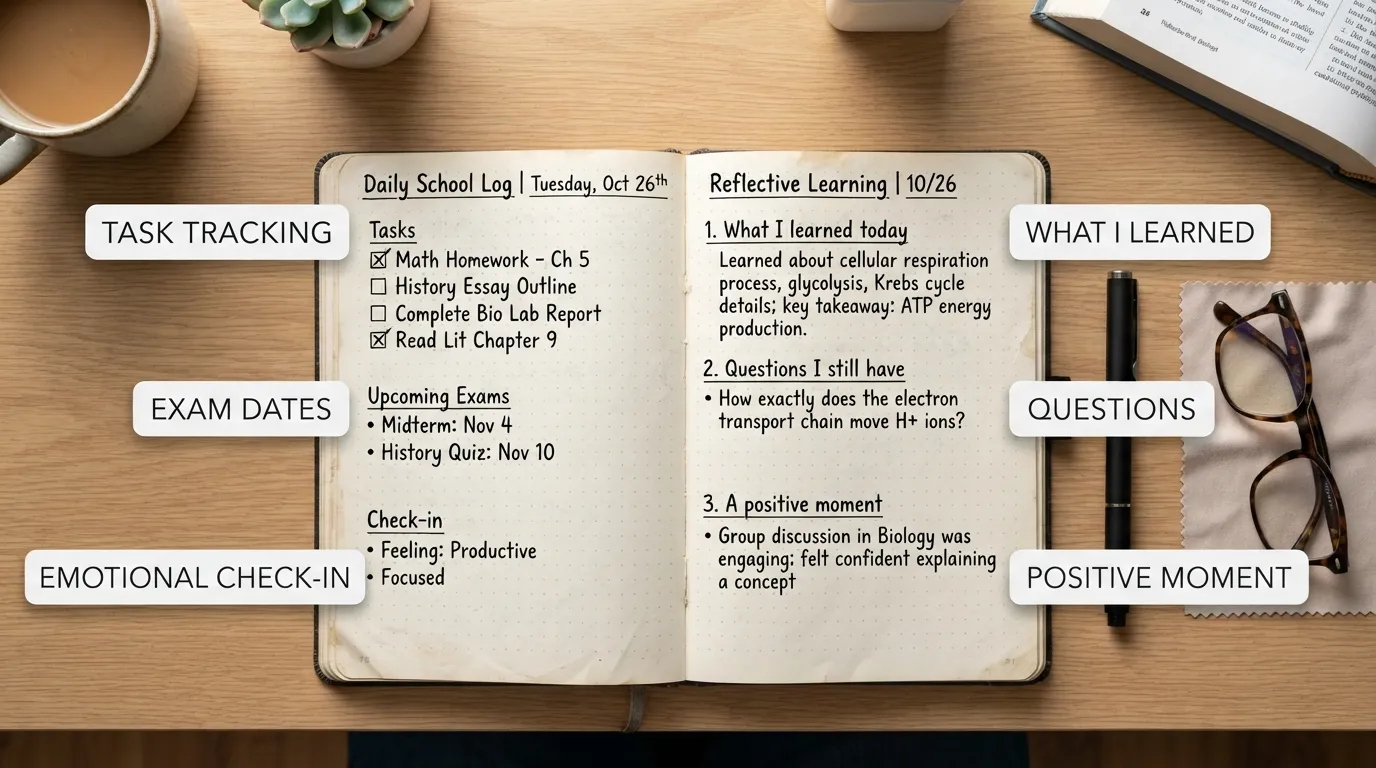
Students need journaling formats that track real academic progress without feeling like empty busywork. Whether you are taking notes on a dense chapter or tracking hours at a clinical placement, the entry should help you process what you are learning while giving you a clear record to reference later.
Daily Class/Reading-Response Journal Example
A reading-response journal helps you digest complex course material by forcing you to pull key ideas into your own words instead of just highlighting sentences. It gives you a dedicated spot to question arguments, note connections to other lectures, and log questions for class discussions.
Class: SOC 302 – Urban Sociology
Date: October 21
Reading: The Death and Life of Great American Cities (Chapters 2–3)
Key Idea: Jacobs argues that natural surveillance—what she calls “eyes on the street”—makes urban spaces safe, rather than just police presence or strict zoning.
Personal Reaction / Connection: This explains why the quiet, empty courtyard behind the science library always feels so eerie at 6:00 PM, while the main plaza with the food trucks feels completely safe even when it’s crowded and noisy.
Questions for Discussion: How does her concept of neighborhood vitality apply to modern digital spaces, or does physical density still matter most?
Weekly Student Journal Example (General Class Use)
A weekly student journal gives you a bird’s-eye view of your coursework across five days. It acts as a light reflective check-in to track major project milestones, study habits, and what concepts still feel shaky before exams roll around.
Week 6 Summary: Oct 13 – Oct 17 | Course: BIO 210
Primary Concept Mastered: Cellular respiration pathways and glycolysis inputs/outputs.
Struggled With: Memorizing the specific enzymes in the Krebs cycle. Need to redraw the diagram on whiteboards this Sunday.
Study Habit Win: Attended office hours on Wednesday. Asking two quick questions saved me at least three hours of confused guessing on the lab report.
Goal for Next Week: Start drafting the literature review outline on Monday night instead of waiting until Thursday evening.
Weekly Internship or Field-Placement Journal Example
Field placements, clinicals, and internships require more structured documentation than regular classes. This format combines practical time-tracking with reflection categories like ethics, critical thinking, and emotional reactions to satisfy academic requirements.
Field Placement Journal > Student: Maya Lin | Placement Site: Metro Youth Services | Supervisor: D. Vance
Week 4: Sept 29 – Oct 3 | Hours Logged This Week: 15 hrs | Total Cumulative Hours: 60/120
Daily Log Summary: > * Mon (5 hrs): Shadowed intake assessments; observed two client intake interviews.
Wed (5 hrs): Co-facilitated afternoon group discussion on coping skills; updated client resource binders.
Fri (5 hrs): Organized resource library; attended weekly interdisciplinary staff meeting.
Critical Thinking & Problem Solving: Observed how the team adapted intake forms when a client struggled with reading literacy. It showed me how rigid administrative paperwork can create unintentional barriers to receiving help.
Values & Professional Ethics: Maintained strict confidentiality when reviewing family histories during Wednesday’s team debrief. Noticed a personal bias toward wanting to “fix” a client’s situation immediately rather than letting them lead their own goals.
Personal Reactions & Processing: Felt nervous during the afternoon group session when conversation stalled for two full minutes. My supervisor reminded me that silence often gives clients space to think, and that I don’t need to fill every pause.
Printable Student Journal Templates
If you need a physical sheet to slip into your binder or turn in to an instructor, use these print-friendly layouts. They drop heavy paragraphs in favor of clean lines that fit easily onto a single printed page.
Daily Class Response Template
| Reading & Topic Notes | |
|---|---|
| Course | |
| Date | |
| Reading / Topic | |
| Main Takeaway | |
| My Analysis / Connections | |
| Discussion Questions |
|
Weekly Field Placement Log Template
| Weekly Internship / Student Log | |
|---|---|
| Student Name | |
| Site / Organization | |
| Week Of | |
| Hours Completed | |
| Daily Activity Log | |
| Monday | |
| Tuesday | |
| Wednesday | |
| Thursday | |
| Friday | |
| Critical Reflection | |
| Application of Theory | |
| Ethical Note | |
| Area for Growth | |
What Are the Types of Journals?
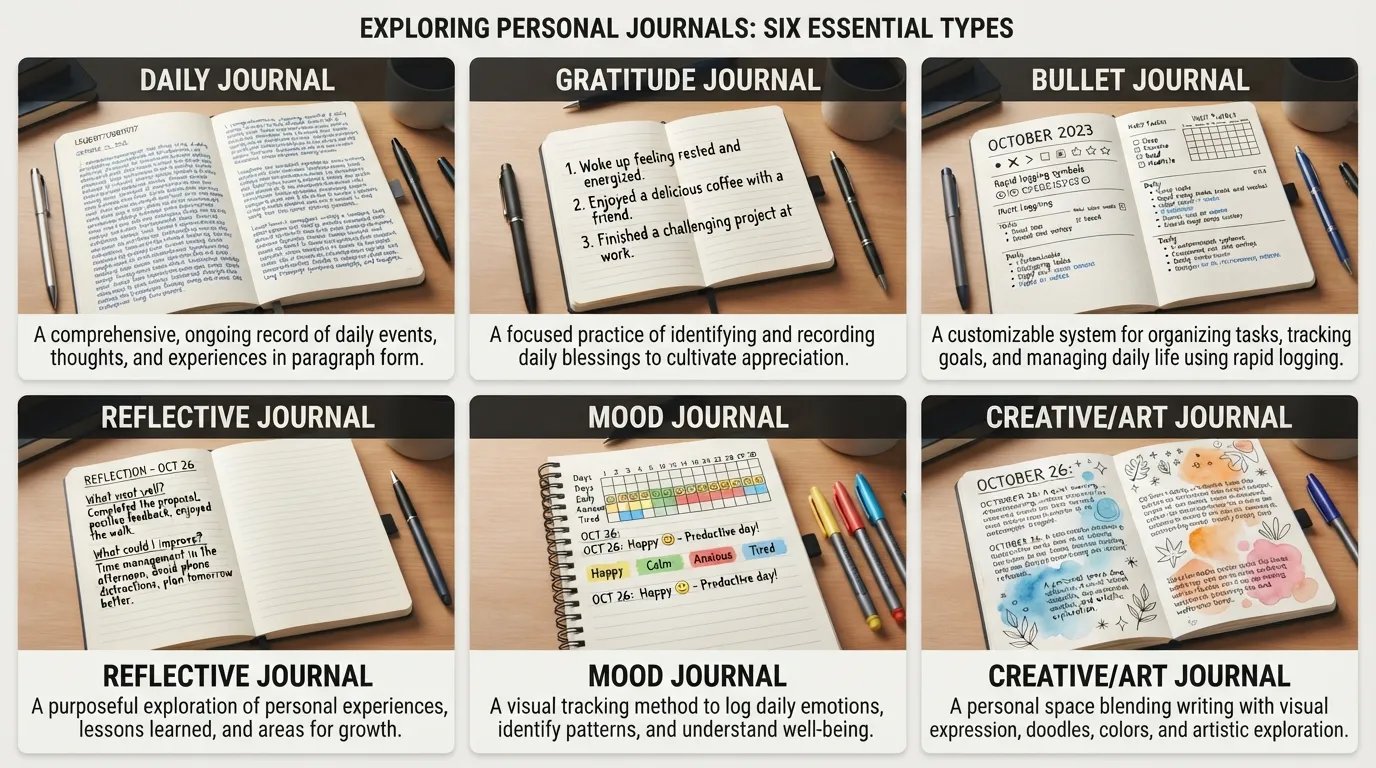
There is no single fixed rule for how many journaling methods exist—whether a guide claims there are 4, 5, or 7 distinct types of journals comes down to how someone chooses to group them. Rather than treating these categories as rigid boxes, it helps to view them as different ways to organize your thoughts depending on what you need in the moment.
| Category | Purpose | Example Types |
|---|---|---|
| Personal & Daily | Capturing day-to-day life, processing emotions, and clearing mental clutter. | Daily journal, Reflective journal, One-line-a-day, Bullet journal |
| Wellness & Mindfulness | Tracking physical health, emotional patterns, and personal growth. | Gratitude journal, Mood journal, Self-care journal, Dream journal |
| Productivity & Goals | Managing tasks, planning future milestones, and logging professional progress. | Work journal, Planner/Goal-setting journal, Habit tracker |
| Creative & Experiential | Documenting specific interests, trips, visual ideas, or external inspiration. | Travel journal, Nature journal, Art journal, Commonplace book |
What Is the 3-3-3 Journaling Method? With Example
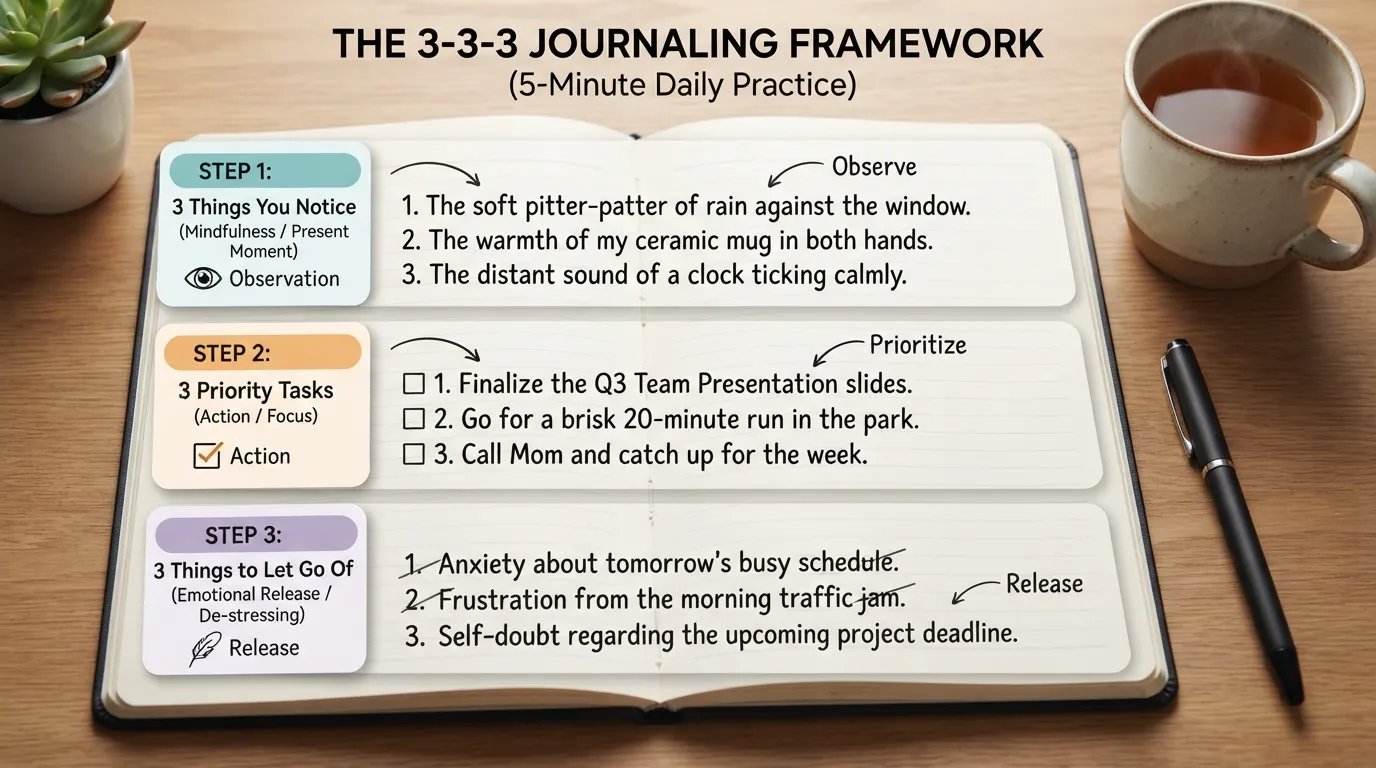
The 3-3-3 journaling method is a quick grounding exercise adapted from sensory anxiety management that brings your focus back to the immediate present. To practice it, you write down three things you can see, three things you hear around you, and three physical sensations or movements you experience right now.
It works exceptionally well when your mind feels scattered or overwhelmed by racing thoughts. By forcing your attention onto concrete physical details in your environment, it breaks mental loops and anchors you back in your body.
3-3-3 Grounding Entry – Wednesday, 4:15 PM
3 Things I See:
The dust motes floating in the streak of sunlight on my desk
My blue ceramic mug with a chipped handle
The green Monstera leaf pressing against the windowpane
3 Things I Hear:
The hum of the refrigerator in the next room
Distant traffic on the main road
Rain clicking softly against the window glass
3 Physical Sensations I Feel:
My feet resting flat and heavy against the cold hardwood floor
The cool breeze from the cracked window on my left cheek
The slight tightness in my shoulders softening as I exhale
3-3-3 Journaling Method Example
How Do You Start a Journal? (Step-by-Step for Beginners)
Starting a journal requires just three simple things: choosing a medium, setting a tiny time goal, and lowering your expectations about how “good” your writing needs to be. You don’t need a formal routine or an expensive leather notebook to begin.
Pick your format. Decide whether you write better by hand in a basic notebook or typing on a phone or laptop. Physical notebooks offer a break from screens, while digital apps make it easy to type out quick thoughts on the bus.
Set a ridiculously small goal. Commit to writing for just two minutes or filling half a page each day. Small goals eliminate resistance and help build a natural habit before you worry about word count.
Use a simple prompt if your mind goes blank. If staring at a blank page feels intimidating, answer one basic question: “What felt heavy today?” or “What made me laugh this morning?”
Skip perfectionism entirely. Your journal is for your eyes only, so ignore messy handwriting, bad spelling, or half-finished sentences. The goal is to clear your head, not to write a book.
Keep your journal visible. Leave your notebook on your pillow or keep your journaling app on your phone’s primary home screen. Visual cues remind you to write before your day gets busy.
How to Start Journaling for Beginners
Daily & Weekly Journal Templates You Can Copy
| Reading & Topic Notes | |
|---|---|
| Course | |
| Date | |
| Reading / Topic | |
| Main Takeaway | |
| My Analysis / Connections | |
| Discussion Questions |
|
| Weekly Internship / Student Log | |
|---|---|
| Student Name | |
| Site / Organization | |
| Week Of | |
| Hours Completed | |
| Daily Activity Log | |
| Monday | |
| Tuesday | |
| Wednesday | |
| Thursday | |
| Friday | |
| Critical Reflection | |
| Application of Theory | |
| Ethical Note | |
| Area for Growth | |
Why Keep a Journal? (Benefits, Backed by Research)
Keeping a journal gives your mind a private clearinghouse to process life before it turns into mental clutter. When you put raw thoughts onto paper, you externalize them, which reduces the constant loop of rumination that makes stressful days feel so heavy.
According to the University of Rochester Medical Center, regular journaling serves as a practical tool for managing mental health by helping you track symptoms, identify daily stressors, and recognize emotional triggers. By seeing your habits laid out on paper, you can spot unhealthy behavior patterns and take proactive steps to fix them.
HelpGuide.org also highlights that writing down your thoughts helps slow down racing emotions, creating a safe space to gain clarity and work through complex problems step by step. Rather than letting worries bounce around in your head, the physical act of writing helps calm your nervous system and puts everyday challenges into perspective.
Why Keep a Journal (Benefits of Journaling)
If You Meant an Academic Journal
An academic or scholarly journal is a peer-reviewed, periodical publication where researchers, professors, and subject experts share original research, study results, and theoretical analysis within a specific field. Unlike personal journals, these are formal, heavily cited, and written for an expert audience to advance academic knowledge.
Well-known examples of academic journals include:
Nature (multidisciplinary scientific research)
The New England Journal of Medicine (clinical medical research)
The American Economic Review (economics)
The Journal of Applied Psychology (organizational and behavioral psychology)
If you came here looking for research papers or peer-reviewed literature, you’ll want to search academic databases like PubMed, JSTOR, or Google Scholar rather than a personal wellness notebook.
If You Meant a "General Journal" (Accounting)
In accounting, a general journal is a business’s master chronological record of financial transactions written down before they get posted to individual ledger accounts. Its main purpose is to maintain a reliable, double-entry audit trail—documenting every debit and credit with dates and brief descriptions—so financial records stay accurate and balanced over time.
Common entry types recorded in a general journal include opening entries, adjusting entries, compound entries, closing entries, and transfer entries.
Frequently Asked Questions
A dot journal refers to the physical notebook featuring a dot grid paper pattern. Bullet journaling (or BuJo) is the specific organizational methodology—created by Ryder Carroll—that uses rapid logging, signifiers, and index systems to track tasks, events, and notes within a notebook.
A standard beginner dotted journal typically contains 160 to 240 pages (or roughly 80 to 120 sheets). This range provides enough room to run a full year of monthly logs, weekly spreads, and custom collections without making the notebook excessively heavy or bulky to carry daily.
No, you do not need expensive or specialized pens to start. Any smooth, fine-point ballpoint pen, gel pen (0.38mm to 0.5mm), or fineliner (such as a Sakura Pigma Micron or Pilot G2) works perfectly for basic daily logging and drawing grid frames.
Yes, you can apply the bullet journaling methodology (rapid logging, indexing, and signifiers) to any lined, squared, or blank notebook. However, a dot grid notebook is preferred because the faint 5mm grid lines provide subtle structure for drawing clean boxes and matrices without cluttering the background visually.
Pimchanok Srisuk
Pimchanok Srisuk is the Journaling Editor at Holistic Wellbeing Living. She writes about journaling prompts, reflective writing, emotional clarity, and mindful routines. With seven years of experience creating personal-growth content, Pimchanok helps readers use simple writing practices to understand their thoughts and make calmer everyday decisions.