1. Morning Routine Journaling Formats
A comprehensive breakdown of morning journaling techniques, covering stream-of-consciousness writing, simple prompts, and practical habits for building a consistent daily practice.
Jump to:
Toggle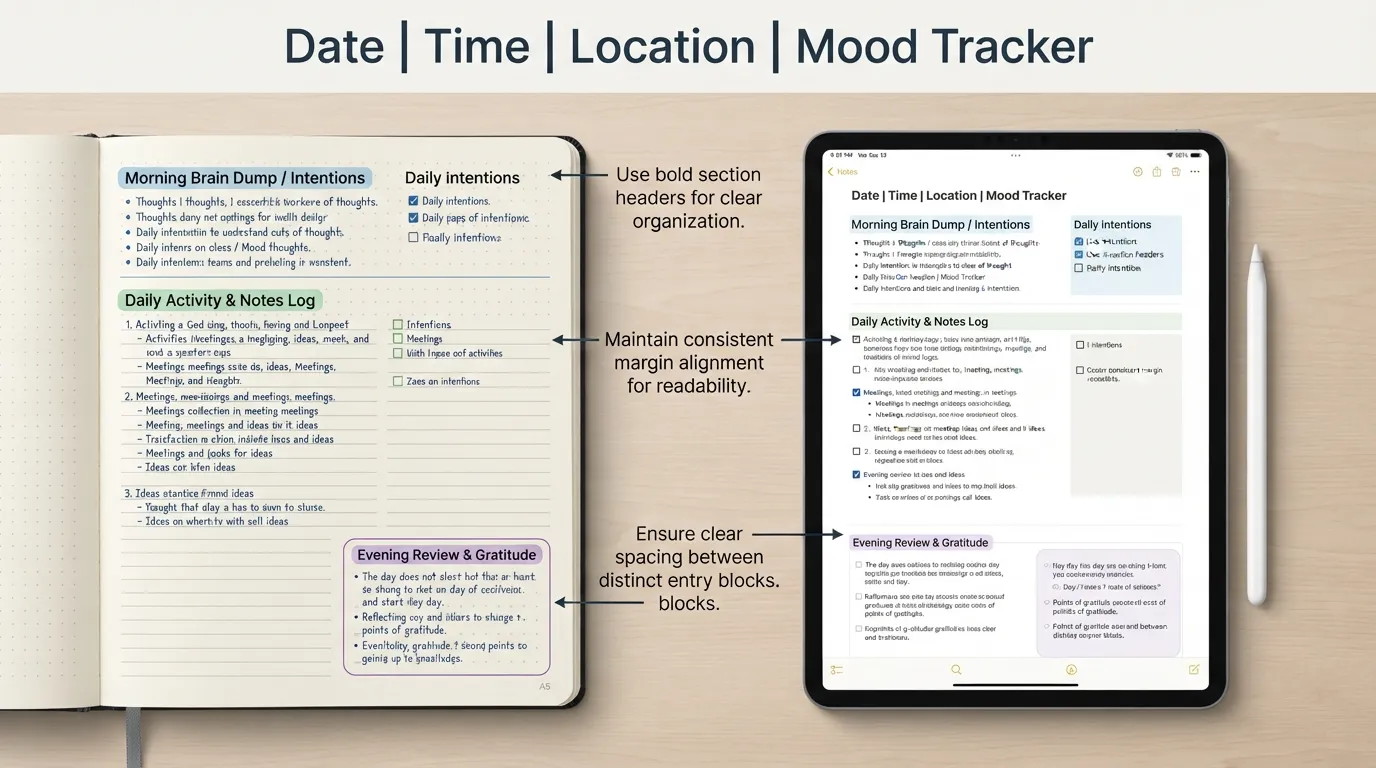
A journal format is a simple, structured layout used to organize your daily thoughts, events, and self-reflections on paper. Unlike free-form writing, a proper journal format relies on three core elements: a header (date, time, location), a body (the raw entry or record), and a reflection (what you learned or how you felt). Structuring your entries this way turns a blank page into a quick, repeatable process instead of an overwhelming daily chore.
Here is the exact structural breakdown of a standard, high-yield journal page layout:
Starting a journal entry with zero structure triggers decision fatigue—you spend more energy deciding how to write than what to write. Following a consistent layout provides instant momentum, letting you drop directly into expression without freezing up over the first sentence.
A standard journal page layout relies on a simple, repeating three-part structure: a Header, a Main Body, and a Closing Reflection. Structuring a blank page with this specific sequence removes friction, keeps your entries readable, and ensures you capture both raw thoughts and useful insights every single time.
The header anchors your entry in time and context, making your journal an accurate, searchable record when you review it later. Always place these three data points at the top of your page:
Date & Time Stamp: Write out the full date and exact time (e.g., Thursday, July 23, 2026 – 8:30 AM). Recording the time helps you track your psychological state during specific periods of the day.
Location Tag: Jot down where you are writing (e.g., Home Office or Corner Coffee Shop). Physical location adds sensory context to your mental state when reading entries years down the line.
Mood & Energy Tracker Metrics: Assign quick numerical values or keywords to your baseline state (e.g., Mood: 8/10, Energy: High). According to clinical psychology research, tracking emotional states visually aids in pattern recognition over time.
The main body is where you process your experiences. Depending on your objective for the day, choose one of two distinct structural approaches:
Continuous Paragraphs (Stream-of-Consciousness): Best used for emotional processing, stress reduction, and deep storytelling. Writing uninterrupted blocks of text helps bypass your internal editor, allowing hidden anxiety or insights to surface naturally.
Bulleted Lists (Rapid Logging): Best used for task management, rapid daily tracking, and productivity. Using short bullet points keeps your entry concise, saves time on busy days, and separates action items from random thoughts instantly.
Never leave an entry open-ended without a logical conclusion. Concluding your page brings mental closure and converts your raw writing into actionable clarity.
1-Sentence Key Takeaway: Summarize the core insight of your entry into a single sentence (e.g., “Today reminded me that taking a 15-minute walk before checking email prevents mid-day burnout.”).
Daily Priority Question: End with a direct question to prompt action for tomorrow (e.g., “What is the single most important task I must complete before noon?”).
Different journaling styles serve different needs. Whether you want to reduce stress, track daily habits, or process complex emotions, choosing the right structure prevents frustration and ensures consistency.
Created by Ryder Carroll, Bullet Journaling relies on a method called Rapid Logging. Instead of writing long sentences, you use short, actionable bullets paired with specific symbols (syntax) to organize your day visually:
Popularized by Julia Cameron in The Artist's Way, this format involves writing three pages of unedited longhand thoughts immediately after waking up. The goal is complete cognitive offloading—putting your raw internal dialogue onto paper without self-editing, worrying about grammar, or focusing on neatness.
The 3-3-3 format is a structured, low-friction framework designed for quick daily alignment. It balances emotional grounding with practical focus using three distinct categories:
When facing resistance or a mental block, full blank pages can feel intimidating. The Sentence Completion Format uses partial prompt stems to bypass your conscious filters and uncover underlying feelings fast:
This format uses a script-style layout to externalize internal conflicts. By assigning voices to two contrasting parts of yourself—such as your Anxious Self and your Wise Self—you create psychological distance from reactive emotions.
When you need to make critical choices or set clear personal boundaries, a visual grid layout works better than standard narrative blocks. Splitting the page into clean vertical columns helps you evaluate trade-offs objectively:
| Options / Decisions | Pros & Gains (+) | Cons & Trade-offs (-) |
|---|---|---|
| Option A: Launch Project Today | Moves the pipeline forward; captures momentum early. | Higher risk of minor technical bugs; tight testing window. |
| Option B: Delay Launch by 48 Hours | Ensures full QA testing; reduces stress for the team. | Pushes marketing timeline back; delays initial data gathering. |
The Time-Block format merges daily scheduling with real-time reflection on a single page. Divide your page vertically into two distinct zones: standard hours on the left margin and corresponding execution notes on the right margin.
Visual learners can explore these step-by-step video guides to master different journaling structures, setups, and daily routines.
A comprehensive breakdown of morning journaling techniques, covering stream-of-consciousness writing, simple prompts, and practical habits for building a consistent daily practice.
Learn essential personal journal formatting rules, proper date logging, and how to structure daily entries to capture personal reflections, actions, and key life events.
A structured walkthrough on proper layout mechanics, document styling, header formatting, and citation rules for academic or formal daily entry journals.
Academic journal writing requires a shift from pure emotional expression to structured critical reflection. When writing reflective journal entries for coursework, university assignments, or research logs, your content must balance subjective experience with theoretical analysis and formal formatting standards.
To score high marks and maintain academic rigor, break your reflective entries down using the 15 / 50 / 35 rule. This balanced framework prevents entries from turning into simple summaries or overly casual diary entries:
Description (15% of total length): Provide a concise, objective summary of the topic, lecture, clinical experience, or core text. Stick strictly to facts—what happened, what was discussed, or what problem was presented.
Critical Analysis (50% of total length): Connect your real-world experience or reaction directly to academic theories, class reading materials, or lecture concepts. Evaluate why things happened the way they did, question assumptions, and cite relevant literature to back up your analysis.
Future Application (35% of total length): Detail how this new insight will directly alter your future practice, professional approach, or study habits. Outline concrete action steps you will take when encountering similar situations in the future.
When instructors request a formal journal submission, adhere strictly to the American Psychological Association (APA 7th Edition) formatting guidelines to ensure professional presentation:
Page Layout & Typography: Set margins to standard 1-inch on all sides. Use readable, standard fonts such as Times New Roman (12 pt) or Calibri (11 pt), and ensure the entire document is double-spaced without adding extra line breaks between paragraphs.
In-Text Citations & Academic Evidence: Whenever you connect a personal reflection to an academic concept or lecture reading, include formal parenthetical citations containing the author’s last name and publication year (e.g., Smith, 2024). For complete rules on structuring title pages, running headers, and references, consult the official APA Style Guidelines.
To save time and eliminate setup friction, copy and paste any of the structured templates below directly into your digital notes app (Notion, Google Docs, Apple Notes) or write them directly onto your physical journal page.
A minimalist, high-yield structure designed for everyday logging, habit tracking, and evening reflection.
======================================================================
DAILY JOURNAL ENTRY
======================================================================
Date: [MM/DD/YYYY]               Time: [00:00 AM/PM]
Location: [Home Office / Cafe]   Mood & Energy: [e.g., 8/10 | High]
Title / Main Theme: "____________________________________"

----------------------------------------------------------------------
1. MORNING BRAIN DUMP & OBJECTIVES
----------------------------------------------------------------------
• Top Priority Today:
  [ ] ________________________________________________________________

• Secondary Tasks:
  [ ] ________________________________________________________________
  [ ] ________________________________________________________________

• What's on my mind right now? (Stream of consciousness / raw thoughts):
  - __________________________________________________________________
  - __________________________________________________________________

----------------------------------------------------------------------
2. DAILY LOG & MID-DAY REFLECTION
----------------------------------------------------------------------
[Notes, key conversations, decisions made, or notable occurrences]
-

----------------------------------------------------------------------
3. EVENING REVIEW & LESSONS LEARNED
----------------------------------------------------------------------
• What went well today?
  1. ________________________________________________________________
  2. ________________________________________________________________

• What caused friction or anxiety today, and how did I handle it?
  -

• Key Takeaway / Lesson for Tomorrow:
  "__________________________________________________________________"
======================================================================A self-compassion framework focused on emotional regulation, identifying triggers, and cultivating grounded gratitude.
======================================================================
MENTAL HEALTH & GRATITUDE CHECK-IN
======================================================================
Date: [MM/DD/YYYY]               Time: [00:00 AM/PM]
Current Emotional State: [Anxious / Calm / Overwhelmed / Energized]
Physical State Check (Body Scan): [Tight shoulders / Rested / Tired]

----------------------------------------------------------------------
1. GRATITUDE & GROUNDING
----------------------------------------------------------------------
I am deeply grateful for these 3 specific things today:
1. ___________________________________________________________________
2. ___________________________________________________________________
3. ___________________________________________________________________

----------------------------------------------------------------------
2. EMOTIONAL PROCESSING & UNPACKING
----------------------------------------------------------------------
• What am I feeling right now? (Name the specific emotions):
  -

• What is driving this feeling? (External factors or internal thoughts):
  -

• Is this within my direct control?
  [ ] Yes  --> Action step I can take right now: ______________________
  [ ] No   --> What I need to let go of: _____________________________

----------------------------------------------------------------------
3. SELF-COMPASSION & DAILY AFFIRMATION
----------------------------------------------------------------------
• A compassionate message to myself today:
  "__________________________________________________________________"

• One small thing I will do today just for my well-being:
  - __________________________________________________________________
======================================================================An assignment-ready framework structured around critical analysis rules for university students and academics.
======================================================================
ACADEMIC REFLECTIVE JOURNAL
======================================================================
Student Name: [Your Full Name]       Course Title: [Course Code & Name]
Date of Entry: [DD Month YYYY]       Week / Module: [e.g., Week 4]
Topic / Lecture Focus: "____________________________________"

----------------------------------------------------------------------
PART 1: OBJECTIVE DESCRIPTION (15% of Entry)
----------------------------------------------------------------------
[Summarize the key theoretical concepts, case study, clinical event, or reading objectively without personal opinion.]

• Core Concept / Event:
  -

• Key Facts / Findings Presented:
  -

----------------------------------------------------------------------
PART 2: CRITICAL ANALYSIS & THEORETICAL CONNECTION (50% of Entry)
----------------------------------------------------------------------
[Evaluate why this occurred. Connect your experience directly to required readings, academic frameworks, and literature.]

• How does this connect to course theories or literature?
  - As noted by Author (Year), "..." This aligns with my observation because...

• Assumptions challenged or insights gained:
  -

----------------------------------------------------------------------
PART 3: FUTURE APPLICATION & ACTION PLAN (35% of Entry)
----------------------------------------------------------------------
[Detail specifically how this insight will alter your academic approach, professional practice, or future research.]

• What will I do differently when encountering this situation again?
  1. ________________________________________________________________
  2. ________________________________________________________________

• Concrete Next Steps:
  -
======================================================================To start journaling, keep your entry friction-free by setting a simple daily target—such as writing for just 5 minutes or filling 3 bullet points. Pick a medium that feels natural (a physical notebook or a digital app like Notion) and focus on writing without self-judgment or overthinking grammar.
The 3-3-3 journaling method is a quick daily reflection framework where you write down: 3 things you are grateful for, 3 key achievements or tasks for the day, and 3 areas of focus or improvement for tomorrow. It promotes mindfulness and daily goal clarity in under 5 minutes.
A diary format primarily focuses on recording daily events, chronological activities, and emotional experiences ("what happened today"). A journal format focuses on deep self-reflection, problem-solving, goal-setting, critical analysis, and strategic personal or academic growth ("what I learned and how I will apply it").
For academic assignments, use a structured reflective framework (such as Description, Critical Analysis, and Future Application). Balance personal experience with academic theories, cite required course materials using proper formatting (like APA style), and maintain a formal yet analytical tone throughout your entry.
Pimchanok Srisuk
Pimchanok Srisuk is the Journaling Editor at Holistic Wellbeing Living. She writes about journaling prompts, reflective writing, emotional clarity, and mindful routines. With seven years of experience creating personal-growth content, Pimchanok helps readers use simple writing practices to understand their thoughts and make calmer everyday decisions.