Jump to:
ToggleDream Journal for Nightmares: A Step-by-Step Guide to Track, Understand, and Reduce Bad Dreams

You wake up at 3 AM. Your chest feels tight, your heart is racing, and the room feels too quiet. You want to close your eyes and go back to sleep, but you are terrified of slipping right back into the same horrifying scene.
It is completely fair to wonder if picking up a pen right now is a bad idea. If you just replay a terrible dream on paper, you risk re-traumatizing yourself, but using a dream journal for nightmares the right way changes the dynamic entirely—it turns an overwhelming experience into something you can manage and rewrite.
If bad dreams are keeping you up at night, know that you are not alone; frequent nightmares affect millions of adults, and they are a real, treatable sleep issue.
In this guide, you will learn why journaling calms a distressed brain, the exact steps to log a nightmare safely, and a proven psychological technique to rewrite bad dreams so they stop haunting your sleep.
Is It Normal to Have Nightmares This Often?
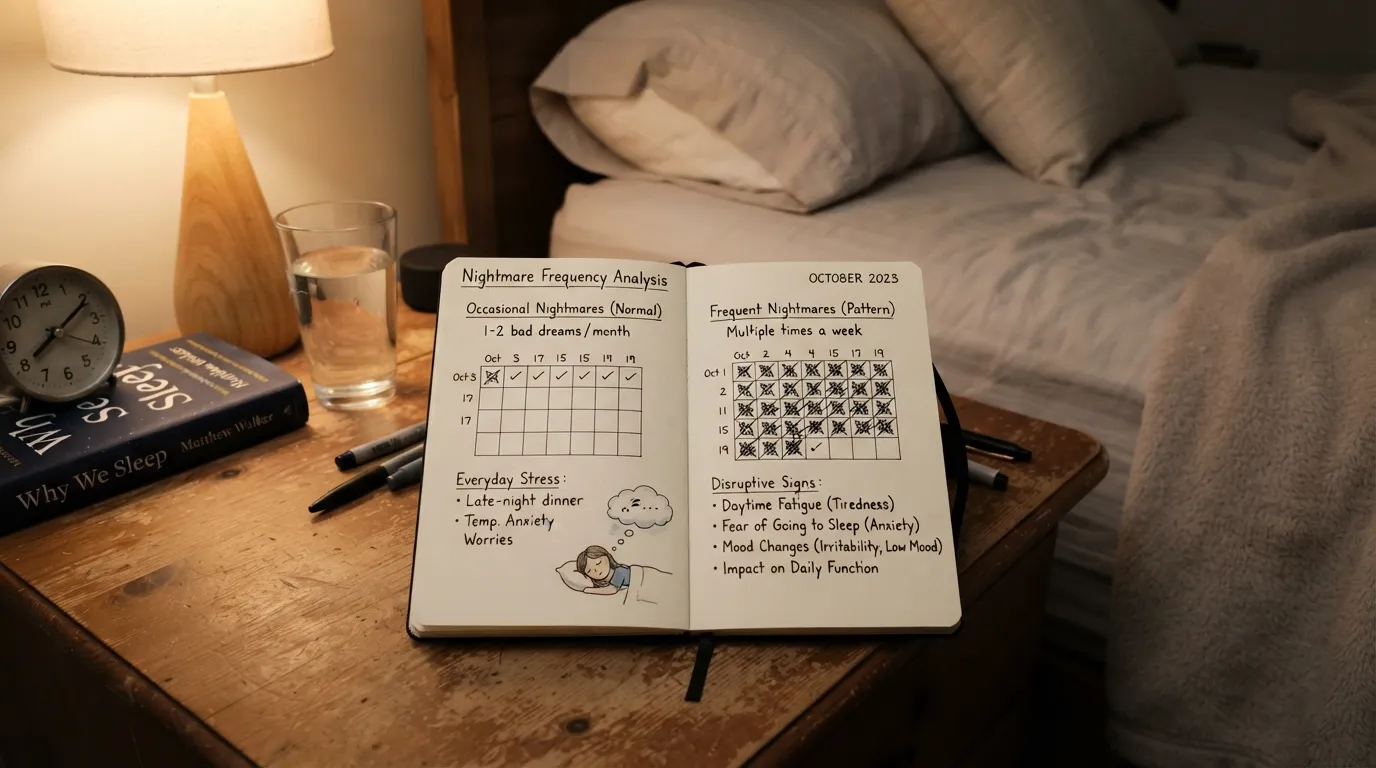
If you just woke up sweating at 3 AM, you are probably wondering why your brain keeps doing this to you. The short answer is yes—it is much more common than you think. Most adults have a bad dream every now and then, especially when life gets stressful or sleep gets messy. Women, younger adults, and people who do not get enough sleep tend to report them even more often.
Here is something that surprises a lot of people: everyone actually dreams every single night. The only real difference is whether you remember those dreams when you wake up or forget them immediately.
So, how do you know if what you are experiencing is just bad luck or something bigger?
Occasional nightmares: You wake up shaken once in a while, but it does not ruin your day or keep you from falling back asleep.
Frequent nightmares: They happen multiple times a week, disrupt your rest, and make you dread going to bed.
When scary dreams start happening so often that they ruin your daytime energy and mood, they cross the line from normal sleep glitches into nightmare disorder territory. Keeping a dream journal for nightmares can help you track these patterns so you can start taking your sleep back.
What Is a Dream Journal for Nightmares (and Does Writing Them Down Actually Help)?
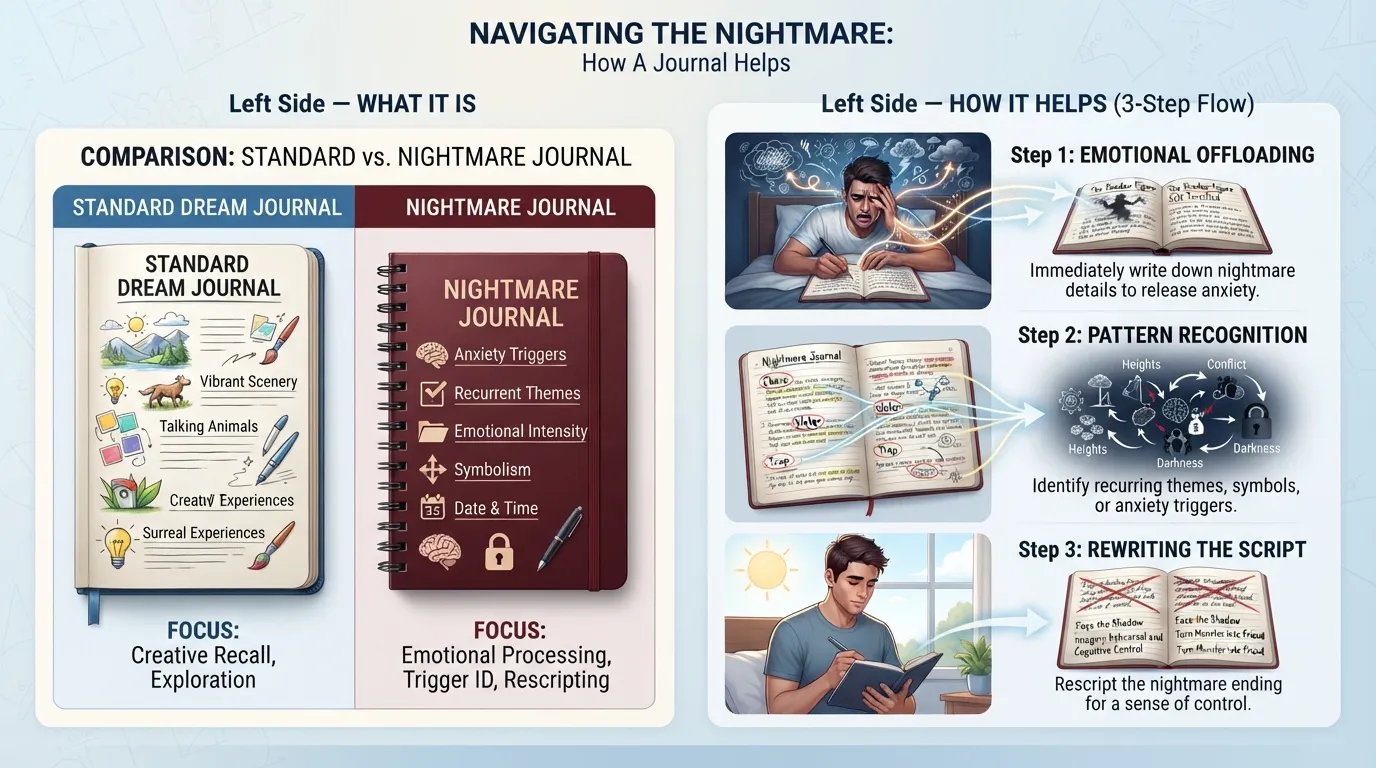
A dream journal for nightmares isn’t just a notebook where you log strange late-night thoughts. It’s a targeted tool designed specifically to track, unpack, and dismantle disturbing dreams so they lose their power over your sleep.
When you wake up heart pounding in the middle of the night, your brain is caught in a state of high alarm. Keeping a dedicated nightmare journal gives that panicked energy a immediate, safe place to land. Instead of letting scary images loop endlessly in your mind, you put them onto paper where you can look at them clearly.
Does Writing Down a Nightmare Make It Worse?
It’s completely normal to worry that writing down a scary dream will just make you feel worse. The truth comes down to the difference between re-living a nightmare and processing it.
Re-living a dream: Simply replaying the scary moments in your head over and over keeps your nervous system on high alert. This passive loop can spike your anxiety and make going back to sleep feel impossible.
Processing a dream: Using structured writing forces your brain to switch from pure emotion to logic. When you write down the details, rate your distress, and actively rewrite the story, you change how your brain stores the memory.
Research on cognitive behavioral techniques like Imagery Rehearsal Therapy (IRT) shows that actively rewriting bad dreams lowers their intensity over time. You aren’t giving the nightmare more power—you’re taking control away from it.
How This Differs From a Regular Dream Journal
A general dream journal is usually meant for boosting creativity, tracking weird themes, or improving overall memory. A nightmare journal has a very specific mission: relief.
Regular dream journal: Focuses on general recall, capturing positive or neutral details, and exploring broad self-insight.
Nightmare-focused journal: Focuses on pattern-spotting, tracking emotional triggers, and actively rescripting scary endings into safe ones.
Why a Nightmare Journal Works (Benefits, Backed by Research)
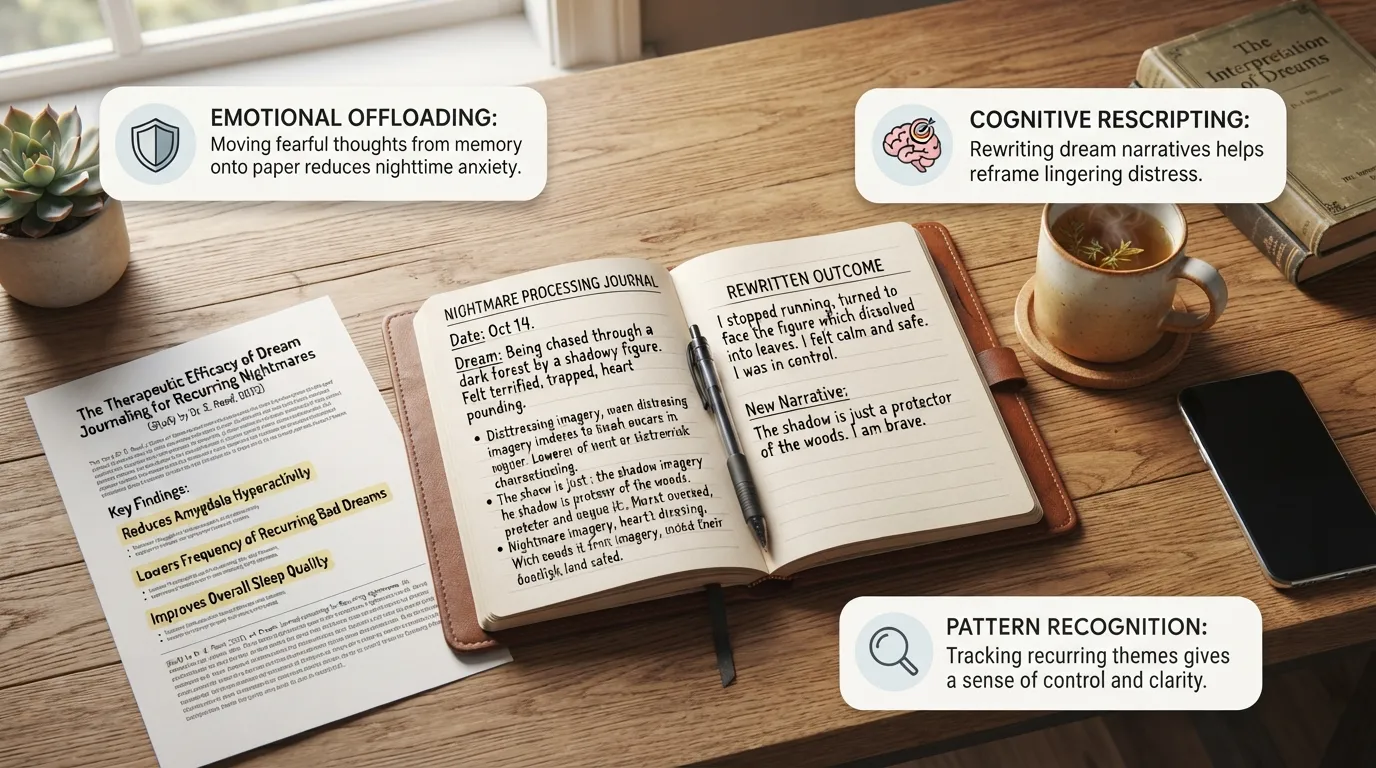
Waking up in a cold sweat leaves your heart pounding and your mind racing. When you lie awake at 3 AM, bad dreams feel overwhelming because they stay trapped inside your head. Keeping a dream journal for nightmares shifts that power dynamic, giving you a safe physical space to unpack the distress before it ruins your sleep.
Reduces the Fear Around Falling Asleep
When disturbing dreams repeat, going to bed starts to feel like entering a trap. Writing down the details in a dream journal for nightmares externalizes the fear, moving terrifying images out of your mind and onto paper. This simple act lowers nighttime hyperarousal by signaling to your nervous system that the threat is contained, making bedtime feel safe again.
Reveals Your Personal Nightmare Triggers
Tracking your nights helps you spot direct patterns between daytime stress, late meals, or schedule changes and nighttime distress.
Improves Dream Recall Over Time
You cannot heal what you cannot remember clearly. Consistently using a dream journal for nightmares sharpens your memory, turning terrifying fogs of emotion into concrete storylines you can analyze objectively. Research in sleep psychology shows that actively paying attention to your sleep memories trains the brain to process dream content without overwhelming your waking mind.
To learn more about how tracking sleep memories builds mental clarity, you can read the Sleep Foundation's guide to dream journaling.
For a practical look at building this habit gently, watch this step-by-step breakdown on capturing dream memories without stress:
Is the Foundation for Rescripting Techniques
Putting the exact narrative of a bad dream on paper gives you the written raw material required to rewrite its ending and regain control.
How to Start a Dream Journal for Nightmares (Step-by-Step)
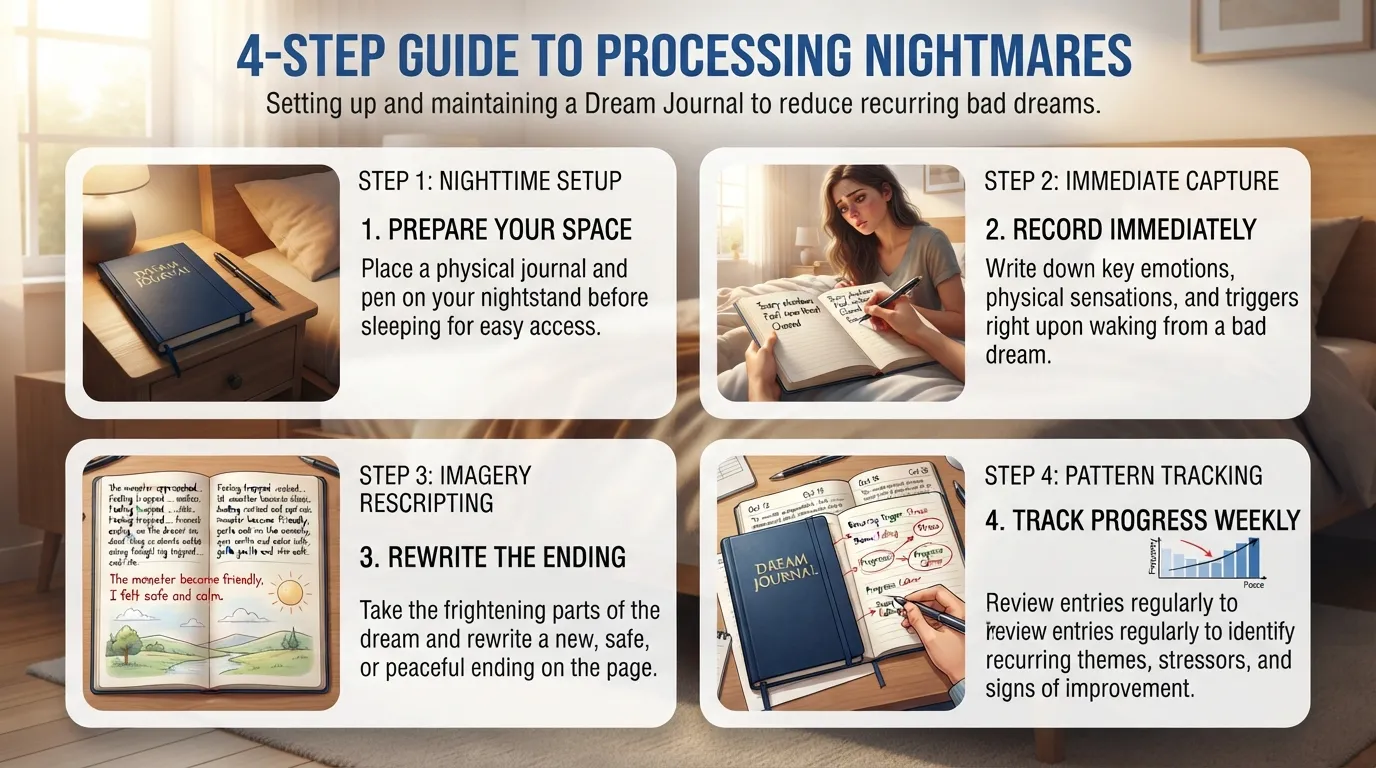
When bad dreams wake you up in the middle of the night, your brain goes into high alert. Setting up a real process takes the chaos out of those moments. Here is how to build a routine that actually helps you process bad dreams instead of just reliving them.
Step 1 – Choose Your Format (notebook / notes app / voice memo)
Pick the tool that feels easiest for you when you are exhausted. A physical paper notebook works best for most people because it keeps bright screens away from your eyes at night.
If writing by hand feels too slow while your heart is racing, use a simple notes app or a voice recorder on your phone. Just make sure to turn on a blue-light filter first.
Step 2 – Keep It Within Arm’s Reach
Put your journal and a pen right on your nightstand before you turn off the light. Do not leave it across the room or tucked away in a drawer.
If you have to sit up, turn on a main light, or walk around to find your journal, your brain will wake up completely. That makes it much harder to fall back asleep once you finish writing.
Step 3 – Set an Intention Before Sleep
Before you close your eyes, take a slow breath and tell yourself what you want to dream about. This mind-prep technique is called dream incubation.
It sounds simple, but guiding your thoughts right before sleep helps steer your brain away from terrifying loops. You can whisper a single phrase, like: “If I dream tonight, I am safe in my bed.”
Step 4 – Write the Moment You Wake Up, Before Reaching for Your Phone
Capture the dream as soon as you open your eyes. Dream memories fade fast, usually within the first few minutes of waking up.
Resist the urge to check your text messages, emails, or social media first. Grabbing your phone floods your brain with new information that wipes out the details of the nightmare before you can write them down.
Step 5 – Record What Actually Matters
You do not need to write an essay or tell a complete story. Focus only on the core details that hold the emotional charge of the dream:
Emotions felt, and their intensity: Name the exact feeling—like fear, helplessness, or panic—and note how strong it was.
Key images, people, setting: Jot down where you were, who was there, and any specific objects that stood out.
The exact moment right before waking: Write down what triggered you to snap awake, like falling, screaming, or a sudden noise.
Any symbol/element seen in past nightmares: Note recurring themes, like a specific dark hallway, a missing car, or being chased by the same shape.
Step 6 – Rate the Nightmare 1–10 for Emotional Intensity
Give the nightmare a quick number score right after you finish writing. A rating of 1 means mild discomfort, while 10 means overwhelming terror that left your heart pounding.
Tracking this number over time gives you clear data. You will start to see if your bad dreams are becoming less frequent or losing their harsh grip on you.
Step 7 – Review Weekly, Not Daily
Close the book as soon as you finish writing in the morning, and do not look at it again that day. Staring at terrifying dream entries every morning will only keep your stress levels high.
Instead, set aside ten minutes once a week during daylight hours to look back through your entries. This gives you enough distance to spot recurring patterns without getting pulled back into the fear.
Your First Entry: A Copy-Paste Nightmare Journal Template

When you wake up with your heart racing at 3 AM, your brain is flooded with stress. Trying to figure out what to write in your dream journal for nightmares is the last thing you want to do.
Keep this template saved on your phone or on a sticky note next to your bed. Fill in the blanks while the details are still fresh, without forcing yourself to write a long essay.
What happened, in order: Stick to the raw facts of the plot. Write down three to four bullet points max, like “I was running down a dark hallway, the floor gave out, and I fell.”
How I felt during the dream (emotion + 1–10 intensity): Name the exact feeling—like fear, shame, or feeling helpless—and give it a quick score. For example, Panic, 9/10.
How I felt the moment I woke up: Describe your immediate body reaction. Notice if your chest felt tight, if you were dripping sweat, or if you felt totally numb.
What in real life this might connect to: Look for small triggers from your recent days. Did you watch a stressful news report, have an argument with a coworker, or go to sleep feeling anxious about money?
One thing I’d change if I could rewrite the ending: Take back your control by changing the narrative. Swap out a scary outcome for a safe, neutral, or powerful new ending to shift how your brain stores the memory.
Rewriting the story in your journal is a proven technique known as Imagery Rehearsal Therapy, which actively trains your brain to break repeating nightmare patterns.
Watch this simple guide to see how rewriting your dream endings works in real time:
The One Technique That Makes the Biggest Difference: Rewriting the Ending
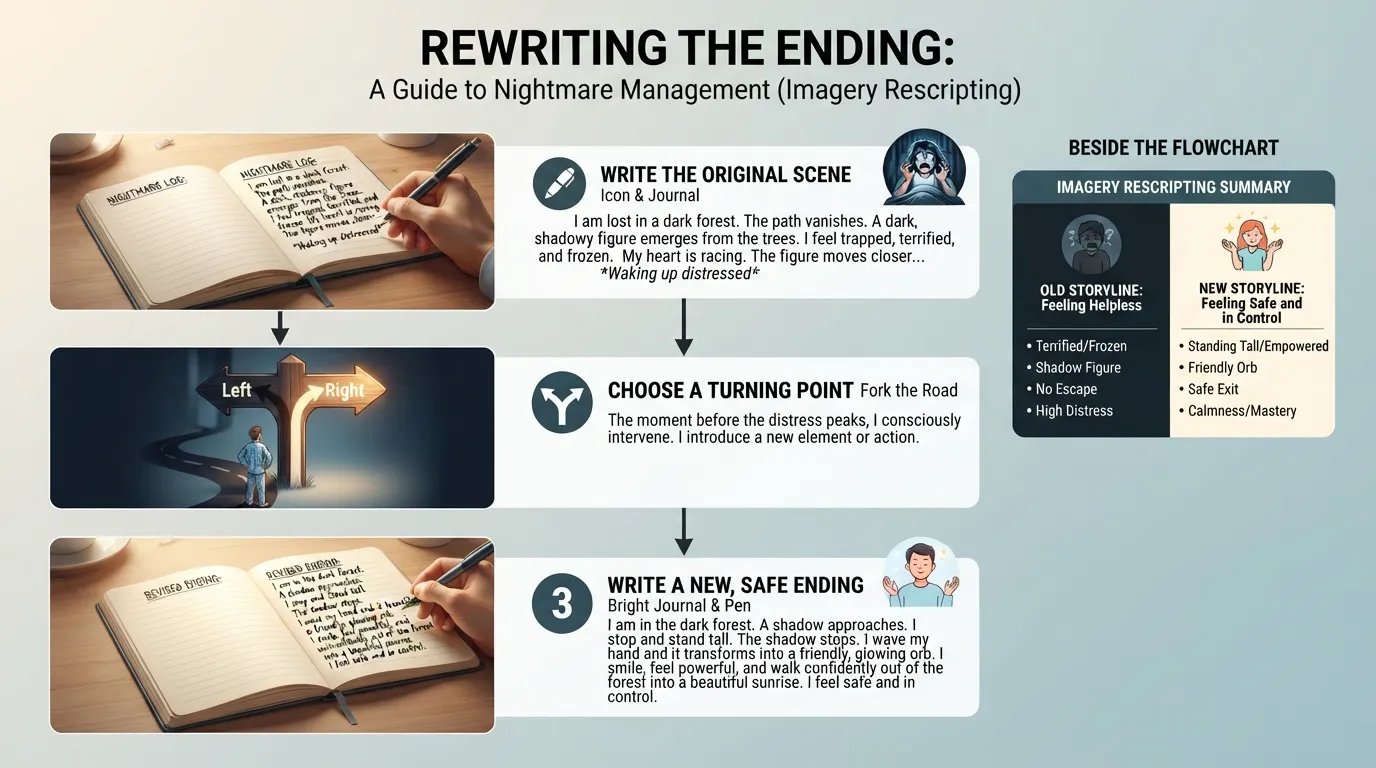
What Imagery Rehearsal Therapy (IRT) Is
If you deal with recurring bad dreams, standard advice like “just vent on paper” usually falls short. That is where Imagery Rehearsal Therapy (IRT) comes in. IRT is an evidence-based cognitive behavioral technique designed specifically for nightmare disorder and trauma-related bad dreams.
Instead of treating your mind like a helpless audience member, IRT treats you like the director of the movie. It works on a simple premise: nightmares are learned brain habits. When you experience a frightening dream repeatedly, your brain gets stuck in a loop. IRT breaks that loop by manually changing the script while you are wide awake, which trains your brain to play a different story when you fall asleep.
How to Do It Yourself After a Journal Entry
Using a dream journal for nightmares gives you the exact raw material you need to practice IRT on your own. You do not need complex tools—just your journal, a pen, and a few quiet minutes during the day.
Here is how you can apply this process directly in your notebook:
Pick the scariest moment: Read through your recent journal entry and isolate the exact moment where the fear peaks or where the story turns dark. You do not need to rewrite the entire dream—just focus on that specific scene.
Write a new, non-threatening version: Take back control and write a new ending on a fresh page. Change the threat into something harmless, absurd, or peaceful. If something is chasing you, rewrite the story so you turn around and find a friendly guide, or give yourself the ability to fly away instantly. You decide how it ends.
Mentally rehearse it while awake: Spend 5 to 10 minutes once or twice a day mentally visualizing this new, neutral ending in vivid detail. Do this while relaxed during daylight hours, not right before bed.
Taking the extra step to rewrite the ending is what makes this approach so much more effective than simply writing your feelings down. Journaling alone offloads the emotional stress, but rescripting actively rewires the brain’s response so the original bad dream loses its power over time.
For a deeper look into how clinical professionals use these methods to treat chronic sleep disruptions, you can review the official American Academy of Sleep Medicine nightmare treatment guidelines.
What Your Journal Might Reveal: Common Nightmare Triggers
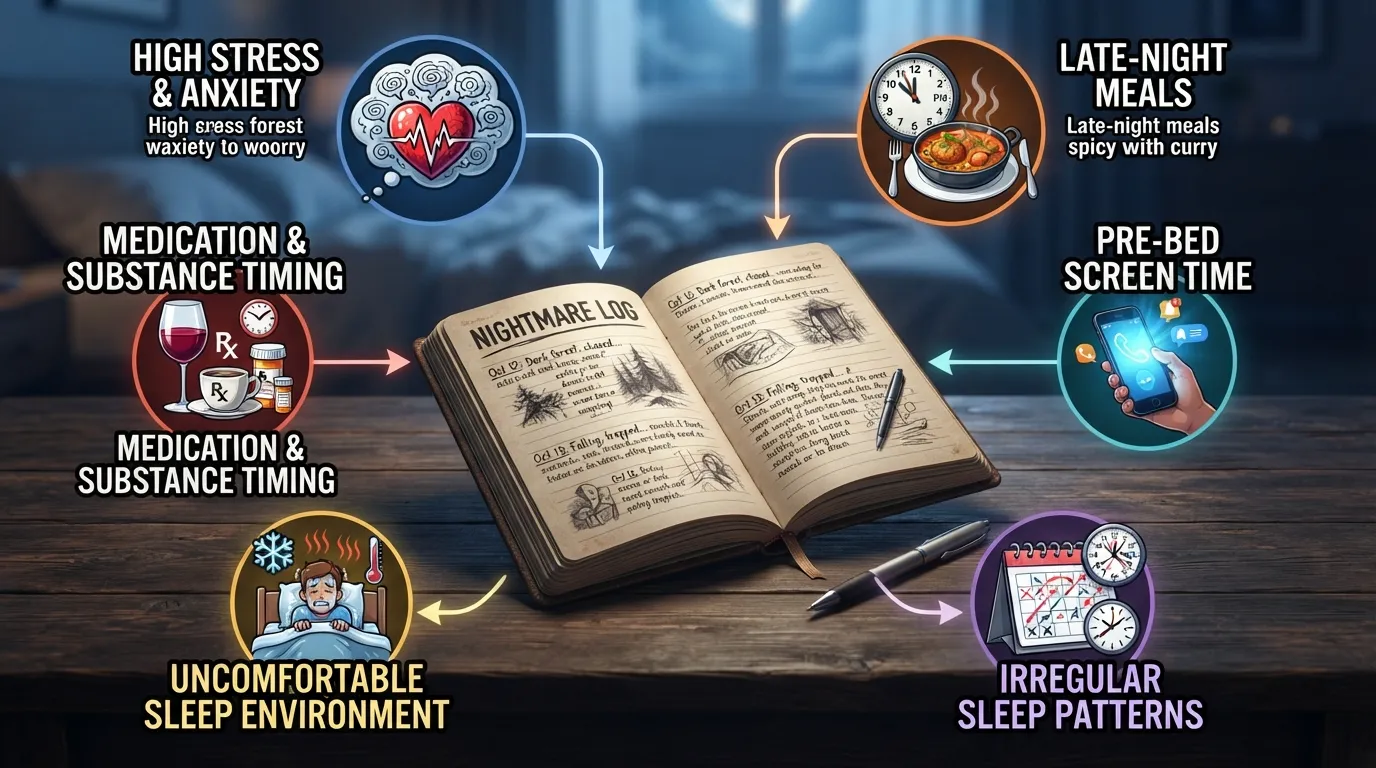
When bad dreams keep waking you up, your mind is usually responding to a specific signal. Keeping a dream journal for nightmares helps you spot the exact patterns and real-life triggers that set off your brain while you sleep.
Here are the most common triggers to look for when reviewing your entries:
Stress and unresolved daytime worry: Heavy emotions don’t just disappear when you close your eyes. The anxieties you push aside during the day often surface at night as intense or frightening dreams.
Certain medications: Some prescription drugs—especially blood pressure medications, antidepressants, and sleep aids—can alter your REM sleep cycle and cause vivid bad dreams.
Note: This is not medical advice. Never stop or change your medication without speaking to your doctor first.
Screen time and content before bed: The light from phones and TVs keeps your brain alert, but the type of content matters just as much. Watching tense shows, reading the news, or scrolling through disturbing media right before sleep gives your subconscious unsettling material to work with.
Sleep deprivation or an irregular schedule: Being overly exhausted actually pushes your brain into longer, deeper REM sleep periods once you finally pass out. This rebound effect makes nightmares much more intense and far easier to remember.
Late meals and alcohol close to bedtime: Eating heavy or spicy food late at night speeds up your metabolism and brain activity right when it needs to slow down. Alcohol might help you fall asleep faster, but as it wears off, it disrupts your sleep quality and frequently triggers middle-of-the-night panic.
Unprocessed grief, trauma, or major life changes: Significant painful experiences linger in the nervous system. Nightmares are often your mind’s blunt attempt to process grief, sudden disruptions, or past trauma that feels too overwhelming to tackle while awake.
When Nightmares Are More Than "Just Dreams": Nightmare Disorder
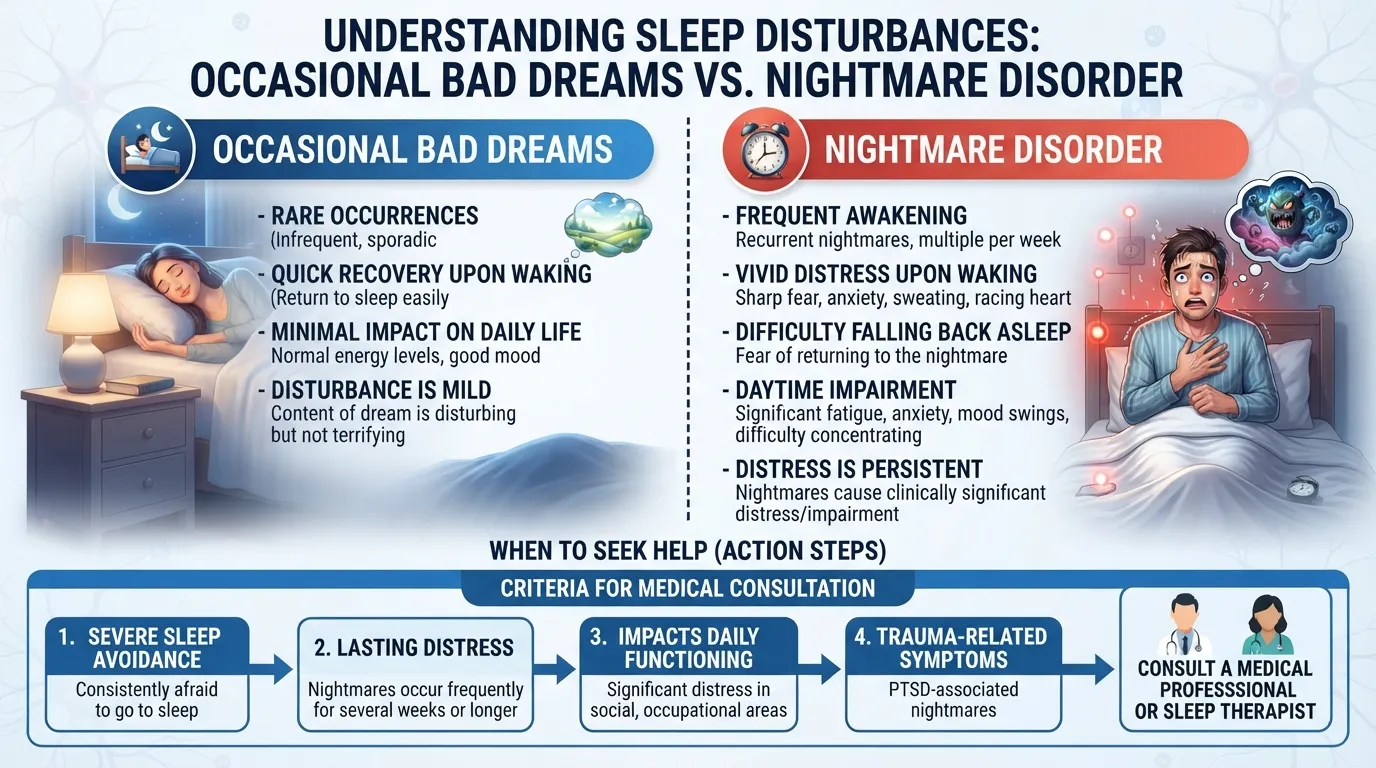
Waking up drenched in sweat once in a while is normal. But when bad dreams start ruining your waking hours, you might be dealing with something more than an occasional bad night.
The Clinical Threshold
Doctors look at two main things to decide if nightmares have crossed into Nightmare Disorder: how often they happen and how much they mess up your day.
Frequency: You have vivid, disturbing dreams at least once a week for over a month.
Daytime Impact: The fear follows you into the morning. You feel constantly exhausted, struggle to focus at work or school, or feel anxious as bedtime gets closer.
Sleep Avoidance: You actively fight sleep because you are afraid of what you will see when you close your eyes.
If your nights feel like a battleground and your days feel foggy because of it, your body is telling you that these dreams need attention.
The Link Between Nightmares and Mental Health
Research shows a strong connection between recurring nightmares and overall mental health. Conditions like PTSD, depression, anxiety, bipolar disorder, and schizophrenia often involve severe sleep disruptions.
When your brain is processing trauma or managing heavy emotional stress, those feelings frequently leak into your dream world. However, having frequent nightmares does not automatically mean you have a mental health condition. They are simply a signal from your brain that something is overflowing and needs relief.
If you want to read more about how doctors classify this condition, check out this guide on Nightmare Disorder from the Sleep Foundation.
When to Bring Your Journal to a Professional
A dream journal for nightmares is not just a place to vent; it is real data for your care team. If your nightmares happen weekly, leave you panicked during the day, or wake you up repeatedly, it is time to share your notes with a therapist or doctor.
Here is how your journal helps your doctor:
Pattern Tracking: It shows exact dates, times, and recurring themes without relying on your memory when you are tired.
Treatment Planning: Therapists use your written dream accounts for targeted treatments like Imagery Rehearsal Therapy (IRT).
Medication Review: It helps track if a new medication or medical change is triggering vivid dreams.
Watch this quick overview on how doctors evaluate sleep disruptions and nightmares:
Best Types of Nightmare Journals to Try
When you wake up startled at 3 AM, the last thing you need is a complicated setup. The best dream journal for nightmares is simply the one that feels easiest and safest for you to use when your chest is tight and your hands are shaking.
Here are three practical options to consider, depending on what feels most comforting to you:
Guided or Prompted Nightmare Journal
Best for: Anyone who wants structure without having to decide what to write.
When you wake up shaken, your mind can feel scrambled. Staring at a blank page might feel overwhelming, or even make your anxiety spike. A guided journal gives you specific, gentle questions to answer—like asking about the physical feelings in your body or giving you a set frame to rewrite the nightmare’s ending. It keeps you grounded so you don’t spiral into overthinking.
Plain Notebook and Pen
Best for: Low friction and keeping screen light out of your eyes.
Sometimes simple is best. A basic paper notebook sits on your nightstand, ready the second you open your eyes. Writing by hand helps slow down racing thoughts, and staying away from your phone keeps bright blue light from waking up your brain even further. You don’t need fancy paper—just something reliable that you can scribble in without judgment.
Voice-to-Text Journaling App
Best for: Times when you are too groggy or shaken to hold a pen.
If a nightmare leaves you trembling or totally drained, holding a pen can feel like too much effort. Speaking softly into a voice note lets you get the nightmare out of your head without turning on a lamp or sitting up. Many apps automatically convert your spoken words into text, so you can review or rewrite the dream later when you feel calm and well-rested during daylight hours.
Frequently Asked Questions
Nightmares usually peak during early childhood, roughly between the ages of 3 and 6, as young minds begin processing fear and vivid imaginations. They tend to drop off during late adolescence, though another smaller spike often happens in early adulthood due to stress, life transitions, and shifting sleep patterns.
You cannot easily stop a nightmare while sleeping, but you can rewrite its story while awake. Writing down the bad dream in your journal and deliberately changing the scary ending gives your brain a safer script to rehearse. For a complete guide on how to practice this step-by-step, see the rescripting section above.
Low levels of vitamin B6 and vitamin B12 are frequently tied to vivid or disturbing dreams, as these vitamins help your body make sleep-regulating chemicals like serotonin and melatonin. Vitamin D deficiency can also disrupt your overall sleep quality, leading to lighter, more fragmented sleep where nightmares are more likely to wake you up.
Conditions like Post-Traumatic Stress Disorder (PTSD), major depression, and generalized anxiety disorder are strongly linked to vivid, distressing dreams. If terrifying scenes keep interrupting your rest, see the Nightmare Disorder section above to understand how chronic sleep disturbances are evaluated.
You should pay close attention to recurring nightmares that make you wake up sweating, feeling exhausted, or afraid to go back to sleep. When the exact same terrifying theme shows up repeatedly in a dream journal for nightmares, your brain is usually signaling an unresolved emotional stressor that needs attention during your waking hours.
Lucid nightmares—where you are fully aware that you are trapped inside a terrifying dream but cannot alter the storyline or easily force yourself awake—are among the rarest dream experiences reported. Because they feel so overwhelming, recording these rare events in your journal can help you spot the specific stress triggers that cause them.
People living with schizophrenia often report dreams that mirror waking hallucinations, featuring extreme sensory distress, severe paranoia, and fragmented figures. For a deeper look at how serious psychiatric conditions affect your sleep, see the Mental Health sub-section above.
No, having nightmares every night is not typical and usually indicates severe emotional distress, medication side effects, or an underlying sleep issue; see above for details on when to seek outside support.
Eating heavy, spicy, or high-sugar meals late at night boosts your body temperature and brain activity during REM sleep, making unsettling dreams far more vivid; see the Triggers section above for a complete look at evening habits.
While everyone's mind is different, five terrifying themes show up in dream journals far more than any others:
- Falling from a great height
- Being chased by a stranger or an animal
- Teeth falling out, breaking, or crumbling
- Arriving completely unprepared for an exam or work presentation
- Being physically trapped or unable to move
Yes, chronic nightmares are highly treatable using targeted journaling techniques and cognitive behavioral strategies; see the rescripting section above to start using these practical tools tonight.
Final Thoughts
A dream journal for nightmares will not erase terrifying dreams overnight, but combining daily tracking with imagery rescripting is a proven, research-backed path to fewer and less intense nights. Over time, turning toward the distress on paper takes away its power in your sleep. If you want to explore more ways to support your mind through writing, check out our complete Journaling Guide for practical techniques that fit into your daily routine.
Pimchanok Srisuk
Pimchanok Srisuk is the Journaling Editor at Holistic Wellbeing Living. She writes about journaling prompts, reflective writing, emotional clarity, and mindful routines. With seven years of experience creating personal-growth content, Pimchanok helps readers use simple writing practices to understand their thoughts and make calmer everyday decisions.