Header — Holistic Wellbeing Living

4 Writing Prompts for Adults And How to Actually Use Them

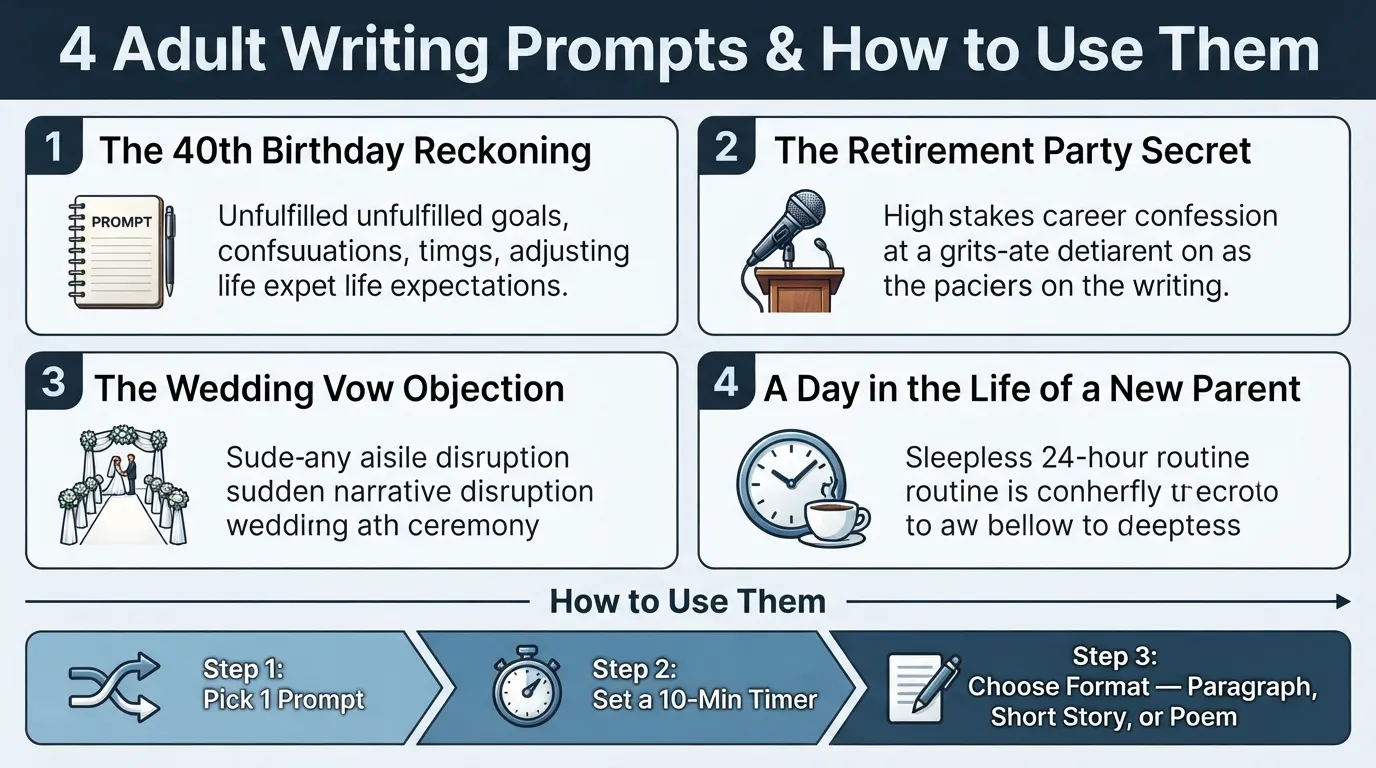
Infographic showing 4 adult writing prompts with step-by-step instructions on how to set a timer, write without editing, and choose a creative format.

If you’re looking for 4 writing prompts for adults, the four best scenario-based ideas to start with are reflecting on a 40th birthday party, exploring the quiet transition of a retirement party, unpacking the tension of a wedding vow objection, and capturing a raw, unsensored day in the life of a new parent. These distinct prompts give you an instant entry point to process big life changes or practice creative storytelling. Here’s how to make each one actually work for you.

The 4 Writing Prompts for Adults

When you pick up a pen as an adult, you aren’t looking for whimsical grade-school exercises about magic portals or talking animals. You want scenarios that match the weight, tension, and subtle griefs of real life. These four high-leverage narrative frameworks give you a direct route into those complex emotions.

1. The 40th Birthday Reckoning

The Prompt: Write about a character facing their own 40th birthday party, forced to confront the specific goals they set at 20 that remain completely untouched.
  • Why It Works Emotionally: Midlife milestones act like a mirror we didn't ask to stand in front of. This prompt taps into the quiet tension between who we thought we would become and who we actually are. It pits youthful idealism against adult reality without needing external drama.
  • Starter Line: "The cake had forty small candles, but all I could see was the dusty blue binder sitting in my old bedroom closet, still filled with plans I never started."
  • Quick Tip: Avoid making this a wall-to-wall pity party. Focus on one specific item—a place never visited, a career path abandoned, an artistic dream shelved—and track how the character feels about that missing piece in the middle of a crowded, noisy room.

2. The Retirement Party Secret

The Prompt: The guest of honor receives their lifetime achievement gift at a retirement party, then steps up to the microphone and confesses something massive about their career.
  • Why It Works Emotionally: Retirement isn't just about stepping down; it's about the terrifying freedom of no longer having to play a specific professional role. When a person reaches the absolute end of their tenure, the consequences of keeping a secret evaporate, making it the perfect pressure-cooker setting for sudden honesty.
  • Starter Line: "Arthur held the heavy crystal clock in both hands, looked around the conference room at forty years of familiar faces, and finally set the microphone down on the podium."
  • Quick Tip: Make the confession grounded rather than sensationalized. A hidden shortcut they took thirty years ago, a crucial document they deliberately hid, or a quietly kept lie that built their entire reputation feels much more authentic than a wildly over-the-top movie reveal.

For more on how to use deep emotional dynamics like worst-case scenarios and character contrasts in your storytelling, check out Emily Tamayo Maher's breakdown on craft techniques.

3. The Wedding Vow Objection

The Prompt: It’s a quiet moment during the wedding ceremony. Just as the couple begins to trade their vows, a voice from the back of the crowd yells, "I object!"
  • Why It Works Emotionally: Society teaches us to keep our feelings neatly tucked away during major public rituals. An objection breaks the implicit social contract of a room, exposing the raw, messy human desire that normally stays hidden beneath polite surface expectations.
  • Starter Line: "The minister was mid-sentence, his hand raised over our joined fingers, when the church doors swung heavy against the frame."
  • Quick Tip: Resist the urge to write a stereotypical romantic comedy scene. Make the objection come from an unexpected angle—a business partner, an estranged sibling, or someone who isn't trying to win the bride back, but is instead trying to prevent a completely different disaster.

4. A Day in the Life of a New Parent

The Prompt: Trace the relationship between a first-time parent and their newborn across one single, continuous, sleepless 24-hour cycle.
  • Why It Works Emotionally: Early parenthood strips away every layer of self-protection you possess. By locking the focus to a single day, you capture the unique, hallucinatory mix of profound love, bone-deep exhaustion, isolation, and identity shift that defines those fragile first months.
  • Starter Line: "At 3:14 AM, the kitchen clock hummed louder than the infant breathing against my shoulder, and I realized I couldn't remember what day of the week it was."
  • Quick Tip: Anchor the narrative in physical senses—the cold kitchen tile under barefoot heels, the smell of warm milk, the weird blue glow of a smartphone at four in the morning. Grounding the scene in small sensory details keeps the piece from drifting into abstract reflections on love.

How to Turn a Prompt Into a Paragraph, Story, or Poem

Once you pick a writing prompt, the biggest hurdle is deciding how far to take it. Beginners often freeze up because they assume every prompt requires a full-length short story or a massive project. In reality, a single prompt can be molded into four distinct forms, depending entirely on how much time and energy you want to invest.

1. The Paragraph Version (5 Minutes, One Scene, One Feeling)

If you are short on time or feeling intimidated by a blank page, aim for a single paragraph. Don’t worry about explaining who the characters are, setting up a backstory, or resolving a conflict. Pick one sensory detail—like the hum of a refrigerator at midnight or the cold weight of a glass award—and focus entirely on capturing a single emotional state. Writing just three to five honest sentences gives your brain a quick win without the pressure of a major commitment.

2. The Short Story Version (Beginning, Middle, and End)

When you want to build a narrative arc, expand your prompt into a complete scene structure. Start in media res—right in the middle of the action—rather than spending paragraphs setting the stage. Establish what your protagonist wants in the first few lines, introduce a small obstacle that gets in their way, and force them to make a choice by the end. You don't need an epic length; a satisfying short story can live within 500 to 1,000 words as long as something inside the character changes between the first page and the last.

For a breakdown on overcoming blank-page paralysis and building low-pressure writing momentum, check out Marie Forleo and Laura Belgray's discussion on free-writing and creative expression.

3. The Poem Version (Pull One Image or Line and Expand It)

Poetry strips away the need for logical narrative continuity. To turn a prompt into a poem, pull out a single striking visual or phrase and isolate it. Instead of explaining why a retired worker feels conflicted about their life, describe the exact pattern of light hitting the dust on their desk. Play with line breaks to force natural pauses, rhythm, and emphasis. Poetry allows you to explore the atmosphere of a prompt using metaphor and imagery rather than chronological plot progression.

4. The Journal Version (First-Person Self-Reflection)

If you prefer non-fiction and personal growth over creative writing, process the prompt through personal experience. Reframe the fictional scenario into a direct question for yourself: When was a time I felt the pressure of an unfulfilled milestone? Write in the first person without filtering or editing your grammar. Treat the page as a safe container to explore your own memories, unfiltered thoughts, and unexpressed reactions.

More Writing Prompts for Adults, By Mood

Different days call for different creative outlets. When you don't have the emotional bandwidth for a heavy narrative, matching your writing exercise to your current mental state is the fastest way to get your pen moving without feeling drained.

Fun & Lighthearted Prompts

Use these prompts when you want to write purely for play and stress relief, without heavy thematic emotional weight:

  • The Neighborhood Feud: Two suburban neighbors get into an increasingly absurd cold war over a stray lawn ornament that keeps mysteriously moving back and forth between their front yards.
  • The Over-Prepared Tourist: A character packs three suitcases for a simple weekend camping trip, only to realize they forgot the single most important piece of gear.
  • The Unintended Masquerade: Someone walks into a high-stakes corporate dinner wearing the completely wrong outfit after misinterpreting a vague dress code on the invitation.

5-Minute Prompts for a Busy Day

Short on time? These quick micro-exercises require zero setup and can be finished on a quick break or during your morning coffee:

  • The Object in Your Pocket: Reach into your coat, purse, or desk drawer. Write five sentences describing the oldest item in there and how it got there.
  • Overheard Dialogue: Think of the last sentence you heard someone say in public today. Use it as the opening line for a three-sentence scene.
  • The Unsent Message: Draft a short, honest text message you thought about sending today, but deleted right before hitting send.

For a huge collection of creative fiction scenarios and quick story seeds, check out Elizabeth Coyle's breakdown of concept-driven writing prompts. [00:00:07]

Beginner-Friendly Prompts (no experience needed)

If you haven't written creatively in years, start here. These low-pressure entry points focus on familiar ground so you don't have to invent anything from scratch:

  • The Unfamiliar Kitchen: Describe making a meal in someone else’s kitchen where you can't find any of the utensils or spices. Focus on the sensory frustration.
  • The Lost Item: Write about losing something small but sentimental—like a key ring or an old receipt—and the exact moment you realized it was gone.
  • The First Apartment: Recreate the sound, smell, and visual layout of the very first place you lived in on your own.

Want These Prompts On the Go? Free Printable + Instant Pick

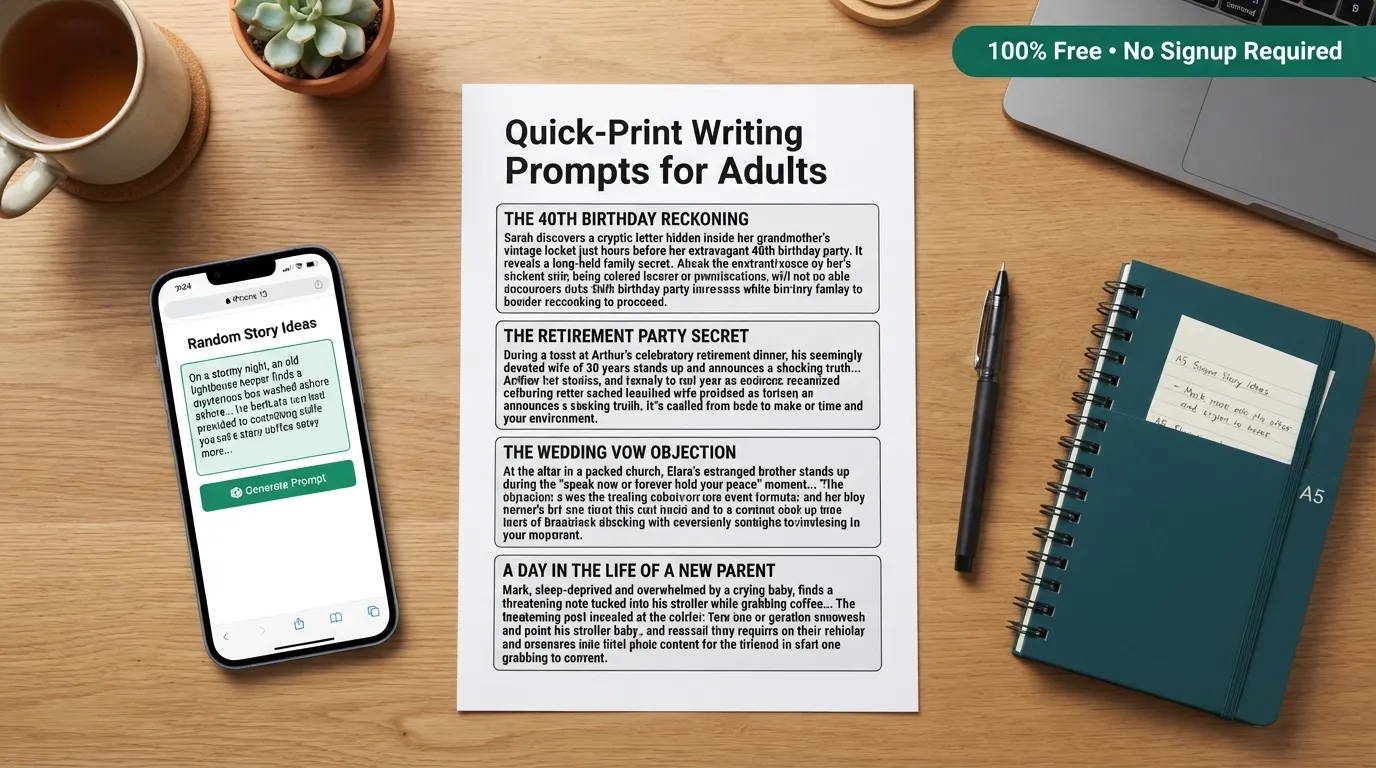
A printable writing prompt reference sheet laid out next to a smartphone showing a random writing prompt picker interface on a wooden desk with a pen and notebook.

You don’t need to hand over an email address, create an account, or navigate through endless pop-ups just to get a clean copy of these writing exercises. Everything here is 100% free with no signup required—just save, print, or use the quick picks below whenever inspiration strikes.

Quick-Print Reference Card

Here is a clean, distraction-free version of all four primary adult writing prompts that you can copy, save, or print for your desk or journal folder:

The 40th Birthday Reckoning: Write about facing goals set at 20 that remain completely untouched, and deciding whether to chase them or let them go.

The Retirement Party Secret: The guest of honor steps up to the podium for their farewell speech and confesses a massive secret about their entire career.

The Wedding Vow Objection: A sudden voice from the back row interrupts a quiet ceremony right as vows are being exchanged, forcing a hidden truth to light.

A Day in the Life of a New Parent: Trace one single, continuous, sleepless 24-hour cycle from the perspective of someone navigating early parenthood.

Can’t Decide? Pick One for Me

If decision fatigue is keeping you from starting, pick a random number between 1 and 6 to choose your prompt for today:

  1. Option 1: The 40th Birthday Reckoning

  2. Option 2: The Retirement Party Secret

  3. Option 3: The Wedding Vow Objection

  4. Option 4: A Day in the Life of a New Parent

  5. Bonus Pick A: Describe a character making a life-changing decision while sitting alone in a quiet parking lot at night.

  6. Bonus Pick B: Write about finding an old, unopened letter hidden inside the pages of a secondhand book.
Why Writing Prompts Are a Wellness Practice, Not Just a Creativity Exercise

While writing prompts are widely recognized as tools for fiction writers and storytellers, they also serve a powerful role in personal mental well-being. Expressive writing—the act of translating internal thoughts, emotional friction, and unspoken stress into physical words on a page—offers a structured container to process hard emotions without the need for immediate solutions or external validation.

When you sit down with a focused prompt, you lower the cognitive load required to start writing. Rather than staring at a blank page wondering where to begin, a prompt directs your attention onto a single scenario or detail. This brief, low-pressure journaling practice helps disrupt repetitive thought loops and provides measurable stress relief, allowing your mind to organize complex feelings safely at your own pace.

Extensive health and psychological research supports the therapeutic benefits of guided self-expression. According to researchers at the Harvard Medical School, writing about difficult emotional experiences can significantly reduce stress levels, improve mood, and enhance emotional regulation by helping the brain process unaddressed life challenges.

For practical insights on using expressive writing as a tool for emotional clarity, stress relief, and mental reset, watch this guided breakdown.

FAQs

What do I write about if I have no ideas?

When you feel completely stuck, start with a tiny physical detail rather than trying to build a full plot. Pick an object near you—like a lukewarm mug of coffee or an old key—and write three sentences about where it came from or who held it last. Alternatively, choose a low-pressure prompt from our 5-Minute list to bypass decision fatigue and get your pen moving instantly.

What's a good writing prompt for a total beginner?

The best prompts for beginners rely on familiar everyday experiences so you don't have to invent a complex world from scratch. Prompts like The Unfamiliar Kitchen or The Lost Item work exceptionally well because they focus on real sensory memories and emotions, allowing you to write naturally without worrying about story structure.

Can a writing prompt just be one paragraph?

Yes, absolutely! A single paragraph is often the best way to approach a prompt, especially on busy days. Focusing on just one scene, one setting, or a single emotional beat allows you to complete a satisfying writing session in under five minutes without the pressure of drafting a full story.

What are some quick writing topics I can use today?

Quick writing topics include drafting an unsent text message, describing the oldest item in your pocket, or taking the last sentence of a conversation you overheard in public and using it as an opening line. These micro-topics require zero preparation and fit easily into a morning coffee break.

Are these writing prompts free to use?

Yes, 100%. Every prompt, exercise, and idea listed on this page is entirely free to use for personal journaling, creative writing practice, blog inspiration, or classroom activities, with no registration or sign-up needed.

Is there a printable or PDF version?

Yes! We provide a clean, distraction-free printable box directly on the page. Simply scroll to the printable section and click the print button to immediately save or print a reference card with the primary adult prompts for your desk or notebook.

Start Writing Today

The hardest part of any writing practice is simply starting. You don’t need a full hour of quiet, a flawless plot outline, or an impressive vocabulary to begin—you just need ten minutes and a willingness to put words on the page without judging them.

Pick one of the four primary prompts that speaks to you right now. Set a timer for 10 minutes, put your pen to paper or fingers to the keyboard, and let the words flow naturally. Crucially, do not edit as you go. Allow yourself to write messy, imperfect sentences, because the goal is momentum, not perfection.

If you enjoy using writing as a mirror for personal growth and self-discovery, explore our detailed guide on how to start a daily dream journal to deepen your daily reflection routine.

Link copied to clipboard!

Editorial Integrity

Our content is 100% human-written, evidence-backed, and continuously updated to fulfill reader intent with maximum honesty.

Daily Mindset Shift

"Small, consistent habits compounded over time create unshakeable momentum."

Leave a Comment