Jump to:
ToggleWriting Prompts for High School: 200+ Journal, Creative & Essay Ideas (2026 Guide)
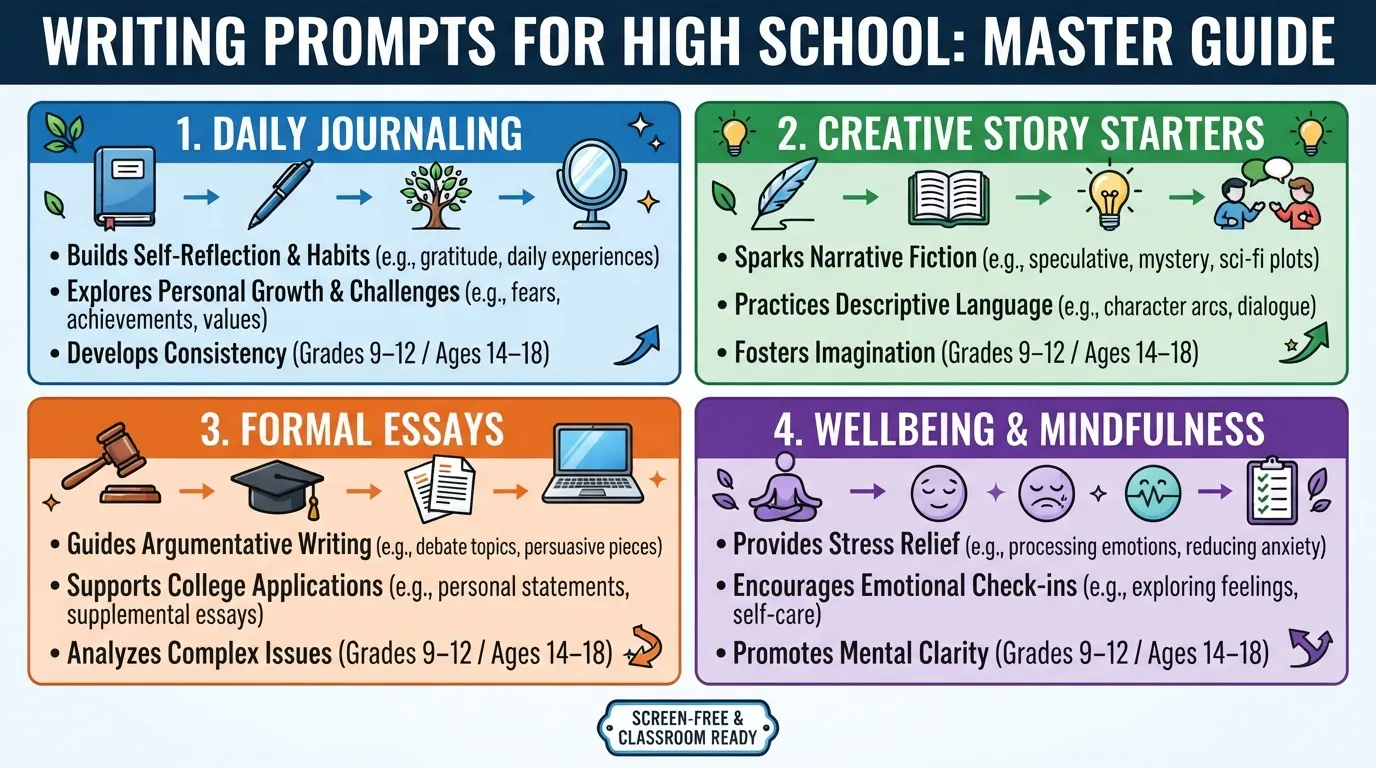
High school writing prompts are targeted topic starters, open-ended questions, and creative scenarios designed to help 14- to 18-year-olds develop critical thinking, process complex emotions, and build regular writing stamina without the dread of a blank page. Whether you are an English teacher hunting for low-stakes bellringers, a parent looking to support a reluctant writer at home, or a high schooler searching for genuine journal topics that don’t feel insulting, this guide gives you immediate access to structured, age-appropriate ideas.
Here is what you will find inside:
Daily Journal Prompts: Quick reflection questions covering identity, stress, and future goals.
Creative Writing Starters: Narrative, fiction, and character-driven scenarios that spark imagination.
Persuasive & Essay Prompts: Deep argumentative topics tailored for classroom debates and academic practice.
Mindfulness & Mental Health Topics: Low-pressure exercises designed for personal growth and stress relief.
What Are Writing Prompts for High School Students?
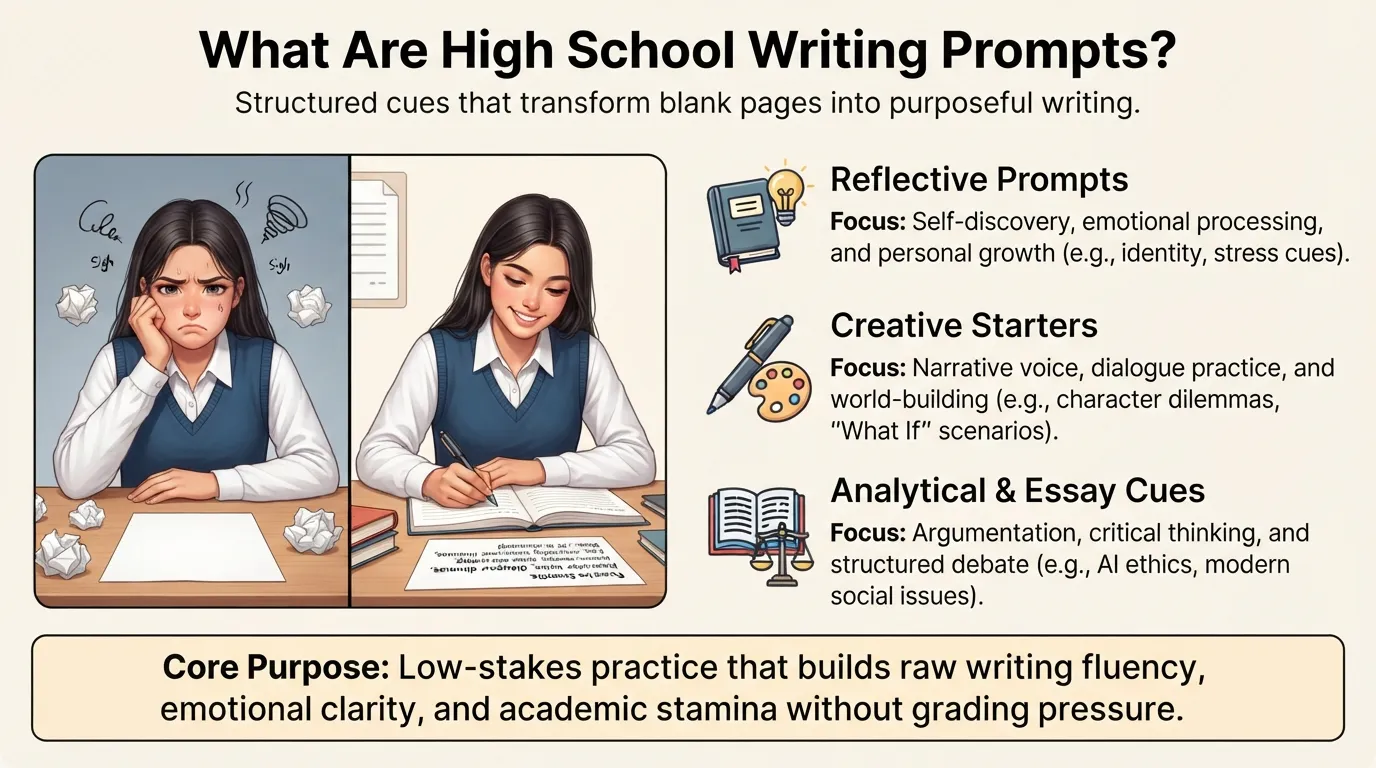
High school writing prompts are structured cues—ranging from single reflection questions to complex scenarios—that give teenagers a focused starting point for their writing. Unlike open-ended assignments that trigger blank-page paralysis, a good prompt provides enough boundary to spark immediate thought while leaving room for personal voice. They span three main formats: reflective journal entries that build self-awareness, creative starters that exercise narrative technique, and analytical questions designed for formal argument.
Why Low-Stakes Writing Matters
Removing grades from everyday writing changes how teenagers think. When high schoolers know an entry won’t be picked apart for grammar or thesis structure, their focus shifts from performance to original thought. Daily, low-stakes writing builds the stamina, emotional clarity, and raw fluency students need before tackling complex academic essays.
How to Use These Prompts Effectively
Prompts only work if students feel safe enough to answer them honestly. When you frame writing as a tool for emotional regulation rather than just another assignment, teens move past performative answers and start using the page to process their thoughts.
Building a Daily/Weekly Journaling Routine
Consistency matters more than length. Set aside 5 to 7 minutes at the start of class or at the end of the day—just enough time to capture an honest thought without overthinking it. Keep the atmosphere quiet, play low instrumental background music if it helps, and let students know right away that spelling, punctuation, and neatness do not count during this window.
Prompt Choice & Student Ownership
Teens shut down when forced into a box that feels irrelevant to their lives. Instead of assigning a single topic to the entire room, offer a menu of 2 or 3 distinct prompts each session—perhaps one reflective, one creative, and one quick-list topic. Giving students the authority to select their own angle immediately builds buy-in and respects their individual headspace.
Keeping Journaling Emotionally Safe
If you want high schoolers to write about real things, you have to protect their privacy. Clearly define the boundaries up front: personal journals should remain private unless a student explicitly invites you to read an entry. Never force anyone to read their journal aloud; instead, offer voluntary sharing options or allow students to submit an alternate, lightweight entry if a specific prompt touches on a sensitive topic.
Top 10 Quick-Start Writing Prompts for High School
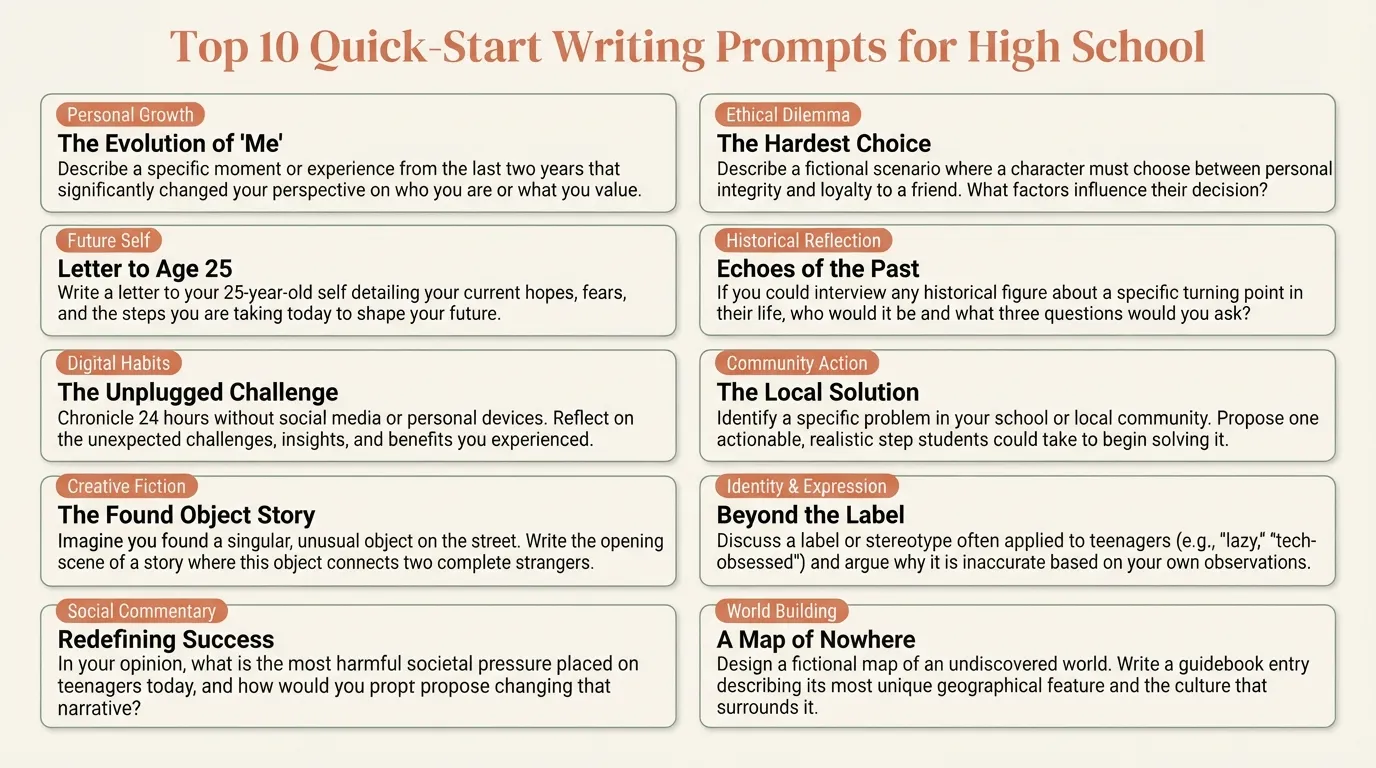
Here are ten high-impact, age-appropriate writing prompts designed to get high schoolers writing immediately:
Defining Moments: Describe a minor decision you made in the last year that ended up having a surprisingly big impact on your life.
Future Self: Write a letter to yourself five years from now. What is one thing you hope you haven’t forgotten about your current life?
Digital Habits: If you had to delete all social media apps off your phone for 30 days, what would you miss the most—and what would be a relief?
Changing Perspectives: What is one opinion or belief you used to hold strongly that you have completely changed your mind about? Why did it shift?
Unspoken Gratitude: Think of a person in your daily life who rarely gets recognized for what they do. What makes their contribution important?
Handling Pressure: What does “stress” feel like in your body, and what is one small boundary that helps you regain control?
Character Dilemma: Write a short scene where two close friends realize they are competing for the exact same spot, job, or opportunity.
Media Critique: Pick a movie, book, or show you loved as a child. Looking at it now as a teenager, what hits differently?
Ideal Learning: If you could design a single high school class that every student should be required to take for adult life, what would it cover?
Creative Twist: Choose an everyday physical object in your room (a worn shoe, an old jacket, a broken phone case) and tell its story from its own point of view.
Journal Prompts for High School Students (by Category)
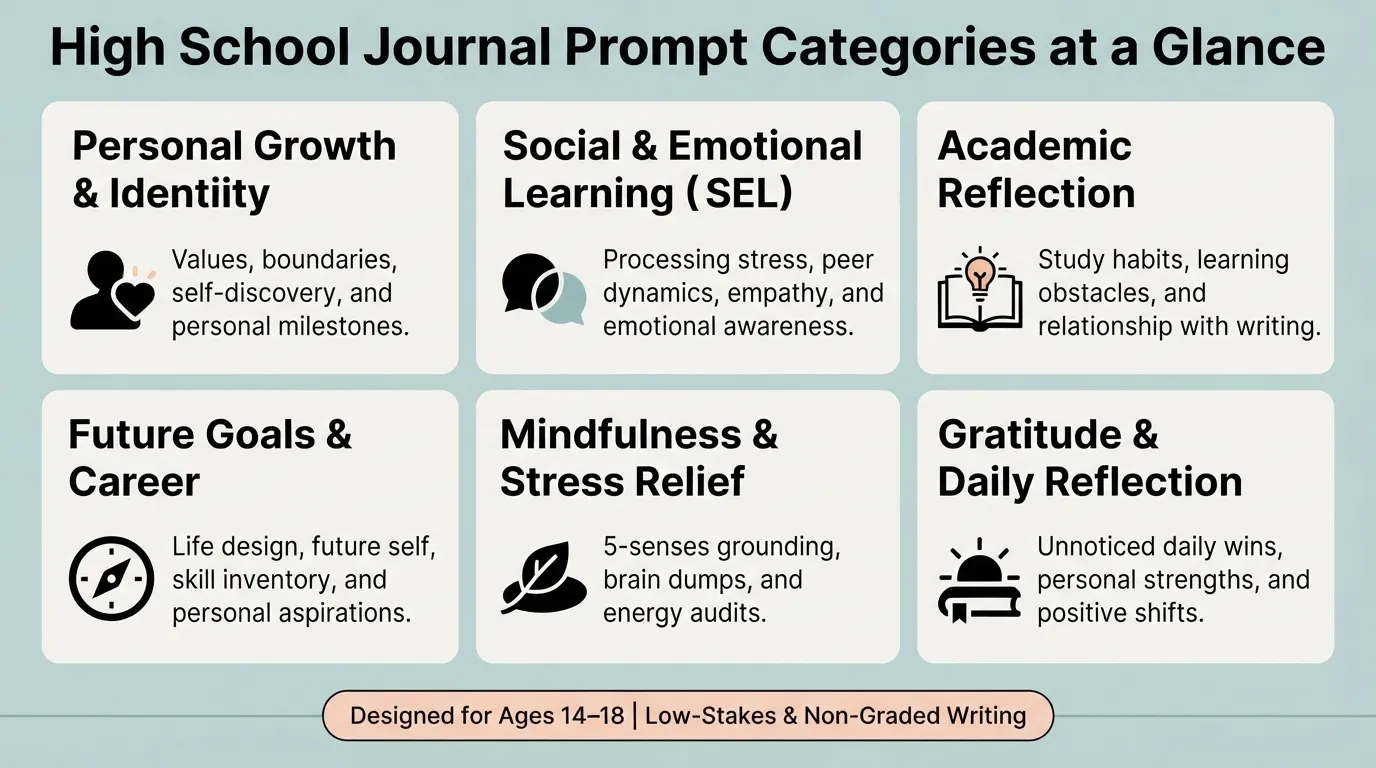
Journaling gives teenagers a private, zero-judgment space to make sense of who they are, where they are going, and how they interact with the world around them. The key to high engagement is offering prompts that feel relevant to their daily lives without backing them into a corner.
Below are categorized journal prompts tailored specifically to the emotional reality of 14- to 18-year-olds.
Personal Growth & Identity Prompts
Self-discovery in high school is fluid and constantly evolving. These prompts help students examine their personal values, boundary lines, and the shift from childhood to young adulthood:
Values Check: Describe a time you stood up for a belief, even when your friend group or family held a different view. What gave you the confidence to hold your ground?
Masks We Wear: What is a version of yourself that you present to school or social media, versus the version of yourself when you are completely alone?
Core Comforts: Think back to a time you failed or felt deeply embarrassed. What did that experience teach you about your own resilience?
Evolving Standards: What is a rule or expectation you set for yourself that you recently realized you need to let go of?
Defining Success: Write about what success looks like to you personally, completely separate from grades, test scores, or college acceptance letters.
Academic Reflection Prompts
Metacognition—thinking about how we learn and express ourselves—builds smarter, more adaptable students. These questions focus on study habits, classroom mindsets, and personal literacy:
Relationship with Writing: How do you feel when a teacher asks you to write a multi-page essay versus when you write privately for yourself? Where does that difference come from?
Learning Barriers: Describe a subject or topic that felt completely impossible at first. How did you handle the frustration, and where do you stand with it now?
Reading History: Think of one book, article, or piece of writing that actually shifted how you see the world. What made it resonate with you?
Ideal Environment: What does your physical and mental environment look like when you are doing your best, most focused work?
Feedback Mindset: When you receive critical feedback on an assignment, what is your initial emotional reaction, and how do you process it into actionable steps?
Social & Emotional Learning (SEL) Prompts
Navigating high emotional stakes, stress, and self-regulation requires ongoing practice. These reflection prompts encourage teens to build empathy and emotional awareness:
Emotional Mapping: Describe an emotion you have been avoiding lately. If that feeling had a physical shape, color, or weight, what would it look like?
Empathy Check: Think of someone at school with whom you frequently disagree or clash. What might be happening in their life that influences how they act?
Stress Signals: What are the subtle physical or mental warnings your body gives you when you are heading toward burnout?
Reclaiming Control: When a situation feels completely out of your hands, what is one small thing within your immediate control that you can focus on?
Communication Styles: Describe a recent conflict you had. Looking back, did you communicate your actual needs, or did you react purely out of frustration?
Friendship & Relationship Prompts
Peer dynamics are central to high school life. These prompts zoom in on friend group shifts, social pressure, and boundaries in teenage relationships:
Evolving Friendships: Describe a friendship in your life that has naturally drifted apart over time. How have you handled the change in dynamic?
Friendship Standards: What are the three non-negotiable qualities you need in a best friend, and how well do you model those same qualities for others?
Group Dynamics: Have you ever felt forced to hide a passion or interest to fit into a specific social circle? What happened?
Setting Boundaries: How do you handle saying “no” to a friend without feeling guilty or worried about ruining the relationship?
Support Systems: Who is the person in your life who makes you feel safest to be your authentic self, and what specifically do they do to create that space?
Future Goals & Career Prompts
These broad, reflective prompts encourage students to look toward their adult lives with curiosity rather than anxiety:
Life Design: If money, location, and social expectations were non-issues, what would a typical Tuesday look like for you in ten years?
Skills Inventory: What is a talent or skill you possess that isn’t measured by traditional school subjects or report cards?
Impact vs. Status: Would you rather pursue a high-paying career that feels repetitive, or a career that makes a visible difference in your community with modest pay? Why?
Mentorship Ideal: Describe the kind of adult mentor or leader you hope to become for someone younger than you in the future.
Curiosity Driven: What is a career, industry, or field of study that you know almost nothing about, but secretly find fascinating?
Wellbeing & Mindfulness Prompts
Mindfulness journaling gives students a low-pressure way to slow down, ground themselves in the present moment, and reduce cognitive noise:
Five-Senses Grounding: Look around the room right now. Detail three things you hear, two things you feel physically, and one thing you smell.
Brain Dump: Spend five minutes writing every single thought, task, or worry currently cluttering your mind. Don’t organize them—just empty them onto the page.
Energy Audit: What activity or person gave you energy this week? What activity or situation completely drained it?
Safe Spaces: Describe a physical location where you feel entirely calm, safe, and unhurried. Use sensory details to paint the scene.
Self-Compassion Letter: Write a short paragraph to yourself using the exact same tone of grace and kindness you would offer to a friend who had a terrible day.
Gratitude Journal Prompts
Shifting focus toward gratitude helps counter the constant social comparison and pressure teens experience daily:
Unnoticed Details: Name three small things that happened today that made your life easier or slightly better, but went completely unthanked.
Tech Appreciation: What is one piece of technology or modern convenience you use every day that you would genuinely struggle to live without?
Overcoming Obstacles: Identify a past challenge that felt terrible at the time, but ultimately taught you a lesson you are grateful for now.
Person Spotlight: Write about a teacher, mentor, family member, or neighbor who consistently shows up for you in quiet ways.
Personal Strengths: What is one physical or mental trait you possess that you rarely give yourself credit for?
End-of-Year / Start-of-Year Reflection Prompts
Transition periods at the beginning and end of the school year are ideal moments for self-assessment and setting fresh intentions:
School Year Inventory: What is one mistake you made this past school year that you have completely forgiven yourself for?
Letter to Past Self: Write a letter to the version of you who walked into school on day one of this academic year. What do they need to know?
Setting Intentions: Rather than setting rigid goals, choose one single word to serve as your guiding theme for this upcoming semester. Why that word?
Habit Elimination: What is one habit or mindset from last year that you are actively choosing to leave behind?
Unfinished Business: What is one project, conversation, or personal goal from this year that you want to carry forward and finish?
Journal Entry Starters (Sentence Finishers)
Sentence starters remove the friction of starting from scratch. These fill-in-the-blank prompts provide an immediate launching pad for quick 3-minute entries:
I remember when… I realized that adults don’t actually have everything figured out.
Today I felt… completely overwhelmed by something that shouldn’t have been a big deal, specifically…
The hardest part of my day was… when I had to choose between…
If I could change one thing about today… it would be the way I handled…
Right now, I really need… someone to listen without trying to fix…
I feel most like myself when… I am surrounded by…
One thing nobody tells you about being this age is… how confusing it feels to…
Creative Journal Prompts
By blending reflective journaling with narrative twists, these prompts let students process personal thoughts through creative framing:
Future Retrospective: Write today’s journal entry as if you are your 80-year-old self looking back on your teenage years. What advice do you give your present self?
Metaphorical Weather: Describe your current mental state entirely through weather patterns, landscapes, and seasonal shifts—without using direct emotion words.
Object Perspective: Choose an item in your backpack (a worn notebook, a pair of headphones, a half-used water bottle) and write a journal entry from its perspective observing your day.
Alternate Timeline: Imagine a world where you made the exact opposite choice on a major decision you faced recently. How does your day look different?
Dialoguing with Stress: Personify your biggest current stressor as a character sitting across from you at a diner. Write out the conversation you have with it.
Creative Writing Prompts for High School Students
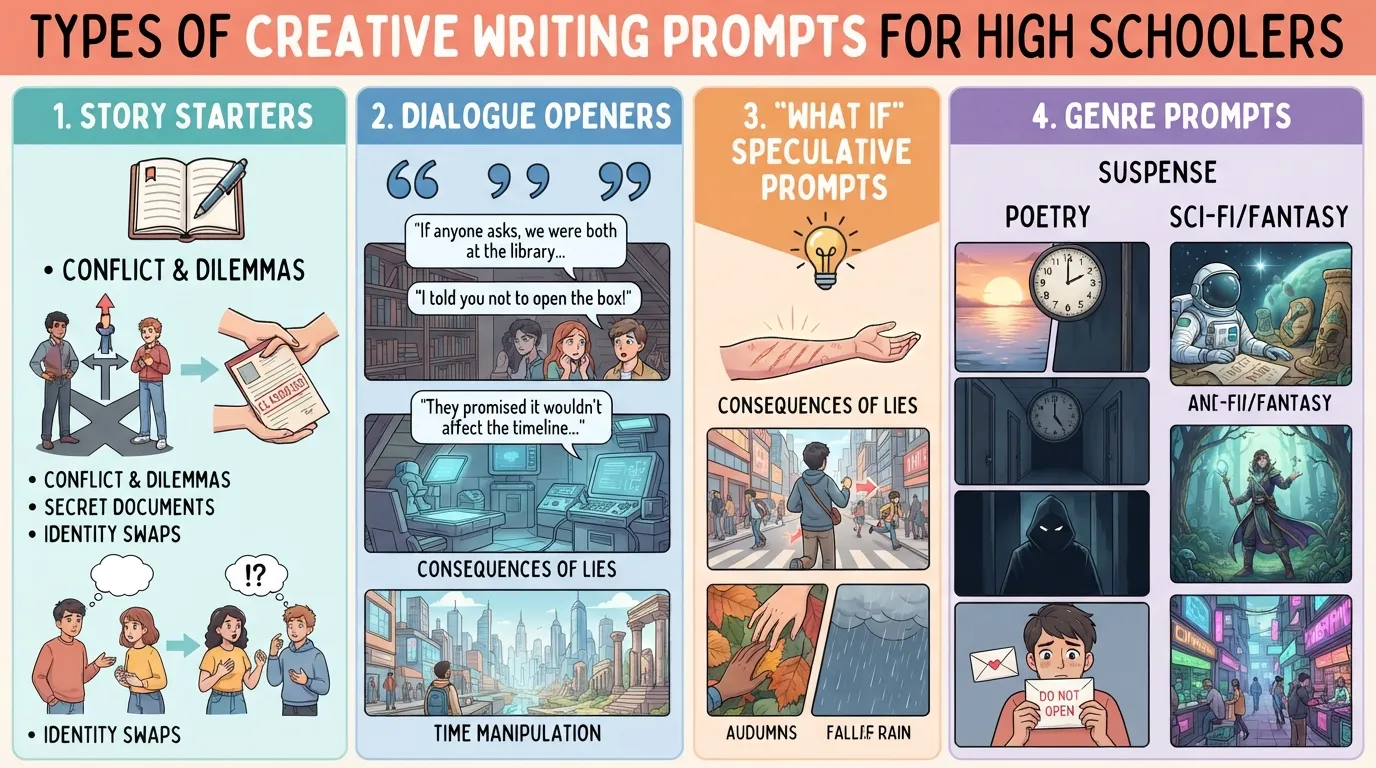
Creative writing offers teenagers a low-stakes playground to experiment with voice, perspective, and narrative structure. Rather than forcing students into rigid essay templates, these creative writing prompts encourage high schoolers to build memorable characters, craft sharp dialogue, and push plot lines into unexpected places.
Story Starters (Character-Based)
Strong stories begin with compelling, flawed characters who want something desperately. Use these character-driven hooks to start a narrative:
The Secret Keeper: Write about a high school senior who discovers a hidden document tucked inside a library book—addressed directly to them by name.
The Reluctant Rival: Two former best friends find themselves competing for the exact same award, scholarship, or position. Start the story at the moment they realize the stakes.
The Unwanted Gift: A teen inherits an old, locked wooden chest from a relative they barely knew, along with a note that says: “Do not open this until you turn eighteen.”
The Identity Swap: Character A has spent four years building a flawless public reputation, while Character B thrives on staying completely invisible. A sudden mix-up forces them to trade roles for a week.
The Final Day: Focus on a character spending their last 24 hours in their childhood hometown before moving across the country.
Dialogue-Opening Prompts
Dialogue should jump straight into tension or intrigue. Begin your scene with one of these opening lines and let the conversation drive the plot:
“I didn’t steal it. I just took it back before you could ruin it.”
“You promised me we would never come back to this building.”
“If anyone asks, we were both at the library until eight o’clock tonight.”
“You’re looking at this all wrong. It’s not a mistake if nobody caught us.”
“I found your name written on the back of the photo. Care to explain why?”
“What If” Prompts
Speculative questions challenge writers to bend reality slightly and explore the logical consequences of a single strange premise:
What if every lie you told left a visible, temporary mark on your skin for 24 hours? How would high school social dynamics change overnight?
What if you woke up tomorrow and realized you were the only person in your town who remembered a specific classmate ever existed?
What if a strange app appeared on your phone that accurately predicted the next minor inconvenience in your life five minutes before it happened?
What if people’s emotions caused the ambient temperature in the room to drop or spike dramatically based on their mood?
What if you could trade one year of your past memories in exchange for mastering any skill instantly? Would you make the trade?
Poetry Prompts
Poetry gives students a space to focus on imagery, rhythm, and emotion without worrying about paragraph structure or traditional plot lines:
The Sound of a Memory: Write a poem centered around a specific sound—a rusting door hinge, rain on a bus window, or static on a radio—that immediately brings back a past summer.
An Ode to the Mundane: Choose an everyday, overlooked object in your room (a worn shoe, an old house key, a broken pen) and write a tribute to its journey.
Two Colors Colliding: Pick two contrasting colors and use them as metaphors to describe a sudden shift in your emotional state or environment.
The Unspoken Words: Draft a poem composed entirely of things you wanted to say during a tough conversation, but chose to keep to yourself.
Portrait of a Place: Describe a specific local spot (a quiet diner, a crowded school hallway, a empty park bench at dusk) using only sensory details—taste, touch, smell, and sight.
Funny/Humor Prompts
Humor writing teaches pacing, timing, and hyperbole. These comedic scenarios encourage lighthearted storytelling:
The World’s Worst Advice: Write a story from the perspective of an overly confident high schooler giving completely terrible advice on how to survive freshman year.
Mishap in the Cafeteria: A simple accident in the school cafeteria escalates into a full-scale, absurd conspiracy theory involving the entire student body.
Pet Perspective: Tell the story of a dramatic, life-altering event from the perspective of a dramatic house cat who completely misunderstands human behavior.
The Failed Heist: A group of teens plans an elaborate, heist-style mission to retrieve a confiscated phone from the principal’s office—and everything goes wrong in the most ridiculous way possible.
Parental Social Media: Write a scene where a teenager tries to explain internet slang and memes to a parent who takes every single phrase literally.
Suspense & Mystery Prompts
Suspense relies on pacing, hidden motives, and ticking clocks. Build tension using these mysterious setups:
The Unmarked Envelope: You open your locker to find an envelope containing a key, a set of GPS coordinates, and a note that says: “You have two hours.”
The Vanishing Bus Stop: A teenager notices that a specific house on their route home looks completely different every single Tuesday—and no one else seems to notice.
The Alibi: Three friends agree to cover for each other regarding where they were last Friday night, but one of them starts giving conflicting details to the rest of the group.
The Locked Room: A group of students staying late for an after-school activity realizes all the doors have been locked from the outside, and the main lights suddenly go off.
The Unknown Caller: You receive a text message from an unknown number containing a photo of your front door taken thirty seconds ago.
Sci-Fi & Fantasy Prompts
Futuristic worlds and magic systems force writers to build clear rules and immersive settings. Use these premises to spark world-building:
The Memory Market: Set your story in a world where memories can be extracted, bought, and sold like digital files. What happens when someone buys a memory that isn’t clean?
The Last Signal: A crew on a deep-space research vessel receives a distress signal originating from a planet that was declared uninhabited fifty years ago.
The Hidden Door: While renovating an old high school basement, a student finds a door that opens into a sprawling, ancient forest instead of a boiler room.
The Glitch: In a society where human consciousness is backed up daily to a central cloud, a teenager wakes up with yesterday’s backup missing entirely.
The Artifact: An ordinary teenager discovers an ancient ring that allows them to pause time for exactly 60 seconds once per day—but every use ages them by a month.
5-Minute and 10-Minute Quick Writing Prompts
When class time is tight, short writing bursts prevent overthinking and help high schoolers dive straight into the entry. Structuring prompts by time constraint gives students a clear boundary, making the writing task feel manageable rather than overwhelming.
5-Minute Warm-Up Prompts
These rapid-fire prompts are designed for quick bellringers or warm-up routines. The goal is pure speed and raw momentum—getting words onto the page without pausing to edit.
One-Word Reaction: Choose a single word that describes your mood right now. Spend five minutes explaining exactly why that word fits today better than any other.
Snapshot Description: Pick one physical item in the room. Write a fast, sensory-rich description of it using at least three adjectives you haven’t used this week.
The Quick Fix: If you had the power to immediately resolve one small, annoying problem in your daily routine today, what would it be and how would your day change?
Unfiltered Stream: Set a timer for five minutes and write continuously without lifting your pen or moving your hands off the keyboard. If you get stuck, write “I am stuck” until the next thought hits.
Immediate Gratitude: List three specific things that happened in the last 24 hours that brought a smile to your face, and add a quick sentence on why each mattered.
10-Minute Deep-Dive Prompts
A ten-minute window offers enough space to develop a fuller narrative arc, explore a complex perspective, or outline a detailed argument without feeling bogged down.
The Unexpected Perspective: Write a short scene about a high-stakes moment (like a championship game or an audition) from the viewpoint of a background spectator who has no personal stake in the outcome.
Reframing a Mistake: Think of a minor setback or failure you experienced recently. Spend ten minutes writing about what that situation looks like when viewed strictly as a necessary learning milestone.
The Fork in the Road: Recall a decision you made in the past month where you almost picked the opposite option. Detail what your life would look like right now if you had taken that alternate path.
A Letter to a Character: Pick a fictional character from a book, movie, or show who made a decision you strongly disagreed with. Write a short, direct letter calling them out and suggesting a better choice.
The Ideal Classroom: Spend ten minutes drafting a realistic proposal for one rule, assignment, or structural change that would make your current English or writing class significantly more engaging.
Essay Writing Prompts & Topics for High School
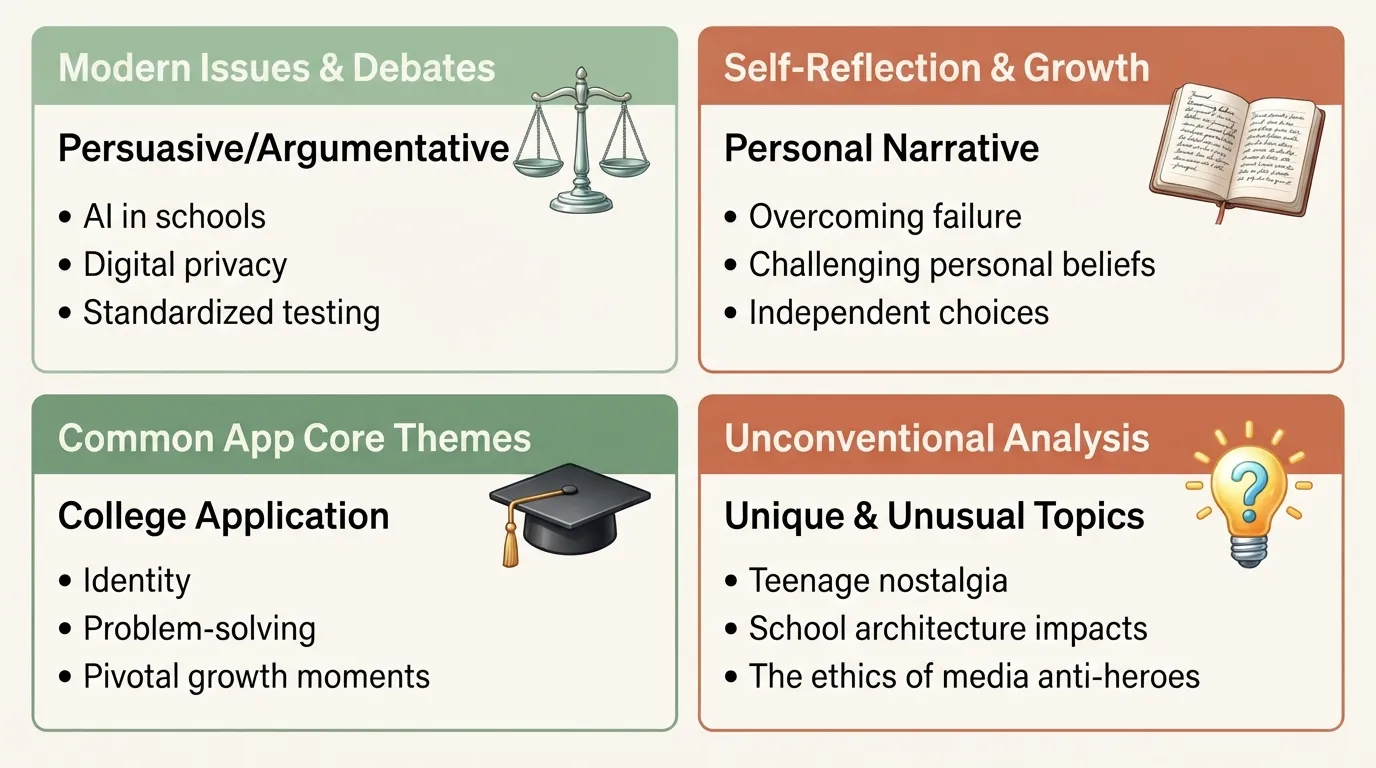
Formal essay writing does not have to feel like a tedious exercise in filling out a rigid outline. When assigned topics that address genuine conflicts, personal growth, or unconventional questions, high schoolers shift from passive compliance to active, compelling argument.
Persuasive/Argumentative Essay Prompts
Strong argumentative essays require students to take a clear, defensible position on issues that directly impact their generation or society at large:
Digital Age Privacy: Should public high schools have the right to monitor students’ public social media accounts for policy violations, or does that constitute an overreach of privacy?
Standardized Testing: Are standardized test scores a reliable measure of a student’s intelligence and future academic potential, or do they primarily reflect socio-economic factors?
Artificial Intelligence in Education: Should schools ban the use of generative AI tools for homework assignments, or should they restructure curricula to integrate AI literacy into daily learning?
Four-Day School Week: Does transitioning to a four-day school week improve student mental health and academic output, or does it create an undue burden on working families?
Youth Representation: Should the legal voting age for local municipal elections be lowered to 16, giving high schoolers a direct voice in community decisions?
Personal Narrative Essay Prompts
Personal narrative assignments help students cultivate self-awareness, hone structural pacing, and articulate pivotal moments in their personal development:
A Challenged Belief: Narrative the moment you realized a core assumption you held about a person, culture, or idea was completely incorrect. How did that realization change your behavior?
Navigating Failure: Describe a situation where you worked relentlessly toward a goal and still fell short. How did you process the immediate fallout, and what did you build from it?
Defining Independence: Recall the first time you made a significant choice entirely on your own, without consulting parents, friends, or mentors. What were the consequences?
Crossing a Cultural Bridge: Detail an experience where you had to adapt to an unfamiliar social, cultural, or familial environment. What did that transition reveal about your adaptability?
The Weight of Expectation: Write about a time you felt caught between living up to someone else’s expectations and staying true to your own priorities.
College Application Essay Prompts
College admissions officers look for authentic personal voice, reflection, and intellectual curiosity. These prompts reflect core themes found on the [suspicious link removed] to help high school juniors and seniors draft compelling application essays:
Background and Identity: Some students have a background, identity, interest, or talent that is so meaningful they believe their application would be incomplete without it. If this sounds like you, share your story.
Overcoming Obstacles: The lessons we take from obstacles we encounter can be fundamental to later success. Recount a time when you faced a challenge, setback, or failure. How did it affect you, and what did you learn?
Questioning Ideas: Reflect on a time when you questioned or challenged a belief or idea. What prompted your thinking? What was the outcome?
Problem Solving: Discuss a problem you’ve solved or a problem you’d like to solve. It can be an intellectual challenge, a research query, an ethical dilemma—anything that is of personal importance.
Personal Growth: Discuss an accomplishment, event, or realization that sparked a period of personal growth and a new understanding of yourself or others.
Unique & Unusual Essay Topics
Injecting unexpected premises into formal essay structures challenges students to apply rigorous analytical thinking to unconventional subjects:
The Psychology of Nostalgia: Analyze why teenagers in the 2020s frequently express deep nostalgia for decades, media, and aesthetics they never personally experienced.
Ethics of Anti-Heroes: Choose a popular fictional anti-hero and argue whether their widespread appeal in modern media reflects a healthy critique of authority or a worrying cultural trend.
The Value of Boredom: Make a case for whether constant access to digital entertainment has eliminated “productive boredom”—and examine what humanity loses when quiet downtime is removed.
Design and Human Behavior: Evaluate how the physical architecture and layout of your high school building subtly shapes student social interactions, stress levels, and movement patterns.
The Evolution of Slang: Trace the lifespan of a specific modern slang term or internet phrase, examining how language shifts from niche online communities into mainstream discourse.
Writing Prompts for High School Seniors
Senior year is a distinct emotional bridge—a time defined by impending independence, shifting friendships, and the heavy anticipation of stepping out of high school life. These writing prompts help high school seniors process this major life transition, reflect on where they have been, and clarify who they want to become next.
The Departure Checklist: Beyond academic prep, what is one practical, emotional, or personal skill you feel you still need to master before moving into your next chapter after graduation?
A Letter to Grade 9: Write a letter to yourself on your very first day of freshman year. What warning signs can you tell them to ignore, and what moments should they hold onto?
Redefining Success: High school measures achievement through GPA, sports records, and college acceptances. How do you plan to define success for yourself once those external metrics disappear?
The Last Firsts: Senior year is full of “last times”—the last first day, the last homecoming, the last pep rally. Describe a recent mundane moment that suddenly felt meaningful because you realized it wouldn’t happen again.
Identity Outside Your Hometown: Most of your peers know you based on years of shared history. Who are you when you step into a room where nobody knows your reputation, background, or past mistakes?
Unspoken Gratitudes: Think of a teacher, school staff member, or peer who shaped your high school experience in a major way, but whom you have never explicitly thanked. Write down what you wish you could tell them before walking across the graduation stage.
The Comfort Zone Test: What is one belief, habit, or safety net from your high school years that you know you need to leave behind in order to grow as an adult?
Example Journal Entries for High School Students (Sample Responses)
Sometimes the hardest part of journaling is figuring out what a finished response actually looks like on the page. Seeing a completed entry helps take away the pressure of overthinking your tone or structure.
The sample responses below show how you can turn a simple prompt into an honest, low-pressure reflection.
A quick note before you read: These examples are here solely for inspiration. Your journal is your own private space—you don’t need to write like anyone else, polish your sentences, or sound impressive. Use your natural voice and let your thoughts flow however they come out.
Sample Entry #1 — Personal Growth Prompt
Prompt: Describe a time you stood up for a belief, even when your friend group held a different view.
Last Tuesday during lunch, the topic of making cutoffs for the track team came up. Everyone at the table was laughing about a freshman who missed the qualifying time by two seconds and dropped his baton. It was classic mob mentality—nobody was trying to be genuinely cruel, but no one was stopping it either. My instinct was to just stay quiet, scroll on my phone, and wait for the conversation to shift.
Instead, I took a breath and just said, “Honestly, at least he put himself out there. Most of us wouldn’t even try out for that event.” The table went dead quiet for a second, and my heart was beating ridiculously fast over five simple words. But then Sarah nodded and changed the subject to the weekend homework. It wasn’t a movie moment where everyone clapped, but walking away from lunch, I felt an inch taller. Standing up doesn’t have to mean starting a fight; sometimes it’s just refusing to laugh along.
Sample Entry #2 — SEL/Emotional Prompt
Prompt: What are the subtle physical or mental warnings your body gives you when you are heading toward burnout?
I used to think stress was just a feeling in my head, but lately, I’ve realized my body keeps the score way before my mind admits it. First, my jaw gets ridiculously tight—especially when I’m staring at my laptop trying to outline an essay. Then comes the mindless phone scrolling. When I start opening and closing the exact same three apps without actually reading anything, that’s my brain’s way of pulling the emergency brake because it feels overwhelmed.
Yesterday afternoon, I noticed both happening at once while studying for AP Chem. Instead of forcing myself to grind through another hour of practice problems like I usually do, I actually paid attention to the warning signs. I shut the laptop, went outside, and walked around the block for ten minutes without my headphones. It didn’t magically fix my workload, but recognizing the burnout cue early stopped me from completely spiraling by 9 PM.
Download the High School Writing Prompts PDF
Access official high school assessment and writing prompts formatted specifically for classroom and student evaluation practice.
Official educational resource provided by the Oregon Department of Education (PDF) .
Frequently Asked Questions
Common questions about high school writing prompts, essay structures, and building low-stakes journaling routines.
What are some cool writing prompts? +
Cool writing prompts push beyond generic descriptions and test character choices under pressure. Examples include writing a scene where a minor lie suddenly becomes visible on skin for 24 hours, or describing a high schooler who discovers a document addressed to them tucked inside an old library book.
What are the creative prompts for high school students? +
Creative prompts for high schoolers focus on narrative tension, unexpected dialogue hooks, and low-stakes world-building. Great options include speculative "What If" scenarios, character-driven story starters, and sensory-focused poetry exercises that let teens explore original voice without strict academic guidelines.
What should a 14-year-old write about? +
Fourteen-year-olds (high school freshmen) respond best to topics exploring identity, changing friend dynamics, media critique, and future independence. Ideal entries involve reflecting on minor decisions with big consequences, setting personal boundaries, or exploring creative fiction scenarios.
What are some good essay topics for high school? +
Good high school essay topics touch on relevant modern debates, such as the ethics of AI tools in school, four-day school weeks, digital privacy, and standardized testing validity. For narrative essays, turning moments of personal failure or challenged assumptions into structured reflection work exceptionally well.
What are some unique essay topics? +
Unique essay topics analyze overlooked cultural or environmental factors, such as analyzing teenage nostalgia for decades they never experienced, how high school architecture shapes student stress, or the societal impact of eliminating quiet, productive downtime.
Can AI write an essay for me? +
AI tools can outline ideas, brainstorm angles, or check grammar, but using AI to write an entire essay violates academic integrity rules in most high schools. Teachers use detection tools, and AI-written text lacks authentic human voice, personal nuance, and emotional depth.
What are the 4 main types of essay topics? +
The four fundamental essay types in high school writing are Expository (explaining concepts/facts), Persuasive/Argumentative (defending a specific claim), Narrative (telling a structured personal story), and Descriptive (detailing a person, place, or experience using sensory language).
How to get 100% on an essay? +
Scoring a top grade requires establishing a razor-sharp thesis in paragraph one, supporting every claim with concrete evidence, using smooth transitions between ideas, rigorously editing for mechanical errors, and addressing counterarguments directly instead of ignoring them.
What are the 7 types of essays? +
In broader academic settings, the seven common essay forms are Narrative, Descriptive, Expository, Argumentative, Compare & Contrast, Cause & Effect, and Critical/Analytical essays.
What is the 10% rule in essay writing? +
The 10% rule states that your introduction and conclusion should each account for roughly 10% of your total word count, leaving the remaining 80% dedicated to the body paragraphs. In editing, it also refers to aiming to cut 10% of fluff and wordiness during your second draft.
What are the 7 college essay prompts? +
The Common Application provides 7 standard prompts covering core personal themes: background/identity, overcoming challenges, questioning a belief, solving a meaningful problem, personal growth, topic of personal interest, and an open topic of your choice.
Pimchanok Srisuk
Pimchanok Srisuk is the Journaling Editor at Holistic Wellbeing Living. She writes about journaling prompts, reflective writing, emotional clarity, and mindful routines. With seven years of experience creating personal-growth content, Pimchanok helps readers use simple writing practices to understand their thoughts and make calmer everyday decisions.