

Header — Holistic Wellbeing Living

Healing Journal Prompts: A Complete, Gentle Library for Every Stage of Healing

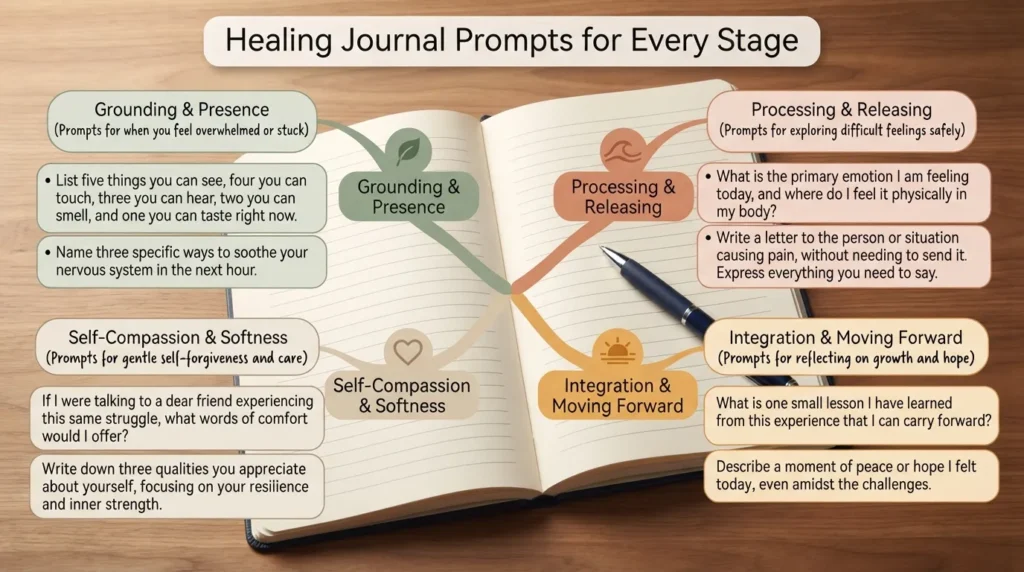
An open, handwritten journal surrounded by watercolor section dividers showing different stages of emotional healing, labeled with gentle writing prompts and supportive reflection exercise ideas.

If you opened this page while sitting on the floor with a heavy chest, or while holding a cup of tea you’ve forgotten to drink, take a slow breath. You don’t need to have your life figured out right now, and you certainly don’t need to be a “good writer” to sit down with a pen. Emotional pain has a way of turning our thoughts into a loud, tangled mess. Putting words on paper isn’t about creating art—it’s simply about giving that heavy weight somewhere else to live for a little while.

Below, you’ll find a soft, structured collection of guided prompts designed to meet you exactly where you are, whether you’re working through old wounds, navigating a hard season, or just trying to feel a bit more like yourself again.

A Quick Note on Safety > Journaling is a gentle tool for emotional processing, but it isn’t a replacement for therapy or professional healthcare. If a prompt stirs up feelings that feel too intense or overwhelming, it is completely okay to stop writing. Close the notebook, step away, and focus on your breathing. Please reach out to a mental health professional or a crisis support line whenever you need extra care.

What Are Healing Journal Prompts (and How Are They Different from Regular Journaling)?

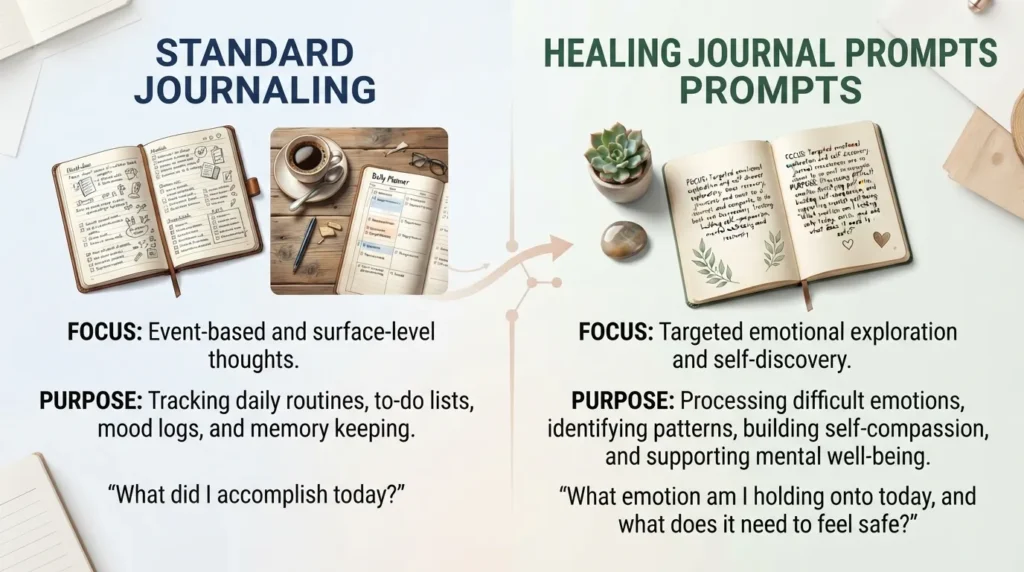
Side-by-side comparison diagram showing the differences between regular journaling for daily thoughts and healing journal prompts for deep emotional processing.

Most of us know the feeling of opening a notebook, staring at the blank page, and writing down a play-by-play of our afternoon. What you ate for lunch, the traffic on the way home, a quick note about how busy work was. That is classic daily journaling, and it has its place.

Healing journal prompts do a completely different job.

Instead of asking what happened today, healing prompts ask how did today feel inside your body? They act like a quiet, supportive guide, nudging you to look beneath the surface. When you are sitting with heavy feelings—like grief, exhaustion, or old anger—staring at a blank page can feel overwhelming. Guided journal prompts for healing give your mind a safe fence to lean on so you do not get lost in the weeds.

A Quick Reminder Before You Begin > You do not need to be a “good writer” to do this. You do not need perfect grammar, full sentences, or a pretty notebook. Your pages are just for you. The goal is never eloquence—it is simply honesty.

Here is what makes this practice different from ordinary diary entries:

  • Regular journaling records your day; healing prompts process your emotions. Standard writing keeps track of events. Healing journal prompts help you untangle why a small moment made you feel so angry, or why a certain memory still hurts.

  • They are built to meet you right where you are. On your best days, you might write three pages. On your hardest days, answering a single prompt with three simple words is more than enough. There is no standard you have to meet.

  • They shift you out of loop-thinking. When we are hurt, our minds tend to play the same painful thoughts on repeat. Specific questions pull those thoughts out of your head and lay them flat on the paper, making them easier to carry.

If you hit a point where a prompt feels too heavy, it is always okay to close the notebook and take a breath. You are in total control of your own pace. You do not need to force anything—you just need to start.

Why Writing Helps You Heal (The Science, in Plain Language)

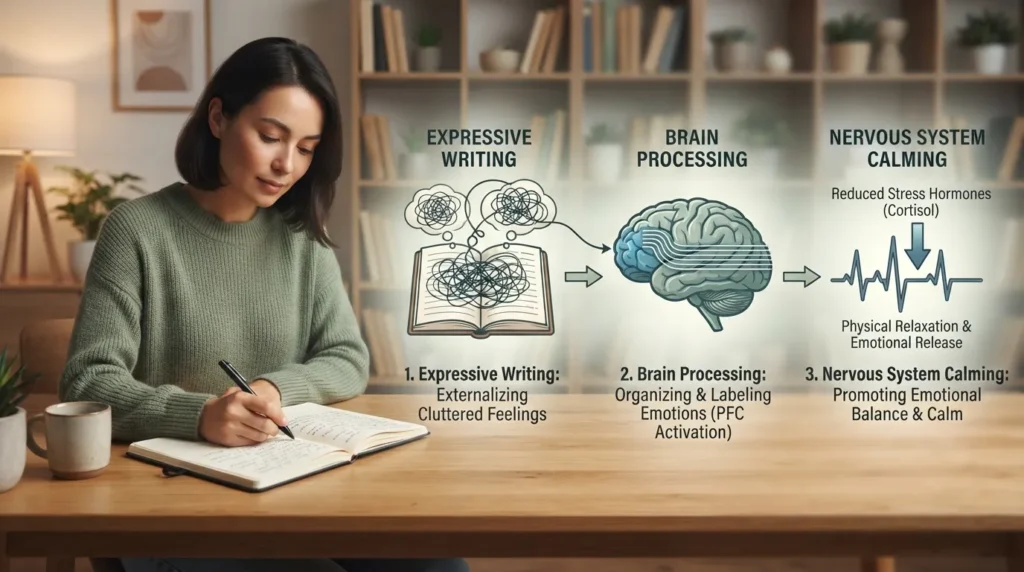
An infographic illustrating how expressive writing impacts the brain, showing a person journaling next to visual steps connecting emotional expression to reduced stress and nervous system regulation.

How Expressive Writing Changes the Brain

When you carry difficult experiences inside, your mind works overtime trying to keep those heavy feelings contained. Putting pen to paper isn’t just a creative outlet—it actually changes how your brain processes emotional pain.

Here is what happens under the surface when you use healing journal prompts to work through hard times:

  • It frees up mental space. Decades of research on expressive writing show that naming your rawest emotions on paper helps your mind organize chaotic thoughts. Instead of keeping painful memories in a constant loop, writing allows your brain to categorize what happened so you can gradually digest it.

  • It dials down your body’s alarm system. When you’re stressed, your nervous system flips into a defensive “fight-or-flight” state. Spending just fifteen minutes writing helps kickstart your body’s rest-and-restore settings, lowering your heart rate and easing physical tension.

  • It gives you back control. Emotional pain usually activates the survival-focused parts of your brain. Engaging in thoughtful journal prompts for healing brings the front part of your brain—the prefrontal cortex—back online. This shift builds healthy distance between you and your feelings, giving you fresh perspective without total overwhelm.

Studies published through the National Institutes of Health highlight how standard expressive writing routines reduce stress and support long-term emotional wellbeing. You don’t need perfect grammar or beautiful handwriting to reap these physical benefits. The simple act of being honest on the page is enough to begin softening the load.

How to Use These Healing Journal Prompts

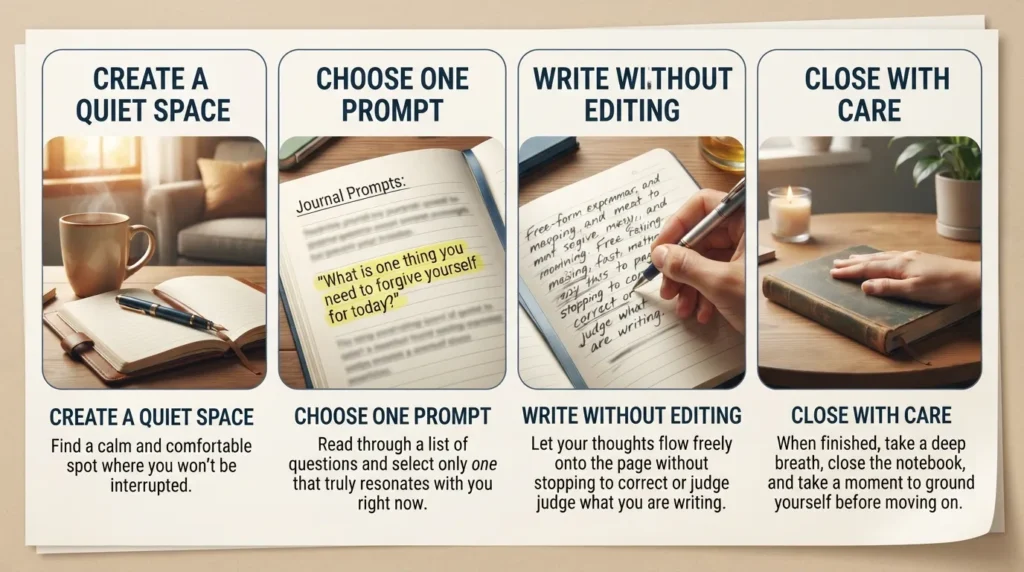
A step-by-step guide showing how to set up a comfortable space, choose a healing prompt, write freely, and gently close a journal session.

Writing can feel intimidating when you are already carrying a heavy load. You do not need to be a good writer to do this, and you definitely do not need to fix everything in one sitting.

Here are a few gentle reminders before you open your notebook:

  • You can do this anywhere, anytime. These journal prompts for healing are yours to keep, completely private, and available whenever you need a moment to check in with yourself.

  • Let go of neatness. Forget about spelling, punctuation, or making sense. Write messy. Write raw. Your journal is a safe place to dump your thoughts without judgment.

  • Keep it short. Start with just 5 or 10 minutes. There is no minimum word count required for processing your feelings. A single sentence is enough.

  • Give yourself permission to skip. If a specific prompt feels like too much today, move past it. Trust your gut and come back when you feel ready.

  • Find a quiet spot. Try to sit somewhere private where you will not be interrupted, even if it is just a comfortable corner of your bedroom.

  • Breathe through the heavy moments. If a prompt brings up intense feelings, pause and take a grounding breath before deciding whether to keep going.

How to Choose the Right Prompt for Today

Healing is rarely a straight line, and what you need on a Tuesday morning might be totally different from what you need on a Sunday night. Use this quick guide to find the right starting point for where you are at right now:

  • If you’re feeling raw or triggered: Start with the Self-Compassion prompts.

  • If you’re processing a specific hard event: Look at the Trauma or Grief prompts.

  • If your mind won’t stop racing: Head straight to the Anxiety prompts.

  • If you keep replaying past mistakes: Focus on the Self-Forgiveness prompts.

  • If you feel disconnected from your younger self: Start with the Inner Child prompts.

A Grounding Technique for When a Prompt Feels Like Too Much

Sometimes writing pulls up unexpected emotions. If your chest feels tight or your body feels overwhelmed while using these healing prompts, pause and bring yourself back to the room.

  • Try the 5-4-3-2-1 technique: Look around you and name 5 things you can see, 4 things you can physically touch, 3 things you can hear, 2 things you can smell, and take 1 deep, slow breath out through your mouth.

  • Take a break: Remember that it is completely okay to close your journal at any moment. Step away, get a glass of water, and come back whenever you are ready.

Healing Journal Prompts for Trauma

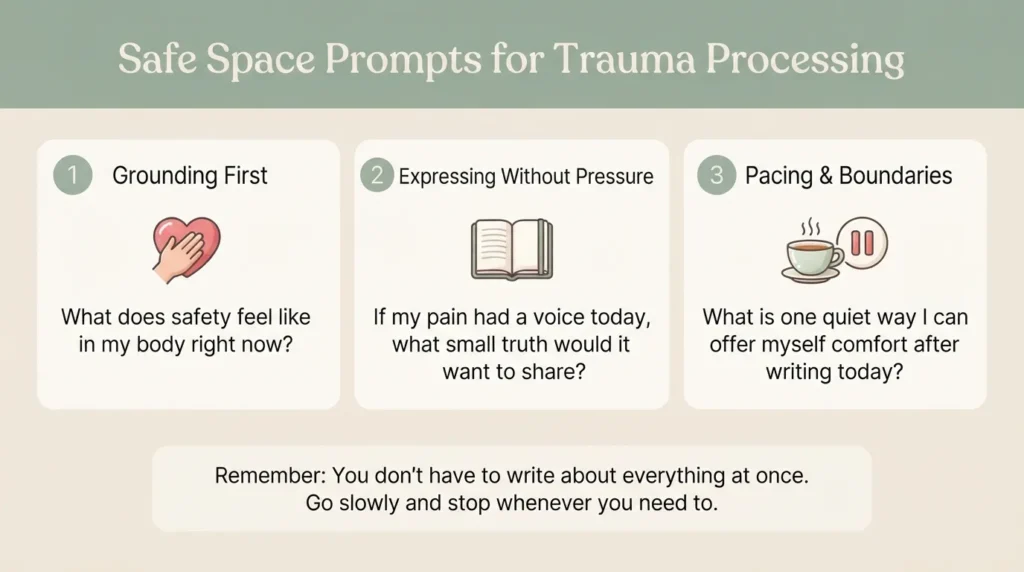
A calm, step-by-step visual guide outlining gentle journal prompts for processing trauma safely and grounded in self-care.

Trauma changes how we experience our own stories. When something deeply overwhelming happens, it often leaves our mind and body feeling disconnected, high-alert, or entirely numb. Journaling can help gently weave those scattered pieces back together, but it has to be done with care.

There is zero pressure to rush this. You do not need to relive painful details or force yourself to feel positive before you are ready. These prompts for healing are designed to help you meet yourself right where you are today, at a pace that feels grounded and secure.

Here are 12 healing journal prompts to support you as you process in your own time:

  • What does safety feel like in your body right now, even in a very small way?

  • If a quiet, protective part of you could talk, what would it tell you it needs right now?

  • Write about a place, real or imagined, where you feel completely untouchable and at ease.

  • What is one signal your nervous system—the internal system that controls your body’s threat response—gives you when it feels overwhelmed?

  • What are three simple things in your immediate surroundings that anchor you to the present moment?

  • Is there a specific emotion you are carrying today that feels too heavy to name? Describe its weight, temperature, or color instead.

  • What is one boundary you have set recently that protected your energy?

  • Write down a phrase or reminder that helps you catch your breath when anxiety spikes.

  • What is something you survived in the past that proves your quiet strength, even if you felt weak while going through it?

  • If you could offer simple, warm comfort to the version of you that went through your hardest moment, what would you say?

  • What is one small, low-pressure act of kindness you can offer yourself before this day ends?

  • What does your body need to hear from you right now to know that the immediate danger has passed?

A Quick Reminder on Pacing: > Trauma work takes time, and your wellbeing comes first. If a specific prompt brings up intense feelings or makes you feel panicked, step away. Close the notebook, take a few deep breaths, press your feet flat onto the floor, and skip anything that feels like too much today. You are always in control of your own writing.

Healing Journal Prompts for Your Inner Child

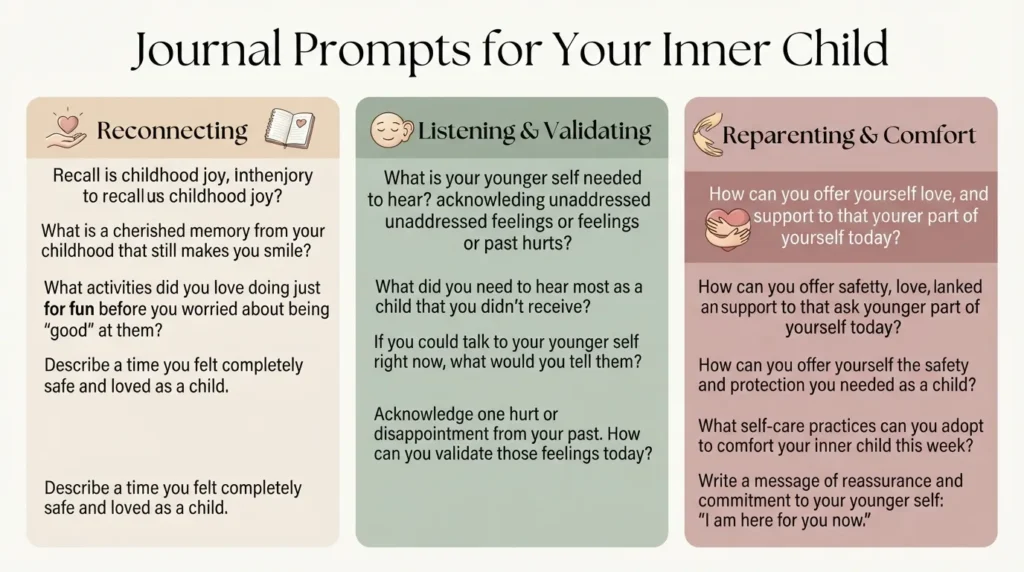
A peaceful graphic outlining gentle journaling prompts and reflective themes designed to help connect with and nurture your inner child.

When wellness spaces talk about the “inner child,” it can sound a bit abstract. But it’s actually very simple. Your inner child is just the part of you that holds onto memories, feelings, and beliefs from your younger years.

If you grew up feeling like you had to be perfect to be loved, or if you felt ignored, scared, or left out, those old feelings don’t just disappear when you turn eighteen. They linger. They show up when someone drops a sharp tone with you, or when you feel an overwhelming surge of panic over a small mistake.

Journaling for your inner child isn’t about blaming the adults from your past. It’s about pulling up a chair for the kid inside you who never got to speak. You’re giving that younger version of yourself the safety, listening ear, and validation they needed back then, but didn’t get.

Take a deep breath before you start. You don’t need to fix anything today. You just need to show up and write.

Prompts for Reconnecting with Your Younger Self

  • What was something you loved doing as a child that made you completely forget about time? When was the last time you let yourself do something just for fun?

  • Think of a time when you were little and felt genuinely safe, cozy, or content. What made that moment feel so peaceful?

  • If you could sit down next to the seven-year-old version of yourself today, what gentle words do you think they need to hear from you?

  • Write down three things your childhood self was really proud of, even if they seem small or silly to you now.

  • What was your favorite toy, book, or blanket growing up, and what kind of comfort did it bring you?

Prompts for Processing Unmet Needs and Old Hurts

  • Was there a rule or expectation in your house growing up that felt unfair or heavy to carry? How does that rule still affect how you live today?

  • Complete this sentence without overthinking it: “When I was younger, I always wanted an adult to tell me…” * Describe a time as a child when you felt misunderstood, left out, or invisible. What were you feeling in your body during that moment?

  • Did you feel like you had to act like an adult too soon, or manage the emotions of the people around you? How does that tendency show up in your current relationships?

  • What is a memory from your youth that still makes your chest feel tight when you recall it? What does that younger version of you need to hear to finally rest?

Prompts for Reparenting and Gentle Healing

  • Using journal prompts for healing your inner child can sometimes stir up old sadness, which is completely normal. In what ways can you offer yourself comfort right now, the same way you would comfort a crying child?

  • Write a list of permissions you give yourself today that you didn’t have growing up (for example: I am allowed to say no, I am allowed to make mistakes, I am allowed to rest).

  • How can you show your younger self that you are in charge now, and that you are keeping both of you safe?

  • Write a short letter to your teenage self. Acknowledge how hard things were for them, and thank them for surviving so you could be here today.

A Gentle Reminder: Healing prompts can bring up surprising or heavy emotions. There is no award for pushing through pain. If a prompt feels too intense, stop. Close the notebook, drink a glass of water, and step outside for a few minutes. You are allowed to go as slow as you need.

Healing Journal Prompts for Grief and Loss

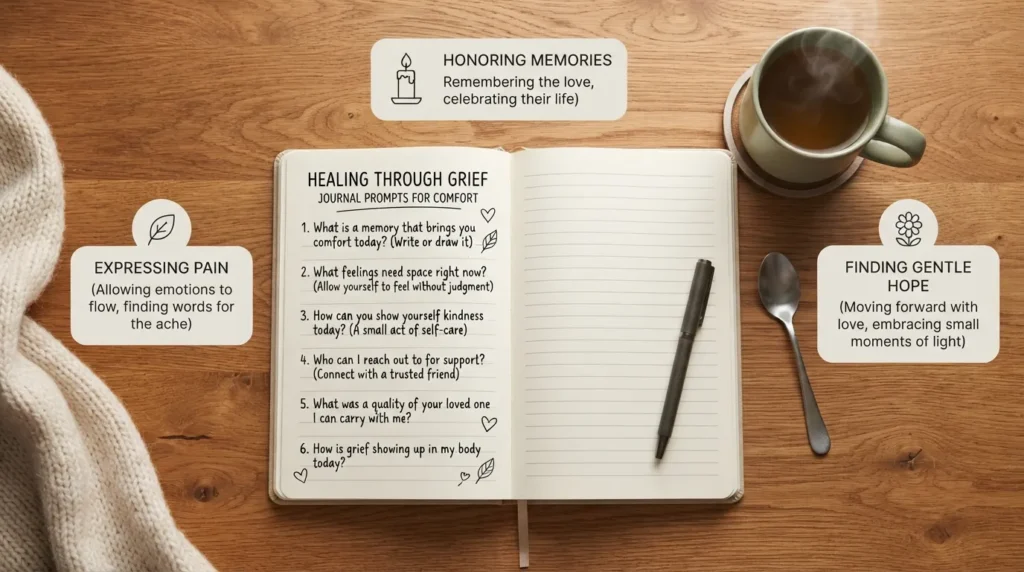
An open journal with written prompts for grief and loss, sitting on a wooden table beside a warm cup of tea and a small photo frame.

When we talk about grief, most people immediately think of death. But loss shows up in so many other ways. It is the ending of a relationship, losing a job, a shift in your health, or stepping away from a life you spent years building. Sometimes, you are simply grieving an old version of yourself that doesn’t exist anymore.

Whatever you lost, your pain is real. Grief isn’t a problem to fix or a test to pass. It’s just a weight you learn to carry differently over time. Writing won’t erase the ache, but it gives your feelings a safe place to land when everything else feels too heavy.

Here are 13 healing journal prompts designed to help you sit with loss at your own pace. You don’t need to answer every single one, and you don’t need to write full pages. Just pick one prompt that feels gentle enough to open today.

  • Describe what you lost as if you were explaining it to someone who cares about you deeply.

  • Where in your body do you feel this loss the most right now? Is it a tightness in your chest, a heavy stomach, or something else?

  • Write down three small memories from before this change that you want to keep close.

  • What do you miss most about how things used to be?

  • Is there something you wish you had said or done before things changed? Write those words out here.

  • How has this loss changed your everyday routine, and what feels hardest about that shift?

  • If your grief had a color, texture, or weight today, what would it look like?

  • What is one truth about this loss that you feel ready to write down, even if it hurts?

  • Who or what helps you feel grounded right now, even for just five minutes?

  • Write a short letter to yourself on the day this loss happened. What kind of kindness did you need to hear back then?

  • What is one pressure or expectation you can drop today to give yourself room to breathe?

  • Is there a part of yourself you feel like you lost along the way? Describe that part of you.

  • What does taking good care of yourself look like right now, in this exact season?

A gentle note on pacing: If writing about your loss feels overwhelming or starts to make you feel unsafe, it is completely okay to close your notebook. These journal prompts for healing are tools for reflection, not a requirement. Go slowly, and give yourself permission to step away whenever you need to.

Healing Journal Prompts for Anxiety

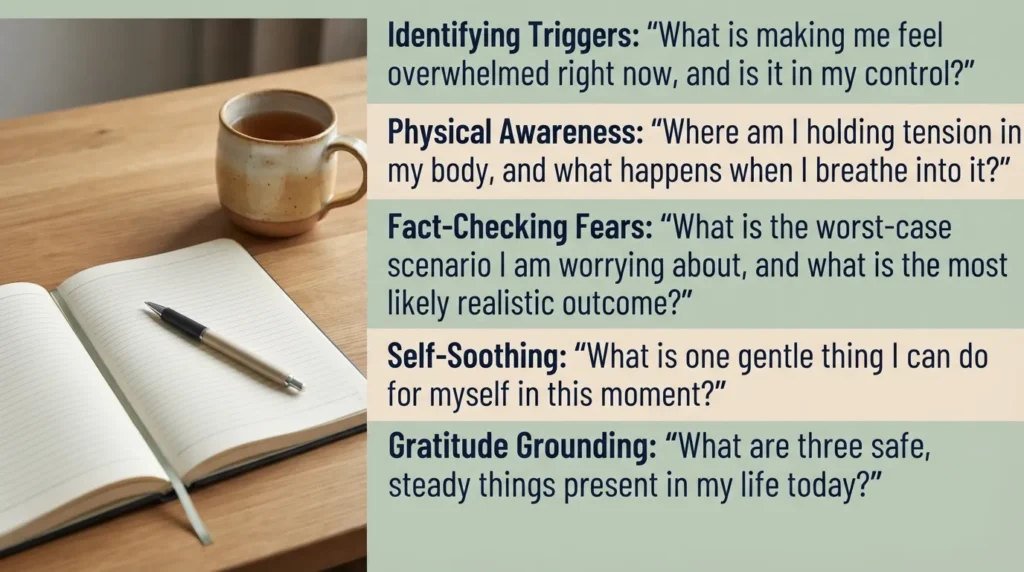
Infographic displaying a structured list of five healing journal prompts for managing anxiety, shown next to an open notebook and a cup of tea.

Prompts to Calm a Racing Mind

When your nervous system—the body’s internal alarm system—is on high alert, trying to analyze your feelings can feel like too much. These prompts are meant to ground you in the present moment and ease the immediate tension in your mind and body.

  • What is one physical thing in the room right now that feels safe, stable, or comforting to look at? Describe it in detail.

  • Write down every single thought currently racing through your head. Don’t worry about punctuation, spelling, or making sense. Just spill it all out until your pen stops.

  • If your anxiety had a shape, weight, or color right now, what would it look like? Where do you feel it in your body?

  • List three things that are completely true right now in this exact second (for example: “I am sitting in a chair,” “I am safe in this room,” “I am breathing”).

  • What is one small demand or expectation you can let go of for the rest of today?

  • Write a gentle note to yourself from the perspective of a wise, caring friend who sees how hard you’re trying.

  • What does your body need right in this moment? Is it a glass of water, a warm blanket, a deep breath, or simply to close your eyes for two minutes?

A Quick Note on Pacing: You don’t have to answer all of these. If a prompt feels too heavy or makes your chest feel tight, step away. Sip some water, feel your feet on the floor, and come back whenever you’re ready.

Prompts to Understand What’s Underneath the Anxiety

Anxiety is often a messenger. Once the initial surge of panic settles, using these healing prompts can help you gently explore what your mind is trying to protect you from.

  • What is the worst-case scenario your mind is playing out right now? If that scenario actually happened, what inner strengths or support would help you handle it?

  • Finish this sentence without overthinking it: “Right now, I am afraid that…”

  • Is there a situation in your life where you feel a lack of control? How can you practice letting go of what isn’t yours to fix?

  • Look back at a time in the past when you felt overwhelmed by uncertainty. How did you make it through that moment?

  • What boundary do you need to set—with work, a loved one, or even your own phone—to protect your peace of mind this week?

  • Is your anxiety trying to tell you that a boundary was crossed, or that you need more rest, support, or space?

  • What is one gentle truth you can tell yourself the next time your thoughts start to spiral?

Healing Journal Prompts for Self-Forgiveness and Letting Go

An open notebook on a wooden table displaying handwritten healing journal prompts focused on self-forgiveness and letting go, placed next to a quiet cup of tea.

Carrying old guilt around is exhausting. Whether you are holding on to a choice you regret from years ago or an old grudge that still stings, clutching the past usually just keeps you stuck in it. Forgiveness isn’t about pretending whatever happened was fine. It is simply deciding you don’t want to carry that heavy weight around every single day.

Writing gives those heavy feelings a safe, quiet place to land. When you put your thoughts on paper, you pull them out of your head where they tend to loop endlessly. These healing journal prompts are designed to help you gently unpack what you are holding so you can finally begin to lay it down.

A Gentle Note: You don’t need to fix everything in one sitting. Pick one prompt that speaks to you, take your time, and step away whenever you need a breather.

Prompts to Release Guilt and Past Mistakes

  • Think of a past mistake that still makes you cringe. If a close friend came to you with the exact same story, what words would you offer them?

  • What is one decision from your past you keep replaying? What were you trying to protect or accomplish at that time, using only what you knew back then?

  • Write down this sentence: “I release myself from the expectation that I should have known better before I actually learned.” How does reading that feel in your body?

  • What is one sentence of forgiveness you desperately need to hear right now? Write it down, address it to yourself, and let it sit on the page.

  • List three old choices you regret. Next to each one, write down one piece of real wisdom you gained because of that experience.

  • Is there an impossible rule you hold yourself to that you would never demand from anyone else? Where did that rule come from?

  • Imagine the past version of you who made that mistake standing in the room. What do they need to hear from present-day you to feel safe enough to move on?

Prompts for Letting Go of Grudges and Old Hurt

  • Is there an old resentment you keep feeding with your time and thought? What is holding on to this anger costing you in your actual life right now?

  • Write a direct letter to someone who hurt you, saying everything you never got to say out loud. (You don’t need to send it—this is just to get the truth off your chest.)

  • What would your average day look like if you weren’t carrying this grudge anymore? Describe a realistic morning where that weight is gone.

  • Complete this phrase without overthinking: “I am finally ready to stop replaying…” Then write until your hand gets tired.

  • What is one clear boundary you can set today to protect your peace so you don’t keep reopening old wounds?

  • Name one thing you are holding on to purely out of habit. What would happen if you just stopped thinking about it for one afternoon?

  • If you completely forgave yourself for your biggest mistake today, what would you spend your mental energy on tomorrow?

Using these journal prompts for healing isn’t a quick fix, but it is an honest start. You don’t have to get this right or clean up your past all at once—you just need to give yourself permission to stop reliving it.

Healing Journal Prompts for Self-Compassion

A person writing gently in a journal beside a warm cup of tea, with open pages showing gentle self-compassion journal prompts for self-acceptance and emotional healing.

Most of us talk to ourselves in ways we’d never dream of talking to a friend. When you slip up, drop the ball, or just feel overwhelmed, that inner voice can get sharp fast. Self-compassion isn’t about giving yourself a free pass to ignore mistakes. It’s about changing the tone of that internal voice so you can recover without tearing yourself down in the process.

When you use journal prompts for healing your relationship with yourself, you aren’t trying to force positive thinking. You are simply giving yourself permission to be human.

Here are a few gentle prompts to help you practice treating yourself with a bit more kindness today:

  • What is one hard thing you are carrying right now, and what would it look like to acknowledge that weight without judging yourself for feeling tired?

  • Think of a recent mistake you made. How would you explain this situation to a close friend if they had done the same thing?

  • Write down the exact phrase your inner critic repeats most often. What is a more supportive, realistic statement you can replace it with?

  • When you feel overwhelmed, what does your body need in that moment that you usually ignore?

  • List three small things you did today that took effort, even if nobody else noticed them.

  • In what area of your life are you expecting perfection right now? What would happen if you lowered the bar to just “doing your best”?

  • What is one boundary you need to set with yourself or someone else to protect your peace this week?

  • Write a short thank-you note to your body for one thing it made possible for you today.

  • Describe a time recently when you felt “not enough.” What was happening around you, and what did you actually need to hear in that moment?

  • What is one self-soothing activity that genuinely helps you feel grounded when you are stressed?

  • If you completely stopped trying to fix yourself for just five minutes, what feelings would come up?

A Quick Reminder on Pacing You don’t have to work through all of these at once. Pick one prompt that feels easy to answer today, write for five minutes, and let that be enough. Healing prompts work best when you go at a pace that feels quiet and manageable.

Healing Journal Prompts for Mental Health (General Well-Being)

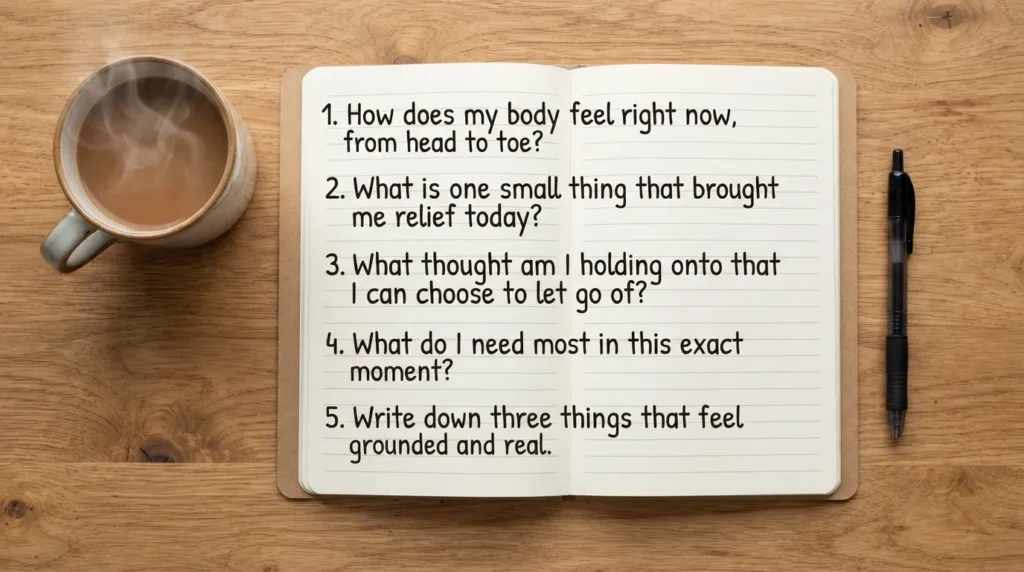
Open journal on a wooden table displaying five simple mental health writing prompts next to a cup of tea and a pen.

Some days don’t come with a major crisis, but everything still feels heavy. You might not be dealing with a deep wound or a fresh loss, yet your mood feels off, your energy is low, and you just feel stuck.

Writing isn’t about fixing yourself on the spot. It’s simply a safe place to put down what you’re carrying so you don’t have to hold it all inside your head. You don’t need beautiful handwriting, perfect grammar, or deep insights. You just need to start.

Here are daily journal prompts for healing to help you check in with your general mood and clear out the mental clutter:

  • What color best describes how you feel right now, and why does that color fit?

  • Write down three small things that drained your energy today, even if they seem silly.

  • What is one quiet need your body or mind is asking for right now?

  • If your current mood were a type of weather, what would it be?

  • What is a thought you keep replaying today that you can grant yourself permission to put down?

  • Write a list of five tiny things that brought you even a brief moment of comfort recently.

  • What is something you are forcing yourself to do right now that could actually wait?

  • How does your physical body feel as you hold this pen—where are you carrying tight energy?

  • What is one boundary you can set today to protect your peace of mind?

  • Finish this sentence: “Right now, I give myself permission to feel…”

  • What is something kind you wish someone would say to you today? Write those words out for yourself.

A Gentle Reminder: If you’re feeling completely overwhelmed or struggling to function, remember that journaling is a tool for reflection, not a replacement for professional help. Reaching out to a counselor or trusted therapist is always a brave and worthy step.

Healing Journal Prompts for Growth and Moving Forward

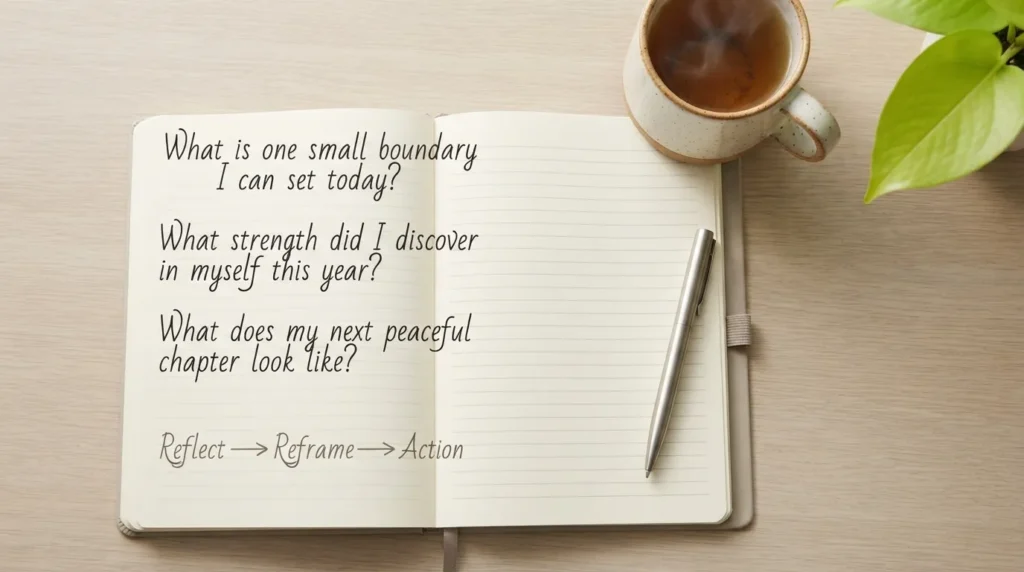
An open notebook with written prompts for personal growth surrounded by a pen, warm tea, and subtle natural lighting, summarizing actionable steps for moving forward.

Healing isn’t just about patching up old wounds. Eventually, the focus shifts to what comes next. You start asking yourself who you want to be now that you aren’t spending all your energy just trying to survive.

This phase of growth can feel a little strange. When you’ve carried heavy burdens for a long time, putting them down leaves your hands unexpectedly empty. Using journal prompts for healing can help you figure out how you want to fill that new space.

These healing prompts are designed to help you look ahead with gentle curiosity rather than pressure:

  • What is one small boundary you set recently that made your daily life feel a little safer or lighter?

  • Imagine yourself six months from today feeling steady and settled. What does a typical morning look like for that version of you?

  • Which old survival habits served you well in the past, but feel ready to retire now?

  • What is one belief about your future that you are finally ready to let go of?

  • If you gave yourself full permission to try something new without needing to be good at it, what would you do?

  • Who in your life currently makes you feel calm, seen, and supported? How can you invest more energy into those relationships?

  • What does peace feel like in your body today, and how can you invite just five minutes more of it into tomorrow?

  • Describe a strength you discovered about yourself while working through a hard season. How does it help you today?

  • What is one promise you want to make to yourself as you step into this next chapter?

  • When you picture your future, what habits or obligations are no longer taking up space in your schedule?

  • What is one simple thing you can do this week that brings you genuine comfort or quiet joy?

Growth after a hard season isn’t about rushing into a brand-new identity overnight. Take your time with these healing journal prompts. You don’t need to have every answer figured out right now—just answering one question when you feel ready is more than enough.

Free Printable Healing Journal Prompts (PDF)

Want to keep these prompts close by, without scrolling back to this page every time? This free printable includes every healing journal prompt from this guide, organized by category, so you can open it whenever you need a place to start writing.

No email required — instant download.

How Often Should You Use Healing Journal Prompts?

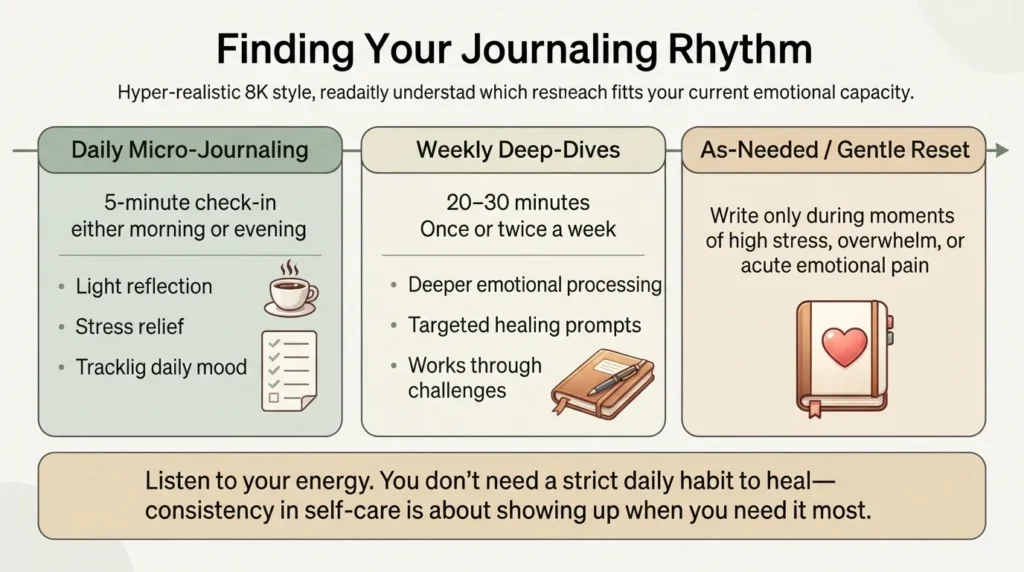
Infographic illustrating different journaling frequencies, from daily check-ins to weekly deep-dives, showing that consistency matters more than perfection.

You don’t need a strict daily routine to make this work. Showing up to write whenever you have the space or the need is more than enough.

Here are a few grounded points to keep in mind as you build your practice:

  • There is no fixed timeline. Healing isn’t linear, and your writing doesn’t have to be either. Some weeks you might feel pulled to write every single day, while other weeks you might not open your notebook at all. Both patterns are completely fine.

  • Aim for two to three times a week. This is a realistic, sustainable starting point for most people. It gives your mind enough space to reflect without making writing feel like another chore on your to-do list.

  • Revisiting the same healing prompts is a sign of growth. You might answer a question today and come back to it six months from now with a completely different perspective. That isn’t useless repetition—it is clear evidence of how much you are evolving over time.

A Quick Reminder on Pacing If a prompt brings up feelings that feel too overwhelming or heavy to sit with on your own, it is okay to close the page. Take a deep breath, step away, and consider talking things through with a therapist or trusted counselor when you feel ready.

When Journaling Isn't Enough — Signs to Reach Out for Support

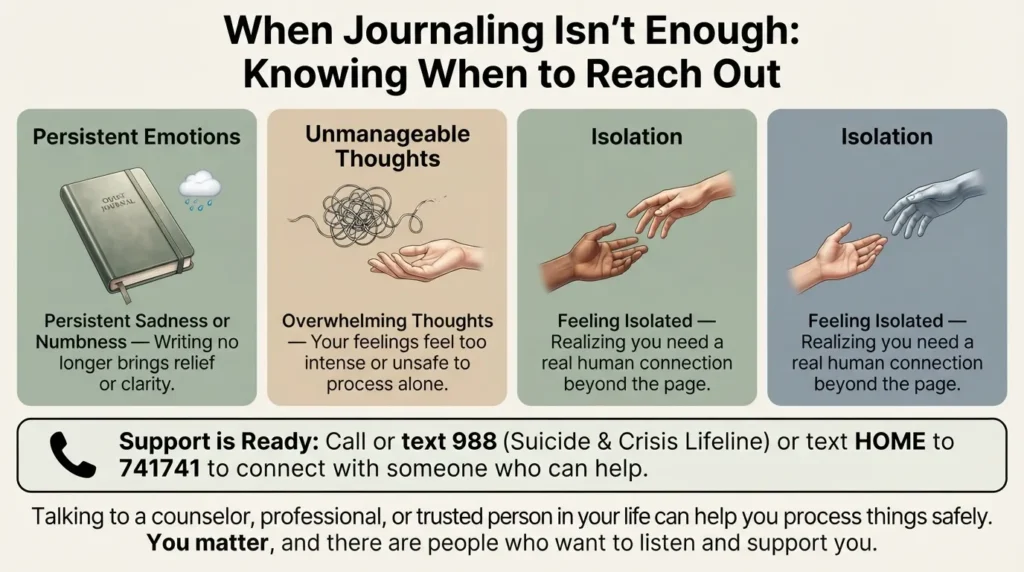
A helpful visual guide listing four key signs that journaling may not be enough, including persistent anxiety, unmanageable thoughts, feeling isolated, and when to contact support resources like the 988 Crisis Lifeline.

Journaling can hold a lot. But it isn’t built to hold everything, and it was never meant to replace real human support. Most of the time, you’ll know the difference between a hard day and something bigger. Here’s what that “something bigger” can look like.

You’ve been feeling persistently sad, anxious, or numb. Not just for an afternoon, but for weeks. If the heaviness doesn’t lift no matter how many pages you fill, that’s worth paying attention to.

Your thoughts feel unmanageable or unsafe. If your mind keeps circling somewhere dark, or you’re scared of your own thoughts, please don’t try to write your way out of it alone. This is exactly the moment to talk to someone.

You feel completely alone with it. Maybe you have people around you, but no one who really knows what’s going on inside. That kind of isolation can make pain feel bigger than it is — and it’s a sign you need a person, not just a page.

If any of this sounds like you right now, please reach out. You can talk to a licensed therapist, or connect with the 988 Suicide & Crisis Lifeline by calling or texting 988, or text HOME to 741741 through Crisis Text Line — both are free, confidential, and available any time, day or night.

Needing more than a journal doesn’t mean you’ve failed at healing. It means you’re paying attention to yourself — which is the whole point of this work in the first place.

Frequently Asked Questions

Not at all. Healing journal prompts aren't about writing well — they're about writing honestly. No one is going to grade your grammar or read over your shoulder. You can write in fragments, ignore punctuation, or repeat yourself. If a prompt makes you pause and actually feel something, it's working, even if the sentences are messy.

Yes. Healing isn't reserved for major, life-defining events. These prompts work just as well for everyday stress, a hard week, a disappointment, or a season of life that just feels off. You don't need a diagnosis or a dramatic backstory to deserve this kind of care. If something is sitting heavy on you, that's reason enough to pick up a pen.

Yes, and it doesn't mean anything has gone wrong. Some prompts stir up feelings you've been holding at a distance, and that can feel heavier for a moment before it feels lighter. Go at your own pace. If a prompt brings up more than you expected, it's okay to put the journal down, breathe, and come back to it another day — or not at all.

Definitely — the two work well together. Journaling can help you notice patterns and put feelings into words between sessions, so you arrive at therapy with more clarity about what you actually want to talk about. Think of it as practice for the conversations you're already having, not a replacement for them.

That happens more than you'd think, and it's not a sign you're doing it wrong. You can simply write "I don't know what to write" and keep going from there — often that honesty opens the door to what's really underneath. Or skip the prompt and come back to it another day. There's no wrong way to sit with a question that doesn't have an easy answer yet.

Final Thoughts: Healing, One Page at a Time

Healing doesn't happen in a single sitting, and it won't happen because you filled every prompt on this page perfectly. It happens in the small, quiet moments where you choose to be honest with yourself instead of looking away. Some days that will look like three full pages. Other days it'll be one sentence, or a single word, and that's still enough.

You don't need to have it figured out to start. You just need a pen, a few quiet minutes, and the willingness to meet yourself where you are — not where you think you should be.

Link copied to clipboard!

Editorial Integrity

Our content is 100% human-written, evidence-backed, and continuously updated to fulfill reader intent with maximum honesty.

Daily Mindset Shift

"Small, consistent habits compounded over time create unshakeable momentum."

Leave a Comment