Jump to:
ToggleJournal Prompts for Teens: 100+ Prompts to Build Self-Awareness, Calm, and Confidence
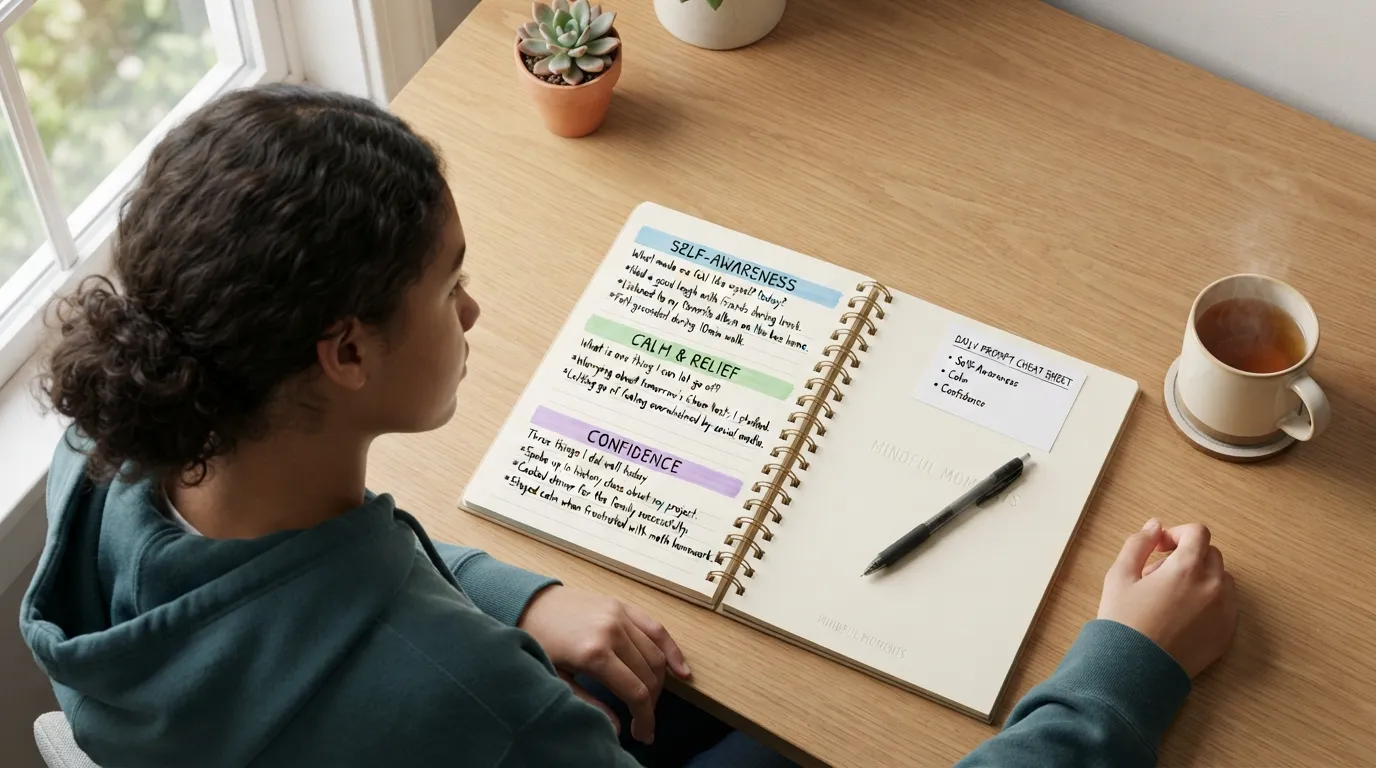
Staring at a totally blank page, pen hovering, mind completely empty—or maybe way too full—is completely normal. Most days, trying to figure out what you actually feel like writing down is harder than the actual writing part.
That’s where journal prompts for teens come in: simple, targeted questions that take the guesswork out of writing and give your chaotic thoughts a clear place to land.
Inside this guide, you’ll find over a hundred realistic, mood-based prompts built specifically for middle and high school life—plus a free downloadable PDF you can print out whenever you need it. Whether you want to blow off steam after a rough day, figure out who you are outside of your friend group, or just quiet a racing mind before bed, there’s something here for you.
While jotting things down in a notebook is a solid way to process tough emotions and build daily calm, it isn’t a silver bullet. Journaling works best as a personal tool for self-reflection and emotional regulation, but it isn’t a replacement for professional therapy if you’re dealing with heavy mental health challenges. Think of it as a low-pressure space to check in with yourself—no grades, no judgment, and zero expectations.
Why Journal Prompts for Teens Matter Not Just Another To-Do
Let’s be honest: your calendar is probably already jammed with homework, sports practice, household chores, and endless notifications. The last thing you need is another item on your daily checklist that feels like homework.
Journaling isn’t meant to be a chore you check off to make adults happy. When done right, it’s actually one of the few places in your life where there are zero rules, no grading rubrics, and nobody watching.
What Journaling Actually Does for a Teen Brain
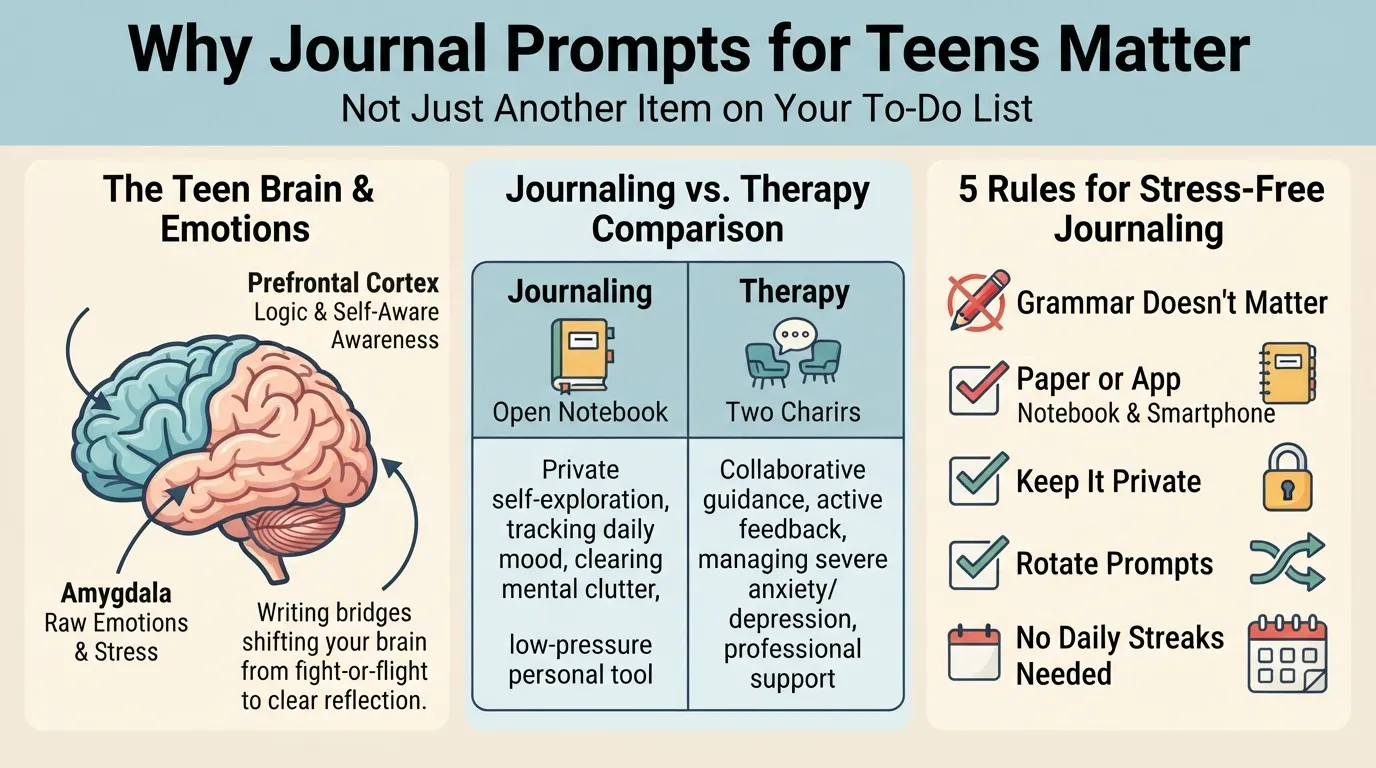
During the teenage years, your brain is going through a massive construction project. The prefrontal cortex—the region responsible for planning, self-awareness, and processing complex emotions—is still under development. Meanwhile, the amygdala, which handles raw emotional reactions, is running at full speed.
When you write down what’s happening inside your head, you bridge that gap. Turning vague, heavy feelings into specific words forces your brain to step back, slow down, and organize the noise. It shifts you out of a reactive “fight-or-flight” state and gives you a chance to name what you’re experiencing. You aren’t just venting; you’re building genuine emotional muscle and learning how to respond to stress instead of just reacting to it.
Journaling vs. Therapy — What’s the Difference
It helps to know what a journal can—and can’t—do for you.
Journaling is self-exploration. It’s a private tool for working through everyday stress, clearing mental clutter, and tracking your personal growth. It gives you a safe mirror to reflect on your day and figure out how you feel on your own terms.
Therapy is a collaborative process. A therapist is a trained professional who provides active feedback, helps you navigate complex psychological patterns, and works directly with you to manage severe anxiety, depression, trauma, or crisis situations.
Think of journaling as maintaining your own mental garden: it keeps things tidy and helps you understand what’s growing. But if a storm damages the foundation, you bring in a professional builder. Writing things down can complement therapy beautifully, but it shouldn’t be relied on as a substitute for professional mental health support when things feel too heavy to carry alone.
How to Actually Start — and Keep It Going
You don’t need a golden pen, a fancy leather binder, or an aesthetic desk setup to do this right. Here is how to make the habit stick without making it feel like work:
Forget proper grammar and spelling. Nobody is marking this with a red pen. If you want to write in sentence fragments, use bullet points, or throw in slang, do it. The goal is expression, not neatness.
Paper or digital? Pick what feels right. An old spiral notebook works great because it keeps you away from screens. But if typing in a password-protected notes app or password-locked document feels safer or easier, go with that.
Protect your privacy. If you’re constantly worried someone might read your pages, you won’t be honest. Keep physical notebooks hidden in a drawer or use a secure digital app with a passcode.
Rotate your prompts. Don’t force yourself to answer the same heavy question every night. Mix it up—use a deep reflection prompt on Sunday evening, and a quick, lighthearted one-liner on a tired Tuesday.
Ditch the daily streak pressure. You don’t have to write every single day for this to be valuable. Skip three days? No problem. Pick it up when you actually need it or when you have ten quiet minutes to spare.
Journal Prompts for Teens by Category
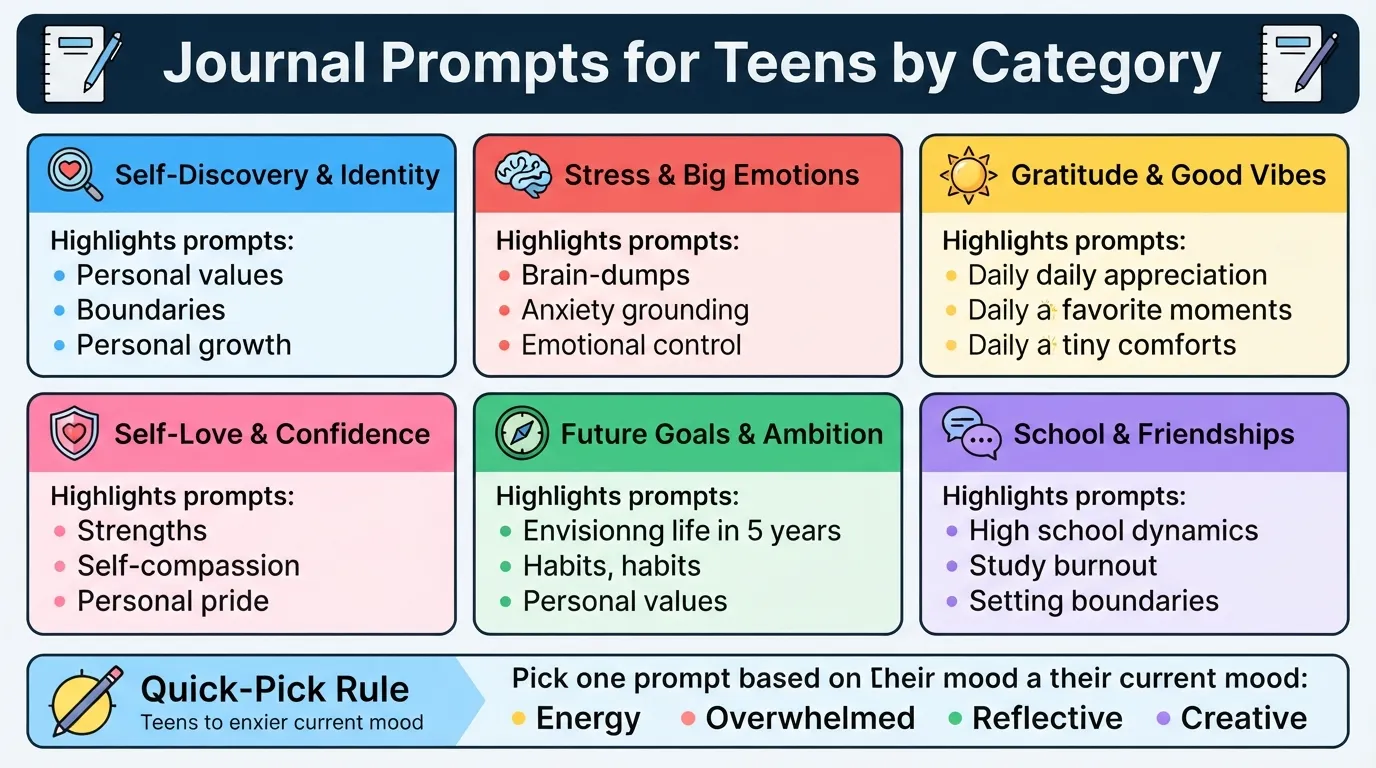
When you open a journal, you don’t need to write a full-length essay about your whole life. The best approach is picking a section that matches your mood right now. Browse through these categories and grab whatever prompt stands out to you today.
Self-Discovery & Identity Journal Prompts
Understanding who you are—outside of your friend group, family expectations, or social media profile—takes time. These prompts help you map out your internal world.
What are three things you genuinely like about yourself that have nothing to do with your looks or school marks?
Describe a moment recently when you felt completely like yourself. What were you doing, and who were you with?
If you could guaranteed succeed at one new skill or hobby, what would you try tomorrow?
What is a personal belief or opinion you hold that you’ve never shared out loud?
When do you feel the most drained, and what is usually causing that energy drop?
Write down three qualities you value most in a close friend. Do you show those same qualities to others?
What is a boundary you wish you could set with someone in your life right now?
If your current personality had a signature song or visual aesthetic, what would it look like?
What is something you used to care deeply about a year or two ago that just doesn’t matter to you anymore?
Managing Stress, Anxiety & Big Emotions
When your mind feels crowded or overwhelming, putting those thoughts onto paper strips them of their power.
What is one thing stressing you out today that is entirely beyond your control?
Why this helps: It visually separates what you can actually fix from what you need to let go of.
Write down every single thought in your head right now for three minutes straight without stopping to edit.
Why this helps: Acts as a mental brain-dump to lower immediate sensory and emotional overload.
Describe your anxiety as if it were an annoying character or a bad weather condition.
Why this helps: Externalizes the feeling so you realize you have anxiety, but you are not your anxiety.
What is the worst-case scenario you’re worrying about, and what is the most realistic scenario?
Why this helps: Directly challenges the brain’s natural tendency to catastrophize difficult situations.
List five things you can see, four you can touch, three you can hear, two you can smell, and one you can taste.
Why this helps: A classic sensory grounding technique that pulls you out of a panic loop back into the present moment.
When you feel overwhelmed, what is one physical sign your body gives you first?
Why this helps: Builds body awareness so you can spot rising stress before it turns into a full burnout.
Write a brief letter of advice to a younger kid who is going through the exact stress you’re feeling right now.
Why this helps: Shifts your perspective from helpless victim to an empowered problem-solver.
What is one small, realistic comfort you can give yourself in the next two hours?
Why this helps: Focuses your attention on immediate self-soothing rather than overwhelming long-term fixes.
For trusted, evidence-based guidance on managing persistent anxiety or understanding teen emotional development, exploring resources from the Child Mind Institute can offer deeper support alongside your daily writing practice.
Gratitude Journal Prompts for Teens
Gratitude isn’t about ignoring life’s problems or pretending everything is perfect. It’s simply training your brain to notice the small good things happening alongside the chaos.
Name a simple, everyday object in your bedroom that makes your life easier or more comfortable.
Who is one person at school or home who made you smile this past week, and what did they do?
Write down a recent mistake or failure that actually taught you something valuable.
What is a favorite song, show, or game that consistently puts you in a better mood?
Describe a delicious meal or snack you ate recently—focus on the taste, texture, and smell.
What is one physical ability or sense you often take for granted?
List three tiny conveniences today that made your life just a bit easier (like good Wi-Fi, a green light, or a warm shower).
What is something nice about your current home environment or local neighborhood?
Self-Love & Confidence Journal Prompts
Self-confidence grows when you start treating yourself with the same kindness you extend to a good friend. Use these to build a healthier internal monologue.
Write down three compliments you wish someone would give you today—then say them to yourself.
What is a challenge you faced in the past six months that you handled better than you expected?
Complete this sentence and write a paragraph on it: “I am proud of myself for…”
How do you typically talk to yourself when you mess up? How can you change that voice to be kinder?
List three personal strengths that make you a resilient person during tough situations.
What is something unique about your background, culture, or story that makes you who you are?
Write down a recent time you stood up for yourself or spoke your mind, even if your voice shook.
If you truly stopped caring about other people’s judgment for one week, what would you wear or do differently?
Future Goals & “Who Do I Want to Become” Prompts
You don’t need your whole life mapped out today. These prompts help you explore your potential without the pressure of rigid long-term decisions.
Describe your ideal weekend day five years from today. Where are you, and who is with you?
What is a topic or cause you could talk about for an hour without getting bored?
Name one habit you want to start building this month, and why it matters to you.
If money and grade point averages were not an issue, what career path would you explore?
What is one place in the world you want to visit before you turn 25, and what draws you there?
Write down three small actions you can take this week to move closer to a personal goal.
Who is someone you look up to, and what specific character traits do they have that you admire?
How do you want people to feel after spending time hanging out with you?
School, Friendships & Everyday Life Prompts
Navigating high school social dynamics and academic pressure can be exhausting. Use these prompts to work through the daily grind.
What is the hardest part about being a high school student right now?
Describe your favorite memory with a friend or group of friends from this past year.
Is there a friendship in your life that feels unbalanced right now? Describe what feels off.
What subject or class challenges you the most, and what is one way you can make it more manageable?
How do you handle feeling left out or excluded, and what helps you reset afterward?
Write about a time you had a misunderstanding with a teacher, parent, or friend. How was it resolved?
What is your favorite way to decompress right after a long school day ends?
What is one rule at school or home that you disagree with, and what is your logical argument against it?
Creative & Fun Journal Prompts for Teens
Writing shouldn’t always feel heavy or serious. When you just want to loosen up, try these imaginative warm-ups.
If you were granted three wishes, but none of them could involve money or physical possessions, what would you wish for?
Design a fictional secret room hidden inside your house. What does it look like, and what’s inside?
If you could swap lives with any fictional character for 24 hours, who would it be and why?
Write a short, funny dialogue between two everyday items in your backpack.
If you were tasked with building a brand-new holiday from scratch, what would people celebrate and how?
If you had to survive a sudden zombie apocalypse with only the items currently on your desk, how long would you last?
Write a review of your life this past month as if it were a newly released movie or video game.
Quick Morning & Nighttime Mini-Prompts
For days when you have zero energy, low motivation, or just a few minutes before the bus arrives or lights go out.
Morning: What is my main goal or priority for today?
Morning: What is one thing I am looking forward to over the next twelve hours?
Morning: One word I want to define my attitude today is…
Nighttime: What was the best part of my day, even if it was tiny?
Nighttime: What is one thing I can let go of before I fall asleep tonight?
Nighttime: How does my body feel right now on a scale of 1 to 10, and why?
Journal Prompts for Teens by Age 13-14 vs. 15-18
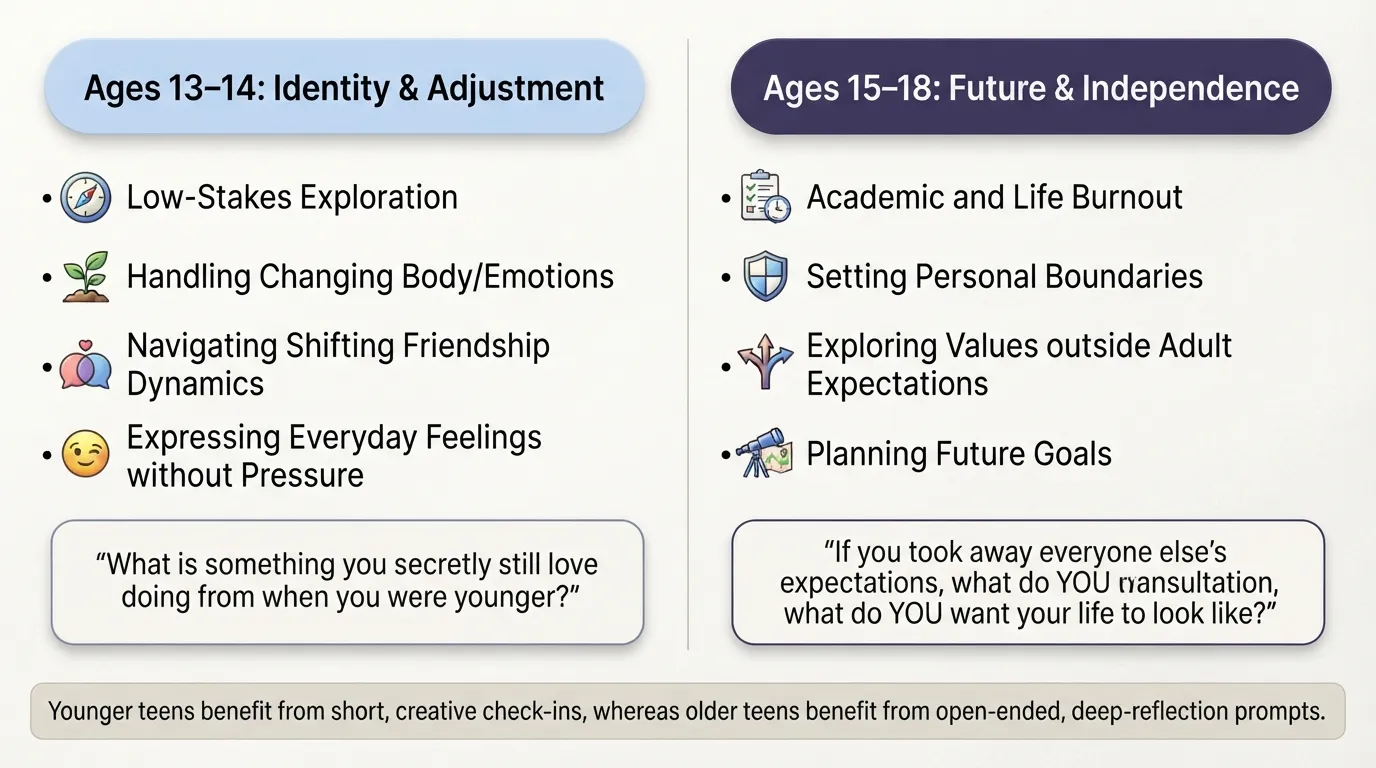
A 13-year-old starting middle school is dealing with completely different daily realities than an 18-year-old preparing for college or entering the workforce. While mood-based prompts work great when you’re looking for a specific vibe, age-tailored prompts meet you right where your brain and social life are at this exact stage.
Middle School (Ages 12-14) — Lower-Stakes, Identity-Exploration Prompts
Early adolescence is all about sudden changes—your body, your friendship groups, and your place in school are all shifting at once. Prompts for this age group focus on low-pressure self-discovery, helping you figure out what you like, how to manage new social dynamics, and how to stay grounded when everything feels a bit awkward.
What is a physical or emotional change you’ve noticed in yourself over the past year that surprised you?
Write about a time a friend group shifted or changed. How did you handle it, and how did it make you feel?
If you could change one thing about your school day to make it less stressful, what would it be?
What is something you secretly still love doing from when you were younger, even if you don’t talk about it much?
Describe your idea of a perfect, zero-stress weekend from start to finish.
Who is one adult (a teacher, relative, or coach) you feel safe talking to when things get confusing?
What is a rule at home or school that feels unfair to you right now, and why?
Write down three small things that instantly put you in a good mood after a long day.
High School (Ages 15-18) — Deeper, Future-Facing Prompts
Older teens face a different level of intensity: driver’s licenses, bigger academic loads, complex relationships, and the constant, echoing question of “what’s next?” These prompts lean into deeper self-reflection, boundary-setting, and sorting out your own values as you prepare for independence.
What is one major expectation people (parents, teachers, society) have of you that feels heavy to carry?
If you took away everyone else’s opinions, what do you actually want your life to look like in three years?
Write about a time you had to make a tough choice between doing what was popular and doing what felt right.
What does genuine independence mean to you, and in what area of your life do you want more of it right now?
Describe a healthy boundary you need to set in a relationship, friendship, or family dynamic.
What is a belief or political/social opinion you used to hold that has changed as you’ve gotten older?
How do you handle failure or falling short of a goal, and how can you treat yourself better when it happens?
Write a letter to your 13-year-old self telling them what you’ve learned and reassurance that they’ll make it through.
Free Printable Journal Prompts for Teens PDF
Sometimes you just want to put your phone in another room, grab a pen, and write without a screen glaring back at you. Having a physical cheat-sheet tucking into your notebook makes it effortless to jump straight into writing whenever you get a free minute.
We’ve put together a clean, distraction-free Printable Journal Prompts Sheet (PDF) featuring our top 50 most popular prompts grouped by mood and category. It’s formatted to print perfectly on a single standard page—ideal for folding into your favorite journal, taping inside your locker, or keeping on your desk.
📄 Download Your Free Prompt Sheet
Get the quick-reference text version with all 50 targeted prompts for quick morning check-ins and evening brain-dumps.
Download Free Prompt Sheet (.TXT)Instant download • No email required • Easy to print or copy
A Note for Parents Searching This for Their Teen
If you’re reading this page hoping to help your son or daughter navigate stress, anxiety, or high school burnout, you’re already doing something right. Journaling is a remarkably effective tool for adolescent emotional growth, but how it’s introduced makes all the difference between a helpful outlet and an unwelcome chore.
Here is how you can support your teen’s writing practice without pushing them away:
Introduce it as a resource, not an assignment. Offer a nice notebook or share a few prompts casually, but avoid making journaling a mandatory daily routine. The moment it feels like homework, most teens will mentally check out.
Protect their privacy fiercely. A teen will only be honest on paper if they know nobody is reading over their shoulder. Unless you have a genuine reason to fear for their immediate safety, resist the urge to look through their notebook—even when they leave it lying on the desk.
Focus on the tool, not the contents. Instead of asking “What did you write about today?”, try asking “Did writing things down help clear your head a bit?” This respects their personal space while still showing you care about their emotional well-being.
Know when to bring in professional support. Journaling is a fantastic tool for day-to-day emotional regulation, but it isn’t a substitute for mental health treatment. If your teen is showing persistent signs of clinical depression, severe anxiety, self-harm, or drastic behavioral changes, use writing as a helpful side habit while connecting them with a licensed counselor or psychologist.
Frequently Asked Questions
What's a good first journal prompt for a teen who's never journaled before? +
Are journal prompts good for teens with anxiety? +
How often should a teenager journal? +
Is it better for teens to journal on paper or an app? +
What if my teen doesn't want to share what they wrote? +
Final Thoughts — Your Journal Is a Judgment-Free Space
At the end of the day, there is no right or wrong way to use these prompts. Your journal doesn’t care about perfect handwriting, neat spelling, or whether you write three pages or three quick sentences. It’s simply a quiet, low-pressure outlet meant to help you unload stress, figure out what you want, and understand yourself a little better every week.
Whenever your mind feels a bit too full, come back, pick a single question that fits your vibe, and give yourself five minutes to just write.
If you’re looking to explore more ways to build healthy daily habits, manage school burnout, or simplify your self-care routine, take a look through our other guides on Holistic Wellbeing Living.
Pimchanok Srisuk
Pimchanok Srisuk is the Journaling Editor at Holistic Wellbeing Living. She writes about journaling prompts, reflective writing, emotional clarity, and mindful routines. With seven years of experience creating personal-growth content, Pimchanok helps readers use simple writing practices to understand their thoughts and make calmer everyday decisions.