Jump to:
ToggleWhat Is Journal Writing? A Complete Guide (Meaning, Types & How to Start)
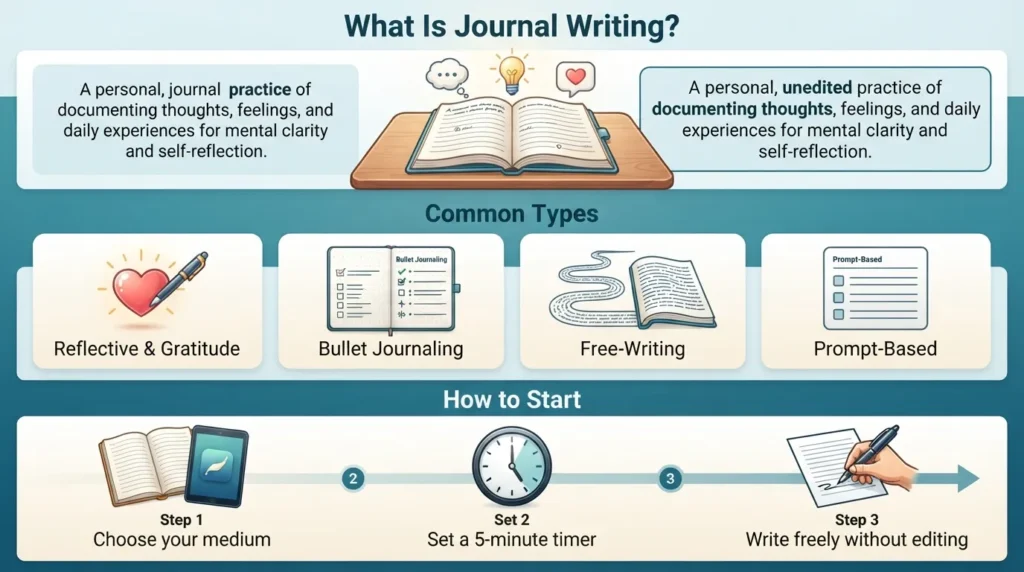
Journal writing is the practice of recording your private thoughts, feelings, memories, and daily experiences on paper or digitally. It is a simple, personal tool that gives your mind a quiet space to process emotions, track goals, and organize messy ideas.
Getting your thoughts out of your head and onto the page gives you mental clarity and cuts through daily stress. This guide breaks down what journal writing means, why it works so well, the main types you can try, and how to build a habit that actually sticks.
What Is Journal Writing?

Journal writing is the act of regularly recording your thoughts, feelings, observations, and experiences in a notebook or digital space. It gives your mind a private place to unload whatever is going on inside your head without judgment.
Unlike a school essay or a work report, the core purpose of journal writing is reflection, not performance. You do not have to worry about proper grammar, perfect spelling, or neat handwriting. Nobody else ever has to read it.
Journaling is for anyone who wants a clearer mind. There are no strict rules you have to follow, no minimum word counts, and no wrong way to do it.
Journal Writing vs Diary Writing (What's the Difference?)

People often use the terms "journal" and "diary" interchangeably, but they serve slightly different purposes. Here is a quick breakdown of how a journal compares to other forms of writing:
| Writing Type | Main Purpose | Primary Audience | Typical Formality |
|---|---|---|---|
| Journal | Reflecting on thoughts, feelings, and personal growth | Just yourself | Informal and flexible |
| Diary | Tracking daily events and routine activities | Just yourself | Informal and sequential |
| Blog | Sharing information, opinions, or stories online | Public readers | Semi-formal to conversational |
| Essay | Proving a point or analyzing a specific topic | Teachers or academic peers | Formal and structured |
Key Differences to Keep in Mind
- Purpose: A diary mostly records what happened during your day (e.g., "I went to the store and ate pasta"). A journal explores how you felt about what happened (e.g., "I felt overwhelmed at the store today because it was so crowded").
- Frequency: Diaries are usually updated daily. Journals can be written in daily, weekly, or whenever you feel the need to process something.
- Audience: Both journals and diaries are strictly private, whereas blogs and essays are created for other people to read.
- Formality: Journals let you write in freeform fragments or bullet points, while essays require strict structure and polished language.
Why Do People Write Journals? (Purpose & Benefits)
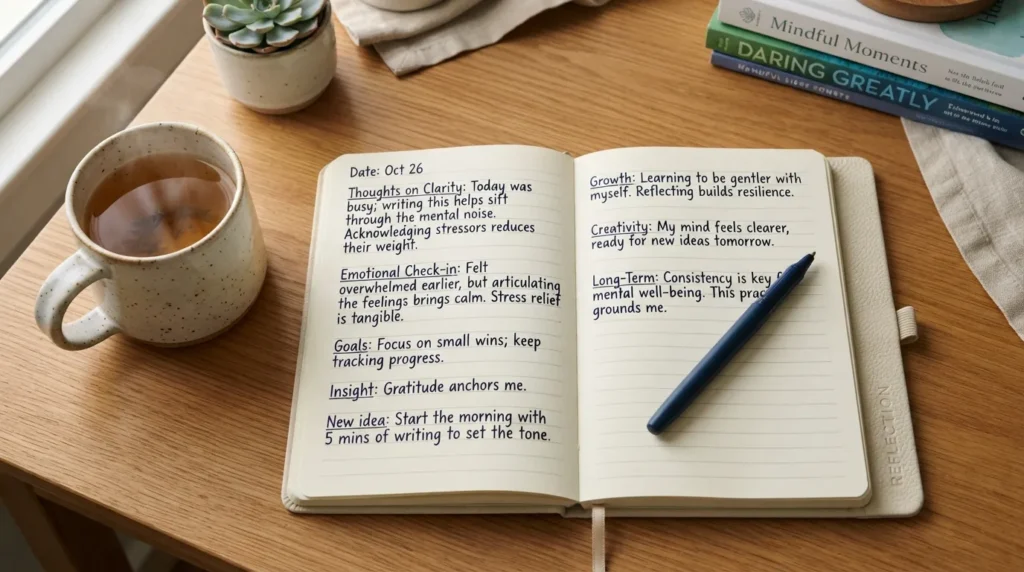
Mental & Emotional Benefits
Relieves daily stress: Writing out your worries gets them out of your head and onto paper, which keeps them from looping continuously in your mind.
Processes heavy emotions: When you feel angry, sad, or confused, writing helps you name the emotion and work through it safely.
Reduces anxiety: Putting a vague sense of dread into specific words makes the problem feel smaller and easier to handle.
Academic & Professional Benefits
Builds writing fluency: The more often you write without worrying about mistakes, the faster and easier words will flow when you have to write formal papers.
Sharpen critical thinking: Freeform writing helps you connect different ideas, spot gaps in your logic, and analyze problems from new angles.
Improves communication skills: Practice expressing your inner thoughts clearly on paper makes it easier to speak your mind clearly in real life.
Personal Growth Benefits
Tracks long-term patterns: Looking back at older entries helps you notice repeating habits, triggers, or personal growth you might have otherwise missed.
Strengthens memory: Writing down details about your life helps lock key memories and lessons into your mind for years to come.
Boosts self-awareness: Regular reflection acts like a mirror, helping you figure out what you actually care about versus what others expect from you.
Types of Journal Writing (With Examples)
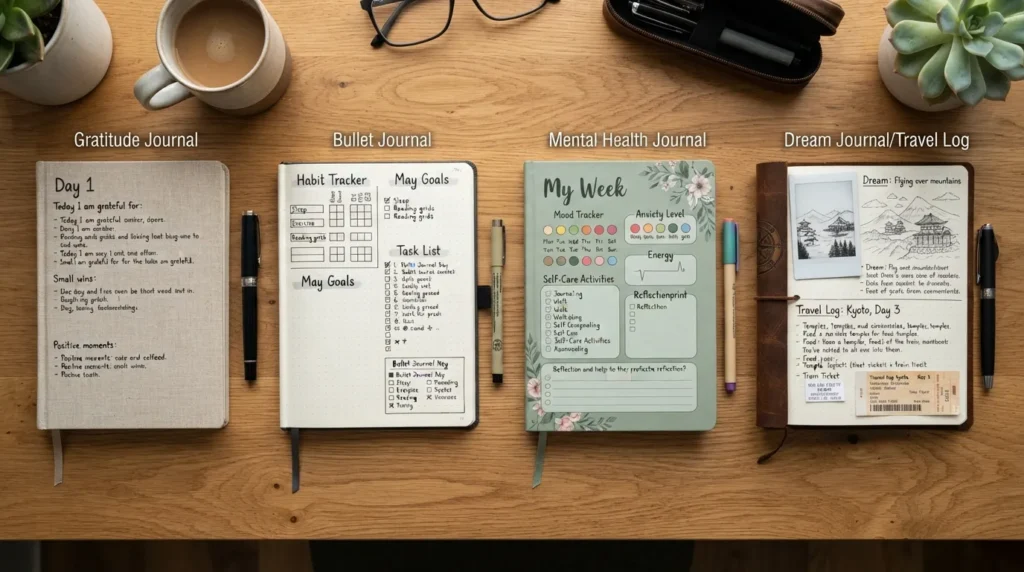
Personal Diary Journal
A personal diary is a private space where you write down your daily thoughts, feelings, and events to process your life.
Example Entry: Today was overwhelming at work. My boss moved the deadline up, and I felt my chest tighten instantly. I took a walk at lunch to clear my head, which helped a little.
Gratitude Journal
A gratitude journal focuses entirely on listing the good things in your life to help shift your mindset toward appreciation.
Example Prompt: Name three small things that brought you peace today, even if the rest of the day felt chaotic.
Bullet Journal (Ryder Carroll method)
Created by Ryder Carroll, this rapid-logging system uses symbols, short notes, and lists to organize your tasks, habits, and thoughts in one place.
Example Entry: [•] Submit project draft by 3 PM | [X] Call dentist | [>] Move budget review to tomorrow | [–] Thought: Need to take more regular breaks.
Stream-of-Consciousness / Morning Pages
This style involves writing down every single thought that pops into your head without stopping, editing, or worrying about making sense.
Example Entry: I don’t know what to write. My hands are cold. I need more coffee. Why did I dream about my old middle school? My back aches a bit today.
Prompt-Based Journal
This method uses specific questions or statements to guide your writing when you don’t know what to talk about.
Example Prompt: What is one fear holding you back right now, and what is the absolute worst thing that would happen if it came true?
Academic / Reflective Journal (college assignment style)
Used often in school or training, this format asks you to link personal experiences or real-world events directly to concepts you are studying.
Example Entry: During group work today, I noticed our team struggled with active listening. This directly mirrors the communication barriers discussed in Chapter 4.
Dream Journal
A dream journal is kept right by your bed so you can write down your dreams the moment you wake up before you forget them.
Example Entry: I was standing on top of a giant clock tower, but the hands were spinning backward. Then my old dog appeared and led me down a endless flight of stairs.
How to Start Journal Writing (Step-by-Step)
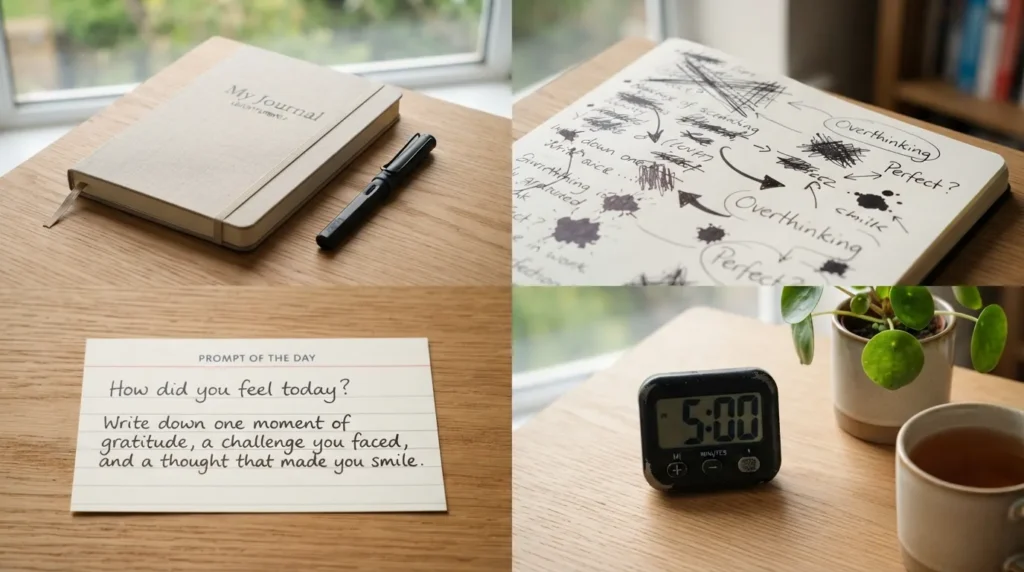
Pick your format: Choose between a physical paper notebook or a digital app on your phone or computer. Go with whichever feels easiest to open every day.
Set a small time limit: Start with just 3 to 5 minutes a day. Keeping it short prevents you from feeling overwhelmed before you even begin.
Attach it to a trigger: Pair your new journaling habit with an existing daily routine, like drinking your morning coffee or winding down right after brushing your teeth.
Use a simple prompt: If you stare at a blank page, ask yourself one quick question: “How am I feeling right now, and why?”
Follow the no-editing rule: Never worry about spelling, grammar, or neat handwriting. Write purely to get thoughts out of your head, not to impress anyone.
Focus on consistency over length: Writing two sentences every single day is much better than writing five pages once a month.
Common beginner mistakes to avoid:
Trying to be perfect: Treating your journal like a graded paper instead of a mess-friendly scratchpad.
Overcommitting too early: Forcing yourself to write for 30 minutes daily right out of the gate.
Buying fancy supplies first: Spending money on expensive notebooks before building the actual habit.
Censoring your true feelings: Holding back what you actually think because you worry someone else might read it.
Popular Journaling Methods
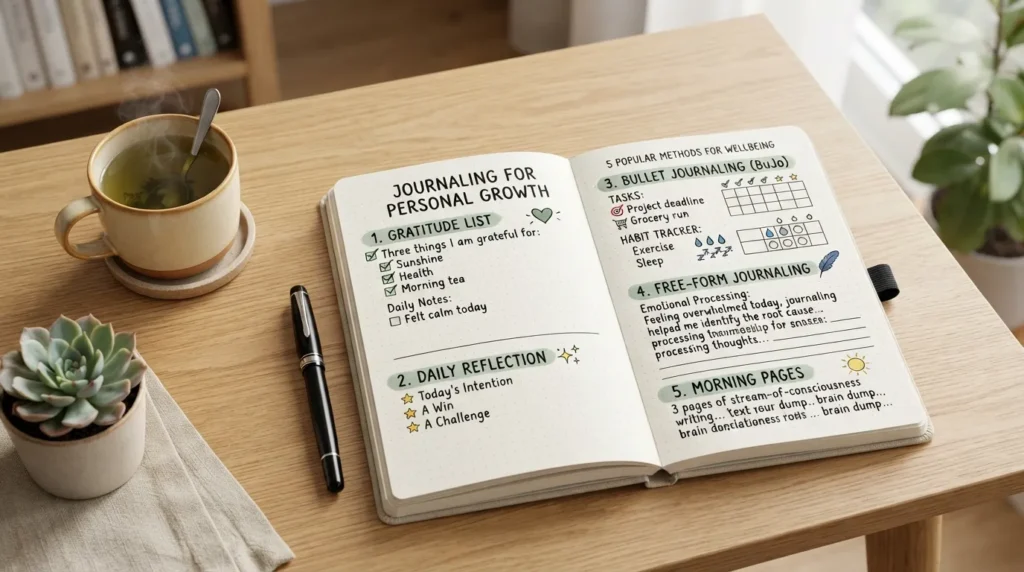
3-3-3 Method
This quick framework keeps things manageable by having you write down 3 things you are grateful for, 3 goals for the day, and 3 things holding your focus back.
5-Minute Journal
A structured morning and evening routine where you answer brief questions about gratitude, daily goals, and personal growth in under five minutes.
Morning Pages
Popularized by Julia Cameron, this habit requires you to fill three full pages of longhand, unfiltered writing first thing every morning.
Prompt-Based Method
A flexible approach where you rely entirely on premade questions or topics to kickstart your daily writing session.
Which method fits your goal?
For stress relief: Morning Pages or Stream-of-Consciousness work best because they let you dump all mental chatter directly onto the page.
For habit-building: The 5-Minute Journal or 3-3-3 Method offer quick, easy structures that take almost no time to finish.
For creativity: Prompt-Based Journaling pushes your brain out of its normal thought patterns and into new ideas.
Journal Writing for Students and Kids

Journal Writing for Students
In the classroom, journal writing is more than just a quiet activity. Teachers use it as a tool for reflective writing, giving students a safe space to process what they learn. Instead of worrying about correct grammar or neat handwriting, students use exploratory writing to work through complex topics in their own words.
It also encourages critical inquiry. By writing about a history lesson or a book chapter, students ask questions, challenge ideas, and form their own opinions.
Journal Writing for Kids
For younger children, journal writing keeps things simple. A child might draw a picture of their day and write just one sentence underneath it to explain what happened.
For English Language Learners (ELLs), teachers often use a dialogue journal. The student writes a short entry, and the teacher writes back with a friendly response. This builds real communication skills without making the child feel tested or judged.
What Journal Writing Is NOT
Not the same as essay writing: There are no grades, strict outlines, or rubrics. You do not need an introduction or a conclusion.
Not the same as a to-do list: A to-do list tracks tasks you need to finish. A journal tracks thoughts, feelings, and experiences.
Not required to be daily or long: You do not have to write every single day, and you do not need to fill pages. A few sentences once or twice a week is enough.
The Dark Side of Journaling (Common Mistakes)

Rumination trap: Replaying a bad event on paper over and over can make you feel worse instead of better.
The fix: Switch from writing about what happened to writing about what you can learn or do next.
Turning it into a chore: Forcing yourself to write when you really do not want to turns a helpful tool into a stressful task.
The fix: Give yourself permission to skip days or write just one bullet point.
Venting without reflection: Screaming on paper feels good in the moment, but it can leave you stuck in anger.
The fix: After venting, ask yourself: “Why did this bother me so much?”
What Psychologists Say About Journaling
Decades of research on expressive writing show that putting painful or chaotic thoughts into words helps lower stress and clear mental space. According to the American Psychological Association, writing about your feelings helps your brain process emotions so you do not carry them around all day.
Psychologists view journaling as an active way to move thoughts out of your head and onto paper where you can deal with them logically.
Frequently Asked Questions
What is an example of journal writing?
An example of journal writing is writing down three things you are grateful for today, along with a few lines about why a difficult work task made you feel stressed.
How do I start writing my journal?
Grab a notebook and a pen, set a timer for three minutes, and write down whatever comes to mind without stopping to edit yourself.
What is the 3-3-3 journaling method?
The 3-3-3 journaling method means writing down 3 things you are grateful for, 3 things you want to accomplish today, and 3 things you want to let go of.
What is the dark side of journaling?
The dark side of journaling happens when you use your notebook to constantly relive negative experiences, which can increase stress instead of relieving it.
What do psychologists say about journaling?
Psychologists state that expressive writing helps reduce mental anxiety, improves emotional regulation, and helps people process difficult life events.
How long should journaling take?
Journaling should take anywhere from 5 to 15 minutes per session, depending on how much time you have and how much you want to say.
Why do people avoid journaling?
Many people avoid journaling because they fear someone else will read it, worry about writing “incorrectly,” or feel they do not have enough spare time.
What is the 3/2-1 method of journaling?
The 3/2/1 method involves writing down 3 things you observed, 2 things you learned, and 1 question you still have about your day or a specific topic.
What happens in the brain when journaling?
Writing about your feelings reduces activity in the amygdala—the brain’s fear center—and activates the prefrontal cortex, which handles logic and self-control.
Is it healthy to journal daily?
Yes, daily journaling is healthy as long as it feels supportive and does not turn into an overwhelming chore or a place to obsess over problems.
What is journal writing for students?
For students, journal writing is an informal way to process classroom material, ask questions, and practice creative and critical thinking without the pressure of grades.
What is journal writing for kids?
For kids, journal writing is an easy activity combining simple drawings and basic sentences to help them express their feelings and practice communication.
What is journal writing in English (as a subject/skill)?
In English classes, journal writing is an ungraded exercise used to build writing fluency, expand vocabulary, and help students express personal ideas comfortably.
Pimchanok Srisuk
Pimchanok Srisuk is the Journaling Editor at Holistic Wellbeing Living. She writes about journaling prompts, reflective writing, emotional clarity, and mindful routines. With seven years of experience creating personal-growth content, Pimchanok helps readers use simple writing practices to understand their thoughts and make calmer everyday decisions.