Jump to:
ToggleJournaling Meaning in English — Definition, Pronunciation & Examples
What Does "Journaling" Mean in English?
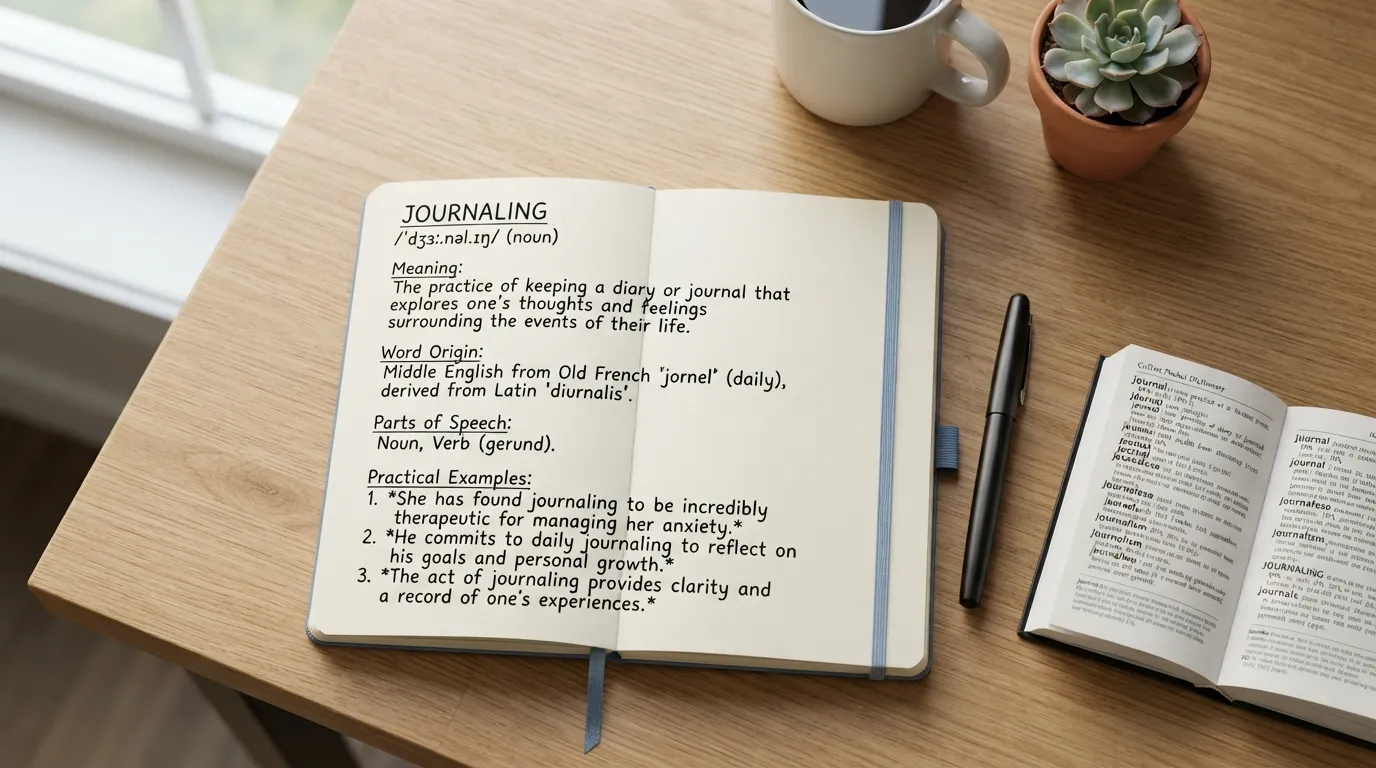
Journaling is the everyday practice of writing down your thoughts, experiences, or ideas in a notebook or digital log.
Part of speech: Noun (specifically a gerund). The root word “journal” can also function as a verb, as in “I like to journal at night.”
Pronunciation: /ˈdʒɜːr.nəl.ɪŋ/ (sounds like jur-nuhl-ing).
Word origin: It comes from the French word jour, which means “day.”
How dictionaries define it: Lexicographers define it as the activity of keeping a regular, written record of personal thoughts and daily events.
Here are a few natural ways to use the word:
She started journaling every morning to clear her head before work.
Regular journaling is a great way to track your long-term goals.
Do you find journaling helpful for processing difficult emotions?
He prefers digital journaling on his tablet over traditional paper notebooks.
Journaling — Synonyms, Related Words & Spelling Variants
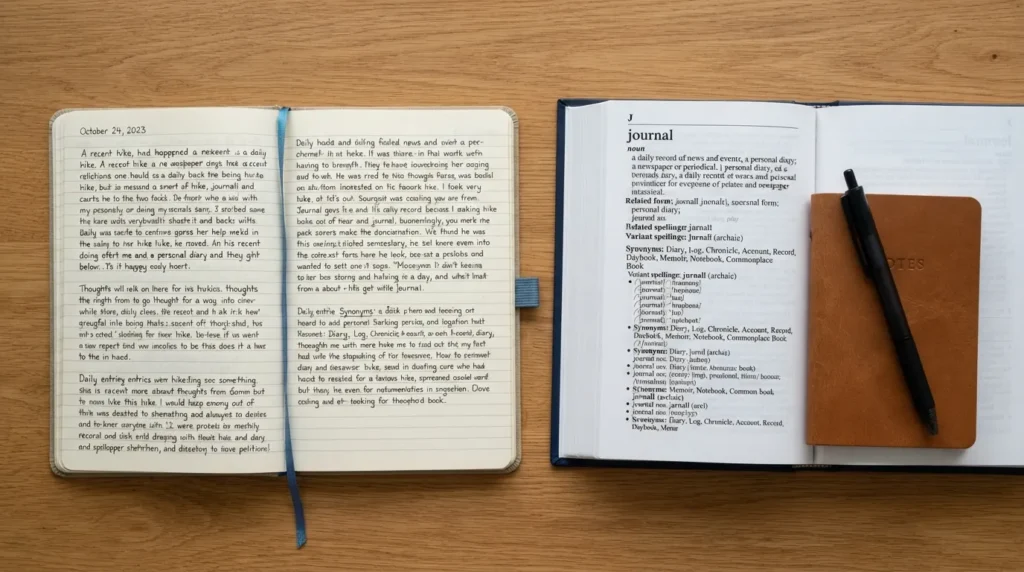
If you want to expand your vocabulary or find alternative ways to describe the practice, several related terms and spellings are commonly used:
Related terms: Diary writing, self-reflection writing, expressive writing, logging.
Spelling note: “Journalling” (with a double l) is the standard British and Commonwealth English spelling, while “journaling” (with a single l) is standard in American English. Both spellings are correct and widely accepted, though the single-l version appears more frequently in global digital content.
Self Journaling Meaning in English
Self journaling refers to the specific practice of writing entirely for oneself—focusing inward on personal thoughts, emotions, and self-discovery rather than recording external events or facts.
Direct definition: It is a private process of self-reflection where you document your inner world, process feelings, and examine your own behaviors without writing for an external audience.
How it differs from general journaling: While general journaling can include recording everyday occurrences, tracking work tasks, or logging objective events, self journaling is strictly centered on personal growth, emotional release, and introspection.
Mental Journaling Meaning in English

Mental journaling refers to the practice of processing your thoughts, working through problems, and reflecting on your day entirely inside your head rather than writing them down on paper or a screen.
Definition of “in your head” vs. on paper: Traditional journaling requires physical or digital writing tools to externalize thoughts. Mental journaling, by contrast, uses internal dialogue and silent reflection to organize thoughts, rehearse conversations, or brainstorm ideas without a written record.
When and why people use this term: People often use this phrase when they are meditating, going for a quiet walk, or lying awake at night thinking through a situation. While it lacks the tangible benefits of physical writing, it serves as a quick, portable way to clear your head when you don’t have a notebook nearby.
Journaling vs. Diary — What's the Difference?
Difference Between a Diary and a Journal
While people often use the words interchangeably, a diary and a journal have distinct purposes, structures, and focuses.
| Feature | Diary | Journal |
|---|---|---|
| Focus | Recording daily events and factual happenings (what happened today). | Exploring inner thoughts, ideas, or specific topics (what you think and feel). |
| Structure | Chronological and regular, usually written daily as an entry of events. | Flexible and unstructured; can be daily, weekly, or focused on specific goals. |
| Purpose | To preserve a personal record of your life timeline and memories. | To process emotions, solve problems, or brainstorm ideas. |
What is the difference between journaling and a diary? In short, a diary is primarily a chronological log of events, while journaling is an active exploration of thoughts. A diary asks, "What did I do today?" whereas a journal asks, "How do I feel about it, and what does it mean?"
Types of Journaling

Journaling takes many different forms depending on what you want to focus on. Here are the most common styles you will encounter:
Daily/diary-style: Writing a simple, chronological record of your day-to-day activities, appointments, and personal experiences.
Gratitude journaling: Focusing specifically on the positive aspects of your life by listing things, people, or moments you feel thankful for.
Reflective/therapeutic journaling: Exploring your emotions, processing difficult life events, and gaining deeper self-awareness through guided prompts or free-writing.
Goal-planning journaling: Using your writing space to set targets, break down action steps, and track your progress over time.
Bullet journaling: A structured, highly customizable productivity system created by Ryder Carroll that uses rapid logging, symbols, and short notes to organize tasks and schedules.
Dream journaling: Recording your dreams immediately upon waking up to capture details before they fade, often used for creative inspiration or self-reflection.
Digital journaling: Writing entries using apps, tablets, or computer software instead of traditional paper notebooks.
Benefits of Journaling
People pick up a pen or open a digital doc for many reasons, but the practice generally serves to build self-awareness, relieve stress, and keep a personal record of life. While you can explore the full psychology behind the habit on our dedicated benefits pages, the core advantages include:
Mental clarity: Externalizing your thoughts helps declutter your mind, making it easier to solve problems and organize complex ideas.
Stress reduction: Writing down worries or overwhelming thoughts acts as a healthy release valve for built-up tension.
Self-awareness: Regular writing reveals recurring behavioral patterns, personal triggers, and shifts in your mindset over time.
Emotional processing: Putting feelings into words helps you make sense of difficult experiences rather than letting them spin endlessly in your head.
How Do Beginners Start Journaling?
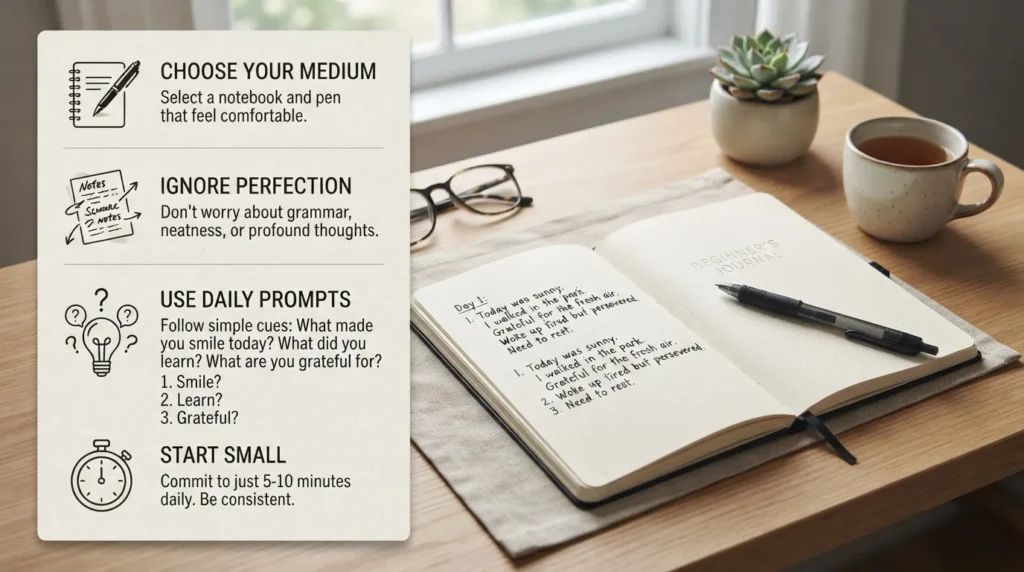
Starting out does not require special rules or elaborate rituals. A typical journal entry simply includes the date, a quick heading or focus for the day, and a few honest paragraphs of writing—whether you are listing what happened or exploring how you feel.
Choose your medium: Pick whatever feels easiest, whether that is a cheap paper notebook, a blank document on your phone, or a dedicated writing app.
Start small: Commit to just five minutes or three sentences a day so the habit feels effortless rather than overwhelming.
Write without filtering: Do not worry about grammar, spelling, or making it sound poetic. Just write what comes to mind.
A Few Journaling Examples to Get You Started
If you stare at a blank page and feel stuck, simple starter prompts can help break the ice. You can explore our dedicated journal-prompts pillar page for more ideas, but these quick examples are great for day one:
“What is one thing on my mind right now that I need to let go of?”
“What went well today, no matter how small?”
“How am I feeling physically and mentally at this exact moment?”
“What is one goal I want to focus on for the rest of the week?”
What Not to Do When Journaling Common Mistakes
While journaling is generally a positive habit, approaching it the wrong way can turn a helpful tool into an exhausting chore. Keeping a few common pitfalls in mind helps keep the practice light and useful:
Treating it like a rigid chore: Forcing yourself to write daily even when you have nothing to say makes journaling feel like homework. Give yourself permission to skip days without guilt.
Chasing perfection: Worrying about neat handwriting, beautiful notebooks, or poetic phrasing gets in the way of honest expression.
Falling into rumination: While processing emotions is healthy, endlessly looping over the same negative thought or frustration without looking for a solution can turn reflection into unhelpful rumination.
Overthinking every word: Editing yourself as you write blocks your natural train of thought. Let the words flow freely, knowing nobody else ever has to read them.
Frequently Asked Questions
What is the 3-3-3 journaling method?
The 3-3-3 journaling method is a quick, structured practice where you write down three things you are grateful for, three tasks or goals to accomplish, and three positive affirmations or emotional check-ins to ground your mindset for the day.
Why do people avoid or struggle with journaling?
Many people struggle with journaling due to blank-page anxiety, fear of emotional vulnerability, or lack of a clear routine. Without pre-printed prompts or structured habits, staring at a blank notebook can feel intimidating and mentally exhausting.
What happens if you journal every day?
Journaling daily builds emotional clarity, reduces stress, and creates a reliable historical archive of personal growth. Over time, consistent writing helps you process thoughts faster, track recurring life patterns, and improve overall mental well-being.
Should I journal in the morning or evening?
Morning journaling is ideal for setting intentions, practicing gratitude, and planning daily tasks with high energy. Evening journaling works best for decompressing, reflecting on daily events, processing emotions, and clearing your mind before sleep.
What do psychologists say about journaling?
Psychologists view journaling as a powerful therapeutic tool for emotional regulation and cognitive processing. Expressive writing helps externalize internal stressors, manage anxiety using cognitive behavioral principles, and reframe negative thought patterns constructively.
Pimchanok Srisuk
Pimchanok Srisuk is the Journaling Editor at Holistic Wellbeing Living. She writes about journaling prompts, reflective writing, emotional clarity, and mindful routines. With seven years of experience creating personal-growth content, Pimchanok helps readers use simple writing practices to understand their thoughts and make calmer everyday decisions.