Jump to:
ToggleHow to Start Journaling: A Beginner's Step-by-Step Guide
What Journaling Actually Is and Why It's Worth Starting
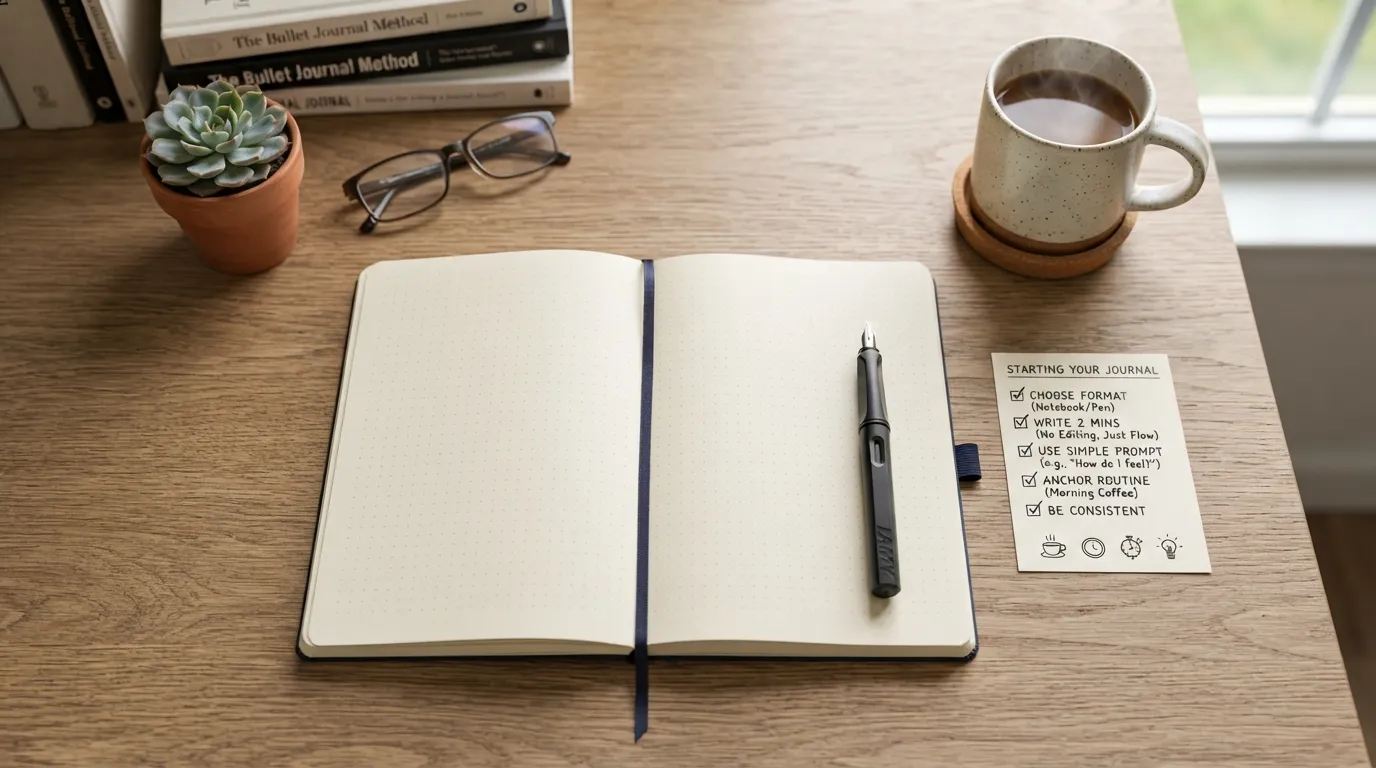
Journaling is simply the practice of putting your thoughts, feelings, and experiences down on paper to clear your head. There are no rules, no grades, and no “right way” to do it—your notebook is entirely yours, with zero expectations to live up to.
Stripping away the pressure of aesthetic perfection reveals a simple tool for mental clarity. You don’t need to write profound life insights or poetic prose for it to matter. Even jotting down a messy paragraph about a frustrating morning or a quiet cup of tea gives your mind a safe place to breathe.
Diary vs. Journal — Which One Do You Actually Want?

Choosing between a diary and a journal mostly comes down to whether you want to log daily events or explore how those events make you feel. A diary focuses strictly on chronology—recording the external facts of your day, what you ate, who you saw, and where you went. A journal digs one layer deeper, serving as a space for your personal reflections, questions, and emotional processing.
Choose a diary if: You want a straightforward record of your life to look back on years from now, or if you prefer a predictable routine like a daily recap.
Choose a journal if: You want to untangle your thoughts, unpack a stressful situation, or use writing as a tool to figure things out as you go.
Neither option is superior, and many people naturally blend the two depending on the day. If you want a simple checklist to decide right now, go with a diary when you want to remember what happened, and a journal when you want to understand how it felt.
What You Need to Start Journaling
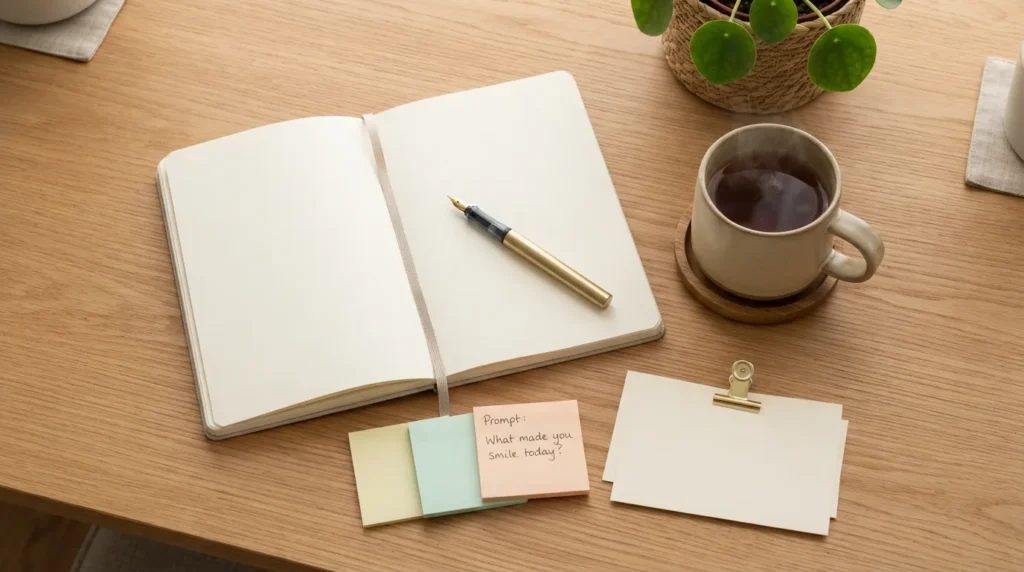
Getting started doesn’t require a special stationery haul or expensive fountain pens. You can choose whichever format fits naturally into your daily routine.
The physical notebook route: Grab literally any notebook you have lying around the house—a cheap spiral notebook, a school leftover, or a plain legal pad. You don’t need a fancy pen either; whatever ballpoint pen is closest will do the job.
The digital route: Open the notes app on your phone, fire up a blank Google Doc, or download a dedicated journaling app if typing feels faster and more natural than handwriting.
How Do I Fill My Empty Diary Without Overthinking It?
Filling an empty diary starts with dropping the expectation that your entries need to read like a published memoir. When staring at a blank page feels paralyzing, stop trying to craft deep philosophical reflections and just write about the literal facts of your day.
List what you ate for breakfast, describe the weather outside your window, or complain about a minor annoyance you encountered this morning. The goal isn’t to create art; it’s simply to break the ice with the page. Once you write down three or four ordinary sentences, the heavy pressure lifts, and the rest flows much easier.
How to Start Journaling: Step-by-Step
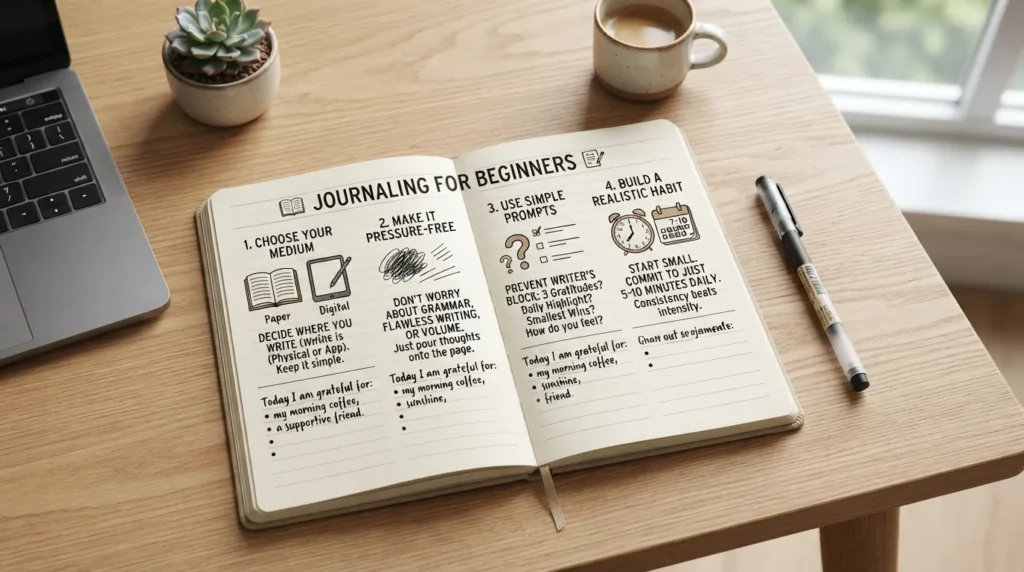
Step 1 – Pick Your Format (paper or app)
Choose the medium that feels the least intimidating to you right now. Grab a cheap spiral notebook from your desk drawer, or open a blank document on your phone or laptop. There’s no magical difference in the benefits between pen-to-paper and typing, so pick whatever gets you actually writing.
Step 2 – Set a Tiny Goal (2–5 minutes or one sentence)
Remove the pressure of daily multi-page reflections by aiming ridiculously small. Commit to spending just two to three minutes with your page, or give yourself permission to stop after writing a single sentence. Consistency matters far more for building a habit than the length of your entries.
Step 3 – Write Your First Entry
When you sit down wondering what to write in your journal first, skip the grand life observations and start with a simple check-in. You can use a straightforward template like this to get the words flowing:
Right now, I feel: (e.g., tired, rushed, calm, distracted)
On my mind today: (e.g., the deadline on Friday, a conversation I had this morning)
One small thing I noticed: (e.g., the sunlight coming through the window, the taste of coffee)
Step 4 – Don’t Edit, Just Write
Let the words spill out exactly as they form in your head without stopping to fix spelling, punctuation, or messy phrasing. This isn’t a final draft meant for anyone else’s eyes, so let it be messy, repetitive, or unpolished.
Keep it imperfect: Many beginners on community forums point out that the biggest trap is trying to make early entries look aesthetic or sound profound, which usually leads to quitting within a week.
Lower the stakes: Others note that shifting your mindset away from “writing a journal” and toward “dumping your mental cache” completely removes the blank-page freeze.
Easy Journaling Methods for Beginners
The 3-3-3 Journaling Method
The 3-3-3 method offers a structured way to clear your head in under five minutes when staring at a blank page feels overwhelming. You simply write down three distinct items across three categories: three things you can see right now, three things you are grateful for, and three tasks or thoughts bouncing around your mind. Grounding yourself in your immediate physical surroundings helps quiet racing thoughts before you dive into your day.
Example Entry:
3 things I see: The blue ceramic mug on my desk, the afternoon sunlight hitting the wall, a stack of unopened mail.
3 things I’m grateful for: A quiet house this morning, a text from a good friend, the fresh coffee brewing.
3 things on my mind: Finishing the quarterly report, scheduling the car maintenance, figuring out what to make for dinner.
The 3-2-1 Journaling Method
The 3-2-1 method works brilliantly as a quick daily check-in or an evening wind-down routine to process your thoughts without endless rambling. This framework asks you to capture three wins or positive moments, two current challenges or stressors, and one priority or lesson to take forward. It keeps your writing focused and prevents journaling from feeling like a chore.
Example Entry:
3 wins: Finished the presentation ahead of schedule, went for a quick walk during lunch, drank a full glass of water first thing this morning.
2 challenges: Feeling a bit drained by afternoon meetings, dealing with a glitchy software update on my laptop.
1 priority: Protect my personal time tonight by logging off work right at five o’clock.
How to Build a Journaling Habit That Actually Sticks
Habit-stack it to an existing routine (coffee, before bed)
Relying purely on motivation to journal rarely works out long-term. Instead, anchor your new habit to something you already do every single day without thinking. If you always brew a cup of coffee every morning, place your notebook directly next to the coffee maker so you write while it brews. If evenings work better for your schedule, leave your journal on your pillow so it’s the first thing you touch when you turn down the bed.
Start smaller than feels necessary
The biggest reason new habits fail is that people aim too high right out of the gate. Commit to writing just one single sentence or setting a timer for two minutes max. When the daily bar is set that low, your brain stops resisting the task, making it effortless to show up consistently.
Beginner Journal Prompts to Get You Unstuck
If you’re sitting with pen in hand but your mind has gone totally blank, don’t force a “deep” realization. Use these simple starters to jumpstart your brain and get those first few sentences onto the page.
What is one thing I’m looking forward to today?
What is the best thing that happened in the last 24 hours?
If I could have a do-over on one moment from today, what would it be?
What is one small thing I learned today?
How is my energy level right now on a scale of 1–10, and why?
What is one thing I need to get off my chest before I can move on?
What’s one thing that made me laugh or smile today?
What is one thing I want to accomplish tomorrow, no matter how small?
Who is one person I’m grateful for right now?
If I could change one thing about how today went, what would it be?
Need more inspiration? Check out our full library of journaling prompts to find exactly the right question for your mood.
Common Journaling Mistakes Beginners Make
When you’re first getting started, it’s easy to inadvertently turn a helpful habit into a source of stress. Keep an eye out for these common traps so you don’t burn out before the habit actually takes hold:
Falling for the perfectionism trap: Thinking your entries need to be insightful, well-written, or visually aesthetic often keeps people from writing anything at all. A messy, rambling page is a successful entry.
Treating a skipped day as a failure: Many beginners assume that missing a day means they’ve failed and should just quit altogether. Life gets busy—just pick it back up the next time you remember, no apology needed.
Over-scheduling your sessions: Trying to commit to thirty minutes of deep reflection every night is a recipe for avoidance. Start with two minutes; you can always write more if you want, but you don’t have to.
Lacking a clear “why”: If you don’t know why you’re journaling—whether it’s to vent, track your mood, or just clear mental space—the practice can feel like busywork. Pick one simple reason, like “I want to worry less before bed,” and focus on that.
Why Do People Struggle to Journal? And How to Fix It
The struggle: Staring at a blank page waiting for inspiration. The fix: Drop the pressure to write something profound and use a low-pressure structure like the 3-3-3 method or a simple brain dump to get immediate momentum.
The struggle: Forgetting to do it or waiting until you “feel motivated.” The fix: Stop relying on willpower and anchor your writing to an existing daily habit, like setting your notebook right next to your morning coffee maker.
The struggle: Feeling like you don’t have enough time for a long reflection session. The fix: Shrink your goal down to a ridiculous extreme—commit to just one single sentence or a two-minute timer.
The struggle: Judging your own handwriting, messy thoughts, or inconsistent schedule. The fix: Remember there are no rules or grades here; treat your notebook as a mental trash can rather than a polished diary meant for an audience.
Types of Journals You Can Try Once You're Consistent
Once you’ve built a steady routine with a basic notebook, you might find yourself curious about branching out into specialized formats. Different styles serve completely different goals, allowing you to tailor your practice as your needs evolve.
Gratitude journals: Focused entirely on shifting your mindset toward appreciation, these feature daily lists of positive moments, big or small. Explore our guide on gratitude journaling practices to learn how to move beyond generic listings.
Bullet journals: A hybrid planner and log system designed by Ryder Carroll that uses rapid logging and custom symbols to track tasks, habits, and schedules in one flexible notebook. Check out our beginner-friendly bullet journal setup guide.
Guided journals: Featuring pre-printed prompts, questions, or daily fill-in-the-blank structures, these are ideal if you prefer having a clear roadmap for every session. Browse our favorite picks in our guided journals review.
Reflective journals: Geared toward self-discovery and processing complex experiences, these invite deep questions and emotional unpacking. Learn more about deep-dive writing in our reflective journaling framework.
Travel journals: Perfect for capturing memories, ticket stubs, sketches, and daily impressions while exploring new places. Read our tips for documenting trips in our travel journaling walkthrough.
Watch: A Simple Walkthrough for Starting Your Journal
How to Start Journaling: A Beginner's Step-by-Step Guide
What Journaling Actually Is (and Why It's Worth Starting)
Journaling is simply the practice of putting your thoughts, feelings, and experiences down on paper to clear your head. There are no rules, no grades, and no "right way" to do it—your notebook is entirely yours, with zero expectations to live up to.
Stripping away the pressure of aesthetic perfection reveals a simple tool for mental clarity. You don't need to write profound life insights or poetic prose for it to matter. Even jotting down a messy paragraph about a frustrating morning or a quiet cup of tea gives your mind a safe place to breathe.
Watch: A Simple Walkthrough for Starting Your Journal
If you learn better by seeing the process in action, these walkthroughs break down everything we've covered—from setting up your space to overcoming the "blank page" fear.
These videos offer different takes on building a habit that lasts. Whether you want a system focused on mental clarity, a comprehensive guide for beginners, or tips on how to start a practice you'll actually keep, you'll find plenty of practical advice to help you move forward with confidence.
Journaling for Specific Goals
Journaling for Anxiety
When anxiety is high, your mind can feel like a room full of competing alarms, making it difficult to figure out what you are actually reacting to. Before you pick up your pen, take three slow, deliberate breaths to signal to your nervous system that you are safe in the present moment. Then, use the naming-the-worry technique: write down the exact, unfiltered fear instead of pushing it away. Giving the abstract dread a specific title (such as “I am terrified I will miss tomorrow’s deadline”) shrinks it down from an overwhelming storm into a single, manageable problem you can look at objectively.
Journaling for Mental Health
Journaling acts as a reliable pressure valve for your emotional well-being, helping you process heavy experiences rather than carrying them around all day. Regular emotional check-ins build self-awareness and help you spot patterns in your mood before they turn into burnout. For specific exercises designed to support emotional regulation and healing, explore our complete library of mental health journaling prompts.
Journaling for Self-Improvement
If your goal is personal growth, your journal becomes a private laboratory for tracking your habits, reflecting on your reactions, and setting clear intentions. Instead of trying to overhaul your entire life at once, use short daily entries to examine one small decision or behavior pattern each week. To find structured frameworks and questions that target personal milestones, check out our self-improvement journaling guide.
FAQs
What are 7 types of journals?
While journaling can take many forms, popular styles typically include gratitude logs, bullet journals, stream-of-consciousness morning pages, art or visual journals, dream journals, travel logs, and reflective prompt journals. Each serves a unique purpose depending on whether you want structured productivity, emotional release, or creative expression. Explore more styles in our Types of Journals section.
Can you give examples of journal writing?
Journal writing can range from tracking daily tasks to processing deep emotions. Here is a brief 2–3 line sample entry snippet illustrating a simple mental clarity check-in:
What are 5 diary entries?
If you are wondering what a short sequence looks like in practice, here is what 5 short entries can look like across a typical week:
- Day 1: Walked through the park during lunch; noticed the crisp autumn air and felt an immediate sense of calm wash over my busy afternoon.
- Day 2: Struggled to focus on complex tasks this morning. Decided to take a 15-minute screen break, which completely reset my concentration levels.
- Day 3: Grateful for a quiet evening catching up on reading without any digital distractions or incoming work notifications.
- Day 4: Felt overwhelmed by unexpected changes to the schedule, but deep breathing helped me adapt smoothly without getting frustrated.
- Day 5: Wrapped up the week feeling accomplished after successfully completing all core personal goals set out on Monday morning.
How do I start journaling if I have nothing to write about?
Staring at a blank page is completely normal. To break the ice instantly, try grounding yourself using your five senses—write down three things you can currently see, two things you can hear, and one physical sensation you feel. Alternatively, write down a single word describing your current mood and expand on why you feel that way.
Pimchanok Srisuk
Pimchanok Srisuk is the Journaling Editor at Holistic Wellbeing Living. She writes about journaling prompts, reflective writing, emotional clarity, and mindful routines. With seven years of experience creating personal-growth content, Pimchanok helps readers use simple writing practices to understand their thoughts and make calmer everyday decisions.