Jump to:
ToggleWhat Does a Journal Look Like? A Complete Visual Guide (With Real Examples)
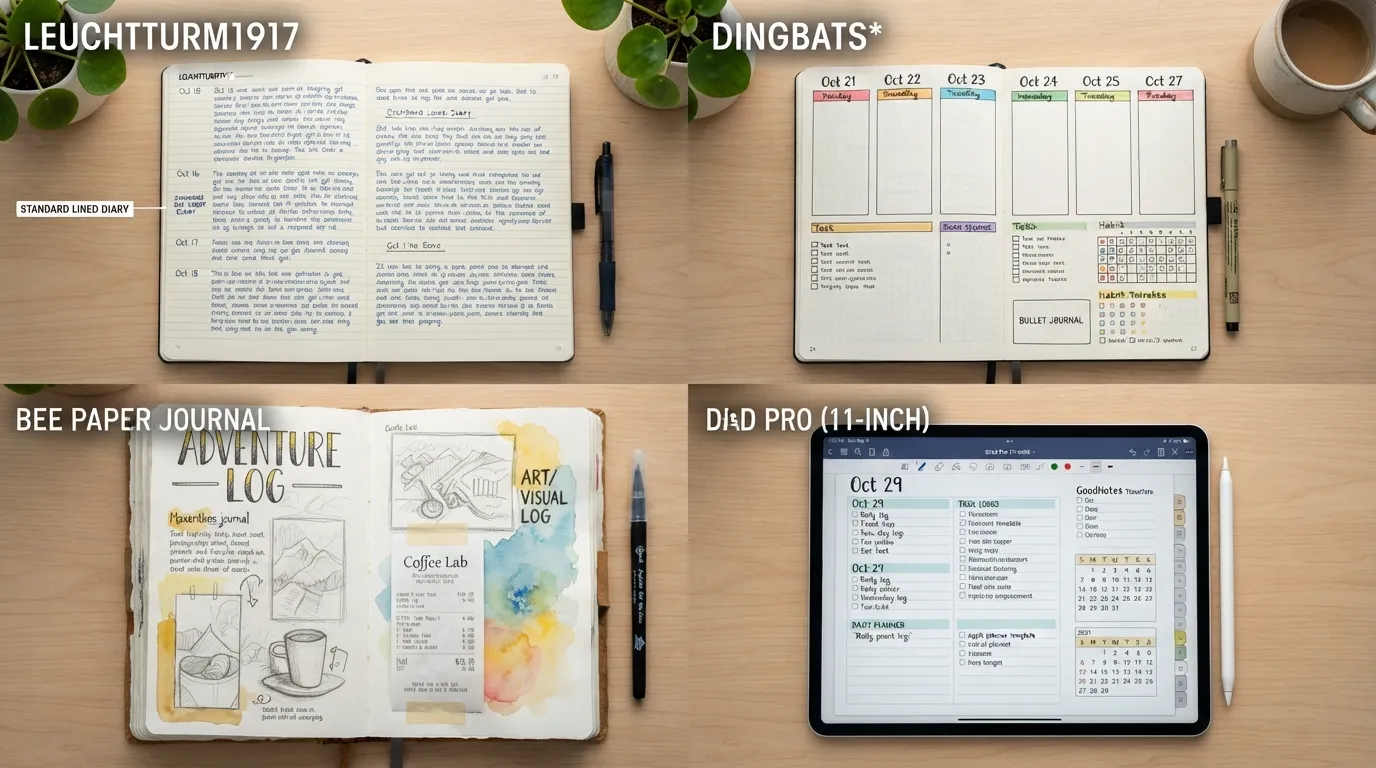
At its most basic, a journal looks like any ordinary notebook or blank digital document where you write down your thoughts, daily events, tracking logs, or ideas. Visually, it can range from a scuffed leather-bound book filled with messy handwritten ink to a minimal, grid-structured digital app on your tablet. In this guide, you’ll see exactly what journals look like on the outside, what real internal pages look like, and how different styles function so you can visualize the right setup for yourself.
What Does a Journal Look Like From the Outside?
When you walk into a bookstore or browse online, a journal is basically a notebook meant for personal writing. It doesn’t need to say “Journal” in big shiny letters on the front. From the outside, it looks like a clean, bound book waiting to be filled.
Cover Materials and Styles (hardcover, faux leather, fabric, personalized)
The cover sets the mood every time you pick the notebook up. Some people prefer a thick, sturdy hardcover because it supports your writing even if you’re typing in bed or sitting on a park bench. Faux leather (often called vegan leather or PU leather) gives you that classic, smooth feel without using real animal hides—it holds up well against everyday spills and tosses into a backpack.
Fabric or linen covers feel warm, textured, and soft in your hands, though they can pick up dust over time. Then there are personalized covers, where you might find an embossed monogram, a hand-drawn illustration, or a motivational quote stamped right on the front.
Binding Types (casebound, spiral, ring, stitched)
Casebound (Thread-Bound): Pages are sewn together in sections and glued to a hard spine.
Pros: Durable, looks like a real book, usually lies flat when open.
Cons: Can be heavy; harder to fold completely back on itself.
Spiral (Wire-O): Metal or plastic rings loop through punched holes down the side.
Pros: Opens 360 degrees so you can fold it in half; great for writing in cramped spots.
Cons: The wire ring can get bent in bags or bump against your wrist while you write.
Ring Bound (Binder Style): Uses 3 to 6 metal rings that pop open to add or remove paper.
Pros: Totally customizable; you can swap pages, rearrange sections, or insert printed habit trackers.
Cons: Bulky spine; the center rings get in the way of your hand on the left-hand page.
Stitched (Saddle Stitch): Pages are folded and held together by simple thread or staples down the center line.
Pros: Very lightweight, slim, and flexible; easy to slip into a back pocket or coat.
Cons: Contains fewer pages; won’t last as long under heavy daily wear.
Common Sizes (A6/A5/A4)
A6 (roughly 4.1 x 5.8 inches): Pocket-sized. Best for quick daily check-ins, grocery lists, or keeping in your purse for sudden ideas on the go.
A5 (roughly 5.8 x 8.3 inches): The absolute sweet spot for most writers. Best for balanced daily entries, long-form thoughts, or light sketching without taking up your whole desk.
A4 (roughly 8.3 x 11.7 inches): Standard letter size. Best for heavy desk work, full-page art journaling, brain dumps, or keeping complex project logs.
What Does the Inside of a Journal Look Like?
Flip open the cover, and you’ll find paper printed in a way that guides how your thoughts flow onto the page.
Lined Pages — best for
Lined or ruled paper has light horizontal lines spaced about 6mm to 8mm apart. It is best for stream-of-consciousness writing, long diary entries, letter writing, or anyone who wants straight text without worrying about keeping their handwriting level.
Dotted and Grid Pages — best for
Dotted paper features a subtle grid of faint dots spaced 5mm apart, while grid paper uses full light lines to create tiny squares. Both are best for bullet journaling, making habit trackers, drawing custom tables, or blending quick sketches with text side-by-side.
Blank Pages — best for
Blank pages offer zero printed lines or guides. They are best for visual thinkers, artists, mind-mappers, or anyone who hates feeling constrained by pre-printed rules and wants the freedom to write at any angle.
Extras You’ll Actually Find (ribbon, elastic band, pocket, numbered index)
A functional journal often comes with small built-in tools. You’ll usually see a silk ribbon bookmark glued into the spine so you can flip right to today’s entry. An elastic band wraps around the outside cover to keep the book snapped shut in your bag.
Inside the back cover, there’s often an expandable paper pocket to hold loose sticky notes, receipts, or photos. Some structured notebooks also print page numbers and a blank index at the very front so you can list where your key memories or project notes live.
What Does a Finished Journal Page Actually Look Like? (Anatomy Breakdown)
If you peek at a page written by someone who journals every day, it rarely looks like a pristine printed page from a novel. It looks human, active, and slightly messy.
The Date/Time Stamp
Up in the top corner—left or right—there’s almost always a quick date stamp. It might read Tues, Aug 15 – 9:30 AM or just 8/15. Knowing when a page was written anchors your entry in time, making it easy to look back months later and remember where you were in life.
Margins and White Space
Real pages leave room to breathe. You’ll see an inch of blank space along the edges where the pen didn’t reach. Sometimes people use those blank margins to jot down a quick thought later, or they just leave them empty so the page doesn’t feel overly crowded.
Optional Header or Title Line
Below the date, some writers add a short header to set the topic. It could be something simple like Morning Coffee Thoughts, Argument with Mom, or Project Ideas. It isn’t required, but it gives the entry a clear starting point.
The Body — Prose, Bullets, or Boxes
The center of the page holds the actual writing. It might be three solid paragraphs of rambling thoughts, a simple bulleted list of what happened today, or small hand-drawn boxes holding specific memories. A single page can easily mix all three styles depending on how much time you have.
Margin Marks (stars, arrows, underlines)
As people write, they react to their own thoughts. You’ll often see key sentences underlined twice, a big star next to an important realization, or an arrow pointing from a paragraph up to a note squeezed into the margin. These little marks show a mind actively processing ideas.
How a Page Ends (the “stop”)
Mid-sentence cut-offs: Real life interrupts writing, and stopping halfway through a thought is completely normal.
Unfinished lines: You don’t have to fill every square inch of paper; leaving the bottom half blank simply means you said what you needed to say.
Trailing off with dashes: A series of dashes or a wavy line across the paper often marks the spot where a writer simply ran out of steam and closed the book.
Real Example Journal Entries (See the Actual Words)
A Daily/Diary Entry Example
Tuesday, Oct 14 — 8:45 PM “Felt totally overwhelmed at work today during the team sync. I completely froze when Sarah asked for my numbers, even though I had them right in front of me. Walked around the block twice after lunch to reset. Note for tomorrow: write down my top two meeting points on a sticky note before logging on.” What makes this layout work: A simple date line and a raw paragraph let you dump thoughts quickly without overthinking structure.
A Gratitude Entry Example
Morning Coffee Thoughts:
The way the sun hit the kitchen counter at 7:00 AM.
Freshly washed bed sheets.
Mark sending that funny dog clip right when I felt stressed. What makes this layout work: Short numbered lists lower the barrier to writing, making it effortless to build a daily habit.
A Bullet Journal Log Example
[x] Submit expense report
[ ] Call dad about weekend plans
! Remember to water the snake plant
– Quick thought: look up that bakery on 4th Street What makes this layout work: Symbols (boxes, exclamation points, dashes) turn chaotic tasks and quick ideas into a clean, skimmable list.
A Dream Journal Entry Example
3:15 AM (Woke up suddenly) “I was standing on a giant wooden dock, but the water below was made of blue glass. Kept trying to find my shoes, but every time I reached down, my hands turned into paper. Weird feeling of urgency, but not full fear.” What makes this layout work: Placing the exact time at the top helps capture hazy details right when you wake up, before they fade.
A Travel Journal Entry Example
Day 3 in Kyoto — Train to Osaka: “Bought a melon pan from the station bakery (180 yen — so warm!). Train is dead quiet except for the track hum. Collected a small stamp at the station gate on page 12.” What makes this layout work: Mixing small expenses, sensory details, and physical keepsakes captures the atmosphere of a trip better than a rigid timeline.
Real Journals vs. "Pinterest-Perfect" Journals
messy handwriting, crossed-out words, and ink smudges vs. flawless calligraphy and perfect hand-lettering
uneven paragraphs, crooked margins, and stray coffee rings vs. color-coded spreads, pristine grid lines, and matching stickers
half-filled pages left blank because life got busy vs. curated weekly layouts filled with decorative doodles
ripped receipts or taped-in ticket stubs vs. color-coordinated photos printed on glossy paper
A messy notebook isn’t a ruined notebook — it’s proof of a living, working mind. Research in expressive writing shows that the mental health benefits of journaling come from getting your authentic thoughts onto paper, not from how pretty the page looks. If you cross out three words in a row or leave an entire week blank, your journal is still doing its exact job.
What Does a Digital Journal Look Like?
App-Based Journals
App-based journals look like clean, continuous feeds on your phone or tablet. Instead of blank paper, you see individual entry cards timestamped by date, often paired with a small mood icon or a photo attached right below the text.
Notion/Doc-Based Journals
Document and workspace journals look structured and modular. You will usually see clear section headers, collapsable toggle lists that hide long reflections, and checkboxes you can click directly on the screen.
How Digital Entries Mirror the Same 3 Layouts
Whether you use paper or a screen, digital journals rely on the exact same core formats:
Dated prose: Plain text blocks that look identical to traditional diary entries.
Bullets and boxes: Custom lists, checkboxes, and tagged blocks for quick updates.
Short notes: Brief, caption-style entries attached to a photo or audio snippet.
What Does a Journal Look Like for Different People?
How a Journal Looks Like for Students
A student’s journal is rarely neat or aesthetic—and that is completely fine. It usually functions as a hybrid space where class notes mix right in with quick mental check-ins. On a single spread, you might see lecture points on the left page and a half-formed rant about group projects on the right.
Entries tend to be short and direct, often written in five-minute bursts between classes. You’ll regularly spot assignment checklists, exam date trackers in the margins, and quick mood ratings written in bright highlighter.
How a Journal Looks Like for Beginners
If you are just starting out, your notebook will probably look very plain, and that is actually the best way to keep it. Most beginner pages feature standard lined paper or basic blank sheets with three to four lines of text per day.
There is zero layout system required. An entry might be as simple as: "Aug 12 – Exhausted today. Work was fine, ate soup, need sleep." It looks low-pressure because it is low-pressure.
Types of Journals and How Each One Looks
| Journal Type | Typical Page Look | Best Paper Type |
|---|---|---|
| Diary | Long blocks of handwritten text, dated top right, occasional scratched-out words. | Lined, 80-100 gsm |
| Bullet Journal | Grid or dot patterns with custom symbols, short task bullets, and monthly logs. | Dot grid, 120-160 gsm |
| Gratitude | Short numbered lists (1-3 items) or quick morning prompts filled out. | Lined or blank, 80 gsm |
| Dream | Rapidly scribbled text right upon waking, sometimes with rough scene sketches. | Blank or lined, 80 gsm |
| Travel | Collaged spreads with taped ticket stubs, maps, stamps, and brief daily summaries. | Blank or mixed media, 120+ gsm |
| Art | Heavy watercolor or ink washes, mixed mediums, minimal to zero text. | Mixed media or cold-press, 200+ gsm |
| Reading | Book titles, star ratings, key quotes copied down, and brief personal thoughts. | Dot grid or lined, 100 gsm |
| Food & Fitness | Structured columns tracking meals, water intake, workouts, and energy levels. | Grid or pre-printed, 90-100 gsm |
| Junk / Venting | Messy scribbles, heavy pen pressure, tear marks, or crossed-out aggressive writing. | Any basic paper, 70-80 gsm |
| Commonplace | Categorized index at the front, followed by quotes, article clips, and recipes. | Lined or dot grid, 90-100 gsm |
Why the Look Matters Less Than the Habit
Focusing too much on making your pages look pretty usually gets in the way of why you started in the first place. Studies highlighted by the American Psychological Association show that expressive writing helps reduce intrusive thoughts and lower stress levels.
When you use your pages for raw emotional processing, the layout does not matter. Research published through National Center for Biotechnology Information confirms that regular reflective journaling supports long-term mental clarity and emotional regulation—regardless of whether your handwriting is clean or completely illegible.
Common Journaling Mistakes to Avoid
Waiting for perfection: Staring at page one for twenty minutes because you are afraid your handwriting will ruin the book.
Comparing to social media: Expecting your everyday pages to look like curated, color-coordinated spreads on Instagram or Pinterest.
Overcommitting daily: Forcing yourself to write two full pages every single morning until the habit feels like a chore.
Mismatched layout choice: Picking a complex dot-grid system when all you really want to do is vent for five minutes before bed.
Quitting after one messy page: Abandoning an entire notebook just because you made a spelling mistake or spilled coffee on a leaf.
How to Start Journaling: A Simple First Step
Pick any notebook you already own. Don’t wait until you buy a leather-bound journal. Grab a cheap spiral notebook, a half-used legal pad, or a pocket memo book sitting in your desk drawer.
Grab a pen that feels good to write with. A smooth gel pen or a simple ballpoint makes a huge difference. If you like how the pen glides across paper, you’ll actually want to write more.
Write today’s date at the top of the page. This tiny act gives your entry structure immediately. It takes two seconds, but it officially transforms a blank sheet into a real journal entry.
Set a timer for 3 minutes. Tell yourself you only have to write until the timer goes off. Removing the pressure of writing a full page helps you overcome that initial freeze.
Stream your thoughts without editing. Write down what you ate for breakfast, a thought stuck in your head, or how tired you feel. Don’t worry about spelling, neat handwriting, or making sense.
Close the notebook and walk away. Once your time is up, stop writing. Building the habit matters way more than making a masterpiece on your first try.
Frequently Asked Questions
How do you write a journal?
You write a journal by simply putting your thoughts, daily events, feelings, or ideas onto paper in whatever format feels natural. You can write in full paragraphs like a letter to yourself, use short bulleted lists, draw diagrams, or combine all three on the same page. There are no strict grammar or structure rules.
What should a journal look like?
A journal can look like anything you want it to look like. It might be a neat notebook filled with organized bullet points and colorful headers, or a scrawled mess of scribbles, crossed-out words, and taped-in coffee receipts. The appearance depends entirely on your personal style and what you use it for.
What is a journal example?
Here is what a quick, real-life journal entry looks like on the page:
Oct 14
Woke up feeling pretty drained today. Work meeting at 10 AM went fine, but I’m still overthinking what I said about the project deadline.
To-do for tonight:
– Walk the dog
– Make pasta
– Read 10 pages before bed
Overall mood: 6/10. Need to get to bed earlier.
What are 7 types of journals?
Daily Log: A basic diary recording everyday events, schedules, and quick thoughts.
Bullet Journal: An organized grid system using symbols, task lists, and calendars.
Gratitude Journal: Short entries focused specifically on listing things you appreciate.
Stream-of-Consciousness: Unedited, free-flowing writing designed to clear brain fog.
Art/Visual Journal: Pages dominated by sketches, watercolors, collages, and hand lettering.
Habit Tracker: Grid-based pages set up to track daily routines like sleep, water, or exercise.
Prompted Journal: A notebook pre-printed with specific questions to guide your daily responses.
How do I start journaling daily?
Anchor your journaling habit to an existing daily routine. Put your notebook right on top of your coffee maker or on your pillow so you see it every single day. Aim to write just two sentences or one bullet point every morning or evening so the goal feels stupidly easy to hit.
What are the top 5 journals?
Leuchtturm1917: Loved for its numbered pages, dot-grid layout, and durable hardcover.
Moleskine Classic: A timeless choice with smooth paper, an elastic closure band, and an inner pocket.
Midori MD Notebook: Features minimal Japanese design and high-quality paper perfect for fountain pens.
Rhodia Webnotebook: Known for its thick, ultra-smooth ivory paper that prevents ink bleed-through.
Field Notes: Pocket-sized paperbacks designed for quick, on-the-go note taking.
What is the best journal for beginners?
A basic A5 grid or dot-grid notebook with an elastic band is usually the best starting point. Dot-grid pages give you subtle guidelines so your handwriting stays straight, but they don’t lock you into rigid lined rows if you want to draw or list things out.
What are the benefits of journaling?
Journaling gets nagging thoughts out of your head and onto paper, which helps lower stress and anxiety. It sharpens your focus, helps you process complex emotions, keeps track of personal goals, and gives you a clear record of how much you’ve grown over time.
What is the purpose of a journal?
The main purpose of a journal is to create a private space where you can process your internal world without judgment. It acts as an external memory bank, a problem-solving sandbox, and a personal tracking tool for your life.
What are common journaling mistakes?
Trying to make every page look perfectly neat or aesthetically pleasing.
Believing you have to write long, deep entries every single day.
Treating journaling like a chore instead of a flexible tool.
Editing or censoring yourself while you write out of fear someone might read it.
How a journal looks like on Reddit?
On subreddits like r/journaling or r/bulletjournal, posts usually show real user setups laid out flat on a desk. You’ll see everything from dense, plain text filled with black gel ink on yellowed paper, to art-heavy spreads covered in floral stickers, pressed leaves, and colorful task trackers.
How does a journal look for students?
A student’s journal usually looks like a mix of personal life and academic planning. You’ll often see weekly assignment trackers, color-coded study schedules, and quick notes on classes right alongside personal reflection, dream lists, or quick mood check-ins.
Pimchanok Srisuk
Pimchanok Srisuk is the Journaling Editor at Holistic Wellbeing Living. She writes about journaling prompts, reflective writing, emotional clarity, and mindful routines. With seven years of experience creating personal-growth content, Pimchanok helps readers use simple writing practices to understand their thoughts and make calmer everyday decisions.