Jump to:
ToggleJournal Writing Examples About Life: 40+ Real Entries, Prompts & a Method to Start Today
Staring at a blank journal page can feel surprisingly heavy. You open the notebook, pen in hand, and suddenly your mind goes completely blank. You wonder if your day was interesting enough to write about, or if you are even doing it right.
That frozen feeling is totally normal, and this page is here to fix it.
Instead of giving you long lists of prompts or broad advice, you will see real journal writing examples about life that you can actually model. These are honest, unpolished snapshots of what everyday journaling looks like in the real world.
What Is a Life Journal Entry?

A life journal entry is a written record of your everyday thoughts, feelings, and personal experiences. It is a private space where you capture small daily moments, process your emotions, and reflect on what happens in your life without worrying about perfect grammar or spelling.
People keep a life journal for a few simple reasons:
To process heavy emotions and clear mental clutter after a tough day.
To preserve real memories, sensory details, and small wins you might otherwise forget.
To build self-awareness by noticing patterns in your mood, stress, and choices.
To gain fresh perspective on personal goals or tough decisions.
The Research Behind It
Putting your life into words is not just a creative habit, it actually changes how your mind handles stress. In a famous study on gratitude by Robert Emmons and Michael McCullough, people who wrote down things they were thankful for every week felt significantly happier and more optimistic about their lives. Mental health experts at organizations like the American Psychological Association also highlight how expressive writing lowers stress and improves emotional clarity
How to Start Writing in a Journal
Pick your format. Choose between a basic paper notebook or a digital document on your phone. Pick whatever gives you the easiest, friction-free access when inspiration strikes.
Set a simple time goal. Pick five minutes early in the morning or right before bed. Keep the time block short so you can stay consistent without feeling overwhelmed.
Write today, not later. Do not wait for a major life event or an emotional breakdown to start. Record what happened this morning, what you ate, or how you feel right now.
Get very specific. Skip broad sentences like “Today was fine.” Focus on one exact moment, like the cool breeze on your walk or a funny comment your coworker made.
Never edit yourself. Turn off your internal critic while you write. Let your words flow freely onto the page without stopping to fix spelling, punctuation, or awkward phrasing.
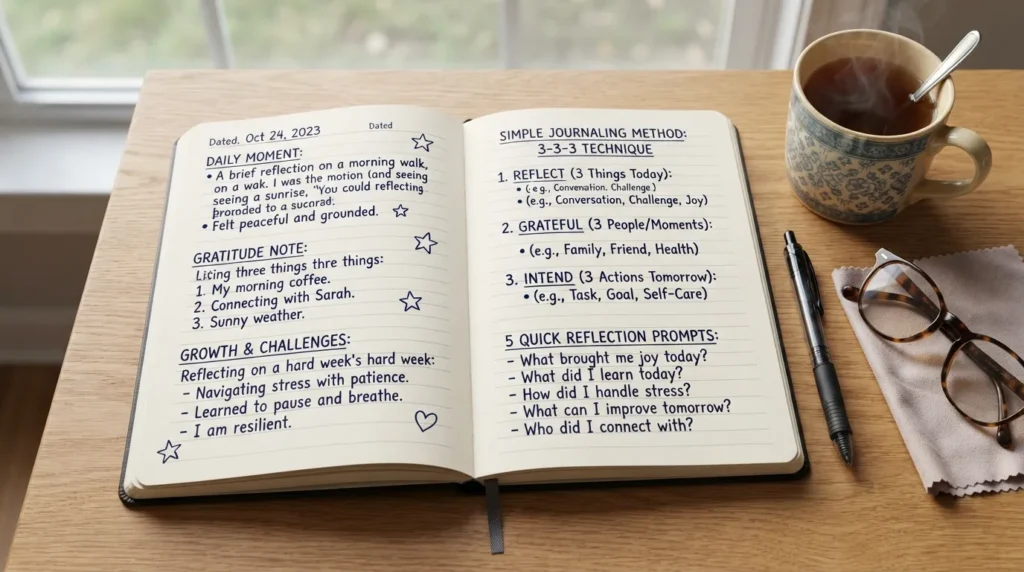
The 3-3-3 Journaling Method (Simple Structure for Beginners)
The 3-3-3 journaling method is a quick grounding technique where you write down three things you see, three sounds you hear, and three physical sensations or movements you experience. It pulls your mind out of racing thoughts and grounds you immediately in the present moment.
A popular variation used for daily planning involves writing down three things you are grateful for, three small accomplishments from today, and three key focus areas for tomorrow.
7 Types of Journals You Can Keep
Daily Life Journal: A loose, open-ended space to log everyday events, thoughts, and feelings as they happen.
Gratitude Journal: A quick daily habit focused entirely on writing down moments, people, and things you appreciate.
Reflection Journal: A thoughtful space to process major decisions, recurring patterns, and personal growth over time.
Dream Journal: A notebook kept right next to your bed to record vivid dreams immediately after waking up.
Travel Journal: A place to capture itineraries, ticket stubs, sensory details, and memories from trips.
Bullet Journal: A flexible system using symbols, lists, and trackers to manage tasks, habits, and schedules.
One-Line-a-Day Journal: A low-pressure format where you write a single sentence about your day every night.
Journal Writing Examples About Life
Daily Moments & Gratitude Examples
October 12 The kitchen smelled like burnt toast and old coffee grounds this morning. I sat at the yellow table while the dog slept on my feet, heavy and warm. My morning commute was surprisingly easy, and I got the corner desk with the good light. It is small, but that quiet twenty minutes before my phone started ringing felt like a tiny gift.
November 3 I finally cleared out the pile of mail sitting on the kitchen counter for three weeks. It took less than ten minutes, which made me laugh at how long I dreaded doing it. I rewarded myself with a hot shower and listened to the rain hitting the bathroom window. Crossing that tiny chore off my mind made the whole evening feel lighter.
December 15 I am thankful for the steam rising off my soup bowl tonight after coming in from the cold. I am glad my sister called while she was standing in line at the grocery store just to tell me a dumb joke. Mostly, I am grateful for this soft blanket and a quiet apartment while the wind rustles the trees outside.
Hard Times & Growth Examples
January 8 My chest felt tight all afternoon after that awkward conversation with my boss. I kept replaying what I said, cringing at my own tone and wishing I had just kept quiet. Writing this down helps me see that my mistake was small, and my boss has likely already moved on to ten other things. I cannot change my words, so I am letting my shoulders drop and breathing out the tension.
February 21 I was terrified to speak up during the team meeting today, but I raised my hand anyway. My voice wobbled a little on the first word, but then I gave my opinion and nobody laughed. My hands were shaking under the table the whole time. I realized that being scared does not mean I have to stay quiet.
March 14 I spent the afternoon fixing a mistake I made on a project because I rushed through the final check. It felt frustrating and embarrassing to admit I dropped the ball to my team. The lesson here is simple: moving fast to look productive always costs me more time in the long run. Slowing down is not a weakness, it is actual efficiency.
Future & Self-Reflection Examples
April 5 Dear future self, I hope you still take long walks on Sunday afternoons without your phone in your hand. Right now, we are working hard to figure out what comes next, so please remember to be kind to yourself when things get messy. I hope you still love the sound of rain, and I hope you are proud of how hard we tried this year.
May 19 I noticed today how quickly I say yes to extra projects just to avoid letting people down. Peace and honesty are core values for me, but pleasing everyone directly breaks both of those rules. Saying a polite no is not being selfish, it is keeping a promise to protect my own time and energy.
June 30 I remembered our old beach house today, specifically the salty smell of the porch screen and the crunch of sand on the linoleum floor. We used to eat melted popsicles on the back steps until our fingers turned blue. Thinking about that warm afternoon brings back a pure, easy kind of joy that I want to bring more of into my life right now.
Journal Writing Examples for Students
Student journals often look different because they balance school assignments, personal growth, and teacher feedback. Having a dedicated space to reflect on classwork, friendships, and daily pressure helps you process the constant changes of school life.
October 14 Today in chemistry lab, my group completely ruined our experiment because we mixed the steps up. I felt frustrated at first, but Mr. Davis helped us figure out where we went off track without making us feel stupid. Outside of class, cafeteria drama made lunch feel exhausting, so I sat in the library for fifteen minutes just to get some quiet. I am realizing that stepping away when things get loud is the best way for me to reset
Weekly Journal Example for Students
Week 12 Review
Biggest Win: Passing my history midterm after studying with Sarah for three days straight.
Main Challenge: Managing my time between track practice and writing my English essay without staying up past midnight.
What I Learned: Staying after class for five minutes to ask questions saves hours of confusion later at home.
Goal for Next Week: Turn off my phone at nine every night so I am not reading group chats in bed.
Journal Writing Examples About Life Struggles
Writing about hard times does not mean you have to fix everything on the page. You do not need to end every entry with a bright silver lining or a fake positive thought. Sometimes, simply putting your pain into plain words gives your mind a safe place to hold it.
March 8 I am bone-tired today, the kind of heavy fatigue that a good night of sleep does not seem to fix. My to-do list keeps growing, and every small task feels like lifting a boulder. I do not have a brilliant plan to solve my burnout tonight, so I am just going to leave the dishes in the sink, go to bed early, and accept that running on low battery is okay for now.
August 22 A sudden wave of grief hit me out of nowhere while I was picking out apples at the store today. A song came on over the speakers that we used to listen to together, and my eyes immediately welled up in the middle of aisle four. It has been over a year, but moments like this remind me that healing is not a straight line. I am letting myself feel sad tonight instead of pretending I am completely over it.
(Note: While writing through emotional pain is a powerful way to process feelings, a journal is a partner to support, not a replacement for talking to a professional, a family member, or a trusted friend when things feel too heavy to carry alone.)
Good Prompts for Journaling About Life
What is one small detail from today that you want to remember five years from now?
What is currently taking up the most mental space or energy in your mind?
Describe a moment recently where you felt completely comfortable being yourself.
What is a boundary you need to set right now to protect your peace?
Write about a mistake you made recently and what it taught you about yourself.
What is something you are holding onto that you need to let go of this week?
If you could change one habit in your daily routine, what would it be and why?
Who made you feel supported or seen recently, and how did they do it?
What does your ideal quiet morning look like from the moment you wake up?
What is a truth about your life right now that you have been avoiding saying out loud?
Common Journaling Mistakes to Avoid
Waiting for the right mood: If you wait until you feel inspired or peaceful, you will rarely write. The best entries often happen on days when you feel chaotic, bored, or tired.
Performing for an imaginary audience: Writing like someone else might read your notebook ruins honesty. Write raw, messy thoughts that are meant only for your eyes.
Staying too vague: Writing “today was bad” does not help you process anything. Focus on specific moments, like a sharp comment, a spilled drink, or a late train.
Treating a missed day like failure: Skipping a few days or weeks is completely normal. Just turn to a fresh page and pick up right where you are without apologizing to your notebook.
Copying someone else’s style: Forcing yourself into an intricate aesthetic or layout that works for an online influencer usually leads to quick burnout. Build a system that fits your actual daily life.
Frequently Asked Questions
What are some examples of journal writing? Journal writing can range from quick daily bullet points and gratitude lists to detailed reflections on hard times, travel logs, or letters to your future self. For full, dated text entries you can model your own writing after, check our Journal Writing Examples About Life section above.
What are 5 journal entries with examples? Five common entry types include a morning gratitude note, a small daily win, a reflection on a tough conversation, a weekly goal review, and a past memory recall. You can read complete, real-life entry examples for these categories in our Daily Moments and Hard Times sections.
What is the best thing to write in a journal? The best thing to write is whatever is actively occupying your mind right now, whether that is a quiet moment of appreciation, a pressing worry, or a simple summary of your afternoon. Honesty matters far more than topic selection, so focus on writing what feels true today.
What are some good list ideas for a journal? Simple list ideas include books you want to read, small things that bring you comfort, places you want to visit, or things you need to forgive yourself for this year. Lists are a fantastic, low-pressure way to fill a page when you do not feel like writing full paragraphs.
Pimchanok Srisuk
Pimchanok Srisuk is the Journaling Editor at Holistic Wellbeing Living. She writes about journaling prompts, reflective writing, emotional clarity, and mindful routines. With seven years of experience creating personal-growth content, Pimchanok helps readers use simple writing practices to understand their thoughts and make calmer everyday decisions.