Jump to:
Toggle60+ Journaling Ideas for Beginners: A Simple Step-by-Step Guide to Start Today
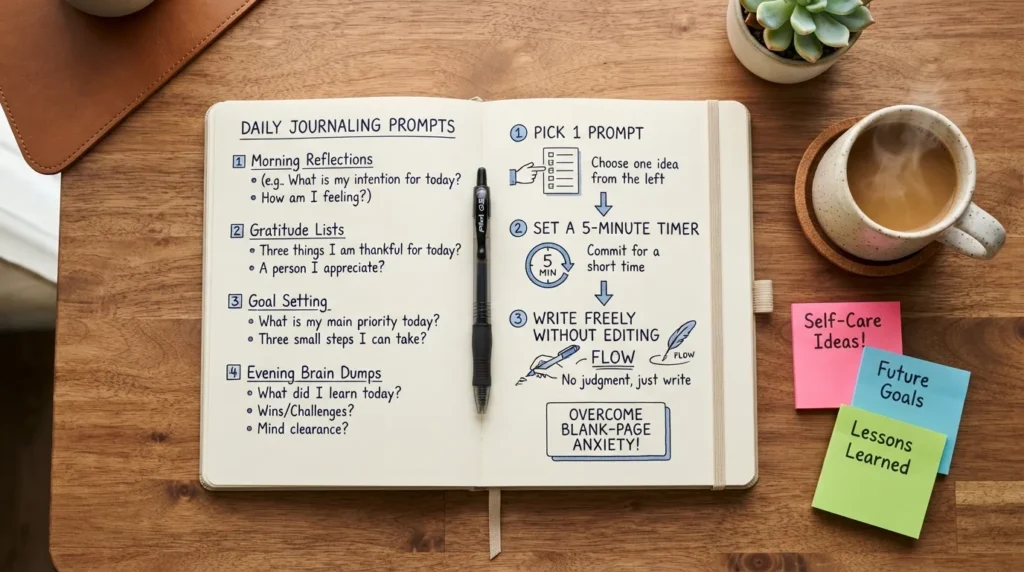
Staring at a blank page can feel more stressful than helpful — especially when you’re not sure where to start. The good news is that journaling has no rules. You don’t need perfect handwriting, a fancy notebook, or hours of free time. All you need is a pen, a few quiet minutes, and one small prompt to get the words flowing.
This guide covers everything a beginner needs: how to start, simple structured methods like the 3-3-3 and 3-2-1 techniques, 60+ easy journaling ideas, common mistakes to avoid, and answers to the questions people ask most about building a journaling habit.
What Is Journaling and Why Should Beginners Start?
Journaling is simply the practice of writing down your thoughts, feelings, and experiences on paper (or a screen) without judgment or a “right” way to do it. It can be a single sentence, a list, a doodle, or a full page of stream-of-consciousness writing.
Research on expressive writing shows that regular journaling is linked to reduced stress, better emotional regulation, improved mood, and even physical health benefits like lower blood pressure and better immune function, according to the Child Mind Institute. For beginners, the real value isn’t in writing something profound — it’s in building a low-pressure habit of checking in with yourself.
How Do Beginners Start Journaling?
If you’re new to journaling, keep it simple. Follow these steps to build a habit that actually sticks:
- Pick a journal you’ll actually want to use. It doesn’t need to be expensive — a plain notebook works just as well as a designer one, as long as you enjoy picking it up.
- Start small. Five minutes a day is enough. You don’t need to fill pages.
- Choose one prompt, not ten. Beginners often overwhelm themselves by trying to answer too many questions at once.
- Write without editing. Spelling, grammar, and neat handwriting don’t matter here.
- Attach it to an existing habit. Journal with your morning coffee, before bed, or during a commute so it becomes automatic rather than another task on your to-do list.
- Don’t aim for daily right away. Journaling two or three times a week is still effective — consistency matters more than frequency.
What Is the 3-3-3 Journaling Method?
The 3-3-3 method is a quick grounding and reflection technique that’s popular with beginners because it removes the pressure of “what do I write?” There are two common versions:
- The grounding version: Write down 3 things you can see, 3 sounds you can hear, and move or name 3 body parts. This version is often used to calm anxiety in the moment.
- The reflection version: Write 3 things you’re grateful for, 3 things you accomplished (or noticed) today, and 3 affirmations or intentions for tomorrow.
Either version takes under five minutes and works well as a nightly wind-down ritual.
What Is the 3-2-1 Method of Journaling?
The 3-2-1 method breaks reflection into three short, decreasing lists so it never feels overwhelming:
- 3 things you’re grateful for
- 2 things you learned, accomplished, or enjoyed today
- 1 intention or focus for tomorrow
Because each section gets shorter, the method is designed to feel achievable even on your busiest or lowest-energy days — you’re never staring at a blank page wondering how much to write.
60+ Simple Journaling Ideas for Beginners
Here’s a full library of beginner-friendly prompts, sorted by category so you can pick whatever fits your mood.
Gratitude & Positivity Prompts
- List 3 tiny things that made you smile today.
- Write about someone who made your week better.
- Describe a place that makes you feel calm.
- Write down one good thing that happened, no matter how small.
- What’s a small comfort you’re grateful for right now?
Brain Dump & Stress-Release Prompts
- Write down everything stressing you out — no editing, no fixing spelling.
- What’s one thing you’re avoiding, and why?
- Set a timer for 10 minutes and write without stopping.
- What would you tell a friend who felt the way you feel right now?
- List every thought currently taking up space in your head.
Self-Reflection Prompts
- How do I actually feel in this exact moment?
- What’s one thing I did well today?
- What pattern do I keep repeating, and what triggers it?
- What does my ideal day look like?
- What am I proud of this week?
Morning Journaling Prompts
- This morning I feel ________.
- Today I need ________.
- One thing I’d love to get done today is ________.
- What’s one small win I’m hoping for today?
- What energy do I want to bring into today?
Evening / Night Journaling Prompts
- Today was ________.
- I’m letting go of ________.
- One thing I’m grateful for today is ________.
- What’s one thing I’d do differently tomorrow?
- What’s still on my mind before I sleep?
Creative & Low-Pressure Ideas
- Make a bulleted list of your current favorite songs, foods, or shows.
- Draw fast lines, shapes, or messy doodles instead of writing.
- Tape in a ticket stub, wrapper, or photo with one sentence about it.
- Write a letter to someone you love (you don’t have to send it).
- Write a letter to something you’re struggling with.
- Jot down a quote from a book, film, or song that stuck with you.
- Fill an entire page with questions — no answers required.
- Write your bucket list and keep adding to it over time.
Goal & Growth Prompts
- What’s one small step I can take toward a goal this week?
- What’s a fear that’s been holding me back?
- What would I attempt if I knew I couldn’t fail?
- What skill am I currently building, and how’s it going?
- What does “success” look like for me right now?
What Not to Do When Journaling? Common Mistakes to Avoid
Beginners often quit journaling not because it doesn’t work, but because of a few avoidable habits:
- Trying to write “perfectly.” Journaling isn’t for an audience — spelling and structure don’t matter.
- Forcing daily entries. Skipping a day (or a week) doesn’t mean you’ve failed. Pick it back up whenever you’re ready.
- Using it only when things go wrong. Journaling only during hard times can make the habit feel heavy. Mix in gratitude and lighter reflection too.
- Re-reading and judging old entries. Old entries reflect where you were, not where you are.
- Overcomplicating it with too many prompts at once. One prompt is enough for a beginner.
Is It Better to Journal in the Morning or at Night?
There’s no universal answer — it depends on what you want from the habit:
- Morning journaling works well for setting intentions, clearing mental clutter before the day starts, and reducing decision fatigue.
- Night journaling works well for processing the day’s emotions, practicing gratitude, and winding down before sleep.
Many beginners find it easier to attach journaling to whichever part of the day already has a quiet moment — like drinking coffee, commuting, or getting into bed.
Is It Healthy to Journal Daily?
For most people, yes. According to WebMD, regular journaling is linked to reduced anxiety and fewer depressive symptoms, even when it isn’t done every single day. That said, journaling doesn’t have to be daily to be effective — a few sessions a week is enough to see benefits for most beginners, and forcing a rigid daily habit can sometimes make the practice feel like a chore rather than a relief.
Downsides of Journaling to Be Aware Of
Journaling is low-risk, but it isn’t entirely without downsides:
- Writing about distressing events without any structure can occasionally intensify difficult emotions before it eases them.
- It can become a way to ruminate rather than process, if you only ever write about what’s wrong.
- It’s not a replacement for professional support if you’re dealing with ongoing anxiety, depression, or trauma — it works best as a supplement to, not a substitute for, therapy.
Frequently Asked Questions
What is the 3-3-3 journaling method? A quick technique where you either ground yourself by naming 3 things you see, hear, and feel (physically), or reflect by writing 3 things you’re grateful for, 3 wins, and 3 intentions for tomorrow.
How do beginners start journaling? Pick a notebook you like, start with just one simple prompt, write for five minutes without editing, and attach the habit to something you already do daily.
What are some cool ideas for journaling? Try a gratitude list, a brain dump, a letter to your future self, a mini collage page, or a “things I’m loving right now” list — see the full list of 60+ ideas above.
What are common journaling mistakes? Trying to write perfectly, forcing daily entries, only journaling during hard times, and overloading yourself with too many prompts at once.
Is it better to journal in the morning or night? Both work — mornings help set intentions, nights help process the day. Choose whichever fits naturally into your existing routine.
Pimchanok Srisuk
Pimchanok Srisuk is the Journaling Editor at Holistic Wellbeing Living. She writes about journaling prompts, reflective writing, emotional clarity, and mindful routines. With seven years of experience creating personal-growth content, Pimchanok helps readers use simple writing practices to understand their thoughts and make calmer everyday decisions.