Jump to:
Toggle100+ Journal Ideas for Students: Academic, Emotional & Creative Prompts (By Age)
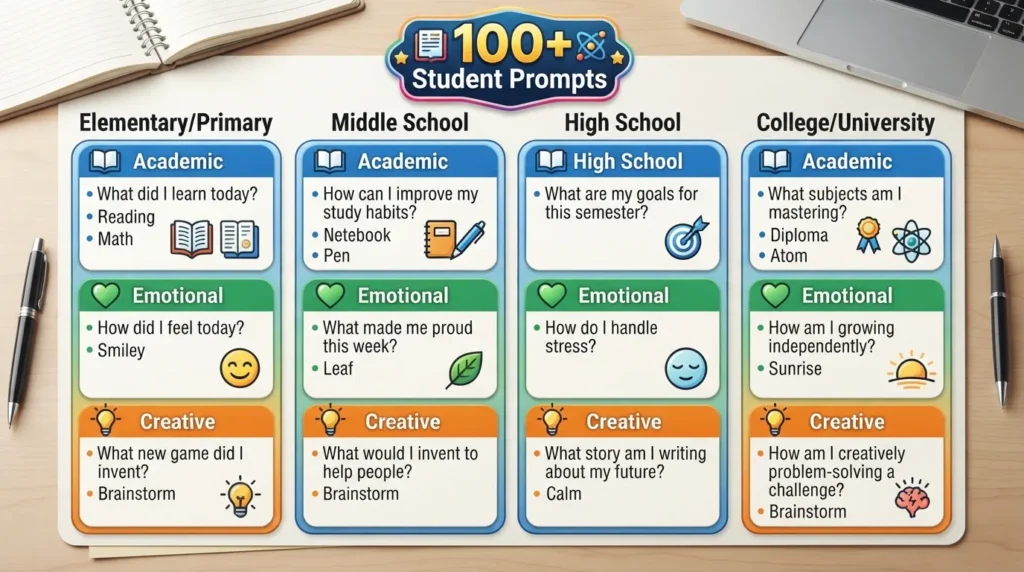
Journaling isn’t just for adults with fancy notebooks and morning coffee rituals. For students, a journal can be a planner, a stress-release valve, and a creative playground — all in one notebook. Whether you’re a parent looking for prompts for your child, a teacher setting up a classroom routine, or a student who just doesn’t know where to start, this guide covers every angle: academic organization, emotional wellbeing, and pure creative fun, broken down by age group so you can jump straight to what fits.
Why Journaling Matters for Students
Journaling gives students a private space to think out loud on paper. Beyond the obvious writing practice, a regular journaling habit is linked to:
- Better emotional regulation — putting feelings into words helps students process stress, frustration, or big emotions instead of bottling them up
- Stronger academic organization — tracking assignments, grades, and deadlines in one place reduces the mental load of “remembering everything”
- Improved focus and memory — reflecting on what was learned helps information stick
- Lower stress and anxiety — a few minutes of writing can work like a pressure valve before a test or a hard day
- A lifelong reflective habit — students who journal young often carry the habit into adulthood as a tool for self-awareness and goal-setting
What Is the 3-3-3 Journaling Method?
The 3-3-3 method is a simple beginner framework: write for 3 minutes, about 3 things (for example, three things you’re grateful for, three things on your mind, or three highlights of your day), 3 times a week. It’s popular with students specifically because it removes the pressure of “writing a lot” — three minutes is enough to build the habit without feeling like homework.
7 Types of Journals Students Can Try
Not every student wants to write a diary entry every day. Here are seven formats worth trying:
- Gratitude journal — a running list of things you’re thankful for
- Bullet journal — a flexible planner-meets-journal hybrid using short bullet points, trackers, and lists
- Reflective journal — traditional diary-style writing about your day or feelings
- Academic/study journal — a dedicated space for tracking classes, grades, and what you’re learning
- Dream journal — recording dreams right after waking up
- Travel journal — documenting trips, big or small (even a weekend visit counts)
- Art/visual journal — combining sketches, doodles, and short notes for students who think visually
Academic Journal Ideas for Students
This is the category most “journal ideas” lists skip — but it’s one of the most useful for students who want their journal to double as a organizational tool.
Organization & Planning Prompts
- Map out a semester-at-a-glance page with major test dates and project deadlines, color-coded by subject
- Build a weekly class schedule grid, including teacher names and office hours
- Keep a running grade tracker and calculate your overall progress in each class
- Break a big assignment into a checklist of small daily steps instead of one overwhelming task
- Log your study hours per subject each week to spot where you’re spending (or not spending) time
Study & Reflection Prompts
- “What finally clicked for me today?” — describe a concept that was confusing and how it started making sense
- Write a short exam post-mortem: what worked, what you’d change next time
- List three questions you still have about this week’s material
- Track a personal “learning streak” — one new thing you understood better each day
- Reflect on which study method (flashcards, re-reading, practice tests) actually helped this week
Journal Ideas for Students' Mental Health
Journaling is one of the simplest tools for managing school-related stress — no app, no cost, just a notebook.
Mood & Stress Prompts
- Color in a small mood tracker box each day and look for patterns at the end of the week
- Do a “brain dump” — write down everything on your mind for two minutes before starting homework, no editing
- Split a page in half: one side for what’s stressing you out, the other for what’s helping you cope
- Write about one thing you’re proud of handling well this week, even if it was small
- Describe a moment today when you felt calm — what were you doing?
Gratitude & Positivity Prompts
- Three things that made you smile today
- One highlight from class or with friends
- A person who made your day a little better, and how
- Something small you’re looking forward to this week
- One thing about yourself you’re grateful for right now
If you’re navigating ongoing stress or anxiety that feels bigger than a notebook can hold, journaling can be a helpful companion tool — but it isn’t a replacement for talking to a school counselor, parent, or another trusted adult.
Creative & Fun Journal Prompts for Students
For students who want their journal to be more playground than planner:
- Write a letter to yourself five years from now — what do you hope has changed?
- Keep a “curiosity log” — random questions you want to look up just for fun
- If you woke up with any one superpower tomorrow, what would you do with it first?
- Design your dream classroom or school from scratch — what would be different?
- Invent a new holiday and describe how everyone would celebrate it
- Make a comic strip of the funniest thing that happened this week
- If your life were a movie right now, what would this week’s title be?
- Describe your perfect Saturday, hour by hour
- Write about a time you changed your mind about something
- Make a “would you rather” list and answer your own questions
Journal Prompts by Age Group
ounger students do best with short, concrete, one-line prompts — and drawing counts as journaling too.
- What is your favorite color, and why do you like it?
- Draw your family and write one word for each person
- What made you laugh today?
- If you could have any pet, what would it be?
- What’s your favorite thing to do outside?
Journal Prompts for Middle & High School Students (Teens)
Teens benefit from prompts that go a little deeper — identity, friendships, and the future.
- What’s something people misunderstand about you?
- Describe a friendship that’s changed over the past year
- What’s a goal you’re working toward right now, and what’s the hardest part?
- Write about a time you had to make a tough decision
- What does “success” mean to you, honestly — not what you think it’s supposed to mean?
Journal Ideas for College Students
College journaling tends to lean practical — managing time, independence, and mental load.
- What’s draining your energy this week, and what’s one small way to protect it?
- Log how you actually spent your time yesterday vs. how you planned to
- What’s one thing about being on your own that’s been harder than expected?
- Write about a class or idea that’s genuinely changed how you think
- What does your ideal week look like a semester from now?
How to Start Journaling Daily
w to Start Journaling Daily
- Pick a consistent time — right after waking up or right before bed both work well; consistency matters more than the exact time
- Start small — 3 to 5 minutes is enough when you’re just building the habit
- Keep a prompt on hand — for the days your brain goes blank, having a go-to prompt list removes the “what do I write about” barrier
- Drop the perfectionism — grammar and neat handwriting don’t matter here; this isn’t an assignment that gets graded
- Do a weekly reread — once a week, flip back through your entries and notice any patterns in your mood, stress, or wins
Common Journaling Mistakes to Avoid
- Trying to write pages on day one — this burns out motivation fast; short and consistent beats long and sporadic
- Being overly self-critical — a journal isn’t the place to judge your own handwriting, grammar, or “boring” days
- Skipping a set time or place — without a routine, journaling becomes easy to forget
- Comparing your journal to someone else’s — aesthetic bullet journals on Pinterest are optional, not the standard
What Does a Journal Entry Actually Look Like?
Here’s a short example to make it concrete:
October 14 — Today was kind of a rough one. I bombed a pop quiz I didn’t know was coming, but honestly I handled it better than I thought I would. Instead of spiraling, I just made a note to review that chapter tonight. Small win, I guess. Three things I’m grateful for: my friend saved me a seat at lunch, the weather was actually nice, and dinner was really good.
FAQs
What are good journal topics for students? Anything from academic reflection (what you learned, what confused you) to emotional check-ins (mood, gratitude, stress) to pure creative writing (imagination prompts, “what if” scenarios). The best topic is whatever gets a student actually writing consistently.
What are some cool ideas for a journal? Try a curiosity log of random questions to research, a comic-strip recap of your week, a “future self” letter, or a visual/art journal that mixes sketches with short notes.
What are 5 quick journal entries anyone can start with today? Three things you’re grateful for, one highlight of your day, a mood check-in, a brain dump of what’s on your mind, and one goal for tomorrow.
What is the best journal for beginners? A plain notebook is genuinely enough to start — the format (bullet journal, guided journal, plain notebook) matters far less than actually writing consistently.
What to write in a journal when you don’t know where to start? Pick any prompt from this list, or simply write about your day for two minutes without stopping to edit. The goal is momentum, not perfection.
Pimchanok Srisuk
Pimchanok Srisuk is the Journaling Editor at Holistic Wellbeing Living. She writes about journaling prompts, reflective writing, emotional clarity, and mindful routines. With seven years of experience creating personal-growth content, Pimchanok helps readers use simple writing practices to understand their thoughts and make calmer everyday decisions.