Jump to:
ToggleJournal First Page Ideas: How to Start Any Journal Without the Blank-Page Fear
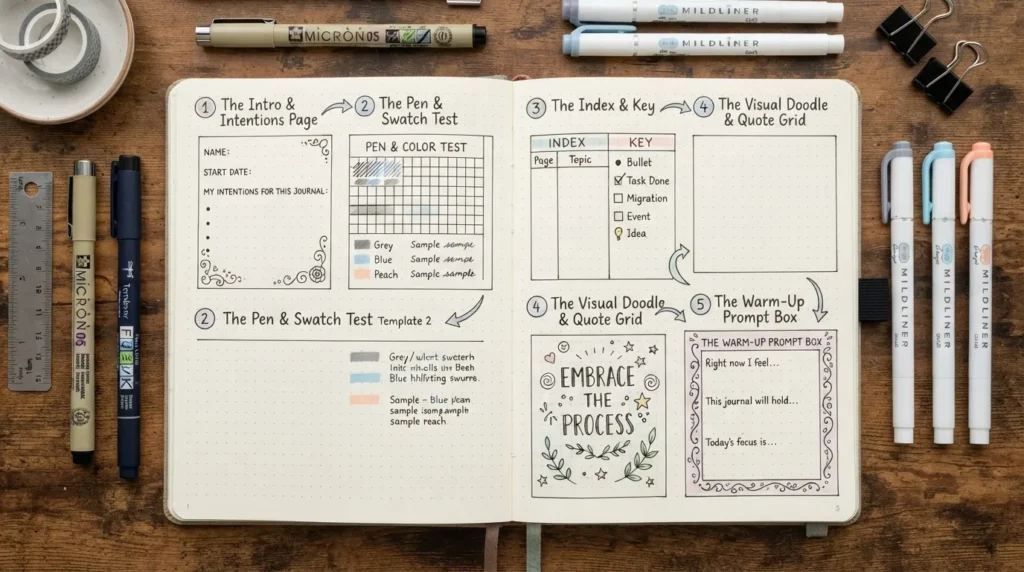
You open a brand-new journal, pen in hand, and freeze. That’s “first page fear” — the worry that whatever you write first has to be perfect, or you’ll ruin the whole thing before you’ve even started. This page fixes that. Below you’ll find first-page ideas sorted by exactly who you are right now — beginner, student, aesthetic-first, or diary-keeper — plus the journaling methods people search for most, and the mistakes worth avoiding before you write a single word.
Why the First Page Feels So Hard (and Why It Doesn't Have to Be Perfect)
Part of the pressure is financial — you don’t want to “waste” an expensive journal on a bad first attempt. Part of it is personal — you’re worried your handwriting, your layout, or your idea won’t look as good as you pictured it. Both of those worries come from the same wrong assumption: that the first page has to be art.
It doesn’t. The first page’s only real job is to get you writing. Everything after it gets easier once that one page is behind you.
Journal First Page Ideas for Beginners
- Leave the first page blank, or start on page 3. Skipping ahead removes the pressure of a “perfect” opening and gives you a couple of backup attempts if your first try doesn’t feel right.
- Write a short intro paragraph. A few lines on why you’re starting this journal and what’s going on in your life right now is enough.
- Add the date and a one-line mood check-in. Something like “Started March 4th. Feeling: hopeful, a little nervous.”
- List three goals for this specific journal. Not life goals — just what you want this one notebook to help you with.
- Write a short letter to your future self. Something you can read back once the journal is full.
How Do Beginners Start Journaling?
Start with one prompt on one page — don’t pressure yourself into writing daily right away. Pick a single method (see the methods section below) instead of freewriting with no structure, and treat your first week as practice, not performance.
Aesthetic Journal Front Page Ideas
- A hand-lettered title page. Your name, the year, or a personal motto in bold or bubble lettering.
- A vision board collage. Magazine cut-outs, washi tape, and stickers arranged around one theme word for the year.
- A pressed flower or leaf spread. Dried botanicals taped alongside a favorite quote.
- A color palette page. Swatches of the colors that match your current mood or season, with a short reflection underneath.
- A minimalist page. Just your name and the date, centered, with plenty of white space and no clutter.
- A scrapbook-style spread. Ticket stubs, photo strips, or fabric scraps layered like a mini collage.
Journal First Page Ideas for Students
- A contact/ownership page. Your name, class or subject, and a note in case the journal is lost.
- A semester goals list. The grades you’re aiming for, habits you want to build, and subjects you’re excited or nervous about.
- A color-coded key. If you’re using different colors for different subjects or priorities, define them on page one.
- A table of contents. Leave the first page (or two) blank and fill in entries as you go — especially useful in a subject notebook or bullet journal.
- A weekly schedule snapshot. A simple grid of your class times or study blocks for quick reference.
What Should I Write on My Diary's First Page?
- Personal details / a “slam book” page. Your name, age, favorite things, and a few fun facts, like a quick self-interview.
- A mission statement. One or two sentences on what you want this diary to be for you — processing emotions, tracking growth, or just having a space that’s yours.
- A life timeline. Key milestones so far, or where you want to be by the time this diary is full.
- A favorite quote that sets the tone. See the Quotes section below for options by mood.
- A photo or self-portrait. A printed picture that represents who you are right now, with a short caption.
- A “right now” snapshot. Your current favorite song, book, worry, and hope — a small time capsule you can look back on later.
Journal First Page Quotes
- For a fresh start: something about new beginnings or turning the page on the past.
- For self-reflection: something about honesty, growth, or knowing yourself.
- For creativity: something about art, imperfection, or making a mess on purpose.
- For motivation: something short and direct about consistency or showing up.
Hand-letter it, print and paste it, or just write it in your normal handwriting — the format matters far less than choosing words that actually mean something to you.
Journaling Methods Worth Starting Your Journal With
What Is the 3-3-3 Journaling Method?
Write down three things you’re grateful for, three things you did that day, and three goals for tomorrow. It takes under five minutes and gives you a reusable template you can return to on every page after your first.
What Is the 3-2-1 Method for Journaling?
Reflect on three things you learned, two things that surprised you, and one thing you want to explore further. It works especially well for a learning journal, a book journal, or an end-of-week reflection page.
5-Minute Journal Prompts
Pick one prompt and write until the timer runs out, without editing yourself. A few to open your journal with:
- “Right now, I feel…”
- “Something I’m avoiding is…”
- “If today went perfectly, it would look like…”
- “One thing I want to remember about this season of my life is…”
What Are Some Good Ideas for Starting a Journal?
- Pick one purpose for this journal — gratitude, creativity, planning, healing — instead of trying to make it everything at once.
- Keep your very first entry short. A paragraph is enough.
- Don’t wait for a “perfect” day to start. Today’s date works fine.
- Set a light rhythm, like with your morning coffee or before bed, instead of a strict daily rule.
- Give yourself permission to skip days without starting the whole journal over.
Is It Healthy to Journal Every Day?
For most people, yes. Expressive writing through journaling is widely recognized as an effective way to process stress, difficult emotions, and even trauma, and it’s considered a well-supported tool for managing everyday stress. That said, daily journaling isn’t a strict requirement for it to help — consistency over time matters more than never missing a day. If journaling ever starts to feel like a source of pressure rather than relief, it’s worth easing off the frequency or changing the format instead of forcing it.
For more on the research behind this, see Healthline’s guide to the benefits of journaling.
What Not to Do When Journaling
- Don’t aim for perfect grammar or handwriting — journaling isn’t for an audience.
- Don’t force positivity if you’re not feeling it. Honest entries are more useful than curated ones.
- Don’t compare your pages to journaling accounts online — those are edited highlights, not the norm.
- Don’t skip re-reading occasionally. Part of journaling’s value comes from looking back.
Watch: A First-Page Walkthrough
If you'd rather see this in action, this video walks through several first-page layouts for a brand-new notebook — useful if you're a visual learner or just want to see how the ideas above come together on paper.
FAQ
What is the 3-3-3 journaling method? The 3-3-3 method is a quick journaling template: write three things you’re grateful for, three things you did that day, and three goals for tomorrow. It takes under five minutes and works well as a repeatable format for every entry.
What is the 3-2-1 method for journaling? The 3-2-1 method asks you to write three things you learned, two things that surprised you, and one thing you want to explore further. It’s best suited to a learning journal, book journal, or weekly reflection page.
What are some good ideas for starting a journal? Pick one clear purpose for the journal, keep your first entry short, start on any date instead of waiting for a “perfect” one, set a light writing rhythm, and let yourself skip days without restarting the whole journal.
What should I write on my diary’s first page? Common options include a short mission statement, a personal-details page, a life timeline, a favorite quote, a photo or self-portrait, or a “right now” snapshot of your current favorites and worries.
What not to do when journaling? Avoid aiming for perfect grammar or handwriting, forcing positivity you don’t feel, comparing your pages to journaling accounts online, and skipping re-reading your own entries later.
What are 5-minute journal prompts? Short, timed prompts meant to be answered without overthinking or editing — for example, “Right now, I feel…” or “Something I’m avoiding is…” You write until the timer runs out, then stop.
Is it healthy to journal every day? For most people, yes — journaling is a well-supported way to process stress and emotion. Daily writing isn’t required for it to help, though; what matters more is staying consistent over time rather than never missing a day.
How do beginners start journaling? Start with one prompt on one page instead of committing to daily writing right away. Choose a single method, like 3-3-3, rather than freewriting with no structure, and treat the first week as practice.
Pimchanok Srisuk
Pimchanok Srisuk is the Journaling Editor at Holistic Wellbeing Living. She writes about journaling prompts, reflective writing, emotional clarity, and mindful routines. With seven years of experience creating personal-growth content, Pimchanok helps readers use simple writing practices to understand their thoughts and make calmer everyday decisions.