Jump to:
Toggle50+ New Year Journal Ideas for Adults (2026) — Reflection, Creative Prompts & Simple Methods
What Makes New Year Journaling Different
The turn of the calendar year carries a distinct psychological weight. Even if time is continuous, our minds naturally crave milestones to pause, take stock, and anchor new intentions. This symbolic “reset” offers a rare collective permission slip to step off the treadmill of daily obligations, evaluate what actually matters, and consciously design the months ahead rather than simply reacting to them.
This guide is designed to help you move beyond generic goal-setting and build a meaningful, sustainable practice. Inside, you will find a curated mix of deep reflective prompts, creative visual spread ideas, structured journaling frameworks, beginner-friendly options, and straightforward answers to common questions about starting your new year journaling journey.
How to Start Your New Year Journal
Best Time to Journal
Choosing the right time to open your notebook depends entirely on your mental energy and what you want out of the practice.
Morning journaling works best if you want to set clear intentions, clear out mental fog before the day starts, and approach your schedule with proactive focus.
Night journaling is ideal for processing daily events, winding down an overactive mind, and reflecting on lessons learned before sleep.
Experiment with both to see which slot feels like a natural pause rather than another chore on your to-do list.
How to Pick Your First Prompt
Starting a new journal can easily trigger perfectionism or performance anxiety. To bypass that initial resistance, pick a prompt that feels low-stakes, highly specific, and forgiving. Avoid massive questions like “What is my life purpose for the next decade?” and instead choose something bite-sized, such as “What is one small comfort I want to prioritize this week?” Allow your first entries to be messy; momentum matters far more than eloquence.
Tools You Need
Getting started requires very little—just a reliable notebook and a pen you actually enjoy writing with. For a deeper breakdown of notebook weights, pen bleed-through, and digital versus analog setups, explore our complete How to Start Journaling Guide.
Printable & Downloadable New Year Journal Prompts
If you prefer holding a physical checklist in your hands while you sit down with your coffee, having a curated reference sheet can streamline your routine. You can easily copy these prompts into a dedicated document or save our printable summary checklist version to keep your favorite questions right inside your journal cover for quick daily access.
Simple Journaling Methods to Try This Year
If staring at a completely blank page leaves you feeling stuck, structured frameworks provide just enough guardrails to help you flow. Rather than relying on open-ended writing every day, integrating these proven methods can keep your practice grounding and manageable.
What Is the 3-3-3 Journaling Method?
The 3-3-3 Method is designed for rapid grounding, making it an excellent choice for busy days. You write down three things you are grateful for, three tasks or intentions for the day, and three things you can physically see or sense in your immediate environment. This practice pulls you out of abstract loops and anchors you directly in the present.
Example Prompt 1: List three quiet moments from yesterday that brought a sense of ease.
Example Prompt 2: Name three realistic boundaries you commit to holding today.
Example Prompt 3: Observe your current space and list three tangible textures or objects you can touch right now.
What Is the 3/2-1 Journaling Method?
The 3/2-1 Method is a powerful evening review practice that helps process lingering mental clutter. You reflect on 3 wins or things that went well, 2 lessons or challenges you navigated, and 1 release—something you are actively choosing to let go of before you sleep.
Example Prompt 1: Identify three small or large accomplishments from today that you are proud of.
Example Prompt 2: What are two difficult situations you navigated today, and what did they teach you about your own resilience?
Example Prompt 3: What is one lingering regret or unnecessary expectation from today that you are ready to leave behind?
The 5-Minute Journal Method
Rooted in positive psychology, the 5-Minute Journal Method uses brief morning and evening prompts to shift your subconscious toward gratitude and self-compassion. By keeping your session short, you eliminate decision fatigue and build a sustainable, long-term habit.
Prompt 1: Three things I am grateful for today.
Prompt 2: One thing that would make today feel truly great.
Prompt 3: One affirmation for the new year that keeps me focused on my growth.
Prompt 4: What is one thing I learned today that I want to carry forward?
Reflective Prompts — Looking Back at the Past Year
True growth requires an honest audit of where you have been. Before rushing into new ambitions, use these prompts to mine the past year for wisdom, ensuring you carry the lessons forward rather than just the baggage.
Celebrate your big wins: What are the three most significant achievements you realized this year, and how did they change your perception of your own capabilities?
Acknowledge the small wins: What are the quiet, invisible victories—the days you showed up when you didn’t want to, or the moments you chose kindness over conflict—that deserve recognition?
Analyze challenges and lessons: Which experience felt the most difficult this year, and what specific strength or resource did you discover within yourself while navigating it?
Examine key relationships: Which individuals or communities added the most genuine value to your life, and how can you deepen those connections in the coming year?
Identify habits to leave behind: What is one routine, behavior, or thought pattern that no longer serves your future self, and what is the first small step toward dismantling it?
One-word recap: If you had to summarize the theme of the past 365 days in a single word, what would it be, and why does that specific word feel accurate?
Creative & Artistic New Year Journal Ideas
Sometimes prose alone cannot capture the transition of a new year. Engaging your creative side helps process emotions and visualize intentions in ways that standard writing sometimes misses, adding a tactile, expressive dimension to your practice.
Vision Board Collage Page
Instead of a digital mood board, gather physical magazines, old prints, or ticket stubs to create a collage spread that represents the energy you want to cultivate. Cut out colors, textures, and phrases that resonate without overthinking the arrangement. This tactile process helps ground your aspirations in your physical space.
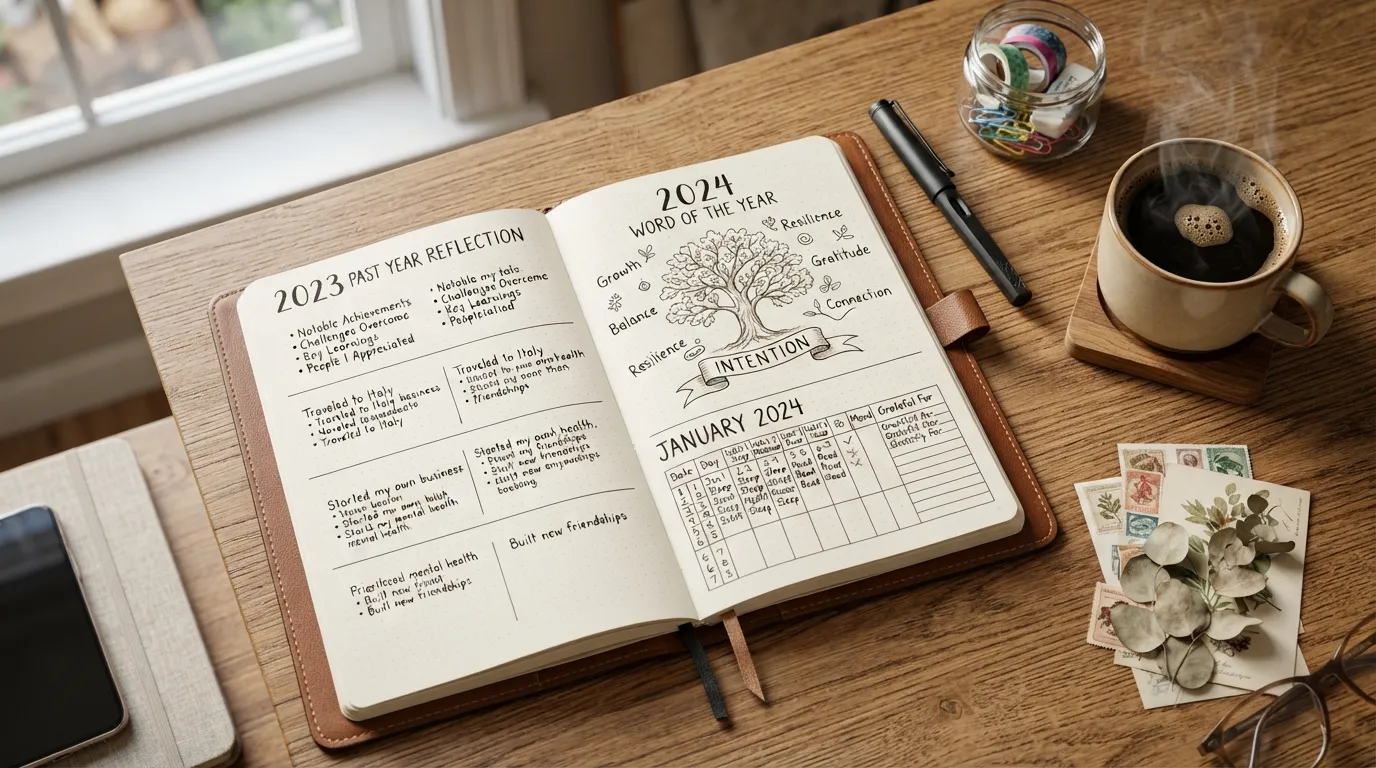
Word of the Year Page
Select a single guiding word to act as your anchor, compass, and filter for the upcoming months. Dedicate a full page to writing this word in bold, artistic lettering, surrounded by notes on why you chose it, how it feels in your body, and what boundaries or habits it inspires you to embrace.
Then & Now Tracker
Create a snapshot page divided into two columns or sections: “One Year Ago” and “Right Now.” Fill it with quick personal data points—your current favorite book, your go-to comfort meal, your primary daily challenge, and your biggest joy. This serves as a fascinating time capsule when you look back twelve months later.
Future Self Letter
Write a handwritten letter dated for the final day of the coming year, addressed directly to your future self. Speak to them with compassion, encouragement, and curiosity about what they have lived through. Fold the page, seal it into an envelope, and tape it onto the back cover of your journal to open next New Year’s Eve.
Junk Journaling Ideas for New Year
Incorporate ephemera from the holiday season—gift tags, wrapping paper scraps, tea bag labels, or receipts from memorable outings—into your pages. Write your reflections directly over or around these scraps. This method turns your journal into an authentic physical record of daily life rather than a pristine, intimidating notebook.
More Creative Writing Ideas — List of 26, Alphabet Journaling, Memory Jar Notes
List of 26: Write a list of 26 things you want to learn, experience, read, or let go of in the upcoming year (or tailor the number to your current age).
Alphabet Journaling: Dedicate a spread to writing lines or intentions starting from A through Z, using quick single words or short phrases for each letter.
Memory Jar Notes: Set aside a dedicated page or pocket to jot down micro-memories and unexpected moments of joy throughout January, creating a running log of gratitude to revisit later.
Goal-Setting & Intention Prompts for the Year Ahead
Moving from reflection into action requires clarity, not pressure. Use these focused prompts to establish realistic goals that align with your actual values rather than external expectations.
Prioritize your health goals: What is one sustainable physical habit—such as a specific sleep routine, strength practice, or nutritional adjustment—that will genuinely support your energy levels this year?
Shape your career and vocation goals: What professional skill do you want to cultivate, or what boundary do you want to set around your work hours to prevent burnout while moving your projects forward?
Outline your financial goals: What is one intentional financial practice you want to adopt, such as automating a savings contribution or auditing recurring expenses, to bring more peace of mind to your wallet?
Focus on personal growth goals: What book, course, or creative hobby have you been putting off that you are finally ready to commit to exploring on a weekly basis?
Define your overarching intention: Looking at all areas of your life combined, what single guiding sentence or overarching theme will serve as your north star for the next twelve months?
Simple & Fun New Year Journal Prompts Low-Effort Ideas
If the idea of deep analysis feels heavy, keep your practice light. Journaling doesn’t always have to be a transformative ordeal; sometimes, it’s just a way to check in with yourself. Try these quick, low-pressure prompts whenever you need a mental reset without the heavy lifting.
Your current vibe: What is one song, food, or comfortable outfit that is making your week feel 10% better right now?
Digital refresh: What is one app you’re using too much and one photo in your camera roll that always makes you smile?
Unexpected joy: What is the most random or surprising thing that made you laugh in the last few days?
The “no” list: What is one tiny, trivial thing you are happily giving yourself permission to stop caring about this month?
Space check: If your current room was a hotel room, what is one thing you’d change to make it feel more relaxing?
Small treat: What is a simple, inexpensive luxury you want to gift yourself this coming weekend?
Conversation highlight: What was the last interesting thing you talked about with a friend that wasn’t related to work or responsibilities?
Mental Health & Emotional Wellbeing Prompts
Journaling is a well-established practice for externalizing internal stressors, providing a safe space to decompress and observe thoughts without judgment. If you are feeling overwhelmed, these prompts are designed to help you regain equilibrium and foster self-compassion during the often-hectic transition into a new year.
Journal Prompts for Anxiety
When you feel caught in a cycle of worry or racing thoughts, the goal of journaling shifts from reflection to regulation. According to guidance from the Mayo Clinic, writing can help manage anxiety by prioritizing problems, fears, and concerns, making them easier to manage. Use these prompts to help move from a state of reactive stress to one of grounded awareness.
The brain dump: Set a timer for three minutes and write down every single worry currently occupying your mind, no matter how irrational it feels; once it is on paper, identify which items you actually have control over today.
The “worst-case” reality check: If your mind is spiraling about a specific future outcome, write down the absolute worst-case scenario, then write down the most likely outcome, and finally, one way you would cope if things went wrong.
Physical state audit: Describe exactly where you feel anxiety in your body—such as a tight chest or shallow breath—and then write down one physical action you can take right now to soothe that specific area.
Self-compassion redirect: If you were talking to a close friend who felt the exact same way you do right now, what specific words of comfort or advice would you give them?
The anchor list: When everything feels chaotic, list five things you can see, four things you can touch, three things you can hear, two things you can smell, and one thing you can taste to bring your nervous system back into the room.
Frequently Asked Questions
What is the 3-3-3 journaling method?
The 3-3-3 method is a quick grounding exercise where you set a timer for 3 minutes, list 3 things you are grateful for, and note 3 specific sensory details from your immediate surroundings. It removes performance pressure and anchors you in the present moment.
What is the 3/2-1 method of journaling?
This is a structured reflection technique used to process a day or week. Typically, it involves writing down 3 wins or lessons learned, 2 areas of focus or things to let go of, and 1 core intention for moving forward.
What are some good journal prompts for 2026?
Great prompts for the year focus on intentional living and adaptability:
- What is one habit or expectation I am ready to leave behind this year?
- What does a genuinely balanced week look like for me right now?
- How can I simplify my daily routine to protect my mental energy?
What are some cool ideas for a journal?
To keep journaling engaging, try experimenting with non-traditional layouts such as a media/book tracker, a one-line-a-day memory log, a pocket weather and nature tracker, or a dedicated page for sketching small everyday objects.
What are some fun journal prompts?
Keep things lighthearted with prompts like: "If my current mood was a weather forecast, what would it look like?", "What is a weird or niche topic I could easily talk about for 30 minutes?", or "Describe my ideal lazy Sunday using only sensory details."
What to write in a journal as an adult?
Adult journaling often bridges practicality and emotional processing. Useful topics include career boundaries, financial reflections, relationship wins, navigating burnout, tracking personal growth, and documenting simple domestic routines.
What are some junk journaling ideas?
Junk journaling uses reclaimed and everyday paper ephemera. Ideas include collaging with old book pages, stitching tickets and receipts into margins, pressing leaves or flowers, and layering stamps, tea bags, and packaging labels.
What should I put in a daily journal?
A daily journal can be as brief or detailed as you like. Common entries include the date, a quick emotional check-in, one highlight or challenge from the day, a short gratitude list, and a brief note about tomorrow's main priority.
What is a good first journal prompt?
An ideal first prompt is low-stakes and grounded: "What do I see, hear, and feel right at this exact moment?" This bypasses writer's block by focusing entirely on immediate physical reality rather than deep self-analysis.
What is the best time to journal?
The best time is whenever you can maintain consistency. Morning journaling helps set intentions and clear mental clutter, while evening journaling is ideal for processing the day's events and unwinding before sleep.
How to journal creatively?
Break away from linear blocks of text by incorporating colored pens, margin doodles, mind maps, ticket stubs, watercolor splashes, or writing entries in the form of letters, bullet points, or fictional dialogues.
What are some creative journal ideas?
Try creating a "Favorites" list page (favorite coffees, songs, smells), a quote collection from people you admire, a visual mood board for the current season, or a 30-day challenge tracker with custom drawn icons.
What are some journal prompts for anxiety?
Helpful anxiety prompts include: "What is within my control right now, and what is outside of it?", "If my worry could talk, what would it be trying to protect me from?", and "What is one physical action I can take right now to ground myself?"
What are some deep journal prompts?
For deeper introspection, explore: "What core belief about myself am I ready to examine or rewrite?", "In what areas of my life am I seeking approval from others instead of myself?", and "What does living authentically look like for me today?"
What are some good prompts for a 5-minute journal?
Quick 5-minute prompts work best when kept punchy: "Three things I'm grateful for today," "How do I want to feel by the end of the day?", and "What is one small win I can celebrate right now?"
Pimchanok Srisuk
Pimchanok Srisuk is the Journaling Editor at Holistic Wellbeing Living. She writes about journaling prompts, reflective writing, emotional clarity, and mindful routines. With seven years of experience creating personal-growth content, Pimchanok helps readers use simple writing practices to understand their thoughts and make calmer everyday decisions.