Jump to:
ToggleStream of Consciousness Journaling: The Ultimate Guide to Clearing Mental Clutter
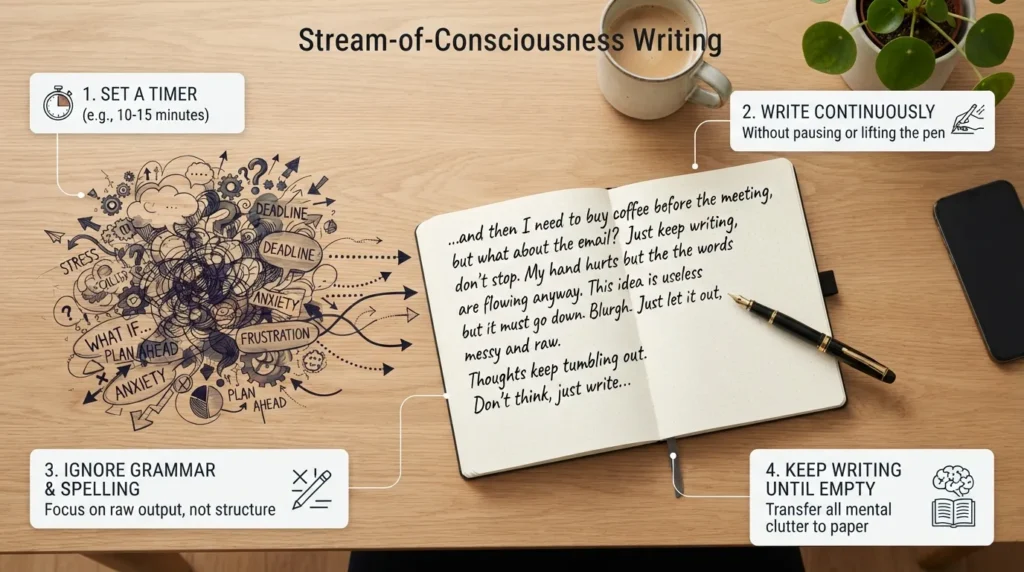
Stream of consciousness journaling is the practice of continuously writing down your raw, unfiltered thoughts the exact moment they enter your mind—without stopping, editing, correcting grammar, or judging what you write. Unlike traditional journaling, which focuses on daily event logs or structured self-reflection, stream of consciousness writing serves as an immediate “brain dump” to eliminate overthinking, reduce anxiety, and bypass your inner critic.
If your mind moves from a stressful work deadline to an old memory, and then to a random grocery list item, you write every single thought down word-for-word. The goal is not to produce beautiful literature or neat notes; the sole objective is to empty your brain onto the page.
What is Stream of Consciousness Journaling?
The Four Golden Rules of Unfiltered Writing
To practice stream of consciousness writing effectively, you must follow four core mechanics:
Keep the Pen Moving: Never pause to think, deliberate, or analyze. If your mind goes completely blank, write “I don’t know what to write” over and over until a fresh thought emerges.
Zero Editing & Zero Censorship: Ignore spelling mistakes, grammatical errors, run-on sentences, and messy handwriting. Do not erase or backspace.
Release Self-Judgment: Allow silly, angry, petty, chaotic, or confusing thoughts onto the page without evaluating whether they sound smart or good.
Set Strict Boundaries: Work against a physical timer (e.g., 10 to 15 minutes) or a fixed page length (e.g., 3 handwritten pages). Stop immediately when you reach your limit.
Traditional Journaling vs. Stream of Consciousness Journaling
Understanding how this method differs from standard reflective writing highlights why it works so effectively for mental stress relief:
Structure:
Traditional: Prompt-driven, thematic, structured, or chronological daily logs.
Stream of Consciousness: Completely raw, unstructured, non-linear, and spontaneous.
Mindset:
Traditional: Analytical, reflective, and retrospective.
Stream of Consciousness: Immediate, present-moment observation without evaluation.
Primary Goal:
Traditional: Goal tracking, memory recording, and personal growth analysis.
Stream of Consciousness: Cognitive offloading, stress reduction, and silencing the inner critic.
Readability:
Traditional: Intended to be saved and re-read over time.
Stream of Consciousness: Often never re-read; can be archived or safely discarded.
Historical & Psychological Origins
The concept was first formulated by pioneering American psychologist William James in 1890 in his book The Principles of Psychology, where he observed that human consciousness is not pieced together in sharp fragments, but flows like a continuous stream. Literary giants such as Virginia Woolf and James Joyce later transformed this psychological concept into a celebrated narrative style.
In the 1990s, author Julia Cameron adapted the approach into a personal transformation practice called “Morning Pages” in her seminal work The Artist’s Way, establishing stream of consciousness journaling as a primary tool for mental wellbeing and creative recovery.
The Science & Benefits: How It Rewires Your Brain
Cognitive Offloading & Deactivating the Inner Critic
When you sit down to write formally, your brain’s prefrontal cortex works hard to organize, filter, and polish your thoughts for logic and social acceptance. Stream of consciousness writing forces speed, effectively tricking and bypassing this cognitive filter. This process—known in cognitive science as cognitive offloading—frees up valuable working memory by releasing unresolved mental loops and background worries.
Neurological Impact: Calming the Amygdala
Groundbreaking research on expressive writing demonstrates that converting raw emotions into physical words reduces neural activity in the amygdala (the brain’s fear and stress response center). This shift lowers cortisol levels, regulates heart rate, and shifts your nervous system into a calm state.
How It Stops Mental Rumination & Overthinking
Overthinking occurs when thoughts spin continuously in an endless internal loop. By physically transferring those thoughts onto paper, you externalize them. Once a worry exists in physical ink, your brain stops holding onto it, effectively breaking the cycle of anxious rumination.
Step-by-Step Guide: How to Start Stream of Consciousness Journaling
Step 1: Choose Your Tools (Paper vs. Digital)
While handwritten notebook writing is recommended because the physical movement slows down anxious thinking, digital typing works well for fast typists. Choose simple tools: a basic spiral notebook and a smooth pen, or a clean digital document with all spellcheck and grammar underlines turned off.
Step 2: Eliminate Distractions & Set a Timer
Put your smartphone on silent mode or in another room. Set a dedicated timer for 10 to 15 minutes. Using a timer removes the need to look at the clock and sets a clear start and end point for your brain dump.
Step 3: Begin Writing Without Hesitation
Write down the very first thought present in your mind right now—no matter how mundane, silly, or chaotic. It could be as simple as: “My desk is dusty and I don’t feel like doing this today.” Keep moving continuously until the timer sounds.
Step 4: Follow the “No-Reread” Rule
When your timer goes off, close your notebook immediately. Do not go back to read, edit, or critique what you just wrote. The emotional discharge happens during the act of writing, not in reading the messy residue left behind.
Popular Frameworks & Techniques
Julia Cameron’s “Morning Pages”
The most famous adaptation of stream of consciousness journaling is Morning Pages. The rules are straightforward: write three handwritten pages every morning immediately upon waking, before checking emails, looking at news, or drinking coffee. It clears away nighttime brain clutter before your daily duties begin.
The 3-3-3 Journaling Method Explained
If three full pages feel overwhelming, the structured 3-3-3 Method offers a faster alternative:
Write 3 things you observe in your immediate environment right now.
Write 3 raw stream-of-consciousness thoughts currently occupying your mind.
Write 3 actionable steps you will take today to move forward.
The 3-2-1 Journaling Method
A quick micro-journaling framework designed to quiet overthinking in under 5 minutes:
3 Stream Thoughts: 3 sentences of unedited mental chatter.
2 Gratitude Points: 2 simple items you are genuinely thankful for right now.
1 Main Intention: 1 single priority focus for the rest of your day.
Real-World Example & Starter Prompts
Raw Stream of Consciousness Entry Example
“Okay timer is running my hands feel cold I don’t know what to write why is my shoulder so tense today I really need to finish that project email but I hate starting it what if they don’t like the design focus keep writing pen moving my feet are cold I wonder if it will rain later I need coffee my head feels heavy writing is weird today I just want to sit on the couch and relax stop overthinking just keep typing…”
10 Fast Starter Prompts When You Feel Stuck
If you face a blank page and don’t know where to start, use one of these low-pressure kickstarters:
“Right now, my body feels…”
“The thing that is taking up the most space in my head is…”
“If I was completely honest with myself today, I would say…”
“I don’t know what to write, but if I did write something it would be…”
“My inner critic keeps telling me…”
“I feel overwhelmed because…”
“The noise around me sounds like…”
“What I am avoiding doing right now is…”
“My breath feels like…”
“Today, my brain wants to complain about…”
Common Challenges & Psychological Safety
Overcoming Perfectionism and Grammar Worries
If you catch yourself erasing words or correcting spelling, recognize that your perfectionism is trying to control the experience. Treat mistakes as proof that your writing is moving fast enough to bypass your internal editor.
What to Do When Your Mind Goes Completely Blank
Mind blanks are normal. Do not stop writing. Physically write the phrase “my mind is blank” or repeat the last word you wrote until your brain shifts gears and supplies a new thought.
When NOT to Use Stream of Consciousness Journaling
While stream of consciousness journaling is highly beneficial for everyday stress and overthinking, mental health experts warn that it may not be suitable in every situation:
Active Trauma Processing: Unfiltered writing during an acute traumatic flashback can lead to re-traumatization without a therapist present. In trauma therapy, structured prompts are safer.
Severe OCD Rumination: If you suffer from obsessive-compulsive disorder, unguided brain dumps can sometimes feed obsessive thought loops rather than relieve them.
If you experience intense emotional distress while journaling, stop immediately, ground yourself by looking around the room, and consult a qualified healthcare professional.
Frequently Asked Questions
Is stream of consciousness journaling safe for anxiety?
Yes, for mild to moderate daily stress and anxiety, it is a safe and proven tool to externalize worries and calm the nervous system. However, if you experience panic attacks or severe PTSD, structured grounding prompts are safer than open-ended writing.
Should I keep or destroy my journal pages?
It is entirely up to you. Many practitioners keep their notebooks to track creative growth, while others shred or burn their pages as a symbolic ritual of letting go of negative emotions. Because these pages are meant for emotional discharge rather than record-keeping, discarding them is completely fine.
How long does it take to see benefits?
Most individuals report feeling immediate relief from mental tension right after a 10-to-15-minute session. Consistent daily practice over two weeks significantly improves emotional clarity, sleep quality, and daily focus.
Can I type instead of write by hand?
Yes, typing works effectively—especially for fast typists. To maintain the unfiltered nature of stream of consciousness writing while typing, make sure to turn off red spellcheck squiggles and avoid using the backspace key.
Pimchanok Srisuk
Pimchanok Srisuk is the Journaling Editor at Holistic Wellbeing Living. She writes about journaling prompts, reflective writing, emotional clarity, and mindful routines. With seven years of experience creating personal-growth content, Pimchanok helps readers use simple writing practices to understand their thoughts and make calmer everyday decisions.