Jump to:
ToggleHow to Write a Reflective Journal: A Step-by-Step Guide for Students & Personal Growth
A reflective journal is an analytical record where you document an experience, explore your emotional response, and critically evaluate the outcome to extract lessons for future action. Unlike a simple diary, reflective writing connects personal experiences with academic theories, professional standards, or personal growth goals. To write a successful entry, follow the 3-Question Model: What happened? So What (why does it matter)? Now What (what will I do next time)?
What is a Reflective Journal?
A reflective journal (also called a reflective diary or log) is a tool used in academic, professional, and personal settings to think critically about experiences. Instead of merely recording facts, reflective journaling forces you to examine why an event occurred, how you reacted, and what you can learn from it.
According to research highlighted by the Australian National University (https://www.anu.edu.au), reflective writing bridges the gap between theoretical knowledge and real-world application.
Difference Between a Regular Diary and a Reflective Journal
Feature: Primary Focus
Regular Diary: What happened (Events & Timelines)
Reflective Journal: Why it happened & What it means (Analysis & Growth)
Feature: Tone
Regular Diary: Passive, informal, narrative
Reflective Journal: Analytical, introspective, structured
Feature: Perspective
Regular Diary: Purely subjective record
Reflective Journal: Subjective experience connected to objective learning
Feature: Outcome
Regular Diary: Memory preservation
Reflective Journal: Behavioral change, skill development, academic grading
Key Benefits of Reflective Practice
Enhances Metacognition: Helps you understand how you think, learn, and make decisions.
Accelerates Academic & Clinical Mastery: Essential for nursing, teaching, business, and counseling students.
Promotes Emotional Regulation: Reduces anxiety by structuring complex emotional events into logical insights.
Descriptive Writing vs. Reflective Writing
The single biggest mistake writers make is falling into the “Fact-Logging Trap”—spending 80% of the journal describing the scenario and only 20% reflecting.
WRONG (80% Description / 20% Reflection): “I attended a team meeting today. John was aggressive about the project deadline. I felt upset. We decided to extend the deadline by two days.”
RIGHT (20% Description / 80% Critical Reflection): “During today’s team meeting, a conflict arose regarding project deadlines. My initial gut reaction was defensiveness and frustration. However, analyzing the situation through conflict-resolution principles, I realize John’s tone stemmed from underlying resource constraints. This experience highlighted my vulnerability to emotional reactivity under pressure.”
Transforming Raw Emotions into Professional Vocabulary
If you are writing for an academic assignment (e.g., nursing or teaching logs), you must transform raw emotional reactions into acceptable reflective terms:
Raw Feeling: “I was super scared and had no idea what I was doing.”
Reflective Translation: “I experienced significant uncertainty regarding clinical procedures, revealing a gap in my procedural confidence.”
Proven Reflective Writing Models & Frameworks
To write a structured and high-scoring journal, utilize academic reflection frameworks recognized by institutions such as the University of Cambridge (https://libguides.cam.ac.uk/reflectivepracticetoolkit/reflectivewriting).
1. Gibbs’ Reflective Cycle (1988)
Description: What happened?
Feelings: What were you thinking and feeling?
Evaluation: What was good or bad about the experience?
Analysis: What sense can you make of the situation?
Conclusion: What else could you have done?
Action Plan: If it arose again, what specific steps will you take?
2. Driscoll’s Model of Reflection
What?: Describe the event, context, and key details.
So What?: Analyze the significance, emotional reaction, and impact.
Now What?: Outline concrete steps for future personal or professional situations.
3. The 5 R’s of Reflective Practice
Reporting: Briefly detail the situation.
Responding: Note your personal feelings and observations.
Relating: Connect the experience to your past knowledge, skills, or personal values.
Reasoning: Explore underlying factors, research, or theoretical frameworks.
Reconstructing: Formulate a new, actionable plan for future encounters.
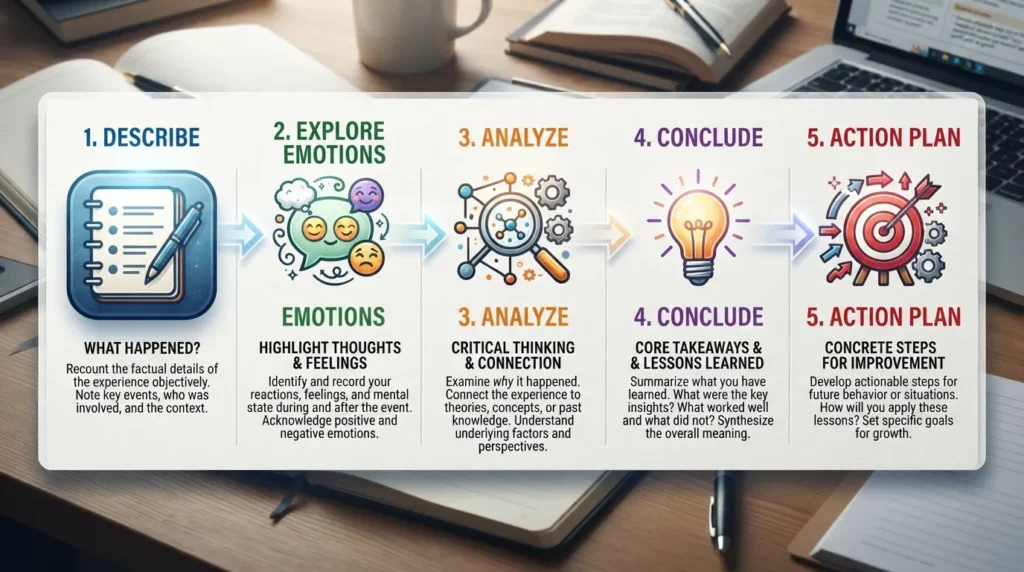
How to Write a Reflective Journal Entry in 5 Practical Steps
[ Step 1: Describe ] –> [ Step 2: Feel ] –> [ Step 3: Analyze ] –> [ Step 4: Conclude ] –> [ Step 5: Action Plan ]
Step 1: Describe the Event Concisely
State the facts briefly using who, what, where, and when. Keep this section under 25% of your total word count.
Step 2: Explore Your Initial Thoughts & Emotions
Be authentic. Identify your gut reactions, fears, excitement, or hesitation during and after the event.
Step 3: Analyze and Evaluate
Ask yourself: Why did things happen this way? What worked well? What failed? How does this connect to my coursework, policies, or personal values?
Step 4: Draw Conclusions & Extract Lessons
Summarize what you learned about yourself, human behavior, or professional practice.
Step 5: Formulate an Action Plan
Detail specific, measurable steps you will take when facing a similar situation in the future.
Real-World Reflective Journal Samples & Examples
Sample Entry: Healthcare / Nursing Student (Clinical Placement)
Date: October 14 Context: Emergency Ward Placement
Description: Today I cared for an elderly patient presenting with acute dyspnea. When her oxygen saturation dropped, I froze momentarily before calling my clinical supervisor.
Feelings: I felt overwhelming panic and inadequate in my clinical competency. I worried my delay compromised patient care.
Analysis: Applying Gibbs’ Cycle, my panic stemmed from a gap between theoretical knowledge and real-time crisis execution. While my instincts to seek supervision were safe, my initial hesitation indicates a need for stronger stress-regulation techniques.
Conclusion: Crisis situations require immediate protocol execution paired with calm communication.
Action Plan: I will practice rapid-assessment simulations weekly and review emergency protocols to build muscle memory under pressure.
Reflective Journal Prompts & Sentence Starters
Sentence Starters for Academic Assignments
“Reflecting on this scenario, I realized that my understanding of…”
“This experience directly challenged my assumption that…”
“Connecting this experience to [Theory/Author], it is evident that…”
Prompts for Personal Growth
“What was the most challenging emotional moment today, and why did it trigger me?”
“If I could replay today’s key conversation, what would I say differently?”
Free Downloadable Reflective Journal Templates
Accelerate your writing process using our custom-designed, structured templates:
Download Printable Reflective Journal Template (PDF)
Download Editable Reflection Sheet (MS Word / Google Docs)
Common Mistakes to Avoid in Reflective Writing
Over-Describing: Dedicating more than 30% of the text to recounting narrative facts rather than analyzing them.
Lack of Personal Perspective: Writing like a generic research report without examining your own role, feelings, and growth.
Missing the Action Plan: Ending the journal without defining clear, practical steps for future scenarios.
Pimchanok Srisuk
Pimchanok Srisuk is the Journaling Editor at Holistic Wellbeing Living. She writes about journaling prompts, reflective writing, emotional clarity, and mindful routines. With seven years of experience creating personal-growth content, Pimchanok helps readers use simple writing practices to understand their thoughts and make calmer everyday decisions.