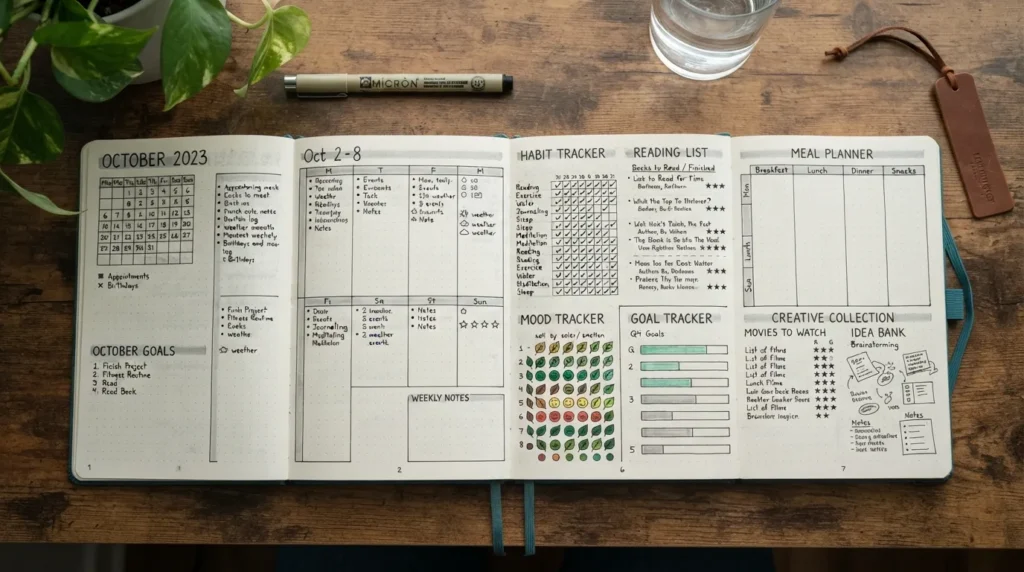
If you’re looking for pages for a bullet journal, you don’t need to fill every spread with a tracker or complicated design. A good bullet journal is built around the pages that help you plan, remember, track, or organize the parts of your life you actually care about.
The best place to start is with a few core pages, then add collections such as habit trackers, reading logs, meal plans, mood trackers, or study pages when they solve a real need. That keeps your journal useful instead of turning it into another task to maintain.
What Pages Should You Put in a Bullet Journal?
For a simple setup, start with an Index, Future Log, Monthly Log, and Daily Log. These are the foundation of the Bullet Journal Method. From there, you can create collections for specific goals, routines, projects, interests, or responsibilities.
A simple rule: Don’t create a page because it looks popular. Create it because it helps you do something you want to do, remember something important, or understand a pattern in your life.
Essential Bullet Journal Pages for Beginners
If this is your first bullet journal, you can keep the setup surprisingly small. These pages give you a practical foundation without requiring elaborate drawings or decorative skills.
1. Index
The Index is your journal’s map. Record the page number and name of important collections so you can find them later.
Best for: Anyone who plans to keep different collections throughout the notebook. If your journal is extremely simple, you may not need a detailed Index.
2. Future Log
Use a Future Log for events, appointments, deadlines, trips, birthdays, or other information that belongs beyond the current month.
Best for: Long-term planning. If you rarely need to look ahead, keep this page simple rather than giving it a large amount of space.
3. Monthly Log
A Monthly Log gives you a broader view of the current month. You can use it for dates, appointments, deadlines, and tasks that need attention during the month.
Best for: Seeing the month as a whole before moving into individual days.
4. Daily Log
The Daily Log is where tasks, events, and notes can be captured as they happen. You do not need to design an elaborate daily spread; the page can remain as simple as a running list.
Best for: Busy days when you need a flexible place for tasks and notes rather than a rigid schedule.
5. Weekly Spread
A weekly spread puts several days together on one page or across two pages. You can add appointments, priorities, meals, habits, or short task lists.
Possible limitation: A detailed weekly layout can take longer to prepare than a simple Daily Log. Keep it minimal if drawing the spread starts becoming a chore.
Bullet Journal Pages by Purpose
Instead of choosing pages randomly, start with what you want your journal to help you accomplish. This is often a better approach than copying a long list of popular spreads.
| Your goal | Useful pages | Why they help |
|---|---|---|
| Planning | Future Log, Monthly Log, Weekly Spread | Keeps dates, deadlines, and priorities visible. |
| Daily organization | Daily Log, To-Do List, Brain Dump | Gives unfinished tasks and thoughts a place to go. |
| Building habits | Habit Tracker, Routine Tracker | Makes recurring behaviors easier to notice. |
| Personal reflection | Mood Tracker, Gratitude Log, Reflection Page | Creates a simple record for reflection. |
| School or college | Class Schedule, Assignment Tracker, Study Log | Keeps academic responsibilities together. |
| Home management | Meal Plan, Grocery List, Cleaning Tracker | Turns recurring household tasks into visible lists. |
Best Bullet Journal Pages for Tracking
Habit Tracker
A habit tracker lets you record whether you completed recurring habits across a chosen period. Keep the list short enough that updating it remains easy.
Good choices: reading, exercise, stretching, journaling, bedtime routines, or another behavior you genuinely want to observe.
Mood Tracker
A mood tracker can give you a visual record of how you felt over time. You can use colors, symbols, numbers, or short words.
Possible limitation: A tracker is only useful if you can maintain it consistently. If filling it in becomes stressful, simplify it.
Sleep Tracker
Record bedtime, wake time, or a simple sleep-quality rating if sleep patterns are something you want to observe.
Tip: Track only the information you will actually use. A small record is often more sustainable than a detailed chart.
Water Tracker
A simple daily grid can help you record your water intake or simply remind you to drink throughout the day. Keep the layout quick to update.
Fitness Tracker
Use this page for workouts, walks, stretching sessions, or other activity you want to remember. Choose a few meaningful fields instead of recording every possible detail.
Creative and Personal Bullet Journal Pages
Bullet journaling can also be a place for ideas, memories, hobbies, and creative projects. These pages are optional, so choose the ones that make you want to open your journal rather than pages that simply look impressive online.
Reading List
Keep books you want to read, books you have finished, ratings, favorite quotes, or short notes. A simple list is enough if you do not want a decorative spread.
Movie or TV List
Use it to record movies or shows you want to watch, finished titles, ratings, or recommendations.
Gratitude Page
Write a few things you appreciated or enjoyed. You can make this a recurring page or use it as an occasional collection.
Bucket List
Collect experiences, places, activities, or personal goals you want to pursue. Because it is a long-term collection, it can remain in your journal and evolve over time.
Travel Planner
Create space for destinations, dates, packing reminders, places to visit, meal ideas, reservations, or notes from the trip.
Memory Page
Use photographs, short notes, tickets, small drawings, or memorable moments to create a personal record of an event or period.
Useful Bullet Journal Pages for Organization
To-Do List Journal Page
A to-do list journal page can be as simple as a running list of tasks. Break larger projects into small actions so the page tells you what to do next rather than simply reminding you that a large project exists.
Better approach: Instead of writing “study,” write a specific next action such as “review chapters 3–4.”
Brain Dump Page
Use a brain dump when you have several thoughts, reminders, or tasks competing for attention. Write them down first and organize them later.
Goal Page
Turn a broad goal into smaller actions, milestones, deadlines, or habits. The most useful goal pages connect the goal to something you can actually do.
Meal Planning Page
Plan meals for several days, collect recipe ideas, or keep a short list of meals your household regularly uses.
Grocery List
A grocery collection can be organized by store section or kept as a simple running list. If the same items are purchased repeatedly, a reusable master list can save time.
Bullet Journal Pages for Students and College
Students can adapt the same bullet journal method around their academic schedule instead of creating a completely separate system.
- Class schedule
- Assignment tracker
- Exam and deadline list
- Study session log
- Semester overview
- Reading list
- Project planner
- College budget
- Important dates
- Self-care or habit tracker
You do not need all of these. For a busy semester, a class schedule, assignment tracker, deadline list, and simple weekly planning page may be enough.
Simple Bullet Journal Pages for People Who Aren’t Artistic
You do not need drawing skills to use a bullet journal. Some of the most useful layouts are also the easiest to create.
- Simple monthly calendar
- Running to-do list
- Minimal weekly spread
- Basic habit grid
- Brain dump
- Reading list
- Goals and next actions
- Simple meal plan
- One-line-a-day memory page
If you have limited time, prioritize function over decoration. A page that takes two minutes to create and gets used for several weeks is more useful than an elaborate spread that you never return to.
Bullet Journal Header Ideas
Headers make pages easier to scan, but they do not need to be elaborate. For a clean layout, use a consistent title style throughout the notebook.
- Simple: uppercase or bold block letters.
- Minimal: one line with a small underline.
- Soft: rounded lettering with a small divider.
- Decorative: add a small leaf, star, dot, or simple border.
- Functional: include the month, week, date, or category directly in the header.
The best header is the one that makes the page recognizable without taking more time to create than the page itself.
How to Choose the Right Bullet Journal Pages
If you have found dozens of ideas but still do not know which ones to use, start with your biggest recurring problem.
- Ask what you want the journal to help with. Is the problem planning, remembering, tracking, studying, organizing, or reflecting?
- Choose one page for that problem. You do not need five trackers for one goal.
- Use it for a while before adding more. This shows whether the page is genuinely useful.
- Remove pages you never use. Your bullet journal should change with your needs.
- Keep the layout as simple as necessary. More decoration does not automatically make a spread more useful.
One useful test: Before creating a new spread, ask, “What will I do differently because I have this page?” If you cannot answer, you probably do not need the page yet.
Do You Need Every Bullet Journal Page?
No. A bullet journal is customizable, and different people use different collections. The goal is not to recreate someone else’s entire notebook.
For one person, a Future Log and Daily Log may be enough. Another person may benefit from a habit tracker, reading list, budget page, or meal planner. Your best setup is the one you will actually use.
Common Bullet Journal Page Mistakes to Avoid
Creating Too Many Trackers
Trackers can be useful, but each one creates another thing to update. Start with the behavior or information you genuinely want to monitor.
Copying a Spread Without Knowing Its Purpose
A beautiful layout may work perfectly for the person who created it and still be wrong for you. Understand the purpose before copying the format.
Spending More Time Decorating Than Using the Journal
Decoration is optional. If elaborate headers, borders, and illustrations make journaling harder to maintain, simplify them.
Making Pages Too Detailed
Only record information that you will use. A page can become less useful when updating it takes more effort than the information is worth.
Bullet Journal Pages You Can Print
If drawing layouts from scratch is not your thing, printable bullet journal pages can save setup time. Common printable formats include monthly calendars, habit trackers, weekly layouts, goal pages, reading logs, meal planners, and task lists.
The important part is choosing a printable that matches how you actually plan. A highly detailed template is not automatically better than a simple one. Before printing, check whether the layout gives you enough space for your information without adding fields you will never use.
Frequently Asked Questions About Bullet Journal Pages
How many pages do you need for a bullet journal?
There is no fixed number. Start with the pages you need for planning and daily notes, then add collections when a recurring need appears. The amount of space each page requires depends on how you use your notebook.
What are some good bullet journal ideas for beginners?
Start with an Index, Future Log, Monthly Log, and Daily Log. After that, add only one or two collections that solve a specific problem, such as a habit tracker, reading list, assignment tracker, or meal plan.
How do you make a bullet journal page?
First decide what the page needs to accomplish. Choose the information you need, give it a clear heading, and create the simplest layout that lets you record and review that information. You can add decoration afterward if you want it.
What are some creative page ideas for a bullet journal?
Try a reading list, movie tracker, travel page, memory spread, bucket list, gratitude page, favorite quotes, recipe collection, or a themed monthly page. Choose ideas that connect to something you already enjoy or want to remember.
What are some simple bullet journal pages?
A running to-do list, monthly log, weekly spread, brain dump, reading list, basic habit tracker, goal page, or one-line-a-day memory page can all be kept very simple.
What pages are good for a bullet journal for beginners?
The best starting pages are usually the ones that solve an immediate need: planning your month, organizing daily tasks, recording future events, or keeping important notes together. Add specialized trackers later if you discover you need them.
What are some good journal prompts?
Useful prompts include: What matters most this week? What am I putting off? What worked well today? What do I want to remember? What is one small action I can take next? Keep prompts connected to a purpose rather than filling space for the sake of journaling.
What are some good bullet journal themes?
Popular themes can be based on seasons, nature, books, travel, food, colors, hobbies, or simple geometric designs. A theme is optional; your pages can be completely functional and still be a bullet journal.
Final Thoughts
The best pages for a bullet journal are not necessarily the most elaborate or the most popular online. They are the pages that make your own life easier to plan, remember, track, or understand.
Start small with the core pages, add collections when a real need appears, and remove layouts that stop being useful. Whether you prefer a minimalist notebook, a creative journal, a college planner, or printable pages, the most effective bullet journal is the one that fits the way you actually live.
For the official Bullet Journal Method: Learn more about the original system, including its core modules, rapid logging, collections, and migration principles, from the official Bullet Journal website.
Pimchanok Srisuk
Pimchanok Srisuk is the Journaling Editor at Holistic Wellbeing Living. She writes about journaling prompts, reflective writing, emotional clarity, and mindful routines. With seven years of experience creating personal-growth content, Pimchanok helps readers use simple writing practices to understand their thoughts and make calmer everyday decisions.