Jump to:
ToggleBullet Journal for ADHD: Simple Ideas, Layouts & Tips That Work
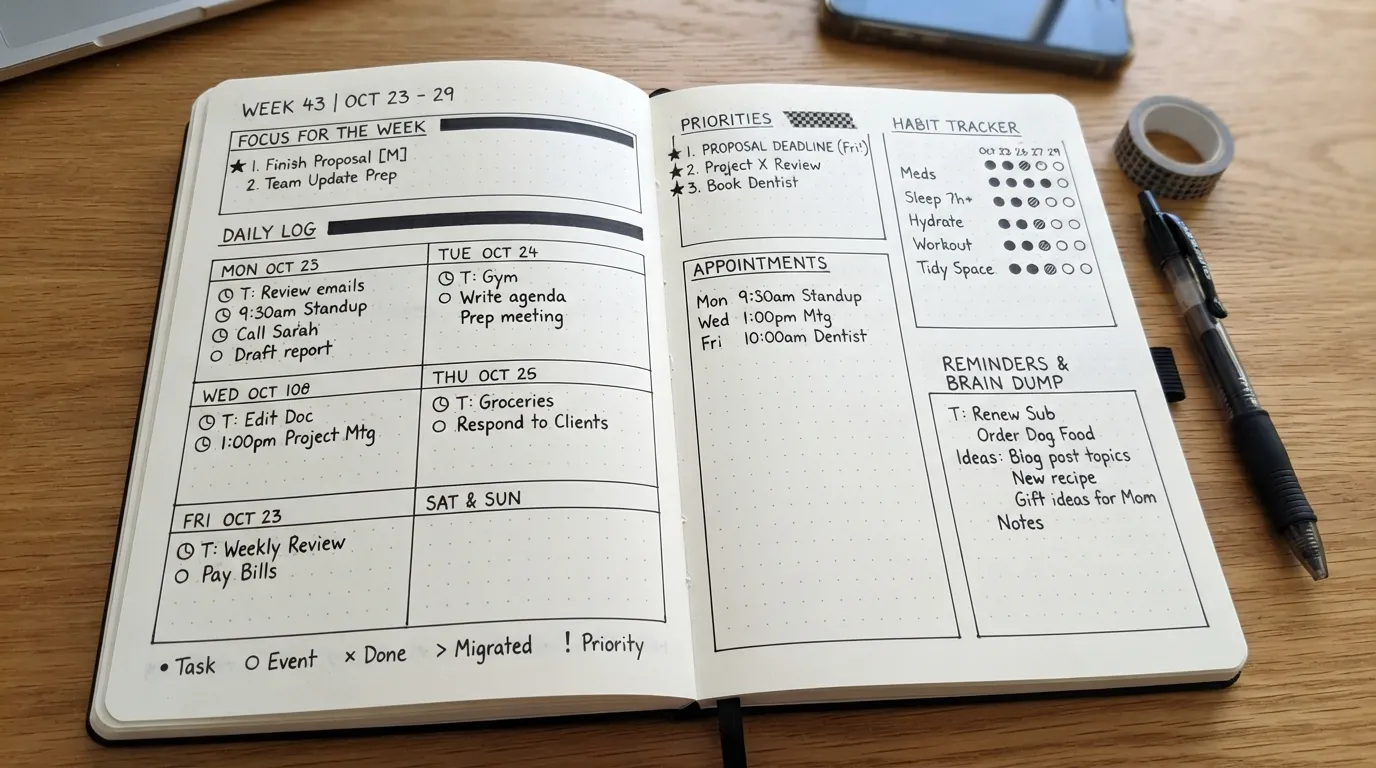
If you have ADHD and traditional planners keep becoming another thing you forget, abandon, or feel guilty about, a bullet journal for ADHD can be a useful alternative. The important part, though, is not creating a beautiful notebook. It is building a simple system that gets information out of your head, helps you decide what matters now, and remains usable when your attention, energy, or schedule changes.
A bullet journal can give you structure without forcing every day into a fixed layout. That flexibility is one reason it appeals to people who find rigid planners difficult. But it is not a treatment for ADHD, and it is not automatically the right tool for everyone. The best setup is the one that reduces friction rather than creating another project to maintain.
The short answer: A bullet journal can be helpful for ADHD because it is flexible, lets you capture thoughts and tasks quickly, and can be adapted to the way you actually work. Start with the smallest useful system—usually an index, a future or monthly view, a daily or weekly log, and a place for brain dumps. Add trackers and custom spreads only when a real problem gives you a reason to add them.
What Is a Bullet Journal for ADHD?
A bullet journal is a flexible notebook-based system that can combine a planner, task list, notes, diary, and collections in one place. The method was created by Ryder Carroll, who has described developing it to manage his own ADHD. The core system uses simple components such as an index, future log, monthly log, daily log, rapid logging, and collections. The official Bullet Journal method explains the system in more detail.
For someone with ADHD, the useful part is not the notebook itself. It is the ability to change the system when your needs change. You can give today’s tasks more space, capture a random idea without deciding immediately where it belongs, create a collection for a recurring problem, or simply turn to the next blank page after missing several days.
That flexibility can be useful because adults with ADHD may experience difficulties with organization, planning, remembering daily tasks, procrastination, and completing lengthy tasks. Those are real areas of daily functioning, but a journal should be viewed as a practical organizational tool—not as a treatment for ADHD. The National Institute of Mental Health and CDC’s current information on adult ADHD provide medical guidance on symptoms, diagnosis, and treatment.
Does Bullet Journaling Work for ADHD?
It can. But I would not describe it as an ADHD “fix.” A better way to think about it is as an external organization system that you can customize around the problems you actually experience.
The strongest reason to try it is its combination of structure and flexibility. A traditional dated planner decides in advance how much space Tuesday deserves. A bullet journal does not. If Tuesday turns into a five-page day, you can use five pages. If nothing happens, you do not have to manufacture content just because a printed box is waiting for it.
That distinction matters for people who have repeatedly abandoned planners. First-hand accounts from ADHD and bullet-journaling communities frequently describe the same pattern: elaborate systems can become overwhelming, while simpler systems are easier to return to after a break. Community discussions also show that beginners can feel overwhelmed before they even know where to start.
Why a Bullet Journal Can Be Useful for ADHD
1. It Gets Tasks and Thoughts Out of Your Head
When you are trying to remember a task, an idea, an appointment, and three unrelated things at the same time, keeping everything mentally active can make it harder to decide what deserves attention. Rapid logging gives you a place to capture those thoughts quickly instead of requiring you to organize everything immediately.
The important idea is capture first, organize later. You do not need to decide whether every thought is a task, project, goal, or future idea the second it appears.
2. It Gives You Structure Without a Fixed Schedule
A dated planner can be useful, but it can also become unforgiving. If you miss Monday, the empty Monday box is still there. In a bullet journal, the next page is simply the next place you continue.
This does not mean flexibility automatically solves consistency. You still need a way to remember to open the journal. The advantage is that the system does not punish you with a large amount of catch-up work when you miss a few days.
3. It Can Make Priorities More Visible
A long task list can make everything look equally important. A simple daily log lets you distinguish between something that must happen today, something you want to remember, and something that can wait.
The point is not to create the perfect priority system. It is to make the next useful action easier to see.
4. It Can Adapt When Your Needs Change
One week you may need a project page. Another week you may need a simple shopping list. Later, you may discover that an energy log or recurring-task checklist is useful. You do not have to redesign the entire notebook to accommodate the change.
5. It Can Reduce the Pressure to “Catch Up”
This is one of the most practical advantages. If you stop using the journal for a week, you do not have to recreate every missing day. Open the notebook, write today’s date, and continue. Work Brighter makes the same point in its updated guide: a bullet journal can be picked up again without filling in every missed day. See the full ADHD bullet-journaling guide.
How to Start a Bullet Journal for ADHD Without Getting Overwhelmed
If you have ever opened Pinterest or Instagram and seen elaborate bullet-journal spreads, you may get the impression that you need markers, stickers, rulers, color coding, trackers, and artistic layouts before you can begin.
You do not.
A minimum useful setup can be:
- One notebook.
- One pen or pencil.
- An index.
- A future or monthly view if you need one.
- A daily or weekly log.
- A place to dump thoughts and tasks.
Step 1: Start With a Brain Dump
Before designing a spread, write down what is occupying your attention. This might include work, errands, appointments, ideas, unfinished tasks, things you need to buy, questions you need to answer, and tasks you keep postponing.
Do not organize the list while you are creating it. The goal is to create a visible starting point.
Step 2: Create Only the Pages You Actually Need
The basic Bullet Journal method includes an index, future log, monthly log, and daily log. Work Brighter also recommends starting with a small set of basic spreads and adding custom collections only when a genuine need appears. Its ADHD-focused guide gives examples of both basic and specialized spreads.
For an ADHD-friendly beginning, I would resist the temptation to build twenty pages on day one. Your first goal is not to create an impressive journal. Your first goal is to discover whether the system makes your life easier.
Step 3: Make Your Daily Log Almost Effortless
Use short phrases. You do not need to write full diary entries for every task. A daily page might contain:
- Send project email
- Call dentist
- Idea: new article topic
- Meeting at 2:00
- Buy groceries
The less effort it takes to record something, the more likely the system is to remain available when you actually need it.
The Best ADHD Bullet Journal Spreads to Try
There is no universal list of “best” spreads for ADHD. The useful question is: What problem am I trying to solve? Choose the spread based on that problem.
Brain Dump
Best for: a crowded mind, scattered ideas, unfinished tasks, or the feeling that you are forgetting something.
How to use it: Put everything down quickly. Sort it afterward into tasks, events, notes, projects, or “not now.”
Task Parking Lot
Best for: ideas and tasks that appear while you are trying to focus on something else.
Write the distraction down instead of switching tasks immediately. This creates a place to return to later without requiring you to trust your memory.
Energy Tracker
Best for: noticing when you tend to have more or less energy.
Keep it simple. You might mark your energy once or twice a day rather than creating a detailed hourly chart. After several weeks, you may notice patterns that help you decide when to schedule demanding work.
Focus or Distraction Log
Best for: understanding what repeatedly interrupts your work.
Record the distraction briefly. You are not trying to monitor every second of your day. The goal is to notice recurring patterns and decide whether a practical change could reduce them.
Process Cheat Sheet
Best for: recurring tasks that you know how to do but repeatedly forget steps for.
For example, you could create a short checklist for preparing for an appointment, starting a recurring work task, packing for a trip, or completing a household routine.
Weekly Reset
Best for: losing track of unfinished tasks or starting each week without knowing what deserves attention. Review unfinished items, upcoming commitments, and the few tasks that genuinely matter next.
A Simple ADHD Bullet Journal Setup You Can Copy
If you want a concrete starting point rather than a collection of ideas, try this deliberately small setup:
| Page | Purpose | Keep it simple by… |
|---|---|---|
| Index | Find important pages later | Add pages as you create them |
| Future/monthly log | Remember upcoming commitments | Record only what you actually need to remember |
| Daily/weekly log | Manage current tasks and notes | Use short phrases and flexible space |
| Brain dump | Capture mental clutter | Do not organize while dumping |
| One custom collection | Solve one recurring problem | Add another only when needed |
You can use this setup for a few weeks before deciding whether you need anything else. If you discover that you never use a particular page, remove it. A flexible system should become smaller when a feature is not useful—not larger just because someone online says you “should” track it.
What If You Stop Using Your ADHD Bullet Journal?
This is one of the most important questions to solve before you start.
Do not create a catch-up project.
If you miss three days, a week, or longer, turn to the next blank page and continue from there. You do not need to recreate every missed day unless those missing records are genuinely important.
Real-world community discussions repeatedly describe the problem of forgetting to check a journal or falling off a system during busy periods. One practical strategy people report using is keeping the journal somewhere visible and connecting it with an existing routine, such as checking it while having morning coffee. ADHD bullet-journal users have discussed this consistency problem directly.
A useful rule: Missing days is not a reason to abandon the system. If restarting takes less than a minute, you have removed one of the biggest barriers to returning.
Does an ADHD Bullet Journal Need to Be Pretty?
No.
Beautiful spreads can be enjoyable, and creativity may be one reason someone loves journaling. But decorative layouts are not what makes the Bullet Journal method useful. Work Brighter specifically notes that elaborate social-media spreads can create the wrong impression and recommends starting with a simple functional design. Its guide recommends function first and aesthetics only if they genuinely help you.
This matters even more if perfectionism makes starting difficult. Recent community discussions show people with ADHD describing the pressure of making a spread “right” as a reason they hesitate to use their blank notebooks. A 2026 discussion on perfectionism and bullet journaling illustrates how freeing a deliberately imperfect approach can feel.
If decorating makes you want to use the journal, keep it. If decorating turns the journal into another task you avoid, remove it.
Common ADHD Bullet Journal Mistakes to Avoid
Creating Too Many Trackers
A tracker is useful when it answers a question you actually care about. If you add ten trackers because they look useful, you may end up spending more time maintaining the journal than using its information.
Designing Months in Advance
If your schedule changes frequently, elaborate future layouts can create unnecessary maintenance. Leave room for reality to change.
Treating the Journal Like a Test You Can Fail
There is no score for perfect consistency. The purpose is to make your information easier to manage.
Making the System Too Complicated to Open
If you need five colors, a ruler, three symbols, and ten minutes before you can record one task, the system has too much friction.
Using It as Your Only Calendar
A paper notebook is not automatically the best place for every type of information. Shared appointments, changing schedules, reminders, and information you need while away from the notebook may be easier to manage digitally. The official Bullet Journal ADHD article itself describes using a digital calendar and phone notes alongside the paper journal. Read the first-hand account.
Bullet Journal vs. Digital Planner for ADHD
You do not have to choose one tool for everything. In many cases, the most practical system is a combination.
| Need | Paper bullet journal | Digital tool |
|---|---|---|
| Brain dumping | Often useful for free-form notes and ideas | Useful when you need access everywhere |
| Shared appointments | Possible, but requires manual updates | Usually more convenient for syncing and reminders |
| Flexible notes | Very flexible | Useful for search and storage |
| Quick capture away from home | Only if the notebook is with you | Usually easier if your phone is always available |
The best setup may therefore be a hybrid: use your bullet journal for thinking, planning, notes, and flexible task management, while a digital calendar handles appointments or information that needs to sync across devices.
How to Make an ADHD Bullet Journal Easier to Stick With
- Keep the journal visible. A beautiful notebook hidden in a drawer is still hidden.
- Attach it to an existing routine. For example, review it while drinking your morning coffee or before you shut down work.
- Reduce setup time. A quick list is better than a perfect spread you never finish.
- Use flexible pages. Let busy days have more space and quiet days have less.
- Do not backfill unnecessarily. Missed days do not automatically require reconstruction.
- Add features only after a problem appears. If you keep forgetting appointments, solve that problem. If you do not need a mood tracker, skip it.
- Review what is working. If a spread consistently creates work without giving you useful information, remove it.
A 10-Minute ADHD Bullet Journal Reset
When everything feels scattered, you do not need to redesign your entire productivity system. Try a short reset:
- Write down everything currently occupying your attention.
- Circle or mark time-sensitive commitments.
- Choose the few tasks that actually need attention next.
- Move longer-term ideas into a future or collection page.
- Leave everything else captured but not immediately actionable.
- Close the journal with one clear next action.
The purpose of this reset is not to make your life perfectly organized. It is to turn an unstructured pile of thoughts into something you can see and act on.
When a Bullet Journal May Not Be the Best Fit
A bullet journal is not automatically better than a traditional planner or digital system. If writing by hand feels slow, you constantly lose the notebook, you need automatic reminders, or you need a shared calendar, another tool may work better for some parts of your life.
It is also possible to turn bullet journaling into procrastination. If you spend an hour designing a spread to avoid a 10-minute task, the journal is no longer helping with the problem it was supposed to solve.
That is why the best test is simple: Does using this notebook make the next useful action easier? If yes, keep the feature. If not, simplify it or remove it.
Frequently Asked Questions About Bullet Journaling for ADHD
Do bullet journals work for ADHD?
They can be useful for some people with ADHD because the system combines structure with flexibility and allows tasks, notes, and ideas to be captured in one adaptable place. They are not a treatment for ADHD, and effectiveness depends on whether the system actually fits the person’s needs.
What is the best Bullet Journal format for people with ADHD?
There is no single best format. A good starting point is a simple index, future or monthly view, daily or weekly log, and brain dump. Add specialized spreads only when they solve a recurring problem.
What type of journaling is best for ADHD?
The best type is the one you can realistically use. For organization, a flexible bullet journal can combine task capture, planning, notes, and collections. For personal reflection, you can add free-form journaling without changing the basic planning system.
What is the best journal for adults with ADHD?
There is no universally best notebook. For a bullet journal, a plain notebook that feels comfortable to write in is enough. Choose something you are willing to carry, open, and use rather than something so elaborate that you feel pressure to keep it perfect.
What should I put in an ADHD bullet journal?
Start with tasks, appointments or future commitments, notes, ideas, and a brain dump. You can later add a project page, energy tracker, distraction log, recurring-task checklist, or another collection if it solves a specific problem.
What if I stop using my bullet journal?
Simply start again on the next blank page. Unless the missing days contain information you genuinely need, there is no reason to recreate them. Removing the pressure to catch up can make returning much easier.
Does bullet journaling treat ADHD?
No. A bullet journal is an organizational tool, not a medical treatment. If ADHD symptoms are interfering with work, relationships, daily responsibilities, or other areas of life, talk with a qualified healthcare professional about appropriate evaluation and treatment. CDC guidance for adults with ADHD explains diagnosis and treatment options.
A Good ADHD Bullet Journal Is a Tool, Not Another Responsibility
The biggest mistake is thinking you need to build the perfect ADHD bullet journal before you can benefit from one.
Start with a notebook, a pen, and a small system. Capture what is taking up mental space. Give important tasks somewhere visible to live. Keep upcoming commitments where you can find them. Then watch how the system behaves in your actual life.
If a spread helps, keep it. If it creates friction, simplify it. If you stop using the journal, start again without trying to repair every missed day. If your calendar needs syncing or reminders, let a digital tool handle that job.
That is the real advantage of bullet journaling for ADHD: you do not have to fit yourself into the system. You can adapt the system to the way you actually live.
Pimchanok Srisuk
Pimchanok Srisuk is the Journaling Editor at Holistic Wellbeing Living. She writes about journaling prompts, reflective writing, emotional clarity, and mindful routines. With seven years of experience creating personal-growth content, Pimchanok helps readers use simple writing practices to understand their thoughts and make calmer everyday decisions.