Jump to:
ToggleEasy Art Journal Ideas: 50+ Creative Ideas for Beginners
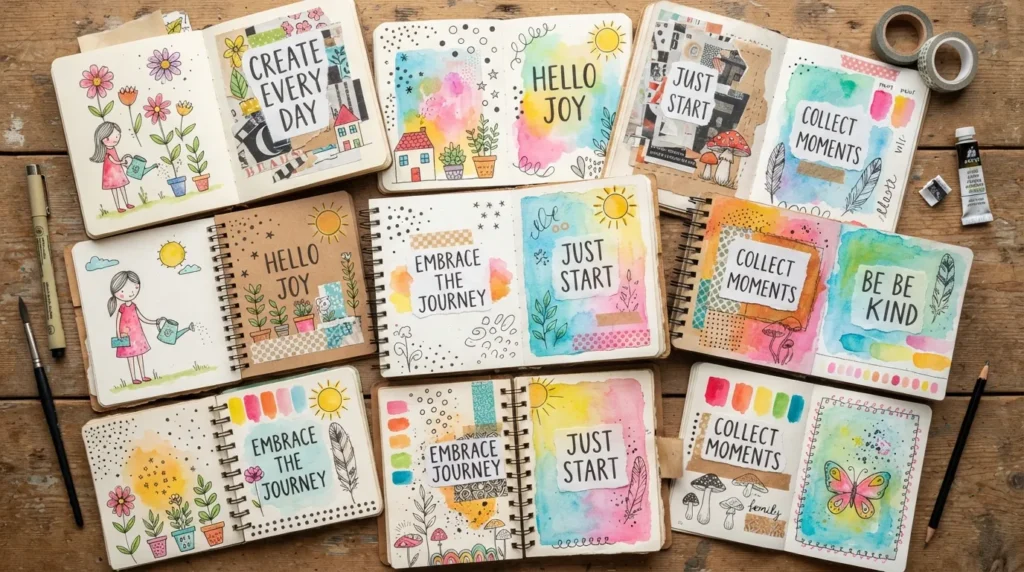
If you have ever opened a blank journal and thought, “I want to make something, but I have no idea what,” you are in the right place. Easy art journaling does not require advanced drawing skills, expensive supplies, or a perfectly planned page. A pen, a few colors, some paper scraps, or even an ordinary object around you can be enough to start.
Below, I have grouped simple art journal ideas by the kind of page you may want to make: quick pages, drawing and doodle ideas, painting and collage, personal pages, nature themes, student-friendly ideas, and pages for days when your creative brain simply refuses to cooperate. For each idea, you will also find a simple way to begin so you are not left staring at another blank page.
The easiest way to start: choose one idea, limit yourself to one or two materials, and give yourself permission to make an imperfect page. Your first goal is not to create a masterpiece. It is simply to make the first mark.
What Is an Art Journal?
An art journal is a place where writing, drawing, painting, collage, color, patterns, photographs, lettering, and other visual elements can live together. Think of it as a visual journal rather than a notebook that has to contain only words.
You can use an art journal to record a memory, explore an idea, experiment with a technique, document your day, express a mood, practice drawing, or simply play with color. There is no single correct way to fill a page.
That freedom is also what makes a blank page intimidating. The ideas below are designed to remove that pressure by giving you a small starting point.
How to Start an Art Journal When You Are a Beginner
You do not need a large collection of art supplies to begin. If you already have a notebook, sketchbook, printer paper, or another type of paper you enjoy using, start there.
A simple beginner setup can be:
- One journal or sketchbook
- A black pen or pencil
- A few colored pencils, markers, crayons, or paints
- Glue if you want to make collages
- Paper scraps, old packaging, magazine pages, tickets, or other interesting pieces of paper
If you are worried about ruining the page, start with something that can be covered later. Scribble across the paper, add a few shapes, glue down scraps, or make broad color marks. Once the page is no longer blank, it becomes much easier to decide what should happen next.
A useful beginner rule:
Do not buy supplies before you know what you enjoy making. Start with what you already own, then add materials when a particular technique gives you a reason to need them.
Easy Art Journal Ideas You Can Try Today
These ideas are intentionally simple. You can follow the instructions closely or use them as starting points and change the colors, words, shapes, or materials to make the page yours.
1. Make a Mood-in-Color Page
Choose three to five colors that match how you feel today. Paint, shade, or draw them across the page, then add a few words or simple symbols that explain your choices.
Make it easier: use only one color and change its pressure, size, or texture to show different feelings.
2. Fill a Page With Simple Doodles
Draw small circles, stars, leaves, hearts, waves, clouds, dots, flowers, or abstract shapes until the page is full. You do not need to plan the composition first.
Try this variation: repeat the same three shapes in different sizes to create a patterned background.
3. Create a Simple Flower Page
Draw five-petal flowers using loose lines. Add stems, leaves, dots, and a simple background. The flowers do not have to look realistic.
Beginner shortcut: draw one flower shape repeatedly rather than trying to invent a different flower every time.
4. Make a Black-and-White Page
Use only black, white, and the color of the paper. Combine bold lettering, thin lines, dots, simple drawings, and negative space.
Why it works: limiting the palette removes one decision from the process, so you can concentrate on shapes and composition.
5. Draw Your Favorite Mug
Put a mug in front of you and sketch it from where you are sitting. Add the drink, a spoon, a few steam lines, or a small note about the moment.
Remember: drawing from a real object removes the pressure of inventing something from nothing.
6. Turn Your Handwriting Into Art
Write a sentence, quote, reminder, or word that matters to you. Make some letters large, some small, and surround the writing with simple patterns.
7. Create a One-Color Page
Pick one color and explore everything you can do with it. Use light and dark versions, outlines, blocks, dots, scribbles, and overlapping shapes.
8. Make a Favorite Things Page
Choose five things you genuinely enjoy. They could be foods, places, songs, books, flowers, clothing, hobbies, or ordinary objects. Draw tiny symbols for each one and add their names.
9. Create a Simple Quote Page
Choose a short phrase and make it the focal point. Add a border, a few illustrations, or a background made from repeated shapes.
10. Make a Pattern Challenge
Draw a grid of small sections. Fill each section with a different pattern: stripes, dots, waves, leaves, checks, spirals, or geometric shapes.
11. Draw a Page of Tiny Objects
Choose ordinary objects around you: keys, glasses, headphones, a plant, a spoon, a shoe, or a candle. Draw them as tiny icons across the page.
12. Make a Memory Collage
Collect small pieces connected to a memory, such as a ticket, wrapper, printed photograph, paper scrap, or handwritten note. Arrange them on the page and add a few words explaining the memory.
13. Try a Magazine Collage
Cut out one image, word, color, or texture that catches your attention. Build the rest of the page around it rather than deciding on a complete composition first.
14. Make a Torn-Paper Background
Tear paper into irregular pieces and overlap them across part of the page. Leave some paper visible, then draw or write over the collage once it is dry.
15. Create a Washi-Tape Grid
Use tape to divide the page into sections. Fill each section with a different color, doodle, word, or tiny drawing. Remove the tape at the end if you want crisp lines.
16. Draw a Simple Self-Portrait
Forget realism. Use a simple face shape, hair, eyes, and a few identifying details. Add objects or colors that say something about you.
17. Make an Abstract Color Page
Choose two or three colors and apply them as blocks, lines, circles, or loose brush marks. Add a second layer after the first one dries.
18. Turn a Scribble Into a Picture
Make a random scribble without knowing what it will become. Then look for shapes inside it and turn one or two of them into objects, animals, faces, or plants.
19. Make a Nature Journal Page
Choose one leaf, flower, tree, shell, cloud, or stone as your subject. Sketch it loosely and record where you saw it or what you noticed.
20. Create a Leaf Pattern
Draw a simple leaf outline and repeat it across the page. Change its size, direction, and color to create movement without needing complicated drawing.
21. Paint a Simple Sunset
Blend two or three warm colors across the background. Add a simple horizon, a few clouds, and a dark silhouette of trees, buildings, or hills.
22. Make a Rainy-Day Page
Use blue, gray, or muted colors. Draw windows, umbrellas, puddles, rain lines, or a warm drink. Add one sentence about how rainy weather makes you feel.
23. Create a Seasonal Page
Pick the current season and collect its colors, objects, textures, and small memories. You can combine drawings, paper scraps, lettering, and paint.
24. Make a Moon and Stars Page
Cover the page with a dark color or use dark paper. Add a moon, stars, clouds, simple constellations, and a short thought or wish.
25. Draw Your Favorite Food
Choose one food you love and simplify it into basic shapes. Add a handwritten description, a memory, or the reason you like it.
26. Make a Playlist Page
Choose several songs and represent each one with a color, symbol, small drawing, or short phrase. The page becomes a visual record of what you were listening to.
27. Create a Dream Page
Choose something you want to experience, learn, make, or visit. Use drawings and words to create a simple visual map of that dream.
28. Make a Gratitude Page
Write three specific things you appreciated recently. Instead of stopping at the words, add a small illustration or color symbol for each one.
29. Draw Your Day in Six Boxes
Divide the page into six sections. Use one tiny drawing, color, or word in each section to represent different moments from your day.
30. Create a “Today I Noticed” Page
Record small things you normally overlook: a shadow, a funny sign, an interesting color combination, a flower, a conversation, or the shape of a cloud.
Easy Art Journal Ideas for Beginners With No Drawing Skills
If drawing makes you nervous, skip drawing as the main event. You can create interesting pages with marks, color, collage, lettering, and simple shapes.
- Color blocks: fill sections of the page with different colors.
- Paper collage: tear paper and layer the pieces.
- Word art: repeat one meaningful word in different sizes.
- Dots and lines: create a page using only dots, stripes, waves, and circles.
- Texture rubbing: place paper over a textured surface and rub gently with a pencil or crayon.
- Sticker composition: arrange a few stickers with handwritten words and simple borders.
- Paint and scribble: cover part of the page with loose color, let it dry, then add simple marks over it.
Easy Art Journal Ideas for Students
For a student art journal, the easiest pages are often the ones that connect creativity with everyday school life.
- Draw your favorite part of the school day.
- Create a page around one subject you are studying.
- Turn important vocabulary into illustrated words.
- Make a visual timeline of a lesson or historical event.
- Draw a simple diagram and decorate it with color.
- Create a “things I learned this week” page.
- Make a study-break doodle page.
- Turn a favorite quotation from a book into a lettering page.
- Draw your ideal study space.
- Create a page around a school memory.
Easy Art Journal Ideas for Kids
For children, keep the instructions open-ended. The goal is to encourage experimentation rather than make every page look the same.
- Draw an imaginary animal.
- Create a page using only fingerprints or simple dots.
- Make a rainbow of favorite colors.
- Draw a dream playground.
- Create a silly monster page.
- Make a collage from colorful paper scraps.
- Draw what you see outside a window.
- Create a page about a favorite animal.
- Turn random shapes into characters.
- Make a “best day ever” picture page.
Easy Art Journal Ideas for Adults
Adult art journaling does not have to become another task on your schedule. You can make pages about ordinary experiences, personal interests, memories, observations, or whatever has your attention right now.
- Make a visual record of your week.
- Create a page about something you are learning.
- Draw an object that has sentimental value.
- Make a color palette inspired by your surroundings.
- Create a page about a recent trip or outing.
- Illustrate a favorite recipe or meal.
- Make a page around a personal goal.
- Create a “what is taking up space in my mind?” page.
- Turn a meaningful sentence into abstract art.
- Make a page documenting small things that made you happy.
Easy Art Journal Ideas When You Have Only 5–10 Minutes
You do not need an entire afternoon. Short sessions can actually make starting easier because there is less pressure to produce a finished masterpiece.
| Time | Try This |
|---|---|
| 2–5 minutes | Fill a small area with dots, lines, or repeated shapes. |
| 5 minutes | Draw one object from your surroundings. |
| 5–10 minutes | Make a mood-in-color page with three colors. |
| 10 minutes | Create a small collage using paper scraps and one focal word. |
Easy Art Journal Ideas With Things You Already Have
One of the easiest ways to avoid creative paralysis is to work with a restriction. Instead of asking “What supplies should I buy?”, ask “What can I make with what is already around me?”
- Old magazines: make a color-based collage.
- Packaging: cut out interesting typography or textures.
- Receipts: use them as collage strips or write over them.
- Newspaper: create a text-based background.
- Paper bags: cut them into shapes or use the paper as a background.
- Old photographs: build a memory page around one image.
- Leaves: sketch their outlines or use them as visual references.
- Scrap paper: create a torn-paper composition.
- Pen only: create a page from lines, words, patterns, and doodles.
What Should You Put in an Art Journal?
Anything that helps you explore, record, remember, notice, or create. If you need a starting point, choose from these seven broad types of art-journal content:
- Visual observations: things you saw, noticed, or want to remember.
- Personal reflection: thoughts, feelings, memories, and experiences.
- Creative experiments: color, texture, patterns, marks, and mixed-media tests.
- Drawing practice: objects, people, plants, animals, or simple studies.
- Collage: photographs, paper scraps, words, packaging, and found materials.
- Idea development: concepts, plans, sketches, mood boards, and visual brainstorming.
- Creative prompts: pages built around a question, theme, word, color, memory, or challenge.
There is no universal official list of “seven types” of journals. These seven categories are simply a practical way to understand what an art journal can contain without turning your journal into a set of rules.
What to Do When You Have No Art Journal Ideas
Creative block often gets worse when you believe you need a brilliant idea before you begin. Try lowering the starting point instead.
The 5-step blank-page reset
- Choose one color.
- Draw one simple shape.
- Add one word.
- Add one layer of texture, collage, or pattern.
- Stop or continue only if another idea naturally appears.
The point is not to force a finished page. It is to create enough movement that the next decision becomes easier.
Try a Creative Thinking Journal Page
An art journal can also work as a creative thinking journal. Instead of writing a traditional answer to a problem, put the problem in the middle of the page and explore it visually.
For example, write a question such as “What could I make this week?” in the center. Around it, add:
- Things you already know
- Things you want to learn
- Colors or images that inspire you
- Materials you already have
- Three possible directions
- One tiny action you can take next
This approach turns the journal into more than a collection of pretty pages. It becomes a place where you can see your ideas developing.
What Is the 3-3-3 Journal Method?
The term 3-3-3 journal method does not have one universal meaning, and it is not a standard art-journaling rule. Different journaling systems use the numbers differently. One common use is a simple three-by-three structure for recording three items in three categories.
For an art journal, you can adapt the idea without treating it as a fixed formula:
- Draw or write three things you noticed today.
- Choose three colors that match the day.
- Add three tiny symbols for what you want to remember.
The useful part is the constraint. A small structure can make a blank page easier to approach.
What Is the 70/30 Rule in Art?
The 70/30 rule is a composition guideline, not a requirement. The basic idea is to let one visual area or element dominate roughly 70% of the composition while a contrasting or supporting element occupies roughly 30%.
You can use it in an art journal by making most of the page one dominant color and reserving a smaller area for a contrasting color, focal image, collage, or block of lettering.
Do not measure the page with a ruler unless you enjoy doing so. Think of 70/30 as a way to avoid giving every element equal visual importance.
What Is the 3/2-1 Journaling Method?
Like the 3-3-3 format, the 3/2-1 journaling method has several versions rather than one universal formula. A common structure uses three things in one category, two in another, and one final thought or intention.
For a creative journal, you could adapt it as:
- 3: things you noticed or learned
- 2: things you enjoyed or want to explore
- 1: creative idea you want to try next
The exact categories can change. The value is in giving yourself a short structure instead of expecting a long free-write.
How to Make Your Art Journal Pages Look More Interesting
You do not need complicated techniques. A few simple design choices can make an easy page feel more intentional.
- Repeat: use the same color, shape, or symbol in several places.
- Vary size: combine large and small elements instead of making everything identical.
- Leave space: not every part of the page needs to be filled.
- Layer: put writing, color, paper, or marks over earlier elements.
- Choose a focal point: make one element larger, darker, brighter, or more detailed than the others.
- Limit your palette: two or three main colors can make a page easier to control.
Common Art Journaling Mistakes Beginners Make
Waiting for the Perfect Idea
You may never feel completely ready. Start with a color, line, word, or small collage instead.
Buying Too Many Supplies
More materials create more choices. A limited supply kit can actually make it easier to start.
Trying to Copy Every Inspiration Image
Use inspiration to learn a technique or composition idea, then change the subject, colors, words, or materials so the page becomes your own.
Stopping Because One Part Looks Wrong
Add another layer. A piece of collage, a border, more paint, or a larger shape can change the relationship between the elements.
Comparing Your Page With Finished Artwork
A finished inspiration image is the result of someone’s process, not a measurement of your own progress. Your journal can be messy, experimental, unfinished, or completely different.
What If You Don’t Like Your Art Journal Page?
You do not automatically need to throw it away. An unwanted page can become the background for the next idea.
- Cover part of it with paint.
- Glue collage paper over the section you dislike.
- Crop the visual focus by adding a border.
- Write over the area with a contrasting pen.
- Add repeated marks to connect unrelated parts.
- Turn the “mistake” into the focal point.
Sometimes the easiest art journal page begins with a page you thought was ruined.
A Simple Way to Choose the Right Art Journal Idea
| If You… | Start With… |
|---|---|
| Have no drawing skills | Color blocks, collage, patterns, or lettering |
| Have only 5 minutes | Doodles, one object, or a small color study |
| Feel creatively blocked | A scribble-to-picture page or mood-in-color page |
| Have paper scraps | A torn-paper or magazine collage |
| Want to remember a day | A six-box day page or “Today I Noticed” page |
| Want to practice drawing | Everyday objects, flowers, leaves, or food |
Frequently Asked Questions About Easy Art Journal Ideas
What are some easy art journal ideas for a beginner?
Start with a mood-in-color page, simple doodles, a favorite object, a collage, repeated patterns, a quote page, or a page made from only one color. These ideas reduce the number of decisions you have to make at the beginning.
What are some cute ideas for an art journal?
Try tiny flowers, clouds, stars, little animals, mini food drawings, simple faces, colorful stickers, tiny houses, hearts, bows, or a page of small objects. A limited color palette can make simple drawings feel more cohesive.
How do I make my own DIY art journal?
The simplest approach is to fold and bind sheets of paper, use a small notebook, or collect loose pages in a folder or binder. The important part is having a surface you are comfortable making marks on; it does not have to be a specially designed art journal.
What are seven types of journals?
There is no single official list of seven journal types. For art journaling, a useful way to group pages is visual observation, personal reflection, creative experiments, drawing practice, collage, idea development, and creative prompts. A single journal can include all seven.
Can an art journal be only drawings?
Absolutely. Your journal can contain only drawings if that is what you enjoy. You can also combine drawings with writing, color, collage, photographs, patterns, or lettering whenever you want.
Do I need expensive supplies for art journaling?
No. You can begin with a basic notebook and one pen or pencil. Add paint, collage materials, markers, or other supplies only when you have a reason to use them.
What is the easiest art journal page to start with?
A color-and-doodle page is one of the simplest starting points. Pick one or two colors, make a few broad marks, and add repeated shapes or lines. You can stop there or build another layer when an idea appears.
Start With One Page
You do not need to choose the perfect art journal idea. Pick the one that feels easiest right now. Give yourself a small limit—one color, one pen, ten minutes, or one simple subject—and begin. Once the blank page has its first few marks, the next idea usually becomes much easier to find.
Pimchanok Srisuk
Pimchanok Srisuk is the Journaling Editor at Holistic Wellbeing Living. She writes about journaling prompts, reflective writing, emotional clarity, and mindful routines. With seven years of experience creating personal-growth content, Pimchanok helps readers use simple writing practices to understand their thoughts and make calmer everyday decisions.