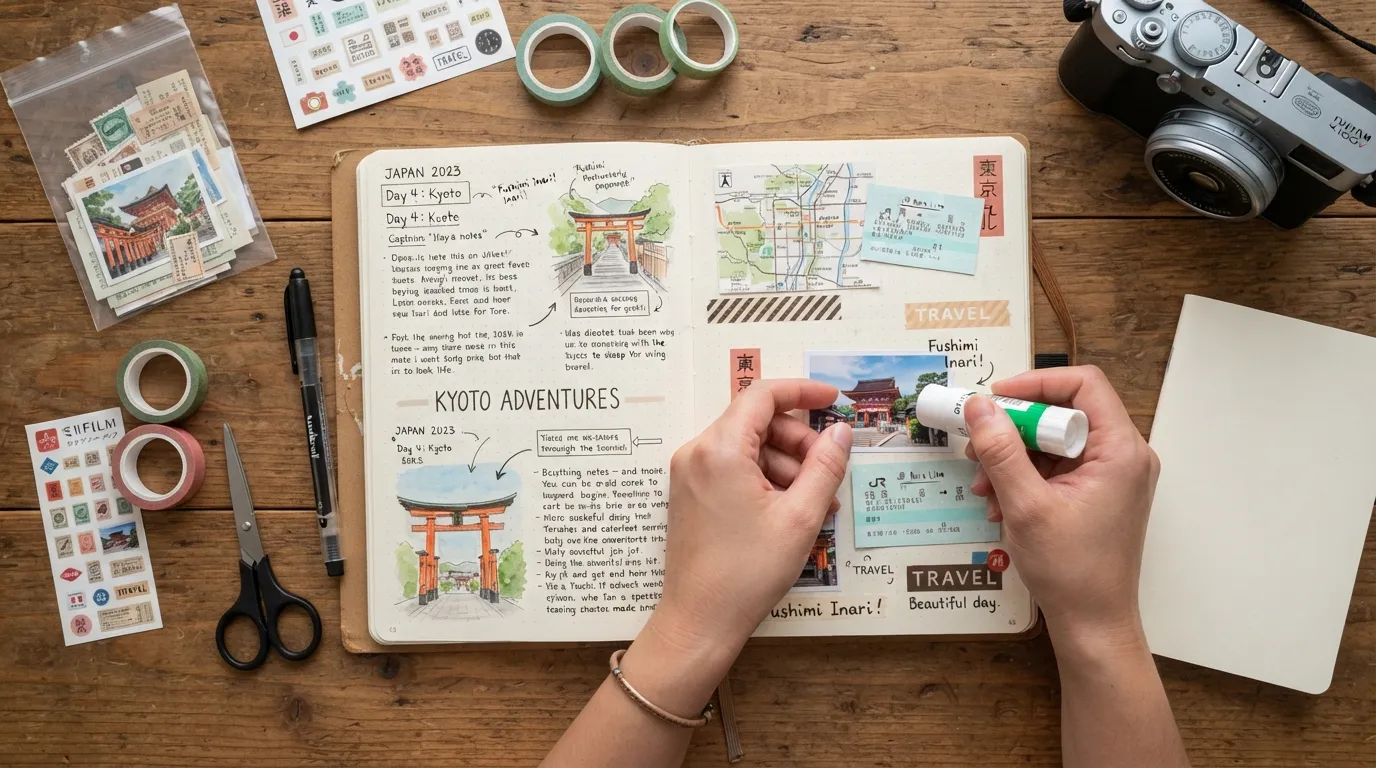
If you want to know how to make a travel journal, you have two good options: build a simple journal from paper and cardstock, or turn a ready-made notebook into a travel diary. Either way, the useful part is not making every page look perfect. It is creating an easy place to save the details you will otherwise forget—where you went, what you ate, who you met, how a place felt, and the tickets, maps, photos, and little paper keepsakes you collected along the way.
I’ll show you both approaches, then give you a simple system for setting up the journal before your trip, filling it during the journey, and finishing it when you get home.
choose a small notebook, reserve the first few pages for your trip overview and route, then use one spread for each day or destination. During the trip, write short notes and save paper keepsakes. You can add photos and decorate the pages later.
First Decide What “Make a Travel Journal” Means for You
People use the phrase make a travel journal in two different ways, so choose your path before buying supplies.
| Option | Best if you want | What you need |
|---|---|---|
| Make one from scratch | A handmade, customizable journal | Paper, cardstock, needle and thread or stapler |
| Use a ready-made notebook | The fastest and easiest setup | Notebook, pen and a few basic craft supplies |
If your real goal is recording your travels rather than bookbinding, I would use a ready-made notebook. If making the journal itself is part of the experience, the handmade version is worth doing.
Choose a Journal That Matches the Way You Travel
There is no single “best” travel journal. The right choice depends on whether you mostly write, sketch, paste souvenirs, or combine everything.
| Journal type | Works well for | Consider |
|---|---|---|
| Lined notebook | Long written entries | Less flexible for drawings and layouts |
| Blank notebook | Sketches, collage and photos | Writing straight can be harder |
| Dot-grid notebook | Mixed writing, trackers and layouts | A strong all-round beginner option |
| Sketch or watercolor journal | Painting and visual travel journaling | Usually thicker and heavier |
| Small travel notebook | Light packing and quick daily notes | Less space for large souvenirs |
Portability matters more than people expect. A beautiful oversized journal that stays in your hotel room is less useful than a simple notebook you are comfortable carrying every day.
Keep Your Travel Journal Supplies Simple
You do not need a full art kit. A compact travel journaling pouch can contain:
- one reliable pen
- one or two colored pens, pencils or markers
- a glue stick or double-sided tape
- a small roll of washi tape
- small scissors if practical for your trip
- a small ruler if you like structured layouts
- a lightweight envelope, pouch or accordion folder for paper keepsakes
The last item is especially useful. Instead of stopping to design a page every time you receive a ticket or brochure, put it into one place and deal with it later.
How to Make a Handmade Travel Journal From Scratch
A basic handmade booklet is enough for a short trip. You do not need advanced bookbinding skills.
- Choose your paper. Use ordinary printer paper for writing or thicker mixed-media paper if you plan to sketch and glue items onto the pages.
- Fold the sheets in half. Stack a manageable number of folded sheets rather than trying to make a very thick book.
- Make the cover. Fold cardstock, kraft paper or another sturdy sheet around the pages.
- Bind the center. For a simple version, staple along the fold. For a more handmade finish, pierce a few holes along the fold and stitch the pages together with strong thread.
- Add a pocket. Glue an envelope or folded piece of paper inside the back cover for tickets and other loose items.
- Label the trip. Add the destination, dates and your name to the cover.
If binding feels like extra work, skip it. Using a notebook does not make your travel journal less meaningful.
Set Up a Few Pages Before You Leave
Do not pre-design every page. Leave enough flexibility for unexpected moments. I would prepare only the pages that help organize the trip.
Trip cover page
Write the destination, travel dates and a simple title such as “Portugal — Spring 2026.” Add a photo, small illustration or sticker only if you want one.
Route or world map
Draw, trace or paste a map and mark the cities or countries on your route. You can connect stops with lines and add dates or transportation symbols as the trip progresses.
Useful planning pages
Depending on the trip, reserve space for:
- a simple itinerary
- accommodation information
- transport details
- places you hope to visit
- packing reminders
- a simple budget or expense log
- useful local words or phrases
Keep bookings, passport details and other sensitive information somewhere secure rather than turning your journal into a complete record of private travel documents.
What Should You Put in a Travel Journal?
A good travel journal records more than a list of attractions. The details that feel unimportant today are often the things that bring the trip back most clearly later.
Useful things to record include:
- date and location
- where you went and what you did
- people you met
- interesting conversations or phrases
- meals, drinks and local foods
- weather
- something that surprised you
- something that went wrong
- how you felt about a place
- sounds, smells and textures
- small sketches or maps
- photos and paper keepsakes
That sensory information matters. “Visited the old market” tells you what happened. “The alley smelled of coffee and spices, scooters kept squeezing past us, and the shopkeeper laughed when I mispronounced the local word for thank you” brings the memory back.
Collect Ephemera Without Turning the Journal Into Clutter
Ephemera is the small printed material you collect during a journey. It can make a travel diary feel connected to the actual place.
You might save:
- train or attraction tickets
- postcards
- small maps
- museum or attraction brochures
- business cards
- stamps and labels
- receipts
- cafe or restaurant paper items
- pressed flowers where collecting them is permitted
receipts can contain information you may not want permanently displayed, and some thermal receipts fade with time. Cover or remove private details and consider photographing or copying an important receipt before using it in the journal.
You also do not need to glue every item in. Choose pieces that add a memory, story or visual detail instead of keeping paper just because you collected it.
Use This Simple Travel Journal Template
If a blank page makes you hesitate, use the same basic structure for every destination or day.
Date: ____________________
Place: ____________________
What I did: ____________________
Favorite moment: ____________________
Something I ate or drank: ____________________
Something unexpected: ____________________
A detail I do not want to forget: ____________________
Photo, ticket, sketch or keepsake: ____________________
You can copy this into a notebook, recreate it in a document, or print several copies. If you want a travel journal PDF for personal use, create the template in your preferred document editor and use its print or export-to-PDF option.
A Travel Journal Entry Example
Your entries do not need to read like polished travel writing. Here is the kind of detail that works well:
May 14 — Rome
We walked from the hotel toward the historic center before breakfast. The streets were quieter than yesterday and it had rained overnight, so the stone pavement was still shiny.
My favorite moment was not one of the major sights. It was standing at a tiny counter with coffee while two local customers argued cheerfully with the man behind it. I understood almost none of the conversation, but everyone seemed to be enjoying it.
I kept the cafe receipt and made a quick sketch of the street corner so I can remember where it was.
Notice that the entry includes a place, an action, a feeling and one specific sensory memory. That is usually more memorable than trying to document every hour of the day.
Creative Travel Journal Ideas That Add Meaning
Decoration is useful when it helps tell the story. You do not need to turn every spread into a scrapbook competition.
Memory pages
- favorite meal of the trip
- funniest moment
- best view
- best unexpected discovery
- things you would do differently next time
Visual pages
- photo collage
- hand-drawn street or transit map
- watercolor landscape
- food sketches
- postcard and stamp spread
- ticket timeline
Simple travel trackers
- cities visited
- foods tried
- miles or steps walked if you already track them
- daily expenses
- new words learned
How to Keep a Travel Journal When You Are Busy
This is where many travel journals fail. People imagine they will spend an hour every night writing and decorating, then discover that travel itself is exhausting.
A better system is capture now, create later.
During the trip, take two or three minutes to record:
- the date and place
- three memorable things
- one feeling or reaction
- anything you want to remember later
Then put your tickets and other paper items into your travel pouch. When you have more time—in a cafe, on a train, at the airport or after the trip—you can turn those raw notes into fuller pages.
Do Not Let Perfection Stop You From Journaling
One reason people avoid journaling is that they make the task too demanding. They think every entry needs beautiful handwriting, a long story and a perfectly designed page.
It does not. Try these rules instead:
- No time? Write three bullet points.
- Do not like drawing? Use photos, tickets and words.
- Missed a day? Rebuild it from your photos, map history or quick phone notes.
- Your page looks messy? Leave it. Travel itself is rarely perfectly organized.
- Do not want to craft during the trip? Collect material and assemble it when you return.
Consistency matters more than presentation if your real goal is preserving memories.
Finish the Journal After the Trip
When you get home, gather your notebook, photos and saved paper items before memories start becoming vague.
- Sort tickets, receipts, postcards and brochures by date or destination.
- Choose only the photos that add something to the story.
- Use your quick notes to fill any unfinished entries.
- Add maps, captions and keepsakes where they naturally fit.
- Create a final reflection page with favorite moments, surprises and what you learned.
Do not feel obligated to use every saved item. Your journal should tell the story of the trip, not become storage for every piece of paper you brought home.
Travel Journal vs. Regular Journal
A regular journal can cover any part of your daily life, thoughts or routines. A travel journal is focused specifically on a journey and usually combines written memories with practical travel details and visual material such as maps, photos, tickets and postcards.
A travel diary can be mostly written. A travel scrapbook can be mostly visual. A travel journal sits comfortably between the two, so you can choose the balance that feels natural to you.
Making a Travel Journal for a School Project
If you are making a travel journal for school rather than documenting an actual holiday, keep the structure factual but still make it feel like a journey.
A simple student format can include:
- a cover with destination and project title
- a map showing the location
- a short itinerary
- one entry for each day or place
- facts about food, culture, landmarks or transport
- photos, drawings or printed tickets
- a final reflection on what you learned
If the trip is fictional or research-based, say so rather than presenting imagined experiences as things that actually happened.
Are Travel Journals Worth It?
They are worth it if you value remembering the details behind your photos. A camera records what a place looked like. A journal can also preserve what happened around the photo—what you noticed, what surprised you, what you were thinking and the small moments you would probably forget a few years later.
Questions About Starting a Travel Journal
How do I write a travel diary?
Start each entry with the date and place, then write what happened, one or two details you noticed, and how you felt about the experience. You can add photos, tickets, sketches or maps, but they are optional.
What is a travelling journal?
A travelling or travel journal is a notebook or handmade book used to document a trip. It can contain written entries, plans, maps, drawings, photos, expenses and physical keepsakes collected during the journey.
What is the best travel journal to use?
For most beginners, a small durable notebook with either dot-grid or blank pages gives enough flexibility for writing and visual material. If you mainly write, lined pages may be easier. If you paint, choose paper designed for the medium you use.
How do I make a travel journal cover?
Keep it simple: add the destination, dates and one visual element such as a map outline, postcard, photo, sticker or small drawing. For a handmade journal, use heavier cardstock so the cover protects the pages inside.
Do I need to write in my journal every day?
No. Daily notes can help while memories are fresh, but you can also record quick bullet points during the trip and write longer entries later. Choose a routine that does not interfere with enjoying the journey itself.
Useful Travel Journaling References
For more examples and different approaches to keeping a journey diary, these resources offer useful first-hand and visual inspiration:
Pimchanok Srisuk
Pimchanok Srisuk is the Journaling Editor at Holistic Wellbeing Living. She writes about journaling prompts, reflective writing, emotional clarity, and mindful routines. With seven years of experience creating personal-growth content, Pimchanok helps readers use simple writing practices to understand their thoughts and make calmer everyday decisions.