Jump to:
ToggleKeeping a Food Journal: What to Track, Examples, and Tips
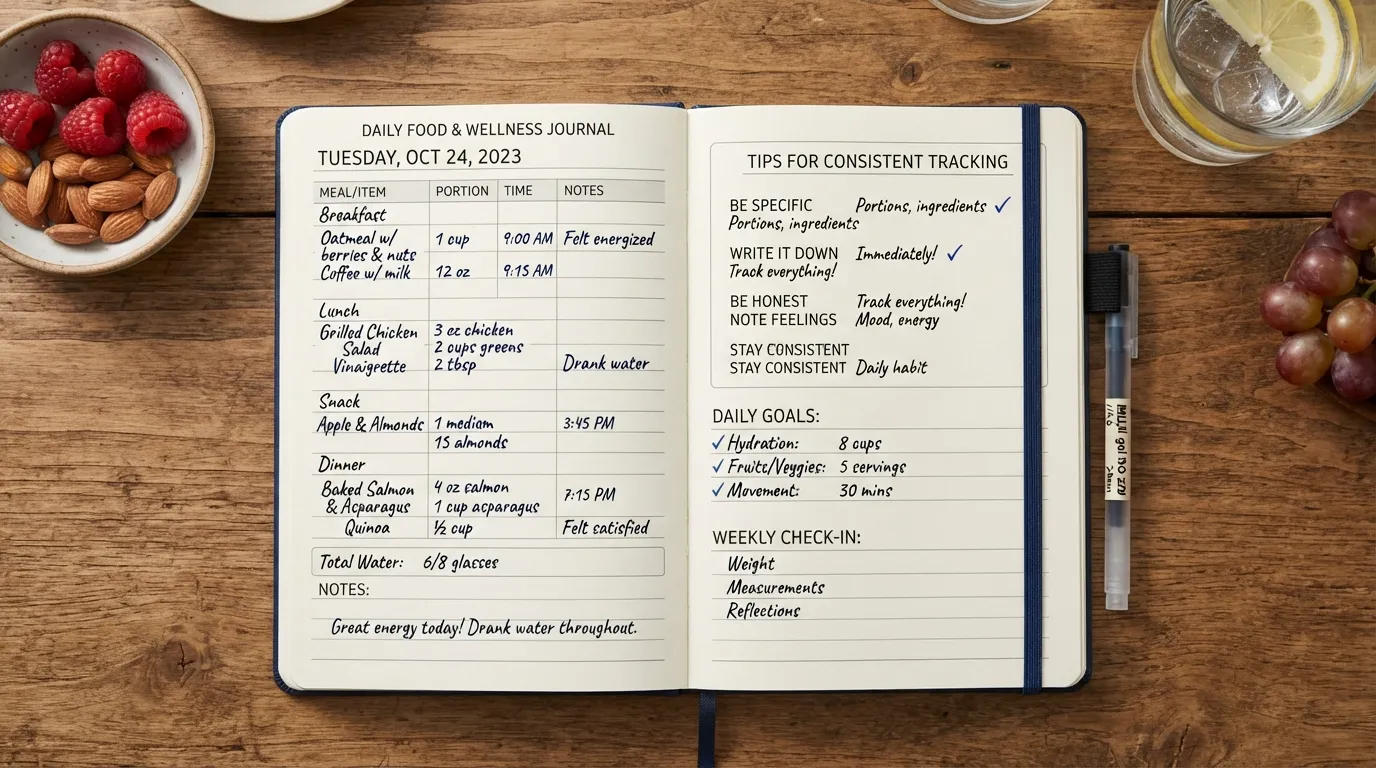
Keeping a food journal means recording what you eat and drink so you can see patterns that are surprisingly easy to miss from memory alone. Depending on your goal, you may also record portions, meal times, hunger, mood, activity, digestive symptoms or specific nutrients. You can do it in a paper notebook, with photos, in a spreadsheet or with a food-tracking app.
The useful part is not simply writing everything down. It is reviewing what you recorded and deciding what the pattern means for you. A good food journal should answer a question, not create another daily chore.
Start with your purpose: Are you trying to understand your eating habits, support weight management, improve nutrition, notice emotional-eating triggers or connect certain foods with digestive symptoms? Your answer determines what is actually worth tracking.
What Should You Write in a Food Journal?
For most beginners, I would start with five basics: what you ate or drank, how much, when, where and any useful context. You can add more detail only when it helps answer your particular question.
What to record | What that means |
Food and drinks | Record meals, snacks and drinks. Include extras such as sauces, dressings, toppings, cream, sugar and condiments when they are relevant. |
Amount | Use practical measures such as cups, tablespoons, ounces, pieces or an honest estimate if measuring is not useful or practical. |
Time | Note when you ate. This can reveal long gaps between meals, repeated late-night eating or predictable snack times. |
Place and situation | Kitchen table, desk, restaurant, car or sofa; alone or with other people; working, driving, scrolling or watching TV. |
Hunger and mood | If useful, note whether you were physically hungry, stressed, bored, tired, anxious, happy or eating out of habit. |
Symptoms | For symptom tracking, record what happened, when it started, how long it lasted and how noticeable it was. |
Specificity matters. “Chicken” tells you less than “fried chicken strips with barbecue sauce.” “Coffee” tells you less than “large coffee with milk and two teaspoons of sugar.” The point is not perfection; it is recording enough detail to recognize a useful pattern later.
Track What Matters for Your Goal — Not Everything
One reason food journaling becomes exhausting is that people try to record every possible metric from day one. I would do the opposite. Decide what you want to learn, then collect only the information that can help answer that question.
Your goal | Prioritize | Usually optional |
Understand habits | Foods, drinks, time, place, hunger, mood and distractions | Detailed calories or nutrient totals |
Weight management | Foods, drinks, portions, eating times and patterns related to your nutrition plan | Every micronutrient unless your plan requires it |
Improve nutrition | Foods plus the nutrients relevant to your goal, such as fiber, sodium or saturated fat | Unrelated metrics that will not change your decisions |
Mindful eating | Hunger, fullness, feelings, location, distractions and reasons for eating | Calories if numbers make the process less helpful |
Digestive symptoms | Ingredients, preparation, portion, time, symptom type, onset, duration and severity | Calorie targets unless separately needed |
This goal-first approach makes a food and nutrition journal easier to maintain because every field has a reason to exist.
How to Start Keeping a Food Journal
- Write down your purpose. A useful question might be, “Why am I always hungry in the afternoon?” or “Do certain meals seem to precede my stomach symptoms?” A specific purpose keeps the journal focused.
- Choose the simplest format you will actually use. Paper, phone notes, photos, a spreadsheet or an app can all work.
- Choose your fields. Start with food, drink, amount and time. Add mood, hunger, symptoms or nutrients only if they relate to your goal.
- Record as you go. Writing an entry during or soon after eating is usually more accurate than reconstructing the entire day at bedtime.
- Include the easy-to-forget extras. Drinks, tastes while cooking, toppings, sauces and small snacks can matter when you are trying to understand your overall pattern.
- Review instead of judging. After several days, look for repeated situations rather than labeling a day as “good” or “bad.”
- Turn one pattern into one action. You do not need to overhaul your entire diet because of one week of notes.
A Simple Food Journal Template You Can Copy
You do not need a complicated printable. This basic layout works in a notebook, document, spreadsheet or phone note:
Date:
Time:
Food/drink:
Amount:
Where/who with:
What I was doing:
Hunger before eating:
Mood/context:
Symptoms or notes afterward:
Delete any line you do not need. A journal with six fields that you complete consistently is more useful than a 20-field tracker you abandon after two days.
What a completed entry can look like
Time | Food and amount | Context |
7:30 a.m. | Oatmeal with banana and milk; coffee | At kitchen table; hungry before breakfast; felt satisfied afterward |
12:45 p.m. | Chicken sandwich, side salad and water | Eating at desk while working; ate quickly |
3:30 p.m. | Chocolate bar and coffee | Not very hungry; tired and stressed before a meeting |
7:15 p.m. | Rice, grilled fish, vegetables and water | Dinner with family; comfortably hungry beforehand |
This is only an example, not a recommended meal plan. Its value is the context. Looking back, the person might notice that the afternoon snack appears alongside tiredness and work stress rather than strong physical hunger. That gives them something specific to investigate.
Use a Simple Hunger and Fullness Scale If It Helps
You do not need to turn hunger into a scientific measurement. If your goal is mindful eating, a simple personal scale can make vague feelings easier to compare from one meal to another.
- 1: Very hungry
- 2: Clearly hungry
- 3: Neutral
- 4: Satisfied
- 5: Very full
Treat it as your own consistent reference rather than a diagnostic scale. The useful question is whether a pattern develops, such as regularly reaching dinner extremely hungry after a long afternoon without food.
Paper, Photos, an App or a Spreadsheet?
There is no universally best way to keep a food journal. The best format is the one that captures the information you need with the least friction.
Format | Best for | Trade-off |
Paper notebook | Simple journaling, feelings and handwritten reflection | Harder to total nutrients or search old entries |
Photo log | Busy people who regularly forget to write meals down | A photo may not capture ingredients, amounts, drinks or how you felt |
Food-tracking app | People who want nutrient information or searchable entries | Can become more detailed than your goal requires |
Spreadsheet | Custom symptom tracking or people who like reviewing patterns | Requires some setup and may be inconvenient while away from home |
If you want a completely free food journal, a small notebook, your phone’s notes feature or a basic spreadsheet may be all you need. If you choose an app, judge it by your goal and ease of use rather than by how many metrics it can display
How Long Should You Keep a Food Diary?
You do not necessarily need to keep one forever. The right duration depends on what you are trying to learn.
For a general snapshot, several complete days can already be useful. The American Academy of Family Physicians’ FamilyDoctor guidance suggests that at least three to four complete days can give a doctor useful information to review. If you want to compare weekday and weekend habits, a full week usually gives you a broader picture.
For a recurring health symptom, the useful timeframe may be different. A healthcare professional or registered dietitian can tell you how long to track based on the symptoms and what they are trying to evaluate.
A practical seven-day starter approach
- Days 1–2: Simply get used to recording food, drinks and times.
- Days 3–4: Notice whether portions, hunger or context need more detail.
- Days 5–6: Make sure weekend or social eating is represented if it normally differs from weekdays.
- Day 7: Review the week and identify one or two repeated patterns worth acting on.
How to Review Your Journal Instead of Just Collecting Data
This is where many food journals fail. You record a week’s worth of information and then never use it. I would set aside a few minutes at the end of the week and ask questions that connect your entries to your original goal.
- Which eating times repeat most consistently?
- Are there long gaps that leave you extremely hungry later?
- Do certain snacks appear repeatedly when you are stressed, bored or tired?
- Are you regularly eating while distracted?
- Which meals tend to leave you comfortably satisfied?
- Do weekday and weekend patterns look different?
- If you are tracking a nutrient, are you moving toward your specific target?
- For symptom tracking, do particular foods, ingredients, portions or combinations repeatedly appear before the same symptoms?
Turn a pattern into a small action
Suppose your journal shows that you regularly buy a snack from the vending machine around 3:30 p.m. when you are tired. “Stop snacking” is vague. A better experiment might be: bring a planned afternoon snack to work on weekdays for the next week.
Or suppose you notice that dinner is often eaten in front of the television and you have difficulty noticing when you feel satisfied. A useful experiment might be to eat dinner at the table without a screen three nights this week and compare how the experience feels.
This observation-to-action approach is more useful than trying to “fix” every imperfect entry at once.
Keeping a Food Journal for Weight Loss
A food journal can support weight-management efforts because self-monitoring makes eating patterns more visible. Research reviews of behavioral weight-loss programs have found dietary self-monitoring commonly used in successful interventions. That does not mean writing food down automatically causes weight loss or that everybody needs to count calories.
If weight management is your goal, I would focus first on information you can actually use:
- What you eat and drink
- Useful portion estimates
- Meal and snack times
- Repeated high-hunger periods
- Drinks, sauces and extras you normally forget
- Situations linked with unplanned eating
- Nutrients or calorie information only when they are part of an appropriate plan for you
Then review patterns rather than obsessing over one meal. Your journal is evidence about your routine, not a scorecard for whether you were “good” or “bad.”
Keeping a Food Journal for Stomach Issues or Food Intolerance
When digestive symptoms are the reason for keeping a food journal, you need more than a meal list. The useful relationship is:
Food or ingredient → amount → time → symptom → onset → duration → severity
For example, instead of writing only “stomach hurt after dinner,” record the meal’s main ingredients, approximate amount, when you finished eating, when the symptom began, what the symptom felt like and how long it lasted.
You can use a simple personal symptom scale such as:
- 0: No symptom
- 1: Mild
- 2: Moderate
- 3: Severe
Use the same scale consistently so you can compare entries. It is only a recording tool, not a diagnosis.
Important: A food journal may help you and a healthcare professional identify patterns, but it cannot confirm a food allergy, intolerance, IBS or another medical condition by itself. Avoid removing large groups of foods for long periods based only on your diary. Restrictive elimination diets can create nutritional problems and are better planned with a qualified healthcare professional or registered dietitian.
Common Food Journaling Mistakes
Waiting until the end of the day
Memory gets less reliable as the day goes on. If you cannot write immediately, take a quick photo or short note and complete the detail later.
Leaving out drinks, toppings and small bites
These may be relevant to your nutrition or symptom pattern. Record them when they matter to your goal.
Trying to make the journal look “healthy”
A journal only works when it reflects what actually happened. You are collecting information, not submitting homework for a grade.
Tracking too much
If every snack requires several minutes of data entry, simplify the journal. More data is not automatically better data.
Recording without reviewing
A week of perfectly detailed entries has limited value if you never look for patterns or decide what to do with what you learned.
Changing several things at once
If you change breakfast, snacks, caffeine, meal timing and exercise simultaneously, it becomes difficult to understand which change made a difference. When appropriate, use your journal to choose one manageable experiment at a time.
Is It Healthy to Keep a Food Journal?
For many people, yes. Food journaling can increase awareness and help organize information that would otherwise be difficult to remember. But it is not automatically helpful for everyone.
If tracking calories, portions or body-related numbers makes you increasingly anxious, guilty, restrictive or preoccupied with food, that is a reason to reconsider the method rather than simply becoming more disciplined about it.
If you have an eating disorder or a history of disordered eating: detailed calorie and portion tracking may be inappropriate or triggering. Cleveland Clinic advises against focusing on amounts and calories in that situation. A qualified clinician, therapist or registered dietitian can help determine whether a less numerical journal — such as recording thoughts, feelings and symptoms — is more appropriate.
When Should You Share Your Food Journal With a Professional?
A journal becomes especially useful when another person needs a clearer picture of what has been happening between appointments. Consider sharing it with a registered dietitian, doctor or other appropriate healthcare professional when you are:
- trying to understand persistent digestive symptoms;
- considering a restrictive elimination diet;
- managing a health condition that affects dietary choices;
- unsure which nutrients or measurements are worth tracking;
- using food tracking as part of a structured weight-management plan; or
- finding that journaling is increasing anxiety, guilt or obsessive thoughts about food.
Bring the clearest, most honest record you can rather than trying to produce a “perfect” week. The irregular days are often useful information too.
Questions People Often Have About Food Journaling
Do I need to count calories in a food journal?
No. Calorie tracking is one possible form of dietary self-monitoring, not a requirement. If your purpose is mindful eating, meal timing, digestive symptoms or understanding habits, other information may be more useful.
Do I need to weigh every portion?
Not necessarily. Measurements can improve accuracy when portion information matters, but reasonable estimates may be enough for many purposes. Choose the level of precision your goal actually requires.
Should I include water?
Include it if hydration is relevant to what you are trying to understand. At minimum, record drinks that contribute information relevant to your nutrition, caffeine, alcohol or symptom patterns.
What if I forget an entry?
Add what you reasonably remember and continue with the next meal. Do not abandon the entire week because one entry is incomplete. Consistency over time is more useful than perfection.
What is the best food journal for beginners?
The simplest one. Start with food, drink, amount and time. Add one or two context fields related to your goal. You can always add detail after you learn what information is actually useful.
Make the Journal Lead to a Decision
Keeping a food journal works best when the journal has a clear job. You record what happened, look for repeated patterns and then decide whether one small change or a professional conversation makes sense.
If you are starting today, do not build a complicated tracking system. Pick your goal, choose four or five useful fields, record your next meal honestly and continue long enough to see a pattern. That is usually a better starting point than trying to measure everything from the first bite.
Trusted References
For further information on food journaling, nutrition and health-related tracking, these sources were used to support this guide:
- Cleveland Clinic — Food Journaling: What It Is, Benefits & Tips
- FamilyDoctor.org — Nutrition: Keeping a Food Diary
- American Heart Association — Keeping a Food Diary
- Harvard Health Publishing — Why Keep a Food Diary?
- Healthline — Food Journaling Instructions and Tips
- American Society for Nutrition — The Benefits of Food Journaling