Jump to:
ToggleHow to Make Your Own Fitness Journal: Simple Setup + Examples
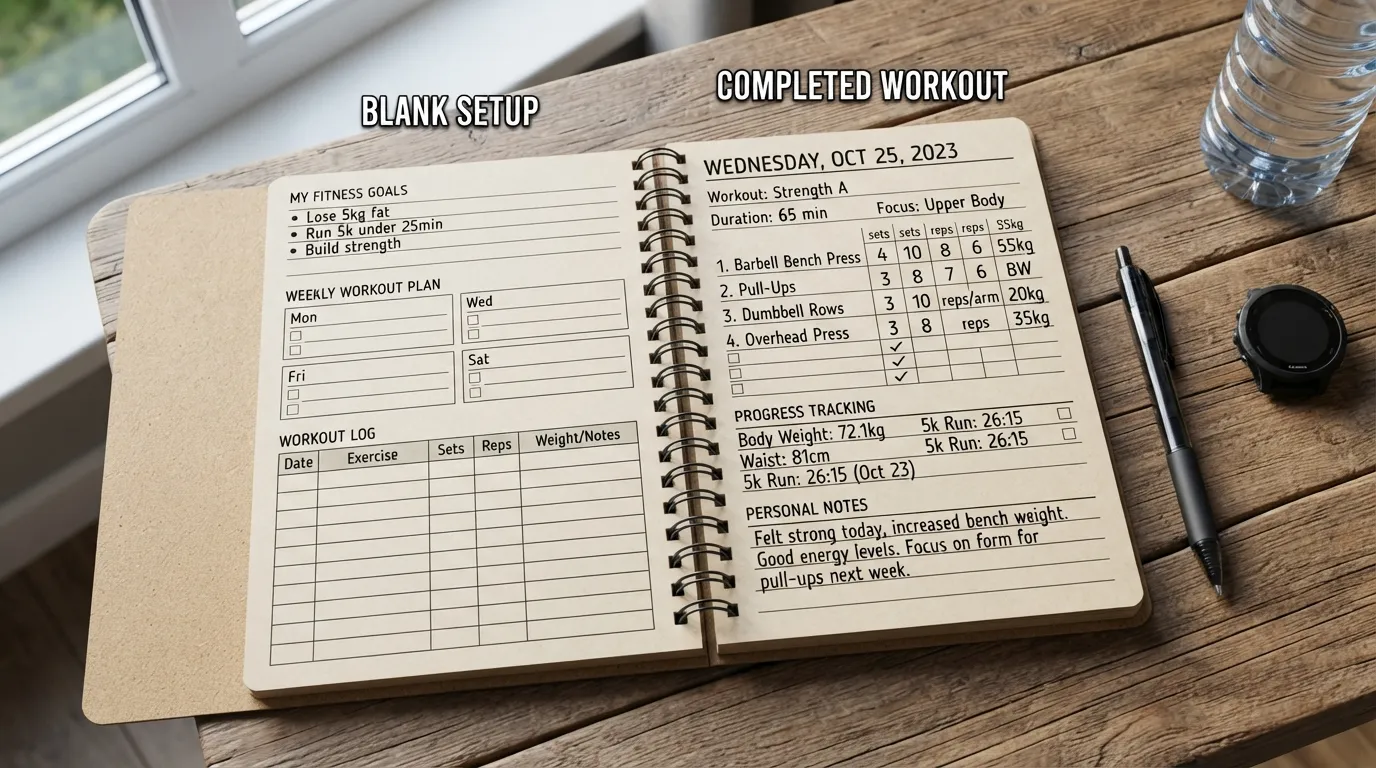
To make your own fitness journal, choose a format you can update easily, create pages for your goals and starting point, then build a simple workout log for the information you actually use. At a minimum, I recommend recording the date, exercise or activity, sets and reps or time and distance, the load or intensity, and one short note about how the workout went.
You do not need an elaborate planner. A blank notebook, three-ring binder, spreadsheet, printable template, or fitness-journal app can all work. The best setup is the one that is quick enough to use during or immediately after a workout and detailed enough to help you decide what to do next.
A simple five-part fitness journal
Organize it around goals and baseline → training plan → daily workout log → useful recovery notes → weekly or monthly review. Start with the minimum information you need and add extra fields only when they help you make a better training decision.
How to Make Your Own Fitness Journal
1. Choose a format you will actually use
Start by deciding where you want to record your workouts. Do not choose a complicated system simply because it looks impressive. If logging a workout becomes a chore, you are less likely to keep doing it.
Format | Best for | Main trade-off |
Notebook | Simple, portable workout logging | Pages cannot easily be rearranged |
Three-ring binder | Testing custom printable layouts | Less portable than a small notebook |
Spreadsheet | Comparing numbers over time | Can be awkward to update mid-workout |
App | Fast digital logging and searchable history | You may be limited by the app’s structure |
Printable or Canva layout | Creating a personalized visual planner | Requires some setup before you begin |
If you are unsure, I would start with a notebook or binder. A binder is especially useful while you are experimenting because you can replace pages that are not useful instead of rebuilding the entire journal. You can also browse customizable workout-planner templates on Canva if you prefer to design and print your own pages.
2. Define what you want the journal to help you do
A fitness journal works better when every field has a purpose. Before designing pages, write down the main result you want to monitor. Your goal might be getting stronger, running farther, exercising more consistently, improving a specific skill, or simply understanding which routines work best for you.
Then create a short starting-point page. Depending on your goal, that could include:
- your main short-term and long-term goals;
- your current workout frequency;
- starting weights, repetitions, running pace, distance, or other performance measures;
- personal records you want to improve;
- body weight, measurements, or progress photos only when they are genuinely relevant to your goal.
Body measurements are optional, not a requirement for a useful fitness journal. If your goal is improving strength, endurance, technique, mobility, or workout consistency, performance measures may tell you far more than body measurements.
3. Organize the journal before filling it
If you are wondering how to organize a workout journal, keep the structure predictable. You should be able to open it and find your previous workout without searching through unrelated notes.
A practical page order is:
- Goal page: the outcome or habit you are working toward.
- Baseline page: your useful starting measurements or performance numbers.
- Training-plan page: your usual weekly schedule or planned sessions.
- Daily workout pages: what you actually did during each session.
- Personal-record page: important strength, speed, distance, or skill milestones.
- Weekly or monthly review: what improved, what stalled, and what you will change next.
In a bound notebook, page numbers and a simple index can make this much easier. In a binder, use dividers. In a spreadsheet or app, use separate tabs, tags, or categories for goals, workouts, and reviews.
4. Build a minimum workout log first
This is the page you will use most often, so make it fast. A beginner does not need twenty fields.
Minimum workout-log template
Date: ____________________
Workout: ____________________
Exercise/activity: ____________________
Load / sets / reps OR time / distance: ____________________
Effort or intensity: ____________________
Short note: ____________________
Next time: ____________________
For strength training, an even faster line format is Exercise – Weight – Sets × Reps. This keeps the page compact while preserving the information you need to compare one session with the next. James Clear demonstrates a similar simple workout-log system in his workout journal guide.
5. Customize the fields for your type of training
There is no single perfect fitness-journal page because useful metrics change with the activity. A running log and a strength-training log should not force you to record the same information.
Training type | Useful fields | Example next decision |
Strength | Exercise, load, sets, reps, optional rest or RPE | Repeat, add reps, or increase load |
Running/cardio | Distance, duration, pace or speed, optional heart rate, effort | Change distance, pace, or recovery |
General fitness | Activity, duration, intensity, rounds or circuits, short note | Repeat or adjust difficulty |
Mobility/yoga | Routine, duration, positions or movements, comfort, range or control notes | Repeat, progress, or modify a movement |
RPE means rating of perceived exertion. It is simply a way to record how difficult a workout or set felt to you. You do not have to use it. If a field never influences what you do later, remove it.
6. Add context only when it explains performance
Numbers do not always explain why a workout felt unusually easy or difficult. A short context note can help you spot patterns later.
Depending on your goals, optional notes could include:
- energy level;
- sleep;
- stress;
- soreness or recovery;
- weather for outdoor training;
- exercise modifications;
- form or technique cues you want to remember;
- anything unusual that may have affected the session.
Keep these notes short. “Slept poorly, legs felt heavy” is usually more useful than writing half a page after every workout. G&G Fitness also recommends combining workout statistics with relevant notes so you can interpret changes rather than looking at numbers in isolation; its fitness-journal guide gives examples of workout and context details people may track.
7. Create a weekly or monthly review page
This is the step many workout logs miss. Recording data is not the real goal. The value comes from using that information to make your next decision.
At the end of the week, review a few questions:
- Which workouts did I complete?
- Where did my weight, repetitions, pace, duration, or technique improve?
- Where am I repeating the same numbers without progress?
- Were difficult sessions linked with poor sleep, unusual stress, soreness, or another repeated factor?
- What should I repeat next week?
- What is one useful change I should make?
Use this review loop
Record → compare → identify a pattern → choose an action → test it in the next workout. If you never review a metric or use it to make a decision, consider removing it from your journal.
What Should You Put in a Fitness Journal?
Your fitness journal should contain enough information to answer three basic questions: What did I plan? What did I actually do? What should I do next?
For most people, I would divide fields into three levels.
Essential fields
- date;
- exercise or activity;
- sets and reps, or duration and distance;
- weight, resistance, pace, intensity, or another relevant performance measure;
- a short note or next-session target.
Useful optional fields
- start and finish time;
- rest intervals;
- heart rate when relevant;
- RPE or perceived effort;
- energy;
- sleep or recovery notes;
- technique reminders;
- personal records and milestones.
Goal-specific fields
Body weight, body measurements, progress photos, meals, hydration, calories, supplements, or other lifestyle information may be useful for certain goals, but they do not belong in every workout journal. Add them only when they are relevant and useful to you. A journal can help you observe patterns, but it should not be used to diagnose an injury, medical condition, or nutrition problem.
Fitness Journal Examples You Can Copy
A blank template is easier to understand when you can see what a completed entry might look like. The numbers below are examples only; they are not workout recommendations.
Strength-training example
Date: Monday
Squat: 135 lb – 3 × 8
Bench press: 95 lb – 3 × 8
Row: 80 lb – 3 × 10
Note: Final squat set felt easier than last week.
Next time: Review the previous sessions and decide whether increasing the load or repetitions fits the training plan.
Running example
Date: Wednesday
Workout: Easy run
Distance: 3 miles
Duration: 31 minutes
Effort: Comfortable
Note: Legs felt fresh; weather was cooler than the previous run.
Next time: Compare with similar easy runs before changing distance or pace.
Weekly review example
Planned workouts: 4
Completed: 3
Improved: More repetitions on two strength exercises
Pattern noticed: Evening workouts were harder after shorter sleep
Next action: Keep the program the same and test an earlier training time when possible.
Fitness Journal vs. Workout Log: What Is the Difference?
A workout log usually focuses on individual training sessions: exercises, loads, repetitions, distance, time, pace, and similar performance information.
A fitness journal can include that workout log plus broader goals, reflections, progress reviews, personal records, recovery notes, and other information that helps you understand your overall fitness routine. You can keep a very simple workout log inside a broader fitness journal without creating two separate systems.
Why Do People Journal at the Gym?
The biggest reason is that memory is a poor workout-tracking system. Once several sessions have passed, it is easy to forget exactly which weight you used, how many repetitions you completed, how fast you ran, or what modification worked.
A consistent journal can help you:
- see what you actually completed rather than what you planned to complete;
- compare similar workouts over time;
- keep useful training details in one place;
- notice plateaus, improvements, and recurring patterns;
- remember technique cues and modifications;
- make the next workout decision using your previous results.
The YMCA also recommends keeping a fitness journal as a practical way to plan exercise and measure progress. You can read its fitness-journaling guidance for another straightforward approach.
Common Fitness Journal Mistakes
Tracking too much
If every workout requires ten minutes of paperwork, simplify the journal. Start with your essential performance fields and add something only when you know why you need it.
Recording from memory much later
Log the important numbers during the session or as soon as practical afterward. Details become less reliable when you try to reconstruct an entire workout at the end of the day.
Mixing planned and completed work
It is useful to write your plan before training, but clearly mark what you actually completed. Otherwise, looking back at the page may give you an inaccurate training history.
Changing units or abbreviations
Choose consistent labels for pounds or kilograms, miles or kilometers, repetitions, sets, time, and other measurements. Consistency makes older entries much easier to compare.
Never reviewing the journal
A notebook full of numbers is only an archive. Review it regularly and turn useful patterns into a specific next action.
Drawing conclusions from one workout
One unusually good or bad session does not necessarily establish a trend. Compare multiple similar sessions before deciding that your routine is working or failing.
Treating pain as just another metric
You can record discomfort or pain so you remember when it occurred, but a fitness journal cannot tell you what caused it. New, severe, persistent, or concerning pain should not be diagnosed from your notes; get appropriate professional advice instead.
How to Keep Your Fitness Journal Useful Over Time
Your first layout does not have to be permanent. After a few weeks, look at which fields you consistently use and which ones you ignore.
I would keep a field when it helps you:
- compare workouts;
- remember an important detail;
- identify a repeated pattern;
- measure progress toward a specific goal;
- make a future training decision.
If it does none of those things, you probably do not need to track it. Your journal should become simpler and more useful as you learn what matters to you, not larger just because more data is available
Questions About Making a Fitness Journal
How do you start a fitness journal?
Start with a notebook, binder, spreadsheet, printable template, or app. Write your goal and starting point first, then create a repeatable workout page with the date, activity, performance numbers, a short note, and your next-session target.
What is the best fitness journal?
The best fitness journal is the one you can update consistently and review easily. A notebook is often best for simplicity, a binder for custom printable pages, a spreadsheet for comparing data, and an app for convenient digital logging.
Can I make a fitness journal for free?
Yes. You can use a notebook you already own, create a spreadsheet, or design a basic workout-journal template in a free document or design tool. You do not need to buy a dedicated fitness planner to start tracking workouts.
How do you make a workout log?
Create one repeatable entry for each workout. Record the date, exercise or activity, sets and reps or time and distance, load or intensity, and a short note. Keep the same units and field names so sessions are easy to compare later.
Should I use a fitness journal and an app together?
You can. An app or fitness tracker may automatically collect activity data, while a journal can hold the context the device does not know, such as how the session felt, exercise modifications, technique reminders, and what you want to change next time. Day One’s fitness-journal guide is one example of using a digital journal for workout entries and reflection.
How often should I review my workout journal?
A short weekly review works well for immediate adjustments, while a monthly review gives you a broader view of consistency and progress. You can review more or less often depending on your training plan, but do not wait so long that the journal becomes a record you never use.
A useful fitness journal does not need to record everything. Build the simplest version that shows what you did, how it went, and what you should do next. Once that system is working, add new pages or metrics only when they make the journal more useful.
Pimchanok Srisuk
Pimchanok Srisuk is the Journaling Editor at Holistic Wellbeing Living. She writes about journaling prompts, reflective writing, emotional clarity, and mindful routines. With seven years of experience creating personal-growth content, Pimchanok helps readers use simple writing practices to understand their thoughts and make calmer everyday decisions.