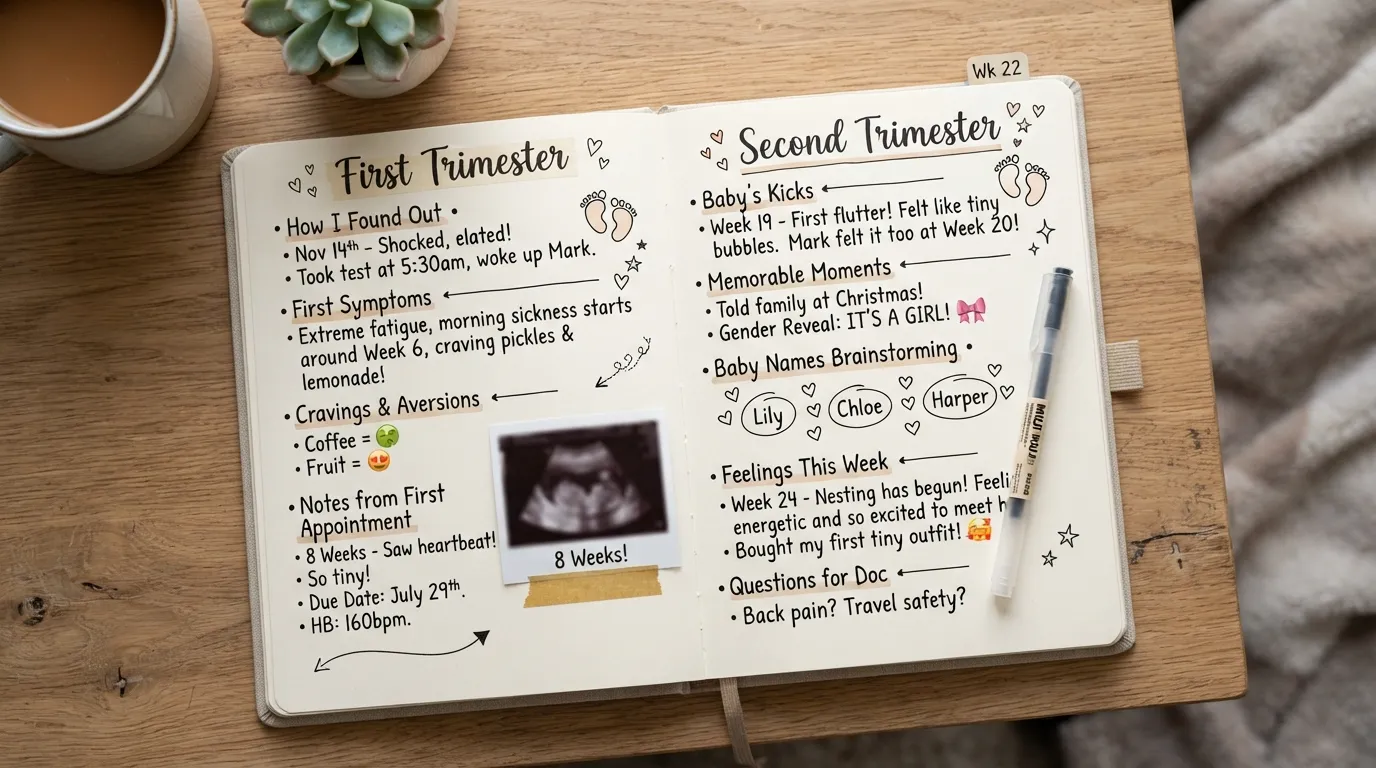
If you are wondering what to write in a pregnancy journal, start with the moments you would hate to forget: when you found out you were pregnant, how you felt, important appointments and milestones, body changes, cravings, baby-name ideas, photos, preparations, and little notes to your baby.
You do not need to document every day or answer dozens of prompts. I would build the journal around a few repeatable questions, then add special pages for milestones, photos, keepsakes, and memories that feel personal to you. That gives you a journal you can actually keep up with instead of another pregnancy project that becomes overwhelming.
- The day you found out you were pregnant
- Your first reaction and the reactions of people you told
- Your due date and meaningful appointment memories
- Ultrasound and sonogram memories
- The first heartbeat and first movements you noticed
- Cravings, aversions, symptoms, and funny pregnancy quirks
- Bump photos and body changes you want to remember
- Baby-name ideas and why you liked them
- Your hopes, fears, questions, and feelings
- A few letters or short notes to your baby
Start With a Simple Pregnancy Journal Setup
The easiest pregnancy journal is not necessarily the prettiest one. It is the one you can open and use without having to design a perfect page first.
- Choose your format. Use a blank notebook, guided pregnancy journal, digital journal, app, printable pages, or scrapbook.
- Divide it into three pregnancy stages. First, second, and third trimester sections make it easy to find memories later.
- Create one repeatable weekly page. This removes the pressure of deciding what to write every time.
- Leave space for special memories. Ultrasound pictures, photos, letters, baby-name lists, nursery ideas, and keepsakes deserve their own pages.
- Keep the rules flexible. A photograph and three sentences can be a complete journal entry.
If you are making a DIY pregnancy journal in a blank notebook, do not fill every page in advance. Pregnancy rarely follows a perfectly predictable story. Leaving blank pages gives you room for surprises and moments you did not expect to matter.
Use This Simple Weekly Pregnancy Journal Template
Instead of searching for new prompts every week, I would reuse the same small framework and add extra questions only when something important happens.
Week / date:
How I feel today:
Body changes or symptoms I noticed:
Something about the baby or pregnancy I want to remember:
A funny, difficult, or unexpected moment:
What I am thinking about right now:
One thing I want to tell my baby:
Photo, ultrasound image, note, or keepsake to add:
What a Filled Entry Can Look Like
Week: 18
How I feel: More energetic this week, but I still get tired earlier in the evening.
Something I noticed: My bump suddenly looks much more obvious in photos.
Moment to remember: I felt a tiny flutter after dinner and spent the next ten minutes wondering if it was really the baby.
Funny detail: I cannot stop thinking about cold oranges.
What is on my mind: We have started talking seriously about names.
Note to baby: I already find myself wondering what your personality will be like.
Your entries can be shorter than this. The purpose of the template is to help you remember details, not to turn every week into a writing assignment.
What to Write in Your First-Trimester Journal
The first trimester often contains some of the biggest “firsts,” so this is a good place to capture discovery, early feelings, family reactions, and the beginning of your pregnancy story.
- What made you decide to take a pregnancy test?
- What date, time, and place did you find out?
- What was the first thought that went through your mind?
- Who was the first person you told?
- What were their exact words or reaction?
- How did you announce the pregnancy to family or friends?
- What due date were you given?
- What do you remember about your first prenatal appointment?
- What did you feel when you first saw an ultrasound image?
- What symptoms or body changes surprised you?
- What foods did you suddenly want or avoid?
- Did you have any vivid or strange pregnancy dreams?
- What are you most excited about?
- What are you nervous or uncertain about?
- What would you tell your future self about these first few weeks?
You do not need to make the first trimester sound magical if it did not feel that way. Fatigue, uncertainty, nausea, fear, excitement, relief, disbelief, or mixed emotions can all be part of an honest journal.
What to Write in Your Second-Trimester Journal
The second trimester is a natural place to focus on growing connection, visible changes, scans, movement, photos, names, and the everyday experience of pregnancy becoming more noticeable.
- When did your pregnancy start to feel more “real” to you?
- When did you first notice your bump changing?
- Take a bump photo and write one sentence about how you felt seeing it.
- What do you remember most clearly from your ultrasound or anatomy scan?
- When did you first notice movement that you believed was the baby?
- How would you describe that first movement in your own words?
- Which foods are you loving right now?
- Which smells, foods, or habits have become difficult?
- What baby names are currently on your list?
- Which names have you already rejected, and why?
- What was the first baby item you bought or received?
- Have you started thinking about the nursery or sleeping space?
- What has changed in your daily routine?
- What is one thing pregnancy has taught you about yourself so far?
- What would you like your baby to know about your life right now?
What to Write in Your Third-Trimester Journal
By the third trimester, your journal can shift naturally toward preparation, anticipation, final pregnancy memories, family plans, and the thoughts you want to preserve before birth.
- How does your body feel different now compared with the first trimester?
- What movements or routines have become familiar to you?
- What makes the baby seem most active from your perspective?
- What are you enjoying most about pregnancy right now?
- What are you ready to be finished with?
- What is currently packed or planned for the hospital or birth setting?
- What are your birth preferences or questions for your care team?
- How are you preparing your home for the baby?
- What did you enjoy most about your baby shower or another celebration, if you had one?
- Which gifts or messages felt especially meaningful?
- What family traditions would you like to continue?
- What are you most curious about when you imagine meeting your baby?
- What worries are still on your mind?
- What do you hope your first days together will feel like?
- Write a final pregnancy letter to your baby before birth.
Write About More Than the Big Pregnancy Milestones
Ultrasounds, kicks, showers, and baby names matter, but some of the memories you may enjoy most later are ordinary details that would otherwise disappear.
Capture What Everyday Life Feels Like
- What does a normal morning look like right now?
- What meal or snack do you keep reaching for?
- What song, book, show, or podcast are you enjoying?
- What clothes are most comfortable at this stage?
- What small thing made you laugh this week?
- What phrase does someone keep saying about the baby?
- What does your home look or feel like before the baby arrives?
Write About Your Own Changing Identity
- What has surprised you about yourself during pregnancy?
- What has been harder than you expected?
- What has been easier than you expected?
- What are you proud of yourself for handling?
- How has your idea of becoming a parent changed?
- What part of your current life do you hope to keep after the baby arrives?
Add Optional Partner or Support-Person Prompts
If someone is sharing the journey closely with you, leaving them a page can preserve memories you would never be able to write from their point of view.
- What did you think when you first heard the pregnancy news?
- Which moment has made you most excited so far?
- What do you imagine the baby will be like?
- What is one thing you admire about me during this pregnancy?
- Write your own short note to the baby.
If a partner page does not fit your situation, skip it. A pregnancy journal should reflect your real life rather than force you into someone else’s template.
Ideas for Letters to Your Baby
You do not need to write long emotional letters. A few short notes throughout pregnancy can become some of the most personal pages in the journal.
- The day I found out about you…
- Right now, I imagine you…
- One thing I hope you always know…
- This is what our family is like before you arrive…
- These are the people already excited to meet you…
- Today I felt you move and…
- I keep wondering whether you will…
- One family tradition I want to share with you is…
- If you ever read this when you are older, I want you to know…
- The night before we meet, I am feeling…
DIY Pregnancy Journal Ideas for a Blank Notebook
If you prefer creating your own journal instead of buying a guided book, keep the layout useful first and decorative second. Here is a simple structure you can adapt to a lined, blank, or dot-grid notebook.
1. Create Trimester Dividers
Use paper tabs, stickers, or washi tape to mark the first, second, and third trimesters. This is easier to maintain than designing a separate layout for every week before you begin.
2. Make a Pregnancy Discovery Page
Include the date you found out, your reaction, a photo if you want one, and a short story of what happened that day.
3. Add a Bump-Photo Timeline
Take photos at whatever interval feels realistic to you. Using the same location, pose, or outfit can create a clear visual timeline, but consistency is optional.
4. Leave Space for Ultrasound Pictures and Keepsakes
You can attach photographs directly, create a paper pocket, or add a small envelope for copies of cards, notes, appointment keepsakes, or other flat items you want to preserve.
5. Create a Baby-Name Page
Do not record only the final name. The rejected names and the reasons behind them can be surprisingly fun to revisit later.
6. Make a Nursery or Baby-Space Mood Board
Add color swatches, sketches, printed inspiration, furniture ideas, or photographs showing how the baby’s space changed over time.
7. Reserve a Page for First Purchases
Photograph or describe the first outfit, book, blanket, toy, or practical baby item you bought and why you chose it.
8. Keep a Letters Section
Leave several blank pages rather than deciding how many letters you should write. You might write once every trimester, after major milestones, or only when you feel inspired.
Which Type of Pregnancy Journal Should You Use?
There is no single best pregnancy journal for everyone, including first-time moms. Choose the format that removes the most friction for you.
| Format | Best if you… | Main trade-off |
|---|---|---|
| Blank notebook | Want complete control over sections, writing, and decoration | You create the structure yourself |
| Guided journal | Prefer ready-made prompts and less planning | Some prompts may not fit your experience |
| Digital journal or app | Want searchable entries, phone access, photos, voice notes, or reminders | May feel less like a physical keepsake |
| Scrapbook or printable pages | Enjoy photos, visual layouts, decorations, and keepsakes | Can take more time to maintain |
If you tend to overthink stationery or layouts, I would choose either a simple guided journal or a plain notebook with the weekly template above. You can always add decorative pages later.
What If You Miss Several Weeks?
Do not abandon the journal because you fell behind. Pregnancy journaling is not a streak you have failed.
I would use this five-minute catch-up method:
- Check your calendar for appointments or important dates.
- Look through recent photos for bump changes, outings, purchases, or celebrations.
- Scan messages for funny reactions, name conversations, or moments you told someone about.
- Choose only three to five memories from the missing period.
- Write a short recap instead of trying to reconstruct every week.
“I missed writing for three weeks, but these are the things I want to remember: we had an ultrasound, my bump became much more noticeable, we finally narrowed our name list to three choices, and I started waking up much earlier than usual.”
How Often Should You Write in a Pregnancy Journal?
You do not need to journal every day. For most people, a weekly entry or an entry whenever something memorable happens is easier to maintain.
A simple rhythm might be:
- Weekly: a short check-in using your repeatable template
- At milestones: appointments, scans, first movements, celebrations, or important preparations
- Monthly: bump photo or larger reflection
- Whenever you feel like it: letters, fears, dreams, funny moments, or ordinary memories
There is also no perfect time of day. Write when you are most likely to remember. For one person that may be five quiet minutes before bed; for someone else, it may be immediately after an appointment while the details are still fresh.
Pregnancy Journaling Mistakes That Make It Harder to Continue
Trying to Make Every Entry Beautiful
If every page needs perfect handwriting, stickers, photographs, and a finished design, you create a high barrier to writing. Keep normal entries simple and decorate only when you enjoy it.
Saving Only Happy Memories
Your journal does not have to present pregnancy as one long happy highlight reel. Difficult days, uncertainty, frustration, fears, or mixed emotions can be meaningful parts of the story too.
Using Too Many Prompts
A list of 50 prompts can give you ideas, but it can also make the journal feel like homework. Choose only the questions that help you remember something you actually care about.
Quitting Because You Missed a Week
Skip the missing pages, write a short recap, and continue from today. A complete memory book does not require a complete daily record.
Writing Only Facts
Dates and milestones matter, but your future self may care just as much about how you felt, what made you laugh, what you were worried about, and what ordinary life looked like before your baby arrived.
Use Your Journal for Memories and Questions, Not Medical Monitoring
It is fine to write down symptoms, appointment notes, questions you want to ask, or changes you personally notice. That can help you remember what you wanted to discuss.
But your journal should not replace prenatal care or be treated as a diagnostic tool. If something about your health or pregnancy concerns you, contact the healthcare professional responsible for your care rather than relying on a journal entry or a general journaling prompt.
A Few Memories You May Be Especially Glad You Saved
If you want your pregnancy journal to feel personal rather than generic, focus occasionally on details only you could write.
- The exact words someone said when you announced the pregnancy
- A baby name you almost chose
- A craving you found ridiculous
- A photograph of your home before baby gear took over
- The first baby item that made the pregnancy feel real
- A song you played repeatedly during pregnancy
- A strange dream you still remember the next morning
- A normal weekend that captures what your life felt like at the time
- A joke or nickname that became part of the pregnancy
- A short note describing who you were before you became this baby’s parent
The best pregnancy journal is not the one with the most pages, the prettiest layouts, or the largest number of prompts. It is the one that preserves enough of your real experience that, years later, you can open it and remember not only what happened, but what this season of your life actually felt like.
Pimchanok Srisuk
Pimchanok Srisuk is the Journaling Editor at Holistic Wellbeing Living. She writes about journaling prompts, reflective writing, emotional clarity, and mindful routines. With seven years of experience creating personal-growth content, Pimchanok helps readers use simple writing practices to understand their thoughts and make calmer everyday decisions.