Jump to:
ToggleFuture Self Journaling: How to Start, Prompts, Examples & Template
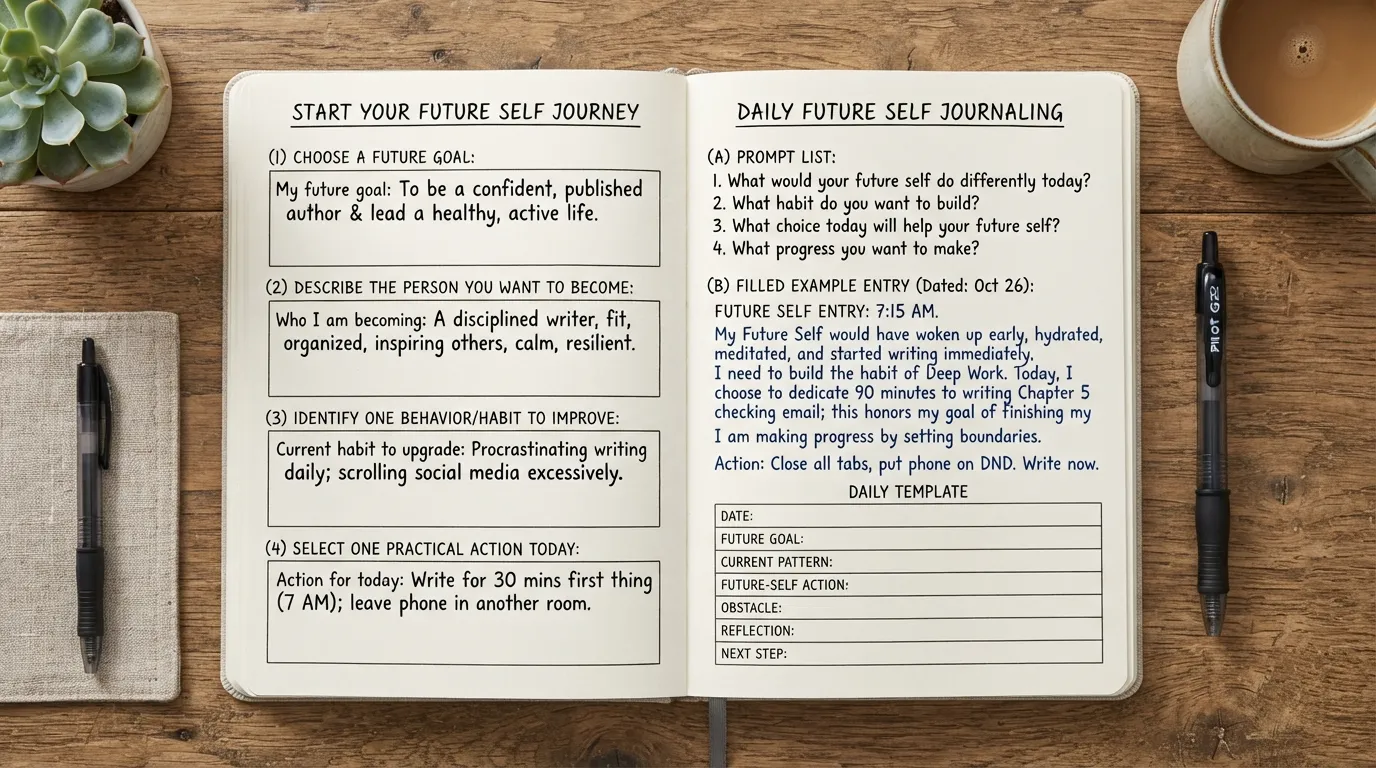
Future self journaling is a structured way of writing about the person you want to become and the choices that can move you in that direction. You can use it as a short daily practice for changing one habit, or you can write to, from, or as a future version of yourself to clarify bigger goals and decisions.
The useful part is not pretending you can predict the future. It is making your future feel specific enough that you can ask a practical question: What would the person I want to become do next? Then you turn that answer into something you can actually do today.
If you are completely new to it, start small: choose one behavior you want to improve, describe how your future self handles it, write one action you can take today, and review what happened later. You do not need a special journal, perfect visualization skills, or a dramatic life plan.
What Is Future Self Journaling?
The phrase is used for two closely related practices, and separating them makes the idea much easier to understand.
Approach | What You Write About | Best For |
Daily behavior-change journal | One habit or pattern, an intention, today’s action, gratitude, and reflection | Habits, reactions, routines, consistency, self-awareness |
Future-self perspective journal | A future day, identity, goals, decisions, lessons, or a letter to/from your future self | Long-term direction, transitions, decisions, goals, perspective |
The first approach is strongly associated with Dr. Nicole LePera, The Holistic Psychologist, whose Future Self Journal method begins by identifying one behavior or pattern and then uses daily affirmations, intentional actions, gratitude, and reflection on the person you are becoming. Her original guide also emphasizes observing yourself first if you do not yet know what you want to change. You can see the original Future Self Journaling guide here. :contentReference[oaicite:0]{index=0}
The broader version is less rigid. You might imagine an ordinary day six months from now, write a letter to yourself one year from now, or answer a difficult current question from the perspective of a wiser future version of you.
Why Writing About Your Future Self Can Be Useful
One useful psychological idea here is future self-continuity: how connected your present self feels to the person you will be later. A major review in the Annual Review of Psychology describes present-future self-continuity as the subjective sense of connection between your current and future selves and reviews links with motivation, intentions, decisions, and behavior. Read the review on self-continuity. :contentReference[oaicite:1]{index=1}
There is also newer evidence that structured future-oriented writing can change how connected people feel to their future selves. A 2026 randomized study tested a text-based “day preconstruction” exercise across four preregistered experiments involving 1,624 participants. The exercise increased future self-continuity in all four studies. It did not improve every outcome researchers measured, including real monetary delay-discounting choices, although one study found improvement in valued living after participants imagined a distant-future day. View the study on PubMed.
What that does and does not mean: research on future-self connection supports the idea that making your future self vivid can influence how you think about present choices. It does not prove that every journaling prompt will “rewire your brain,” guarantee a new habit in 30 days, or manifest a specific outcome.
I would use future self journaling for what it does well: slowing down automatic thinking, clarifying what matters, noticing patterns, turning vague goals into specific behaviors, and giving current decisions a longer time horizon.
How to Start Future Self Journaling
You can make this complicated, but you do not need to. I recommend this six-step beginner process.
- Choose what you want the journal to help with.
Pick a real problem or direction: becoming more consistent, reacting less impulsively, building a skill, improving a routine, making a career decision, or simply understanding what you want next. - Choose a future timeframe.
For a daily habit, tomorrow or 30 days from now may be enough. For lifestyle or career direction, six months to five years may give you more perspective. - Describe your future self in observable terms.
Avoid only writing “I am successful” or “I am happy.” Ask what that future person actually does on an ordinary Tuesday. How do they respond under pressure? What routines do they keep? What have they stopped tolerating? - Pick one behavior you can practice now.
Your future self is not built in one journal entry. Convert the vision into one present-day action that is small enough to complete. - Write from the perspective that helps most.
You can write to your future self, as your future self, or simply write about how today’s choice helps that person. - Review what actually happened.
Reflection matters more than producing beautiful pages. Notice whether you acted differently, what got in the way, and what you want to try next.
Which Future Self Journaling Method Should You Use?
Different goals need different prompts. This is the simplest way I would choose a method.
Your Goal | Method to Try | Useful Prompt |
Change one habit | Daily behavior journal | What would future me do in this situation? |
Clarify a life direction | Write as your future self | What does an ordinary day in my life look like? |
Work through a decision | Future-self advice | Which choice will I respect a year from now? |
Capture a transition | Letter to future self | What do I hope I remember about this period? |
Review progress | Looking-back entry | What changed, and what surprised me? |
A Future Self Journaling Template You Can Reuse
If a blank page makes you freeze, use the same structure until writing feels easier. You can copy this into a notebook, phone, document, or printable page.
Date: ____________________
The future timeframe I am thinking about: ____________________
The person I am becoming is someone who: ____________________
One behavior or pattern I want to change: ____________________
One choice my future self would make today: ____________________
The obstacle I expect: ____________________
How I will respond to that obstacle: ____________________
How today’s action helps my future self: ____________________
Something I appreciate today: ____________________
What I learned when I reviewed the day: ____________________
Future Self Journaling Example
Here is what a complete entry might look like when the goal is to become more consistent with exercise.
Future timeframe: Six months from now
Who I am becoming: I am someone who moves regularly even when my schedule is busy. I do not wait for the “perfect” workout.
Pattern I want to change: If I cannot exercise for an hour, I usually do nothing.
Today’s future-self action: Take a 20-minute walk after lunch.
Likely obstacle: I may tell myself I am too busy after a morning meeting runs late.
My response: Twenty minutes still counts. If lunch does not work, I will walk immediately after work.
Why future me benefits: I am practicing consistency instead of all-or-nothing thinking.
Evening reflection: I walked for 18 minutes. It was not perfect, but I kept the promise.
Tomorrow: Repeat the walk and put it in my calendar before the day gets busy.
Notice that the entry does not depend on predicting the future. The imagined future provides direction; the useful work happens in the present.
Future Self Journaling Prompts
You do not need to answer every prompt. Pick one or two that fit what you are working on.
Identity and Direction
- Who am I becoming?
- What does my future self value that I currently neglect?
- What would an ordinary day look like if I were living more like that person?
- What am I no longer willing to keep doing?
- What would future me want current me to stop overcomplicating?
Habits and Behavior
- What behavior or pattern do I want to change?
- What situation usually triggers the old pattern?
- How would my future self respond differently?
- What is one small way I can practice that response today?
- Which repeated choice would make the biggest difference over time?
Goals and Decisions
- Which current goal will still matter to me a year from now?
- What would future me wish I had started earlier?
- If I choose option A, what might my life look like six months from now? What about option B?
- Which decision better matches the person I say I want to become?
- What information do I still need before making this decision?
Career and Skills
- What skill has future me become noticeably better at?
- What did I practice consistently to get there?
- Which opportunity would future me be glad I pursued?
- What does future me know how to do that I can begin learning now?
Relationships
- How does future me communicate during disagreement?
- Which relationships do I want to invest in more intentionally?
- What boundary would make a future relationship healthier?
- What small action could show someone they matter to me today?
Daily Reflection
- What choice did I make today that my future self will benefit from?
- Where did I fall back into an old pattern?
- What did I learn about myself?
- What am I grateful for today?
- What is the smallest useful action I can repeat tomorrow?
These prompts overlap with the behavior-focused themes seen in Dr. Nicole LePera’s Future Self Journal and in first-hand prompt guides that ask readers to connect current choices, gratitude, routines, and behavioral change with their future selves.
How Far Into the Future Should You Journal?
There is no universal “correct” distance. Choose a timeframe that matches the question you are trying to answer.
Timeframe | Useful For | Question to Ask |
Tomorrow / this week | Immediate behavior | What can I do differently next time? |
30 days | Habits and routines | What would consistent practice look like? |
6–12 months | Goals, skills, lifestyle | What could realistically be different by then? |
3–5 years | Identity and major direction | What kind of life am I trying to build? |
10+ years | Values and big-picture perspective | What will I wish I had protected or prioritized? |
Do not treat these timeframes as rules. If five years feels abstract, use six months. If tomorrow feels too narrow, imagine one year. The best timeframe is the one that gives you enough perspective without becoming pure fantasy.
How to Visualize Your Future Self When You Cannot “See” the Future
You do not need to form a vivid movie in your mind. Visualization can be verbal and concrete. If the question “Where do you see yourself in five years?” produces nothing, make the task smaller.
Start with five things you can describe:
- A feeling: calmer, more capable, less rushed, more connected
- A value: independence, family, creativity, stability, learning
- A behavior: planning ahead, speaking up, exercising, saving, practicing
- An environment: what your typical home, desk, commute, or workday looks like
- An ordinary moment: what you are doing at 7:30 on a normal Wednesday
The ordinary-day approach is often more useful than inventing an impressive future résumé. A realistic future self has routines, annoyances, trade-offs, and responsibilities—not just achievements.
Morning or Night: When Should You Write?
There is no single best time. The Holistic Psychologist’s guide explicitly notes that morning works for its author, while other people may prefer bedtime or a lunch break; the important part is finding a time you can realistically use. :contentReference[oaicite:4]{index=4}
Time | Best Use |
Morning | Set an intention and choose one future-self action before the day gets busy. |
Evening | Review what happened, notice patterns, and decide what to repeat or change. |
Weekly | Write longer entries about goals, decisions, and a more distant future. |
You can also split the practice: one sentence in the morning about how you want to act, followed by two or three sentences at night about what actually happened
Do You Have to Handwrite a Future Self Journal?
No. A notebook can help you slow down, but a future self journal is still useful if the only format you will consistently use is digital. Ranking guides also show people using notebooks, computers, scheduled emails, audio, and video as different ways of communicating with a future version of themselves. :contentReference[oaicite:5]{index=5}
Format | Useful When |
Notebook | You want a distraction-free ritual and enjoy writing by hand. |
Notes app | Convenience matters more than having a dedicated journal. |
Computer | You think faster while typing or prefer longer entries. |
Voice or video note | Writing itself creates unnecessary resistance. |
Dated email or letter | You want to revisit a specific transition or future milestone later. |
What If Future Self Journaling Feels Difficult?
Problem | Try This |
I do not know what I want. | Do not invent a five-year plan. Observe what currently frustrates, drains, interests, or matters to you. Start there. |
I cannot visualize my future. | Describe one value, habit, feeling, or ordinary daily scene instead of a complete life. |
I missed several days. | Restart with today’s date. Do not spend a week writing about why you failed to journal. |
My goal changed. | Update the journal. The purpose is reflection and direction, not loyalty to an outdated version of your future. |
I overthink every answer. | Set a five-minute limit and answer one prompt. Useful beats polished. |
Thinking about the future makes me distressed. | Reduce the timeframe to tomorrow or this week, switch to present-focused journaling, or stop the exercise if it is making things worse. |
How Often Should You Do Future Self Journaling?
Frequency should match the method. If you are tracking one behavior, a brief daily entry can be useful because you are repeatedly observing the same pattern. If you are writing a longer letter to yourself three years from now, doing it every day would probably add little.
Dr. Nicole LePera’s specific Future Self Journal method is designed around daily practice and one selected behavioral pattern at a time, while broader future-self journaling guides use much looser schedules. Her site also provides a free Future Self Journal resource built around small actionable steps and new daily choices. View The Holistic Psychologist’s free Future Self Journal. :contentReference[oaicite:6]{index=6}
For a beginner, I would rather see you write five focused minutes three or four times a week than create an ambitious daily ritual you abandon after four days.
Is Future Self Journaling the Same as Manifestation?
Not necessarily. Some people include future self journaling in manifestation practices because both may involve imagining a desired future. The practical journaling method, however, does not require you to believe that visualization itself causes an external outcome.
A grounded way to use it is: describe the future you want, identify what is under your control, and connect that future to a behavior you can practice now. Visualization can help you clarify direction, but it cannot guarantee a job, relationship, amount of money, health result, or other specific event.
How Do You “Talk” to Your Future Self?
Treat your future self as a perspective, not an oracle. You are not asking that imaginary person to predict what will happen. You are using distance from the current moment to think more clearly.
Try a short dialogue:
Current me: I keep postponing this course because work is already exhausting.
Future me: I understand why. But waiting for a completely free month kept us stuck.
Current me: What should I do?
Future me: Give it two scheduled hours this week. Decide after four weeks whether the course deserves more time.
The value comes from forcing a vague problem into a clearer decision
Common Mistakes That Make the Practice Less Useful
- Trying to transform your whole life at once. Pick one pattern or decision first.
- Writing only about outcomes. “I am rich and successful” gives you far less information than describing behaviors, skills, trade-offs, and routines.
- Confusing optimism with certainty. You can hope for a future without pretending you know exactly how it will unfold.
- Making every entry inspirational. Useful journaling can include doubt, conflict, setbacks, and changed plans.
- Using prompts without action. Add one behavior you can test in real life.
- Treating the journal as a substitute for professional care. It is a reflective tool, not a diagnosis or treatment plan.
A Simple Seven-Day Way to Try It
If you are still unsure whether future self journaling suits you, test the practice instead of committing to a complicated system.
- Day 1: Describe one part of your life you want to handle differently.
- Day 2: Describe how your future self behaves in that situation.
- Day 3: Identify one recurring obstacle.
- Day 4: Practice one different response and write what happened.
- Day 5: Ask what future you would want you to continue.
- Day 6: Write about one thing that did not work without judging yourself.
- Day 7: Review the week and decide whether the practice gave you useful clarity or changed any actual choices.
If you gained useful insight, continue. If every entry felt repetitive, change the prompts, move to a weekly format, or use another form of reflection. A journal is a tool, not an obligation.
Questions People Often Have About Future Self Journaling
What is the future self technique?
There is no single universal technique with that name. In journaling, it generally means deliberately taking the perspective of the person you want to become and using that perspective to examine current habits, decisions, goals, or values. Dr. Nicole LePera’s specific Future Self Journal is a more structured behavior-change version of this broader idea.
How do I become my future self?
Do not start by trying to “feel like” a completely different person. Identify one characteristic of that future version of you and convert it into a repeatable current behavior. If your future self is financially organized, today’s behavior might be reviewing your spending for ten minutes. If future you is more skilled, today’s action might be one focused practice session.
What if I struggle to see a future for myself?
Reduce the question. You do not need to know your career, location, relationship status, or complete life plan. Ask how you would like tomorrow, next month, or one ordinary part of life to feel different. If thinking about the future consistently causes significant distress, future-oriented journaling may not be the most useful exercise for you right now.
Can you manifest something just by visualizing it?
Visualization alone cannot guarantee an external result. What it can do is help you make a goal more concrete, notice choices that align with it, and rehearse how you want to respond. Treat visualization as a reflection and planning tool rather than a promise that imagining an outcome will make it happen.
Is a Future Self Journal different from a regular journal?
A regular journal can cover anything happening in your life. A future self journal deliberately connects what you write today with a later version of yourself, usually by focusing on future identity, habits, goals, decisions, or a message you want to revisit later.
Pimchanok Srisuk
Pimchanok Srisuk is the Journaling Editor at Holistic Wellbeing Living. She writes about journaling prompts, reflective writing, emotional clarity, and mindful routines. With seven years of experience creating personal-growth content, Pimchanok helps readers use simple writing practices to understand their thoughts and make calmer everyday decisions.