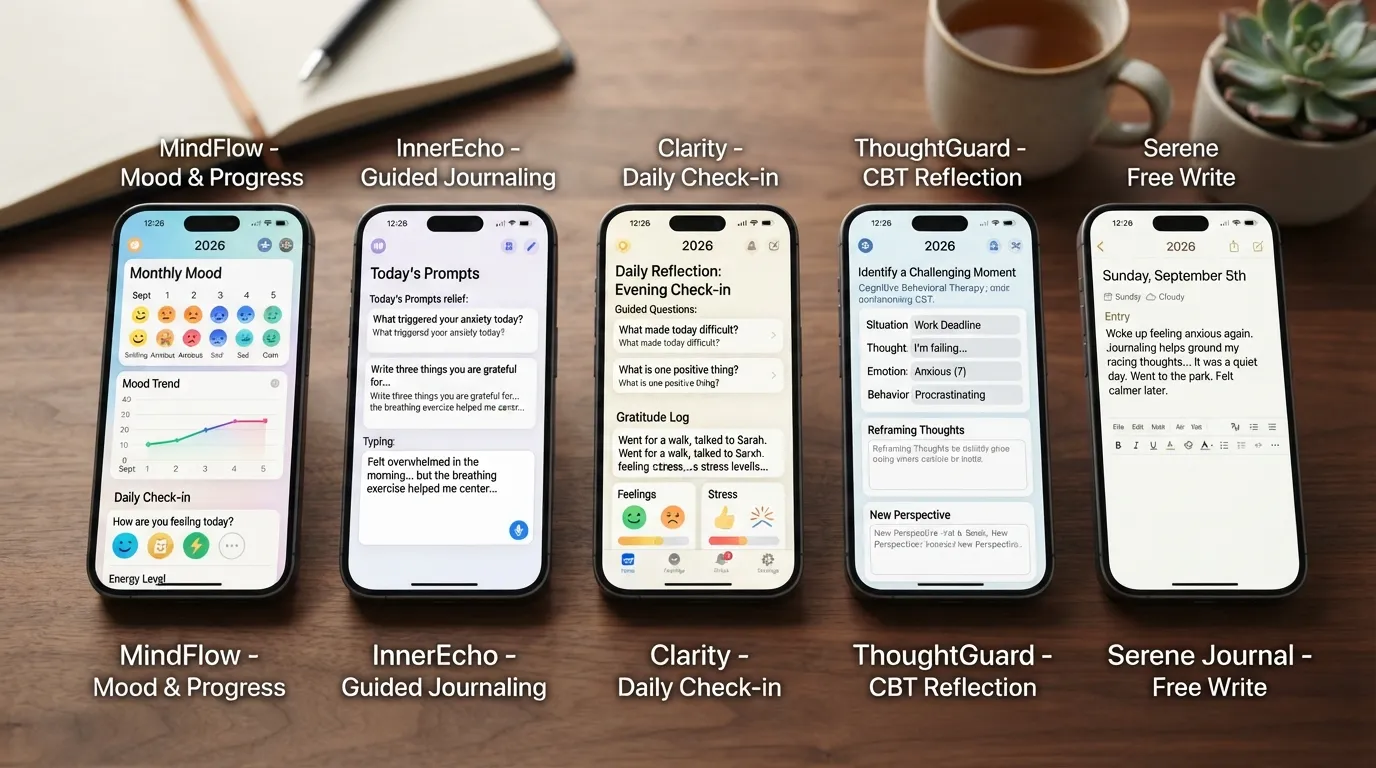
If you are looking for journaling apps for anxiety and depression, I would not choose one simply because it has the most prompts, the highest app-store rating, or an AI chatbot. The better choice depends on what you actually need when you open the app.
For anxiety and repetitive worry, WorryTree is one of the strongest fits because it organizes worries using CBT-style tools. If low mood makes long-form writing feel like work, Daylio makes daily tracking much easier with quick mood and activity check-ins. Clarity: CBT Thought Diary is a better fit when you specifically want structured thought records, while Reflectly suits people who prefer guided or AI-assisted reflection. Sanvello is worth considering if you want journaling alongside a broader set of mental-wellness tools.
One important distinction: a journaling app can support reflection, mood awareness, or coping skills, but it is not automatically a treatment for anxiety or depression. Evidence supporting CBT or expressive writing generally should not be treated as proof that every app using those ideas has been clinically proven.
The Best Journaling Apps for Anxiety and Depression by Need
| App | Best for | Why it stands out |
|---|---|---|
| WorryTree | Anxiety and recurring worries | Helps you capture, categorize, and work through specific worries rather than simply writing about them repeatedly. |
| Daylio | Low-effort mood tracking | Lets you record mood and activities quickly, which can be useful when writing a full journal entry feels overwhelming. |
| Clarity | CBT-style thought journaling | Provides structured thought-diary exercises designed to help you notice and challenge unhelpful thinking patterns. |
| Reflectly | Guided and AI-assisted prompts | Useful if blank-page journaling is difficult and you prefer questions that guide the reflection process. |
| Sanvello | Broader mental-wellness support | Combines mood tracking and journaling-style activities with additional mental-wellness tools. |
I would treat this table as a starting point rather than a universal ranking. Someone dealing mainly with repetitive worry needs something different from someone who struggles to find enough energy to write, and both may need something different from a person already using CBT with a therapist.
How I Would Evaluate a Mental-Health Journaling App
Mental-health apps deserve more scrutiny than ordinary note-taking apps because you may be entering highly personal information about your mood, thoughts, relationships, symptoms, or treatment. I would therefore look beyond star ratings and evaluate six things.
- Fit for your actual problem: Does the app help with worry, low mood, thought patterns, mood tracking, or simple reflection?
- Structure: Does it give you useful prompts or CBT-style exercises, or is it mainly an open blank page?
- Friction: Can you use it on a difficult day without feeling that journaling has become another task?
- Privacy and security: How is journal data stored, synced, shared, deleted, or processed by AI systems?
- Cost and access: Is the free version genuinely useful, and which important features sit behind a subscription?
- Evidence and safety: Is the app merely inspired by an evidence-based method, or has the specific product itself been studied?
This approach is similar to the way independent mental-health app evaluation frameworks consider factors such as accessibility, privacy, clinical foundation, usability, engagement, interoperability, and safety. The FASTER mental-health app evaluation framework is a useful example of why an app should be assessed on more than popularity.
1. WorryTree: Best Fit for Anxiety and Repetitive Worry
If anxiety is your main concern, WorryTree makes more sense to me than a completely blank journal because it is designed around worries rather than general life logging. Its CBT-influenced approach encourages you to identify a worry, decide what kind of worry it is, and think about an appropriate response.
That structure matters because anxious journaling can become unhelpful when you repeatedly write about the same fear without reaching a decision, reframing the thought, or taking an action. WorryTree gives the writing a clearer purpose.
I would choose WorryTree if:
- you tend to overthink the same problems;
- you want more structure than a blank journal;
- you are interested in CBT-style worry management;
- you want journaling to lead toward a practical next step.
Skip it if: what you mainly want is a traditional diary for long memories, photos, creative writing, or detailed life documentation.
2. Daylio: Best When You Want to Journal Without Writing Much
Daylio is different from a conventional journal. Its strength is that you can record a mood and selected activities with very little typing. That makes it particularly useful when motivation or concentration is low.
Over time, those small check-ins can help you notice relationships between mood and activities such as sleep, exercise, work, social contact, or other parts of your routine. You can still add notes, but you do not have to produce a full journal entry every day.
It is also one of the most widely used apps in this group. Its current Google Play listing shows a very large user base, while the Apple App Store listing also shows substantial review activity. I would use that as evidence of adoption and usability, not as proof of clinical effectiveness.
I would choose Daylio if:
- writing feels like too much effort on difficult days;
- you mainly want to track mood and activities;
- you like visual trends and simple check-ins;
- you want to begin with a lower-friction journaling habit.
Skip it if: you mainly want deep guided reflection or a structured CBT thought record. Mood tracking and expressive journaling are related, but they are not the same activity.
3. Clarity: CBT Thought Diary for Structured Reflection
Clarity: CBT Thought Diary is more appropriate when your goal is not simply to record how you feel but to examine the thoughts connected with those feelings. Thought diaries are commonly associated with CBT because they can help you slow down, identify an automatic thought, examine it, and consider a more balanced interpretation.
That makes Clarity a stronger fit for people who dislike open-ended journaling or who want a more structured mental framework for reflection.
I would choose Clarity if:
- you want structured thought records;
- you are interested in identifying thinking patterns;
- you already understand or are learning CBT concepts;
- you want prompts that push reflection beyond “How do I feel today?”
Keep the evidence distinction clear: CBT has a substantial evidence base, but an app using CBT-inspired exercises should not automatically be described as clinically proven unless the specific app has supporting evidence.
4. Reflectly: Best for Guided and AI-Assisted Journaling
Reflectly is a better match if you want prompts to do some of the conversational work for you. Instead of opening an empty page and deciding what to write, the app guides reflection through questions and interactive journaling features.
That can be useful when you know you want to process an experience but cannot work out where to begin. The trade-off is that AI-guided journaling adds another privacy question: what happens to the text you enter?
Before using any AI journal: check whether your journal text is sent to external AI providers, whether it may be retained, whether it is used to improve models or services, and whether you can permanently delete your data. Do not assume “private journal” and “AI processing” mean the same thing across every app.
5. Sanvello: Best if You Want More Than a Journal
Sanvello is worth considering if journaling is only one part of what you want. It combines mood-related tracking and reflective activities with a broader set of mental-wellness features.
That broader approach can be useful if you want several tools in one place. It can also feel excessive if your real goal is simply to write privately for five minutes each day.
I would choose it when: you value an all-in-one experience more than a minimalist journal. I would skip it when simplicity and private long-form writing are the main priorities.
Journaling App, Mood Tracker, or CBT App: Which Do You Actually Need?
One weakness in many “best mental-health journal app” lists is that they compare completely different tools as though they do the same job. They do not.
| Type | What it does best | Good choice when |
|---|---|---|
| Journal | Longer reflection, memories, thoughts and experiences | You want freedom to write in your own way |
| Mood tracker | Fast mood and activity logging | Consistency matters more than long writing |
| CBT-style app | Structured work with worries or thought patterns | You want more direction than a diary provides |
Which App Makes More Sense for Anxiety?
For anxiety, I would prioritize structure over unlimited writing space. If the main problem is recurring worry, an app such as WorryTree may be more useful than a general diary because it gives the worry somewhere to go next. If the issue is automatic negative thoughts, a CBT thought diary such as Clarity may make more sense.
A traditional journal can still be valuable, but if you notice that you repeatedly write the same feared scenario and feel more activated afterward, try changing the method rather than simply writing more. A prompt such as “What can I act on now?” or “What evidence supports and does not support this thought?” may be more useful than another page of worry.
Which App Makes More Sense When Depression or Low Mood Makes Journaling Hard?
When your energy, motivation, or concentration is low, the best journaling system may be the one that asks the least from you. This is where Daylio-style micro-journaling has a practical advantage.
A check-in can be as small as:
- selecting your mood;
- marking what you did that day;
- adding one short sentence;
- stopping there.
That is still useful data. A journaling habit does not become better simply because every entry is long.
Can Journaling Actually Help With Anxiety and Depression?
Journaling can help some people organize thoughts, identify emotional patterns, put experiences into words, and prepare useful topics to discuss with a therapist. Structured approaches can also incorporate techniques drawn from CBT or other therapeutic frameworks.
What I would not do is make the leap from “journaling has evidence behind it” to “this specific app treats anxiety or depression.” App-specific evidence varies considerably, and independent evaluations of mental-health apps have found that popularity alone is not a reliable indicator of clinical quality, evidence, or privacy. You can read an example of this broader app-quality research in this systematic assessment of mental-health apps.
I therefore see journaling apps as tools that may complement self-reflection or professional care, not replacements for an appropriate mental-health assessment or treatment plan.
When Journaling Starts to Feel Like Rumination
Journaling is not automatically helpful just because you are writing about feelings. If every entry circles around the same fear, self-criticism, regret, or hypothetical disaster without producing perspective or action, the writing may be reinforcing the loop rather than helping you step outside it.
If you notice that pattern, try changing the structure:
- Name the thought: What exactly am I telling myself?
- Name the emotion: What am I feeling and how intense is it?
- Separate fact from prediction: What do I actually know?
- Identify control: Is there something useful I can do?
- End the entry: Choose one next step instead of continuing indefinitely.
If journaling consistently leaves you significantly more distressed, stop treating “more journaling” as the solution. Discuss the pattern with a qualified mental-health professional if you can.
Which Journaling App Is the Most Private?
I would be careful with any article that names one app as “the most secure” without examining its current privacy policy, storage architecture, account system, backup method, and AI processing. Those details can change.
Before entering sensitive mental-health information, check these questions:
- Are journal entries stored locally, in the cloud, or both?
- Is data encrypted only while being transmitted, or is journal content end-to-end encrypted?
- Can you lock the app with biometrics or a separate passcode?
- Can you export your journal before deleting your account?
- Can you permanently delete stored data?
- Does the company share data with analytics, advertising, or other service providers?
- If AI is used, where is your text processed?
- Can your entries be used to train or improve AI systems?
The Federal Trade Commission’s health-app privacy guidance is a useful reminder that information collected by health and wellness apps can be sensitive even when the product is not a traditional medical record system.
What Is the Best Free Mental-Health Journal App?
If cost is the main concern, I would begin with an app that remains genuinely usable without immediately requiring a subscription. Daylio is one of the most obvious places to start because it offers core mood-journaling functionality with a free entry point, although premium features are available.
Free plans and subscription limits can change, so check the current App Store or Google Play listing before choosing an app solely because an older article describes it as free. The important question is not simply “Is there a free download?” but “Can I do the thing I need without paying?”
How to Pick an App in About 30 Seconds
If all the options are starting to look the same, I would make the decision this way:
| Your main need | Start by looking at |
|---|---|
| I keep looping over worries | WorryTree |
| I do not have the energy to write much | Daylio |
| I want CBT-style thought exercises | Clarity |
| I want prompts to guide me | Reflectly |
| I want several wellness tools together | Sanvello |
| Privacy is my highest priority | Compare current storage, encryption and AI-data policies before choosing |
What Real Users Often Care About More Than Feature Lists
Community discussions around digital journaling reveal a practical issue that app roundups sometimes miss: people frequently want fewer features, not more. Simplicity, reminders, privacy, a reasonable price, and an interface you can use consistently can matter more than another dashboard or AI feature.
That is visible in discussions such as this digital-journaling community thread about finding a simple and private app. Reddit experiences are anecdotal rather than clinical evidence, but they are useful for understanding usability problems that product pages may not highlight.
How to Start Journaling Daily Without Making It Another Chore
If you have never maintained a journal consistently, I would start much smaller than most journaling advice suggests.
- Choose one purpose. For example: track mood, work through worries, or notice thought patterns.
- Set a tiny minimum. One mood check-in or three sentences counts.
- Use the same cue. Journal after breakfast, before bed, or after taking your evening medication if that routine already exists.
- Do not force emotional depth. A neutral entry is still an entry.
- Review patterns occasionally. The purpose is to learn something useful, not simply accumulate entries.
Consistency is more likely when the app matches your energy level. If you repeatedly avoid an app because each check-in feels like homework, the app is probably a poor fit regardless of how many features it has.
What About Apple Journal and Google Apps?
Apple’s built-in journaling app is called Journal. It can work well for general personal journaling, especially if you already use an iPhone and want a straightforward place to record experiences.
Google does not have a direct equivalent specifically designed as a therapeutic journaling app. Tools such as Google Keep or Google Docs can certainly be used for journaling, but they do not provide the same mental-health-specific structure as apps such as WorryTree or Clarity.
If your entries contain sensitive mental-health information, choose based on privacy and functionality rather than simply using whichever note-taking app happens to be installed already.
Journal or Diary: Does the Difference Matter?
In everyday use, the words overlap. A diary often emphasizes recording what happened, while a journal may place more emphasis on reflection, thoughts, feelings, patterns, or personal growth. For anxiety and depression, the label matters less than the method. A simple diary can be useful if it helps you notice patterns, and a “mental-health journal” can be unhelpful if it only encourages repetitive rumination.
A Few Questions I Would Ask Before Installing Any App
- Do I want to write, track, or work through thoughts?
- Will I realistically use this when my anxiety or mood is worse?
- Do I want AI reading or responding to my entries?
- Can I export my journal if I change apps?
- Can I share useful summaries with a therapist if I want to?
- What happens to my data if I delete my account?
- Does the free plan include the feature I actually need?
- Am I choosing this because it fits me, or simply because it has the most reviews?
Frequently Asked Questions
What is the best journaling app for mental health?
There is no single best app for everyone. WorryTree is a strong fit for anxiety and repetitive worry, Daylio is useful for low-effort mood tracking, Clarity suits CBT-style thought work, Reflectly provides guided prompts, and Sanvello offers a broader collection of mental-wellness tools.
Can journaling help with both anxiety and depression?
It can help some people reflect on thoughts, identify mood patterns, and organize experiences, but results vary. Journaling should not be treated as a replacement for professional treatment when anxiety or depression is persistent, severe, or interfering substantially with daily life.
What is one of the most popular journaling or mood-tracking apps?
Daylio is one of the most widely adopted apps in this group, with a large number of downloads and reviews across the major app stores. Popularity can indicate usability and adoption, but it should not be confused with proof that an app is clinically better.
Are mental-health journaling apps free?
Some offer useful free features, while others use subscriptions or place advanced tools behind a paid plan. Check the current app-store listing because pricing and feature limits can change.
Should I share my journal with my therapist?
Only if you want to. Some people find it useful to bring mood trends, repeated worries, or specific journal entries into therapy. If this matters to you, check whether the app offers a clear export or sharing option before committing to it.
What if journaling makes me feel worse?
Stop and reassess the method. Try shorter entries, mood tracking, or structured prompts instead of repeatedly writing through the same distressing thoughts. If journaling consistently increases distress or you are struggling to manage your symptoms, speak with a qualified mental-health professional.
If you need more than an app:
Journaling can be one useful tool, but severe anxiety, depression, thoughts of self-harm, or an immediate safety concern deserve direct professional support. If you are in immediate danger, contact local emergency services. In the United States, you can also call or text 988 to reach the Suicide & Crisis Lifeline.
Which One Would I Start With?
I would not start by asking which app has the longest feature list. I would ask which problem I want the app to solve.
If anxiety and repetitive worry are the main issue, I would start by looking at WorryTree. If low mood makes writing difficult, I would start with Daylio. If I specifically wanted structured CBT thought work, I would compare Clarity. If guided questions are what keep me writing, I would consider Reflectly. If I wanted a broader mental-wellness toolkit rather than a dedicated journal, I would look at Sanvello.
Then I would check the app’s current privacy policy, free-plan limitations, export options, and platform support before putting sensitive information into it. That final check matters just as much as choosing the right journaling style.
Pimchanok Srisuk
Pimchanok Srisuk is the Journaling Editor at Holistic Wellbeing Living. She writes about journaling prompts, reflective writing, emotional clarity, and mindful routines. With seven years of experience creating personal-growth content, Pimchanok helps readers use simple writing practices to understand their thoughts and make calmer everyday decisions.