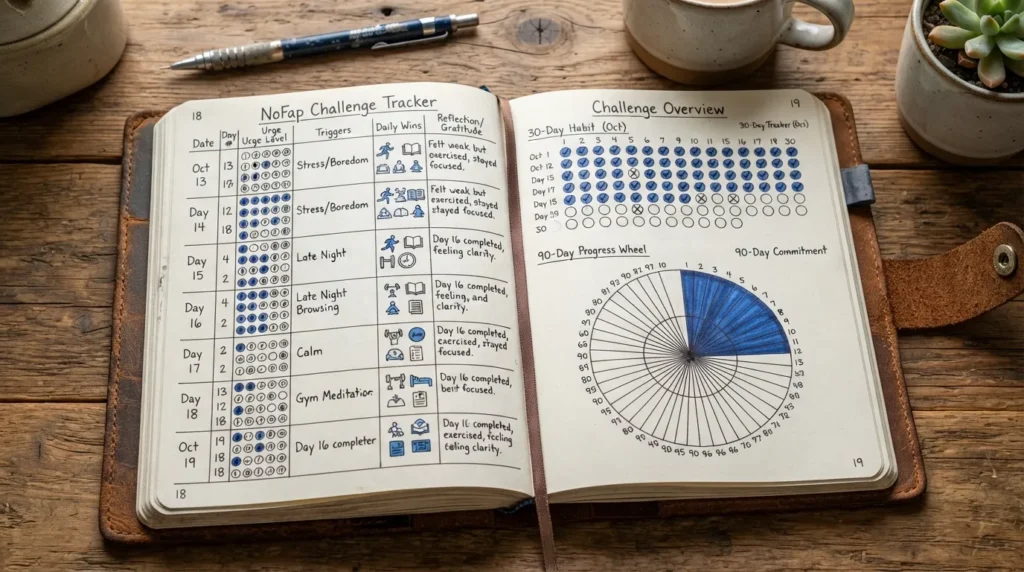
If you’re looking for a NoFap challenge journal, you don’t need a complicated planner. A useful journal simply gives you a consistent place to record your day, notice urges and triggers, reflect on what happened, and decide what you want to do differently next time.
Below, I’ll show you what to track, how to structure a daily entry, how a 30-day or 90-day journal can work, and how to use your notes for reflection rather than treating a streak number as the whole story. I’ve also included a practical template you can copy into a notebook or digital journal.
One important distinction: a NoFap challenge is a personal behavior-change goal, not a medical treatment with guaranteed outcomes. Research does not establish that masturbation abstinence automatically produces the broad health benefits sometimes claimed online. A journal is most useful when you use it to understand your own goals, patterns, triggers, choices, and progress.
What Is a NoFap Challenge Journal?
A NoFap challenge journal is a notebook or digital journal used to document your experience during a period when you have chosen to reduce or abstain from pornography, masturbation, or both, depending on your personal goal.
The exact goal does not have to be identical for everyone. NoFap itself describes its challenges as temporary experiments or challenges and notes that users choose their own goals. NoFap’s own explanation also distinguishes its challenge approach from a universal rule that everyone must permanently avoid masturbation.
That makes the journal less about proving that you can reach an arbitrary number and more about answering useful questions: What situations are difficult for me? What patterns keep appearing? What responses help? What do I actually want to change?
Why Keep a NoFap Journal?
A journal gives you something a streak counter cannot: context. Instead of remembering only that you reached Day 12, you can look back and see what was happening on Day 4, Day 7, or Day 12.
- Accountability: writing down what actually happened makes it harder to gloss over recurring patterns.
- Trigger awareness: you can record situations that repeatedly precede an urge, such as boredom, stress, isolation, or late-night phone use.
- Pattern recognition: several days of notes may reveal that certain times, places, emotions, or routines are repeatedly difficult.
- Reflection: you can compare what you expected to happen with what actually happened.
- Decision support: your notes can help you decide which routines are worth changing and which strategies seem useful for you.
Research on abstinence from masturbation does not support treating abstinence itself as a guaranteed health intervention. One study of abstinence motivation found that perceived personal and social effects were important factors in why people wanted to abstain, while a 2025 study of No Nut November found no significant change in measured sexual-wellbeing outcomes after the period of abstinence. :contentReference[oaicite:0]{index=0}
What Should You Track in a NoFap Journal?
You don’t need to write a page every day. A short, consistent entry is usually easier to maintain. These fields give you enough information to review your experience without turning the journal into a chore.
| Journal field | What to record | Why it helps |
|---|---|---|
| Day and date | Your current challenge day and calendar date. | Keeps your entries organized and makes later review easier. |
| Urge level | A simple 1–10 rating when an urge occurs. | Makes it easier to compare difficult situations over time. |
| Trigger | What was happening immediately before the urge? | Can reveal recurring situations that deserve attention. |
| Emotion | How you felt before or during the urge. | Helps separate situational triggers from emotional patterns. |
| Response | What you did after noticing the urge. | Shows which responses you want to repeat or reconsider. |
| Daily win | One useful action or positive decision from the day. | Keeps the journal focused on behavior and learning, not just avoidance. |
| Reflection | One sentence about what you learned. | Turns daily notes into information you can use later. |
A Simple Daily NoFap Challenge Journal Template
You can copy the following format into a notebook, notes app, document, or printable planner. Keep it short enough that you can realistically use it every day.
Daily Entry
Day: __________
Date: __________
My goal for today: ______________________________
Strongest urge, if any (1–10): __________
What happened before it? ______________________________
How was I feeling? ______________________________
How did I respond? ______________________________
What helped? ______________________________
Today’s win: ______________________________
What I learned today: ______________________________
If nothing difficult happened that day, don’t invent something to write about. A simple entry such as “No significant urges today; regular routine worked well” is enough. Consistency matters more than filling a page.
Example of a Completed Journal Entry
Seeing a completed entry makes the template easier to use. Here’s a simple example:
Day: 7
Urge: 7/10
Trigger: I was bored and scrolling on my phone late at night.
Emotion: Restless and unmotivated.
Response: Put the phone away, left the room, and went for a short walk.
What helped: Changing the environment made it easier to stop focusing on the urge.
Lesson: Late-night phone use appears to be a recurring situation I should plan around.
Notice that the entry doesn’t claim a guaranteed biological effect. It simply records what happened, what the person did, and what they learned. That’s the kind of information that becomes useful when you review several entries together.
How to Track Urges and Triggers
If your main reason for journaling is to understand difficult moments, don’t record only the urge itself. Record the sequence around it.
- Notice the situation: Where were you, what were you doing, and what happened immediately beforehand?
- Rate the urge: Use a simple 1–10 scale if that helps you compare days.
- Name the emotion: Bored, stressed, lonely, frustrated, restless, or another feeling that fits your experience.
- Record your response: Write what you actually did next.
- Record the result: Did the situation change? Did the urge become easier to manage? Did another trigger appear?
- Write one lesson: Keep it practical and specific.
Over time, this gives you more useful information than a streak number alone. You may discover that the difficult part is not simply “Day 10” or “Day 20,” but a repeatable situation such as being alone late at night, using a particular app, or dealing with a specific emotional state.
Should You Track a Streak or Track Triggers?
You can track both, but they serve different purposes.
| Tracking method | What it tells you | Best use |
|---|---|---|
| Streak count | How many consecutive days you’ve followed your chosen goal. | Simple progress tracking. |
| Trigger tracking | Which situations and emotions tend to precede difficult moments. | Pattern recognition and planning. |
| Response tracking | What you did when a difficult moment occurred. | Identifying strategies you want to repeat or change. |
If you only care about the number, a tracker may be enough. If your goal is to understand your behavior and make deliberate changes, the combination of streak, trigger, and response notes is more informative.
30-Day NoFap Challenge Journal
A 30-day journal is useful when you want a clearly defined short-term challenge. You can use the same daily template for all 30 days and add a short weekly review.
Days 1–7: Focus on establishing the journaling routine and recording situations that feel difficult.
Days 8–14: Look for repeated triggers, times of day, environments, or emotional patterns.
Days 15–21: Compare the responses that helped with the ones that did not seem useful.
Days 22–30: Review the entire month and identify what you want to continue, change, or stop doing.
Don’t treat Day 30 as a medical finish line. Thirty days is simply a convenient period for a personal challenge and review. Research on temporary abstinence does not establish a universal set of health or sexual-wellbeing changes that everyone should expect after 30 days. :contentReference[oaicite:1]{index=1}
90-Day NoFap Journal: What Should You Track?
A 90-day journal gives you more room to compare patterns over time. The same daily entry can still work; the main difference is that you should add periodic reviews rather than writing increasingly long daily entries.
At the end of each week, review:
- Which triggers appeared more than once?
- Which situations were easiest or hardest?
- Which responses seemed useful?
- Were there particular times of day that repeatedly caused difficulty?
- What routine change do you want to test next week?
At the end of each 30-day period, look at the bigger picture rather than judging yourself only by the streak. Ask whether the journal helped you understand your behavior, follow your chosen goal, and make decisions that fit your actual life.
30-Day vs. 90-Day vs. Blank Journal
There isn’t one universally best journal format. The right option depends on how much structure you want.
| Format | Best suited to | Main advantage |
|---|---|---|
| 30-day tracker | Someone who wants a defined short-term challenge. | Simple start and clear review point. |
| 90-day journal | Someone who wants a longer observation period. | More entries for comparing recurring patterns. |
| Blank notebook | Someone who dislikes fixed prompts. | Maximum flexibility. |
| Guided journal | Someone who wants prompts and a repeatable routine. | Less effort deciding what to write each day. |
What to Write After a Relapse or Setback
If you have a setback, the journal should help you understand it rather than turn it into a reason for shame. One event doesn’t tell you everything about your overall progress.
Try recording:
- What happened? Keep the description factual.
- What happened beforehand? Note the environment, activity, and circumstances.
- How were you feeling? Record the emotion without judging yourself for having it.
- What did you notice too late? Identify a point where you might have made a different choice.
- What can you change? Choose one realistic adjustment rather than creating a long list of rules.
Avoid turning the entry into punishment. A useful journal asks, “What can I learn from this?” rather than “How can I make myself feel worse about this?”
Morning or Evening: When Should You Journal?
Either can work. The best time is the one you can maintain consistently.
| Time | Useful things to record | Why choose it |
|---|---|---|
| Morning | Today’s goal, possible difficult situations, and a simple plan. | Useful if planning helps you stay focused. |
| Evening | Urges, triggers, responses, wins, and lessons from the day. | You can review the entire day while it is still fresh. |
| Both | A short plan in the morning and a short review at night. | Best when you want both planning and reflection. |
How to Review Your NoFap Journal Each Week
Daily entries become much more useful when you occasionally step back and look for patterns.
- Count recurring triggers. Which situations appeared more than once?
- Look at your strongest urges. What was happening around those entries?
- Compare responses. Which actions seemed useful enough to repeat?
- Check your routine. Did sleep, schedule, isolation, screen use, or other circumstances repeatedly appear in your notes?
- Choose one experiment. Pick one realistic change to try during the next week.
A useful weekly question: “What did my journal teach me this week that I would not have noticed from counting days alone?”
Common NoFap Journal Mistakes
Only Counting the Streak
A streak can be useful, but it tells you very little about why a difficult day happened or what helped you handle it.
Writing Vague Entries
“Today was hard” is less useful than “The difficult moment happened while I was alone and bored late at night.” Specific notes are easier to review.
Making the Journal Too Complicated
If every entry takes 20 minutes, you may stop using the journal. Start with five or six useful fields and add more only if they actually help.
Treating a Setback as Total Failure
A setback can be recorded as information. Look at what happened before it, what you noticed, and what you might change rather than treating the entire journal as worthless.
Assuming Every Online Claim Is a Fact
Online NoFap discussions often include strong claims about testosterone, dopamine, brain changes, sexual performance, or guaranteed benefits. Those claims should not automatically be treated as established medical facts. Research on masturbation abstinence is more limited and nuanced than many online summaries suggest. :contentReference[oaicite:2]{index=2}
Does Not Masturbating for 30 Days Increase Testosterone?
There is no good basis for telling everyone that a 30-day NoFap challenge will produce a predictable or meaningful testosterone increase. A small older study found higher testosterone concentrations after three weeks of sexual abstinence in its participants, but that finding does not establish a general 30-day benefit or prove that abstinence improves health or performance. :contentReference[oaicite:3]{index=3}
For that reason, your journal is better used to track your own goals and experiences than to assume that a specific day will automatically produce a biological milestone.
Can a NoFap Journal Help With Compulsive Sexual Behavior?
A journal can be a useful self-monitoring tool, especially if your goal is to notice patterns and understand situations in which you feel that your behavior is difficult to control. But journaling should not be treated as a substitute for professional care when sexual behavior is causing significant distress, relationship problems, work or study problems, or a persistent sense of loss of control.
It is also important not to label yourself as having an “addiction” simply because you masturbate frequently. Research distinguishes frequency from impaired control and distress, and high frequency by itself is not enough to establish a disorder. :contentReference[oaicite:4]{index=4}
What If You Miss a Journal Day?
Don’t throw away the journal because you missed one entry. Continue from the next day.
If you want to understand why you missed it, add a short note such as:
“Missed yesterday’s entry because my schedule changed. I want to keep the evening entry shorter so it’s easier to maintain.”
The goal is to create a journal you can actually maintain, not another system that makes you feel like you failed when your routine changes.
Frequently Asked Questions
How long should a NoFap challenge be?
There is no medically established universal challenge length. Thirty days is a convenient period for a structured personal experiment, while some people choose shorter or longer periods. Choose a duration that matches your goal rather than assuming that a particular number of days guarantees a particular result.
What should I write in a NoFap journal every day?
At minimum, record the day and date, your goal, any significant urge, the trigger or situation around it, how you felt, how you responded, and one thing you learned. If the day was uneventful, a short entry is enough.
Should I track urges from 1 to 10?
You can. A 1–10 scale is a simple personal tracking method that can make entries easier to compare. It is not a clinical measurement, so use the same scale consistently rather than treating the number as a medical score.
Is a 30-day NoFap challenge guaranteed to improve sexual health?
No. A 2025 study examining temporary abstinence in the context of No Nut November found no significant differences in measured sexual-wellbeing outcomes after the abstinence period compared with the comparison group. More research is needed, and individual experiences can vary. :contentReference[oaicite:5]{index=5}
Is a NoFap journal better than a simple streak counter?
If you only want to count consecutive days, a streak counter may be enough. If you want to understand triggers, emotions, situations, responses, and recurring patterns, a journal provides much more context.
What is the best NoFap journal format?
The best format is the one you will actually use. A guided 30-day journal suits someone who wants structure, a 90-day journal suits someone who wants a longer tracking period, and a blank notebook works well if you prefer freeform writing. The daily fields in this guide can work with any of them.
What if journaling makes me feel more anxious or ashamed?
Change the way you use it. Keep entries factual, avoid harsh self-judgment, and focus on patterns and practical choices. If the topic is causing significant distress or interfering with your daily life, consider speaking with a qualified mental-health or sexual-health professional rather than relying only on a self-guided challenge.
A Simple Way to Start Today
You don’t need to buy a special planner before you begin. Open a notebook or notes app and create these seven fields:
- Day and date
- Urge level, if relevant
- Trigger or situation
- Emotion
- Response
- Today’s win
- One lesson
Then write your first entry in a few sentences. At the end of seven days, read the entries together and look for one recurring pattern. At the end of 30 days, review the bigger picture.
That simple system gives you something more useful than a number alone: a record of what you experienced, what situations mattered, what responses you tried, and what you learned about your own goals.
Pimchanok Srisuk
Pimchanok Srisuk is the Journaling Editor at Holistic Wellbeing Living. She writes about journaling prompts, reflective writing, emotional clarity, and mindful routines. With seven years of experience creating personal-growth content, Pimchanok helps readers use simple writing practices to understand their thoughts and make calmer everyday decisions.