Jump to:
ToggleGratitude Journal: How to Start, What to Write, Benefits & Examples
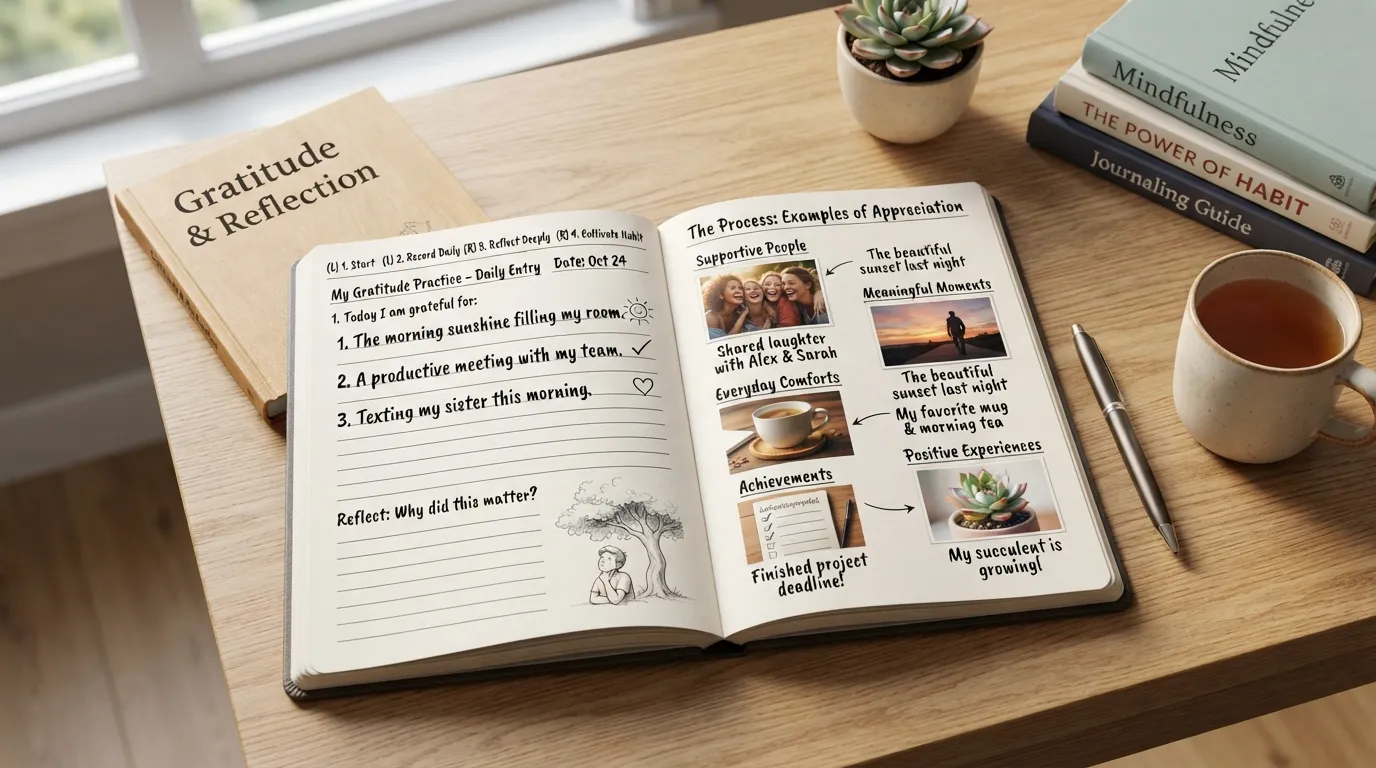
A gratitude journal is a notebook, diary, or digital space where you regularly record people, experiences, moments, and things you genuinely appreciate. The practice can be as simple as writing three specific things you are thankful for, or it can use guided prompts that help you reflect more deeply.
You do not need a special gratitude journal book, perfect handwriting, or a long daily routine. A plain notebook, your phone, or an online gratitude journal can work. What matters more is that you actually record your thoughts, make them specific, and use a routine you can realistically maintain.
A simple way to begin: Write down three things you appreciated today. For each one, add one sentence explaining why it mattered to you. That small detail usually makes the entry more meaningful than a repetitive list of “family, health, food.”
What Is a Gratitude Journal?
A gratitude journal, sometimes called a gratitude diary, grateful journal, or gratitude notebook, is a written record of what you appreciate in your life. It is one form of intentional gratitude practice within the broader field of positive psychology.
The important word is notice. You are deliberately paying attention to experiences that might otherwise disappear into an ordinary day: someone checking on you, finishing a difficult task, having a peaceful breakfast, hearing a song you love, getting help when you needed it, or simply enjoying a comfortable bed.
UC Berkeley’s Greater Good in Action practice describes gratitude journaling as physically recording things you feel grateful for rather than only thinking about them. It recommends focusing on specific events, people, or experiences and favoring depth over a long superficial list. You can read its full practice guide at Greater Good in Action.
How to Start a Gratitude Journal
If you are wondering how to write a gratitude journal, keep the first version simple. A complicated system creates more opportunities to quit.
- Choose somewhere to write. Use a blank notebook, guided journal, notes app, document, or dedicated journal app.
- Pick a realistic time. Morning, evening, or a few scheduled days each week can all work.
- Start with three things. They can be significant or extremely small.
- Make each entry specific. Name the moment, person, action, or experience rather than using a broad label.
- Add why it mattered. One extra sentence gives the entry context and helps prevent your journal from becoming mechanical.
- Continue without chasing a perfect streak. A practice you return to is more useful than an ambitious routine you abandon after four days.
What Do You Write in a Gratitude Journal?
You can write about people, places, opportunities, ordinary comforts, personal progress, acts of kindness, experiences, lessons, nature, health, work, relationships, or something difficult that eventually taught you something valuable.
When I want an entry to go beyond a generic list, I use this simple pattern:
What happened → Why it mattered → What I noticed or felt → What I want to remember
A weak entry vs. a more meaningful entry
Very broad: “I am grateful for my friend.”
More specific: “I am grateful that Maya called me after my difficult meeting. She remembered what I was worried about and gave me space to talk. It reminded me that I have someone who pays attention when things are hard.”
Both statements express gratitude, but the second preserves an actual memory. It identifies the action, why it mattered, and the relationship behind the feeling.
A Complete Gratitude Journal Example
Here is a realistic gratitude journal example you can adapt rather than copy word for word:
Tuesday evening
- The quiet drive home.
Traffic was lighter than usual and I listened to music instead of checking work messages at every stop. Those twenty minutes gave me some space between work and home. - My coworker helping with the report.
I was behind, and Daniel checked two sections without making me feel embarrassed about asking for help. It made the afternoon less stressful. - Dinner at the table.
Nothing special happened. We simply ate together without phones for about half an hour. I noticed how rare uninterrupted conversations have become, and I want to protect more time like that.
Notice that none of these entries requires an extraordinary life event. A useful daily gratitude journal can contain ordinary moments, provided they mean something to you.
Does a Gratitude Journal Actually Work?
Research suggests that gratitude practices can improve some aspects of emotional well-being, but the evidence does not support treating a gratitude journal as a guaranteed cure for stress, anxiety, depression, sleep problems, or physical illness.
One influential 2003 randomized study by Robert Emmons and Michael McCullough compared people who focused on blessings with comparison groups recording hassles or other events. Across the studies, the gratitude groups showed improvements on several measures of well-being, although not every outcome improved. Positive affect was one of the more consistent findings. The study is indexed by PubMed.
A broader 2023 systematic review and meta-analysis included 64 randomized clinical trials of gratitude interventions. Across the included studies, gratitude interventions were associated with greater gratitude, better mental-health measures, fewer symptoms of anxiety and depression, and more positive mood. However, the review also reported important limitations, including substantial differences between studies and concerns about study quality. You can review the full open-access paper through the National Library of Medicine.
What about physical health and sleep?
Claims that gratitude journaling broadly “improves physical health” deserve more caution. A 2020 systematic review of randomized gratitude interventions found mixed evidence across physical-health outcomes. Subjective sleep quality improved in five of eight studies that measured it, but the authors concluded that more research was needed before firm conclusions could be made. The review is available on PubMed.
A gratitude journal can be a low-cost well-being practice, but it is not a replacement for professional mental-health care. If you are dealing with persistent anxiety, depression, trauma, or another serious concern, gratitude journaling can be one small practice alongside appropriate support rather than the entire solution.
Should You Write Every Day?
A daily gratitude journal is popular because a daily cue can make the practice easier to remember. But daily writing is not proven to be universally superior for everyone.
Berkeley’s current gratitude-journal exercise suggests about 15 minutes at least three times per week for at least two weeks. Other guided journals use a short daily routine. Research has tested different schedules, so there is no single scientifically established frequency that everyone must follow.
I would choose frequency based on whether your entries stay meaningful. If daily writing makes you repeat the same automatic list, try three or four thoughtful sessions per week. If a daily cue helps you notice new details consistently, keep it daily.
Is It Better to Journal in the Morning or at Night?
Neither morning nor night is universally best. They simply support slightly different uses.
Time | What it can help you do |
Morning | Start the day by noticing what you value and setting your attention before work, messages, and distractions take over. |
Evening | Reflect on specific events that actually happened during the day while those details are still fresh. |
If you are unsure, try one week in the morning and one week at night. Keep whichever routine feels easier to sustain and produces more thoughtful entries.
What Is a 5-Minute Gratitude Journal?
A 5 minute gratitude journal is simply a short, structured journaling routine designed to fit into a busy day. You do not need a particular branded product to use the idea.
For example:
- Write three things you appreciate.
- Choose one and explain why it mattered.
- Add one intention for the day or one lesson/highlight from the evening.
The commercial Five Minute Journal is one well-known guided version. Its current structure combines morning gratitude and intention-setting with evening reflection. You can use that type of guided structure, or build a simpler version yourself.
Blank or Guided? Paper or Digital?
The best gratitude journal is not necessarily the most expensive one. It is the format that removes friction for you.
Format | Best fit |
Blank notebook | Best if you enjoy freedom, longer reflections, drawing, or changing your format. |
Guided journal | Useful if you stare at a blank page or want recurring prompts and a fixed routine. |
Digital app or notes | Convenient if your phone is always with you, you want reminders, or you prefer typing. |
Simple printable page | Useful if you want guidance without buying a whole gratitude journal book. |
A physical book can make the practice feel separate from screen time. A gratitude journal app or online gratitude journal is easier to search, carry, and update anywhere. Neither format has to be “better” in general; convenience and consistency matter more than aesthetics.
Gratitude Journal Prompts That Lead to Better Entries
Prompts are most useful when they make you notice something you would not have written automatically. Instead of collecting hundreds of questions, rotate a small group with different purposes.
For everyday moments
- What small moment made today easier?
- What did I enjoy that I normally take for granted?
- What was unexpectedly pleasant today?
For people and relationships
- Who helped me recently, and what exactly did they do?
- Who made me feel understood?
- What quality do I appreciate in someone close to me?
For difficult days
- What made today slightly more manageable?
- Who or what gave me practical support?
- What difficulty did I handle better than I might have in the past?
For perspective
- What part of my current life would a younger version of me appreciate?
- What convenience would I miss if it disappeared tomorrow?
- What ordinary part of today do I want to remember a year from now?
What If You Cannot Think of Anything to Be Grateful For?
Do not force yourself to describe a bad day as wonderful. Gratitude is not supposed to erase disappointment, anger, grief, exhaustion, or fear.
On a difficult day, make the target smaller and more neutral:
- The shower was warm.
- Someone answered my message.
- I had enough food for dinner.
- The room was quiet for ten minutes.
- I completed one task I had been avoiding.
You can also write, “Today was hard, and I do not feel particularly grateful right now.” That is more honest than forcing positivity. A journal should help you notice your experience, not pressure you to deny part of it.
Common Gratitude Journaling Mistakes
- Writing the same generic list every day. “Family, health, home” may be true, but rotate the detail: what happened today that made one of those things noticeable?
- Trying to write too much. A short specific entry can be more sustainable than a page you dread completing.
- Turning it into another productivity target. Missing a day is not failure.
- Using prompts mechanically. Skip a prompt if it produces an answer you do not care about.
- Forcing gratitude during genuine distress. Acknowledge what is difficult rather than using gratitude to argue with your emotions.
- Expecting a treatment effect. Gratitude journaling may support well-being, but it cannot replace appropriate medical or psychological care.
A Simple 7-Day Starter Routine
If you want structure without committing to a complicated journal, try this one-week experiment:
- Day 1: Write three small things you appreciated today.
- Day 2: Write about one person and one specific thing they did.
- Day 3: Record something ordinary you usually overlook.
- Day 4: Describe an unexpected positive moment.
- Day 5: Write about something difficult that showed you a strength, resource, or source of support.
- Day 6: Re-read earlier entries and notice what themes repeat.
- Day 7: Decide what schedule you actually want to continue: daily, every other day, or several times per week.
The purpose of the week is not to prove that you can maintain a streak. It is to discover what type of gratitude practice feels genuine enough to keep.
A Few Questions People Commonly Ask
What is the best gratitude journal?
The best gratitude journal is one you will actually use. Choose a blank notebook if you enjoy freedom, a guided journal if prompts help you start, or a digital option if convenience and reminders matter more than writing by hand.
Do you have to write three things every day?
No. Three is a convenient format, not a requirement. Some practices use up to five items, and some research has used daily while other studies have used weekly schedules. Quality and consistency matter more than obeying one number.
Is the “3-3-3” journal method the same as gratitude journaling?
Not necessarily. “3-3-3” is used online for several different journaling and self-help routines, so there is no single universal 3-3-3 gratitude-journal method. If a version simply asks you to list three grateful thoughts or three categories of reflection, you can use it, but you do not need that label to keep a gratitude journal.
What are the “four A’s of gratitude”?
There is no single research-standard “four A’s of gratitude” framework that every gratitude practice follows. Different coaches, articles, and organizations use their own four-word models. For journaling, you do not need one: noticing something specific, appreciating it genuinely, reflecting on why it matters, and recording it is enough.
What hormone is released when you feel gratitude?
It is misleading to describe gratitude as releasing one specific “gratitude hormone.” Human emotions involve complex brain and body processes, and popular claims that gratitude simply releases a single chemical such as dopamine or oxytocin often oversimplify the evidence. You do not need a hormone claim to explain why a reflective practice may feel meaningful.
Can children keep a gratitude journal?
Yes, but the format should match the child’s age. Younger children can draw one thing they liked or finish a sentence such as “Today I was happy when…”. Berkeley’s Greater Good in Action also has a separate gratitude-journal practice for students.
Pimchanok Srisuk
Pimchanok Srisuk is the Journaling Editor at Holistic Wellbeing Living. She writes about journaling prompts, reflective writing, emotional clarity, and mindful routines. With seven years of experience creating personal-growth content, Pimchanok helps readers use simple writing practices to understand their thoughts and make calmer everyday decisions.