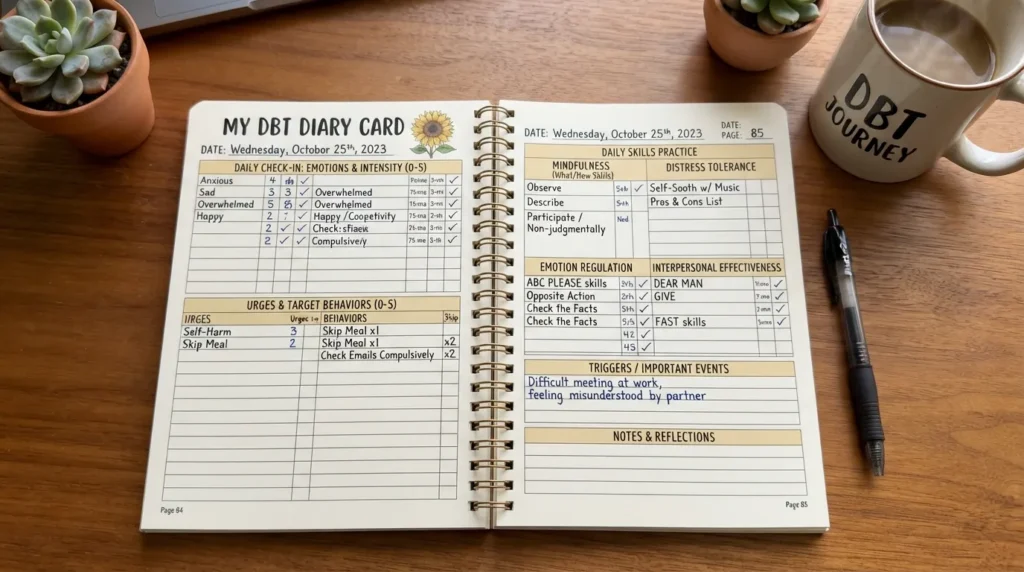
A DBT journal is a practical tool for recording emotions, urges, behaviors, triggers, and the DBT skills you practice. You may use one as a simple daily DBT diary card, a guided journal with exercises, or a therapy notebook for deeper reflection.
The important distinction is that a DBT journal is not simply a place to write about your day. A well-designed journal helps you notice patterns, practice skills, and bring useful information into therapy or your own structured reflection.
In simple terms: a DBT journal helps you track what happened, what you felt, what you wanted to do, which skills you used, and what you learned from the situation. It can make emotional patterns easier to notice and discuss.
What Is a DBT Journal?
DBT stands for Dialectical Behavior Therapy. A DBT journal is a structured writing or tracking tool that can support the practice of DBT skills between therapy sessions.
Depending on the format, you might use it to record your emotions each day, rate the intensity of an urge, identify a trigger, track a target behavior, practice a DBT skill, or reflect on how a difficult situation unfolded.
One common form is the DBT diary card. Diary cards are designed for regular tracking and can be reviewed during therapy. Other DBT journals are more guided and include writing prompts, exercises, and explanations of DBT skills. A workbook may go even further by teaching skills through structured exercises.
For a useful example of a traditional DBT diary card, you can explore DBT Self Help’s diary card resources.
DBT Journal vs. Diary Card vs. Workbook
These terms are sometimes used interchangeably, but they can serve different purposes. Understanding the difference makes it easier to choose the right therapy notebook or journal for what you actually need.
| Format | Main purpose | What you may record | Best fit |
|---|---|---|---|
| DBT diary card | Daily tracking | Emotions, urges, target behaviors, skills | Regular monitoring and therapy review |
| DBT journal | Tracking plus reflection | Experiences, emotions, patterns, skills, reflections | People who want more writing space |
| DBT workbook | Learning and practicing skills | Exercises, worksheets, skill practice | People learning DBT skills systematically |
You do not necessarily need all three. The best choice depends on whether your main goal is quick tracking, deeper reflection, or structured skill learning.
What Do You Track in a DBT Journal?
A structured DBT journal or diary card can contain several types of information. The exact layout varies, so you do not have to force every category into one notebook.
Emotions and their intensity
You can record which emotions showed up and how intense they felt. Some diary cards use numerical ratings, such as a 0-to-5 or 0-to-10 scale. The exact scale depends on the form you are using.
The number is less important than using the same scale consistently enough to notice changes. For example, if sadness was a 7 in the morning and a 3 later, that gives you something concrete to reflect on.
Urges
An urge is the desire or impulse to do something, whether or not you actually act on it. Tracking urges separately from behaviors can help you notice the difference between having an urge and acting on it.
Target behaviors
A DBT diary card may track specific behaviors that you and your treatment provider have identified as important to monitor. What counts as a target behavior should be individualized rather than copied from someone else’s diary card.
Triggers and events
Writing down what happened before a strong emotional reaction can help you identify patterns. You might record the situation, what you interpreted it to mean, how you felt, and what happened next.
DBT skills you practiced
Many DBT tracking tools include space to record which skills you practiced. The four broad DBT skills areas are:
- Mindfulness: skills for paying attention to the present moment and observing experiences more intentionally.
- Distress tolerance: skills for getting through difficult moments without making the situation worse.
- Emotion regulation: skills for understanding and responding to emotions more effectively.
- Interpersonal effectiveness: skills for communicating, maintaining relationships, setting boundaries, and working toward interpersonal goals.
How to Use a DBT Journal Step by Step
If you are new to DBT journaling, keep the process simple. You are not trying to produce a perfect diary entry. The goal is to create useful information you can learn from.
- Choose one consistent time. A short daily check-in is often easier to maintain than waiting until you have a lot to write.
- Record the main emotions. Note what you felt and, if your journal uses ratings, record the intensity.
- Notice urges and important behaviors. Separate what you wanted to do from what you actually did.
- Identify the trigger or situation. Briefly describe what happened before the emotional change.
- Record the skill you tried. Write down the DBT skill you practiced, if any.
- Notice what changed. You can record whether the emotion, urge, or situation changed after using the skill.
- Review patterns rather than judging yourself. A journal is more useful when it helps you observe what happened instead of turning every entry into self-criticism.
A useful mindset
Think of your journal as a record for learning, not a test you can pass or fail. An entry does not need to sound positive. Honest, brief tracking can be more useful than writing a long entry that feels forced.
What Does a Completed DBT Journal Entry Look Like?
A realistic example can make the process much easier to understand. Imagine that someone receives a short message from a friend and interprets it as rejection.
| Journal field | Example entry |
|---|---|
| Situation | A friend replied briefly to my message. |
| Emotion | Hurt and anxious. |
| Intensity | 7/10. |
| Urge | Send several follow-up messages immediately. |
| Skill practiced | Paused, noticed the emotion, and used a distress-tolerance or mindfulness skill that had been practiced in DBT. |
| Afterward | The urge became less intense, and I waited before responding. |
The point of the example is not to create a perfect answer for every situation. Your actual entry will depend on what happened, what you experienced, and the skills you are learning.
DBT Journal Prompts for Reflection
A diary card is useful for quick tracking, but sometimes you want more space to understand an experience. That’s where journal prompts can help.
You could reflect on questions such as:
- What emotion was strongest today?
- What happened immediately before that emotion became stronger?
- What did I notice in my body?
- What urge did I experience?
- What did I do in response to the urge?
- Which DBT skill did I try?
- What happened after I used the skill?
- What pattern am I beginning to notice?
- What would I like to discuss with my therapist?
If you want structured prompts rather than creating your own, guided DBT journals and therapy notebooks can provide a more organized starting point.
Which DBT Journal Format Should You Choose?
There isn’t one universally best DBT journal. Start with the format that matches the job you want the journal to do.
| If you mainly want to… | A useful format to consider |
|---|---|
| Track your day quickly | A simple DBT diary card |
| Write more deeply about experiences | A guided or blank DBT journal |
| Learn and practice DBT skills | A DBT workbook |
| Use prompts and guided exercises | A guided DBT journal |
| Keep everything flexible | A therapy notebook that you customize |
Can You Use a Free DBT Journal or Template?
Yes. You do not necessarily need to buy a specific journal to start tracking. A blank notebook, a suitable diary-card template, or a digital tool can work depending on what you need.
The important thing is not the cover or brand. Look for a format that gives you enough space to record the information that matters to your goals.
For example, DBT Self Help provides diary-card resources, while clinical resources such as the DBT diary-card explanation from ACP can help you understand what these forms are intended to track.
If you prefer a guided book rather than a blank template, The DBT Skills Daily Journal from New Harbinger Publications is one example of a guided journal format.
How a DBT Journal Can Fit Into Therapy
One of the most useful features of structured DBT tracking is that it can give you something concrete to review. Instead of trying to remember an entire week from memory, you may have a record of emotions, urges, behaviors, situations, and skills you practiced.
If you are working with a DBT therapist, ask what they want you to track. Different treatment plans may use different diary-card formats or target different behaviors.
Your journal can also help you identify questions to bring into a session, such as why a particular situation repeatedly triggers a strong emotional response or which skills were difficult to use.
One important distinction
A journal can support therapy, but it is not the same thing as DBT treatment. If you are receiving professional care, use the tracking format recommended by your treatment provider when possible.
What Are the Benefits of Keeping a DBT Journal?
The value of a DBT journal comes from what you do with the information, not simply from filling in pages.
- It can make patterns easier to notice. Repeated situations, emotions, urges, or reactions may become easier to see when they are recorded consistently.
- It gives you a record of skills practice. You can see which skills you tried and what happened afterward.
- It can support therapy conversations. A diary card can give you and your therapist concrete information to discuss.
- It creates a pause for reflection. Writing can help you slow down enough to distinguish an event from your emotional response to it.
- It can make progress more visible. Instead of relying only on memory, you can look back at your records and notice changes in patterns or skill use.
These benefits should be understood realistically. Journaling is a tool, not a guarantee that difficult emotions or behaviors will disappear.
What Are the Downsides of DBT Journaling?
DBT journaling can be useful, but it is not perfect for every person or every situation. A few practical limitations are worth knowing before you start.
- It takes consistency. Tracking every day can become another task if the format is too complicated.
- Writing about difficult experiences can feel uncomfortable. You may need support from a qualified professional when journaling brings up distress that feels difficult to manage.
- More writing is not always better. A short, honest entry can be more useful than pages of repetitive rumination.
- The wrong format can become frustrating. If you only need quick tracking, a long workbook may feel excessive. If you need guided practice, a blank notebook may not give you enough structure.
- A journal cannot replace appropriate treatment. If you need professional mental-health care, journaling should not be treated as a substitute for it.
Common DBT Journaling Mistakes to Avoid
Trying to write a perfect entry
Your journal is a tracking and learning tool. You do not need polished sentences or profound insights every day.
Only recording the bad days
If you only write when something goes wrong, you may miss useful information about what helped on ordinary or better days.
Turning the journal into self-criticism
Try to record what happened without automatically labeling yourself as good or bad. The useful question is often, “What happened, and what can I learn from it?”
Copying someone else’s target behaviors
A diary card should reflect your own goals and treatment needs. If you are in DBT therapy, ask your therapist which behaviors and skills you should track rather than copying another person’s form.
Is DBT Appropriate for Everyone?
DBT is a structured form of psychotherapy, and whether it is appropriate depends on the person’s needs, goals, circumstances, and access to suitable professional care. It is not something you should decide based only on a journal or a list of online symptoms.
If you are considering DBT because you are struggling with intense emotions, difficult behaviors, relationship problems, or recurring crises, a qualified mental-health professional can help you determine whether DBT or another approach makes sense for you.
You also do not need to diagnose yourself before asking for help. A journal can help you organize what you have been experiencing, but it should not be used to make a diagnosis.
Frequently Asked Questions About DBT Journals
Is a DBT journal the same as a DBT diary card?
Not necessarily. A diary card is generally designed for structured daily tracking, while a DBT journal may include more room for reflection, prompts, or guided exercises. Some products combine both approaches.
Can I use a normal notebook as a DBT journal?
Yes. A normal notebook can work if you create a structure that helps you track the information you need. If you are working with a therapist, ask whether they want you to use a particular diary-card format.
What should I write in a DBT journal?
You can write about emotions, their intensity, urges, important behaviors, triggers, situations, skills you practiced, and what happened afterward. A guided journal may also provide prompts for deeper reflection.
How often should I use a DBT journal?
Many DBT tracking tools are designed for daily use, but the best routine depends on the tool and your treatment plan. If your therapist has given you a diary card, follow their instructions rather than creating a different schedule.
Can a DBT journal replace therapy?
No. A journal can support reflection and skills practice, but it is not a replacement for psychotherapy or other professional care when that care is needed.
What is the 24-hour rule in DBT?
The phrase “24-hour rule” can refer to specific DBT treatment practices, but it should not be treated as a universal instruction that applies identically to everyone. DBT programs and therapists can use different protocols depending on the treatment setting and the behavior being addressed. If you have heard this rule from a therapist, use their specific explanation rather than relying on a generalized internet version.
What are some criticisms or downsides of DBT?
DBT can require regular skills practice, structured tracking, and willingness to work through uncomfortable experiences. Some people may also find the structure demanding. Whether those drawbacks matter depends on the individual, the treatment setting, and the quality of support available. A qualified clinician can help you weigh whether DBT fits your needs.
A Simple DBT Journal Structure You Can Start With
If you want to experiment with a simple therapy notebook, you can create one page around these prompts:
Date: ____________________
Main emotion: ____________________
Intensity: ____________________
What happened? ____________________
What urge did I notice? ____________________
What did I do? ____________________
Which skill did I practice? ____________________
What happened afterward? ____________________
What would I like to remember or discuss? ____________________
This is a general journaling structure, not a substitute for a therapist-provided diary card. If you are participating in formal DBT, use the format your treatment team recommends.
The Bottom Line
A DBT journal can be much more useful than a traditional diary when it gives you a clear way to track emotions, urges, behaviors, triggers, and DBT skills. A diary card is usually best for quick structured tracking, while a guided journal or workbook can give you more space for exercises and reflection.
If you’re just starting, don’t worry about creating the perfect system. Choose a format you can realistically use, keep your entries honest and manageable, and look for patterns rather than judging yourself for having difficult days.
Most importantly, let the journal serve a purpose: notice what is happening, practice useful skills, learn from your experiences, and bring important patterns or questions into appropriate professional support when you need it.
Pimchanok Srisuk
Pimchanok Srisuk is the Journaling Editor at Holistic Wellbeing Living. She writes about journaling prompts, reflective writing, emotional clarity, and mindful routines. With seven years of experience creating personal-growth content, Pimchanok helps readers use simple writing practices to understand their thoughts and make calmer everyday decisions.