
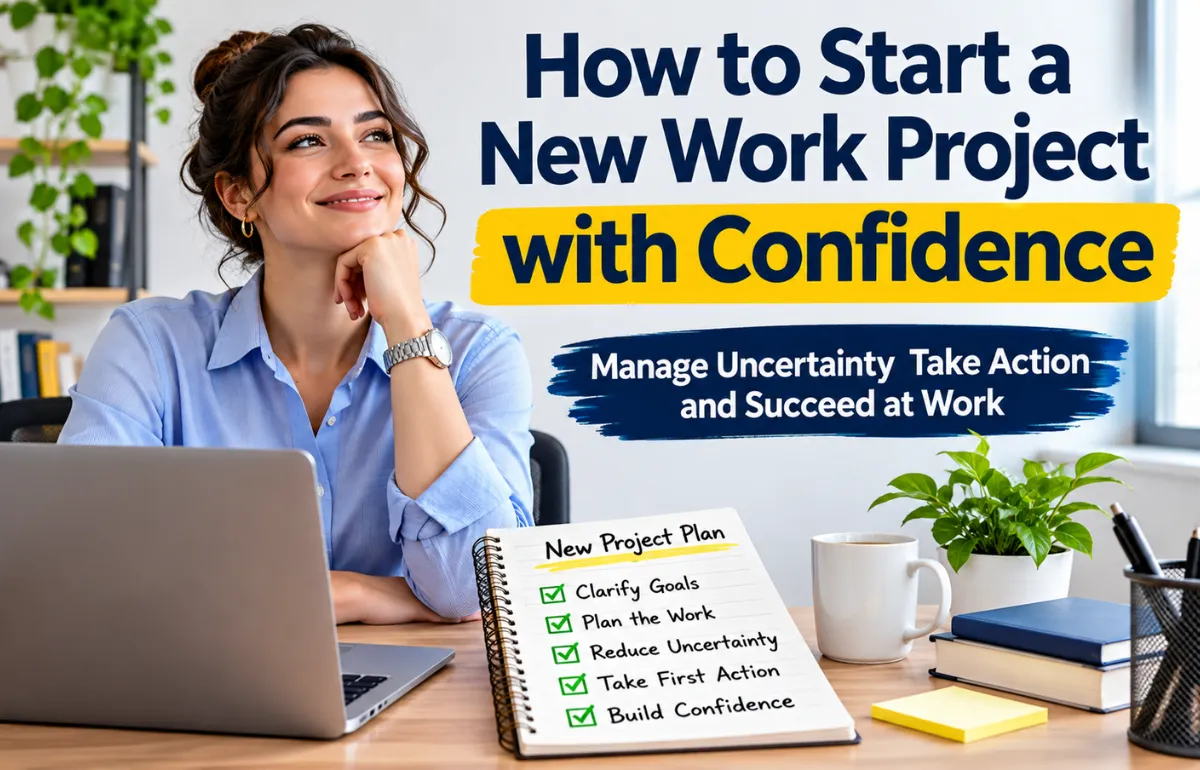
Learning how to start a new work project with confidence begins with accepting uncertainty, understanding project expectations, identifying knowledge gaps, and taking small, purposeful actions. Starting confidently means trusting your ability to learn, make informed decisions, and handle challenges without needing to have every answer beforehand.
I recommend beginning with a clear project objective, realistic expectations, and an initial action plan that leaves room for adjustments. Instead of trying to eliminate every possible risk, focus on understanding which uncertainties require immediate attention and which can be addressed later.
An unfamiliar assignment can make even a capable professional question their abilities. However, feeling uncertain does not automatically mean you are unprepared.
The key is to develop enough clarity to move forward without allowing unfamiliarity, overthinking, or the fear of making mistakes to control your decisions.
Why Starting an Unfamiliar Work Project Feels Intimidating
There is something particularly uncomfortable about receiving an assignment that falls outside your usual responsibilities.
You might understand your regular duties perfectly, yet a new project suddenly introduces unfamiliar expectations, different people, unexpected decisions, and responsibilities you have never handled before.
I see this as a distinction between lacking ability and lacking familiarity. These are two very different problems, although they can feel remarkably similar.
When starting a new project at work, you may worry about:
- Making mistakes that affect your professional reputation.
- Misunderstanding what your manager expects.
- Lacking the technical knowledge required.
- Asking questions that seem too basic.
- Missing deadlines because of unexpected complications.
- Disappointing colleagues who depend on your work.
These concerns become more manageable when you identify their actual causes.
For example, worrying about an unfamiliar software tool requires a different response from worrying about unclear project expectations. One requires learning, while the other requires communication.
Treating every concern as a general confidence problem makes it harder to find a practical solution.
1. Identify Exactly What Makes You Feel Uncertain
Before creating a detailed project plan, I recommend identifying the specific unknowns that are making the assignment feel difficult.
A vague thought such as “I don’t know if I can do this” offers very little direction. A specific concern such as “I don’t understand how the client will evaluate the final report” gives you something concrete to investigate.
Separate Uncertainty From Actual Inability
Imagine being asked to prepare a departmental performance report for the first time.
You may feel unqualified because you have never created this particular report. However, you might already possess useful skills in research, data interpretation, communication, and organization.
Your challenge is learning how to apply existing abilities within an unfamiliar context.
The following comparison helps distinguish different types of workplace uncertainty.
| Source of Uncertainty | What It Means | Practical Response |
|---|---|---|
| Knowledge gap | You lack specific information | Research or request guidance |
| Skill gap | You need to develop an ability | Practice through a small task |
| Unclear expectations | Success has not been defined | Discuss requirements |
| Resource limitations | Necessary tools or support are missing | Request access or assistance |
| Fear of judgment | You worry about others’ opinions | Seek constructive feedback |
| Decision uncertainty | Several approaches seem possible | Compare options and consequences |
Identifying the correct source of uncertainty prevents unnecessary self-criticism.
It also helps you direct your energy toward solving the actual problem rather than questioning your overall competence.
2. Create a Personal Uncertainty Map
One exercise I recommend for unfamiliar projects is creating an uncertainty map before committing to a detailed schedule.
Unlike a traditional task list, this exercise focuses on what you need to understand before completing the work effectively.
Divide a blank page into three sections:
- What I know.
- What I assume.
- What I need to confirm.
Under the first section, record established facts such as deadlines, assigned responsibilities, and available resources.
Under the second, include information you believe is correct but have not verified.
The third section should contain unanswered questions that could influence your decisions.
Give Important Unknowns a Deadline
Not every unanswered question deserves immediate attention.
Suppose you are developing an employee training program. Understanding the intended audience is essential before designing the material, while choosing the presentation colors can probably wait.
I suggest assigning a confirmation deadline to each significant uncertainty.
Ask yourself when you actually need the answer to prevent delays or unnecessary rework.
This approach allows you to begin working without becoming distracted by every detail that remains unresolved.
3. Clarify What Success Looks Like Before You Begin
A significant source of project anxiety is attempting to meet expectations that have never been clearly communicated.
You might spend considerable time producing something impressive, only to discover that your manager wanted a much simpler outcome.
I would prioritize a conversation about the project’s purpose before investing heavily in its execution.
Useful questions include:
- What problem is this project intended to solve?
- What should the finished deliverable accomplish?
- Who will evaluate or approve the work?
- Which requirements are essential?
- What limitations should I work within?
- What responsibilities fall outside my role?
Define the Minimum Acceptable Outcome
An unfamiliar project can become overwhelming when you imagine that every aspect must exceed expectations.
Instead, establish what a complete, acceptable result looks like.
If you are preparing a business presentation, the essential outcome might be explaining three recommendations clearly enough for management to make a decision.
Complex animations, elaborate graphics, and additional research may contribute little to that objective.
Knowing the difference between necessary work and optional improvements gives you a more realistic starting point.
4. Build Confidence Through Evidence Rather Than Reassurance
Positive thinking can be helpful, but repeatedly telling yourself that everything will work out does not resolve practical uncertainties.
When considering how to start a new work project with confidence, I prefer an evidence-based approach.
Look for previous accomplishments that demonstrate your ability to handle related challenges, even if the projects themselves were different.
Perhaps you have successfully learned an unfamiliar tool, solved a customer problem, managed competing deadlines, or explained a complicated subject to someone else.
Those experiences provide evidence of transferable skills.
Create a Transferable Skills Inventory
Imagine being asked to coordinate a product launch despite having no previous launch management experience.
Although the assignment is unfamiliar, you may already know how to communicate with colleagues, organize information, monitor deadlines, and resolve disagreements.
Write down three skills the project requires that you already possess. Then identify the abilities you still need to develop.
This gives you a more balanced assessment of your readiness.
Rather than approaching the assignment as a complete beginner, you can recognize the foundation you are bringing to it.
5. Use the First 48 Hours to Reduce Uncertainty
I recommend treating the beginning of an unfamiliar assignment as a short discovery period rather than expecting immediate expertise.
For a project with enough lead time, the first 48 hours can help you gather information, identify obstacles, and establish a workable direction.
During this period, review the project brief, examine relevant documents, identify stakeholders, and investigate unfamiliar requirements.
If previous versions of similar projects exist, examine them for useful patterns and potential mistakes.
Produce Something Small but Useful
Before the discovery period ends, create an initial deliverable.
It could be a one-page outline, a basic spreadsheet, a preliminary design, or a sample section of a report.
The purpose is not to impress anyone with finished work. It is to discover whether your understanding translates into something useful.
For example, producing a sample report section might reveal missing data that you would otherwise discover several days later.
A small deliverable makes uncertainty visible while changes are still relatively inexpensive.
6. Know Which Decisions Require Certainty
One reason people struggle with overcoming project anxiety is that they treat every decision as equally consequential.
However, choosing a temporary document format is not the same as approving a substantial expenditure or committing to a client deadline.
I recommend distinguishing reversible decisions from decisions that carry significant consequences.
| Decision Factor | Reversible Decisions | High-Consequence Decisions |
|---|---|---|
| Examples | Draft layouts, internal outlines | Contracts, budgets, public commitments |
| Information needed | Enough to make reasonable progress | Thorough verification |
| Cost of mistakes | Usually manageable | Potentially substantial |
| Approval | Within delegated authority | Often requires authorization |
| Best approach | Experiment and adjust | Investigate and confirm |
This distinction prevents unnecessary hesitation without encouraging careless decisions.
When a choice is inexpensive to reverse and within your authority, a reasonable experiment may teach you more than extended deliberation.
However, decisions involving safety, legal obligations, sensitive information, or significant financial commitments deserve appropriate review.
Professional confidence includes recognizing when independent action is appropriate and when additional expertise is necessary.
7. Ask Questions Without Undermining Your Professional Confidence
Many professionals hesitate to ask questions because they believe doing so will expose their inexperience.
Unfortunately, remaining silent can create bigger problems when incorrect assumptions influence important decisions.
I recommend preparing questions that demonstrate both initiative and a genuine desire to understand the assignment.
Instead of saying, “I have no idea what I’m supposed to do,” try:
“I’ve reviewed the requirements and identified two possible approaches. Could you clarify which outcome matters most?”
This communicates preparation while acknowledging uncertainty.
Request Direction, Not Constant Reassurance
There is a difference between seeking useful guidance and repeatedly asking someone whether your work is good enough.
Specific questions help you develop independence.
Ask a colleague whether a proposed method meets a particular requirement rather than requesting approval of every minor decision.
Whenever possible, explain what you have already investigated and identify the exact point where assistance would be valuable.
This makes collaboration more efficient and helps you approach unfamiliar responsibilities with greater independence.
8. Plan Around Learning Milestones
Traditional project schedules often focus on completed tasks, deadlines, and deliverables.
For unfamiliar assignments, I recommend including learning milestones as well.
A learning milestone represents something you need to understand before you can reliably complete the next phase of work.
For example, if you are managing a website redesign for the first time, your initial milestones might include understanding customer requirements, identifying technical limitations, and confirming which pages require updates.
These discoveries should influence your subsequent schedule.
Avoid Creating False Precision
Predicting exactly how long an unfamiliar task will take can produce misleading expectations.
If you have never used a particular reporting system, promising to complete a complex analysis in four hours may be premature.
Consider giving a provisional estimate and explaining what could affect it.
After testing the system or completing a small portion of the task, revise the estimate using better information.
This approach supports realistic project planning while reducing the pressure to defend guesses made before you understood the work.
9. Establish a Clear Response to Unexpected Problems
Starting confidently does not mean assuming nothing will go wrong.
It means preparing to respond constructively when difficulties appear.
I recommend creating a short contingency plan that identifies likely obstacles and defines your response to each one.
For instance, if access to essential information is delayed, determine which independent tasks can continue while you wait.
If a colleague becomes unavailable, identify who else can provide the necessary assistance.
Set an Escalation Threshold
An escalation threshold is a predetermined point at which a problem requires additional support or a decision from someone with greater authority.
For example, you might decide to notify your manager when a missing approval threatens an agreed deadline.
Establishing this threshold beforehand reduces the emotional difficulty of deciding whether to report a problem.
It also prevents manageable issues from quietly developing into serious complications.
Knowing how you will respond to setbacks can make starting unfamiliar work feel considerably less intimidating.
10. Collect Feedback Before Becoming Too Invested
Waiting until a project is nearly complete before requesting feedback can increase the cost of correcting misunderstandings.
I recommend arranging an early review of your initial work, particularly when requirements are unfamiliar or open to interpretation.
A preliminary review might involve examining a sample deliverable, discussing your proposed direction, or confirming that your interpretation of the project matches stakeholder expectations.
Early feedback allows you to separate problems with your approach from problems with the instructions.
Treat Corrections as Project Information
Receiving feedback can feel personal when you are already uncertain about your abilities.
However, a request to revise your initial approach does not necessarily indicate poor performance.
It may reveal information that was unavailable when you began.
Instead of interpreting every correction as evidence of incompetence, identify what the feedback teaches you about the project’s requirements.
This distinction supports professional confidence and makes it easier to adapt without becoming defensive or discouraged.
11. Keep a Record of Your Growing Competence
Progress on unfamiliar projects is not always immediately visible.
You might spend several hours understanding a process without producing a finished deliverable. From the outside, this may appear unproductive, even though you have removed an important obstacle.
I suggest maintaining a brief personal progress record during the project.
At the end of each working day, answer four questions:
- What do I understand now that I did not understand earlier?
- Which assumption have I confirmed or corrected?
- What obstacle have I successfully handled?
- What is my next meaningful action?
This record captures progress that a conventional task list might overlook.
It also provides useful evidence when self-doubt returns, particularly during the more demanding stages of an assignment.
Over time, information about how you overcame difficulties can become a practical resource for future projects.
How to Start a New Work Project With Confidence When You Have No Experience
Suppose your manager asks you to develop a customer feedback analysis, but you have never completed this type of assignment.
Rather than attempting to master everything immediately, I would begin by confirming what decision the analysis needs to support.
Next, I would examine a small sample of customer responses, identify recurring themes, and prepare a preliminary summary for feedback.
Once the approach is confirmed, I would expand the analysis to the remaining responses and refine the findings.
If unfamiliar statistical methods become necessary, I would request guidance rather than pretending to understand them.
This example demonstrates that limited experience does not prevent meaningful progress.
By narrowing the assignment into manageable learning opportunities, you can develop relevant competence while completing useful work.
The goal is to make responsible progress from your current level of understanding, not to behave as though you already possess years of experience.
Common Mistakes That Damage Confidence at the Start of a Project
Certain working habits can make unfamiliar assignments more stressful than necessary.
I recommend watching for these common mistakes:
- Researching endlessly without applying what you learn.
- Accepting unrealistic deadlines to appear capable.
- Hiding confusion until it causes significant problems.
- Comparing your beginner-level knowledge with an experienced colleague’s expertise.
- Making important decisions using unverified assumptions.
- Treating early mistakes as permanent judgments of your abilities.
Another easily overlooked mistake is measuring your readiness by how comfortable you feel.
Comfort may develop slowly, even when your actual performance is improving.
A more useful measure is whether you understand the objective, recognize the outstanding risks, and know how to proceed responsibly.
Conclusion
Understanding how to start a new work project with confidence involves learning to manage uncertainty rather than expecting it to disappear.
I recommend clarifying expectations, identifying knowledge gaps, testing your approach through small deliverables, and seeking feedback before committing to major decisions.
Start your next assignment by writing down one confirmed fact, one unverified assumption, and one question that needs answering.
Then choose a meaningful action that moves the project forward.
You do not need complete certainty to begin. You need enough clarity to take the next responsible step and a willingness to adjust as your understanding grows.
Frequently Asked Questions (FAQs)
1. How do I start a new project at work when I feel overwhelmed?
Clarify the main objective, identify the most urgent uncertainty, and complete one manageable task before expanding your focus.
2. How can I overcome the fear of starting a new project?
Identify what you fear, prepare for realistic risks, and use small practical accomplishments to develop confidence gradually.
3. How do I manage a work project with no previous experience?
Break the assignment into manageable learning milestones, seek experienced guidance, and request early feedback on your approach.
4. Is it normal to feel nervous when starting a new work project?
Yes. Unfamiliar expectations and responsibilities can create nervousness, even among experienced professionals. Preparation and familiarity can help reduce it.
5. What is the first thing to do when starting a new project?
Confirm the project’s purpose, expected outcome, essential requirements, and success criteria before investing significant time in execution.

FOLLOW YOUR CURIOSITY
A little more to explore
Stay with the topic. Find another perspective to take into your day.
How to Be a Confident Leader: 12 Ways to Earn Trust
By Nattaya Boonmee
How to Be Confident in an Interview: 15 Practical Tips
By Nattaya Boonmee
How to Gain Confidence in Public Speaking: 15 Tips
By Nattaya Boonmee