
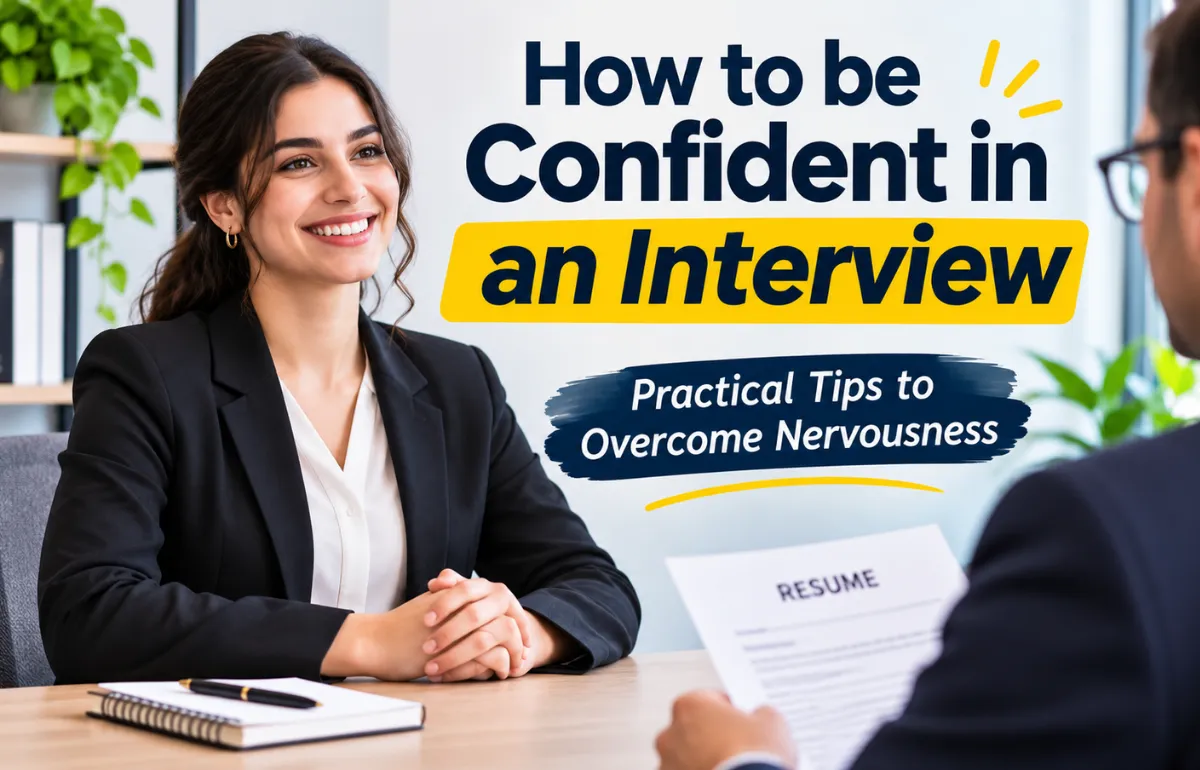
Knowing how to be confident in an interview starts with proper preparation, recognizing your abilities, managing nervousness, and communicating your thoughts clearly. Interview confidence is the ability to present your skills, experience, and personality without allowing fear or self-doubt to control your performance.
You can build confidence by researching the company, practicing common interview questions, improving your body language, and developing a positive mindset. During the interview, speaking slowly, listening attentively, and taking thoughtful pauses can help you remain composed.
I believe genuine confidence comes from understanding what you bring to the table rather than trying to impress everyone in the room.
You don’t need to eliminate nervousness completely. You simply need to learn how to perform well despite feeling nervous.
Whether you’re attending your first job interview or applying for a senior position, confidence is a skill you can develop with consistent practice and the right approach.
Why Do You Feel Nervous Before a Job Interview?
Job interviews involve uncertainty. You don’t know exactly what questions you’ll face, how the interviewer will respond, or whether your qualifications will meet their expectations.
This uncertainty can trigger overthinking and make even well-prepared candidates question their abilities.
Some common reasons behind interview anxiety include:
- Fear of rejection or failure.
- Lack of interview experience.
- Negative experiences from previous interviews.
- Insufficient preparation.
- Comparing yourself with other candidates.
- Pressure to secure employment.
- Fear of being judged.
Sometimes, nervousness comes from caring deeply about the opportunity rather than lacking the skills required for the job.
I recommend identifying the specific reason behind your anxiety. When you understand what makes you uncomfortable, you can work on that particular problem instead of treating nervousness as a personal weakness.
How to Be Confident in an Interview Before It Begins
The work you do before meeting an interviewer can significantly influence how you communicate during the actual conversation.
Here are some practical ways to develop that confidence.
1. Research the Company Beyond Its Homepage
Walking into an interview without understanding the organization can make you feel unnecessarily vulnerable.
Start by exploring the company’s website, products, services, mission, recent developments, and workplace culture.
However, I recommend taking your research a little further.
Look at how the company communicates with customers, what challenges its industry faces, and how your potential role contributes to its objectives.
For example, if you’re applying for a marketing position, examine the company’s existing campaigns and consider what you could contribute.
This preparation gives you meaningful talking points and makes it easier to answer questions naturally.
Instead of relying entirely on memorized information, you’ll have a genuine understanding of the organization and why you want to work there.
2. Create a Personal Evidence Bank
Generic positive affirmations can be helpful, but reminding yourself of actual accomplishments gives your confidence a stronger foundation.
I recommend creating what I call a personal evidence bank.
Take a notebook and write down five to seven examples of situations where you demonstrated valuable skills, solved problems, helped someone, or overcame a challenge.
Your evidence bank might look something like this:
| Experience | Skill Demonstrated |
|---|---|
| Completed a project ahead of schedule | Time management |
| Resolved a customer complaint | Communication |
| Learned unfamiliar software independently | Adaptability |
| Organized a group assignment | Leadership |
| Identified and corrected an error | Problem-solving |
| Helped a struggling colleague | Teamwork |
These experiences don’t need to be extraordinary. Ordinary situations often provide excellent evidence of professional competence.
Reviewing this collection before an interview helps replace vague self-doubt with specific reasons to believe in your abilities.
3. Prepare Answers Without Memorizing Scripts
Practicing common interview questions is useful, but memorizing entire answers can create additional pressure.
If you forget a single sentence, you may struggle to remember what comes next.
Instead, prepare three or four key talking points for each common question.
Start with questions such as:
- Tell me about yourself.
- Why do you want this job?
- What are your greatest strengths?
- What is your biggest weakness?
- Why should we hire you?
- How do you handle difficult situations?
For behavioral interview questions, I recommend using the STAR method, which is also widely recommended by university career centers.
STAR stands for:
- Situation: Explain the circumstances.
- Task: Describe your responsibility.
- Action: Explain what you did.
- Result: Share the outcome.
This structure keeps your answers organized while allowing you to speak naturally.
The goal is to remember your experiences, not memorize sentences about them.
4. Practice Recovering From Unexpected Questions
Most interview preparation focuses on answering familiar questions correctly. However, I think practicing how to recover from unexpected situations deserves equal attention.
Ask a friend to conduct a mock interview and include questions you haven’t prepared for.
You can also record yourself answering unfamiliar questions.
Practice responding when you lose your train of thought, misunderstand a question, or need additional thinking time.
For instance, try saying:
“That’s an interesting question. I’d like a moment to think of a relevant example.”
This exercise teaches you that an awkward moment doesn’t have to ruin the entire conversation.
When you know how to recover from mistakes, you become less afraid of making them.
5. Develop a Strong Opening Introduction
The first few minutes of an interview can influence how comfortable you feel throughout the conversation.
Preparing a short professional introduction gives you a reliable starting point.
I suggest including your professional background, one relevant strength, and your reason for applying.
For example, a recent graduate might say:
“I recently completed my degree in business administration, where I developed a strong interest in project management. During my academic projects, I enjoyed organizing tasks and coordinating with team members. I’m now looking for an opportunity to develop those skills in a professional environment.”
Keep your introduction relevant, conversational, and approximately 30 to 60 seconds long.
A familiar opening can help you settle into the interview before more challenging questions arrive.
6. Remove Unnecessary Sources of Stress
Sometimes, what feels like a lack of confidence is actually the result of poor planning.
Running late, struggling with uncomfortable clothing, or searching for important documents moments before an interview can increase anxiety.
Prepare your outfit, résumé, portfolio, transportation arrangements, and other necessary items the previous evening.
If you’re attending a virtual interview, check your internet connection, camera, microphone, and meeting link beforehand.
I also recommend getting adequate sleep and avoiding excessive caffeine, especially if it makes you feel restless.
You cannot control every aspect of an interview, but reducing avoidable problems gives you more mental energy to focus on the conversation.
7. Change Your Relationship With Nervousness
Trying to force yourself to stop feeling nervous can make you increasingly aware of your anxiety.
A different approach is to reinterpret what you’re experiencing.
Research by Harvard Business School professor Alison Wood Brooks found that reframing pre-performance anxiety as excitement improved performance in certain activities, including public speaking.
Although these experiments were not specifically about job interviews, the approach offers a useful mindset exercise.
Instead of thinking, “I’m nervous because I’m going to fail,” try telling yourself, “I’m excited because this opportunity matters to me.”
You don’t have to convince yourself that everything will go perfectly.
Simply recognize that feeling nervous and being capable can exist at the same time.
How to Be Confident During a Job Interview
Preparation provides a foundation, but maintaining confidence during the conversation requires a slightly different set of skills.
8. Use Natural and Confident Body Language
Your body language can influence how your communication is perceived.
However, constantly monitoring every movement can make you feel uncomfortable and distracted.
Focus on a few manageable habits:
- Sit upright without becoming physically stiff.
- Keep your shoulders relaxed.
- Maintain comfortable, natural eye contact.
- Use appropriate hand gestures.
- Smile when it feels genuine.
- Avoid repeatedly checking your phone or watch.
You don’t need to maintain uninterrupted eye contact or adopt an exaggerated posture to demonstrate confidence.
Cultural differences, disabilities, and individual communication styles also influence body language.
I would prioritize being attentive, approachable, and comfortable over trying to perform a particular version of confidence.
9. Slow Down and Allow Yourself to Pause
Nervous candidates sometimes speak too quickly because silence feels uncomfortable.
Unfortunately, rushing through an answer can make it harder to communicate important details.
When the interviewer finishes asking a question, give yourself a brief moment to organize your thoughts.
Then begin with your main point before adding supporting information.
For example, if someone asks how you manage competing deadlines, start by explaining your approach to prioritization. Afterward, provide a relevant example.
A short pause often feels considerably longer to the person speaking than it does to the listener.
You don’t need to fill every moment of silence. Taking time to think can help you deliver more thoughtful and organized responses.
10. Focus on the Conversation Rather Than Your Performance
One of the most useful mindset changes I recommend is shifting your attention away from yourself.
During an interview, you might constantly wonder:
Am I speaking clearly? Do I look nervous? Was that a bad answer? Does the interviewer like me?
These thoughts compete for your attention while you’re trying to communicate.
Instead, concentrate on understanding what the interviewer wants to know.
Listen carefully, identify the purpose behind the question, and provide the most relevant information you have.
Think of the interview as a professional conversation in which both parties are evaluating whether they are a suitable match.
You are also learning about the company, its expectations, and whether the position supports your career goals.
11. Learn How to Answer Questions You Don’t Know
Not knowing an answer doesn’t automatically make you an unsuitable candidate.
Pretending to understand something, however, can damage your credibility.
If you’re unfamiliar with a particular tool, process, or technical concept, acknowledge your current level of knowledge and explain how you would approach learning it.
For example:
“I haven’t worked directly with that software yet. However, I’ve used similar tools, and I would start by reviewing its documentation and practicing with a small project.”
This response demonstrates honesty, initiative, and adaptability without exaggerating your qualifications.
If you’re facing a technical problem-solving question, explaining your reasoning may also help the interviewer understand how you approach unfamiliar challenges.
Knowing how to be confident in an interview includes accepting that you won’t have every answer.
12. Recover Quickly After a Poor Answer
Imagine giving an answer and immediately realizing that you’ve misunderstood the question.
Your first instinct might be to panic and assume you’ve ruined your chances.
Instead, make a simple correction:
“I realize I approached that question from a slightly different angle. A more relevant example would be…”
I recommend treating each interview question as a separate opportunity.
A weak response doesn’t require the next response to be weak as well.
Avoid mentally replaying earlier mistakes while the interviewer is asking something new.
If a correction is necessary, make it briefly and move forward. Recovering professionally can demonstrate your ability to remain composed under pressure.
13. Ask Questions That Demonstrate Genuine Interest
Confidence isn’t only about answering questions. It’s also about being comfortable asking them.
Prepare a few thoughtful questions about the role, team, responsibilities, and professional development opportunities.
You might ask:
- What would success look like during the first three months?
- What challenges is the team currently facing?
- How does the company support professional development?
- How is performance evaluated in this position?
I particularly like questions about expectations and workplace challenges because they encourage a more meaningful discussion.
Asking questions reminds you that accepting a job is also your decision.
You’re gathering information that could affect your career, daily responsibilities, and long-term professional satisfaction.
How to Build Interview Confidence With Little or No Experience
Attending your first interview can be intimidating when you believe other candidates have more impressive qualifications.
However, professional experience isn’t the only way to demonstrate your potential.
Academic projects, internships, volunteering, personal initiatives, and part-time employment can all provide relevant examples of your abilities.
Consider situations where you’ve demonstrated responsibility, learned independently, or worked effectively with others.
14. Stop Apologizing for Your Experience Level
There is a difference between acknowledging your limitations and unnecessarily undermining yourself.
Instead of presenting your lack of experience as a reason someone shouldn’t hire you, explain what you’ve already learned and how you’re prepared to grow.
| Self-Doubting Response | Confident Response |
|---|---|
| I don’t really have any experience. | I’m at the beginning of my professional career. |
| It was just a college project. | That project helped me develop teamwork skills. |
| I’m probably not the best candidate. | My strengths align with several requirements of this role. |
| I don’t know much about that. | I’m currently developing my knowledge in that area. |
| I hope I can manage the responsibilities. | I’m prepared to learn and take responsibility. |
These adjustments aren’t about hiding your limitations.
They’re about describing your abilities accurately without allowing unnecessary self-criticism to weaken your message.
15. Set Three Controllable Interview Goals
Judging your interview performance entirely by whether you receive a job offer can make every conversation feel like a high-pressure test.
Hiring decisions involve factors beyond your control, including budgets, internal candidates, and organizational priorities.
Before your interview, I recommend setting three personal goals that you can influence directly.
For example:
- Explain at least two relevant accomplishments clearly.
- Listen carefully and avoid rushing through answers.
- Ask one meaningful question about the position.
Afterward, evaluate whether you achieved those goals.
This approach helps you recognize progress even when you don’t receive the outcome you wanted.
Over time, these small improvements can strengthen your self-confidence and make future interviews feel more manageable.
How to Calm Your Nerves Five Minutes Before an Interview
If your interview is about to begin and you’re feeling overwhelmed, last-minute cramming may not be particularly helpful.
Instead, I recommend following a short preparation routine.
During the first minute, put away unnecessary distractions and settle into a comfortable position.
Spend the next minute breathing gently and slowly without forcing yourself to take unusually deep breaths.
Then recall three relevant accomplishments and remind yourself why you applied for the position.
Use the remaining time to review your opening introduction, relax your shoulders, and direct your attention toward the upcoming conversation.
A simple thought to carry into the interview is:
“I don’t need to demonstrate perfection. I need to communicate what I know and what I can contribute.”
This routine isn’t designed to eliminate anxiety completely. Its purpose is to help you begin the interview with greater focus and composure.
What’s the Difference Between Confidence and Overconfidence?
Genuine confidence involves understanding your strengths while remaining open to feedback and new information.
Overconfidence involves overstating your abilities, dismissing limitations, or assuming you know more than everyone else.
A confident candidate can discuss accomplishments without taking unnecessary credit for other people’s contributions.
They can acknowledge a mistake without becoming defensive and admit when they need further training.
I recommend aiming for quiet professional assurance rather than trying to dominate the conversation.
You can demonstrate competence while remaining respectful, curious, and willing to learn.
Conclusion
Learning how to be confident in an interview requires preparation, realistic self-belief, effective communication, and the ability to manage uncomfortable moments.
You don’t need an outgoing personality or years of professional experience to present yourself confidently.
Start by creating your personal evidence bank, practicing answers aloud, and preparing for unexpected questions.
Before your next interview, schedule a short mock interview and choose three specific behaviors you want to improve.
Confidence develops when you repeatedly give yourself opportunities to practice, make adjustments, and recognize your progress.
Frequently Asked Questions
How can I be confident in an interview if I am shy?
Prepare your answers, practice speaking aloud, and focus on communicating clearly rather than trying to appear outgoing.
How do I stop being nervous before an interview?
Research the company, practice common questions, breathe slowly, and remind yourself of your relevant accomplishments.
How can I look confident in an interview?
Maintain relaxed posture, use natural eye contact, speak at a comfortable pace, and take brief pauses when necessary.
Is it okay to admit that I am nervous in an interview?
Yes. Briefly acknowledging nervousness is acceptable, provided you remain professional and continue focusing on the conversation.
How do I gain confidence for my first job interview?
Practice mock interviews, research the position, and prepare examples from your education, volunteering, internships, or personal projects.

FOLLOW YOUR CURIOSITY
A little more to explore
Stay with the topic. Find another perspective to take into your day.
How to Be a Confident Leader: 12 Ways to Earn Trust
By Nattaya Boonmee
How to Start a New Work Project with Confidence: 11 Tips
By Nattaya Boonmee
How to Gain Confidence in Public Speaking: 15 Tips
By Nattaya Boonmee