
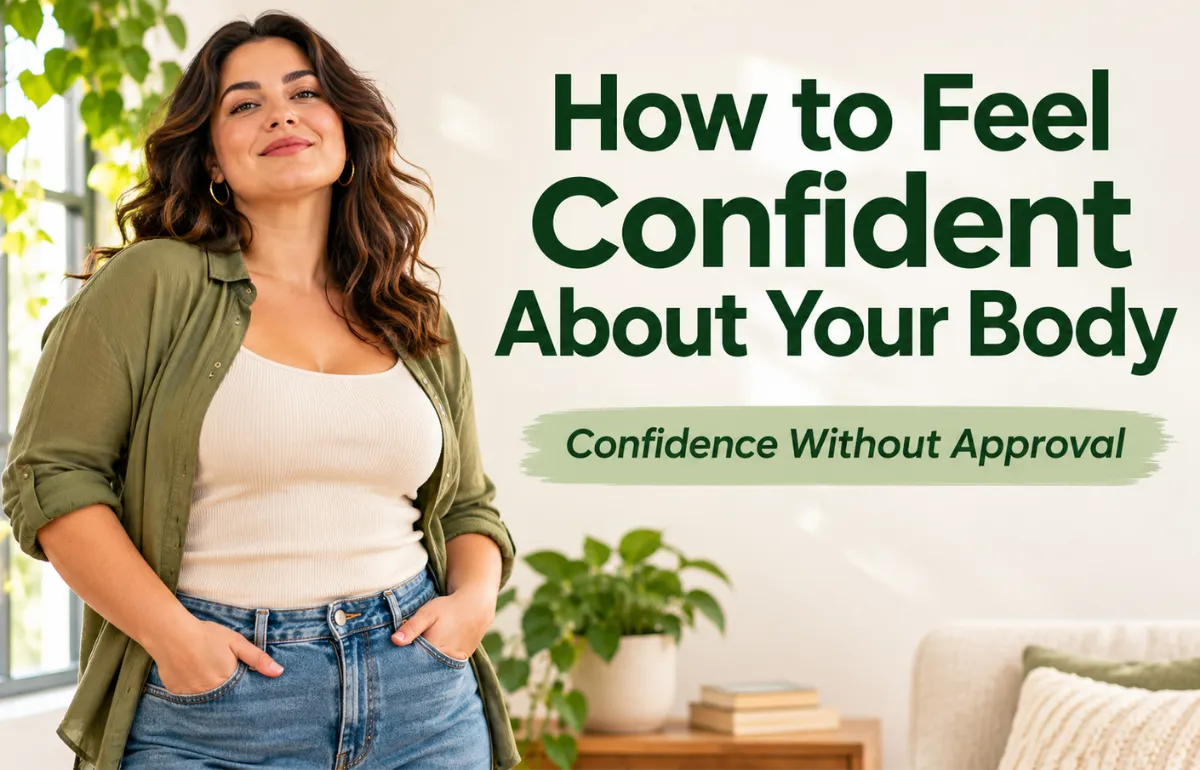
Learning how to feel confident about your body begins with accepting yourself as you are, separating your self-worth from your physical appearance, and treating your body with respect. Body confidence is the ability to feel comfortable in your own skin without constantly needing approval, compliments, or reassurance from others. You can develop it by practicing self-compassion, reducing unhealthy comparisons, challenging negative thoughts, and appreciating your body beyond its appearance.
I believe the most sustainable kind of confidence comes from changing your relationship with your body rather than constantly trying to change your body itself.
You don’t have to achieve a certain weight, fit into a particular clothing size, or meet society’s beauty standards to deserve confidence.
What matters is learning to live comfortably and meaningfully without allowing your appearance to determine how you feel about yourself.
What Does It Really Mean to Feel Confident About Your Body?
Body confidence means feeling secure enough in your body to participate in life without excessive fear of being judged for your appearance.
It doesn’t mean looking in the mirror every morning and loving everything you see. Nor does it mean never experiencing insecurity.
A confident person can have uncomfortable feelings about their appearance without letting those feelings control their decisions.
I like to think of body confidence as a relationship built on respect rather than admiration. Admiration can fluctuate, but respect doesn’t have to disappear whenever you’re having a difficult day.
You can dislike a photograph of yourself and still enjoy the memory it represents. You can feel insecure about a physical feature and still believe you’re worthy of love, happiness, and connection.
That’s the difference between temporary appearance satisfaction and a healthier sense of self-worth.
Why Does Body Confidence Often Depend on Other People’s Opinions?
From an early age, many people receive messages suggesting that physical attractiveness determines their value.
Family comments, advertising, social media, beauty trends, and cultural expectations can gradually shape how people perceive themselves.
When compliments become a primary source of confidence, their absence can feel like rejection. This creates a pattern in which self-esteem depends on something outside your control.
The problem isn’t enjoying compliments. It’s needing them to feel acceptable.
I recommend asking yourself a few uncomfortable but useful questions:
- Would I still wear this outfit if nobody complimented me?
- Would I enjoy this photograph if I never shared it online?
- Would I feel comfortable attending an event without receiving attention?
- Do I make appearance-related decisions for myself or to gain approval?
Your answers can reveal where your confidence currently comes from and which areas deserve more attention.
How to Feel Confident About Your Body: 12 Practical Ways
Building a healthier body image requires consistent changes in your thoughts, habits, and everyday decisions. Here are the approaches I recommend for developing confidence that doesn’t depend on physical perfection.
1. Stop Making Your Appearance a Measure of Your Worth
Your appearance is one part of your identity, not a complete representation of who you are.
When physical attractiveness becomes the main measure of personal value, ordinary changes such as aging, acne, weight fluctuations, or hair loss can feel like personal failures.
Instead, recognize the qualities that make your life meaningful. Your kindness, curiosity, creativity, integrity, and ability to connect with others deserve attention, too.
Try writing down five qualities you value about yourself that have nothing to do with appearance.
Read them whenever you notice yourself measuring your worth against someone else’s looks.
The purpose isn’t to replace one standard of perfection with another. You deserve basic respect even when you’re not achieving, helping, or impressing anyone.
2. Practice Body Neutrality Instead of Forced Positivity
You don’t have to love every part of your body to accept it.
Body neutrality encourages you to reduce the importance of appearance and acknowledge your body without constantly evaluating whether it looks good or bad.
For someone struggling with body dissatisfaction, saying, “I love everything about myself,” may feel unrealistic.
I prefer starting with believable, neutral statements:
- My body deserves care regardless of its appearance.
- I don’t need to find myself attractive every day.
- My physical features don’t determine my worth.
- I can enjoy my life while experiencing insecurity.
Body neutrality can provide a more approachable starting point than expecting yourself to feel positive all the time.
Body Positivity vs. Body Neutrality vs. Body Acceptance
| Aspect | Body Positivity | Body Neutrality | Body Acceptance |
|---|---|---|---|
| Main focus | Challenging appearance-based stigma and celebrating body diversity | Reducing emphasis on appearance | Accepting your body as it is |
| Relationship with appearance | Encourages appreciation and inclusion | Appearance doesn’t need constant evaluation | Allows both positive and negative feelings |
| Daily approach | Celebrating and respecting diverse bodies | Redirecting attention toward living | Practicing respect without conditions |
| Example thought | All bodies deserve celebration and respect. | I don’t need to evaluate my appearance today. | I accept myself, even when I feel insecure. |
These approaches can coexist. You don’t have to choose one permanently.
3. Appreciate Your Body Without Focusing on Its Appearance
One helpful way to improve body confidence is to pay attention to what you experience through your body rather than how it appears to others.
Think about the ability to enjoy music, experience warmth, express affection, communicate ideas, or engage with your surroundings.
A 2015 randomized controlled study published in the journal Body Image found that structured writing exercises focused on body functionality improved several aspects of body image among participating women.
The Expand Your Horizon study offers evidence that shifting attention beyond appearance can support body appreciation.
However, I wouldn’t make physical ability another condition for self-worth. People living with disabilities, chronic illness, fatigue, or limited mobility deserve the same acceptance.
Your body doesn’t have to perform exceptionally well to deserve compassion.
4. Reduce Appearance-Based Social Comparisons
Comparing yourself to other people can make you overlook your individuality and develop unrealistic expectations.
Social media often intensifies this habit because photographs may be carefully selected, edited, filtered, or taken under favorable lighting.
Even completely unedited photographs capture only a moment in someone’s life.
Rather than telling yourself never to compare, notice what happens immediately after a comparison.
Do you become more critical of yourself? Do you feel pressured to change? Does your mood suddenly decline?
I suggest unfollowing or muting accounts that regularly trigger these reactions. Replace them with content related to your interests, hobbies, education, or meaningful relationships.
Your online environment doesn’t need to revolve around bodies, including supposedly ideal ones.
5. Change the Way You Speak to Yourself
Negative self-talk can turn an ordinary experience into a prolonged episode of insecurity.
For example, noticing that an outfit fits differently is an observation. Concluding that you’re unattractive, unsuccessful, or unworthy because of it is a judgment.
Learning to distinguish observations from judgments helps create emotional distance from self-critical thoughts.
Instead of arguing with every negative thought, acknowledge it and choose a more compassionate response.
| Self-Critical Thought | Healthier Response |
|---|---|
| I look terrible today. | I’m having a difficult body image day. |
| Everyone looks better than me. | I don’t need to compete with other people’s appearances. |
| I should hide my body. | I’m allowed to take up space. |
| I need compliments to feel attractive. | Other people’s opinions don’t define my worth. |
| I’ll be confident after changing my body. | I can practice confidence while my body is as it is. |
I recommend using language that feels realistic rather than repeating exaggerated affirmations you don’t believe.
6. Wear Clothes That Respect Your Current Body
Clothing should accommodate your body rather than become a test of whether your body is acceptable.
Keeping uncomfortable clothes as motivation to change your appearance can create unnecessary pressure during everyday activities.
Choose clothing that allows you to move, sit, work, and socialize comfortably. You don’t need to wait for a future version of yourself to enjoy personal style.
I would also encourage you to separate comfort from concealment.
Ask yourself whether you’re choosing an outfit because you genuinely enjoy wearing it or because you’re afraid someone might notice a particular feature.
There is nothing wrong with dressing modestly or preferring loose clothing. What matters is whether the decision reflects your preferences or your insecurities.
7. Break the Habit of Constant Body Checking
Repeatedly examining your reflection, scrutinizing photographs, or asking others how you look may provide temporary reassurance.
However, when reassurance becomes necessary throughout the day, it can keep your attention fixed on appearance.
Start by noticing when you engage in body checking and what triggers the urge.
Before returning to the mirror, ask whether another check will provide useful information or simply repeat a concern you’ve already examined.
I recommend using mirrors for practical purposes, such as grooming and getting dressed, while gradually reducing unnecessary appearance evaluations.
The goal isn’t to avoid your reflection completely. It’s to develop a relationship with mirrors that doesn’t require constant judgment.
8. Separate Self-Care From Self-Correction
There is a meaningful difference between caring for your body and treating it as a problem that needs fixing.
Self-care involves responding to your physical and emotional needs. Self-correction, when driven by appearance anxiety, often involves trying to become acceptable through physical changes.
Eating regular, satisfying meals, getting adequate sleep, enjoying accessible movement, and seeking medical care are ways of respecting your body.
These activities don’t need to produce visible changes to be worthwhile.
You can enjoy skincare, exercise, fashion, or grooming without making them requirements for self-acceptance.
A useful question is: Would this activity still be valuable to me if it didn’t improve my appearance?
9. Stop Postponing Your Life Until You Look Different
One overlooked consequence of low body confidence is how easily it can delay meaningful experiences.
Perhaps you’ve avoided swimming, declined invitations, stayed out of photographs, or postponed a vacation because you didn’t feel comfortable with your appearance.
Waiting for perfect confidence before participating in life can reinforce avoidance.
I recommend beginning with an activity that matters to you but feels manageable.
Imagine attending a friend’s gathering despite feeling self-conscious. Instead of monitoring your appearance throughout the evening, you focus on conversations, laughter, and shared experiences.
The success of that evening isn’t determined by whether you felt attractive. It’s determined by whether you were able to engage with something meaningful.
Confidence can develop through participation, even when discomfort hasn’t disappeared.
10. Set Boundaries Around Unwanted Body Comments
Building confidence about your body also means protecting yourself from unnecessary appearance-related criticism.
Friends, relatives, colleagues, and strangers may make comments about your weight, skin, clothing, or physical features without understanding their impact.
You don’t have to participate in those conversations.
Simple responses can establish healthier boundaries:
- I’d rather not discuss my appearance.
- Please don’t comment on my weight.
- I’m focusing on my well-being instead of how I look.
- Can we talk about something else?
I favor short, respectful responses because you shouldn’t have to explain your entire relationship with your body to justify a boundary.
Other people’s reactions to that boundary aren’t a reliable measure of whether it was reasonable.
11. Build an Identity Outside Your Physical Appearance
When appearance occupies too much mental space, other parts of your identity can become neglected.
Developing interests, learning new skills, maintaining friendships, and pursuing meaningful goals can help broaden your sense of self.
Think about what makes you feel engaged, curious, peaceful, or connected.
Perhaps you enjoy reading, gardening, writing, cooking, learning languages, or spending time outdoors.
I suggest choosing an activity whose enjoyment has little connection to how you look.
The more opportunities you create to experience yourself as a complete person, the less necessary it may feel to seek validation through physical attractiveness.
12. Accept That Body Confidence Will Fluctuate
Nobody needs to feel confident every moment of every day.
Stress, illness, hormonal changes, relationship difficulties, aging, and social situations can influence how people experience their bodies.
A difficult day doesn’t erase the progress you’ve made.
Rather than trying to eliminate insecurity completely, develop the ability to respond to it without abandoning your usual self-care or meaningful activities.
You can feel uncomfortable in your body and still eat nourishing meals, meet friends, wear comfortable clothes, and treat yourself respectfully.
I consider that a more useful expression of confidence than simply feeling attractive.
How to Measure Body Confidence Without Looking in the Mirror
Instead of measuring progress through photographs, clothing sizes, or compliments, pay attention to changes in your behavior.
I suggest a weekly reflection built around three areas: permission, attention, and participation.
Permission means allowing yourself to enjoy life without first earning approval through your appearance.
Attention means noticing how much of your mental energy is consumed by appearance-related concerns.
Participation means engaging in meaningful activities even when you experience some insecurity.
Ask yourself:
- Did I make fewer decisions based on fear of judgment?
- Was I able to enjoy an activity without constantly monitoring my appearance?
- Did I respond more kindly to a negative thought?
- Did I respect my body’s needs during a difficult day?
This reflection isn’t a psychological assessment or something you need to score perfectly. It’s a practical way to recognize progress that appearance alone cannot reveal.
A Five-Minute Daily Exercise for Building Body Confidence
If you’re unsure how to feel confident about your body consistently, start with a small daily practice.
I recommend a five-minute exercise that combines awareness, self-compassion, and intentional action.
Minute 1: Recognize Your Current Feelings
Notice how you’re feeling about your body without immediately trying to change those emotions.
You might feel comfortable, frustrated, insecure, or indifferent. All these experiences can be acknowledged without judgment.
Minute 2: Identify an Appearance-Related Thought
Write down one thought that’s occupying your attention. Consider whether it reflects a fact, an assumption, or an internalized expectation.
Minute 3: Offer a Respectful Response
Respond to that thought with realistic, compassionate language.
For example, “I feel uncomfortable today, but that doesn’t make me less deserving of respect.”
Minute 4: Recognize One Non-Appearance Value
Identify something that matters to you outside your physical appearance, such as friendship, creativity, independence, or curiosity.
Minute 5: Choose One Meaningful Action
Decide how you’ll act on that value today, even if your body image isn’t particularly positive.
Repeating this exercise can help redirect your attention toward the kind of life you want to experience.
When Body Image Concerns May Require Professional Support
Sometimes, negative body image involves more than occasional insecurity.
If appearance-related concerns consume considerable time, interfere with relationships, lead to restrictive eating, or cause you to avoid everyday activities, professional support may be helpful.
Persistent preoccupation with perceived physical imperfections can also be associated with body dysmorphic disorder (BDD).
According to the National Health Service (NHS), treatments such as cognitive behavioral therapy can help people manage BDD symptoms.
I encourage anyone experiencing significant appearance-related distress to speak with a qualified mental health professional or healthcare provider.
Seeking support is a way of caring for yourself, not an indication that you’ve failed to become confident independently.
Final Thoughts
Understanding how to feel confident about your body isn’t about convincing yourself that you look perfect. It’s about recognizing that your appearance doesn’t determine your right to live fully, receive respect, or experience happiness.
I believe lasting body confidence grows when you stop treating acceptance as something you must earn.
Start today by choosing one activity you’ve been postponing because of insecurity. Take a manageable step toward enjoying it without requiring your appearance to change first.
Your body can be part of your life without becoming the central measure of its value.
Frequently Asked Questions
1. How can I stop feeling insecure about my body?
Reduce appearance-based comparisons, challenge self-critical thoughts, practice body neutrality, and participate in meaningful activities without waiting for insecurity to disappear.
2. Can I be confident without liking my appearance?
Yes. Body confidence can come from self-respect and acceptance without requiring you to find every physical feature attractive.
3. How can I improve my body confidence without losing weight?
Focus on body acceptance, comfortable clothing, compassionate self-talk, meaningful experiences, and supportive relationships rather than changing your weight.
4. Why do I feel so self-conscious about my body?
Self-consciousness may develop through social comparisons, past criticism, unrealistic beauty standards, bullying, or appearance-based expectations.
5. How long does it take to develop body confidence?
There’s no fixed timeline. Progress varies according to individual circumstances, consistent practice, emotional well-being, and access to appropriate support.

FOLLOW YOUR CURIOSITY
A little more to explore
Stay with the topic. Find another perspective to take into your day.
How to Be Calm and Confident: 12 Ways to Stay Composed
By Nattaya Boonmee
How to Feel Confident on a Date: 15 Tips to Beat Nerves
By Nattaya Boonmee
How to Be Confident in a Relationship: 12 Powerful Tips
By Nattaya Boonmee